What Lisa Watched Last Night: The Haunting of Sorority Row (dir by Bert Kish)


On Friday night, after we saw the movie Hanna, a friend Jeff and I returned back to my house and retreated to my bedroom where he eventually fell asleep and I tried to sleep.  Insomnia, however, won out and I ended up watching a Lifetime horror movie called The Haunting on Sorority Row.

Why Was I Watching It?

I couldn’t get to sleep.  Poor me.  So, I turned on the TV, checked out what was on the DVR, and as soon as I saw The Haunting of Sorority Row, I knew what I had to do.  Somehow, I forgot that, regardless of how low I turned down the sound the last time I was watching it, whenever I turn on my TV, the volume is always reset to full blast.  So, as soon as I hit play, the TV literally thundered to life and woke up not only Jeff but probably the rest of the neighborhood as well.

As I frantically turned down the volume, Jeff sat up in bed and asked, “What’s this?”

“It’s a movie,” I said, “Sorry, I couldn’t sleep.”

“I bet it’s a horror film,” he said.

“Yeah,” I nodded.  Then I looked over my shoulder, gave him my wicked little smile (well, I like to think of it as being my wicked little smile), and I added, “It’s a Lifetime horror film.”

“Oh,” he replied, sounding much less enthusiastic.

Anyway, The Haunting of Sorority Row put him back to sleep in about five minutes.  Me, I still haven’t slept which is why I’m still sitting here in my beloved Pirates t-shirt while Jeff peacefully sleeps behind me.  Maybe after I finish writing this, I’ll give sleep another chance.

What’s The Movie About?

It’s about a haunting on sorority row.  More specifically, it’s about a really angry ghost who is determined to kill the four sorority sisters who are hiding a secret.  Their ringleader is Leslie who is played by an actress named Lisa Marie Caruk.  And that’s a great name.  Anyway, Blair Waldorf herself, Leighton Meester, is also pledging this haunted sorority and she is determined to set things right.

What Worked?

Oh, this is a Lifetime Movie so everything worked.  I mean, you know what you’re getting with Lifetime and part of the reason why we love Lifetime movies is because they’re all exactly the same.  The perfect Lifetime Movie is the epitome of a stupid movie that can be best enjoyed by intelligent women with a healthy sense of the absurd.  I’d like to think that I qualify on all three of those.

That said, there were a few things that worked even if you decided to ignore the fact that they were found in a Lifetime film.  Not surprisingly, the nearly-all female cast was a lot more likable and their roles were a bit more developed than you’d expect to find in a horror film.  Leighton Meester is probably one of the most underrated actresses working right now and she does a great job playing the film’s “final girl” while Lisa Marie Caruk has a lot of fun playing the bullying head of the Sorority.

Another thing that worked here was the great pleasure that I got out of imagining how many of you guys rented this film thinking it was a typical, Dead Women In Lingerie Slasher Film just to discover that it was instead a Lifetime movie.

What Didn’t Work?

This film works pretty well as a Lifetime movie but it totally sucks as a horror film. A lot of this is due to the fact that this is a TV movie which pretty much means that it can’t really show anything that would scare us. 

As often happens in Lifetime movies, the main character’s boyfriend is a eunuch.  In this one, we’re asked to believe that an 18 year-old boy would refuse to have premarital sex with Leighton Meester.  Yeah, right.  Because boys have so much self-control…

Finally, this is another one of those films that suffers from having a final twist that’s so obvious that most viewers will figure it out before the movie even begins.  Yes, it’s that obvious.

“Oh my God!  Just like me!” Moments

There’s a scene in which one of the unfortunately sorority sisters ends up getting trapped in the shower and scalded to death by hot water.  This is scene vaguely disturbed me because 1) I’m claustrophobic, 2) I have a fear of scalding water, and 3) I’ve actually managed to get trapped in a shower before and I had to scream and scream until someone heard me, ran into the bathroom, and told me that I needed to pull (as opposed to pushing) the shower door in order to open it.  Of course, my hands and arms were too busy trying to cover up me for me to take his advice on the door.  So, I said. “Thank you. sir,” and then waited until he left.

Otherwise, it was hard for me to relate to this film because I never pledged nor did I ever want to pledge a sorority in college.  I was actually invited to do so by one of them but, at the time, I said, “No, that’s way too bourgeois  for me.” 

“Bourgeois?” she replied, confused.

Lessons Learned 

I definitely did the right thing by never joining a sorority. 

Song of the Day: Container Park from Hanna (The Chemical Brothers)


Tonight I saw what would probably end up as one of the top films of 2011. I am talking about Joe Wright’s modern fairy tale, Hanna, and starring one of the industry’s finest young actress in Saoirse Ronan in the title role. The latest “song of the day” comes directly from this film which was fully scored by British electronica duo, The Chemical Brothers.

“Container Park” arrives close to the end of the second act of the film and perfectly accompanies one of the film’s best action sequences. The Chemical Brother’s give this song a very heavy and deep bassline which set’s the rhythm for the whole sequence. They begin the song very subtly with just a hint of dissonance creeping into the dark fairy tale-like melody. I just loved how they were able to combine not just the fairy tale aspect of the film, but also add in that sense of danger with subtle use of distortion and dissonance to unbalance the original melody.

This song went perfectly well with the action sequence it complemented and it was halfway through the song that I realized (like all of the music in this film) that the bassline was setting up the rhythm of the action itself. I saw this clip at WonderCon 2011 and the song was the same and as I look back to that clip to seeing the clip as part of the whole film I was impressed how The Chemical Brothers’ score for this film was very instrumental in setting up each scene and not just becoming background music.

“Container Park” is just one of several great songs from the Hanna soundtrack by The Chemical Brothers. First there’s the wonderful, cover-filled soundtrack for Sucker Punch and now this full-on electronica score for Hanna. It’s been a very good year, so far, for soundtracks and I do believe we’ve got more excellent examples coming down the pipeline.

Above is the original song used in the film while below is a remix done by the duo and found on the film’s website. The latter has been extended, but I really don’t see too much of a difference between the two other than their running times.

Scenes I Love: Rambo


Watching Ninja Assassin made me think about how much film and special effects technology has advanced to the point that the ways people can die in a film really is only limited by the imagination of the filmmakers involved. My new choice for “Scenes I Love” may make me come across as some gorehound, violence-loving neanderthal (the first two are actually correct but the third is false since I’m homo sapiens), but I love this scene I have chosen because it’s so over-the-top yet holds many truths to the events happening therein.

Rambo was Sylvester Stallone’s attempt to restart the Rambo franchise and to a certain extent he does so. The film was better than the third one and in terms of storytelling was equal to the second one and just a tad short of the original film. It’s a film one will not write to the Academy about, but Stallone brings back the franchise to what made it popular in the first place. He brought the character of John Rambo back to being the self-destructive, self-loathing, war-scarred veteran who just wants to be left alone to live his miserable life, but always gets dragged into one good-intentioned crusade after another.

This scene happens right at the very end and one could say it’s the film’s climactic eruption of testosterone. Rambo literally explodes Burmese soldiers’ bodies through his effective use of a .50 caliber heavy machine gun (and those who think the gun’s effect on people’s bodies was over-the-top…those people would be wrong. That is exactly what a .50 caliber round does to a body. It doesn’t do a body good) and some help from the people he’s trying to rescue. It’s hard not cheer Rambo in this scene after watching these very same soldiers massacre an entire Burmese village, raping captured young women and bayonet little kids before throwing them into a hut’s raging fire.

This scene also shows why the Rambo films have been labeled as nothing but mindless violence trying to make itself to be something profound (he is killing the bad people and trying to save those who are defenseless). I always though this franchise was just about one very angry guy who may or may not be right in the head, but who definitely has a weird sense of right and wrong. Not to mention very good at killing massive amounts of people in very messy ways.

There’s a part halfway in this scene where the higher-than-though leader of the Christian missionary group (who had earlier in the film lectured Rambo for being too violent in saving his and his people’s lives) played by Paul Schulze sees the carnage happening all around him and decides to go all caveman on one soldier who killed one of his congregation. A part of me actually smirked at this part. I knew that no matter how well-intentioned, principled and civilized a man thinks he is there’s something primal deep down inside that wants to commit violence.

Lisa Marie Does A Line With The Cocaine Fiends (dir. by William A. O’Connor)


Back in the 1930s, the American film industry regulated itself with the Motion Picture Production Code.  The production code stated that, in films, crimes would always be punished, profanity would not be heard, bodies would remain clothed, and drug abuse would not be portrayed.  The only way to get around these rules was to make sure that the film was “educational” and that it pretended to condemn the behavior shown on-screen.  This was the birth of what would eventually become grindhouse cinema.

It’s always interesting to watch these early grindhouse films because, even with the inclusion of such forbidden elements as nudity, violence, and drugs, they all still seem oddly innocent.  Yes, there’s always a scene or two of the lead actress undressed but the camera rarely lingers as if it’s aware that it’s somehow breaking the rules.  Whenever one of these films dealt with drug addiction or white slavery, the depictions were often so heavy-handed and silly that it was obvious that nobody involved with the film had any first-hand knowledge of what they were showing.  The end results were often undeniably fun.

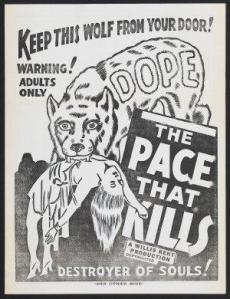
I watched one of these films last night, 1935’s The Cocaine Fiends (also known as The Pace that Kills, which is a much better title).  The Cocaine Fiends starts with a waitress named Jane (Lois January) who meets and falls in love with a mysterious fellow named Nick the Pusher (Noel Madison).  For most people, I would think that Nick the Pusher’s name would be a dead give away to what he does for a living but Jane is from the country and, by this film’s logic, this makes her an idiot.  Anyway, Jane goes to the city with Nick.  Whenever Jane starts to get a headache, Nick gives her some headache powder.  Jane snorts the powder and her headache goes away.  Soon, she’s calling herself Lil and sleeping with strangers to get money so that Nick will keep giving her headache powder.  Soon Jane/Lil discovers that she hasn’t been doing lines of headache powder at all!  Nope, that white powder is cocaine!

(Now, I know you’re probably laughing at Jane but I have to be honest and admit that last year, I was at work when I got a terrible migraine.  This woman who works in the same building as me took sympathy on me and gave me a little packet of white powder.  I quickly got out my credit card and a dollar bill and cut myself a line.  “Wait, what are you doing!?” she said as I held the tightly rolled dollar bill up to my nostril.  “I’m going to do a line,” I said.  “Oh no, honey,” she said, sweetly, “you don’t snort B.C. Headache Powder.”  True story.)

Anyway, Jane’s brother, Eddie (Dean Benton), comes to the city looking for his sister and gets a job working as a carhop.  At his job, he befriends Fanny (Sheila Bromley) who, seriously, is one of the greatest film characters ever.  Seriously, I had a huge girlcrush on Fanny by the end of this film.  Not only is she hot and independent but she also hides cocaine underneath her garter and says stuff like, “Tonight, I’m going to take you on a sleigh ride with some snowbirds.”  Eddie has a crush on Fanny too and they end up hanging out at sordid nightclubs together.  Unfortunately, Fanny also gets Eddie hooked on cocaine and soon, they both get fired.  Eddie forgets about finding his sister while Fanny turns to prostitution to support her habit.

Meanwhile, Fanny’s friend Dorothy (Lois Lindsay) doesn’t use cocaine but she still ends up getting kidnapped by Nick anyway.  Apparently, Dorothy’s father is rich.  While Eddie spends his time at an opium den (a surprisingly effective sequence), Dorothy’s boyfriend Dan (Charles Delaney) recruits Lil (remember her?) to help him rescue Dorothy and hopefully reveal the secret identity of the shadowy figure in charge of the city’s dope trade…

Did I mention all of this happens in 61 minutes?  Seriously, the Cocaine Fiends is one busy film.  Now, to be honest, all of this plot doesn’t leave much room for anything resembling introspection or nuance but perhaps that’s appropriate for a film about cocaine. I do have to admit that the Cocaine Fiends isn’t as much fun as some other exploitation films from the roadshow era.  Unlike a lot of those films, Cocaine Fiends actually does have at least a tenuous connection to reality in that, when abused, cocaine actually is a dangerous drug that can contribute to people doing some pretty dangerous things.  Still, for those searching for sordid melodrama and committed overacting, they’ll find it a surplus of it here.

 That said, like the best grindhouse films, the Cocaine Fiends occasionally offers up a moment or two of true insight.  For me, what made this film more than just a camp oddity was its sympathetic portrayal of women trapped in a cold, male-dominated underground where being female means being a commodity.  What sets The Cocaine Fiends apart from other films of that era (not to mention most films made today) was the fact that it didn’t attempt to present their tragic fate as some sort of karmic punishment or divine retribution for straying from what society deemed the proper feminine path.  Most films continue to insist that women “ask for it.”  Whatever other faults The Cocaine Fiends may have, it knows better than to think anyone asks to be violated, abused, and exploited.

To be honest, the main reason I occasionally watch a film like The Cocaine Fiends is because I’m a just a history nerd at heart.  Watching a film like The Cocaine Fiends, made outside of the idealized worldview of the Hollywood Establishment, is probably about as close as I’m going to get to using a time machine to go back to the 30s and experience the culture firsthand.  I love how Eddie, when Fanny offers to let him stay at her apartment, automatically responds with, “But we’re not married.”  And then there’s the sequence in the “dangerous” night club which, as far as decorations, music, and proper attire are concerned, reminded me of my senior prom.  It’s also where Eddie freaks out upon getting a bill for $9.97.  Luckily, Fanny is there to loan him enough money to pay it.

Anyway, for those who have an hour to kill, here’s 1935’s The Cocaine Fiends…

Quickie Review: Ninja Assassin (dir. by James McTeigue)


There comes around a few films every year which I end up enjoying despite how awful it is to most everyone. I’m a major fan and follower of all things grindhouse and for some grindhouse means it was made during the late 60’s and through most of thru the 70’s. I always thought of grindhouse as a state of mind. I mean I like to believe that’s why Robert Rodriguez and Quentin Tarantino make the films that they make (all of them grindhouse films at heart if not execution). So, it happens that in 2009 there was one film which was panned universally by critics and mainstream audiences everywhere. It was the second film by Wachowski Brothers protege James McTeigue. He was the same director who made the impressive V for Vendetta film adaptation (I still believe to this day that the Wachowski Brothers had a hand in directing that adaptation).

When word came down that he was going to do a modern ninja film which included Sho Kosugi (he practically was the star of most, if not all, of the best-known ninja grindhouse flicks of the 70’s and 80’s) there was no doubt that this film would rock. The heightened anticipation for this martial arts extravaganza would turn out to be more a whimper than a bang. James McTeigue’s Ninja Assassin became one of 2009’s worst films of the year and part of me don’t agree with how most people viewed it.

The story for this film was quite simple. Former ninja assassin tries hiding from his former ninja clan and it’s badass ninja leader (played by badass ninja-man himself, Sho Kosugi). The part of this former ninja was played by Korean singing pop sensation who went by the name Rain. He got the lead part for this film due to the Wachowski Brothers and uber-action producer Joel Silver having been impressed seeing his work on the Wachowski Brothers’ very-maligned and misunderstood live-action take on the classic Japanese anime series, Speed Racer. The brothers and Silver saw a start on the rise in their midst and decided to make a film around Rain. The fact that the film ended up being Ninja Assassin must’ve been one reason why we haven’t heard of him in the US since.

Still, Rain did a good enough job as the blank-faced, albeit master of the ninja arts, Raizo. He was chosen because he looked the part, moved like the part and probably powers that be thought him being shirtless half the time would bring in the huge J-pop and K-pop demographic. Again, the producers might have been reaching a bit much when they were developing Ninja Assassin.

The rest of the film is Raizo being chased by his former clan, having flashbacks of his time as a child being trained by the Ozuna ninja clan to become their top assassin, then back to the present trying to kill as many ninja as possible, while avoiding getting killed himself. Believe me when I say that the blood and body parts rain down like dismembered bodies were on sale at Wal-Mart and everything was tagged “Entire Stock Must Go!”.

Ninja Assassin will live and die through it’s action sequences and despite the heavy use of CGI-blood the action in this film were pretty good. There’s the usual slo-mo tricks the Wachowski Brothers have become well-known for and it seems like their protege have learned from them well. I actually thought that the ultra-violent and very gory action scenes is why this film reminded me of past martial arts grindhouse flicks. Those were also very bloody and violent. It was as if the filmmakers of those film were telling McTeigue that the more blood and violence the merrier.

I would mention that the film had some good performances from the non-ninja roles played by Naomie Harris and Ben Miles, but I’d be lying. Their work here was passable and just needed to fill the slow and dialogue-heavy gaps in-between ninja butchering. These non-ninja butchering scenes actually slowed the film down. I do believe that if they were replaced with more ninja butchering hapless Interpol security agents and vice versa then Ninja Assassin would’ve turned out a hundred times better. Sometimes mindless gory violence is better than wince-inducing dialogue and exposition.

From the sound of this review one would think that I didn’t like Ninja Assassin. Part of me doesn’t like this film, but the part of my brain which understands the nature of grindhouse flicks loved this film because of the very awful things people say about it. This is a film which was so bad that it passed the point of awfulness and became entertaining in its very own way. I mean this film definitely felt like a Sho Kosugi ninja flick but of the digital age. I always believed that no matter the era and no matter how advanced film techniques get there will always be filmmakers out there who go about in a serious manner to create a good film, but despite their best intentions and plans the overall execution and final product don’t live up to their expectations. In a way, that’s what most grindhouse films tend to be in the end. Films made with the best in mind but got lost in its very own grandiose plans to come out batshit nuts on the other side.

PS: Those wondering how ninja having no guns can take on militayr-trained agents in tactical armor wielding the latest in assault rifles. Well, who needs a Heckler&Koch G36 assault rifle when one can throw shuriken as fast as an assault rifle. In the end, Ninja vs. SWAT makes for a badass, mindless climactic battle scene.

Song of the Day: Endless Love (by Lionel Richie and Diana Ross)


Lisa Marie’s latest post about the film Love Story and her reaction to it got me thinking that I haven’t put up an R&B ballad as “Song of the Day” for quite awhile now. Well, just as the day is close to coming to an end to start a new one I’ve chosen to continue the theme began by the previous post and picked the R&B ballad, “Endless Love”.

“Endless Love” is a ballad duet sung by Lionel Richie and Diana Ross. These two of the biggest R&B stars of the 70’s and early 80’s. Their star and singing power truly shines in this duet of the love theme for the very maudlin, cheesy and almost-grindhouse romantic film of the same name starring Brooke Shields, Martin Hewitt and a young James Spader. The film itself is quite forgettable if one was looking for something in the same vein as Love Story, but for those looking for a very twisted look at true love then Endless Love is the flick for you.

The film might not have been popular with critics, but the theme definitely resonated with the public and critics. It has been voted by Billboard as the greatest song duet of all-time. It’s become a staple with wedding planners since it came out to be played during wedding receptions. It got a modern cover duet by Luther Vandross and Mariah Carey in 1994.

There’s not much to say about this song other than watch the video and just listen to the song and it’s lyrics. Even the most coldhearted bastard out there may just melt a bit as they listen to this song.

Endless Love

My love,
There’s only you in my life.
The only thing that’s right.

My first love,
You’re every breath that I take.
You’re every step I make.

And I
(I-I-I-I-I)
I want to share,
All my love with you.
No one else will do.

And your eyes,
Your eyes, your eyes,
They tell me how much you care.
Ooh yes, you will always be,
My endless love

Two hearts,
Two hearts that beat as one.
Our lives have just begun.

Forever,
(Ohhhhhh)
I’ll hold you close in my arms.
I can’t resist your charms.

And love,
Oh, love,
I’ll be a fool, for you.
I’m sure,
You know I don’t mind.
Oh, you know I don’t mind.

‘Cause you,
You mean the world to me.
Oh, I know,
I know,
I’ve found in you,
My endless love.

Oooh, love,
Oh, love,
I’ll be that fool, for you.
I’m sure,
You know I don’t mind.
Oh you know,
I don’t mind.

And, YES!
You’ll be the only one.
‘Cause no one can deny,
This love I have inside,
And I’ll give it all to you.
My love,
My love, my love,
My Endless Love!

Lisa Marie Laughs and Cries Over Love Story (dir. Arthur Hiller)


They are so freaking pretty!

I’ve discovered something as I’ve pursued my mission to see every single film ever nominated for best picture.  Quite a few of the nominees (perhaps the majority of them) are no longer impressive because they’ve simply become dated by the passage of time.  We can still watch these films and understand (and believe) that they were probably quite groundbreaking and impressive when initially released.

And then there’s the films like the 1970 best picture nominee, Love Story.  These are the nominees that you quickly realize were never good.  These are the films that were nominated because they either dominated the box office or perhaps they just lucked out and were released in a bad year for cinema in general.  At least that’s what we tell ourselves.  In all honesty, the circumstances of how they came to be nominated are often enigmatic and shrouded in mystery.  I have yet to read a single critic — from either 1970 or the present day — who has had a single kind thing to say about Love Story and, after sitting through it last night, I can say that for once, me and the critical establishment are in agreement.

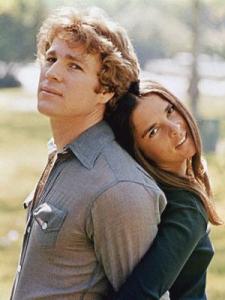
The plot of Love Story is pretty simple and I’m going to go ahead and include the entire story here because quite frankly, it’s impossible to spoil something this predictable.  Oliver (Ryan O’Neal) meets Jenny (Ali MacGraw).  Oliver is a rich jock who is attending Harvard.  Jenny is a poor music student.  Upon first meeting her, Oliver calls Jenny a “bitch.”  Jenny calls Oliver “a dumb jock.”  Oliver falls in love with Jenny.  Jenny calls Oliver “a dumb jock.”  Oliver and Jenny get married.  Oliver’s father (Ray Milland) disapproves.  Jenny’s father (John Marley) is just kind of confused.  Cut off from the family fortune, Oliver struggles to provide for Jenny.  (Apparently, the 70s were a tough time to be a graduate of Harvard Law School.)  Jenny and Oliver have a fight.  Oliver cries.  Jenny says, “Love means never having to say you’re sorry,” which seems to be an underhanded way of admitting that most guys aren’t ever going to say that anyways.  Oliver is happy.  Jenny comes down with a never-named terminal illness and dies.  The end.

I know that I’m supposed to watch a movie like Love Story and just shrug my shoulders and go, “Oh well, it’s not very good but I’m a girl so I’ll love it unconditionally.”  And God knows, I tried my best,  I tried so very hard to just shut down my mind and give control over to my heart.  Because, believe it or not, I’m just a dorky, asthmatic romantic.  I’m the type of girl who gets all giggly and excited when she gets flowers, despite all of my allergies.  I can remember every sunset I’ve ever watched.  The rare times we actually do have a winter down here in Texas, I’m all about the snowball fights that end with a long, passionate kiss.  I love Valentine’s Day and I remember anniversaries.  I still have every gift that I’ve ever been given, even the really cheap and ugly things that I wouldn’t be caught dead wearing in public.  Every trinket, every stuffed animal, every card, every piece of jewelery, every note, every article of lingerie, every movie ticket — if it’s an artifact of a past or current relationship, I have it all safely stored in a place of honor. 

Yes, I adore everything that Love Story was selling and yet, as I watched Love Story, I felt myself growing more and more cynical with each passing moment.  Fortunately, the movie only last 99 minutes because if it had gone on for a few 120, I probably would have ended up “an old maid…closing up the library!” like Donna Reed in It’s a Wonderful Life.  The problem with Love Story isn’t that it’s not romantic; it’s that it takes the standard clichés of romance and embraces them to such an extent that I didn’t feel as if I was being manipulated by the film as much as I felt like I was being brutally violated by it.

Seriously, the entire time I was watching, I felt like the film was screaming at me, “Look at how beautiful they are!  Look at that sunset!  Listen to that music!  Cry, damn you, cry!”  Never mind the fact that MacGraw and O’Neal — pretty as they are to look at — generate close to zero chemistry.  Never mind that  MacGraw responds to being terminally ill by laying in bed with her hair artfully spread on the pillow behind her while director Arthur Hiller practically bathes her in a warm, saintly glow.  Never mind that “Love means never having to say you’re sorry,” doesn’t make any freaking sense at all.  Trust me, if you love me and yet you still insist on acting like an asshole, you sure as Hell have to apologize to me. 

On the plus side, the film’s got one of those overdone, lush soundtracks; the type that can make you cry as long as you don’t pay attention to what’s happening on-screen.  (That said, Taylor Swift is nowhere to be found.)  Ryan O’Neal is surprisingly likable as Oliver but Ali MacGraw — oh my God, where do I begin?  Actually, I don’t think I will because there’s simply no way I can explain just how bad of a performance she gives here.  Instead, I’ll just point out that Love Story also features the film debut of Tommy Lee Jones.  He’s credited as Tom Lee Jones here and he plays Oliver’s roommate.  He’s an on-screen for about 12 seconds and he delivers exactly one line. 

Needless to say, he pretty much steals the entire film.

Supernatural: The Anime Series to be Released on DVD/Blu-Ray


Ever since it was announced in around Fall of 2010 that an anime series was going to be made based on the first two seasons of the popular CW drama series, Supernatural, I knew I had to get the DVD and/or Blu-Ray release of this series.

Like most Japanese anime series they rarely got shown in the US unless it was part of a video set. It’s rare to find newly shown episodes in Japan shown in the US at the same time. Lately, a new practice of streaming new episodes on-line through official anime streaming sites has given American anime fans the same access to new episodes as their Japanese counterparts. A fine example of this recent practice was the simultaneous airing of each new episode for the horror-ecchi series, Highschool of the Dead. Unfortunately, this wasn’t the case for the Supernatural anime series.

So, it was a relief to read the news release earlier this week about the anime series being released in the US through DVD and Blu-Ray sets of Supernatural the Animation season 1.

The DVD and Blu-Ray Season 1 sets will be released by Warner Home Video on July 26, 2011.

If there was ever a series that belongs to be redone in anime fashion it was, and is, Eric Kripke’s Supernatural. As I joked with people about this news once it was confirmed, the Supernatural slashfic community will now have to deal with an equally rabid yaoi community which has already sprouted since Supernatural the Animation premiered on Japanese TV earlier this year.

One thing that should please both subbed and dubbed warring camps is that the DVD and Blu-Ray release should have both original Japanese voice cast (which includes the very Japanese voice actors who dub the Dean and Sam Winchester characters in the live-action showing of the series in Japan) and the stars of the series itself, Jensen Ackles and Jared Padelecki dubbing the anime series in English (though it would seem Padelecki will be voicing all 22-episodes while Ackles only select episodes).

People I know who have seen the series while it aired in Japan have spoken nothing but positive things about the first season. So, far the announcement hasn’t been followed up with the items being put up for pre-orders on Amazon.com or any of the online video retailers. I’m sure that will change once more details about the DVD and Blu-Ray release come down in the coming weeks.

Source: Anime News Network

Lisa Marie Goes Down On Mildred Pierce (dir. by Michael Curtiz)


A quick note: By titling this post “Lisa Marie Goes Down On Mildred Pierce” I have now not only proven that there’s no dare I will not accept but I’ve also won a small but useful sum of cash.  Never let them tell you that blogging doesn’t pay off.

Like a lot of people, I was looking forward to HBO’s remake of Mildred Pierce, featuring Kate Winslet in the role made famous by Joan Crawford.  And I hate to say it but, as hard as I’ve tried, I simply can not get into this remake.  Maybe it’s because the remake’s director, Todd Haynes, has apparently decided to use five hours to tell the exact same story that the original film told in less than two.  All I know is that the HBO version has, so far, been slow, ponderous, and ultimately a rather dull affair.

As I attempted to stay awake through the remake, I found myself wondering how the original 1945 film compared to the remake.  Fortunately, I just happened to have the original on DVD.  As well, by watching the original Mildred Pierce, I could continue my current mission to see every single film ever nominated for best picture.  (Joan Crawford won the Oscar for Best Actress for her performance as Mildred but the film itself lost Best Picture to Billy Wilder’s The Lost Weekend.)

 Mildred Pierce opens with the murder of sleazy playboy Monty Beragon (Zachary Scott).  Monty’s wife, Mildred (Joan Crawford), responds to the murder by attempting to frame her ex-business partner, the equally sleazy Wally Fay (Jack Carson).  However, the police arrest Mildred’s 1st husband, the well-meaning but really, really dull Bert (Bruce Bennett).  This leads to Mildred going to the police in an attempt to clear Bert’s name.  As the police interrogate Mildred, she tells them (and the film uses flashbacks to show us)  how she went from being a dissatisfied housewife to a succesful businesswoman to finally becoming Monty’s wife.  Through it all, Mildred is motivated by the need to take care of and spoil her manipulative daughter Veda (Ann Blyth).

Seen now, Mildred Pierce is an artifact of different time but, as a secret history nerd, I happen to love studying artifacts.  Like many of the films of the late 40s, Mildred Pierce‘s melodramatic plot serves as a reflection of a culture that, in the wake of World War II, was no longer as smugly complacent about how the world worked.  As I watched Mildred Pierce, the thing I immediately noticed was just how much the film seemed to be suspended between pre-War and post-War culture.  It’s the type of film that goes out of it’s way to acknowledge Mildred’s role as a “new woman” but, at the same time, still finds time to include numerous “comedic” scenes of various men leering at Mildred’s ankles. 

(Actually, I guess they were supposed to be staring at her legs but, since this was the 40s, this could only be represented by an occasional flash of ankle.  Personally, my ankles are okay but I like my legs better.)

Mildred Pierce is often cited as being a forerunner to feminist cinema and I have to admit I have some issues with that.  Yes, the film does acknowledge that a woman can be tough and that a woman can be a succesful businesswoman.  However, the film’s message ultimately seems to be that mothers who work will ultimately raise daughters who will become burlesque dancers and potential killers.  Mildred Pierce doesn’t so much celebrate female independence as much as it fears it.  If only Mildred had remained married to boring and predictable Bert than Veda would never have ended up as a murder suspect.

The question of ideology aside, the original Mildred Pierce remains an entertaining example of old school melodrama.  Director Michael Curtiz was one of those “craftsmen” who, in the 30s and 40s, seemed to direct hundreds of films without ever really establishing any sort of unique style of their own.  Instead, they simply used whichever style that would be most efficient towards dramatizing the script.  For Mildred Pierce, Curtiz imitated the style of a B-movie film noir.  It’s a good approach for this story even if Curtiz doesn’t seem to understand  the shadows of noir quite as well as his contemporaries Billy Wilder or Robert Siodmak.

Of course, Mildred Pierce is best known as the film that won Joan Crawford an Oscar.  I haven’t seen many of Crawford’s films (though I have seen Faye Dunaway playing her in Mommie Dearest) and I’ve got an unapologetic girlcrush on Kate Winslet but I honestly have to say that I prefer Crawford’s version of Mildred to Winslet’s.  Because, as much as I idolize Kate Winslet, she doesn’t seem to so much be playing Mildred Pierce as much as she’s observing her.  Crawford, meanwhile, sank her perfectly manicured nails into the role and pretty much refused to let go until she got her Oscar.  Crawford plays Mildred as a woman so obsessed with survival that she seems to be perfectly willing to destroy the rest of the world if that’s what it takes.  To be honest, it’s really not a great acting job but it certainly is fun to watch. Technically, Winslet gives the better performance but Crawford is a lot more entertaining.

(That said, I still love Kate and I actually would probably fall at her feet and say, “Thank you,” if I ever met her in real life because she’s really one of my heroes.  Physically, I developed early and I had to deal, at way too early an age, with a combination of a physical maturity and emotional immaturity.  By the time I was 13, I was so totally overwhelmed by the insecurity and uncertainty but then I read an interview with Kate Winslet in which she said, “I like having tits and an ass.”  And that, to be honest, was the first time I had ever come across anyone saying that it was okay to like your body.  So, anyway, the point of all that is that I love Kate Winslet.)

Crawford pretty much dominates the entire film but a few of the other performers do manage to make an impression.  As Mildred’s ex-husband, Bruce Bennett is pretty boring but the other men in Mildred’s life are well-played by Jack Carson and Zachary Scott.  Scott especially was well-cast as the type of guy that we always says we’re done with just to end up hooking up with them whenever we’re at our weakest.  As Veda, Anne Blyth gives such a driven and intense performance that you actually believe that she could be the daughter of Mildred Pierce.

In the end, Mildred Pierce isn’t really a great film but it is a lot of fun and that’s a definite improvement on the current remake.

Scenes I Love: 13th Warrior


Cavatica didn’t know where I borrowed and changed the chant in the beginning of my ThunderCats post previous to this one so I decided what better way to answer his question than using one of Lisa Marie’s favorite past features in the blog. I always did enjoy her “Scenes I Love” posts since it showed that even a bad film could have a redeeming quality with that one perfect scene that redeems the rest. Or it could be a scene that just reinforces just how great the rest of the film truly is.

So, my first attempt at “Scenes I Love” happens to be from the final battle in John Mctiernan’s epic tale of an Arab chronicler becoming sword-brothers with a band of Viking warriors and their king, Buliwfy. I love this scene for the reciting of the Viking Death Prayer by the few defenders left at the end of the film. Buliwfy, the Viking king, begins the prayer to be followed by the rest then finished by Ahmed Ibn Fadlan (Antonio Banderas) just in time to stand fast against a charge of the inhuman “Eaters of the Dead” (really just a remnant tribe of neanderthals).

That prayer is very powerful and with Jerry Goldsmith’s rousing music providing a proper background it’s definitely hard for one not to pick up a sword or axe and stand fast against the incoming horde.

The original Viking Death Prayer

Lo, there do I see my Father..
Lo, there do I see my Mother
And my Sisters and my Brothers..
Lo, there do I see the line
Of my people back to the beginning..
Thay do bid me to take my place among them..
In the Halls of Valhalla,
Where the Brave may live forever.