Ok, so this particular choice for “song of the day” is not the usual metal, rock or even apocalyptic and horror music, but that’s why my taste can range so far and wide. My latest choice is the song “Listen To Your Heart” by the Belgian trance duo D.H.T. who covered it from the original Roxette track.
I enjoyed the original Roxette version which is so 80’s power synth ballad, but for some reason this cover by D.H.T. is my favorite. Maybe it’s because it’s a much slower vocal version of the song which does have a much faster tempo with a lot of 80’s style instrumentation. It also may be due to the fact that I just seem to get lost in the vocal stylings of Edmée Daenen who is the vocal front of the trance duo.
Lastly, it could also be that she has quite the voice in addition to being quite the hot number herself. Or I’m just a sucker for sappy ballads.
Hey, even the dark heart of a metal and horror aficionado will soften somewhat once in awhile.
Listen To Your Heart
I know there’s something in the wake of your smile. I get a notion from the look in your eyes, yea. You’ve built a love but that love falls apart. Your little piece of heaven turns too dark.
Listen to your heart When he’s calling for you. Listen to your heart There’s nothing else you can do. I don’t know where you’re going And I don’t know why, But listen to your heart Before you tell him goodbye.
Sometimes you wonder if this fight is worthwhile. The precious moments are all lost in the tide, yea. They’re swept away and nothing is what it seems, The feeling of belonging to your dreams.
Listen to your heart When he’s calling for you. Listen to your heart There’s nothing else you can do. I don’t know where you’re going And I don’t know why, But listen to your heart Before you tell him goodbye.
And there are voices That want to be heard. So much to mention But you can’t find the words. The scent of magic, The beauty that’s been When love was wilder than the wind.
Listen to your heart When he’s calling for you. Listen to your heart There’s nothing else you can do. I don’t know where you’re going And I don’t know why, But listen to your heart Before you tell him goodbye.
Listen to your heart, mm hmm.
I don’t know where you’re going And I don’t know why, But listen to your heart Before you tell him goodbye.
Skyline, which just opened this weekend, is currently getting almost universally terrible reviews from the nation’s mainstream critics. The consensus seems to be that the film features impressive special effects but that can’t make up for the predictable storyline, cardboard characters, and bad dialogue.
(Oddly enough, this is being said by the same critics who, last year around this time, were raving about Avatar. It’s as if these critics are trying to make up for essentially giving James Cameron a free pass by now nitpicking every single effect-driven movie to death.)
Well, to be honest, a lot of what they’re saying about Skyline is true. The characters are pretty thinly drawn, the script is pretty basic, and the plot is derivative. But you could have guessed that just from watching the movie’s trailer. Skyline is a fun and enjoyable little movie, the type that you’re already forgetting about as you walk out of the theater.
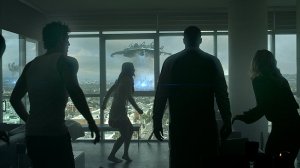
Plotwise, a bunch of rich people get together in L.A. They party, they drink, and they do things that would make their mother’s cry. The next morning, Earth is invaded by brain-sucking aliens and our hung-over protagonists, trapped in a luxury hotel, attempt to survive the next three days. And that’s pretty much it.
The cast is pretty much made up of people you’re used to seeing on TV and most of them give TV-movie-style performances. They struggle not to be overwhelmed by the special effects but, to be honest, this actually makes the film more effective. The cast’s struggle to keep up with the special effects neatly parallels humanity’s losing battle against the aliens. However, for the most part, the cast does what is required of them and they do it well enough. It is a little bit distracting that a key supporting role is played by Scubs’ Donald Faison because every time I saw him, I kept expecting to hear a Zach Braff inner monologue.
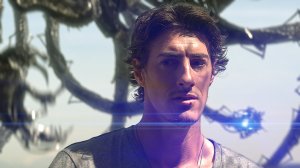
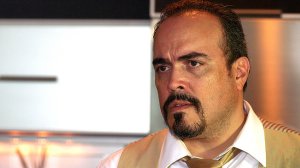
The film’s nominal lead is played by Eric Balfour, who is actually probably about as appealing as he’s ever been in his role here. In the past, I’ve always been vocal about “not getting” Eric Balfour but, lately, I’ve been starting to see his appeal. (And no, my sudden appreciation of Balfour has nothing to do with the fact that I had a kinda fun conversation with him on twitter once — well, okay, maybe a little.) I think in the past Balfour has been cast in parts where his facial hair was expected to carry the dramatic weight of the role. In this film, Balfour is actually allowed to play a sort of “everyman” type role and he’s actually very appealing in the role. Plus, I never noticed this before but Eric Balfour has like literally got the sexiest biceps ever. They’re at least in the top ten as far as sexy biceps are concerned. Also in the cast is David Zayas (you’ll recognize him from Dexter) who doesn’t have sexy biceps but is still a totally hot badass in his own mysterious way. Here he plays a concierge who shows up out-of-nowhere and quickly becomes the coolest character in the film. He gets to deliver the film’s best one-liner as well.
Ultimately, Skyline is a movie about special effects and it is here that the film triumphs. Working with a relatively low budget, the filmmakers have managed to create aliens that are not only believable and occasionally scary but kinda fun as well. These are the type of old-fashioned aliens that have come to Earth with only one purpose in mind and the special effects — the ominous mother ship floating over L.A. and the various things (they appear to be some sort of cross between animal and machine) that patrol the city in search of fresh victims — all have a retro feel to them that is undeniably appealing.
For all the criticism that Skyline has been getting, the really only inexcusable flaw is that the film is basically is 10 minutes too long. If the final ten minutes (or “Day 3” as the film puts it) had been cut out of the final film, Skyline would probably be getting much less slammed by the reviewers, the majority of whom would probably then be able to see the movie for the silly, campy, and enjoyable little b-movie that it really is. However, that ending — well, a bad ending can ruin an otherwise decent movie and if you need proof, here it is. In fact, I suggest that anyone who goes to see Skyline should leave as soon as that title — Day 3 — appears on the screen. Just stand up and walk out of the theater and allow the end of Day 2 to be the end of the movie. Trust me, you’ll have much fonder memories of the experience afterward.
Here’s the latest edition of Lisa Marie’s Favorite Grindhouse and Exploitation Trailers. (I know, I know — worst intro paragraph evuh! Following the tradition of the Pieces trailer, which can be found below, I’m keeping things simple. I’ll be back to my usual complicated self next week.)
Believe it or not, this was directed by Abel Ferrara, the same man who directed Ms. 45. Fear City is one of the few Ferrara films that I haven’t seen but the trailer just oozes sleaze doesn’t it? And speaking of sleaze, maybe that’s what all the men in this film were putting in their hair. Seriously, why not call it Gel City? And how about Billy Dee Williams there, sounding like the angel of the final judgment? Shut up, Billy Dee Williams!
This is one of Lucio Fulci’s final films and you’re either going to love it or you’re going to hate it. The film is surprisingly meta for an Italian horror film not directed by Michele Soavi. This is the one where Fulci plays himself and attempts to personally answer his critics. Anyway, the reason I love this trailer is because of the cat puppet that appears at the end. It’s so cute! (Ignore the quote from Clive Barker — he’s almost as much of a whore as Stephen King.)
I imagine this is another film that’s “exactly what you think it is.” I love trailers that show off what was considered to be chic and decadent in the past. This is one is from the 70s. (Surprised?)
While the rich people were partying in London, cannibals were apparently ruling the streets of Atlanta. According to actor John Saxon, starring in Cannibal Apocalypse made him suicidal. Cannibal Apocalypse is actually a pretty good film with an anti-war subtext and it features a great supporting performance from Giovanni Lombardo Radice so seriously — shut up, John Saxon! (Actually, Saxon gives a really great performance here — of course, his character is meant to be suicidal — and he’s the main reason that Cannibal Apocalypse works.)
Much like Cannibal Apocalypse, Cannibal Man is actually an allegory of alienation that’s disguised as a horror movie. Cannibal Man is a seriously strange movie and highly recommended.
One of my favorite movies of all time is Joe D’Amato’s haunting 1979 romance Beyond The Darkness. Not only is it one of the best Italian films ever (and the best film ever directed by D’Amato) but I think it’s also one of the best films ever made.
One reason the film is so effective is because of its soundtrack, which was composed and performed by (who else?) Goblin. The music will be familiar to any Italian horror fan, largely because it was reused by about a thousand other movies that came out in the years after Beyond The Darkness. (Director Bruno Mattei, in particular, was fond of it.)
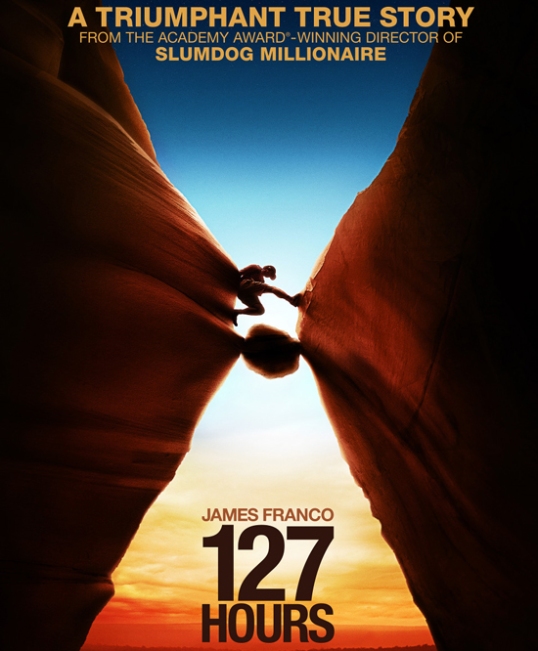
Last Friday night, my friend Jeff and I went down to the Plano Angelika and saw Danny Boyle’s new film, 127 Hours.
I have to admit that I was a little bit uneasy about seeing this film. First off, it’s a movie based on the true story about a mountain climber who spent 5 days trapped in a narrow canyon. I am intensely claustrophobic, to the extent that I’ve had panic attacks just from finding myself trapped in a crowded grocery store aisle. (Seriously, why does everyone in the world have to go shopping for La Choy Sweet and Sour sauce at the same time I do?) Secondly, the trapped climber eventually escaped by using a dull knife to saw off his right arm. I mean, ewwwwww!
But I knew I had to see the film for three reasons. Number one, it stars James Franco who I’m kinda in love with. Number two, Danny Boyle is one of my favorite directors. And, finally, 127 Hours is probably going to be nominated for best picture. So, I worked up my courage and I tried not to think about the various news reports about audience members passing out while watching the film, and I went to the movie. And I’m glad I did because 127 Hours is one of the best films that I’ve seen in quite some time.
James Franco plays Aron Ralston, a cocky but likable guy who decides to spend the weekend hiking across some place called Blue John Canyon. (Sorry, I’m not really an outdoorsey type of girl.) He tells no one of his plans and the only people who know he’s even at the canyon are two girls that he meets while there. The girls have gotten lost in the canyon and they accept Aron’s help in finding whatever grand archeological thing it is that they’re looking for. (See previous apology.)
I have to be honest here. As I watched these two girls go off with a perfect stranger, a part of me wanted to be all like, “Oh, I would never do something as stupid as go off with some stranger I met out in the middle of nowhere.” But, then again, this isn’t just some stranger. This is James Franco. So, I’ll refrain from passing judgment. I just hope that the girls had their pepper spray with them.
(The two girls, by the way, are played by Kata Mara and Amber Tamblyn. I loved Joan of Arcadia. Can you believe they cancelled it for Ghost Whisperer? Not cool, CBS.)
Anyway, after frolicking in an underground pool, Aron and the girls part company. They invite him to come to a party the next night. They tell him to just look for a big, inflatable Scooby Doo. Aron agrees, walks off, and promptly finds himself trapped in a canyon when a boulder falls on top of him and pins his right arm against the canyon wall. As quickly as that, Aron goes from being a carefree adventurer to literally being a prisoner, isolated and alone. As Franco screams for help, Boyle pulls the camera upward from Aron until eventually he’s a barely noticeable speck surrounded by a barren (and otherwise unpopulated) desert. It’s a moment that you know is coming but it’s still shocking and devastating because it stands in such stark contrast to the film’s first 20 minutes when both Boyle and Franco filled each scene with a sense of constant motion. Suddenly, everything has stopped and we’re as trapped as Aron.
The rest of the film is pretty much a one-man show. We watch as Aron spends the next five days fighting to just survive. He tries to chip away at the rock with a knife (yes, that knife). He talks to his camera, keeping a diary and leaving messages for his family. He fights off hungry ants and tries to conserve his water. He even manages to invent a pretty neat little pulley system to try to move the rock. Finally, he starts to hallucinate, seeing everything from his family disdainfully watching his predicament to a gigantic inflatable Scooby Doo stalking him in the canyon. And finally, of course, he starts to cut off his arm.
He also finds some time to think about the life he led up to the moment he found himself trapped underneath the rock. This is where Boyle really shines because, in the hands of most directors, these scenes probably would have been very maudlin and heavy-handed. However, Boyle presents these scenes in an almost impressionistic style. We see hints of the life that Aron has led but Boyle never comes out and blatantly says that, up until this point, Aron never been willing to truly connect with others. We sees scenes of Aron’s ex-girlfriend breaking up with him but we’re never specifically told what led to her leaving him. And we don’t need to be. Boyle presents us with the evidence and trusts us to draw the correct conclusion.
I am very proud to say that I watched the entire film without once having a panic attack though I did start to feel a little bit light-headed when Aron really started to get into sawing off his arm. At this point, I did end up burying my head in Jeff’s shoulder and watching the scene out of the corner of my eye. At the same time, it’s an oddly exhilarating sequence because we know that the only way Aron will survive is by cutting off his arm and, as a result of Franco’s performance, we really do want Aron to survive.
In retrospect, 127 Hours really is the ultimate guy film in that the film basically celebrates a guy who gets stranded in the desert for five days yet manages to survive without ever once having to ask for directions. However, as a result of the whole experience, he comes to realize he should have been nicer to his ex-girlfriend which means that chicks like me can enjoy the movie as well. My main concern is that the film is such a total guy flick that we might see a sudden epidemic of men amputating their limbs in order to show that they can handle it as well as James Franco did. As we left the theater, I assured Jeff that he didn’t have to chop off his hand just to impress me. Hopefully, he listened.
James Franco is generating a lot of Oscar buzz for his performance here and he should be. Franco is one of those performers who is so pretty that it’s easy to forget that he’s actually a pretty good actor. I thought he deserved a nomination for his performance in Milk. He deserves the Oscar for his performance here.
Along with a best actor nod for Franco, it seems likely that 127 Hours will also pick up nominations for best picture and best director. Interestingly enough, Boyle will probably find himself competing with the man he beat two years ago, David Fincher (previously nominated for The Curious Case of Benjamin Button and a probable nominee this year for The Social Network.) This is somehow appropriate as Danny Boyle has consistently proved himself to be the director that David Fincher is supposed to be and, by being a massively hyped film that lives up to all the praise, 127 Hours is the anti-Social Network. While The Social Network uses a “true” story as an excuse to judge and ridicule, 127 Hours uses its true story to celebrate humanity, flaws and all. Whereas Fincher seems to only celebrate film, Boyle celebrates life.
In 2009, a small film from South Africa turned the film industry on its ears. Neil Blomkamp’s District 9 was a sci-fi film which took the well-traveled alien invasion subgenre and added a new twist to the whole thing. The invasion wasn’t malicious and the bad guys ended up being the puny humans themselves. The ending of that film mentioned something about a possible real invasion of the aliens who were being oppressed, but until Blomkamp and Peter Jackson decide on making a follow-up sequel then we’ll just have to settle for the sudden wave of alien invasion films which seem to be popping up out of nowhere the last couple months.
There’s the little-to-no budget film Monsters which dealt with the landing of large tentacled aliens in the Central American jungles and how the world has come to cope with the aftermath. This one was more of a character piece with the aliens themselves little-seen til the very end. But it definitely falls under the alien invasion genre.
Then there’s Skyline by The Strause Brothers which comes out November 12 and while it also has a very low-budget compared to epic alien invasion films in the genre the film looks to have some top-notch special-effects. The story and acting may not be up the par with the visuals but then Roland Emmerich’s Independence Day was the same and it made a ton.
While late to the party it looks like Battle: Los Angeles by filmmaker Jonathan Liebesman (another South African) may be the one to pull off not just being a dramatic piece, but a sci-fi war film and FX-heavy visuals. From what could be seen in the trailer it definitely has a look that some people has called Black Hawk Down meets Independence Day.
It stars Aaron Eckhart, Michelle Rodriguez, Bridget Moynihan and Michael Peña and is set for a 03-11-2011 release.
“I may have dropped into Normandy on D-Day, but I still had Liberty in Paris or London. You Gyrenes had jungle rot and malaria.”
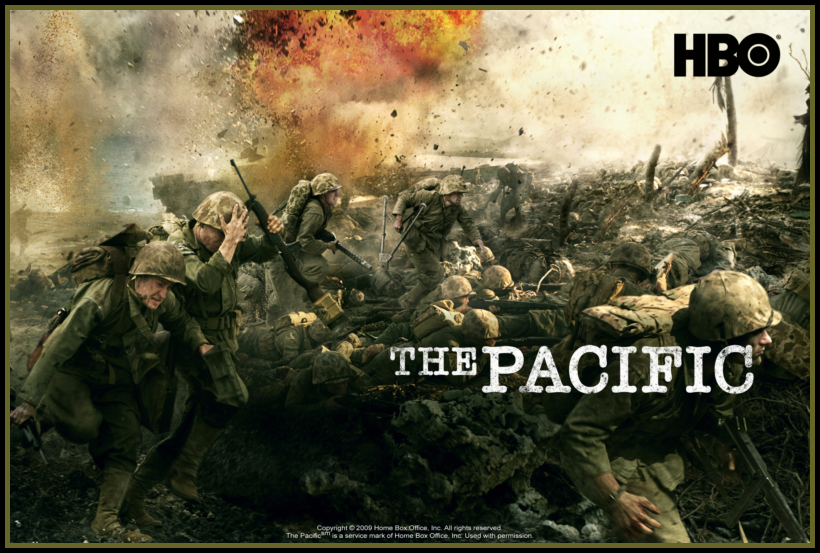
In 2001, HBO came out with a mini-series that detailed the experiences of the men of Easy Company, 506th Parachute Regiment of the 101st Airborne. This series was produced with loving care by Tom Hanks and Steven Spielberg. Two men who were instrumental in the success of an earlier World War 2 project called Saving Private Ryan. This series was called Band of Brothers and became one of the most critically-acclaimed mini-series of its time and has become part of the staple of military-themed shows and films that gets shown on Memorial and Veterans Day in the United States.
Even as this series was only a year old there was talk from some of its admirers about whether HBO and the team of Hanks and Spielberg would re-visit this era Tom Brokaw called “The Greatest Generation”. To re-visit and tell the stories of the men who fought on the other side of the European Theater in what was an even more hellish battlezone in the Pacific. It took almost 9 years, but the ending result is the mini-series called simply The Pacific.
The Pacific tells the story of three Marines of the 1st Marine Corps Division from their time before their unit ships out to the Pacific Theater of Operations and through some of the bloodiest and most savage battlefields of World War 2. There’s Gunnery Sgt. John Basilone (played by Jon Seda) who would show the sort of stoic heroism people nowadays would dismiss as a figment of Hollywood writers, but who actually did all the things only seen in action films. Bookending Basilone would be two newcomers to the art of war in PFC Robert Leckie (James Badge Dale of AMC’s recently cancelled series, Rubicon) and Cpl. Eugene “Sledgehammer” Sledge (Joseph Mazzelo from Jurassic Park). These two Marines are our guide through the unending hell that were the battles in Gen. MacArthur’s island-hopping campaign to beat back the Army and Naval forces of Imperial Japan.
It’s also these two men and their memoirs which detail their experiences during the war in the Pacific which make up the bulk of the narrative for the series. One would be Sledge’s With the Old Breed: At Peleliu and Okinawa which many consider as one of the best first-hand accounts of combat in the Pacific. The other one is Helmet for My Pillow by Leckie which was a more personal account of his time from Marine boot camp and experiencing a type of warfare in the Pacific which was new to a young man from the States. A type of warfare where the enemy didn’t surrender and would sacrifice his life in the service of one’s Emperor.
Basilone, Sledge and Leckie’s stories never come together but were told in concurrent fashion to show the audience the differing views of each. All three would go through the same meat-grinder that were the battles in immortalized places named Guadalcanal, Cape Gloucester, Peleliu, Iwo Jima and Okinawa.
We see Basilone’s heroism on Guadalcanal make him into a Stateside hero and taken away from those he fought beside to help push war bonds for the government. This change in environment for him doesn’t sit well with Basilone as we see the survivor’s guilt in him. Why does he get all the celebrity attentions when others like him were still fighting and dying the same battles he was just in months before. His story is the most poignant of the three as he finds happiness while training new Marines for the war only for his need to get back into the fight win out. The fact that all this happened for real makes his story even more memorable. Hollywood writers have tried to capture such moments and often-times fail. It was great to see Basilone’s story told for everyone to see that the world past, present and future has real-life heroes that Hollywood could never replicate but only imitate.
Jon Seda’s performance was in-line with what one thinks a gung-ho Marine should be but he brought a sense of realism to the role. He didn’t try to make Basilone more a hero than he already was. I like to compare his performance to that of Tom Hanks’ Capt. Miller in Saving Private Ryan and Damian Lewis’ Maj. Dick Winters in Band of Brothers. He was a man who did acts of bravery as seen by others on the battlefield and one which made him a celebrity to the civilians Stateside. But in the end he just saw it as him doing his job as he was trained and trying to keep his men alive. He didn’t see himself as a hero and while his Stateside role of war hero pushing war bonds did bring some perks he never fit in. Seda’s work in Part Eight where he meets his future wife was some of the best work in this series.
In Leckie’s story we see a man swept up in the great enlistment drive which happened right after the Japanese attack on Pearl Harbor. His story sees a cocky and smart young man wanting to do his part for the war effort yet not knowing the sort of sacrifices he’ll have to make or the horrors he will witness and inflict to survive day-to-day. We see Leckie quick to make friends in his unit during their training and then through their baptism of fire in the Battle of Tenaru before seeing the real horror of the war in the Pacific as his unit and the rest of the 1st Marine Division land of the island of Guadalcanal.
His time on Guadalcanal would soon erase any romanticized notion of honor and glory in battle Leckie may have had when he decided to enlist. As a writer in his civilian life prior to the war’s start he would continue to write his experiences in-between battles and skirmishes with the Japanese. Even when friends in his unit would die each and every day it seems Leckie seemed to want to keep that savagery at bay with his writing which would become a basis for his wartime memoirs. His story ends midway through the series and we won’t see him again until the final denouement as we see Leckie’s life as a civilian once again after the war. His final time in the warzone would be on the Battle of Peleliu (one of the bloodiest battles in USMC history and one that would be steeped in tragedy afterwards) where a severe concussive blast would render him unable to fight. It’s scenes on one of the hospital ships off the coast of Peleliu where Leckie’s own survivor’s guilt is temepered by the realization that any more time out in the battlefield would surely strip him of his humanity and turn him into the growing examples of battle-scarred and psychologically damaged Marines who have seen and done too many horrible things to ever return back to their civilian life intact.
The final episode shows Leckie (with James Badge Dale in a confident and cocky turn) the one who seem to adjust to the life back to civilian life with a modicum of ease. While he still carries the scars of battle in his psyche its that time in the Pacific which has also given Leckie the confidence to get his old job back at the local paper he used to work for and woo the pretty girl next door he had been shy and awkward with in the very first episode. While his performance wasn’t as good as Seda it was still a noteworthy one which brought the person of PFC Robert Leckie to the masses watching this series.
Lastly, we come to the third of the three whose story the series revolves around. The story of one Cpl. Eugene Sledge who, like Leckie, wanted to do his part for the war effort. While his young age at the start of the war prohibited him from enlisting without his parents’ consent he finally gets a chance a year later when he is of age and just in time for him to join the Corps, train and see his first taste of combat in the Pacific on the killing grounds of Peleliu then the hellish nightmare battlefields of Okinawa.
Sledge’s story is the most complex and runs the gamut of dark emotions a young man should never have to take. His young idealism in helping his country in its time of need will get some tempering even before he ships out to become a Marine. His father tells him of having to treat young men from an earlier era from another major war which had engulfed the world. His father spoke about how some of these young men who came back whole physically didn’t do so psychologically. He spoke about how the horrors of war seemed to have “ripped the souls” from these returning young men and how he didn’t want his son to go through the same thing. But as young, headstrong men who think they’re invincible are wont to do he enlists anyway.
The performance by Joseph Mazzello (hard to believe this young man is the same young boy who ran and escaped from CGI raptors and T-Rex on Spielberg’s Jurassic Park) tops all other performances in this cast full of noteworthy and great acting work. We don’t just see his Sledge go through each horrific scene after scene of battle and its aftermath with is emotional and psyche gradually sliding down into the abyss, but we could actually see Mazzello’s body, mannerisms and the look in his eyes make the same changes. I fully bought into his performance as the young idealistic young man from Mobile, Alabama slowly turned into the same uncaring, savage Marine one had to become to survive the war in the Pacific. He had seen enough bodies of Marines and enemy Japanese torn apart and strewn about everywhere one looked that one became inured to them.
One of the most powerful scenes in the series has Sledge confronted by the aftermath of what he and his mortar-team might have been responsible for. It was deep into the campaign to take the island of Okinawa and Sledge and his fellow Marines have been brought to the edge of insanity by all the fighting. A fight which has some of them questioning why the enemy just doesn’t surrender. An enemy willing to suicide charge into heavily armed Marines and also willing to herd Okinawan civilians into the line of fire. It’s this brutality by the enemy and mirrored by his fellow Marines which brings Sledge to a darker side of his nature which we as an audience don’t see a way out for him. But in the scene close to the very end of Part Nine brings Sledge back from the abyss and reminds him that there’s still humanity in him and the very Marines he has been with since the beginning. His reaction afterwards to a group of new Marines killing a young Japanese soldier for sport sickens him. We see Sledge realizing how just days and months before he was spouting the very same savage hate for the enemy as these newly arrived Marines looking for their first kill.
Of the three it’s Sledge who will carry the deepest scars of the Pacific for the rest of his life. We see the extreme difficulty he has in adjusting back to civilian life. Nightmares haunt his nights and flashbacks of the battlefields hound his steps in the daytime. His mental and emotional breakdown as he tries to go back to hunting with his father encapsulates this series at its most basic core. This series doesn’t have the camaraderie and brotherhood established between fellow soldiers that its predecessor had. While Band of Brothers also showed the horrors of war in Europe it was balanced by the hope that everyone in Easy Company had their brothers in arms to back them up when the bullets flew and shells exploded. This wasn’t the case in the Pacific.
Sure the were the same camaraderie and brotherhood, but the type of enemy fought in abject conditions which made downtime from battle almost as bad as the battle themselves didn’t bring hope. It only brought misery and a fatalistic view of the world Sledge and his fellow Marines existed right there and then. His breakdown in the final episode shows how those who fought in the Pacific definitely bore deeper scars and returned more damaged than their European brothers. Scars not just inflicted by the enemy but those they’ve inflicted on themselves by fighting savagery with their own form of savagery. It was a kill or be killed world and returning back from that brink didn’t happen to everyone and those who were able to return did so not whole.
I understand that some were disappointed by how The Pacific turned out. How it didn’t live up to the standards created by Band of Brothers. Some have said that there was no main focus to the narrative the way its predecessor strictly followed the men of Easy Company through the battles in Europe. They’ve pointed out how some episodes took too much time to get to the battle scenes. I think trying to compare The Pacific to Band of Brothers is foolish and a doesn’t give this follow-up mini-series the proper due it deserves.
The Pacific wasn’t trying to tell Band of Brother in the Pacific. While the two series do take place in the same world war the circumstances surrounding the storylines in both series diverge to take different paths. The first series almost seem like men fighting for a common cause and the good fight against tyranny. The Pacific is all about revenge. Revenge and payback for Pearl Harbor at first then as the series moves forward it becomes revenge and brutality for seeing their buddies die. This series showed nothing noble about the fighting in the Pacific. It was just a struggle to survive from one day to the next.
So, while this series may not be the second coming of Band of Brothers it does stand on its own merits and I think was the more powerful of the two. It didn’t flinch away or dismiss the darker side of the “good guys” and showed that war truly is hell and that those who fight and live through it were truly never the same. I say watch The Pacific and stop trying to compare it to Band of Brothers or any of the several shows dealing with the current wars. The Pacific should be watched as seen as the bookend to Band of Brothers. A darker journey to seeing the war of the “Greatest Generation” from the eyes of those who fought and died on the islands and jungles of the Pacific.
I read earlier that film producer Dino De Laurentiis died on Wednesday. He was 91 years old and he either produced or helped to finance over a 150 movies. He started his career with Federico Fellini and went on to produce two of the iconic pop art films of the 60s, Roger Vadim’s Barbarella and Mario Bava’s Danger: Diabolik. Then in the 70s he went through the most infamous stage of his career when he produced several overblown “event” films like the 1976 remake of King Kong. However, even while De Laurentiis was devoting his time and effort to critically reviled attempts at spectacle, he was also supporting the visions of independent directors like David Lynch. In the 21st Century, De Laurentiis was probably best known for producing the Hannibal Lecter films.
De Laurentiis, born in Naples, was a Southern Italian and, not surprisingly, was one of those legendary, larger-than-life moguls who built his career walking on the thin line between the Mainstream and the Grindhouse. Hollywood is run by people who try to be De Laurentiis but De Laurentiis was the real thing.
Dino De Laurentiis, R.I.P.
(On a personal note, De Laurentiis produced one of my favorite films of all time, Bound. And I’m a fourth-Southern Italian myself. Southern Italians are the best.)
As I’m sure I’ve mentioned before, I’ve always loved to dance. Before I embraced the movies, my life was about dancing. I was going to be Prima Ballerina and my mom paid for several years of ballet class to help me reach that goal. I obsessed on it the way that I obsess, today, on Lucio Fulci and Jean Rollin. However, my brilliant career was cut short by two things — 1) I’m about as graceful as a Clydesdale and 2) I ended up tumbling down a flight of stairs when I was 17 and essentially shattering my ankle. Actually, I guess those two things might be connected. Anyway, I can’t complain because giving up my affected love of ballet allowed me to discover my very true love of film. I was never really a great dancer (though I was, and am, very enthusiastic) but I’m very good at watching movies.
However, I still love to dance and I still love movies — even mainstream movies — that feature dancing. That’s why I’m so looking forward to seeing Black Swan next month. Until then, here’s 6 of my favorite dance scenes from the movies.
Let’s start off with one of my favorite “dance” scenes of all time, my man Giovanni Lombardo Radice and Lorraine De Selle breaking it down in Ruggero Deodato’s The House On The Edge of the Park. The man in yellow is David Hess.
If anyone’s ever wondered why I was crushing on Joseph Gordon-Levitt in Inception (as opposed to Tom Hardy, Cillian Murphy, or Leonardo DiCaprio), it was largely because of this scene from (500) Days Of Summer.
Murder Rock is kinda sorta like my own personal Holy Grail — it’s a grindhouse dance movie directed by Lucio Fulci! Plus, it costars Christian Borremeo, who co-starred in The House on the Edge Of The Park and Dario Argento’s Tenebrae.
Okay, so I think Nine was definitely the worst the movie of 2009. Yes, even worse than Avatar. However, I love this scene and I love the song featured in it, Cinema Italiano. Yes, technically, it’s a really terrible song that displays an astounding ignorance of Italian cinema. If anything, the lyrics appear to be describing the French New Wave. True, the song do make reference to “neo-realism” but you get the feeling no one involved with Nine ever saw Open City or The Bicycle Thief. But the thing is do damn catchy that I still find myself singing it in the shower. Like me, Kate Hudson is obviously not much of a singer or a dancer but she’s very enthusiastic.
An Unmarried Woman was apparently very groundbreaking in 1978. Seen now, it seems like a better title for it would be An Unmarried Woman Who Can Still Afford A Penthouse Apartment In New York City. Still, the late, great Jill Clayburgh’s performance holds up well and I like the film if just because it’s still one of the few movies out there that’s willing to acknowledge that an unmarried woman can still be a sensual, happy woman. The scene below captures perfectly the exhilarating joy of just surrendering to the music and dancing. Plus, for me, this is one of those “Hey, I do that too!” scenes. In fact, my ankle is still hurting as a result of rewatching this film last Friday.
The second episode of The Walking Dead just aired and while it didn’t have the emotional impact the Frank Darabont-directed pilot episode had it still more than held its own. It was an episode that more than lived up to it’s title and for zombie fans and gorehounds this episode should assuage any thoughts that the series will be heavy on emotional themes and scenes while lacking on any sort of zombie mayhem and bloody good horror (shout out to the Bloody Good Horror Crew). With an apt title of “Guts” the follow-up episode of this series looks to move the story forward now that we’ve gotten some of the basics of this new zombie apocalyptic world and its rules out of the way in the pilot episode.
When last we left our intrepid hero, Rick Grimes, he had gotten himself into quite a pickle. Mode of transportation was now chow for the zombies he had cantered into and he was now stuck inside a tank with no idea of how to get himself out of the situation until he hears a voice over the tank’s radio. One would think that we’d see the start of the second episode starting up from this very last moment in the pilot, but instead we get a quieter, but more disturbing sequence to begin the show. It involves Rick’s wife Lori out in the woods near their make-shift camp outside Atlanta. The scene is set-up to almost be a jump scare scene and for some I’m sure the pay-off in the end probably made them jump, but instead we get another glimpse into Lori Grimes’ current situation and expands on what she has been doing since leaving their Kentucky town with her son Carl and Shane Walsh, Rick’s partner. This opening scenes really paints Lori in a bad light and I’m not sure it needed to be handled so heavily. I’ll reserve a bit of judgement on this development on Lori and Shane as characters. The pilot episode seem to have hinted to something like this maybe happening already before the zombie apocalypse dropped in their laps which would definitely diverge this series from the original comic book source. Only time will tell if the planned triangle-drama will pay off in the long-run or ruin a major character’s growth with audiences in this show’s future.
This brief interlude leads up to where we last left Rick and his mysterious friend on the other end of the tank’s radio. From the moment this scene starts the show puts the episode on high gear and never lets up. The pilot episode was all about quiet desolation and isolation for our main character. This second offering is all about adrenalin and desperation as Rick goes from one dangerous situation into another. We also get to meet his benefactor who had been helping him by way of radio. In a role that should make Steven Yeun a fan favorite at comic book and fan conventions starting now, we meet a fan favorite of the comic book.
The character of Glenn has always been one of the constants in the comic book series. He has been with Rick since the very beginning and while his character doesn’t have the emotional and/or dramatic gravitas as the others he does prove himself to be voice of reason when everyone around him seem to be on the verge of losing their minds from the constant barrage of danger not just from the zombies but from other people as well. It was good to see Glenn portrayed early on as the snarky character the original source material had him before he become just a tad domesticated as the series went along. The fact that he was the one who seem to know how to truly survive in this new world while those around him seem to be making mistakes after mistakes should make fans of his character very happy.
We meet the rest of Glenn’s group which includes original character from the comic book in Andrea with four new additions created just for the series. All these new characters almost have “red-shirt yeoman” tattoed to their foreheads with the exception of Michael Rooker’s blatant racist redneck role of Merle Dixon. Rooker takes this over-the-top character and drives it into the ground. I thought the character could’ve used just a tad bit of subtlely in how he was written, but Rooker definitely looked liked he was having fun with the character. In any other actor’s hand the character of Merle Dixon would’ve looked just foolish, but the Rook’s manic intensity in playing the role made me hope the situation the group left him in wouldn’t be the last we see of Merle. Rook needs to get some more screen time to either play his character’s racist personlaity to the very end or at least time to round him out a bit before he finally gets his just desserts.
Laurie Holden as Andrea seemed like she was still searching for her character’s main focus. We find out that her younger sister is back at the camp with Lori and Shane and that she’s very knowledgeable with firearms. Her Andrea also seem to be slightly prone to panicking (though with zombies having destroyed one’s world panicking seems like a natural thing to do). I hope Daradont and his writers (Robert Kirkman being one of them) don’t mess with Andrea too much, but just expand on the type of person she is and how it will grow in time to be the Andrea everyone who are fans of the comics see as one kick-ass lady.
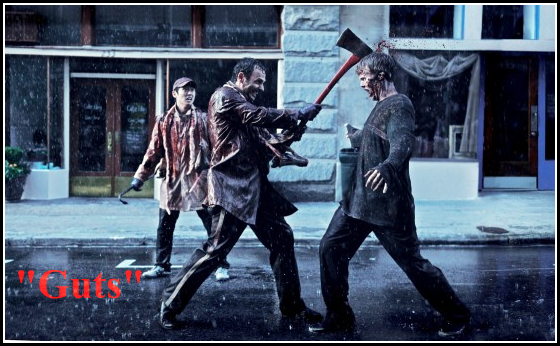
Now, the aforementioned episode title and what it means. It literally means guts. One could see the word used metaphorically to describe Glenn’s character finding his inner courage to follow Rick into one crazy and dangerous plan to save everyone in the group. Or one could see it in the way everyone who saw the episode saw it. Rick, Glenn and their group hacking a zombie to pieces to use it’s guts to camouflage themselves. This sequence is in line with how the comic book handled it but was moved up in the story’s timeline. This slight adjustment tells me that Darabont and crew look to be mixing and matching some of the original source’s narrative to create something more dramatic on the tv screen. Either way the sequence was the best one in the episode. It had the gross out factor zombie and gorehounds love. It also had tension and white-knuckle terror as we wonder if their trick will fool the zombies and when nature throws a curvebal their way while their in the middle of a horde I could almost sense millions of viewers shouting at Glenn and Rick to drop their shit and run (for people in the same situation they may literally drop their shit before running).
While the second episode didn’t have the quieter and emotional moments as the pilot episode it did have the adrenalin boost some horror fans were missing from the first one. Some have called this episode a let-down from the pilot because it played off as your typical zombie siege story. From group members bickering to rehashing scenes from other zombie films to solve their problem. I can’t say I disagree with them, but I didn’t see it as being a bad thing. I understand some critics and non-zombie fans want something new and fresh to be done in the zombie genre. Again I wholeheartedly agree, but one also cannot forget that this is a zombie horror series and zombies will still be on the forefront of what makes the show tick. A zombie story with no guts and in-group bickering is not a zombie story. How they handled it in this episode show that the writers know how to take the usual zombie story tropes and do it well.
Now, if the series is just all about gore or interpersonal drama then it will lose people. The writers definitely have their work cut out for them about balancing what horror fans want and what fans of dramatic storytelling want. So far, they’ve done a good job, but with four more episodes left in this freshman season the question now is will they be able to pull it off and end the season on a high note. Official word that AMC has announced the series has been renewed for a second 13-episode season should make fans of the show happy and make the writers get somne of the burden off their shoulders. They now have some leeway in terms of time to go at their pace. I do think even episode that skew more towards the dramatic need at least a couple exploding headshots and one gore scene just to keep the horror fans sated til the next gore-heavy episode.
Extras
This episode also had some memorable lines to remember and repeat…
Glenn: “He’s also an organ donor.” (right before Rick takes a fireaxe into one of the truely dead “walkers”)
T-Dog: “Yeah, dead puppies and kittens.” (after Rick tells a visibly sick Glenn to think of puppies and kittens to take his mind off the gore)
Rick: “We need more guts.” (realizing that he and Glenn need more zombie guts and viscera after already wearing almost a full body suit of it. Still best line of the episode.)

 Through the Shattered Lens