It’s been awhile since I picked a film for the Grindhouse of the Day feature. For this go-round I will go into the little-known grindhouse fantasy subgenre.
Grindhouse flicks seem to always deal with horror, blaxploitation, Italian murder mysteries and scifi, but the fantasy subgenre has always been kept from the conversation. This is a shame since there’s been some very good (in grindhouse terms) flicks in the fantasy genre that could qualify as grindhouse. I would especially point out the ones made after the release of the very popular Conan the Barbarian. The one I chose is from that grindhouse master of the 1980’s: Albert Pyun. I speak of his 1982 sword and fantasy flick, The Sword and the Sorcerer.
The film definitely riffs-off of the Schwarzenegger-Milius fantasy epic. We have a kingdom conquered and destroyed by an evil tyrant who uses black-armored soldiers in addition to getting the help of an undead sorcerer. This time around the Conan-archetype is played by 80’s TV star Lee Horsley who does a valaint effort to affect a Shakespearean speech pattern (for some reason when people think fantasy they instantly try to speak like they were in a Shakespearean production). Baddie icon Richard Lynch plays the evil tyrant and he definitely looked like he was having the time of his life in the film despite the corny dialogue. There’s an abundance of graphic violence, nudity and magic spells (done in early 80’s heavy metal effects).
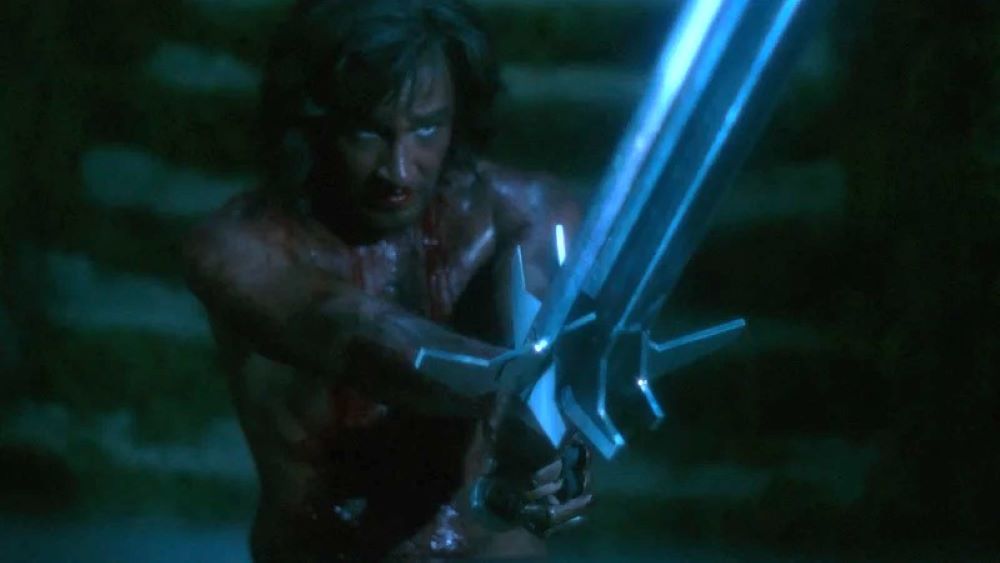
One thing this flick does have which made it a cult classic for fans of the fantasy genre is the sword in the title. The main character of Talon wielded a three-bladed sword. Let me repeat that: A THREE-BLADED SWORD. The sword wasn’t just sporting three blade but the wielder has the ability to shoot two of the blades at someone. Definitely puts to shame those sissy Spetnaz ballistic knives. Arnold may have had an Atlantean-forged blade in Conan the Barbarian, but Lee Horsley definitely outsworded him in his flick.
Another thing about this flick which makes it a favorite of mine is the poster art created for it. The producers of the film did one other thing right outside of populating the film with a kick-ass sword, much nudity and violence. I talk of the Frank Frazetta painted posters done up for the flick. More than one version were done depending on the region. The one above which was the original was the best and the film definitely lives up to what Frazetta painted.
1) A Black Veil For Lisa— There’s several things that I love about this trailer. I love the faux-noir narration. I love the teasing tone. I love the old school femme fatale attitude of lead actress Lucianna Paluzzi. But, to be honest, the main reason I love it is because it’s all about a redhead named Lisa. That and the line “Every man wants a Lisa…”
2) The Italian Stallion— This is the trailer for the re-release of Sylvester Stallone’s porn debut, A Party At Kitty and Stud’s. I’ve never seen the movie nor do I have much desire to see it but this trailer just amused me to no end. Whether its the awesomely phony line readings of Gail Palmer or the catchy and empty theme song, this trailer feels like a genuine time capsule.
3) The House On The Edge of the Park— Speaking of catchy but empty theme songs, Ruggero Deodato’s The House on the Edge of the Park features my personal favorite, Riz Ortolani’s infamous Do It To Me (Once More). It can be heard at the end of this trailer and once it gets stuck in your head, it’ll stay there forever. As for the trailer itself, it’s a perfect example of how a well-edited trailer can actually make a somewhat draggy film seem exciting (that said, this movie is one of my all-time guilty pleasures, as misogynistic and wrong-headed as it ultimately is). A few things I love about this trailer — the blue-tinted views of New York City, David Hess’s iconic psycho performance, the sight of my man Giovanni Lombardo Radice dancing, and the fact that the trailer actually manages to 1) get the movie’s name wrong and that 2) nobody ever bothered to fix it.
(Author’s note: Whoops! Before you watch this, I have to admit that I’d forgotten just how explicit, violent, and exploitive this trailer really is. So, consider this to be definitely NSFW — not that you should be watching any of these trailers at work, to begin with — and seriously, no joke, don’t watch this trailer if you are easily upset or offended. Honestly, if I saw this trailer without having any knowledge of how silly the actual movie really is, I would probably find this trailer to be deeply offensive. Well, no, actually, I probably wouldn’t. For the most part, I’m only offended by things that happen offscreen in the real world. — Lisa Marie Bowman)
4)The Texas Chainsaw Massacre— Yes, I know everyone’s probably seen this trailer a hundred times but it’s still probably one of the best and most effective trailers of all time. Plus, I’m from Texas so you know I had to mention this movie at some point. (I may have mentioned this in the past, but seriously — try to imagine this movie being as effective if it was called The Vermont Chainsaw Massacre.)
5) Mindwarp (a.k.a. Galaxy of Terror) — I’ve been eagerly awaiting the chance to buy this film on DVD ever since seeing this trailer on the latest 42nd Street Forevercompilation. Rumor has it that this film was actually directed by James Cameron, back when he was still interesting. Supposedly, this film features a very aggressive tentacle but, to be honest, I mostly just want to see Sid Haig’s arm get cut off. (Seriously, who doesn’t? Take that, Capt. Spaulding!)
6)Stage Fright— This is the wonderfully intense and claustrophobic trailer to the great Michele Soavi’s 1st film, Stage Fright, a movie I’m going to watch as soon as I finish up this post. So, with no further delay…
With Comic-Con over the hype surrounding the tv adaptation of Robert Kirkman’s zombie apocalypse comic book series has reached stratosphere status. The 6-episode first season was already one of the most anticipated new shows of the upcoming fall season from just the fans and geek community talking about it nonstop in the internet, but with it’s unveiling at this year’s San Diego Comic-Con the mainstream press has latched itself onto the series. The common reaction to the series at the panel in Hall H seemed to be a unanimous positive one.
Character photos, Drew Struzan posters and new trailers have added to the hype. The comic book series has hit it’s milestone 75th issue. Sales of the comic and it’s collected softcover and hardback graphic novels have seen a spike in sales. AMC has added to the series’ website a taste of the the comics for people to get an idea of what to expect from the series. This motion comic of the first issue of The Walking Dead really captures the horror and hopelessness of the world Kirkman has created and Daabont plans to show up on the TV screen.
Last Tuesday night, as we watched the end credits of Cyrus rolling across the screen at the Plano Angelika, a very dear and close friend of mine leaned over and whispered in my ear, “That was a really odd fucking movie.”
(Actually, it was two weeks ago. Sorry, I started this review a while ago and only recently returned to finish it.)
And he’s right. Though the film is worth seeing (though I’d honestly suggest waiting until it comes out on DVD unless you’re just the world’s biggest John C. Reilly or Jonah Hill fan), Cyrus really is an odd fucking movie.
Cyrus is the latest film from Jay and Mark Duplass, the two brothers responsible for 2008’s Baghead, one of the unacknowledged great films of the last decade. In Cyrus , John C. Reilly plays a character named — appropriately enough — John. John is a likable loser, a less musical version of the character Reilly played in Chicago. When the movie opens, John is depressed over the fact that his ex-wife, Jamie (Catherine Keener), is getting married again. At Jamie’s suggestion, he goes to a party where he proceeds to have too much to drink, flirts awkwardly with every woman he sees, and somehow manages to charm Molly (Marisa Tomei). Molly is soon sleeping over at John’s house but every morning, John wakes up to discover that she’s either already left or is in the process of sneaking out. John asks her if she’s married. Molly replies that she’s not but is still vague about why she never stays the entire night. Finally, one morning, John follows Molly after she leaves. He sits out in front of her house and, after she’s left for work, John proceeds to creep around outside the house.
And, of course, its while he’s doing all of this creepy stalker stuff that he first meets Cyrus (played, of course, by Jonah Hill). Cyrus is Molly’s 22 year-old son and from the minute he first appears, its obvious that there’s something off about him. He’s far too friendly and speaks in the oddly stilted cadence of someone who is obviously making an effort to act “normal.” He spends all of his time composing New Agey synthesizer music in an elaborate home recording studio. Of course, the main sign that there’s something odd about Cyrus is that he’s played by Jonah Hill.
However, the main thing that distinguishes Cyrus is just how close he is to his mother. From the first moment that we see him and Molly interact (he’s playing his music and Molly enters the house and immediately starts dancing to it), its obvious that Cyrus is Oedipus, Norman Bates, and Yanni all wrapped up into one package. And, obviously, he views John as being competition…
Cyrus is an uneven film, one that starts out strong but — once the title character is actually introduced — suddenly seems to get hit by an identity crisis. Is it a realistic portrait of sad, lonely people trying to find love in uncertain times or is it an Apatowish mix of stoner sentiment and over-the-top comedy? Is Cyrus meant to be the emotionally wounded, painfully insecure outsider that he appears to be the movie’s more contemplative moments or is he just a sociopathic comedic device that Reilly has to overcome in order to pursue his relationship with Tomei? That’s the question that is at the heart of Cyrus and discovering the answer is the film’s entire excuse for existing. Unfortunately, the Duplass Brothers don’t seem to know the answer themselves and as a result, the entire film feels directionless and we’re left with too many unanswered questions.
For instance, where is Cyrus’s father? It’s mentioned by both Cyrus and Molly that the father is no longer in their lives but why? Though its never explicitly stated, its obvious that both Cyrus and Molly have suffered abuse in the past, probably at his hands. However, the issue itself is never directly confronted and its hard to believe that John wouldn’t have asked about it at some point. For that matter, beyond her role as Cyrus’s mother and John’s girlfriend, Molly isn’t given any back story whatsoever. Considering the fact that the entire movie is about how Cyrus and John feel towards her, it’s interesting that she’s never given a scene where she really gets to explain how she truly feels towards either of them. A good deal of the film’s attitude towards Molly can be seen in the fact that, while a major plot point hinges on her being at her job as opposed to at home, we never find out just what exactly it is that she does for a living.
That’s unfortunate because, in many ways, Cyrus shows a good deal of promise and psychological insight. One of the subtle pleasures of the film is seeing how all of the various relationships (John and Molly, John and Cyrus, Molly and John, John and his ex-wife, Cyrus and Molly) actually run parallel with each other. When Molly first flirts with John, John replies, “Are you hitting on me? I’m Shrek.” And it seems like he’s got a point until you see Cyrus and Molly together. It’s at that point that you realize that John probably once looked just like Cyrus and that Cyrus is eventually going to grow up to be John. It’s hard not to wonder if Cyrus’s father looked like John or if Molly is attracted to John because he reminds her of her son. On the other hand, much as Cyrus is totally dependent on Molly, John is similarly dependent on his ex-wife (who, as played by Catherine Keener, looks strikingly similar to Marisa Tomei). In a nice touch, his ex-wife’s new husband seems to have the same opinion of John that John has of Cyrus.
The Duplass Brothers also get a quartet of excellent performances from the film’s leads. This is all the more exceptional considering that three of them are playing characters that are either underwritten (Tomei and Keener) or else totally inconsistent (Hill). The film really belongs to John C. Reilly who is such a sympathetic, likable presence as John that he convinces the audience to forgive a lot of the film’s unevenness. His best moments are to be found in the film’s opening party scene where he essentially acts like a total drunk jackass yet you still feel oddly sorry for him. He’s just such a nice guy.
As previously stated, Cyrus is an odd film, an uneasy mix of independent and mainstream sensibilities. Watching it, I found myself wondering if the Duplass Brothers were really sure what type of movie they wanted to make, if they wanted to emulate the cold, detached dry wit of the Coen Brothers or if they were indulging in a little Judd Apatow-style schmaltz. Both styles attempt to co-exist in Cyrus and the end result is a movie that seems to be struggling to establish its own identity. Still, Cyrus is worth seeing if just for the performances. As flawed as the film is, it confirms what Baghead indicated, that the Duplass Brothers as intriguing filmmakers to watch out for in the future.
In 2008 a Swedish film called Let the Right One In stormed through the film festival circuit and became one of the most critically-acclaimed film of that year. The film was an adaptation the a novel by the same name by Swedish author John Ajvide Lindqvist. It took the vampire genre which has started to gain a sort of resurgence in the past 5 years due to the teen-pop vampire-romance franchise Twilight.
Tomas Alfredson’s film was definitely the anti-Twilight of this resurgence. It was a beautifully-shot and framed film with a dark, poignant story to match the visuals. While arthouse film fans and horror fans with discerning taste praised the film the rest of the general public either ignored it or never even heard about it. This is always the case when it comes to foreign films which tries to make a bridgehead onto the U.S. film market.
The film has since been discovered by the general public through home video sales and through Netflix, but not before an American film studio has bought the rights to produce an American remake for the American market. It fell onto the shoulders of Cloverfield director Matt Reeves to film this remake and try to dampen any advance outrage by the original film’s fans. While there will remain a very vocal group denouncing this “Americanized” remake of Let the Right One In (renamed Let Me In for the remake) I think casting decisions and certain stylistic choices by Reeves has me hoping that this remake will not fail but actually stand on it’s own while still letting the original keep it’s status as one of the best horror films of the past decade.
Above is the newly released Red Band Trailer for the film and below are two posters for the remake which were unveiled over at San Diego Comic-Con 2010. Both posters definitely take on a very stylized look. The second one looks too similar to Park Chan-wook’s poster for Thirst. The first one I like better as it combines the film’s innocence with the darker underlying story really well.
“There are things in this world that go beyond human understanding.”
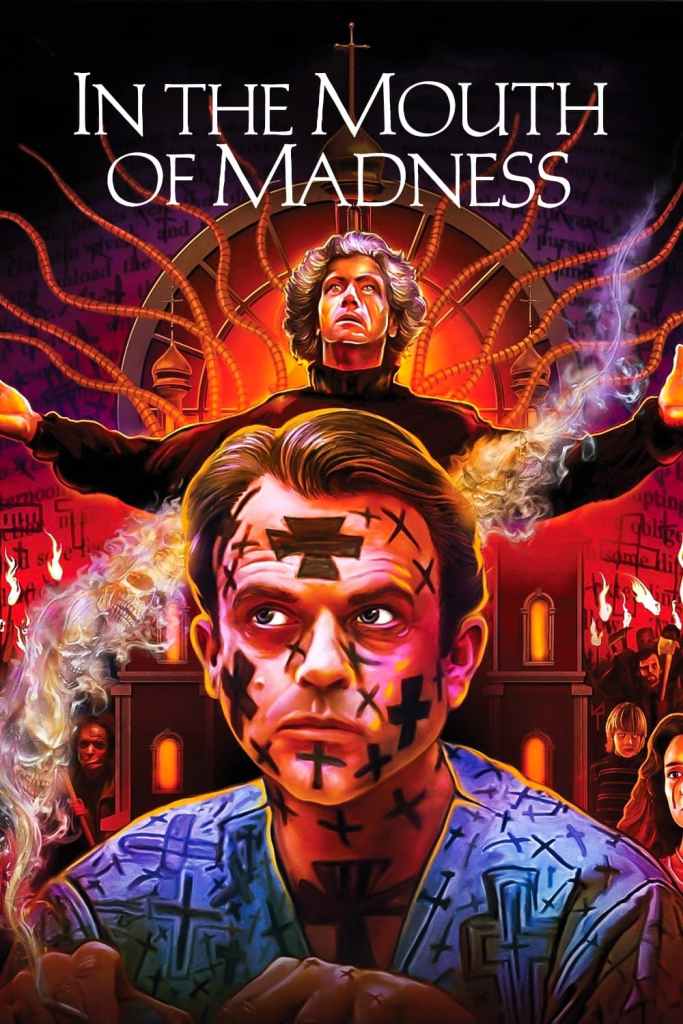
John Carpenter’s reputation as one of the great American horror directors rests on his ability to merge the cinematic with the philosophical—to craft films that stay frightening not because of what they show, but because of what they suggest. Yet by the early 1990s, Carpenter’s once unshakable relationship with audiences had weakened. His influence remained undeniable, but several of his later films seemed to miss the spark that defined Halloween, The Fog, or The Thing. Then arrived In the Mouth of Madness (1995), a work that signaled a late creative resurgence. It paid intelligent homage to two pillars of horror literature—Stephen King and H. P. Lovecraft—while offering a disturbing reflection on authorship, sanity, and the power of belief. The film reasserted Carpenter’s command not only over frightening imagery but also over the psychological territory that underpins enduring horror.
At a narrative level, In the Mouth of Madness follows John Trent (Sam Neill), an insurance investigator known for exposing fraud and deception. His skepticism becomes both his strength and undoing. Trent is hired by publishing executive Jackson Harglow (played by the legendary Charlton Heston) to locate Sutter Cane, a best-selling horror novelist whose disappearance threatens both the company’s finances and the stability of Cane’s obsessed fanbase. Every sign points to something far stranger than a publicity stunt. Cane’s readers are exhibiting troubling behavior, as though the author’s new book has triggered more than just entertainment—it has become contagion.
Carpenter crafts Trent’s descent into uncertainty with meticulous pacing. At first, Neill’s character regards the assignment as routine, dismissing the hysteria surrounding Cane’s novels as marketing excess. But when his investigation hints that the locations and events in Cane’s fiction may correspond to real places and real disturbances, the film begins to twist the rational into the uncanny. The story’s sense of unreality builds with deliberate restraint—incidents grow progressively stranger, but never so overt that Trent can confidently identify what’s madness and what’s truth. Carpenter thrives on this ambiguity, pulling both protagonist and viewer into an atmosphere where logic erodes and fiction itself seems to rewrite reality.
Accompanying Trent on his search is Linda Styles (Julie Carmen), the publisher’s editor assigned to ensure the investigation runs smoothly. While her performance has sometimes been considered subdued, Styles functions as the audience’s second perspective: observant, mildly skeptical, and gradually aware that the world around her no longer behaves according to its former rules. Carpenter positions her as a necessary counterpoint to Trent’s brittle rationalism, highlighting the conflict between recognizing patterns and succumbing to fear. As they move closer to locating Cane, their surroundings take on the familiar haunted quality of an archetypal New England town—Hobb’s End—built from the shared DNA of King’s Castle Rock and Lovecraft’s Arkham. The town becomes more than setting; it is a physical embodiment of literary influence and psychological instability.
The choice of Sam Neill proves essential to the film’s success. His trademark combination of intelligence and emotional vulnerability allows Trent’s transformation from calculating skeptic to disoriented seeker to feel natural rather than theatrical. Few actors could portray a man so evidently rational who nonetheless finds himself seduced by forces his disciplined mind cannot resist. Neill’s body language carries much of the horror; his expressions shift between dry disbelief and quiet terror, suggesting that intellect offers no protection once perception itself begins to betray you. Carpenter exploits this performance with close framing and asymmetric compositions, visually trapping Trent in spaces that subtly curve or distort. The director’s technical command ensures that even ordinary scenes seem charged with quiet wrongness.
While In the Mouth of Madness never references the mythos of Lovecraft by name, its influence saturates the film. Lovecraft’s hallmark—cosmic indifference—exists here not through tentacled gods but through the crumbling borders between fiction and the human mind. The suggestion is that the very act of creating and consuming stories might awaken something ancient and uncontrollable. When Trent confronts the nature of Cane’s work, Carpenter’s direction avoids overstatement. Instead of grand confrontations, he conveys horror through disorientation—the feeling that language, images, and even memory are slipping toward incoherence. Reality itself becomes a character, unstable and untrustworthy.
Jürgen Prochnow’s portrayal of Sutter Cane adds another layer of unease. His calm, confident manner diverges from standard portrayals of deranged genius. Prochnow makes Cane unnerving precisely because he appears so certain of his vision. The author views himself not as a mere storyteller but as a conduit, claiming that what he writes merely reveals a preexisting truth. Through him, Carpenter explores a potent question that haunts all creators: does imagination serve human purpose, or is it an independent force that uses human minds as tools? Cane’s conviction blurs that line, turning the creative process into possession. To audiences familiar with the concept of “mad artists” in literature, his belief offers both fascination and dread.
Carpenter imbues this theme with visual invention. The cinematography and set design combine the mundane with the surreal—painted walls pulse, corridors bend, horizons vanish. Rather than relying on excessive gore or digital spectacle, the director emphasizes textures and shadows, creating optical unease rather than overt shock. The town of Hobb’s End seems perpetually detached from time, its streets looping back on themselves. By employing low, creeping camera movements and deliberate color desaturation, Carpenter evokes a dreamscape decaying from within. The film’s sound design—especially Carpenter’s own pulsating score, co-composed with Jim Lang—heightens that tension with rhythmic basslines reminiscent of a heartbeat slowing to a stop. Every technical choice reinforces the narrative’s central sensation: uncertainty.
Michael De Luca’s screenplay deserves particular credit for its clever structure. The film is framed as a story told from inside an asylum, immediately hinting that the perspective may be unreliable. This framing allows Carpenter to shift between psychological thriller and cosmic horror without losing cohesion. As viewers, we are made complicit in Trent’s investigation but warned not to trust his perceptions. The resulting experience is disorienting yet coherent—a cinematic maze where each turn feels inevitable once taken. The writing never lingers long on exposition, instead suggesting connections through implication and repetition. In this way, De Luca’s script succeeds in translating Lovecraftian dread into visual terms: a fear of knowledge itself.
Very few directors have managed this particular tone as successfully. Lovecraft’s fiction often resists cinematic adaptation precisely because its greatest horror lies in what cannot be shown. In the Mouth of Madness solves this problem by making the act of storytelling itself the subject of terror. By focusing on an author whose imagination reshapes reality, Carpenter transforms literary horror into filmic language. In doing so, he edges close to achieving what decades of other attempts had failed to capture—a true Lovecraftian mood rendered on screen, grounded not in spectacle but in existential dislocation.
Despite its craftsmanship and intelligence, In the Mouth of Madness struggled at the box office upon release. Its ambiguity, self-reflexivity, and intellectual leanings proved challenging for mid-1990s audiences who expected more conventional scares. Yet over time, the film’s reputation has flourished. Today, it is often regarded as the concluding entry in Carpenter’s loosely connected “Apocalypse Trilogy,” following The Thing (1982) and Prince of Darkness (1987). All three films share a fascination with humanity confronting forces it cannot comprehend—scientific, metaphysical, or divine. In each, Carpenter presents apocalypse not as fiery destruction but as revelation: the moment when human understanding collapses under greater cosmic truth. That philosophical core links these works across more than a decade of filmmaking.
Revisiting In the Mouth of Madness now, one is struck by how prophetic it feels. Its concerns about cultural contagion and media-induced madness anticipate contemporary conversations surrounding viral misinformation, fandom extremism, and the blurring between online identity and reality. The “disease” in the film—ideas that rewrite perception—mirrors our present anxiety about the stories and images that shape collective belief. Carpenter’s horror, always grounded in social awareness, here expands into a warning about a world unable to distinguish narrative invention from lived experience.
Even limited in budget, Carpenter demonstrates confident control of visual tone and rhythm. His filmmaking reminds viewers that suggestion often unsettles more deeply than spectacle. Rather than overwhelming audiences with jump scares, he leads them through gradual disintegration, where each logical step seems to justify the next until coherence itself fractures. The film invites reflection rather than relief, leaving viewers haunted by the possibility that the boundaries between art and life are far thinner than comfort allows.
While Carpenter would go on to direct more films after 1995, In the Mouth of Madness stands as one of his last profoundly accomplished achievements. It encapsulates the elements that made his earlier works enduring: tight pacing, minimalist storytelling, and ideas that resonate beneath genre tropes. The film’s legacy continues among filmmakers who explore metafictional or cosmic horror, from Guillermo del Toro’s long-sought adaptation of At the Mountains of Madness (a feat that may never come to fruition outside of concept art and videos) to the psychological labyrinths of contemporary horror auteurs. Though Carpenter’s film never directly adapts Lovecraft, it succeeds where many literal adaptations fail—by preserving the essence of incomprehensible terror rather than translating it into spectacle.
Ultimately, In the Mouth of Madness remains a rare horror film that asks not just what we fear, but why we need fear in the first place. Its central notion—that imagination itself can undo reality—strikes at the heart of storytelling. Carpenter’s mastery lies in letting that idea linger long after the credits roll. What begins as an investigation grows into a philosophical nightmare, compelling viewers to question how much of their world is built from collective belief. In that sense, the film transcends its genre to become one of Carpenter’s most unsettling reflections on human perception. Decades later, its message still resonates: the stories we consume may shape us more profoundly than we realize.
Have I mentioned how much I loved The Girl With The Dragon Tattoo? Have I suggested that the late Stieg Larsson, in the Millenium Trilogy, did for Europe what James Ellroy did for America with the American Tabloid trilogy? Have I gone into the fact I think Noomi Rapace’s performance as Lisbeth in both the original film and its sequels will probably be remembered as one of the greatest film performances of all time? Have I explained that I think, even beyond Rapace’s performance, Lisbeth herself is one of the best characters in the history of film? For that matter, have I talked about the hours that I’ve spent standing with my back to a mirror and looking over my shoulder and debating on which shoulder-blade a dragon would look most appropriate? Personally, I think my left shoulder-blade is a bit nicer than my right but last night, my friend Jeff was telling me that…
Sorry, I’m losing focus here. Okay, getting the ADD under control. Anyway, the point of the matter is that I love The Girl With The Dragon Tattoo.
That’s why I feel a lot of caution about the upcoming, David Fincher-helmed remake. First off, quite frankly, I really don’t see what can be improved on the original films. It’s not as if the original film version of the Girl With The Dragon Tattoo failed to do justice to the book (if anything, the book fails to do justice to the film that eventually made from it). I suppose a remake would give people who can’t handle subtitles the chance to see the story but honestly, who cares about those losers? Speaking of the story, the rumors I hear seem to indicate that this remake is going to be an “Americanized” version of The Girl With The Dragon Tattoo, which I’m not really sure can be done as the entire book is basically meant to act as a metaphor for Swedish society. Of course, it is possible that the remake is going to be set in Sweden as well but if that’s the case, what’s the point of the remake?
I know the usual argument to these concerns is that, as a director, Fincher will not allow the film to be Hollywoodized. At one point that may have been true but, judging from The Curious Case of Benjamin Button, Fincher’s got more Hollywood in him than most people want to admit. The fact that he’s also teamed up with Aaron Sorkin (an establishment figure if there ever was one) to direct a movie about Facebook doesn’t exactly fill me with confidence but I’ll hold off on judging until the Social Network actually shows up in theaters.
However, I am encouraged by the news (announced yesterday) that Fincher has cast Daniel Craig as the male lead, Mikael Blomkvist (or whatever his name is going to be in the Hollywood version). Craig’s name had been mentioned for the role ever since the remake was first announced but there were also reports that the role would go to Brad Pitt (who, of course, has already made 3 films with Fincher). Nothing against Brad Pitt (who I think is a truly underrated actor) but it’s hard to think of a worst choice for the role of Mikael. Mikael’s defining characteristic is just how ineffectual he is. He’s the ultimate well-meaning intellectual, the type of guy who wants to fight injustice but is to insulated from the harsh realities of life to effectively do so. (That’s why he needs Lisbeth, she represents everything he wishes he could do but can’t.) In short, Mikael is a hero by default and casting an actor like Brad Pitt would throw the entire movie off-balance.
Mikael is not a role for a star. Mikael is a role for a character actor and, James Bond aside, that’s exactly what Daniel Craig is. (That’s one reason why Craig’s Bond is dull, regardless of how good a performance Craig gives in the role.) Not only is Craig the right age, he projects just the right amount of idealistic weariness for the role. Admittedly, it helps that Craig bears a passable physical resemblance to the original Mikael, Michael Nyqvist which, if nothing else, will make it easier for fans of the original film — like me — to accept him.
(For the record, my personal choice for Mikael would have been Tim Roth.)
Of course, the question now is who will win the role of Lisbeth and why would they want it? For me, Noomi Rapace is Lisbeth. She is the girl with dragon tattoo. It’s hard to think of single mainstream actress in her 20s or early 30s who could hope to match Rapace’s performance. (Perhaps a young Angelina Jolie could have though physically, Jolie is all wrong for the part.) However, even beyond what Rapace did with the character, Lisbeth is one of the most vivid and memorable characters in recent literary history. Even without having to worry about the shadow of Rapace’s previous performance, the role is not an easy one.
Originally, rumor had it that Kristen Stewart was a lock for the role. At the risk of being burned at the stake as a heretic, I’m going to say that I think Stewart could have been an adequate (though not a great) Lisbeth except for the fact that she’s about ten years too young. (While Lisbeth is described as looking like a teenager, she also projects a worldliness of someone much older. Physical appearance can be faked but life experience can not.) Carey Mulligan, star of An Education (the best film of 2009, by the way), was another actress who was frequently mentioned.
Well, according to Entertainment Weekly, neither Stewart nor Mulligan will play Lisbeth Salander. Neither will Natalie Portman who, according to EW, was offered the role but turned it down. The offer to Portman makes sense as she’s physcially right for the role and she’s an undeniably talented actress. However, much as Pitt could never have been convincing as Mikael, Portman would have been miscast as Lisbeth. Portman may be a talented actress but she’s also a rather passive one. Even in her previous “action” roles (Leon, V For Vendetta), Portman essentially played a lost, damaged character (much like Lisbeth) who needed an older male figure to serve as her mentor (which, needless to say, is nothing like Lisbeth).
Again, according to EW, the role of Lisbeth has been narrowed down to four actresses: Rooney Mara, Lea Seydoux, Sarah Snook, and Sophie Lowe. It’s probably a good sign that none of these actresses are household names exactly. Competing with the shadow of Noomi Rapace’s Lisbeth is going to be difficult enough without also having to deal with the shadow of their own previous performances. (For instance, even if Stewart gave a brilliant performance as Lisbeth, it would still be impossible for me to get through the remake without making at least one Twilight joke.)
For me, the real question is not who is going to be cast as Libseth but if Fincher and his producers are going to give us the real Lisbeth — this would be the unapologetically lesbian Lisbeth who can only befriend Mikael once she’s sure that she doesn’t any sort of sexual attraction towards him — or if we’re going to get a more mainstream, Hollywood version of Lisbeth. Are we going to get the real Lisbeth who needs no one or are we going to get another version of what Hollywood claims to be a strong woman, one who can fight up until the final 30 minutes of the film at which point she’s suddenly rendered helpless by the demands of Mainstream Filmmaking 101.
More than anything, that will be the test that Fincher’s Girl With The Dragon Tattoo will have to pass if it wants to be anything more than an unneeded imitation of the original.
(Incidentally, the perfect Lisebth Salander would be Jena Malone. End of story.)
It looks like the unnamed horror project Guillermo Del Toro was quite coy about during this past week’s San Diego Comic-Con may turn out to be one of his dream projects finally getting a chance to be up on the big-screen. Mike Fleming over at Deadline has reported that Del Toro’s next directing project since leaving The Hobbitwill indeed be his long-gestating project to adapt H.P. Lovecraft’s classic scifi novella, At The Mountains of Madness.
He will not be going alone in this project as best buddy and confidant James Cameron has also joined Del Toro on his dream project as producer. Fresh off of the humngous success of Avatar has made Cameron the King of Hollywood once again and his name and clout should be able to give Del Toro the necessary muscle to get Universal not just to move the project forward but give Del Toro the budget he wants and the hands-off treatment he works best under.
Fleming also reports that the film will be in 3D which makes sense with Cameron being on-board and someone who can give Del Toro all the assistance he needs with the 3D tech Cameron has developed from his work with Avatar. The fact that Cameron will let his name be used in the promoting of the film speaks volumes as Cameron is known to be very choosy as to which projects he lends his name out to that he doesn’t direct.
There will be some moans and groans to the mention of 3D. Del Toro has never dismissed 3D, but didn’t see himself as having a particular project that worked best with it. Like any visually-gifted filmmaker, Del Toro knows how to use the tools of his trade both new and old so I don’t think Cameron’s 3D film-tech will be something he wouldn’t want to try out. Plus, if there was ever a story to be adapted onto the big-screen that would not just work well with Cameron’s 3D tech but also look beautiful it would have to be a Lovecraft tale and especially one with a setting and plot that’s not just epic but cosmic in scale. From the massive vistas of the non-Euclidean structures of the Elder Gods to the Plateau of Leng which may or may not have been the base for Cthulhu and his Star-spawns. Plus, we can’t forget the amorphous beings the “Shoggoths” which definitely would become even more terrifying in 3D.
I really hope that this project moves forward and with the speed with which Del Toro works I won’t be surprised if during San Diego Comic-Con in 2011 we get to see good footage of the film as a sneak-peek for a 2012 release.
It may be weeks before AMC puts up a much more high-quality version of this trailer, but until then this is the only one non-Comic-Con goers can watch. The trailer definitely shows enough of what Darabont and his writers are going for to assuage any fear I have that they’re straying too far away from Kirkman’s laid out plans and that they may be staying too loyal to the original source.
I really like how the trailer shows enough scenes from the comic book’s first couple issues that fans have memorized. This series (6 episodes in total) will definitely be the show to watch this coming tv season. That scene with the zombies swarming in, around and over the tank sent chills up my spine.
I also love how loud and well the panel attendees received the trailer. Now time for the series to impress the non-fans. If the series does that then The Walking Dead will join Mad Men and Breaking Bad in creating a trifecta of the best shows on basic cable and probably tv in general.
It’s difficult to explain why exactly Blood Freak, a no-budget horror film from 1972, is a movie that you simply have got to see. I could tell you about how it’ll force you to wonder if the movie was meant to be taken seriously or if it’s all just a huge joke. I could go on for paragraph after paragraph about how this movie (and its status as one of the great cult films of the last century) represents one of the purest triumphs of independent cinema and how this movie is one of the few American films to ever come close to Lucio Fulci’s theory of “pure film.” But I fear that even after I do all that, I will not be able to convey just how beautifully odd and wonderful this movie truly is.
So, instead of doing all of that, I think I’ll just tell you what Blood Freak is about.
Steve Hawkes (a body builder who appeared in several Spanish exploitation films in the late 60s) plays an aimless drifter who, as the movie starts, finds himself in Florida. He meets a virginal young woman named Angel. Soon, they are a very clean-cut, chaste couple. As seen in the clip below, Angel even gets him a job working at the local turkey farm.
However, there’s trouble brewing. Angel has a sister named Ann. Ann is Angel’s opposite in every way. Not only does she stay out for all hours of the night with her sleazy friends but she also introduces our hero to a little drug called marijuana.
Soon, Hawkes discovers that — apparently like most of America in the early 70s — he is now addicted to marijuana! (“I have a feeling I’m hooked!” he explains.) Of course, we all know what happens when you mix marijuana and repeated exposure to turkeys. That’s right, our hero ends up falling asleep and then waking up as a blood-crazed man/turkey hybrid, as seen in the scene below (which, fair warning, has some fake blood in it).
However, if that wasn’t enough, there’s one more thing that makes this movie an absolute requirement for any discerning film lover. Blood Freak has a narrator. And our narrator isn’t some wimpy, off-screen guy with a stern voice and a moralistic outlook. No, our narrator is Brad Grinter, the film’s writer and director. Grinter pops up every few minutes, sitting behind a desk and explaining the larger social and moral concerns raised by the story of a muscle-bound drifter transformed into a half-Turkey. Whenever Grinter appears to lose his train of thought (which happens frequently), he holds up what appears to be the film’s script and reads his commentary line-for-line. While he explains why marijuana is bed (Mmmkay), Grinter puffs away on an ever-present cigarette. Several times, he has to pause in his commentary in order to hack up a lung. One of his more inspiring moments can be seen below:
(On a related note, I usually love Something Weird Video but I’m a little bit annoyed with them that they’re apparently only selling the Blood Freak DVD as part of an over-priced box set. Still, a used copy of the film on DVD shouldn’t be hard to track down. Why anyone would want to sell their copy of it, I can’t begin to guess but apparently, not everyone recognizes the brilliance of this film in quite the same way as I do. Their loss.)





 Through the Shattered Lens