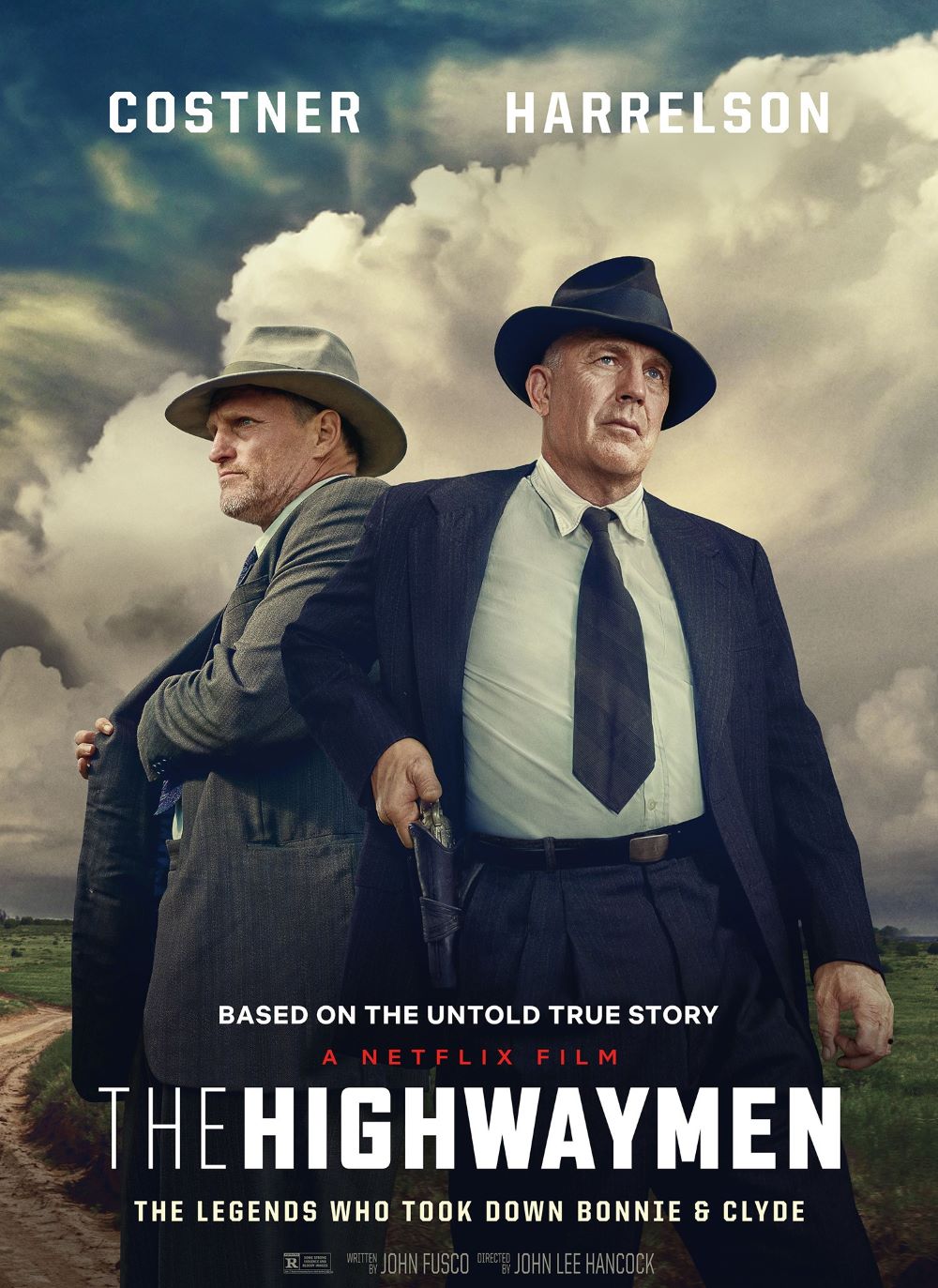
Review: The Highwaymen (dir. by John Lee Hancock)


“People don’t always know who they are… ’til it’s too late.” — Frank Hamer

The Highwaymen, as directed by John Lee Hancock, delivers a character-driven, period crime drama that refreshes a story so often mythologized in American pop culture. Instead of glamorizing Bonnie and Clyde, the film spotlights the two former Texas Rangers tasked with ending their crime spree: Frank Hamer (played by Kevin Costner) and Maney Gault (played by Woody Harrelson). Set against the bleak dustbowl landscape of 1934, the film opens with the criminal duo breaking their associates out of Eastham Prison, setting the state of Texas into a panic. In desperation, Governor “Ma” Ferguson authorizes the return of Hamer, a seasoned lawman whose old-school methods have largely been left behind in modern policing.

From the start, The Highwaymen takes its time, inviting viewers into a slower, more contemplative chase rather than the kinetic action often associated with outlaw stories. Hamer, long retired and resistant to rejoining the fight, is persuaded both by the severity of Bonnie and Clyde’s violence and the humiliation his state faces in failing to catch them. Gault, for his part, is recruited despite his own personal struggles, adding a layer of regret and weariness to their partnership. Their pursuit is marked by straightforward detective work—staking out small towns, following trails, and confronting a public that is strangely captivated by the criminals they hunt. The film repeatedly draws attention to the way crowds and the press elevate Bonnie and Clyde, reflecting on an early version of true crime celebrity culture.

The dynamic between Hamer and Gault forms the emotional core of the movie. Their bond is shaped by years of experience, mistakes, and a real sense of being out of place in a society that now doubts their relevance. There’s plenty of banter and friction, but also reflective moments that dig into the costs of life spent in pursuit of justice. Throughout the investigation, the film uses the Texas and Louisiana landscape as a powerful backdrop—the vast, windswept highways underscore the isolation and existential gravity faced by these lawmen. The cinematography favors wide shots and muted colors, giving the chase a feeling of endlessness and melancholy.

Instead of showcasing Bonnie and Clyde as glamorous anti-heroes, the film keeps them at a distance, rarely granting much screen time or dialogue. Violence is handled abruptly and unsentimentally. When it finally arrives, most notably in the climactic ambush, it is portrayed as brutal and inevitable, reminding the viewer that myths are built on blood and public spectacle. The lawmen’s final confrontation results in the infamous shootout, depicted with documentary-like restraint. The aftermath involves a bullet-riddled car towed through throngs of onlookers—an eerie scene that highlights how tragedy becomes spectacle.

One of the film’s greatest strengths is in its portrayal of moral ambiguity. Both Hamer and Gault operate by principles shaped in a different era. Their methods can be rough and unorthodox; they clash with younger law enforcement and the FBI, whose approaches are more bureaucratic, less personal. The film hints at the toll violence and a lifetime in law enforcement has taken on them, including a poignant story from Gault about a tragic accident in his past. These reflections draw out the muted sadness underlying their pursuit, exploring themes of justice, changing times, and what remains after one’s era passes.

Performance-wise, Costner and Harrelson bring authenticity and gravity to their roles. Their chemistry is quiet and real, developed largely through understated scenes—silent drives, awkward motel breakfasts, and occasional arguments broken up by mutual respect. Supporting roles, like Kathy Bates’s steely governor and John Carroll Lynch’s earnest corrections chief, flesh out the historical setting and institutional pressures.

The film doesn’t always dig as deep as it could into the complexities of Depression-era justice, but its restraint and focus on character make up for that. Rather than indulging in nostalgia or sensationalizing violence, it keeps its lens on the human cost—the consequences for the victims, the weariness of the men trying to restore order, and the strange cultural fascination with outlaws. If you’re looking for a grounded historical drama that trades fast action for thoughtful pacing, and puts working-class grit front and center, The Highwaymen is worth the ride.

Alexandre Dumbass and THE SHAWSHANK REDEMPTION – a scene that I love!


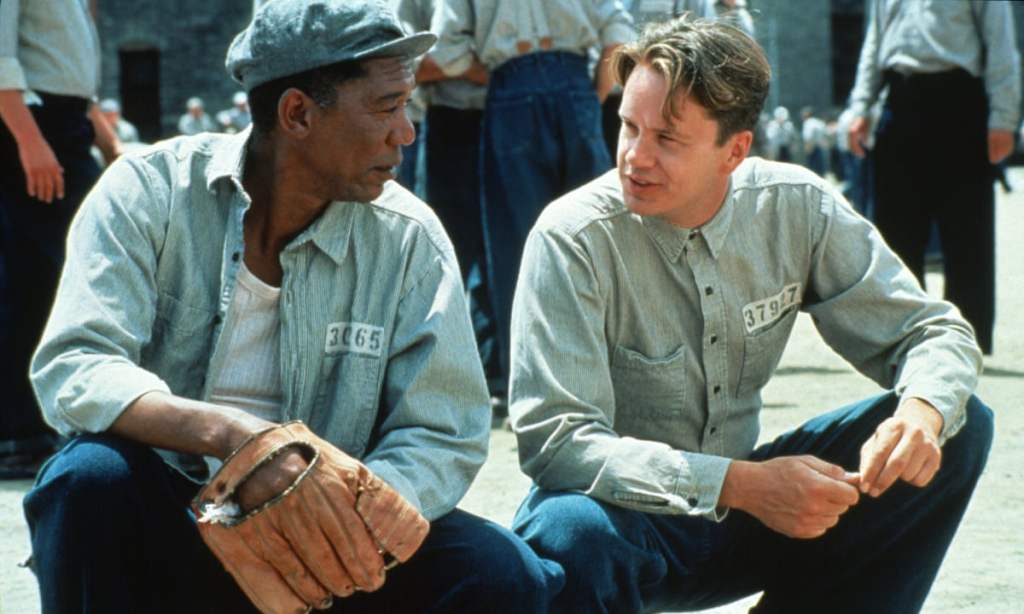
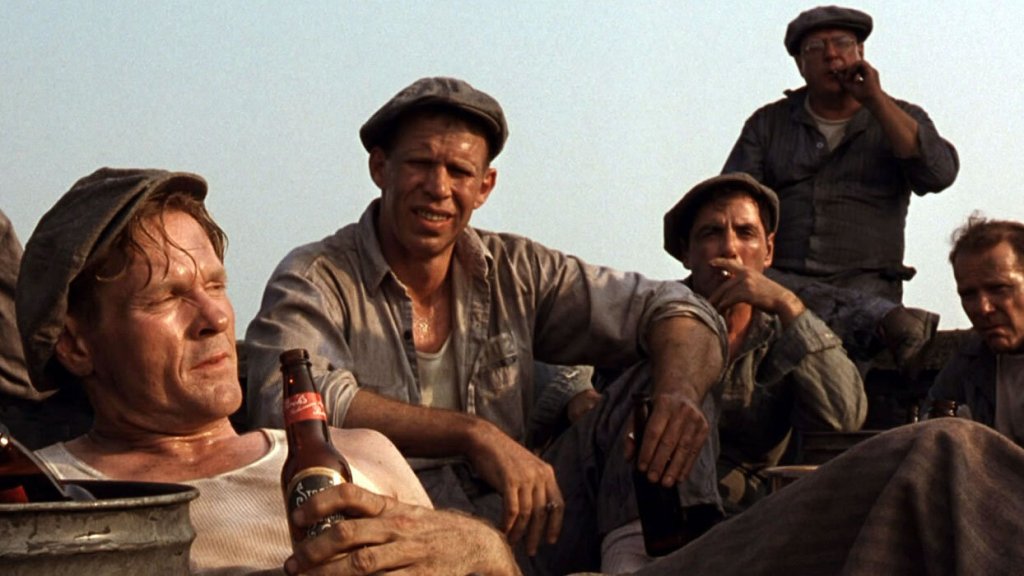
In honor of Director Frank Darabont’s 66th birthday, I’m sharing a scene from his masterpiece, THE SHAWSHANK REDEMPTION. One of the best things about this movie is how much humor is found behind those prison walls, often coming from seemingly unexpected places. In this scene, the humor is found when the characters take on the mundane task of cataloging the prison library. Enjoy!

I recently reviewed THE SHAWSHANK REDEMPTION on my son’s birthday. 

THE SHAWSHANK REDEMPTION (1994) – In honor of our son’s birthday, I review his favorite movie!


I sent our son a text the other day and asked him if he had an answer for the question “What’s your favorite movie?” I thought I knew the answer but it turns out I was only half right. I expected his answer to be THE HATEFUL EIGHT. Rather, the answer I received back was “The Hateful Eight or Shawshank Redemption!” Since I recently wrote about the time that he and I attended THE HATEFUL EIGHT roadshow in Dallas, I decided I would write about THE SHAWSHANK REDEMPTION this time around. It doesn’t hurt that it’s one of my favorite movies as well. It also doesn’t hurt that it’s the very top rated film on the Internet Movie Database.

Based on Stephen King’s “Rita Hayworth and Shawshank Redemption,” the story is well known… hot shot banker Andy Dufresne (Tim Robbins) is convicted of the murder of his wife and her lover, and gets sentenced to life at the Shawshank prison. Once on the inside, we meet a variety of characters that you expect in a prison movie. We meet Warden Norton (Bob Gunton), the hypocrite who speaks of the Bible while hiding a corrupt, evil spirit. We meet Captain Hadley (Clancy Brown), the brutal chief prison guard, who rules over the inmates with intimidation and a real willingness to inflict violence and pain on anyone who shows the least bit of independence. We meet Red (Morgan Freeman), the long-time inmate who has the ability and connections to get you anything you need. We meet other inmates like Heywood (William Sadler), the inmate who seems like a jerk when you first meet him but turns out to be a pretty good fella; Tommy (Gil Bellows), the young guy who comes into prison and may know something that proves Andy’s innocence; Brooks (James Whitmore), the old man who gets released after almost a lifetime in prison, and doesn’t know how to adjust to life on the outside; and Bogs (Mark Rolston), the sadistic prisoner who wants to force himself on Andy, and is willing to kill to get what he wants. Life isn’t easy at all in Shawshank, but Andy’s intelligence and ability to prove himself useful to Warden Norton and Captain Hadley allows him to finds ways to make life more bearable for him and his friends. After nineteen years in prison, even though he maintains his innocence, it appears that Andy is content to live out his remaining years in prison. Or is he??

I’ll never forget the first time I saw the movie THE SHAWSHANK REDEMPTION. I didn’t see it until a year or two after its initial release in 1994. I was one of those guys who figured a movie that praised by the critics was probably not something that I would like that much. Plus, at the time, the title of the movie just seemed kind of weird. But I kept hearing about how great it was, so I finally decided to give it a viewing. I agree with my son, I think THE SHAWSHANK REDEMPTION is one of the most emotionally uplifting movies ever made. Why is that you might ask? My answer would be because there’s something profoundly satisfying about people who persevere through the worst times imaginable and continue to find hope where most of us would be hopeless. Prison life is shown as horrific. One prisoner is literally beaten to death by Captain Hadley on his first night in prison for crying. Andy fights off the sadistic Bogs as much as he can, but he is unable to completely fight off his advances. But no matter what he goes through, Andy Dufresne is able keep moving forward, and he does not allow the prison life to completely crush his spirit. He keeps finding ways to persevere. Andy’s actions and endurance turn simple acts like listening to Mozart or having a beer into overwhelming emotional highs for us as the audience. The film also maintains a realistic sense of humor, which might seem difficult under the circumstances. This sense of humor is found in such mundane tasks as creating a prison library, providing tax prep services for the guards, or attending multiple parole hearings over the years. These comedic moments are earned by the way the movie takes it’s time letting us really get to the know the characters and then laugh with them as the individual moments occur. And the friendship between Andy and Red is something that deeply resonates with me. I think we all would like to have that kind of friendship. These kinds of friendships aren’t built overnight, and often they require a level of shared experience that is almost impossible to find. But they find it behind Shawshank’s prison walls, and it connects them for life. In my opinion, the friendship between these two characters leads to one of the most emotionally satisfying endings to any film, ever.

Director Frank Darabont was able to obtain some of career-defining performances from his cast. As good as Tim Robbins is as an actor, in my opinion, he has never been better than he was as Andy Dufresne. And I say this knowing full well he won an Oscar for MYSTIC RIVER. He maintains his dignity against all odds and only appears to break down a time or two. Morgan Freeman is great as always as Red, but his character is so important because we see him go from a hopeless skeptic, to a man who truly has hope thanks to his friendship with Andy. Freeman seems to handle this transition effortlessly. I’m going to give a shoutout to James Whitmore as well. With a career going all the way back to the 1940’s, his performance as Brooks Hatlen is one of the more touching and heartbreaking performances of the film. I haven’t seen all of his work, but I have never seen him better than he was in THE SHAWSHANK REDEMPTION. Each additional cast member, from Bob Gunton, Clancy Brown and Mark Rolston, to Willam Sadler and Gil Bellows all have powerful moments that add to the overall effect of the film.

Looking back now, it’s hard to believe that THE SHAWSHANK REDEMPTION did not win the Academy Award for best film. It lost to FORREST GUMP when the awards were handed out in 1995. It’s even harder to believe that the film did not win a single Academy Award even though it received seven nominations. But at the end of the day, that doesn’t really matter to me. I just know that it’s a great film, and it reaches emotional heights that very few movies, if any, have ever reached before. That’s a pretty damn good legacy.

Horror Film Review: Salem’s Lot (dir by Gary Duberman)


The new version of Salem’s Lot, which has finally been released on Max after sitting on the shelf for nearly three years, is not very good.

At the same time, it’s definitely not terrible.  There are a few effective scenes.  The finale, which is a bit different from what happens in the book, is enjoyably berserk.  The film made good use of Gordon Lightfoot’s Sundown and, as a history nerd, I appreciated the fact that the movie used the book’s original 70s setting as opposed to trying to update the whole thing.  When writer Ben Mears (Lewis Pullman) wants to investigate the history of the old Marsten House, he has to go to the library.  People looking up stuff on microfiche is always, from a cinematic point of view, more compelling than them pulling up Wikipedia.

Ultimately, the movie is just kind of forgettable.  It’s mediocre in the bland way that so many recent horror films have tended to be.  The movie’s style has far more in common with David Gordon Green’s unfortunate forays into horror than to anything done by Mike Flanagan.  While it may not have originally been meant for a streaming release, streaming is where it begins because it feels like something that would get dumped on Netflix without much fanfare.

It’s a shame because Salem’s Lot really is one of Stephen King’s better novels, written at a time when King was still embracing his pulpy side and without any of the self-important commentary that’s come to mar some of King’s more recent works.  The novel is essentially a small town soap opera, documenting the often sordid lives of the citizens of Jerusalem’s Lot.  King introduces a vampire to the mix and most of the town’s problems are solved by folks dying and then coming back from the dead.  Ben Mears is a typical King protagonist, a writer from Maine who is trying to deal with a childhood trauma and who discovers that ‘Salem’s Lot has a long and apparently cursed history.  In both the book and the movie, Ben teams up with a group of vampire hunters to battle Kurt Barlow (played here by Alexander Ward) and his human servant, Straker (Pilou Asbaek).

The book works because it takes the time to turn Salem’s Lot into a vivid community and, as such, it’s hard not to feel the loss as the town dies off as a result of Barlow’s vampiric invasion.  Clocking in at less than two hours, the movie really doesn’t have time to do that.  The movie’s version of the town just comes across as being another stereotypical New England town, full of flinty characters and mudrooms.  The community never comes to life and, as such, there’s not much emotional resonance as the community dies off.  (It’s not a coincidence that the most successful adaptation of Salem’s Lot was a miniseries.)  Add to that, the 2024 film features some truly unfortunate acting, which again makes it difficult to accept the town as a community with its own traditions and culture.

There are certain character types and themes that seem to appear in all of Stephen King’s novels and the subsequent adaptations.  At its worst, the new Salem’s Lot feels like it’s quickly going through a checklist of all of the expected Stephen King elements.  It’s like, “Main setting — check!  Writer protagonist — check!  Schoolyard bully — check!  Child in danger — check!”  The end result is a film that feels almost like a parody Stephen King, containing all of his familiar tropes without any of the literary flair that made the original book a classic of vampire literature.

The good thing is that the Tobe Hooper adaptation holds up well and it’s also available on Max.  Check it out this weekend.

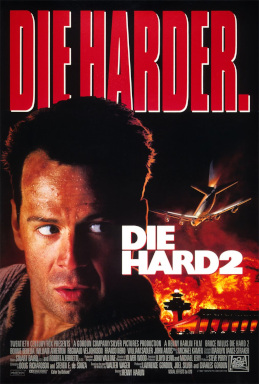
Holiday Film Review: Die Hard 2: Die Harder (dir by Renny Harlin)


During 1990’s Die Hard 2, John McClane (Bruce Willis) asks himself, “How can the same shit happen to the same person twice?” and he does have a point.

I mean, consider the situation.  In 1988, McClane spent his Christmas sneaking around a skyscraper and saving his wife from a group of sadistic mercenaries.  Two years later, John McClane spends his Christmas sneaking around an airport and saving his wife from a group of sadistic mercenaries.

There are a few differences of course.  In 1988, the mercenaries were only interested in stealing as much money as they could and each mercenary had his own properly ghoulish personality.  In 1990, the mercenaries are really more of a cult, led by the fanatical Col. Stuart (William Sadler).  And, along with trying to make some money, they are also trying to free General Ramon Esperanza (Franco Nero), a Central American drug lord and former CIA asset.  Despite the fact that the mercenaries are played by familiar actors (like Robert Patrick, John Leguizamo, Tony Ganois, and Vondie Curtis-Hall), none of them are quite as memorable as the henchmen that Alan Rickman commanded in the first film.  And while Sadler has charisma and makes a big impression during his first scene, his character is nowhere near as interesting or entertaining as Hans Gruber.  Franco Nero, it must be said, is as dashing as ever.  He really seems to be having fun in this movie.

A lot more people die in Die Hard 2 than died in the first Die Hard and the majority of them are innocent bystanders.  This isn’t like the first film, where Harry Ellis died because his coke-addled mind led him to believe that he could outsmart Gruber.  The victims in Die Hard 2 include a friendly church caretaker and over 200 passengers of an airplane that Stuart tricks into crashing on an airport runway.  The scene where the plane crashes remains disturbing no matter how many times that you see it and it truly makes you hate Colonel Stuart.  When the plane crashes, despite McClane’s futile efforts to warn the pilots, McClane sobs and it’s a powerful scene because it’s the first scene in which McClane has not had a quip or a one-liner ready to go.  In this scene, McClane fails to save the day and, for a few minutes, he’s helpless.  I usually end up crying with McClane.  Today, those tears are also a reminder of what a good actor Bruce Willis truly could be whenever he let down his defenses and allowed himself to be vulnerable on screen.

Die Hard 2 is usually dismissed as not being as good as the first movie and …. well, that’s correct.  It’s not as good but then again, few actions films are.  There’s a reason why Die Hard continues to be held in such high regard.  That said, Die Hard 2 is not bad.  The stakes are a bit higher and the action scenes a bit more elaborate, as you would expect from a film directed by Renny Harlin.  Bruce Willis plays McClane with the blue collar swagger that made his such an awesome hero in the first film.  Bonnie Bedelia and William Atherton also return from the first film and Atherton once again gets his comeuppance in a crowd-pleasing moment.  The cast is full of character actors, all of whom get a chance to make an impression.  Dennis Franz is the profane head of security who eventually turns out to be not such a bad guy.  John Amos is the major who eventually turns out to be not such a good guy.  Colm Meaney has a few heart-breaking moments as the pilot of the doomed airplane.  My favorite supporting performance is given by Fred Thompson, bringing his quiet authority to the role of tough but fair-minded Air Traffic Control director.  Watching Die Hard 2, it does feel as if the viewer has been dropped in the middle of these people’s lives.  Everyone seems real.  No one seems like a mere plot device.

Is Die Hard a Christmas movie?  You bet it is!  But so is Die Hard 2 and it’s not a bad one.

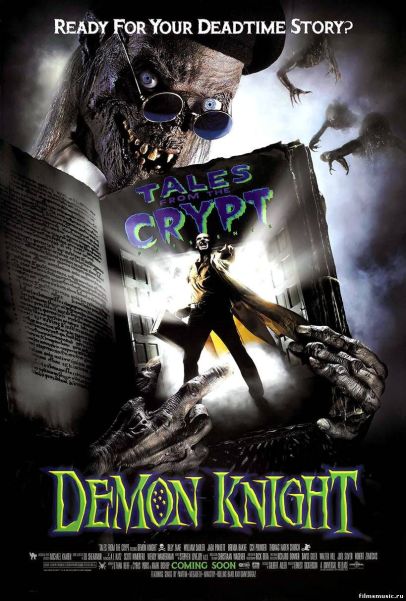
Tales from the Crypt: Demon Knight (dir. by Ernest Dickerson)


Demon Knight PosterI remember going to the movies for Demon Knight. I loved Tales from the Crypt on HBO, and the idea of a movie was cool at the time. My sister and my best friend joined me for the showing. It was treat to watch. I left the cinema thinking of different tales that could come up using some of the elements in this story.
For those unfamiliar with Tales From the Crypt, the show aired on HBO during the late 1980s, and part of the 1990s. Based off of the old horror tales from EC Comics, each episode was a horror story. Unlike Tales From the Darkside, Monsters and Darkroom, Tales from the Crypt had the bonus of being on cable. This meant they were able to get away with more gore and nudity than their prime time counterparts. Perhaps that’s the only real disadvantage with the film. At least with Tales From the Darkside: The Movie, the story could push into darker elements with their restrictions lifted.

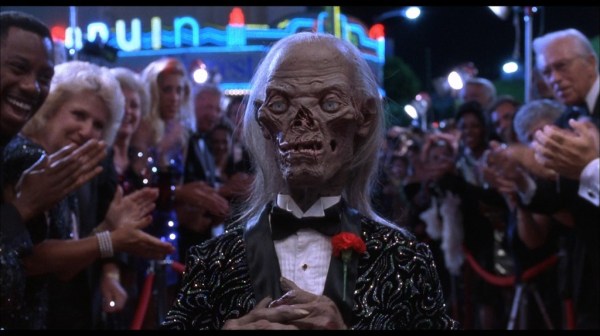
As with every episode of the show, Demon Knight is sandwiched between a scene with the Crypt Keeper (John Kassir) greeting the audience with some corny jokes and introducing the story. Frank Brayker (William Sadler – The Mist, Bill & Ted Face the Music) is on the run from The Collector (Billy Zane – Titanic). With his options dwindling and the strange seven-star pattern tattoo on his hand slowly forming a circle, Brayker makes his last stand at a motel with a group of individuals. In his possession is a key shaped vial that has the power to create wards. These wards hold back the army of demons that wish to reclaim the key and bring darkness across the land. Can Brayker make it through the night, while protecting the key and everyone around him? That’s pretty much the plot.

Demon Knight CryptKeeper

The Crypt Keeper is ready for his close up in Demon Knight. 

Having previously worked as a Cinematographer for Spike Lee, Ernest Dickerson made the jump to directing with 1992’s Juice. Demon Knight was his follow up and for the most part, it’s good. The creature design is interesting, reminiscent of Top Cow’s comic book, The Darkness. The demons are thin and indeed strange to behold, but they mostly take a back seat to Billy Zane’s Collector, who tries to seduce everyone into turning against the rest of the group.  Zane brings a lot of humor to the movie with his villain, as does Thomas Hayden Church (Sideways) playing that one guy you’d really like to slug in the mouth. CCH Pounder (Avatar), Jada Pinkett (Collateral), Brenda Bakke (L.A. Confidential), the legendary Dick Miller (Gremlins and just about everything Joe Dante did), and Charles Fleisher (Who Framed Roger Rabbit?) and Gary Farmer (Forever Knight) round it all out. It’s Sadler’s film to carry, however, and he does a great job here playing the hero.

From a sound/musical standpoint, Demon Knight boasts a interesting soundtrack, which I picked up around the time I first saw the film. Filter’s “Hey Man, Nice Shot” seemed like the only song featured in the film, but Ministry’s “Tonight We Murder”, Henry Rollins “Fall Guy” and Pantera’s “Cemetary Gates” are the standouts. The pacing of the film is pretty even, despite being a one shot. There’s not enough of a slowdown to feel bored. Demon Knight is just one regular Tales from the Crypt tale in a longer format. I would have preferred shorter pieces in this larger timespan, but that’s more a nitpick than anything.

Overall, Tales From the Crypt: Demon Knight is a fun film to visit around Halloween. Just make sure your doors and windows are locked (and sealed, if possible), when watching.


Horror Film Review: The Grudge (dir by Nicolas Pesce)


Eh, who cares?

Released way back in January (and, in fact, I think it may have been the first horror movie released in 2020), The Grudge is the latest film to tell the story of a house where ghosts compel inhabitant after inhabitant to kill themselves and their families.  Look, we all know how it works.  We’ve all seen Ju-on.  We all know that it begins with someone dying while extremely angry or extremely sad and then a curse being passed on from person to person.  The original Japanese films are frightening while the American versions tend to get bogged down in all of the usual horror clichés.  We all know how these things work.

Anyway, this version of The Grudge takes place, for the most part, at 44 Reyburn Drive, where a number of people die over the course of the film.  The Grudge is told in a nonlinear fashion, so we hope back and forth in time.  We meet a lot of different people and sit through a lot of different stories but none of them are particularly interesting.  Two real estate agents discover that their unborn child is going to have a rare genetic disorder.  An elderly couple prepare for an assisted suicide.  A nurse is haunted by the things that she saw while she was working in Japan.  A detective obsesses on all of the murders.  In the present day, another detective (Andrea Riseborough) tries to figure out why so many murders are connected to the house.  It’s difficult to really get caught up in her investigation because we already know the answer.

It’s all pretty dull.  Maybe if I had never seen any of the other Grudge films, I would have found this movie more interesting but The Grudge doesn’t really bring anything new to the table.  All it really does is remind you of how formulaic the American version of franchise has always been.  Of course, everyone’s going to die and, of course, there’s going to be a shock ending.  (Interestingly enough, the international version has a different ending.)  It’s all rather boring and it’s hard not to get annoyed that the film assembled a truly amazing cast and then basically didn’t anything with them.  Consider some of the people in this film: Andrea Riseborough, Demian Bichir, John Cho, Betty Gilpin, Lin Shaye, Jacki Weaver, William Sadler, Frankie Faison.  Wasting a cast with that much talent really does amount to cinematic malpractice.  It seems like it should be an impossible mistake to make but The Grudge somehow manages to do it.

The film’s nonlinear format doesn’t add much to the story.  I mean, you know everyone’s going to die eventually so having the story told in random chunks and pieces doesn’t really add any sort of suspense.  One could argue that the film does deserve some credit for being as dark as it is.  I mean, it does kill the type of sympathetic characters who, normally, would survive other horror films.  But, even with that in mind, it’s all just kind of boring.  I don’t hold a grudge against anyone for trying to reboot the franchise but this film just doesn’t bring anything new to the table.


Film Review: The Hot Spot (dir by Dennis Hopper)


As befits the title, the 1990 film, The Hot Spot, is all about heat.

There’s the figurative heat that comes from a cast of characters who are obsessed with sex, lies, and murder.  There’s the literal heat that comes from a fire that the film’s “hero” sets in order to distract everyone long enough so that he can get away with robbing a bank.  And, of course, there’s the fact that the film is set in a small Texas town that appears to be the hottest place on Earth.  Every scene in the film appears to be drenched by the sun and, if the characters often seem to take their time from getting from one point to another, that’s because everyone knows better than to rush around when it’s over a hundred degrees in the shade.  As someone who has spent most of her life in Texas, I can tell you that, if nothing else, The Hot Spot captures the feel of what summer is usually like down here.   I’ve often felt that stepping outside during a Texas summer is like stepping into a wall of pure heat.  The Hot Spot takes place on the other side of that wall.

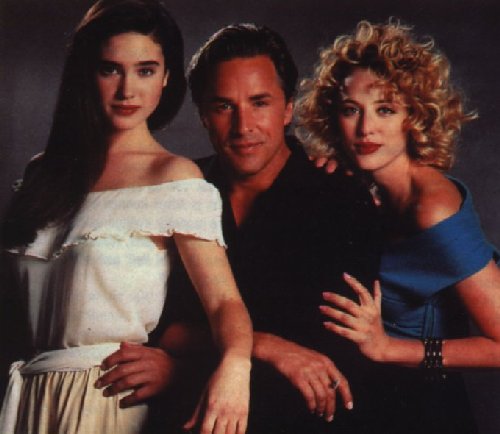
The Hot Spot is a heavily stylized film noir, one in which the the traditional fog and shadows have been replaced by clouds of dust and blinding sunlight.  Harry (Don Johnson) is a drifter who has just rolled into a small Texas town.  Harry’s not too bright but he’s handsome and cocky and who needs to be smart when you’ve got charm?  Harry gets a job selling used cars, though he actually aspires to be a bank robber.  Harry finds himself falling in love with Gloria (Jennifer Connelly), a seemingly innocent accountant who is being blackmailed by the brutish Frank Sutton (William Sadler).  Meanwhile, Harry is also being pursued by his boss’s wife, Dolly (Virginia Madsen), an over-the-top femme fatale who is just as amoral as Harry but who might be a little bit smarter.  Complicating matters is that, while Harry’s trying to rob a bank, he also ends up saving a man’s life.  Only Dolly knows that Harry isn’t the hero that the rest of the town thinks he is.  She tells him that she’ll keep his secret if he does her just one little favor….

The Hot Spot was directed by Dennis Hopper (yes, that Dennis Hopper) and, from the start, it quickly becomes apparent that he’s not really that interested in the film’s story.  Instead, he’s more interested in exploring the increasingly surreal world in which Harry has found himself.  The Hot Spot plays out at a languid pace, which allows Hopper to focus on his cast of small-town eccentrics.  (My particular favorite was Jack Nance as the alcoholic bank president who also doubles as the town’s volunteer fire marshal.)  The film is so hyper stylized that it’s hard not to suspect that every character — with the possible exception of Harry — understands that they’re only characters in a film noir.  For instance, is Dolly really the over-the-top femme fatale that she presents herself as being or is she just a frustrated housewife playing a role?  Is Gloria really an innocent caught up in a blackmail scheme or is she just smart enough to realize that the rules of noir requires her to appear to be Dolly’s opposite?  And is Harry being manipulated or is he allowing himself to be manipulated because, deep down, he understands that’s his destiny as a handsome but dumb drifter in a small town?  Do any of the characters really have any control over their choices and their actions or has everyone’s fate been predetermined by virtue of them being characters in a film noir?  In the end, The Hot Spot is more than just a traditional noir.  It’s also a study of why the genre has endured.

It’s a long and, at times, slow movie, one that plays out at its own peculiar pace.  As a result, some people will be bored out of their mind.  But if you can tap into the film surreal worldview and adjust to the languid style, The Hot Spot is a frequently entertaining and, at times, rather sardonic slice of Texas noir.

Back to School #61: The Battle of Shaker Heights (dir by Efram Potelle and Kyle Rankin)


Poster_of_the_movie_The_Battle_of_Shaker_Heights

“When you’re 17, every day is war.” — Tagline of The Battle of Shaker Heights (2003)

Anyone here remember Project Greenlight?  It’s a show that used to be on HBO and Bravo, in which Matt Damon and Ben Affleck would arrange for a director and screenwriter to get a chance to make their low budget feature film debuts.  The catch, of course, is that a camera crew would then follow the director as he (and all of the Greenlight “winners” were male) struggled to get the film made.  Mistakes would be made.  Money would be wasted.  Producer Chris Moore would randomly show up on set and start yelling.  In short, it was typical reality show drama with the catch being that the film itself would then be released in a theater or two.

Well, after being consigned to footnote status for the past nine years. Project Greenlight is coming back for a fourth season and a lot of people are pretty excited about it.  And why not?  I own the first two seasons of Project Greenlight on DVD and I’ve watched the third season on YouTube.  It’s a lot of fun, mostly because all of the directors, with the exception of season 3 winner John Gulager, turned out to be so incredibly inept.  (Gulager is one of the few Project Greenlight success stories — not only did his movie, Feast, come across as being made by a professional but he’s actually had a career post-Greenlight.)  It all makes for good televised drama.

However, it doesn’t necessarily make for a good movie.

Case in point: 2003’s The Battle of Shaker Heights.

The Battle of Shaker Heights is about a creepy 17 year-old named Kelly (played by the reliably creepy Shia LaBeouf).  His mother (Kathleen Quinlan) is an artist.  His father (William Sadler) is a former drug addict who, despite having been clean for 6 years, still has to deal with his son’s constant resentment.  Kelly is a high school outcast who spends all of his spare time thinking and talking about war.  Every weekend, he takes part in war reenactments.  At night, he works in a 24-hour grocery store where he doesn’t realize that he’s the object of Sarah’s (Shiri Appleby) affection.

(Why Sarah has so much affection for Kelly is a good question.  Maybe it’s the scene where he throws cans of cat food at her…)

At a reenactment of the Battle of the Bulge, Kelly meets and befriends Bart (Elden Hansen), which leads to him meeting Bart’s older sister, Tabby (Amy Smart).  Tabby is an artist, because the film isn’t imaginative enough to make her anything else.  (We’re also told that she’s a talented artist and it’s a good thing that we’re told this because otherwise, we might notice that her paintings are the type of uninspired stuff that you can buy at any county art fair.)  Kelly decides that he’s in love with Tabby but — uh oh! — Tabby’s getting married.  Naturally, she’s marrying a guy named Minor (Anson Mount).  Imagine how the film would have been different if his name had been Major.

As a film, the Battle of Shaker Heights is a bit of a mess.  It never establishes a consistent tone, the dialogue and the direction are all way too heavy-handed and on the nose, and Shia LaBeouf … well, he remains Shia LaBeouf.  In some ways, Shia is actually pretty well cast in this film.  He’s an off-putting actor playing an off-putting characters but the end of result is an off-putting film.

Of course, if you’ve seen the second season of Project Greenlight, then you know that The Battle of Shaker Heights had an incredibly troubled production.  Neither one of the film’s two directors were particularly comfortable with dealing with the more low-key human aspects of the story.  Screenwriter Erica Beeney was not happy with who was selected to direct her script and basically spent the entire production whining about it to anyone who would listen.  (Sorry, Erica — your script was one of the film’s biggest problems.  When you actually give a character a name like Minor Webber, it means you’re not trying hard enough.)  Finally, Miramax took the completed film away from the directors and re-edited it, removing all of the dramatic scenes and basically leaving a 79-minute comedic cartoon.

So, in the end, Battle of Shaker Heights is not a very good film.  But season two of Project Greenlight is a lot of fun!

Review: Iron Man 3 (dir. by Shane Black)


IronMan3

“You can take away my suits, you can take away my home, but there’s one thing you can never take away from me: I am Iron Man.” — Tony Stark

[WARNING: SPOILERS WITHIN]

Iron Man 3 review by Leonard Wilson

That line above would make such a great send-off for what could be the final Iron Man film. In a perfect world, having Shane Black’s Iron Man 3 as the final one in the franchise wouldn’t be such a bad thing. This doesn’t mean that Iron Man will not appear in any future Marvel Studios endeavors, but as a solo franchise a series couldn’t have found a better way to fly into the Malibu sunset. I say this because in over 5 years Marvel Studios has created a trilogy that took a character in Tony Stark and put him through a character journey encompassing four major film releases and one cameo. They did so in such a way that we saw the character grow from a rich genius dilletante, to a desperate asshole trying to find his identity as Iron Man to finally realizing that he’s the hero with or without the Mark suits he’s has created.

Iron Man 3 is the culmination of what Jon Favreau began with Iron Man in 2008 and Joss Whedon expanded on in 2012’s Marvel’s The Avengers. It took a writer of renown such as Shane Black (who also replaced Favreau as director) to get to the heart of what makes Iron Man ticks. It helped that the returning cast led by Robert Downey, Jr. as Tony Stark and Iron Man once again did a great job in their roles with some characters even getting to do some surprising heroic stuff on the screen.

IronMan3

Iron Man 3 starts off with a flashback scene just hours before the arrival of the new millennium. This is just Tony Stark before he becomes Iron Man so we see the character in full charming asshole mode. This sequence is important in that it sets up the whole plot of the film and, in my opinion, the overall story for the entire trilogy. We’re introduced to the geeky Aldritch Killian (played with equal amounts of geeky desperation and overconfident megalomania by Guy Pearce) who sees in Stark the mentor he needs to get his think tank going. With only sex with brilliant scientist Maya Hansen (played by Rebecca Hall) on his mind Killian is soon forgotten and humiliated by Stark.

The rest of the film sees Tony Stark having to pay a steep price for his behavior towards Killian in that flashback and, in conjunction, with his days and nights haunted by the events in New York with the invading Chitauri invasion having given him a case of the PTSD the film looks to bring Tony Stark at his most vulnerable and lowest. It’s a return to the proverbial “Cave” for Tony Stark as he must contend not just with the elusive terrorist mastermind The Mandarin, but also solve the mystery of who or what’s causing the inexplicable explosions and bombings occurring around the nation. All this he must do through most of the film without the use of his Iron Man suits and relying mostly on his own genius intellect and skill with making weapons and gadgets out of anything readily available.

Speaking of The Mandarin (in an excellent performance by Sir Ben Kingsley), Shane Black and co-writer Drew Pearce made a controversial decision (for comic book fanboys at least) to make the iconic Iron Man villain more than he appears to be. It’s a decision that won’t sit well with the more vocal and rabid comic book fans who sees any deviation from Iron Man lore as an affront worth of loud, vociferous rabble, rabble, rabbling that would make Randy Marsh and the people of South Park proud.

mandarin-iron-man-3

To say that the twist in the story that explains who The Mandarin was such a surprise would be quite the understatement. The most important and iconic nemesis of Tony Stark comes out with both barrels of deliberate menace and sociopathic showmanship. We’re meant to see this character as the face of all the evils and troubles that has plagued Tony Stark since the first film. Kingsley plays this part of the character in the film to the hilt. Yet, it’s not until the second half of the film when we find out just who exactly The Mandarin really was and is that Black and Pearce finally put to rest whether the producers and writers would be able to handle a character that’s been seen as a racial caricature from a less than enlightened time.

Whatever howls and apoplectic ravings fanboys might be having about changing the traiditional character of The Mandarin into the pill-popping, drunk British wanna-be actor Trevor Slattery as a bait-and-switch was a brave move on the parts of Black and Pearce. To find out that The Mandarin was just a conjuration by Aldritch Killian to keep the eyes of the world’s governments and superheroes on someone else was very Bond-like. The fact that Killian himself is the true Mandarin and the Ten Rings terrorist organization his creation to have his revenge on Stark for humiliating him on the even of the new millennium closes the circle on what was begun all the way back in the first Iron Man.

This so-called “twist” was so unexpected (the internet scouring for any tidbits about the film’s plot having found nary a hint of this change) that it seemed like some sort of gimmick but as the film barreled on through the second half into it’s explosive conclusion one had to admire the massive stones by Black and Pearce to change such an iconic character knowing how it could easily alienate and anger fans of comic book. It’s this thinking outside the box by this franchise’s new director and screenwriter which makes me feel like Marvel Studios (especially studio head Kevin Feige) have their Phase 2 plan set to spring surprises on comic book and non-comic book fans alike as it marches on towards Avengers 2.

originalIron Man 3 was a definite improvement over the bloated second film in the series. It also manages to reach the high bar set by the first film, though as an origin story it still comes away as being the best of the trilogy, but not by much. There was much trepidation from fans of the film franchise when Favreau was replaced by Marvel Studios as director by one Shane Black. While Black was well-known for being a top-notch screenwriter who literally redefined the buddy cop genre his work as a filmmaker was just still only the suprise film Kiss, Kiss, Bang, Bang. While this third film still had some holes in it’s plot that was explained rather conveniently by some brief bits of dialogue it still managed to tell a compelling story of actions and consequences and the discovery that our hero finally makes about just who is the hero of the saga: the man or the machine.

If there’s to be another film bearing the title of Iron Man I would surely hope that Feige and the powers-that-be over at Marvel Studios and Walt Disney just speed-dial Shane Black’s name and to also bring back his co-conspirator Drew Pearce. The franchise is well and good in their keeping. As the final moments of the end credits tick by we’re promised that Tony Stark will return. I sure hope so.