Cleaning Out The DVR #29: Broadcast News (dir by James L. Brooks)


(For those following at home, Lisa is attempting to clean out her DVR by watching and reviewing 38 films by the end of this Friday.  Will she make it?  Keep following the site to find out!)

220px-Broadcast_News

I’ll give you three chances to guess what the 1987 film Broadcast News is about.

Broadcast News takes place at the Washington bureau of a major network news operation.  (You can tell this film was made in the 80s in that nobody’s working for a blog and there’s no mention of Fox, MSNBC, or CNN.)  This is where a group of hard-working men and women do their best to make the national news anchor, Bill Rorish, look good.

Bill Rorish is played by Jack Nicholson and, even though he only has about five minutes of screen time (out of a 133 minute movie), he pretty much dominates the entire film.  Some of that is because he’s Jack Nicholson and he kicks ass.  All Jack has to do to dominate a scene is show up and arch an eyebrow.  But, beyond that, everyone in the movie is obsessed with impressing Bill Rorish.  Whenever a reporter and his producer get a story on the air, they obsessively watch to see if Bill smiles afterward.  Bill Rorish is the God they all hope to please and the film (as well as Nicholson’s performance) suggests that he barely even knows that they’re alive.  It’s telling that the only time Bill shows up in person (as opposed to appearing on a TV screen), it’s because a huge number of people at the Washington bureau are being laid off.

When Bill says that it’s a shame that budget cuts are leading to so many good newspeople being laid off, someone suggests that maybe Bill could help by taking a cut in his million-dollar salary.  Needless to say, Bill Rorish is not amused.

Broadcast News centers on three of the characters who work at the Washington Bureau.  First off, there’s Jane Craig (Holly Hunter), a producer.  Jane is a true believer in the mission and the importance of journalism.  Her ethics and her belief in what constitutes proper journalism are everything to her and, at times, she can get more than a little self-righteous about it.  (If Broadcast News were made today, Jane would spend the entire movie whining about how new media is destroying the country.)  At the same time, Jane is completely neurotic, a self-described “basket case” who, at one point, ends up sobbing in a hotel room as she prepares to go to sleep by herself.

Jane’s best friend is Aaron Altman (Albert Brooks), a reporter who wants to someday be an anchor.  Aaron is smart and funny (and he better be, seeing as how he’s being played by Albert Brooks) but he’s not telegenic and he’s almost as neurotic as Jane.  Like Jane, Aaron is all about journalistic ethics but there’s a defensiveness to Aaron.  Whenever Aaron complains about vapid news anchors, it’s obvious that he’s more jealous than outraged.

And then there’s Tom Grunick (William Hurt), who represents everything that Jane and Aaron claim to be against.  He’s handsome, he’s smooth, he’s charismatic, and he’s definitely not an intellectual.  He knows little about the specifics of current events.  However, he has great instincts.  He knows how to sell a story and he knows how to present himself on camera.  He’s also a surprisingly nice and sincere guy, which makes it all the more difficult for Aaron to justify his belief that “Tom is the devil.”

From the minute that Tom arrives at the Washington bureau, there’s a strong attraction between Tom and Jane.  (Jane even sends another reporter to Alaska after she finds out that Tom slept with her.)  Tom wants to be a better reporter.  Jane wants to be happy but fears compromising her ethics.  And Aaron … well, Aaron wants Jane.

Not surprisingly, considering that the film was made 29 years ago, there were some parts of Broadcast News that felt extremely dated.  A scene where Aaron complains about a story that Tom did on date rape feels especially uncomfortable when viewed today and both Jane and Aaron occasionally came across as being a bit too self-righteous.  In today’s media world, Tom’s sins really didn’t seem like that big of a deal.

But, for the most part, I enjoyed Broadcast News.  It was an intelligent film, one the featured people having actual conversations about actual ideas and, listening to them, I realized how rare, in both movies and real life, that actually is.  It’s a witty film, full of good performances.  While I hope I never become as self-righteous as Jane, I could still relate to her in her more neurotic moments.  And who wouldn’t want a best friend like Aaron?

And, for that matter, who wouldn’t want a lover like Tom?

(That’s something I never expected to write about a character played by William Hurt.)

And, of course, there’s this scene.  Poor Aaron!

Broadcast News was nominated for best picture of 1987.  However, it lost to The Last Emperor.

http://www.youtube.com/watch?v=BPjx2pI–2U


The Final Captain America: Civil War Swings By


Captain America Civil War

We are just two weeks away from the release of Batman v. Superman: Dawn of Justice and just a week from the premiere of Netflix’s Daredevil Season 2. What better way to remind people that there is another hero vs hero film coming out to start off the summer than with the final full trailer for Captain America: Civil War.

One things which distinguishes this latest and final trailer happens right at the very end. One could almost say that this was the trailer’s post-credit sequence.

Captain America: Civil War swings into action on May 6, 2016.

Captain America: Civil War Super Bowl TV Spot “Rivals”


Captain America - Civil War

It’s that time of the year when the country (to some extent the world) witness a sporting event that’s become almost ritualistic in how it gathers it’s audience. I’m talking about the yearly Super Bowl pitting the NFC champions against the AFC champs. Even if one wasn’t a huge fan of football, the Super Bowl has become such an event day not just for the game, but the half-time show. Then there are the commercials which has become just as anticipated as the game itself.

It’s this day that we get major studios plying their upcoming films for the summer blockbuster season and Disney is not a studio to let this day pass without showing something new regarding one of their biggest films this summer.

The first Captain America: Civil War trailer a couple months ago got everyone anticipating the film. Now we have the Super Bowl TV spot to fan the flame of hype for the film that dared to go up against Batman v. Superman: Dawn of Justice when they both had the same release date: May 6, 2016. The latter film blinked and opted to dominate the film landscape a couple months earlier.

This tv spot emphasizes the fractured nature of Avengers that lends to the film’s title of civil war.

So, which team are you on? Are you on Team Captain America? Or are you more the Team Iron Man?

I guess, we’ll find out this May 6, 2016.

Captain America: Civil War Is Coming


Captain America - Civil War

“A Titan against a Titan!”

Captain America: Civil War is the opening shot of Marvel’s Phase 3 for their cinematic universe. The huge success of Captain America: The Winter Soldier, both in the box-office and among critics, even convinced Marvel Studios and Disney to pit this upcoming sequel against DC’s own Batman v. Superman: Dawn of Justice. One of the two had to blink and move their release date and it ended up being DC.

In what many have called Avengers 2.5 due to the amount of Marvel superheroes involved in the story, Captain America: Civil War will look to explore the consequences of the collateral damage incurred by Captain America and his teammates in the Avengers whenever they fight it out in public. The destruction of Midtown Manhattan during the Battle of New York was the start. The wreckage of three advanced SHIELD Helicarriers in the Potomac was another. Yet, it looks like the destruction of the capital city of Sokovia during the team’s fight against Ultron may have been the straw that broke the global governments’ back.

So, will Tony Stark and his team of Pro-Registration win out over the out-gunned Team Captain America who do not want to be beholden to the agendas of any world government?

We shall find out when Captain America: Civil War drops on everyone on May 6, 2016.

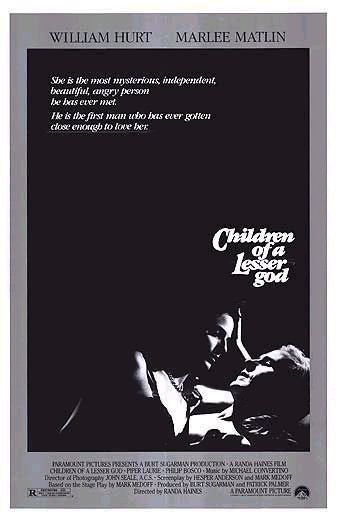
Embracing the Melodrama Part II #76: Children of a Lesser God (dir by Randa Haines)


Children_of_a_Lesser_God_film_posterSo, we all know that The Hurt Locker was the first best picture winner to have been directed by a woman.  And we also all know that, when Kathryn Bigelow won her Oscar for that film, she was the first woman to win the Academy Award for Best Director.

But do you know the title of the first film to be both be directed by a woman and to be nominated for best picture?  Well, you probably do now because I’m assuming that you’ve read the title of this post and you’ve seen the picture of the film’s poster above.  But, let’s just pretend that you don’t so I can triumphantly say, “The 1986 film Children of a Lesser God was the first nominee for best picture to be directed by a woman!”

And the name of that director was Randa Haines.  Never heard of her?  You’re probably not alone in that.  After making her feature debut with Children of a Lesser God, Haines only directed three more theatrical films.  Instead, she’s spent most of her career in television and, if not for the nudity and the language, Children of a Lesser God could probably pass for a well-made Lifetime movie.  That’s not necessarily a criticism because I happen to like well-made Lifetime movies.  But still, it’s not surprising that Children of a Lesser God was the only 1986 best picture nominee not to receive a nomination for best director.

(For the record, Platoon won best picture and Oliver Stone won best director.  Nominated in Haines’s place was David Lynch for Blue Velvet.)

As for the film itself, it’s a well-acted and well-made film.  It’s not exactly great in the way that we ideally expect a best picture nominee to be.  It’s directed a bit too much like a television movie and the film ends on a happy note that doesn’t exactly feel earned.  (If any film would have benefitted from a bittersweet conclusion, it would have been Children of a Lesser God.)  Still, at the same time, you can tell why the film was nominated.  It deals with a social issue (in this case, the way that the deaf are marginalized by mainstream society) and it’s a romance between … well, I was going to say mature adults but actually, William Hurt was 15 years older than Marlee Matlin when they played lovers in this film, which adds a perhaps unintentional layer of ambiguity to their relationship.  Children of a Lesser God was also the first film to feature a deaf performer in a lead role and, when Marlee Matlin won the Oscar for Best Actress, she became both the youngest and, to date, the only deaf actress to win.

Ultimately, Children of a Lesser God is more interesting from a historical point of view than a cinematic one.  But the value of history should never be underestimated!  It’s a worthy-enough film and Matlin’s angry performance holds up well.  (As for William Hurt, how you respond to his performance will depend largely on how much tolerance you have for his voice.  Whenever Matlin communicates through sign language, Hurt repeats aloud whatever it is that she’s said.  As a result, the film is basically 2 hours straight of William Hurt talking and, on occasion, it’s a bit too theatrical and distracting.  If the film were made today, the filmmakers would probably just use subtitles.)  Finally, and perhaps most importantly, even if it didn’t lead to bigger things for Randa Haines, Children of a Lesser God did open the door for others to follow.

Lisa Reviews An Oscar Nominee: The Big Chill (dir by Lawrence Kasdan)


Big_chill_ver1

There are certain films that truly are “You just had to be there” films.  These are the movies that were apparently loved by contemporary audiences but, when viewed today, it’s difficult to see just what exactly everyone was getting so excited about.  Sometimes, this is because the film itself was so influential and has been copied by so many other films that the original has had its power diluted.  And then, sometimes, it’s just a case that the film was never that good to begin with.

I’m guessing that The Big Chill must be one of those “you just had to be there” type of films.  First released in 1983, The Big Chill was nominated for best picture.  If you look the film up over at the imdb, you’ll find lots of comments from people who absolutely adore this film.  However, when I watched the film as a part of TCM’s 31 Days of Oscar, I have to admit that my reaction can be best summed in one word.

Meh.

Now, don’t get me wrong.  I’m not saying that The Big Chill was a bad film.  To be honest, it was neither memorably bad nor remarkably good.  Instead, it just was.  Overall, the performances were good, the direction was shallow, and the screenplay was occasionally good and occasionally shallow but mostly, it was the epitome of serviceable.

At the start of The Big Chill, Alex is dead.  With the exception of a scene where his corpse is being prepared for burial, Alex never actually appears on screen.  (Originally, Kevin Costner was cast to play the role in a flashback but director Lawrence Kasdan cut the scene.)  What little we learn about Alex, we learn from listening to the other characters in the film talk about him.  For instance, Alex was apparently brilliant but troubled.  He attended the University of Michigan in the 1960s and was close to 7 other politically radical students.  While everyone else was busy selling out their ideals, Alex stayed true to his and, as a result, he ended up spending his life depressed and poor.  Alex ultimately ended up committing suicide, an act that leads to his 7 friends reuniting for his funeral.

Opening with Alex’s funeral and taking place over one long weekend, The Big Chill follows Alex’s friends as they try to figure out why Alex committed suicide and debate whether or not they’ve sold out their college ideals.  They also spend a lot of time listening to the music of the youth, getting high, watching a football game, and washing dishes.

(Interestingly enough, they spend the weekend in the exact same house where Alex committed suicide.  Which, to be honest, I would think would be kind of creepy.)

There’s Harold (Kevin Kline) and Sarah (Glenn Close), who are the unofficial grown ups of the group.  It was at their vacation home that Alex committed suicide and, over the course of the film, we find out that Alex and Sarah had a brief affair.  Harold owns a company that makes running shoes and, to at least one friend’s horror, is now good friends with the local police.  Sarah, meanwhile, splits her time between crying in the shower and smiling beatifically at her friends.

(Incidentally, throughout the film, Kevin Kline speaks in one of the least convincing southern accents that I’ve ever heard…)

Meg (Mary Kay Place) is a former public defender who, after deciding that all of her poverty-stricken clients really were scum, has now become a real estate attorney.  Meg wants a baby and is hoping that one of the men at the funeral might be willing to impregnate her.  Meg is a chain smoker so good luck, unborn child.  Before Alex killed himself, she had an argument with him.  (“That’s probably why he killed himself,” someone suggests.)

I liked Karen (JoBeth Williams) because she’s prettier than Meg and less condescending than Sarah.  She’s unhappily married to an advertising executive named Richard (Dan Galloway).  As they drive to the cemetery, Richard tells Karen that he can’t believe her famous friends all turned out to be so boring.  Karen is unhappy in her marriage and, after Richard returns home and leaves her in South Carolina for the weekend, decides that she wants a divorce.

That’s good news for Sam (Tom Berenger), an actor who is best known for playing private detective J.T. Lancer on television.  Sam is upset that nobody takes him or his career seriously.  Meg was hoping that Sam would be the father of her baby but, instead, Sam is more interested in Karen.

And then there’s Nick (William Hurt), who is a former radio psychologist-turned-drug dealer.  Nick was wounded in Vietnam and is impotent as a result.  In case you somehow forget that fact, don’t worry.  Nick brings it up every few minutes.

Michael (Jeff Goldblum) was my favorite among the men because he’s at least willing to admit that he’s a self-centered jerk.  Michael is a former underground journalist who now works for People Magazine.  Nobody seems to like Michael and yet, he’s still invited to stay over the weekend.  Personally, I like to think that he does so just to get on everyone’s nerves.  Good for him.

And finally, there’s Chloe (Meg Tillis), who was Alex’s much younger girlfriend and who doesn’t seem to be impressed with any of Alex’s friends (with the exception, of course, of impotent old Nick).

I have to admit that I probably would have responded more to The Big Chill if it was actually about my generation, as opposed to being about my grandparents. Someday, someone my age will make a movie about a bunch of college friends reunited for a funeral and it will be filled with my music and my cultural references and I’ll think it’s brilliant.  And then, a 30 years later, some snotty little film reviewer will watch and probably say, “Meh.  Old people.”

Such is life.

http://www.youtube.com/watch?v=O19k-YtwXTg

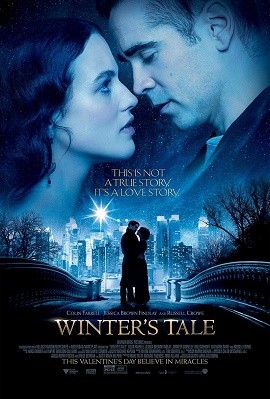
A Late Film Review: Winter’s Tale (dir by Akiva Goldsman)


Winter's_tale_(film)

I liked Winter’s Tale.

And I don’t care what anybody else says!

And that’s a good thing too because, critically, Winter’s Tale has been one of the most maligned movies of 2014.  It came out on Valentine’s Day, at the same time as Endless Love.  And the critics absolutely hated it!  For a while there, the online film community was taking bets on which one of the two Valentine’s Day releases would end up with the lowest score on Rotten Tomatoes.  And, though it was a close race, Winter’s Tale actually ended up with the lower score, coming in at 13% as opposed to Endless Love‘s 15%.

That’s right — according to most mainstream film critics, Winter’s Tale was actually worse than Endless Love.

Well, those critics were wrong.  That’s how I felt when I first saw Winter’s Tale and, after watching it a second time on HBO, that’s still how I feel.  Winter’s Tale is not a bad movie!

(Incidentally, Winter’s Tale has a 6.2 rating over at the imdb, which would seem to indicate that I’m not the only person who knows better than Peter Travers.)

Admittedly, the plot of Winter’s Tale does not make much logical sense but that’s kind of the point.  It’s a tale and tales are not about being realistic.  Tales are about emotion and the whole point of listening to or telling a tale is to inspire feelings. To truly appreciate Winter’s Tale, you have to understand that this is a fairy tale that happens to be set in the most mythical of American cities, New York.

Opening in 1895 and ending in 2014, Winter’s Tale tells the story of Peter Lake (Colin Farrell).  When Peter was an infant, his immigrant parents were refused entry into Manhattan because they both had tuberculosis.  So, they put Peter in a toy boat and dropped him into ocean and watched as the boat slowly floated towards America.

Jump forward 21 years and Peter has grown up to be a thief, working for a gangster named Pearly Soames (Russell Crowe).  What few people know is that Pearly is actually a demon who regularly visits his boss, Luicfer (played by Will “Yes, that Will Smith” Smith).  Pearly is immortal as long as he stays in New York City.

When Peter decides that he wants to leave Pearly’s gang, Pearly orders that Peter be killed.  However, while fleeing from the rest of the gang, Peter is rescued by a flying white horse.  While Peter’s first instinct is to fly the horse out of New York and spend the winter in Florida, he instead decides to rob one more mansion.  (It helps that the horse literally takes him to the mansion.)

While robbing the mansion, Peter meets Beverly Penn (Jessica Brown Findlay), a passionate and talented pianist who is dying of tuberculosis.  In what is literally a case of love at first sight, Peter forgets about robbing the mansion and instead has a cup of tea with Beverly.  They discuss their lives and Beverly tells Peter that everyone has a miracle inside of them and that everyone becomes a star after dying.

Soon, Peter and Beverly are a couple and Peter even manages to win over Beverly’s suspicious father, Isaac (William Hurt).  Peter and Beverly spend the winter at her family’s summer home.  Peter believes that his miracle is to save Beverly.  Meanwhile, an angry Pearly waits for his chance to get revenge…

Now, I will admit that there are some obvious flaws with Winter’s Tale.  Russell Crowe goes totally overboard, with his accent wildly going from Australian to New Yorkish to Scottish and back again.  Meanwhile, Will Smith is not necessarily a bad choice to play the devil and he actually gives a pretty good performance but it doesn’t chance the fact that, whenever he’s on screen, all you can think about is that he’s Will Smith and he’s playing the devil.

But, honestly, who cares?  This is an amazingly romantic film and Farrell and Findlay have a lot of chemistry.  When you see them together, you have no doubt that Peter and Beverly are meant to be together.  You care about them as a characters, even if you don’t always understand everything that’s happening around them.  Their love feels real and, when it comes to telling a love story, isn’t that the most important thing?

(Add to that, does any actor fall in love as convincingly as Colin Farrell?)

And the film itself is gorgeous!  From the costumes to the set design to Caleb Deschanel’s cinematography, the film is just beautiful to look at.  Undoubtedly, cynics would argue that the film is almost too glossy in its appearance but Winter’s Tale is not a film for cynics.  It’s a film for romantics.

So, yes,  I did like Winter’s Tale and I am not ashamed to admit it.

Review: A History of Violence (dir. by David Cronenberg)


“In this family, we do not solve our problems by hitting people.” — Tom Stall

David Cronenberg’s A History of Violence opens like a familiar American story but soon transforms into something far darker and more complex—a meditation on how violence reshapes identity and reality itself. The film begins in small-town Indiana where Tom Stall, a mild-mannered diner owner, becomes an overnight hero after killing two violent spree killers who attempt to rob his restaurant. These killers—Billy and Leland—serve as the initial violent intrusion that shatters Tom’s peaceful world and propels the narrative forward. Their actions attract the attention of Carl Fogarty, an East Coast mobster whose relentless pursuit gradually forces Tom and his family to confront a buried, violent history. This confrontation unravels the fragile facade of domesticity and sets the stage for the film’s profound exploration of identity, perception, and the primal tensions beneath civilization.

Cronenberg’s direction is a study in restraint and precision. Far from glamorizing violence, the film presents it as brutally efficient and intimately physical. Cronenberg himself described the action sequences as neither choreographed nor aestheticized but raw, unembellished, and quick—realistic portrayals of violence drawn from street-fighting techniques rather than cinematic spectacle. This choice heightens the emotional impact, making every outbreak of violence feel sudden, close, and devastatingly human. The opening extended shot of the spree killers, for example, follows them in a languid, almost eerie calm before revealing their cold-blooded brutality, establishing an unsettling tone early on. Cronenberg’s camera work—often tight and intimate—immerses viewers in moments where violence erupts not as a fantasy but as a harsh reality, forcing the audience to reckon with its consequences rather than its thrill.

Viggo Mortensen anchors the film with a layered performance that seamlessly navigates the duality of Tom Stall—a man striving for peaceful normalcy—and the darker instincts touched by his mysterious past. Mortensen’s portrayal moves fluidly between the affable family man and the capable, restrained force beneath, embodying the film’s exploration of how violence shapes identity and perception. His physicality and subtle shifts in tone reveal a man perpetually caught between two worlds, never fully belonging to either. Maria Bello as Edie complements Mortensen beautifully, delivering a performance rich in emotional complexity. Her character oscillates between nurturer and survivor, revealing a raw, sometimes unsettling vulnerability beneath her composed exterior. Bello’s nuanced acting gives weight to the evolving dynamics of fear, desire, and trust within their marriage, especially evident in scenes that contrast tender intimacy with underlying tension.

The supporting cast enriches the film’s moral landscape. Ed Harris brings a quiet menace to Carl Fogarty, embodying violence as a cold, business-like inevitability rather than a source of pleasure or spectacle. William Hurt’s portrayal of Richie Cusack is especially memorable—his eight-to-ten-minute screen time is electrifying, providing a darkly charismatic figure who embodies familial loyalty intertwined with brutal pragmatism. Hurt’s performance deftly balances charm and cruelty, offering one of the film’s starkest reminders of violence’s cyclical nature within families. These actors contribute to the film’s thematic depth, portraying violence as a heritage passed down and a force that both defines and corrodes.

Cronenberg’s screenplay, coupled with Howard Shore’s minimalist score, emphasizes mood and psychological tension over action set pieces. The film refuses to indulge in excessive gore or prolonged combat; instead, it presents violence as a disruptive force that shatters normalcy and forces internal reckonings. A notable subplot involving Tom’s teenage son and a school bully underscores the generational transmission of violence and fear, reinforcing the idea that violence’s impact extends beyond immediate events to shape social and familial identities.

One of the film’s most powerful effects is the way it forces viewers to reconsider notions of safety, civility, and identity. Tom’s line, “In this family, we do not solve our problems by hitting people,” starkly contrasts with his son’s chilling rejoinder, “No, in this family, we shoot them.” This exchange encapsulates the film’s core tension—the desire to reject violence while simultaneously being shaped by its inescapable presence. Moments of quiet domesticity are undercut throughout by an ever-present undercurrent of menace, illustrating Cronenberg’s thesis that violence is not merely an event but a contagion of perception and reality.

Ultimately, A History of Violence is a film of dualities—between past and present, civility and savagery, love and fear. Cronenberg’s direction delicately balances these tensions, crafting a film that is at once a taut thriller and a profound psychological study. The performances, especially those of Mortensen and Bello, give the film its emotional resonance, while the supporting cast strengthens its examination of violence’s personal and social ramifications. By the film’s haunting conclusion, viewers are left with a haunting question: can anyone truly escape the shadows cast by violence, or are we forever altered by its imprint?