Ghosts of Sundance Past: Longtime Companion (dir by Norman Rene)


The Sundance Film Festival is currently underway in Utah.  For the next few days, I’ll be taking a look at some of the films that have previously won awards at Sundance.

First released in 1990, Longtime Companion was one of the first mainstream feature films to deal with the early days of the AIDS epidemic.

The film follows a group of friends and lovers over the course of ten years.  The film opens with a crowded and joyous 4th of July weekend at Fire Island.  Willy (Campbell Scott) is a personal trainer who has just started a relationship with an entertainment lawyer who, due to his beard, is nicknamed Fuzzy (Stephen Caffrey).  Willy’s best friend is the personable and popular John (Dermot Mulroney).  David (Bruce Davison) and Sean (Mark Lamos) are the elder couple of the group.  Sean writes for a soap opera and one of Fuzzy’s clients, Howard (Patrick Cassidy), has just landed a role on the show.  He’ll be playing a gay character, even though everyone warns him that the role will lead to him getting typecast.  The group’s straight friend is Lisa (Mary-Louise Parker), an antique dealer who lives next door to Howard and who is Fuzzy’s sister.  The film takes it times showing us the friendships and the relationships between these characters, allowing us to get to know them all as individuals.

Even as the group celebrates the 4th, they are talking about an article in the New York Times about the rise of a “gay cancer.”  Some members of the group are concerned but the majority simply shrug it off as another out-there rumor.

The movie moves quickly, from one year to another.  John, the youngest of them, is the first member of the group to die, passing away alone in a hospital room while hooked up to a respirator.  (The sound of the respirator is one of the most haunting parts of the film.)  Sean soon becomes ill and starts to dramatically deteriorate.  It falls to David to take care of Sean and to even ghostwrite his scripts for the soap opera.  Howard’s acting career is sabotaged by rumors that he has AIDS while Willy and Fuzzy tentatively try to have a relationship at time when they’re not even sure how AIDS is transmitted.  At one point, Willy visits a friend in the hospital and then furiously scrubs his skin in case he’s somehow been infected.  When one member of the group passes, his lover is referred to as being his “longtime companion” in the obituary.  Even while dealing with tragedy and feeling as if they’ve been shunned and abandoned to die by the rest of America, the characters are expected to hide the details of the lives and their grief.

It’s a poignant and low-key film, one that was originally made for PBS but then given a theatrical release after production was complete.  Seen today, the film feels like a companion piece to Roger Spottiswoode’s And The Band Played On.  If And The Band Played On dealt with the politics around AIDS and the early struggle to get people to even acknowledge that it existed, Longtime Companion is about the human cost of the epidemic.  The film is wonderfully acted by the talented cast.  Bruce Davison was nominated for an Oscar for his sensitive performance as David.  If not for Joe Pesci’s performance in Goodfellas, it’s easy to imagine that Davison would have won.  The scene where he encourages the comatose Sean to pass on will make you cry.  Interestingly, when David gets sick himself, it happens off-screen as if the filmmakers knew there was no way the audience would have been able to emotionally handle watching David suffer any further.

Longtime Companion played at the 1990 Sundance Film Festival, where it won the Dramatic Audience Award.

Lisa Marie Reviews An Oscar Nominee: Goodfellas (dir by Martin Scorsese)


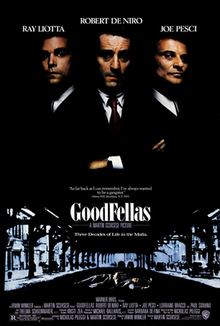
First released in 1990 and continuously acclaimed ever since, Goodfellas did not win the Oscar for Best Picture.

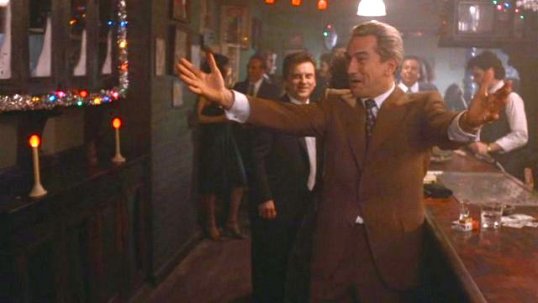
I’m always a bit surprised whenever I remember that.  Goodfellas didn’t win Best Picture?  That just doesn’t seem right.  It’s not the other films nominated that year were bad but Goodfellas was so brilliant that it’s hard to imagine someone actually voting for something else.  Seriously, it’s hard to think of a film that has been more influential than Goodfellas.  Every gangster film with a soundtrack of kitschy tunes from the 6os and 70s owes huge debt to Goodfellas.  Every actor who has ever been cast as a wild and out-of-control psycho gangster owes a debt to Joe Pesci’s performance as Tommy DeVito.  When Ray Liotta passed away two years ago, we all immediately heard him saying, “I always wanted to be a gangster.”  Robert De Niro’s Jimmy Conway remains the epitome of the ruthless gangster.  For many, Paul Sorvino’s neighborhood godfather redefined what it meant to be a crime boss.  Lorraine Bracco made such an impression as Karen Hill that it somehow seemed appropriate that she was one of the first people cast in The Sopranos, a show that itself would probably have not existed if not for Goodfellas.  Frank Sivero, Samuel L. Jackson, Tobin Bell, Debi Mazer, Vincent Gallo, Ileana Douglas, Frank Vincent, Tony Sirico, Michael Imperioli, Tony Darrow, Mike Starr, Chuck Low, all of them can be seen in Goodfellas.  It’s a film that many still consider to be the best of Martin Scorsese’s legendary career.  Who can forget Robert De Niro smoking that cigarette while Sunshine of Your Love blared on the soundtrack?  Who can forget “Maury’s wigs don’t come off!” or “Rossi, you are nothing but whore!?”  Who can forget the cheery Christmas music playing in the background while De Niro’s Jimmy Conway grows more and more paranoid after pulling off the biggest heist of his career?

Plus, it’s a Christmas movie!

And yet, it did not win Best Picture.

Myself, whenever I’m sitting behind a garbage truck in traffic, I immediately start to hear the piano coda from Layla.  For that matter, whenever I see a helicopter in the sky, I flash back to a coke-addled Henry Hill getting paranoid as he tries to pick up his brother from the hospital.  Whenever I see someone walking across the street in the suburbs, I remember the scene where Henry coolly pistol-whips the country club guy and then tells Karen to hide his gun.  I always remember Karen saying that she knows that many of her best friends would have run off as soon as their boyfriend gave them a gun to hide but “it turned me on.”  It would have turned me on as well.  Henry might be a gangster and his friends might be murderers but he doesn’t make any apologies for who he is, unlike everyone else in the world.

But it did not win Best Picture.

How many people have imitated Joe Pesci saying, “How am I funny?”  How many times did Pesci and Frank Vincent have to listen to people telling them to “go home and get your fucking shinebox?”  A lot of people remember the brutality of the scene where Pesci and De Niro team up to attack Vincent’s crude gangster but I always remember the sound of Donavon’s Atlantis playing on the soundtrack.

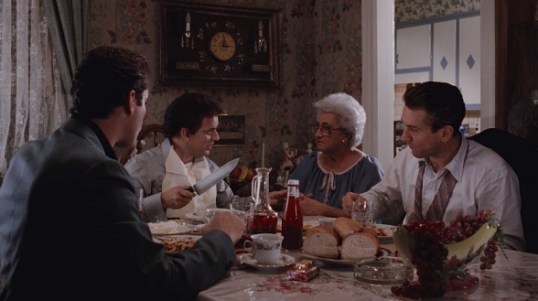
And then there’s Catherine Scorsese, showing up as Tommy’s mom and cooking for everyone while Vincent struggles to escape from the trunk of a car.  “He is content to be a jerk,” Tommy says about Henry Hill.  Just a few hours earlier, Tommy was apologizing to Henry for getting blood on his floor.

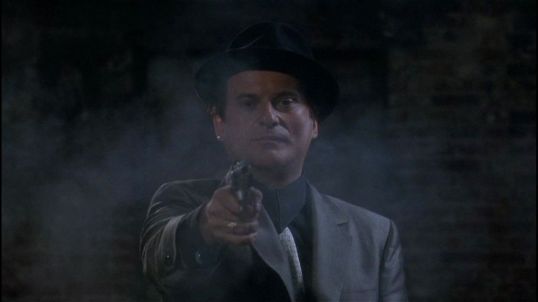
Goodfellas is a fast-paced look at organized crime, spanning from the 50s to the early 80s.  Ray Liotta plays Henry Hill, who goes from idolizing gangsters to being a gangster to ultimately fearing his associates after he gets busted for dealing drugs.  It’s a dizzying film, full of so many classic scenes and lines that it feels almost pointless to try to list them all here or to pretend like whoever is reading this review doesn’t remember the scene where the camera pans through the club and we meet the members of the crew.  (“And then there was Pete The Killer….”)  Goodfellas is a film that spend two hours showing us how much fun being a gangster can be and then thirty minutes showing us just how bad it can get when you’re high on coke, the police are after you, and you’ve recently learned that your associates are willing to kill even their oldest friends.  No matter how many times I watch Goodfellas, I always get very anxious towards the end of the film.  With the music pounding and the camera spinning, with Henry looking for helicopters, and with all of his plans going wrong over the course of one day, it’s almost a relief when Bo Dietl points that gun at Henry’s head and yells at him, revealing that Henry has been captured by the cops and not the Gambinos.  Karen desperately running through the house, flushing drugs and hiding a gun in her underwear, always leaves me unsettled.  It’s such a nice house but now, everything is crashing down.

There’s a tendency to compare Goodfellas to The Godfather, as their both films that re-imagine American history and culture through the lens of the gangster genre.  I think they’re both great but I also think that they are ultimately two very different films.  If The Godfather is sweeping and operatic, Goodfellas is the film that reminds us that gangsters also live in the suburbs and go to cookouts and that their wives take care of the kids and watch movies while the FBI searches their home.  If The Godfather is about the bosses, Goodfellas is about the blue collar soldiers.  The Godfather represents what we wish the Mafia was like while Goodfellas represents the reality.

Goodfellas is one of the greatest films ever made but it lost the Best Picture Oscar to Dances With Wolves, a film that left audiences feeling good as opposed to anxious.  To be honest, Martin Scorsese losing Best Director to Kevin Costner feels like an even bigger injustice than Goodfellas losing Best Picture.  One can understand the desire to reward Dances With Wolves, a film that attempts to correct a decades worth of negative stereotypes about Native Americans.  But Scorsese’s direction was so brilliant that it’s truly a shame that he didn’t win and that Lorraine Bracco didn’t win Best Supporting Actress.  It’s also a shame that Ray Liotta wasn’t nominated for playing Henry Hill.  At least Joe Pesci won an Oscar for redefining what it meant to be a gangster.

Goodfellas is proof that the best film doesn’t always win at the Oscars.  But it’s also proof that a great film doesn’t need an Oscar to be remembered.

Lisa Reviews An Oscar Nominee: The Irishman (dir by Martin Scorsese)


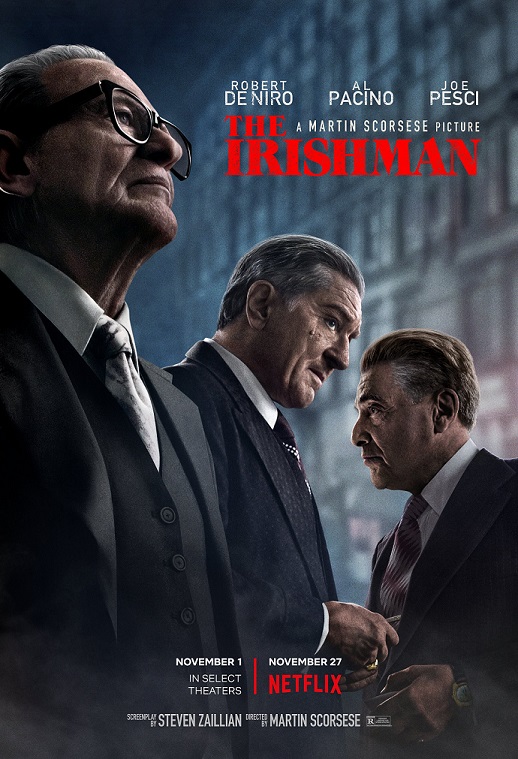
Released by Netflix in 2019 and clocking in at close to 4 hours, the Martin Scorsese-directed Best Picture nominee, The Irishman, is a film about many different things.

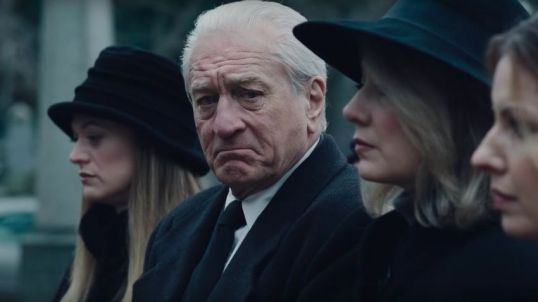
At its simplest, it’s a film about a very old man named Frank Shearan (played by Robert De Niro).  Frank is an Irish-American from Philadelphia.  Frank is a veteran of World War II and a former truck driver who was briefly a fairly important figure in the Teamsters union.  He did a few years in prison.  At the start of the film, though, he’s just another elderly man living in a retirement community.  All of his friends are dead.  His wife passed away years ago.  His children never comes to visit.  In fact, the only people interested in talking to Frank are the FBI but Frank doesn’t have much to say to them.  That’s not to say that Frank isn’t talkative.  For the first time in his life, he wants to talk to people but there’s no one left to talk to.  The only people who listen are those who are required to do so.  A nurse politely nods along as as he tells her about his old friend Jimmy Hoffa.  (She’s never heard of him.)  A priest listens to the story of Frank’s life and offers him absolution.  At times, Frank looks straight at Scorsese’s camera and appears to be talking straight to the audience.  Frank has a lot of interesting stories but who knows how truthful he’s being or if his memory can be trusted.

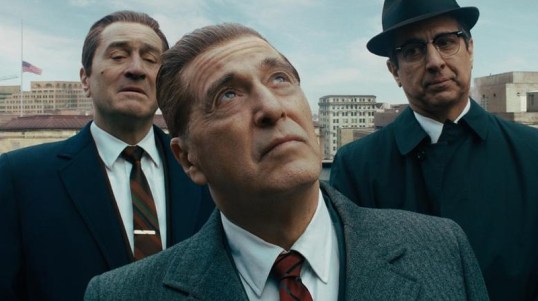
The Irishman, though, is not just the story of Frank.  It is also a secret history of America during the latter half of the 20th Century.  Frank may look old and harmless in that nursing home but, to hear him tell it, he was once acquainted with some of the most powerful men in America.  He went from executing Italian POWs during World War II to executing hits for the Mafia in post-war America.  Along the way, he became close to crime bosses like Skinny Razor (Bobby Cannavale), Angelo Bruno (Harvey Keitel) and Russell Bufalino (Joe Pesci), men who may not have been household names but who still wielded a lot of power.  These are men who, Frank flatly states, fixed the presidential election of 1960 and who later quite possibly killed the man they had elected president.  Frank also became a close associate of Jimmy Hoffa (Al Pacino), the labor leader who was reputed to have mob connections and who disappeared in 1975.

The Irishman is also a tribute to the modern gangster film, featuring role for nearly every living actor associated with the genre.  De Niro, Pacino, Pesci, Keitel, Bobby Cannavale, Domenick Lombardozzi, Gary Basaraba, they’ve all played their share of gangsters in films and television show that were both good and bad.  Having them all appear in one film together serves to remind the viewer of just how much of America’s popular entertainment has revolved around stories of organized crime.  Even as the old school Mafia has declined as a real-world power, it’s become a permanent part of pop culture.  Everyone loves a gangster, except for the people who actually have to deal with them on a daily basis.

Not surprisingly, considering the stars and the director, it’s a film full of smart, detailed performances.  When the film was originally released, Pacino and Pesci got the lion’s share of the praise and they certainly deserved it.  Pacino gets the best lines and brings some unexpected wit to his performance as Jimmy Hoffa.  Pesci, meanwhile, finally gets to play a gangster who is not psychotic and shows that he can be just as compelling when he’s not raising his voice as when he is.  Still, some of my favorite performances came from actors who one wouldn’t necessarily associate with a Scorsese gangster film.  I liked the nervous humor that Ray Romano brought to the role of a corrupt union lawyer.  I liked the seething resentment that Stephen Graham brought to the role of Jimmy Hoffa’s main rival in the union.  (The scene where Graham and Pacino argue over who is more owed an apology for all of their past disagreements is both funny and, due to the people involved, somewhat frightening.)  Jesse Plemons is poignantly dumb in his brief role as Hoffa’s stepson.  Louis Cancelmi doesn’t get a lot of screen time but he steals every scene in which he appears as a paranoid hitman.  (Cancelmi plays a character named Sally Bugs, proving that not everyone in the Mafia gets a cool nickname.)

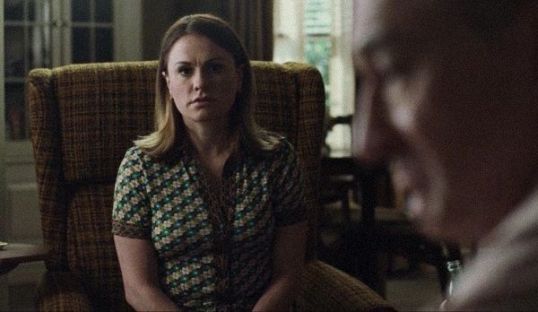
And then there’s Anna Paquin, who provides the film with its moral center.  When the film was first released, many Twitter critics complained that Paquin, who played Frank’s daughter Peggy, only a had a handful of lines.  It was one of the stupidest controversies of 2019, which is saying something when you consider how much time Film Twitter devotes to generating stupid controversies.  Peggy doesn’t say much because she’s decided that she doesn’t want to be a part of her father’s life.  From the moment that she first sees Frank beating up a store owner, Peggy knows that her father and his associates are violent men.  She not only fears them but she resents the damage that Frank does to not only her family but to the families as other as well.  The only one of her father’s associates who she likes is Jimmy Hoffa, because Hoffa cares about helping others.  When Hoffa disappears, Peggy makes a decision to disappear from Frank’s life and Paquin’s withering stare says more than any lengthy monologue could.  Peggy doesn’t say much because she knows that her words would be wasted on a man who she knows is a liar.  The scene where she silently walks away from her now elderly father tells us everything we need to know about the emotional consequences of the life that Frank has chosen to live.  Regardless of how many lines she did or didn’t have, Paquin gave one of the best performances of 2019.

Famously (or, depending on which critics you read, infamously), de-aging technology was used so that De Niro, Pacino, Pesci, and Keitel could play both the younger and the older version of their characters.  At first, it can be a bit jarring.  The de-aging works fine with Pesci and Keitel, both of whom are already supposed to be middle-aged when they first meet Frank.  (Admittedly, Keitel only has a few minutes of screen time.)  With De Niro and Pacino, it’s a bit less successful.  Even when they’re playing younger versions of themselves, De Niro and Pacino still move and stand like old men.  Fortunately, in the case of Pacino, his natural movie star charisma wins out over his obvious age.  In the end, we believe that he’s Hoffa because we want to believe that all of our important historical figures were as interesting and entertaining as Al Pacino is in The Irishman.

And yet, ultimately, even the awkward de-aging works to the film’s advantage because it reminds us that we’re not necessarily seeing what happened.  Instead, we’re seeing what Frank says happened.  We’re seeing his memories, or at least what he claims to remember.  It makes sense that, when Frank thinks about himself as a young truck driver in 1956, he would picture himself not as he was but instead as just a slightly less weathered version of who he would eventually become.  Throughout the film, there are hints that Frank’s memory should not be trusted.  Some of his stories are incredibly detailed while others — like when he transports weapons for the failed invasion of the Bay of Pigs — are a bit more vaguely presented.  Is Frank lying or is he misremembering or are we just expecting too much detail from a man who is now essentially waiting to die?  The film leaves that up for us to determine.

The Irishman is Scorsese at his most reflective.  Compared to Goodfellas and Casino, The Irishman is certainly one of Scorsese’s less “flashy” films.  But, on repeat viewings, it becomes cleat that The Irishman is the perfect conclusion to the gangster trilogy that began with Goodfellas and continued with Casino.  All three of these films deal with someone who rises up the ranks in the mob while remaining, as a result of their ethnicity, an outsider.  (Henry Hill and Frank Shearan are both Irish.  Ace Rothstein was Jewish.)  All three of them are briefly on top of the world and all three of them are left wondering how they’re going to continue their lives after their days at the top are over.  In Goodfellas, Henry Hill makes no secret of his disgust at having to live in the bland anonymity of the suburbs.  In Casino, Ace Rothstein ends the film with a mournful acceptance the fact that he will never return to his beloved Vegas.  (“And that’s that.”)  In The Irishman, Frank finally realizes that he has comes to the end of it all, alone and with nothing but death in his future.  All three of them made their decisions and, in the end, all three of them are left to deal with the consequences.  The trilogy goes from Henry’s anger to Ace’s depression to Frank’s acceptance.

It may seem strange to describe a film like The Irishman as being underrated, seeing as how it was nominated for 10 Oscars and got a Criterion release in record time.  And yet, when the film first came out, there was a vague sense of disappointment to found in even some of the positive reviews.  It was a Scorsese film that was so eagerly awaited and arrived with so much hype that there was no way it could live up to some of the expectations that had been set for it.  (And, of course, there’s also a whole set of people who were predestined to dislike the film precisely because it was a Scorsese film and it was so anticipated.)  It’s a long film and, while Netflix should be praised for allowing Scorsese the freedom to make his epic, it’s also not a film that should be viewed in bits and pieces on a tiny screen.  The Irishman is a film that should be watched in one sitting and it’s definitely a film that most viewers should watch more than once.  It takes more than one viewing to truly grasp the the world that Scorsese has recreated.

The Irishman was nominated for Best Picture.  It lost to a worthy competitor, Parasite.  Still, regardless of who took him the Oscars, The Irishman is a film that will live forever.

In Memory of Robin Williams #1: Dead Poets Society (Dir by Peter Weir)


Robin Williams

Last Monday, after I first heard that Robin Williams had committed suicide, I struggled to find the right words to express what I was feeling.  Finally, I ended up posting this on Facebook:

I keep trying to write something about Robin Williams but the words aren’t coming to me. It’s all too big and strange and sudden and I can’t find the words to sum up my feelings. I feel like a part of my childhood died today. So, instead of trying to be more eloquent or wise than I actually am, I’m just going to say R.I.P., Robin WIlliams.

Finally, a little over a week later, I still don’t know what to say.  How do you sum up a life in just a few words?  I don’t think that they can be done for anyone.  It certainly can’t be done for as iconic a figure as Robin Williams.  So, instead of trying to do the impossible, I’ve spent the last few days watching and reviewing a few of Robin Williams’ films.

And, of course, one of those films had to be the 1989 best picture nominee Dead Poets Society.
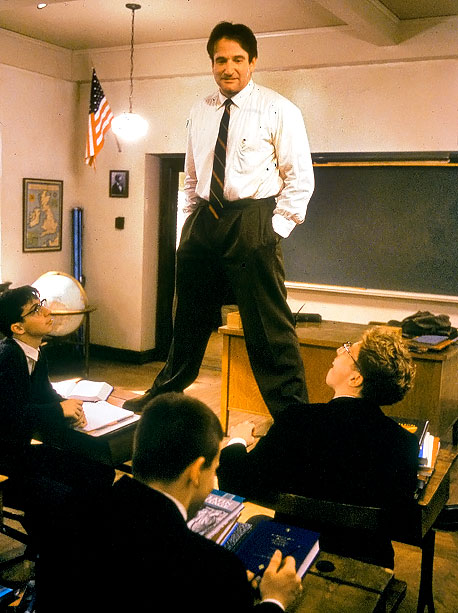
DEAD-POETS-SOCIETY

Now, a quick warning.  The review below is going to contain spoilers.  I’m going to talk about some very important plot points.  But surely you’ve seen Dead Poets Society already.  And even if you haven’t seen it, surely you’ve heard what the film is about and surely, you know what happens.  After all, who doesn’t?  But if you are one of those people who does not know or who has not seen the film — well, why haven’t you?

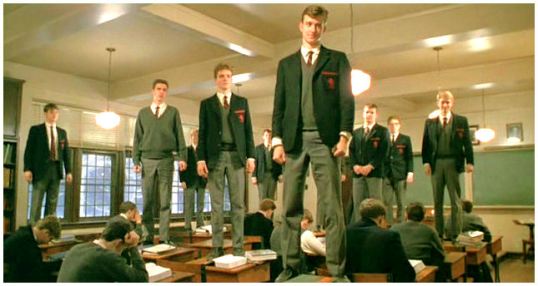
The first time I ever saw Dead Poets Society was in a high school creative writing class.  Our teacher — who, it quickly became apparently, considered herself to be the real-life version of the teacher played by Robin Williams — showed it to us, over the course of three class periods, as an introduction to writing poetry.  I enjoyed the film but the rest of the class absolutely loved it.  Especially the guys.  For the rest of the class year, I would listen to those guy as they bragged about how they were seizing the day.  I remember one day, the classroom was empty except for me and one of the boys.  I can’t remember what led to him doing it (and it could very well have been my suggestion that he try) but he eventually ended up standing on top of a desk just like the students at the end of the film.  Unfortunately, public high school desks aren’t quite as sturdy as private school desks and my friend soon ended up crashing to the floor as the desk slipped out from underneath him.

Ah, memories.
dead-poets-society (1)

Yes, Dead Poets Society is one of those films.  It’s a film that everyone seems to have seen, loved, and found to be inspirational.  And I have to admit that I’ve grown to appreciate it more over the years since I first saw it back in creative writing class.  With each subsequent viewing, I find myself less critical of the film’s melodramatic and predictable moments and more willing to accept the film for what it is — a celebration of life, poetry, and teaching.  Dead Poets Society, from the very moment that Robin Williams makes his first appearance sitting at the end of a line of stodgy old men and flashing an unapologetically impish smile, is a film that defies easy cynicism.  It’s a film that embraces you and you have to be very hard-hearted not to embrace it back.

Dead Poets Society, of course, tells the story of a private school in the 1950s and what happens when a new teacher (Robin Williams, naturally) encourages his students to celebrate creativity, to “seize the day” as the saying goes.  Not surprisingly, just about every other adult thinks that the students would be better off not seizing the day but instead preparing for a life of WASPy conformity.  This leads to a few of Mr. Keating’s students forming a secret society where they can read poetry, talk about their feelings, and basically do their best to honor the memory of Walt Whitman.

poetrybeauty gif

There are seven members of the Dead Poets Society:

There’s Gerard Pitts, who doesn’t really make much of an impression.  The main thing that I always notice about Gerard Pitts is that he looks like a young version of Sam Waterston.  This made sense when I checked the end credits and I discovered that he was played by James Waterston, son of Sam.

Stephen Meeks (Allelon Ruggiero) is another one who doesn’t actually get to do much (beyond boast about the fact that he has a genius I.Q. and create a makeshift radio) but, with his cute glasses, unruly hair, and friendly manner, it’s impossible not to like him.

Of the three main villains in Dead Poets Society, none of them are quite as loathsome as Richard Cameron (Dylan Kussman).  The stern headmaster (played by Norman Lloyd) and the judgmental father (played by Kurtwood Smith) at least have the excuse of being old and set-in-their-boring-ways.  Cameron, however, starts out as a member of the Dead Poets Society but still has absolutely no problem betraying them.  As opposed to the adults in the movie, Cameron is someone who still had a chance to be something more than a worm. That being said, Dylan Kussman makes Cameron into a memorable worm.

Then there’s Knox Overstreet (played by Josh Charles, who appears to have only aged a year or two in between this movie and the first season of The Good Wife).  We know that Knox is rich because his name is Knox Overstreet.  Knox has a crush on a girl who goes to the local high school.  Knox’s subplot doesn’t really amount to much but it’s impossible not to like him because Josh Charles was (and is) simply adorable.

Charlie Dalton (played, quite well, by Gale Hansen) is the one who most enthusiastically embraces the idea of seizing the day.  He’s the one who pretends to get a tattoo, who demands to be known by a new name, who attempts to protest the school’s out-dated traditions, and who ultimately is punished with expulsion after he physically attacks Cameron.  (And, as sorry as I was to see Charlie leave the movie, Cameron totally deserved it.)  For a few months in 2008, Gale Hansen was a very active participant on the IMDB message boards, answering questions, giving advice, and generally just being a very gracious guy.  However, he suddenly stopped posting and, just as mysteriously, all of his previous posts were subsequently deleted.  Hansen, himself, hasn’t acted since 1998 and that’s a shame because he really did do a good job as the enthusiastic, idealistic, and not-quite-as-worldly-as-he-thinks Charlie Dalton.

Neil Perry (played by Robert Sean Leonard) is the one who, inspired to seize the day, appears in a local production of A Midsummer Night’s Dream and, as a result, earns the wrath of his overbearing father.  Seen now, in the shadow of Robin Williams’ tragic death, the scene where Neil commits suicide takes on a terrible poignance and it no longer feels as melodramatic as it did the first time that I saw it.  Whereas, originally, it seemed hard to believe that a character played by the energetic and charismatic Leonard would end up committing suicide over a play, we now know that energy and charisma do not necessarily equal happiness.

And finally, there’s Todd Anderson (played by a very young Ethan Hawke), who is pathologically shy and who, at the end of the film, finally finds the strength to climb up on his desk.  After years of seeing in him in various Richard Linklater films, it’s strange to see the usually verbose Hawke playing such an introverted character.  But he does a good job, turning Todd into the film’s moral center.

Robin Williams In DPS

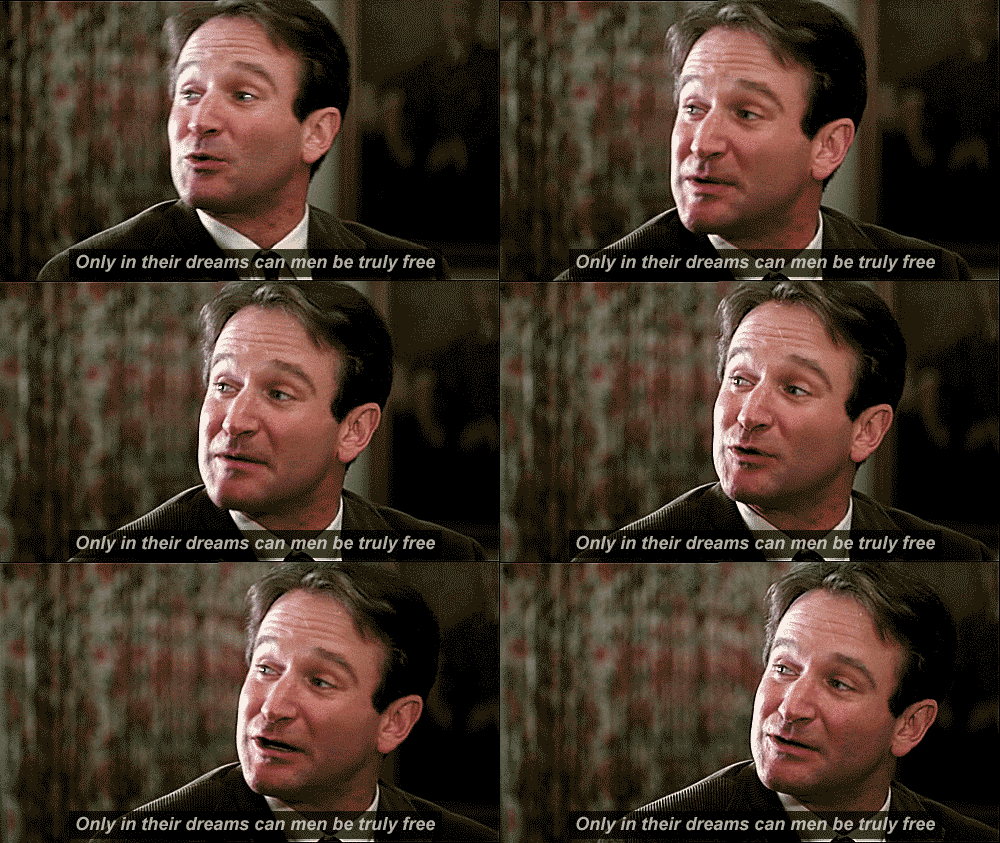
And then there’s their teacher, John Keating who, quite frankly, might as well be named Robin Williams.  That’s not to say that Williams doesn’t give a good performance as Keating.  Indeed, Williams is the glue that holds the film’s ensemble together and his performance so dominates the entire film that, every time that I’ve seen it, I’ve always been surprised to discover just how little screen time he actually has in Dead Poets Society.  As embodied by Robin Williams, John Keating becomes the type of teacher that everyone wishes they could have had just once.  The power of his performance comes from the fact that he not only inspires the viewers to “seize the day” but he actually makes you believe that the day is worth holding on to.  Without Robin Williams, Dead Poets Society would be easy to dismiss as just being a film about a bunch of privileged teenagers reading poetry and pretending to be rebels.  With Williams, however, the film becomes a celebration of life.

Robin Williams, R.I.P.
RW in DPS