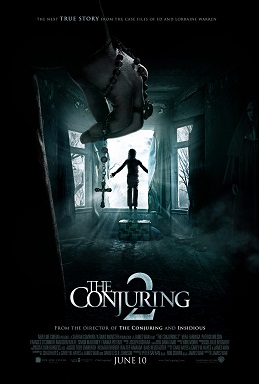
Film Review: The Conjuring 2 (dir by James Wan)


Conjuring_2

The Conjuring 2 will scare the Hell out of you.

Seriously, I’ve seen a lot of horror films, including the first Conjuring (which I absolutely loved).  I’ve seen ghosts, vampires, demons, werewolves, psycho killers, and threats in the shadows.  I’ve seen cats jump out of closets.  I’ve seen ghostly faces suddenly appear in the darkness.  I’ve heard screams and chants and howls.  I’ve seen limbs severed in every possible way.  I’ve seen a lot of cinematic horror and, as a result, I tend to feel that there is nothing that can scare me.

Well, it turns out that’s not true because The Conjuring 2 scared the Hell out of me.

In many ways, The Conjuring 2 tells a familiar story.  Once again, the film begins with an opening crawl that informs us that what we’re about to see is based on a true story.  Once again, a loving but chaotic family is being haunted by evil spirits and the Church has asked paranormal investigators Ed and Lorraine Warren to investigate.

The setup may sound familiar but director James Wan manages to keep the scares compelling.  Over the past few years, Wan has emerged as one of our greatest genre filmmakers.  Whether he’s directing an Insidious film or the latest Fast & Furious installment, James Wan knows how to hold an audience’s attention and how to make the potentially predictable compelling.  In The Conjuring 2, Wan creates and maintains such an atmosphere of dread that even the expected scares (bumps in the dark, voices in the shadows, slamming doors, and faces suddenly appearing in the background) take on an ominous intensity.  From the very first shot, Wan leaves the audience with a profound feeling of unease.  I was not alone in covering my eyes during a few scenes.  I was also not alone is occasionally looking around the darkened theater, just to make sure that there weren’t any ghosts creeping up on me.

That said, we all already know that James Wan is a master of horror.  We know that he can tell a ghost story and, from the minute we saw the first trailer, we all knew that The Conjuring 2 was going to be scary.  What sets The Conjuring 2 apart is the same thing that made the first Conjuring so special.  (For that matter, it’s the same thing that made Wan’s Furious 7 so special.)  Wan fills the screen with horror and spectacle but he also finds the time to celebrate his character’s humanity.

There’s a scene that occurs about 90 minutes into The Conjuring 2.  Ed (Patrick Wilson) and Lorraine (Vera Farmiga) are visiting with the haunted family.  The family has been shaken by both the supernatural and the fact that so many people refuse to believe that they are actually being haunted.  Ed spies a guitar sitting in the corner of the room.  He grabs it and, with the haunted children gathered around them, he launches into a surprisingly good Elvis impersonation.  He sings I Can’t Help Falling In Love With You, all the while glancing over at Lorraine standing in the doorway.

(What makes this especially touching is that Lorraine has been having premonitions of Ed’s violent death and is terrified that she’s going to lose him before they finish investigating this case.)

It’s a totally unexpected scene and yet it works perfectly.  Some of it is because Patrick Wilson and Vera Farmiga have this great chemistry that makes you believe that they actually have been married for years.  But it’s also because the scene reminds us that The Conjuring 2 is about more than just ghosts and scares.  It’s also about love and family.  The haunting is threatening to end Ed and Lorraine’s love story.  The haunting is threatening to destroy a loving family.  Ed and Lorraine aren’t just investigating a ghost but they’re also saving a family.  They’re not just fighting against the supernatural.  They’re fighting for love.

And, in our cynical times, that may sound corny or silly or old-fashioned.  Well. you know what?  The Conjuring was an old-fashioned film and, in a way, so is The Conjuring 2.  But who cares?  Horror works best when it’s mixed with humanity.  The Conjuring 2 may be a horror film but it’s also a celebration of humanity, love, and family.

You may have noticed that I haven’t go into many specifics about the plot of The Conjuring 2.  I don’t want to spoil it for you.  This is a film that you should experience with fresh eyes.  I could tell you about the scariest scene in this film but, if I did, you would not get the full experience.  I’ll just say that I’ve seen a lot of scary movie nuns but none of them can compare to The Conjuring 2.

The Conjuring 2 is the best supernatural horror film that I’ve seen this year so far.  It will scare you and it will touch your heart.  See it.

Also, be sure to stay for the end credits, which feature a lot of genuinely creepy snapshots of the actual locations where the film’s haunting is said to have occurred.  Not only are the pictures scary but they also show the care with which The Conjuring 2 recreated 1970s London.  Is the picture below a scene from the film or is it a picture that was taken during the actual haunting?  You’ll have to see The Conjuring 2 to find out!

the-conjuring-2-1


6 More Film Reviews From 2014: At Middleton, Barefoot, Divergent, Gimme Shelter, The Other Woman, and more!


Let’s continue to get caught up with 6 more reviews of 6 more films that I saw in 2014!

At Middleton (dir by Adam Rodgers)

“Charming, but slight.”  I’ve always liked that term and I think it’s the perfect description for At Middleton, a dramedy that came out in January and did not really get that much attention.  Vera Farmiga is a businesswoman who is touring colleges with her daughter (Taissa Farmiga, who is actually Vera’s younger sister).  Andy Garcia is a surgeon who is doing the same thing with his son.  All four of them end up touring Middleton College at the same time.  While their respective children tour the school, Vera and Andy end up walking around the campus and talking.  And that’s pretty much the entire film!

But you know what?  Vera Farmiga and Andy Garcia are both such good performers and have such a strong chemistry that it doesn’t matter that not much happens.  Or, at the very least, it doesn’t matter was much as you might think it would.

Hence, charming but slight.

http://www.youtube.com/watch?v=i-b_mPVuNOI

Barefoot (dir by Andrew Fleming)

Well, fuck it.

Sorry, I know that’s not the best way to start a review but Barefoot really bothered me.  In Barefoot, Scott Speedman plays a guy who invites Evan Rachel Wood to his brother’s wedding.  The twist is that Wood has spent most of her life in a mental institution.  Originally, Speedman only invites her so that he can trick his father (Treat Williams) into believing that Speedman has finally become a responsible adult.  But, of course, he ends up falling in love with her and Wood’s simple, mentally unbalanced charm brings delight to everyone who meets her.  I wanted to like this film because I love both Scott Speedman and Evan Rachel Wood but, ultimately, it’s all rather condescending and insulting.  Yes, the film may be saying, mental illness is difficult but at least it helped Scott Speedman find love…

On the plus side, the always great J.K. Simmons shows up, playing a psychiatrist.  At no point does he say, “Not my tempo” but he was probably thinking it.

Divergent (dir by Neil Burger)

There’s a lot of good things that can be said about Divergent.  Shailene Woodley is a likable heroine.  The film’s depiction of a dystopian future is well-done. Kate Winslet has fun playing a villain.  Miles Teller and Ansel Elgort are well-cast.  But, ultimately, Divergent suffers from the same problem as The Maze Runner and countless other YA adaptations.  The film never escapes from the shadow of the far superior Hunger Games franchise.  Perhaps, if Divergent had been released first, we’d be referring to the Hunger Games as being a Divergent rip-off.

However, I kind of doubt it.  The Hunger Games works on so many levels.  Divergent is an entertaining adventure film that features a good performance from Shailene Woodley but it’s never anything more than that.  Considering that director Neil Burger previously gave us Interview with the Assassin and Limitless, it’s hard not to be disappointed that there’s not more to Divergent.

Gimme Shelter (dir by Ron Krauss)

Gimme Shelter, which is apparently based on a true story, is about a teenage girl named Apple (Vanessa Hudgens) who flees her abusive, drug addicted mother (Rosario Dawson).  She eventually tracks down her wealthy father (Brendan Fraser), who at first takes Apple in.  However, when he discovers that she’s pregnant, he demands that she get an abortion.  When Apple refuses, he kicks her out of the house.  Apple eventually meets a kindly priest (James Earl Jones) and moves into a shelter that’s run by the tough Kathy (Ann Dowd).

Gimme Shelter came out in January and it was briefly controversial because a lot of critics felt that, by celebrating Apple’s decision not to abort her baby, the movie was pushing an overly pro-life message.  Interestingly enough, a lot of those outraged critics were men and, as I read their angry reviews, it was hard not to feel that they were more concerned with showing off their political bona fides than with reviewing the actual film.  Yes, the film does celebrate Apple’s decision to keep her baby but the film also emphasizes that it was Apple’s decision to make, just as surely as it would have been her decision to make if she had chosen to have an abortion.

To be honest, the worst thing about Gimme Shelter is that it doesn’t take advantage of the fact that it shares its name with a great song by the Rolling Stones.  Otherwise, it’s a well-done (if rather uneven) look at life on the margins.  Yes, the script and the direction are heavy-handed but the film is redeemed by a strong performance from Vanessa Hudgens, who deserves to be known for more than just being “that girl from High School Musical.”

Heaven is For Real (dir by Randall Wallace)

You can tell that Heaven is For Real is supposed to be based on a true story by the fact that the main character is named Todd Burpo.  Todd Burpo is one of those names that’s just so ripe for ridicule that you know he has to be a real person.

Anyway, Heaven Is For Real is based on a book of the same name.  Todd Burpo (Greg Kinnear) is the pastor of a small church in Nebraska.  After Todd’s son, Colton, has a near death experience, he claims to have visited Heaven where he not only met a sister who died before he was born but also had a conversation with Jesus.  As Colton’s story starts to get national attention, Todd struggles to determine whether Colton actually went to Heaven or if he was just having a hallucination.

You can probably guess which side the movie comes down on.

Usually, as a self-described heathen, I watch about zero faith-based movies a year.  For some reason, I ended up watching three over the course of 2014: Left Behind, Rumors of War, and this one.  Heaven is For Real is not as preachy (or terrible) as Left Behind but it’s also not as much fun as Rumors of War.  (Rumors of War, after all, featured Eric Roberts.)  Instead, Heaven Is For Real is probably as close to mainstream as a faith-based movie can get.  I doubt that the film changed anyone’s opinion regarding whether or not heaven is for real but it’s still well-done in a made-for-TV sort of way.

http://www.youtube.com/watch?v=oDcaZ3StTfI

The Other Woman (dir by Nick Cassavetes)

According to my BFF Evelyn, we really liked The Other Woman when we saw it earlier this year.  And, despite how bored I was with the film when I recently tired to rewatch it, we probably did enjoy it that first time.  It’s a girlfriend film, the type of movie that’s enjoyable as long as you’re seeing it for the first time and you’re seeing it with your best girlfriends.  It’s a lot of fun the first time you see it but since the entire film is on the surface, there’s nothing left to discover on repeat viewings.  Instead, you just find yourself very aware of the fact that the film often substitutes easy shock for genuine comedy. (To be honest, I think that — even with the recent missteps of Labor Day and Men, Women, and Children — Jason Reitman could have done wonders with this material.  Nick Cassavetes however…)   Leslie Mann gives a good performance and the scenes where she bonds with Cameron Diaz are a lot of fun but otherwise, it’s the type of film that you enjoy when you see it and then you forget about it.

A Quickie With Lisa Marie: The Judge (dir by David Dobkin)


The Roberts

Hey, everyone!

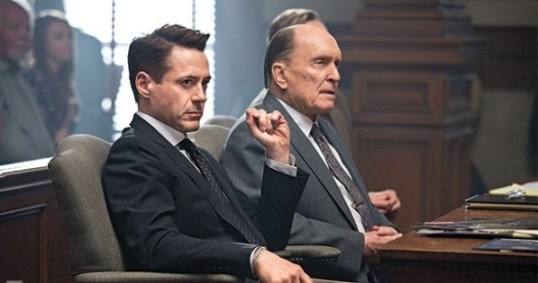
Remember how, earlier this year, a whole lot of people (like me) figured that The Judge would be a surefire Oscar contender and that Robert Duvall would probably receive an Oscar nomination for best supporting actor?

At the time, it made perfect sense.  After all, in the past, courtroom dramas have occasionally been popular with the Academy and, while we all knew that The Judge probably wouldn’t be a modern-day Anatomy of a Murder, there was still reason to hope that the film would turn out to be a watchable melodrama.  Add to that, the movie starred Robert Downey, Jr, an actor who is eventually going to win an Academy Award.  Perhaps most importantly, the title character was played by Robert Duvall, one of the best American actors of all time and an actor who, having recently turned 83, might not get many more opportunities to win one final career-honoring Oscar.

It only made sense to assume that The Judge would be a contender.

And then the trailer came out and those of us who know our film history were left a little bit confused.  It wasn’t that the trailer was necessarily bad.  It was just that it made the film seem rather old-fashioned.  It didn’t feel like a trailer for a film that was set to be released in 2014.  If anything, it almost felt like a parody, as if it was one of those fake, overly Hollywood trailers that appeared at the beginning of Tropic Thunder.  (The fact that the trailer featured Robert Downey, Jr. looking haunted only contributed to this feeling.)

And then the film opened and received reviews that were, at best, respectful and, at worst, scathing.  And I quickly revised my Oscar predictions.

Despite the bad reviews and my own suspicion that the film would not be very good, I still wanted to see The Judge.  I love melodrama.  I love courtroom dramas.  Even more importantly, the Roberts are two of my favorite actors.  Robert Downey, Jr. is always a lot of fun to watch.  Robert Duvall began his career playing Boo Radley in To Kill A Mockingbird and, 52 years later, he’s still a great and uniquely American actor.

So, I saw The Judge this weekend and … well, it’s just a weird movie and not in a good way.  Instead, it’s one of those movies where almost everything seems to be so strangely miscalculated that you really can’t imagine how it could have possibly happened.  The film runs for nearly two and a half hours, despite only having enough plot for maybe an hour-long pilot for a potential mid-season replacement.  The script is amazingly overwritten, full of portentous speeches and clichéd characters.  It’s not enough that Robert Downey, Jr. has two brothers that he has to reconnect with while defending their father on a murder charge.  Instead, one of the brothers also has to be vaguely developmentally challenged so that he can deliver cute lines that are full of “accidental wisdom.”  It’s not enough that Downey reunites with his ex-high school girlfriend (Vera Farmiga, who deserves a better role) but she also has to have a daughter who might be his but could be someone else’s.  It’s not enough that Billy Bob Thornton’s prosecuting attorney is slick and cunning but he also has to be a self-righteous crusader who has rather silly personal reasons for wanting to defeat Downey in court.  It’s not enough that Downey and Duvall eventually end up yelling their personal grievances each other.  Instead, they have to do it while a tornado literally tears through the front yard, the type of directorial choice that is so obvious and heavy-handed that it indicates that director David Dobkin (best known for directing comedies like Wedding Crashers) was desperate to prove that he could be dramatic.

Much like the similarly bad Love and Other Drugs, The Judge is one of those films that tries so hard to be all things to all viewers that it’s ultimately just a huge mess.  Is it a murder mystery?  If so, you have to wonder why we learn so little about the case against Duvall’s judge.  Is it a romantic comedy about Robert Downey, Jr. returning to his small hometown and rediscovering what’s important in life?  If so, you have to wish that the town had a little bit more character beyond just being a standard Hollywood version of what middle America is like.  Is it a family drama?  Well, then it would be nice to know more about the family dynamic beyond the fact that Duvall was stern, Downey was rebellious, and Vincent D’Onofrio is stuck playing the brother who never got to leave home.  It’s a comedy with few laughs and a drama with few tears and ultimately, The Judge just does not work.

However, both of the Roberts give pretty good performances.  That’s what makes The Judge truly frustrating.  Duvall and Downey both do such good work but the material ultimately not only lets them down but lets the audiences down as well.

Oh well.

Duvall

TV Review: Bates Motel 2.6 “Plunge”


Bates Motel The Plunge

Now, I know what you’re saying.

“Gee, Lisa — late much?”

Well, yes, this review of the latest episode of Bates Motel is rather late and for that I apologize.  I have spent this week dealing with the world’s worst cold.  Seriously, it has been pure misery!  However, as I sit here rewatching “Plunge” and working on my review, I think that I may finally be on the road to recovery.

In short, I think I’m finally well enough to take the plunge and review this week’s episode!

This episode was all about people taking “the plunge,” both figuratively and literally.

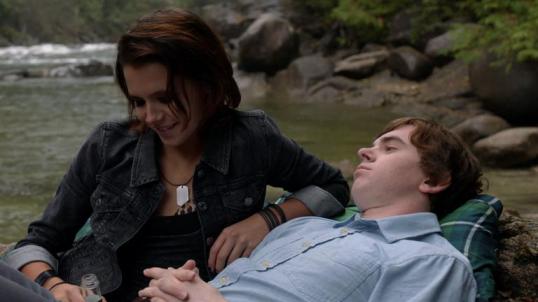
For instance, Emma — after being goaded by both her new pot-dealing boyfriend and Norman’s latest unlikely girlfriend, Cody — removed her oxygen tank and took a plunge into freezing water and nearly died as a result.  Fortunately, Norman Bates was on hand to pull her out of the water and save her life.  On any other show, this would lead to the rebirth of Norman and Emma’s romance but, since this is Bates Motel, Norman ends up going so overboard in his anger towards Cody and Emma’s boyfriend (who I know has a name but I can never remember it) that he quickly goes from being a hero to being the guy who freaks everyone out.

(On a personal note, I have to admit that this whole sequence freaked me out because I don’t swim and, as a result, I very much found myself identifying with poor Emma.)

Norma, meanwhile, takes a plunge into municipal politics.  With the encouragement of her new friend Christine (who I don’t trust) and Christine’s brother George, Norma lobbies to be appointed to the city council.  The Mayor — whose name is Rob — agrees while making it clear that he’s mostly appointing Norma because of who she knows (i.e. Nick Ford).

To a certain extent, you have to wonder just how naïve Norma is.  At the start of this episode, Norma confronted Nick and told him that she didn’t want to work with him anymore.  Nick, more or less, told her that she didn’t have much choice in the matter.  Now, she’s been appointed to the city council and you have to wonder if she realizes just how much of a pawn she has actually become.

Speaking of being a pawn, Dylan has taken the plunge of moving in with Jodi Ford Wilson (Kathleen Robertson), Nick’s daughter and the head of one of the two drug cartels that are currently at war.  Is White Pine Bay really big enough for two drug cartels?  The drug war, to be honest, feels like it belongs in a totally different show.  But, I like Max Thieriot so I can’t complain too much.

Sheriff Romero, who is still living at the Bates Motel, took the plunge of informing Norma that, from his motel room, he has a view of her whenever she undresses in her bedroom.  The awkward flirting between Norma and Romero has been one of the highlights of the second season.

Finally, Norman took the plunge of trying to get his driver’s license.  However, Cody told Emma that Norman suffers from blackouts and Emma responded by calling Norma and telling her (at the exact moment that Norma is watching Norman taking his test).  Norma responds by running over to the car and telling Norman’s driving instructor.  The end result: Norman can’t give his driver’s license and now has another reason to both resent and be dependent upon Norma.

Random Observations:

  • Vera Farmiga kicks ass.  I know that’s become a running theme as far as my Bates Motel reviews are concerned but seriously, she really does.  This week’s Vera Farmiga highlight was the scene where she literally ran down a hill to jump onto Cody’s car.
  • Speaking of kicking ass, just how scary is Michael O’Neill in the role of Nick Ford?  That man can make a simple hello sound like a threat.
  • “Who’s Rob?”  That’s okay, Norma.  I’m not always sure who my mayor is either.
  • I found myself wondering which three senators George helped to get elected.
  • “There are reasons he should not drink.  Medical reasons.  And that’s all I’m going to say.”
  • Norman’s flashbacks while hiding in the closet were disturbingly effective.
  • Wouldn’t it be neat if it turned out the Mayor was related to Nick Ford as well and his name was Rob Ford?
  • If I was Norman’s mom, I probably wouldn’t like Cody either.  Seriously, mother’s worse nightmare that one is.  That said, I relate to the character.  I went through my Cody phase when I was younger.  I think everyone has.
  • George gets extra cool points for liking The Man Who Shot Liberty Valance.
  • Bates Motel has been renewed for a third season!  So, we’ve got at least one more year of White Pine Bay melodrama to look forward to.


TV Review: Bates Motel 2.5 “The Escape Artist”


Bates Motel The Escape Artist

After I posted my extremely laudatory review of last week’s episode of Bates Motel, I received a very interesting comment on Facebook from the veteran horror director and screenwriter Alan Ormsby.  (Among Ormsby’s screenplays: the excellent Deathdream and  Deranged, a film inspired by Ed Gein who, as any Psycho fan knows, also inspired Robert Bloch to first create Norman Bates.) In his comment, Ormsby pointed out something that I had failed to take into consideration.  Whereas Bates Motel presents Norman as suffering from a split personality as a teenager, Psycho established that Norman didn’t “become” Norma until, after years of abuse, he snapped and murdered his mother.  Norman became his mother because he didn’t want to face the reality of his crime.

That’s quite a contrast to the story that is currently being told on Bates Motel.  Whereas Mrs. Bates was the villain of Psycho, she’s become the protagonist of Bates Motel. Whereas the film’s Mrs. Bates was a demonic force who, even after her death, continued to possess her son, the show’s Norma Bates is often times portrayed as just trying to protect both her son from an increasingly amoral world and the world from her obviously disturbed son.

Now, I know that a lot of people are going to argue that Bates Motel is just a TV show and that it’s best not to give it too much thought and they’ll probably start tossing around words like “canon” and “fanfic.”  They’ll say, “Just relax and don’t worry about it.”

But what fun is that?

So, how to explain the difference between the way Norman and his mother are portrayed on TV and in the film?  I’ve come up with a few possible explanations.

1) The doctor at the end of Psycho could have misdiagnosed what happened with Norman and his mother.  As played by Simon Oakland, the doctor was awfully glib and seemed to come from the overdramatic Dr. Phil school of psychology.  After the shocking discoveries at the Bates Motel, everyone needed an explanation and the doctor was happy to provide one as long as he got paid upfront.

2) Bates Motel could be taking place in a parallel universe, one that plays out right next to the Psycho universe, with certain elements occasionally crossing over.  Maybe, when Freddie Highmore’s Norman finally gets around to looking through the peephole behind the painting, he’ll find Anthony Perkins staring back at him.

3) Maybe the Norman Bates of Bates Motel is not actually the Norman Bates of Psycho.  Maybe the TV show will end with Norman and his wife Emma staring down at their newborn son, Norman, Jr.

4) Or maybe Norma is destined to be murdered by her son and that son is destined to take on her identity, run the Bates Motel, and eventually murder both Marion Crane and Milton Arbogast.  However, maybe that son is not going to be Norman but instead, it’s going to be Dylan.  After all, Dylan has been through a lot of emotional and mental turmoil since he tracked down his mother.  Who is to say that he didn’t finally snap and, after killing both his mother and his younger brother, ended up taking on both of their identities?

Obviously, the most plausible solution is the first one but I’m partial to the idea that Bates Motel is taking place in a parallel universe.  That would certainly explain a lot.

As for this week’s episode, it was a rather low-key affair, especially when compared to everything that went on last week.  But you know what?  That’s okay.  Bates Motel has reached the point where not every episode has to have fireworks.  In its second season, Bates Motel seems to be a lot more confident about what type of story its trying to tell and therefore, it can get by with a few episodes that are mostly about appreciating the performances and the show’s off-center vibe.

That’s not to say that things didn’t happen.  Actually, a lot of things happened but none of them were quite as memorable as Norman waving a knife at his uncle while taking on Norma’s personality.

Perhaps the episode’s most dramatic moment was Dylan getting run down in the middle of the street while firing a gun at a car full of rival drug dealers.  (I don’t find the whole drug war to be all that interesting but I do find it amusing that, in the small town of White Pine Bay, nobody ever seems to notice people shooting at each other in broad daylight).  At first, this panicked me because, as played by Max Thieriot, Dylan is one of my favorite characters on the show.  But, it turns out that not only was he not seriously injured but, after being taken to the hospital, he also got to meet his boss and — gasp! — she’s a woman!

We also found out tonight that, on the other side of the drug war, is the Ford Family.  And guess who is in charge of the Ford Family?  None other than Nick Ford, the friendly but slightly sinister guy who has promised to help Norma stop the bypass.  This week’s episode ended with the implication that Nick killed the councilman who was so rude to Norma at the city council meeting.

Speaking of Norma — well, where to begin with what’s going on with Norma?  Not only has she managed to ally herself with a drug lord but she’s also having to watch Norman as he runs around with Cody, a girl who not only has tattoos but who smokes and listens to loud music as well.  On the plus side, Sheriff Romero will apparently be spending several months at the Bates Motel now that the town’s drug dealers have burned down his house.  The scenes between Vera Farmiga and Nestor Carbonell were definite highlights of this week’s episode.  I love the chemistry between the outspoken Norma and the withdrawn Romero.  I’m predicting right now that they’ll be a couple before the final episode of the season and it probably won’t end well.

Vera Farmiga also had another great scene during this episode, in which she responded to Olivia Cooke’s Emma asking her about sex.  Speaking of Emma, she lost her virginity to the cute pot dealer.  Norman has already hinted that he doesn’t consider the cute pot dealer to be a good person so we can probably guess what’s going to eventually happen here.  That said, I’m just glad that Emma finally got to do something that she wanted to do, as opposed to just standing in the background and staring forlornly at Norman.

And finally, Norman is growing even closer to Cody, eventually having sex with her.  (And, again, this is more evidence of my parallel universe theory since the Norman Bates of Hitchcock’s film was a virgin.)   Eventually, he even confessed to her that he often has blackouts.  He also discovered that she comes from an abusive home.

And again, this is probably not going to end well…

Random Observations:

  • Nick Ford’s boat is named “Amnesia.”  What is it with evil people and boats?
  • Did Norman kill Uncle Caleb?  Hopefully, this won’t be another randomly abandoned Bates Motel subplot.

TV Review: Bates Motel 2.4 “Check-Out”


download

As this week’s episode of Bates Motel came to an end, my immediate response was to say: “Now, that’s what I’ve been talking about!”

Much as Norman Bates could never quite decide if he was himself or if he was his mother, Bates Motel has always struggled with whether to fully embrace the over-the-top potential of the show’s concept or whether to try to be a more conventional and audience-friendly show.  Those of us who have been watching since the first episode have often been left to wonder whether Bates Motel would ever truly allow its version of Norman Bates to become as mentally conflicted as the version who showed up in Alfred Hitchcock’s film and Robert Bloch’s novel.  I have always been on the side of those who wanted the show to start boldly going over-the-top and to truly embrace its status as a prequel to Psycho.

The first three episodes of the second season provided hints that the show’s producers agreed with me.  Last night’s episode, however, proved it.

The episode’s final moments , which featured Norman (Freddie Highmore) slipping in-and-out of his mother’s personality while waving a knife at his Uncle Caleb (the same type of knife that was used to kill Janet Leigh in Psycho), were so powerful that they tended to overshadow everything else that happened during the previous hour.  Now, in the case of the drug war subplot, I really don’t mind forgetting.  The drug war is probably the least interesting part of the show and I always find myself hoping that each new episode will be the episode that wraps it up.  Both Dylan (Max Thieriot) and Sheriff Romero (Nestor Carbonell) are interesting characters and they’re both played by talented and appealing actors so why not put them in a subplot that is truly worthy of their talents?  Both of these characters are at their strongest when they’re having to deal with Norma and Norman so why waste time with a plot that — so far at least — has nothing to do with either of them?

However, I did enjoy the episode’s other two storylines.  It’s hard not respect just how determined Norma (Vera Farmiga) is to pretend that everything is normal when it’s clear to everyone else that nothing is normal.  As I’ve stated since this show began, Vera Farmiga kicks ass.  As a result, even though we all know that she’s making the wrong decisions and is raising a future serial killer, it’s impossible not to cheer for her.  From the creepy scene where she and Norman talked to each other while laying in bed to her harrowing argument with Dylan to her hilariously awkward date with George (Michael Vartan), this week’s episode was full of classic Farmiga moments.  Incidentally, I still don’t trust George.  He seems like a nice guy but then again, so did Deputy Shelby.

(Speaking of Deputy Shelby, whatever happened to that girl who chained up in his basement?  Is she still running around in the woods?)

Meanwhile, Emma (Olivia Cooke) may have finally found a boyfriend.  She started the episode waking up in a motel room with the cute guy that she met at Bradley’s beachside memorial.  No, he tells her, they did not have sex though Emma later tells the guy that she would like to do it with him but, at the same time, she wants her first time to be special — especially since it might be her only time.  Emma is my favorite character on the show and Olivia Cooke always does a good job playing her, so I’m always glad to see her get to do something but I have to admit that her new boyfriend isn’t exactly an exciting presence.  Typically, when it comes to television romance, we always hope that our favorite supporting character will end up with the show’s main character.  Certainly, Emma still likes Norman but do we really want to see her get together with him?

Especially after what happened last night.

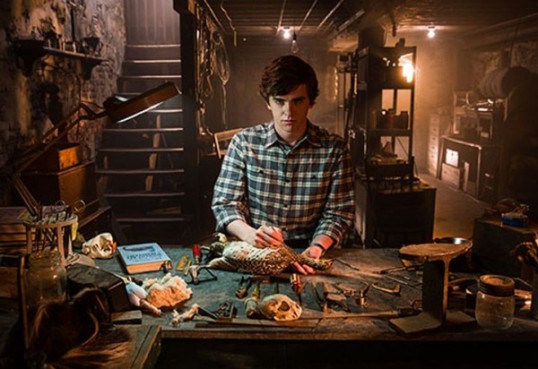
Freddie Highmore really does not get enough credit for his performance as young Norman Bates.  A lot of that is because Norman is written to be something of a blank.  Highmore has to bring to life a potentially soulless character while also working in the shadow of Anthony Perkins’s iconic performance in Hitchcock’s film.  However, especially during this season, Freddie Highmore has really made the character of Norman Bates his own.  That was especially obvious during this week’s episode.  While soft-focus images of his mother being abused flashed through his mind, Norman waved a knife at Uncle Caleb while speaking in Norma’s voice and it worked brilliantly because of Freddie Highmore’s introspective performance.  Freddie Highmore take a potential jump sharking moment and turned it into the climax of the show’s best episode yet.

Did Norman kill his uncle?  That’s something that we’ll have to wait until next week to find out but one thing is for sure.

Bates Motel, much like the characters who run the show’s title establishment, is capable of anything.

Review: Bates Motel 2.3 “Caleb”


Caleb

Well, that’s certainly icky.

Regardless of whatever else may have happened on this week’s episode of Bates Motel, it will always be remembered as the episode where things got even ickier than before.

I’m talking, of course, about the revelation that Dylan’s (Max Thieriot) father also happens to be his uncle, Caleb (Kenny Johnson).  I have to admit that I wasn’t necessarily surprised by this.  In fact, when one thinks about the world that Bates Motel takes place in, there was really no way that Caleb wasn’t going to turn out to be Dylan’s father.  It explains why Norma wants nothing to do with her oldest son and Max Thieriot, Vera Farmiga, and Kenny Johnson all deserve a lot of credit for their performances tonight.

That said, I’m hoping that Caleb — much like Deputy Shelby and so many of the other sleazy men who have stopped off at the Motel — will not be around that much longer because, seriously, he is just so icky!  Bates Motel has a good track record for violently executing sexual predators and I expect that same fate is waiting for Caleb.

If nothing else, Bates Motel seems to be making a good case against men in general.  Is there a single man in Norma Bates’s life who isn’t a deviant of some sort?  Earlier in the episode — before we discovered that Caleb was Dylan’s father — Norma met a guy named George (Michael Vartan).  George seems like a really nice guy but, seeing as this is Bates Motel, I’m still expecting him to have somebody chained up in his basement.

Along with the arrival of Uncle Caleb and Norma meeting George, this week’s other major subplot was Emma (Olivia Cooke) attempting to throw a beachside memorial service for Bradley.  As I’ve stated in the past, Emma is my favorite character so I was happy to finally see her getting to do something.  The memorial service was neatly contrasted with the garden party that Norma attended.  And just as Norma met George, Norman got to know Cody (Paloma Kwiatkowski), who, now that Bradley is gone, is apparently going to be the latest obstacle keeping Emma and Norman from getting together.

Then again, that might be for the best.

Norman and Emma are an adorable couple but, ultimately, he is Norman Bates, isn’t he?

Random Thoughts and Observations

  • This week’s “Vera Farmiga is a great actress who deserves an Emmy moment”: The Grand Canyon joke.
  • The great White Pine Bay drug war is apparently still raging.  Fortunately, I love Max Thieriot or else the whole drug war would be kind of boring.
  • That said, Dylan was kinda lingering a bit while Norma was getting dressed.  Again — icky!
  • The name of the town newspaper is the White Pine Bay Current.  For some reason, that amused me.
  • I felt so bad for Norma when she saw she hadn’t been cast in the town musical.
  • Tonight’s episode was directed by Lodge Kerrigan, who has a great name.
  • One thing that was not mentioned in this week’s episode: The murder of Ms. Watson.  I really hope that the show isn’t going to abandon that mystery just because Sheriff Romero arrested the wrong guy last week.  I have to admit that I’m still holding out hope that Norman did not kill Ms. Watson.
  • It’s interesting to note that Bates Motel and The Following both air on Monday nights.  They’re both unapologetically sordid shows about psychotic murderers and sexual deviants.  However, I love Bates Motel and I absolutely hate what I’ve seen of The Following.  The difference is that The Following is a sincerely misogynistic show whereas Bates Motel seems to actually like its cast of misfits.
  • “You’re in the chorus?  Do you want to be in the chorus?”  Trust me, nobody wants to be in the chorus!
  • That said, I would rather be in the chorus than be on the tech crew.  Poor Norman.

Review: Bates Motel 2.2 “Shadow of a Doubt”


466480041_640

I have to commend Bates Motel for directly referencing Alfred Hitchcock with the title of its latest episode.  Shadow of a Doubt is not only one of Hitchcock’s finest films but it’s also one that shares quite a few themes in common with Bates Motel.  Like Bates Motel, Shadow of a Doubt deals with  the way an outwardly placid surface can hide all sorts of scary and dark secrets.  At this point, it’s a lot easier to imagine Freddie Highmore’s blankly charming Norman growing up to be Joseph Cotten’s friendly murderer Uncle Charlie in Shadow of a Doubt than the twitchy character made famous by Anthony Perkins in Psycho.

Still, it’s hard not to feel that an even better title for last Monday’s episode would have been Norma Bates Sings.

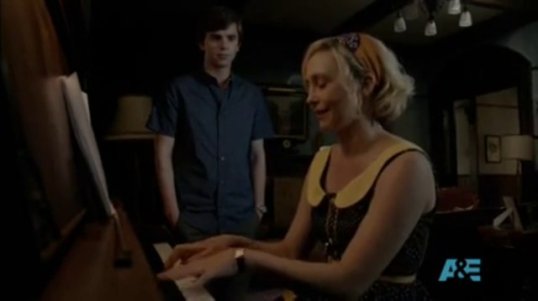
That was pretty much the highlight of last night’s episode and that’s not at all a complaint.  The people behind the show obviously realize just how lucky they are to have Vera Farmiga playing the role of Norma Bates.  The show works best when she’s allowed to take center stage and that’s what literally happens in Shadow of a Doubt.

Norma was singing because she and Norman were both trying out for the town musical.

I loved this subplot on so many levels.

First off, it made perfect sense that Norma, who obviously believes that Norman killed Ms. Watson, would try to find an activity that she and Norman could do together.  This, of course, both allows Norman to be occupied with something other than death and gives Norma an excuse to keep an eye on her possibly dangerous son.

Secondly, and perhaps even more importantly, it seemed exactly like the type of thing that somebody like Norma Bates would get excited about.  Being something of a community theater refugee myself, I couldn’t help but smile when I saw Norman and Norma at the auditions because it felt exactly right.  Everything from Norman’s sullen attitude to Norma’s surprisingly heart-felt (yet endearingly awkward) audition rang true.  During those scenes, Bates Motel went from being that strange little show about a boy who might be murderer to being a very believable and almost touching story about a loving but overdramatic mother and her socially awkward son.

As for the rest of Monday’s episode, I have to say that I was slightly relieved to see Bradley safely get on that bus and head off for a new life.  It’s not so much that I thought Bradley wouldn’t make it as much as I was worried that I’d have to sit through several episodes of Bradley hiding in the basement and Dylan being forced to help search for Gil’s murderer.  Don’t get me wrong.  I think that Nicola Peltz’s performance as Bradley was underrated by a lot of critics and I also think that, as played by Max Thieriot, Dylan is one of the most intriguing characters on the show.  It’s just that I felt that Bradley’s subplot was good for, at most, two episodes.  Bates Motel wrapped it up in two episodes and good for them.

The other big development is that Sheriff Romero arrested a drifter and charged him with Ms. Watson’s murder.  We knew the guy didn’t do it.  The drifter certainly knows he didn’t do it.  And, for that matter, it’s pretty obvious that Romero knows that he’s got the wrong guy too.  However, that is what makes Romero such an interesting character.  He’s less concerned with solving crimes and enforcing order than he is with maintaining balance.  It’s obvious that the entire town of White Pines Bay has found a balance between good and evil, legal and illegal and that balance works for them.  Ms. Watson’s murder threw that balance off and Romero’s actions are more about resetting everything back to normal than anything else.

Otherwise, the townspeople might end up burning somebody alive in the town center again.  (And is anyone ever going to mention that happening ever again or has everyone on the show just blocked it from their mind?)

So, all in all, Shadow of a Doubt was a pretty good episode of Bates Motel and hopefully, it’ll be a sign of things to come for season 2.  My only complaint?  So far, Emma, my favorite character, hasn’t gotten to do anything.

Hopefully, that’ll change in the upcoming episodes.

Personally, I can’t wait to find out!

Review: Bates Motel 2.1 “Gone But Not Forgotten”


bates-motel-season-2-slice1

Bates Motel is back!

During its first season, Bates Motel became something of an obsession for me.  I started out skeptical that a television series that also doubled as a prequel Psycho was a good or even doable idea.  As I watched the wildly uneven first few episodes, I was occasionally intrigued and often frustrated.  I always appreciated Vera Farmiga’s wonderful performance as Norma Bates and, as opposed to a lot of critics, I was always aware of the intelligence that lay underneath Freddie Highmore’s blank-faced interpretation of the teenage Norman Bates.  As the series progressed, I was happy to see the wonderful Nestor Carbonell show up as the enigmatic Sheriff Romero.  Even though his character occasionally seemed like he belonged in a different show, I also loved Max Thieriot as Norman’s bitter but sympathetic older brother, Dylan.  I came to realize that Olivia Cooke’s Emma truly deserved a show of her own where she could solve crimes and worry about finding a date for the prom. Even the oddly named Bradley (Nicola Peltz) came to grow on me, even if I never quite bought the idea that she would have been interested in a someone like Norman.

My main complaint during the first season is that Bates Motel often seemed to be struggling to establish an identity.  A countless number of plots and subplots were introduced and abandoned over the course of just ten episodes.  Was Bates Motel attempting to tell the story of how Norman Bates eventually became a cross-dressing motel keeper and voyeur who murdered women while they showered?  Or was it attempting to tell a story about a single mom who, having moved to a strange new town, now had to struggle to keep her family together? How seriously, I wondered, were we supposed to take the show?  Occasionally, the show seemed to take itself very seriously.  Other times, the show instead seemed to be deliberately over the top, inviting us to laugh along with the melodrama as opposed to at it.

As that first season came to an end, I knew that Bates Motel had a lot of potential but, in order to live up to that potential, it needed to figure out just exactly what it wanted to be.

Well, the second season started last night.  It’s hard to say if Bates Motel has truly figured out what it wants to be but, judging from the premiere, it may be on the right track.

When season one ended, Norman was running home in the rain while his teacher, Ms. Watson, lay dead in her bedroom.  The implication was that the blood-covered Norman had killed her but, as smart viewers know, it probably wasn’t a coincidence that we didn’t actually see him do it.

Season two begins with Norma learning that Ms. Watson has been murdered.  When she asks Norman what happened between him and Ms. Watson, he tells her that he can’t remember anything beyond Ms. Watson offering him a ride back to his house.  Norman and Norma attend Watson’s funeral, where Norman sobs hysterically.  Meanwhile, Bradley — who last season discovered that her murdered father had a mysterious lover named “B” (who, we discover, was Ms. Blair Watson) — jumps off a bridge.

Suddenly, we jump forward four months later.  The motel is thriving, Norma has a new haircut, and her only concern — as usual — appears to be her two sons.  Dylan is spending all of his time down at the marijuana farm while Norman is apparently spending all of his free time either in the basement practicing taxidermy or in the cemetery, visiting Ms. Watson’s grave.  When Norman spots another man standing at Watson’s grave, he is so disturbed that he goes to Sheriff Romero.  Romero then tracks down Norma and tells her that Norman is, essentially, weird.  When Norma confronts Norman about this, Norman admits that he’s been lying.  He does remember going to back Ms. Watson’s house.  He even goes so far as to admit that he watched Ms. Watson undress and that he started feeling “strange.”  However, he also denies having killed her.

If that’s not bad enough, Norma also discovers that work has begun on a new highway that will divert business away from her hotel.  When she goes to a city council meeting to complain, the mayor talks down to her.  That’s his mistake because, as any viewer knows, it’s never a good idea to talk down to Norma Bates.  Norma responds by calling out the entire town on their hypocrisy and giving one of those wonderfully over-the-top speeches that have become her specialty.  Vera Farmiga was nominated for an Emmy for the first season of Bates Motel and, as far as I’m concerned, she earned a second nomination last night.  Seriously, the next time some jerk talks down to you, you just do what Norma Bates does and call him a dick to his face.

The episode’s other major plotline followed Bradley, as she was released from the mental asylum that she was sent to after being rescued from the river.  The friendly and somewhat shallow Bradley of last season appears to be gone.  Instead, she’s been replaced by vigilante Bradley. This is the Bradley who, after considering using her father’s gun to commit suicide, instead uses it to execute Gil, the man who ordered her father’s death.  To be honest, I was initially reluctant about buying the idea that Bradley could so easily become a murderer but then it occurred to me that, out of the main characters, Bradley was one of two who didn’t murder someone last season.  (Or did she?  Check out my first random note below.)

The second season premiere of Bates Motel wasn’t perfect.  I would have preferred to have seen a bit more of Dylan and the show’s most interesting character, Emma, was hardly present at all.  But, on the basis of last night’s episode, it does appear that the show’s creators have figured out that Bates Motel is at its best when it follows the lead of a Vera Farmiga’s sincere yet over-the-top lead performance.  Bates Motel is at its best when it shows the self-awareness to cheerfully embrace its melodramatic potential.

That’s what it did last night and hopefully, that’s what it will continue to do for the rest of this season.

Random Thoughts and Observations:

  1. So, who do you think killed Ms. Watson?  The show wants us to think that it was Norman but, personally, I won’t be surprised if it turns out to be Bradley.  Perhaps she killed Ms. Watson and then attempted to kill herself.  When Bradley shot Gil, she certainly didn’t act like someone who committing her very first murder.
  2. Rumor has it that Nicola Peltz will be leaving the show before the end of this season.  That’s another reason to think that Bradley will ultimately be revealed as Ms. Watson’s murderer.
  3. Hopefully, the show won’t forget about Emma.  She’s a great character.
  4. And yes, I will be reviewing each episode of this odd yet intriguing show.  It should be fun!

bates-motel-season-2-freddie-highmore-600x412

44 Days of Paranoia #42: The Manchurian Candidate (dir by Jonathan Demme)


For our next entry in the 44 Days of Paranoia, we take a look at the 2004 remake of The Manchurian Candidate.  (You can read my review of the original by clicking on this sentence.)

During the first Gulf War, when a platoon of soldiers is attacked by Iraqi forces, their lives are saved by Sgt. Raymond Shaw (Liev Schrieber).  Raymond receives the congressional medal of honor and is eventually elected to the U.S. House of Representatives.  In many ways, Shaw is continuing the family business.  Not only was his father a Senator but so is his powerful and calculating mother (Meryl Streep).  As the film opens, Raymond Shaw has just been nominated for the vice presidency.  A strife-torn America looks to Shaw to save the country.  After all, he’s a war hero.

Or is he?

Major Ben Marco (Denzel Washington), who was a member of Shaw’s platoon, has spent the last few years having nightmares in which he and the other members of the platoon — including Shaw — were captured, brainwashed, and had implants inserted into their bodies.  When Marco discovers that the other members of his platoon have been having the exact same nightmare, he starts to investigate on his own.

When I first started watching this version of The Manchurian Candidate, my initial response was to go, “Bleh!  Remake!”  There’s a reason why most film bloggers automatically despise any and all remakes.  Usually, they add little to the original version and they rarely improve over what was previously there.  Even worse, remakes often times seem to be directed by some of the worst hacks in Hollywood.  What’s more insulting — to have your movie remade or to have it remade by Brett Ratner?

However, Jonathan Demme is not your typical Hollywood hack and that became quickly obvious as I watched his remake of The Manchurian Candidate.  Both Demme’s direction and the screenplay by Daniel Pine and Dean Georgaris show a lot of respect for the original while also providing a few surprises of their own.  Demme creates a convincing portrait of a society that has been consumed by secrecy and is now running the risk of collapsing under the weight of conspiracy.

Unfortunately, the remake doesn’t quite capture the satiric bite of the original.  One of the things that made the original Manchurian Candidate so memorable was the fact that both sides of the ideological divide were ultimately portrayed as being empty, shallow, and ultimately destructive.  The ultimate message was that neither the left nor the right should be trusted.  The remake is a lot more specific about who the villains are and what they believe in and, as a result, its attempts at social and political commentary are a lot more predictable.  The original Manchurian Candidate could both entertain you and make you think.  The remake is very entertaining but never quite thought-provoking.

While it can’t hope to improve on the original, the remake of The Manchurian Candidate is a well-made and compelling action film that features a trio of great performances from Denzel Washington, Liev Schrieber, and especially Meryl Streep.  As her performance here shows, Meryl really should be playing more villains because her performance here is not only impressive but also fun to watch.

Other Entries In The 44 Days of Paranoia 

  1. Clonus
  2. Executive Action
  3. Winter Kills
  4. Interview With The Assassin
  5. The Trial of Lee Harvey Oswald
  6. JFK
  7. Beyond The Doors
  8. Three Days of the Condor
  9. They Saved Hitler’s Brain
  10. The Intruder
  11. Police, Adjective
  12. Burn After Reading
  13. Quiz Show
  14. Flying Blind
  15. God Told Me To
  16. Wag the Dog
  17. Cheaters
  18. Scream and Scream Again
  19. Capricorn One
  20. Seven Days In May
  21. Broken City
  22. Suddenly
  23. Pickup on South Street
  24. The Informer
  25. Chinatown
  26. Compliance
  27. The Lives of Others
  28. The Departed
  29. A Face In The Crowd
  30. Nixon
  31. The Hunger Games: Catching Fire
  32. The Purge
  33. The Stepford Wives
  34. Saboteur
  35. A Dark Truth
  36. The Fugitive
  37. The Day of Jackal
  38. Z
  39. The Fury
  40. The Manchurian Candidate (1962)
  41. Shattered Glass