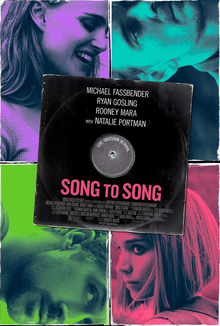
Film Review: Song to Song (dir by Terrence Malick)


You’re watching a movie called Song to Song.  It’s about beautiful people in a beautiful city.

In this case, the city is Austin, Texas.  The people are all involved in the Austin music scene and they’re played by actors like Ryan Gosling, Rooney Mara, Natalie Portman, Michael Fassbender, and Cate Blanchett.  A good deal of Song to Song was filmed at the Austin City Limits festival and several real-life musicians appear as themselves, though only Patti Smith is on screen long enough to make much of an impression.  To be honest, both the music and Austin are almost incidental to the film.  Though the movie was sold as an Austin film and it premiered at SXSW, it could have just as easily taken place in Ft. Worth.

The film is made up of short, deliberately obscure shots.  The camera never stops moving, floating over images of sunsets, sunrises, and oddly empty streets.  Because the film was shot with a wide-angle lens, you’re never not aware of the expanse around the characters.  At times, all of those beautiful film stars run the risk of become specks on the landscape, as if the film itself is taunting the characters for thinking that they are more important than nature.

Who are the characters?  It’s not always easy to say.  There are plenty of voice overs but it’s rare that anyone directly states what they’re thinking or who they are.  When the characters speak to each other, they mumble.  The dialogue is a mix of the banal and the portentous, a sure sign of a film that was largely shot without a script.  Eventually, you turn on the captioning so that you can at least understand what everyone’s muttering.

Michael Fassbender plays Cook.  Cook appears to be a music producer but he could just as easily be a businessman who enjoys hanging out with and manipulating aspiring stars.  People seem to know him but nobody seems to be particularly impressed by him.  Cook spends a lot of time standing in front of a pool.  Is it his pool?  Is it his house? It’s hard to say.  Cook is obsessed with control or maybe he isn’t.  Halfway through the film, Fassbender appears to turn into his character from Shame.

Ryan Gosling is BV.  BV appears to be a lyricist, though it’s never made clear what type of songs that he writes.  At one point, you think someone said that he had written a country song but you may have misheard.  BV appears to have an estranged relationship with his dying father.  BV may be a romantic or he may not.  He seems to fall in love easily but he spends just as much time staring at the sky soulfully and suggesting that he has a hard time with commitment.  BV appears to be Cook’s best friend but sometimes, he isn’t.  There’s a random scene where BV accuses Cook of cheating him.  It’s never brought up again.

Rooney Mara is Faye.  Faye contributes most of the voice overs and yet, oddly, you’re never sure who exactly she is.  She appears to be BV’s girlfriend and sometimes, she appears to be Cook’s girlfriend.  Sometimes, she’s in love and then, just as abruptly, she’s not.  She may be a singer or she may be a songwriter.  At one point, she appears to be interviewing Patty Smith so maybe she’s a music journalist.  The film is centered around her but it never makes clear who she is.

Natalie Portman is Rhonda.  Rhonda was a teacher but now she’s a waitress.  She might be religious or she might not.  She might be married to Cook or she might not.  Her mother (Holly Hunter) might be dying or she might not.

And there are other beautful people as well.  Cate Blanchett plays a character named Amanda.  Amanda has a relationship with one of the characters and then vanishes after four scenes.  There’s an intriguing sadness to Blanchett’s performance.  Since the first cut of Song to Song was 8 hours long, you can assume her backstory was left on the cutting room floor.  (And yet strangely, it works that we never know much about who Amanda is.)  Lykke Li shows up, presumably playing herself but maybe not.  Berenice Marlohe and Val Kilmer also have small roles, wandering in and out of the character’s lives.

There’s a lot of wandering in this movie.  The characters wander through their life, stopping only to kiss each other, caress each other, and occasionally stare soulfully into the distance.  The camera seems to wander from scene to scene, stopping to occasionally focus on random details.  Even the film’s timeline seems to wander, as you find yourself looking at Rooney Mara’s forever changing hair and using it as a roadmap in your attempt to understand the film’s story.

“I went through a period when I thought sex had to be violent,” Rooney Mara’s voice over breathlessly explains, “We thought we could just roll and tumble, live from song to song, kiss to kiss.”

As you watch Song to Song, you find yourself both intrigued and annoyed.  This is a Terrence Malick film, after all.  You love movies so, of course, you love Malick.  Even if his recent films have been flawed and self-indulgent, he is a true original.  You want to support him because he’s an artist but, as you watch Song to Song, the emphasis really does seem to be on self-indulgence.  The images are beautiful but the characters are so empty and the voice overs are so incredibly pretentious.  Should you be mad or should you be thankful that, in this time of cinematic blandness, there’s a director still willing to follow his own vision?

At times, Song to Song is brilliant.  There are images in Song to Song that are as beautiful as any that Malick has ever captured.  Sometimes, both the images and the characters are almost too beautiful.  The music business is tough and dirty but all of the images in Song to Song are clean and vibrant.

At times, Song to Song is incredibly annoying.  It’s hard not to suspect that the film would have worked better if Natalie Portman and Rooney Mara had switched roles.  Mara can be an outstanding actress with the right director (just check out her performance in Carol) but, in Song to Song, her natural blandness makes it difficult to take her seriously as whoever she’s supposed to be.  Portman has much less screen time and yet creates an unforgettable character.  Mara is in 75% of the film and yet never seems like an active participant.

At times, the film is annoyingly brilliant.  Malick’s self-indulgence can drive you mad while still leaving you impressed by his commitment to his vision.

And then, other times, the film is brilliantly annoying.  Many directors have mixed overly pretty images with pretentious voice overs but few do so with the panache of Terrence Malick.

Even fans of Terrence Malick, of which I certainly am one, will probably find Song to Song to be his weakest film.  Even compared to films like To The Wonder and Knight of Cups, Song to Song is a slow movie and there are moments that come dangerously close to self-parody.  Unlike Tree of Life, where everything eventually came together in enigmatic poignance, Song to Song often feels like less than the sum of its parts.  And yet, I can’t totally dismiss anything made by Terrence Malick.  Song to Song may be empty but it’s oh so pretty.


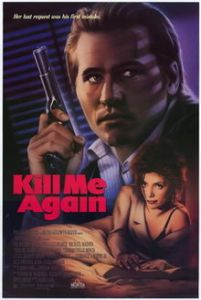
A Movie A Day #19: Kill Me Again (1989, directed by John Dahl)


killmeagainFay Forrest (Joanne Whalley) and her boyfriend, Vince Miller (Michael Madsen), make their living stealing from the mob.  After their latest job results in the death of a made man, Fay decides that she needs to escape from the abusive Vince.  She runs away to Las Vegas, where she looks up a small-time, financially strapped P.I., Jack Andrews (Val Kilmer).  She hires Jack to help her fake her death, offering to pay him $5,000 upfront and $5,000 after she’s dead.  Jack is reluctant to get involved but he also has a loan shark threatening to break every bone in his body.  Jack helps Fay fake her death but then Fay leaves town without paying him the second $5,000.  Even worse, both Vince and the mob quickly figure out that Fay is not actually dead and join Jack in trying to track her down.
Predictable but entertaining, Kill Me Again is an early example of the type of modern neo-noir that would become extremely popular in the 1990s.  In his directorial debut, John Dahl shows some hints of the style that he later brought to films like Red Rock West and The Last Seduction.  Val Kilmer was miscast and a few years too young for his role but Joanne Whalley (or Joanne Whalley-Kilmer as she was known when Kill Me Again was filmed) fully inhabitanted the stock role of the sultry femme fatale who can never quite be trusted.  Michael Madsen goes all out as Vince, giving an early version of his performance in Reservoir Dogs.


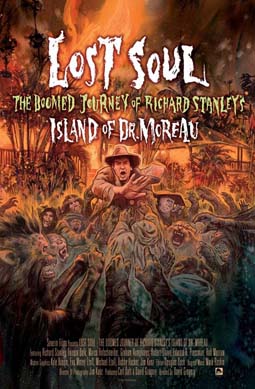
The Things You Find On Netflix: Lost Soul: The Doomed Journey of Richard Stanley’s The Island of Dr. Moreau


lostsoul

I have never actually seen the 1996 film The Island of Dr. Moreau but I certainly have read a lot about it.

It’s one of those films that seems to get mentioned whenever film critics start talking about the worst films of all time and, as a result, the story of the film’s production has become legendary.  The film’s shoot was difficult, for reasons of both nature and human nature.  The film was shot in the inhospitable Australian rain forest and shooting was briefly shut down due to a sudden hurricane.   Richard Stanley, the original director, was unceremoniously fired by New Line Cinema and apparently proceeded to go native in the Australian wilderness, smoking a huge amount of weed while the studio executives feared that he would return and burn down the set.  Veteran director John Frankenheimer was brought in to finish the film and clashed immediately with the film’s notoriously eccentric and difficult stars, Val Kilmer and Marlon Brando.

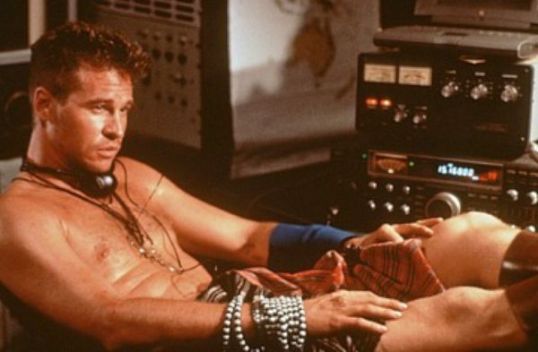
And I have to admit that, every time I read about The Island of Dr. Moreau, there’s a part of me that wants to track down and watch this film and see how bad it could possibly be.  But, every time I find myself too tempted, I think about a shirtless Val Kilmer lounging around in a kilt and I quickly change my mind.

Val

Bleh!

Fortunately, if I want to get a feel for the insanity behind the film’s production, I no longer have to actually watch The Island of Dr. Moreau.  Instead, I can just get on Netflix and watch an entertaining documentary called Lost Soul: The Doomed Journey of Richard Stanley’s The Island of Dr. Moreau.

Lost Soul could have just as easily been called Everybody Hates Val Kilmer.  Val himself declined to be interviewed for the documentary and I have to say that I think that was a huge mistake on his part because literally everyone who did agree to be interviewed appears to absolutely despise Val Kilmer.  It’s not so much that everyone tells a story about Val’s bad behavior as much as the fact that, decades later, everyone still seems to be so traumatized by the experience of having been  anywhere near him.  (German actor Marco Hofschnieder especially seems to take a lot of delight in doing a devastating yet hilarious imitation of Val Kilmer smoking a cigarette and complaining about every line of dialogue, regardless of whether it was his dialogue or not.)

The documentary also includes plenty of crazy Marlon Brando stories but there’s a noticeable difference between the Brando stories and the Kilmer stories.  Brando is portrayed as being an almost tragic figure, a great actor who hated his talent and, as a result, went out of his way to give performances that mocked the very idea of even trying to be good.  As annoyed as everyone seems to have gotten with Brando, there’s still an undercurrent of affection to the Brando stories.  That’s something that is definitely lacking from the Kilmer stories.

(According to the documentary, Brando was not a Val Kilmer fan.  When Kilmer asked Brando if he had visited the Australian reef, Brando replied, “I own a reef,” and reportedly didn’t speak to Kilmer for the rest of the shoot.)

As interesting as the stories about Brando and Kilmer may be, the heart of the film rests with Richard Stanley, the promising young South African director whose brief “mainstream” film career was pretty much derailed by the drama surrounding The Island of Dr. Moreau.  Interviewed at his home in France and captivating the audience with both his intense stare and his mordant sense of humor, Richard Stanley describes both his vision for The Island of Dr. Moreau and the pain of having that vision snatched away from him.  Not only does he confirm that, as has long been rumored, he did sneak back onto the set as an extra but he also explains that the production’s problems were largely due to a mishap involving a warlock named Skip.

Lost Soul makes for an interesting cautionary tale about what happens when an artist has to deal with the establishment.  Watch it with Jodorowsky’s Dune and have yourself a double feature of “what could have been” cinema.

Film Review: Palo Alto (dir by Gia Coppola)


Palo Alto came out in May of last year and it never quite got as much attention as it deserved.  A lot of that is because the film is based on a collection of short stories by James Franco and a lot of critics apparently decided ahead of time that Palo Alto was some sort of vanity project.

Of course, nothing could be further from the truth.  Palo Alto is actually one of the better films of 2014, a minor masterpiece of ennui that also serves as a promising directorial debut for Gia Coppola.  (Of course, Gia’s aunt Sofia made her directorial debut with an ennui-centric literary adaptation of her own, The Virgin Suicides.)

Palo Alto follows several teenagers over the course of one school year.  (It’s no coincidence that, at one point, Fast Times At Ridgemont High shows up on a TV screen.)  The film itself is deceptively plotless, with its occasionally drifting narrative mirroring the lives of protagonists who literally have no direction.  April (Emma Roberts), who is too intelligent to really fit in with either her shallow friends or her flakey family, plays soccer and has a crush on both Teddy (Jack Kilmer) and her coach, Mr. B (James Franco, playing an unapologetically sleazy character).  Teddy is a talented artist who, after a drunk driving accident, finds himself on probation and sentenced to do community service.  Making it difficult for Teddy to stay out of trouble is his best friend, Fred (Nat Wolff), who hides his sociopathic nature behind a constant stream of jokes.  And then there’s Emily (Zoe Levin), who hides her insecurities behind a wall of blow jobs and demeaning sexual encounters.

As for the adults of Palo Alto, they’re for the most part a collection of grim but ineffective authority figures and parents who don’t want to grow up.  Mr. B hides his predatory nature behind a kind smile and a paternal nature.  April’s stepfather (Val Kilmer) is permanently stoned.  Teddy’s mother is unconcerned with her son’s drinking.  Meanwhile, Fred’s father (Chris Messina) offers weed to and hits on his son’s friends.

And it may all sound a bit familiar.  Every year, it seems like there is a countless number of indie films about directionless teenagers and irresponsible parents.  But Palo Alto is distinguished by Gia Coppola’s confident and frequently surreal direction.  Coppola has a good eye for detail and, as a result of the gorgeous cinematography of Autumn Durald, the film is always interesting to watch regardless of how familiar the story may seem.  The entire cast does a good job as well, with Emma Roberts and Nat Wolff as clear stand-outs.

And, I have to admit, that on a personal level, there was a lot of Palo Alto to which I related.  Whether it was the awkward conversations between April and Teddy or the sad look on Emily’s face as she stared at her reflection, there were so many small moments that just felt true.  As I watched Palo Alto, it was impossible for me not to think about my own time in high school.  I knew quite a few Teddys.  I even knew a few Freds.  And sometimes, I was April and then other times, I could have been any of the other characters who wander throughout Palo Alto.

Don’t listen to the haters.  Palo Alto is more than worth your time.

Scenes I Love: Tombstone


Tombstone

Weekend was busy, but still found time to catch a few favorite flicks on TV. One of these happened to be the classic early 90’s western Tombstone starring Kurt Russell and Val Kilmer. I already profiled my favorite scene from this film awhile back, but as I watched the film again I realized there was another sequence that totally made the film for me.

So, the latest “Scenes I Love’ once again comes from Tombstone and it does a great job in showing the darker and vengeful side of Wyatt Earp as played by Kurt Russell. The first scene I loved about this film was more about the cool, calm and badass Wyatt Earp who can spot a bullshitter, blowhard, coward from a miles away. This scene shows Earp in his scary, God’s Wrath mode as he begins his vendetta ride against the Clantons and the Cowboys.

Just love the look of fire and brimstone from Russell’s eyes as he confronts a cowed Ike Clanton and lets him know what he has planned for his clan and group. Better yet, in addition to Kilmer’s Doc Holliday, we also see a younger Michael Rooker aka Merle Dixon. He plays one of the members in Earp’s posse.

Scenes I Love: The Shootout from Michael Mann’s “Heat”.


The shootout in Michael Mann’s “Heat” (1995) remains one of the best ever filmed, in my opinion. Mann himself even tried topping it in Miami Vice (which is good in it’s own right), but this scene (which occurs some minutes in) is so loved, Rockstar Games actually developed a mission in Grand Theft Auto 4 to mimic it.

A group of bank robbers, led by Neal McCauley (Robert DeNiro) finally take down their score, only to find that the police squad out to get them has been tipped off. The video starts as the robbery begins. Vincent Hanna (Al Pacino), along with his team arrive just as the crew is coming out of the bank with the money. The rest is mayhem, with the gunfire sounds echoing all around. Elliot Goldenthal’s score for the piece sets the tone for the robbery, a piece called Force Marker (along with Brian Eno).

What I wouldn’t give to catch this in a theatre somewhere. Enjoy.

Scenes I Love: Tombstone


Kurt Russell I consider one of the biggest badasses of Hollywood and his work in 1993’s Tombstone showed just how much a badass he was and still is.

This scene from that film was one of the best scenes in the entire film. It shows Russell channeling his inner-Wyatt Earp and bitchslapping Billy Bob Thornton (who probably deserves it both in and out of this film). I just love how his demeanor was so confident and how well he judged Thornton’s character as nothing but a blowhard and a bully. This scene even has some killer lines from Russell. How often have we wished we could do what he did in this scene to our own douchebag bosses at work. I know I have imagined it many times.

One cool thing about this scene is how it doesn’t end in the saloon, but continues outside with Val Kilmer just killing it as Doc Holliday. Love how Doc and the Earp’s just ignore Thornton’s Johnny Tyler and how he just stands there looking like the idiot he is. Good thing he said thank you in the end or he may have just gotten another bitchslap session from Wyatt.

Some people love this film. Some people don’t like this film, but I’d be hardpressed to find anyone who didn’t think this scene was the epitome of cool and badassery.

10 Unacknowledged Christmas Classics


It’s December and that means that it’s the Christmas season and that can only mean an abundance of Christmas movies both at movie theaters and on television.  This Christmas movie has even become a genre in a way that the Thanksgiving movie or the Bank Holiday movie never has.

I love the Christmas season because 1) it’s one of the few times that there’s half a chance of seeing snow in Texas, 2) it gives me an excuse to bond with family, and 3) I get lots of presents.  And I enjoy Christmas movies so much that I can pretty much quote every line from It’s A Wonderful Life from memory.  I’ve even been known to enjoy the holiday movie marathons that pop up on the Lifetime Movie Network (especially if they feature Jeff Fahey and his bluer than blue eyes).  However, my favorite Christmas movie remains the original Miracle on 34th Street because Natalie Wood was one of my mom’s favorite actresses and Miracle was one of her favorite films.

However, in this post, I want to highlight 10 movies that have either been overlooked in the past or else films that, while properly acknowledged as classics, are rarely mentioned as being Christmas films.

1) In Bruges (2008)  — Two Irish hitman (Colin Farrell and Brendan Gleeson, both wonderful) hide out in Belgium during the Christmas holiday.  I love this film for so many reason but I have to specifically mention the performance of Ralph Fiennes, who plays an English crime boss with a foul mouth, a murderous personality, and a firmly held set of ethics.

2) Brazil (1985) — One reason why I love Terry Gilliam’s dark satire is because I actually have quite a bit in common with it.  We’re both often misunderstood, we’re both pretty to look at, and we were both released in 1985.  While Brazil is now often acknowledged as one of the best and most imaginative films of the last century, it’s often forgotten that all of this film’s action takes place over the Christmas season.  If you’ve never seen Brazil, see it now.  But be aware that you’ll never look at Michael Palin quite the same way again.

3) Three Days of The Condor (1975) — This espionage thriller (which stars a young, pre-Leatherface Robert Redford) skillfully contrasts cold-blooded violence with the bright outer happiness of the Christmas season.

4) Eyes Wide Shut (2000) — Stanley Kubrick’s final film is a tribute to MK-Ultra conspiracy theories and features rich people trying to be kinky during the Christmas season.  Nicole Kidman does redheads proud with her performance here and we get to see Tom Cruise smoke pot.

5) P2 (2007) — Rachel Nichols is trapped in a parking garage on Christmas Eve by a very scary Wes Bentley.  I have to admit that I’ve always had a morbid fear of either dying, getting seriously injured, or disappearing on Christmas Eve and therefore ruining the holiday for my family.  I guess that’s why P2 resonated with me.

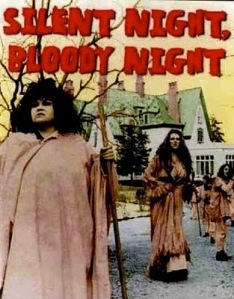
6) Silent Night, Bloody Night (1974) — No, this is not a killer Santa film.  This is the film where a bunch of former Warhol superstars (Ondine and Candy Darling being the most prominent) play a bunch of mental patients who massacre their doctors in a disturbing, sepia-toned sequence.  Years later, on Christmas, another former Warhol superstar — the wonderful Mary Woronov — comes to investigate.  This is actually a fairly good film from director Theodore Gershuny.

7) Christmas Evil (1980) — Now this is a killer Santa film.  Harry is a loser who works in a toy factory but he’s obsessed with Christmas because, when he was a child, he saw mommy humping Santa Claus.  (Isn’t that a song?)  So, one Christmas, Harry dresses up like Santa and goes around killing neglectful parents and others who don’t have the Christmas spirit.  This is an oddly sweet film with an ending that brought very sincere tears to my eyes.

8 ) To All A Good Night (1980) — Okay, this is another killer Santa film and it’s one of those early ’80s slashers where everyone dies because they’re total and complete idiots but two things distinguish this film from other Killer Santa slasher films: 1) it features not one but two psycho Santas and the movie was directed by David Hess, star of Last House On The Left and The House On The Edge of the Park.

9) The Silent Partner (1978) —  However, the greatest of all killer Santas is to be found in this Canadian crime thriller.  Christopher Plummer plays a psycho bank robber who — disguised as Santa — robs a bank.  Elliot Gould plays a lonely bank clerk who uses the robbery as an excuse to steal some cash for himself which leads to Plummer eventually coming after him.  Plummer makes the scariest Saint Nick ever!

10) Kiss Kiss Bang Bang (2005) — This is pure grindhouse brilliance, a dark comedy and a metafictional satire disguised an action movie.  Robert Downey, Jr. is a small-time criminal who accidentally becomes a film star and ends up investigating a murder with a hard-boiled PI (a surprisingly self-aware performance from Val Kilmer).  And it all takes place during the holidays.