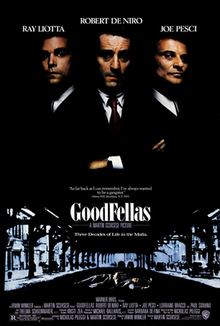
Lisa Marie Reviews An Oscar Nominee: Goodfellas (dir by Martin Scorsese)


First released in 1990 and continuously acclaimed ever since, Goodfellas did not win the Oscar for Best Picture.

I’m always a bit surprised whenever I remember that.  Goodfellas didn’t win Best Picture?  That just doesn’t seem right.  It’s not the other films nominated that year were bad but Goodfellas was so brilliant that it’s hard to imagine someone actually voting for something else.  Seriously, it’s hard to think of a film that has been more influential than Goodfellas.  Every gangster film with a soundtrack of kitschy tunes from the 6os and 70s owes huge debt to Goodfellas.  Every actor who has ever been cast as a wild and out-of-control psycho gangster owes a debt to Joe Pesci’s performance as Tommy DeVito.  When Ray Liotta passed away two years ago, we all immediately heard him saying, “I always wanted to be a gangster.”  Robert De Niro’s Jimmy Conway remains the epitome of the ruthless gangster.  For many, Paul Sorvino’s neighborhood godfather redefined what it meant to be a crime boss.  Lorraine Bracco made such an impression as Karen Hill that it somehow seemed appropriate that she was one of the first people cast in The Sopranos, a show that itself would probably have not existed if not for Goodfellas.  Frank Sivero, Samuel L. Jackson, Tobin Bell, Debi Mazer, Vincent Gallo, Ileana Douglas, Frank Vincent, Tony Sirico, Michael Imperioli, Tony Darrow, Mike Starr, Chuck Low, all of them can be seen in Goodfellas.  It’s a film that many still consider to be the best of Martin Scorsese’s legendary career.  Who can forget Robert De Niro smoking that cigarette while Sunshine of Your Love blared on the soundtrack?  Who can forget “Maury’s wigs don’t come off!” or “Rossi, you are nothing but whore!?”  Who can forget the cheery Christmas music playing in the background while De Niro’s Jimmy Conway grows more and more paranoid after pulling off the biggest heist of his career?
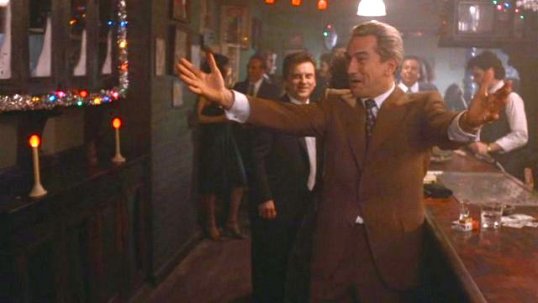
Plus, it’s a Christmas movie!

And yet, it did not win Best Picture.

Myself, whenever I’m sitting behind a garbage truck in traffic, I immediately start to hear the piano coda from Layla.  For that matter, whenever I see a helicopter in the sky, I flash back to a coke-addled Henry Hill getting paranoid as he tries to pick up his brother from the hospital.  Whenever I see someone walking across the street in the suburbs, I remember the scene where Henry coolly pistol-whips the country club guy and then tells Karen to hide his gun.  I always remember Karen saying that she knows that many of her best friends would have run off as soon as their boyfriend gave them a gun to hide but “it turned me on.”  It would have turned me on as well.  Henry might be a gangster and his friends might be murderers but he doesn’t make any apologies for who he is, unlike everyone else in the world.

But it did not win Best Picture.

How many people have imitated Joe Pesci saying, “How am I funny?”  How many times did Pesci and Frank Vincent have to listen to people telling them to “go home and get your fucking shinebox?”  A lot of people remember the brutality of the scene where Pesci and De Niro team up to attack Vincent’s crude gangster but I always remember the sound of Donavon’s Atlantis playing on the soundtrack.
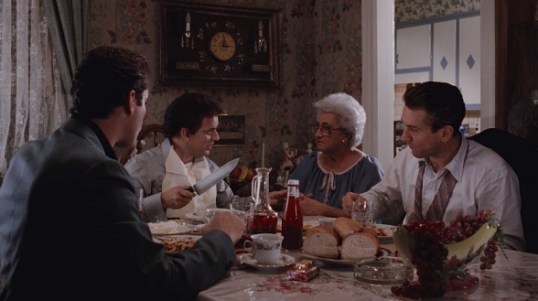
And then there’s Catherine Scorsese, showing up as Tommy’s mom and cooking for everyone while Vincent struggles to escape from the trunk of a car.  “He is content to be a jerk,” Tommy says about Henry Hill.  Just a few hours earlier, Tommy was apologizing to Henry for getting blood on his floor.

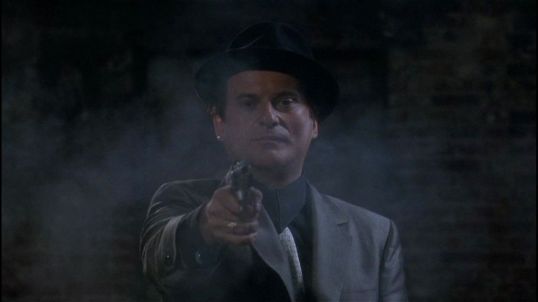
Goodfellas is a fast-paced look at organized crime, spanning from the 50s to the early 80s.  Ray Liotta plays Henry Hill, who goes from idolizing gangsters to being a gangster to ultimately fearing his associates after he gets busted for dealing drugs.  It’s a dizzying film, full of so many classic scenes and lines that it feels almost pointless to try to list them all here or to pretend like whoever is reading this review doesn’t remember the scene where the camera pans through the club and we meet the members of the crew.  (“And then there was Pete The Killer….”)  Goodfellas is a film that spend two hours showing us how much fun being a gangster can be and then thirty minutes showing us just how bad it can get when you’re high on coke, the police are after you, and you’ve recently learned that your associates are willing to kill even their oldest friends.  No matter how many times I watch Goodfellas, I always get very anxious towards the end of the film.  With the music pounding and the camera spinning, with Henry looking for helicopters, and with all of his plans going wrong over the course of one day, it’s almost a relief when Bo Dietl points that gun at Henry’s head and yells at him, revealing that Henry has been captured by the cops and not the Gambinos.  Karen desperately running through the house, flushing drugs and hiding a gun in her underwear, always leaves me unsettled.  It’s such a nice house but now, everything is crashing down.

There’s a tendency to compare Goodfellas to The Godfather, as their both films that re-imagine American history and culture through the lens of the gangster genre.  I think they’re both great but I also think that they are ultimately two very different films.  If The Godfather is sweeping and operatic, Goodfellas is the film that reminds us that gangsters also live in the suburbs and go to cookouts and that their wives take care of the kids and watch movies while the FBI searches their home.  If The Godfather is about the bosses, Goodfellas is about the blue collar soldiers.  The Godfather represents what we wish the Mafia was like while Goodfellas represents the reality.
Goodfellas is one of the greatest films ever made but it lost the Best Picture Oscar to Dances With Wolves, a film that left audiences feeling good as opposed to anxious.  To be honest, Martin Scorsese losing Best Director to Kevin Costner feels like an even bigger injustice than Goodfellas losing Best Picture.  One can understand the desire to reward Dances With Wolves, a film that attempts to correct a decades worth of negative stereotypes about Native Americans.  But Scorsese’s direction was so brilliant that it’s truly a shame that he didn’t win and that Lorraine Bracco didn’t win Best Supporting Actress.  It’s also a shame that Ray Liotta wasn’t nominated for playing Henry Hill.  At least Joe Pesci won an Oscar for redefining what it meant to be a gangster.

Goodfellas is proof that the best film doesn’t always win at the Oscars.  But it’s also proof that a great film doesn’t need an Oscar to be remembered.
Weekly Trailer Round-Up: Roma, Green Book, An Evening With Beverly Luff Linn, Widows, Killer Kate


In 2014, Alfonso Cuaron made history win he became the first Mexican filmmaker to win the Academy Award for Best Director, for his work on Gravity.  This year, Cuaron is back with Roma, a 135-minute film about a middle class family living in Mexico City in the 1970s.  Roma will be released on December 14th and its trailer leads off this week’s trailer round-up.

http://www.youtube.com/watch?v=fp_i7cnOgbQ

Directed by Peter Farrelly, Green Book, is based on the true story of Jamaican pianist Don Shirley’s tour of the deep south.  Serving as his chauffeur and bodyguard was a New York bouncer named Tony Lip.  Shirley is played by Mahershala Ali while Viggo Mortensen play the role of Lip.  (The real Tony Lip later became an actor and played Carmine Lupertazzi in The Sopranos).  Green Book will be released on November 21st.

Judging from the trailer, An Evening With Beverly Luff Linn appears to be a typical heist comedy, enlivened by the presence of Aubrey Plaza.  Prepare to spend an evening with Beverly when this film is released on October 19th.

Based on a BBC miniseries and featuring a killer cast, Steve McQueen’s Widows is one of the most anticipated movies of the fall.  Widows will be in theaters on November 16th.

Finally, Killer Kate will be released on October 26th, just in time for Halloween.

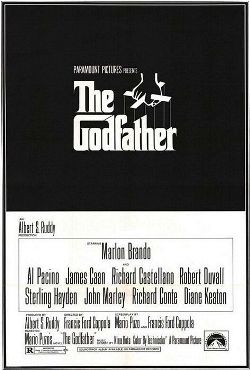
Shattered Politics #31: The Godfather (dir by Francis Ford Coppola)


Godfather_ver1

“I got something for your mother and Sonny and a tie for Freddy and Tom Hagen got the Reynolds Pen…” — Kay Adams (Diane Keaton) in The Godfather (1972)

It probably seems strange that when talking about The Godfather, a film that it is generally acknowledged as being one of the best and most influential of all time, I would start with an innocuous quote about getting Tom Hagen a pen.

(And it better have been a hell of a pen because, judging from the scene where Sollozzo stops him in the street, it looked like Tom was going all out as far as gifts were concerned…)

After all, The Godfather is a film that is full of memorable quotes.  “Leave the gun.  Take the cannoli.”  “I’m going to make him an offer he can’t refuse.”  “It’s strictly business.”  “I believe in America….”  “That’s my family, Kay.  That’s not me.”

But I went with the quote about the Reynolds pen because, quite frankly, I find an excuse to repeat it every Christmas.  Every holiday season, whenever I hear friends or family talking about presents, I remind them that Tom Hagen is getting the Reynolds pen.  Doubt me?  Check out these tweets from the past!

[tweet https://twitter.com/LisaMarieBowman/status/411891527837687810  ]

[tweet https://twitter.com/LisaMarieBowman/status/280387983444697088 ]

That’s how much I love The Godfather.  I love it so much that I even find myself quoting the lines that don’t really mean much in the grand scheme of things.  I love the film so much that I once even wrote an entire post about who could have been cast in The Godfather if, for whatever reason, Brando, Pacino, Duvall, et al. had been unavailable.  And I know that I’m not alone in that love.

But all that love also makes The Godfather a difficult film to review.  What do you say about a film that everyone already knows is great?

Do you praise it by saying that Al Pacino, Robert Duvall, James Caan, Diane Keaton, Marlon Brando, John Cazale, Richard Castellano, Abe Vigoda, Alex Rocco, and Talia Shire all gave excellent performances?  You can do that but everyone already knows that.

Do you talk about how well director Francis Ford Coppola told this operatic, sprawling story of crime, family, and politics?  You can do that but everyone already knows that.

Maybe you can talk about how beautiful Gordon Willis’s dark and shadowy cinematography looks, regardless of whether you’re seeing it in a theater or on TV.  Because it certainly does but everyone knows that.

Maybe you can mention the haunting beauty of Nina Rota’s score but again…

Well, you get the idea.

Now, if you somehow have never seen the film before, allow me to try to tell you what happens in The Godfather.  I say try because The Godfather is a true epic.  Because it’s also an intimate family drama and features such a dominating lead performance from Al Pacino, it’s sometimes to easy to forget just how much is actually going on in The Godfather.

The Godfather tells the story of the Corleone Family.  Patriarch Vito Corleone (Marlon Brando) has done very well for himself in America, making himself into a rich and influential man.  Of course, Vito is also known as both Don Corleone and the Godfather and he’s made his fortune through less-than-legal means.  He may be rich and he may be influential but when his daughter gets married, the FBI shows up outside the reception and takes pictures of all the cars in the parking lot.  Vito Corleone knows judges and congressmen but none of them are willing to be seen in public with him.  Vito is the establishment that nobody wants to acknowledge and sometimes, this very powerful man wonders if there will ever be a “Governor Corleone” or a “Senator Corleone.”

Vito is the proud father of three children and the adopted father of one more.  His oldest son, and probable successor, is Sonny (James Caan).  Sonny, however, has a temper and absolutely no impulse control.  While his wife is bragging about him to the other women at the wedding, Sonny is upstairs screwing a bridesmaid.  When the enemies of the Corleone Family declare war, Sonny declares war back and forgets the first rule of organized crime: “It’s not personal.  It’s strictly business.”

After Sonny, there’s Fredo (John Cazale).  Poor, pathetic Fredo.  In many ways, it’s impossible not to feel sorry for Fredo.  He’s the one who ends up getting exiled to Vegas, where he lives under the protection of the crude Moe Greene (Alex Rocco).  One of the film’s best moments is when a bejeweled Fredo shows up at a Vegas hotel with an entourage of prostitutes and other hangers-on.  In these scenes, Fred is trying so hard but when you take one look at his shifty eyes, it’s obvious that he’s still the same guy who we first saw stumbling around drunk at his sister’s wedding.

(And, of course, it’s impossible to watch Fredo in this film without thinking about both what will happen to the character in the Godfather, Part II and how John Cazale, who brought the character to such vibrant life, would die just 6 years later.)

As a female, daughter Connie (Talia Shire) is — for the first film, at least — excluded from the family business.  Instead, she marries Sonny’s friend Carlo Rizzi (Gianni Russo).  And, to put it gently, it’s not a match made in heaven.

And finally, there’s Michael (Al Pacino).  Michael is the son who, at the start of the film, declares that he wants nothing to do with the family business.  He’s the one who wants to break with family tradition by marrying Kay Adams (Diane Keaton), who is most definitely not Italian.  He’s the one who was decorated in World War II and who comes to his sister’s wedding still dressed in his uniform.  (In the second Godfather film, we learn that Vito thought Michael was foolish to join the army, which makes it all the more clear that, by wearing the uniform to the wedding, Michael is attempting to declare his own identity outside of the family.)  To paraphrase the third Godfather film, Michael is the one who says he wants to get out but who keeps getting dragged back in.

And finally, the adopted son is Tom Hagen (Robert Duvall).  Tom is the Don’s lawyer and one reason why Tom is one of my favorite characters is because, behind his usual stone-faced facade, Tom is actually very snarky.  He just hides it well.

Early on, we get a hint that Tom is more amused than he lets on when he has dinner with the crude Jack Woltz (John Marley), a film producer who doesn’t want to use Johnny Fontane (Al Martino) in a movie  When Woltz shouts insults at him, Tom calmly finishes his dinner and thanks him for a lovely evening.  And he does it with just the hint of a little smirk and you can practically see him thinking, “Somebody’s going to wake up with a horse tomorrow….”

However, my favorite Tom Hagen moment comes when Kay, who is searching for Michael, drops by the family compound.  Tom greets her at the gate.  When Kay spots a car that’s riddled with bullet holes, she asks what happened.  Tom smiles and says, “Oh, that was an accident.  But luckily no one was hurt!”  Duvall delivers the line with just the right attitude of “That’s my story and I’m sticking to it!”  How can you not kind of love Tom after that?

And, of course, the film is full of other memorable characters, all of whom are scheming and plotting.  There’s Clemenza (Richard S. Catellano) and Tessio (Abe Vigoda), the two Corleone lieutenants who may or may not be plotting to betray the Don.  There’s fearsome Luca Brasi (Lenny Montana), who spends an eternity practicing what he wants to say at Connie’s wedding and yet still manages to screw it up.  And, of course, there’s Sollozzo (Al Lettieri, playing a role originally offered to Franco Nero), the drug dealer who reacts angrily to Vito’s refusal to help him out.  Meanwhile, Capt. McCluskey (Sterling Hayden) is busy beating up young punks and Al Neri (Richard Bright) is gunning people down in front of the courthouse.  And, of course, there’s poor, innocent, ill-fated Appollonia (Simonetta Stefanelli)…

The Godfather is a great Italian-American epic, one that works as both a gangster film and a family drama.  Perhaps the genius of the Godfather trilogy is that the Corleone family serves as an ink blot in a cinematic rorschach test.  Audiences can look at them and see whatever they want.  If you want them and their crimes to serve as a metaphor for capitalism, you need only listen to Tom and Michael repeatedly state that it’s only business.  If you want to see them as heroic businessmen, just consider that their enemies essentially want to regulate the Corleones out of existence.  If you want the Corleones to serve as symbols of the patriarchy, you need only watch as the door to Michael’s office is shut in Kay’s face.  If you want to see the Corleones as heroes, you need only consider that they — and they alone — seem to operate with any sort of honorable criminal code.  (This, of course, would change over the course of the two sequels.)

And, if you’re trying to fit a review of The Godfather into a series about political films, you only have to consider that Vito is regularly spoken of as being a man who carries politicians around in his pocket.  We may not see any elected officials in the first Godfather film but their presence is felt.  Above all else, it’s Vito’s political influence that sets in motion all of the events that unfold over the course of the film.

The Godfather, of course, won the Oscar for best picture of 1972.  And while it’s rare that I openly agree with the Academy, I’m proud to say that this one time is a definite exception.