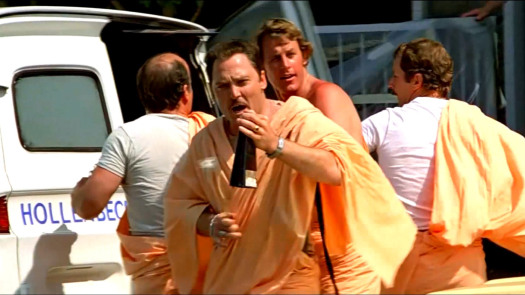
(I recorded the 1986 film, Wisdom, off of Retroplex on Mary 1st.)
(SPOILER ALERT! The ending of this film is so extremely stupid that there’s no way I’m not going to discuss it in this review.)
Meet John Wisdom (Emilio Estevez)!
He’s got one of those ironic names, as people in pretentious movies often do. He’s extremely naive but his name is Wisdom. He does a lot of stupid crap but his name is Wisdom. And I guess the audience is meant to feel that Wisdom understands more than even he knows.
Or something like that.
Who knows?
Anyway, John Wisdom has got some issues. He’s a college dropout who can’t get a good job because he has a criminal record. He didn’t really do anything wrong, of course. All he did was steal a car on the night of his high school graduation. Hey, who hasn’t done that? Anyway, Wisdom would be happy to just spend all day sitting around in his bathtub but his father (Tom Skerritt) insists that Wisdom find some sort of employment.
Eventually, Wisdom ends up working in a fast food restaurant. It turns out that he’s not very good at it, which leads me to suspect that Wisdom probably wouldn’t be very good at any of the other jobs that he was pursuing either. To be honest, the main reason that Wisdom works at the restaurant is so that Charlie Sheen can have a cameo as Wisdom’s boss.
(Strangely, Martin Sheen is nowhere to be found in the movie. It wouldn’t surprise me if Emilio Estevez — who both directed and wrote the script — originally envisioned Martin playing his father. Tom Skerritt does an extended Martin Sheen impersonation as Daddy Wisdom.)
Anyway, Wisdom decides that since the system refuses to give him a fair chance, he’s going to live the rest of his life as an outlaw. So, Wisdom starts to rob banks. However, instead of stealing all of the money, Wisdom is more interested in setting fire to mortgage and loan records. Wisdom explains, via voice over, that he’s concerned about the working people who keeps getting screwed over by the banks. That’s all good and well but I thought the whole reason that Wisdom started robbing banks was because there was no other way for him to make any money. So, when did Wisdom go from being a greedy criminal to an altruistic rebel?
Naturally, Wisdom and his girlfriend, Karen (Demi Moore), becomes folk heroes. Everyone wants to meet Wisdom and protect him from the police. But eventually, Karen gets gunned down by a police helicopter. Poor Karen. She didn’t even want to rob banks. Well, actually, she did want to rob banks. And then she didn’t. And then she did again. Karen’s motivation and personality changes from scene-to-scene, largely because she’s a poorly written character. But no matter. She’s dead now.
But Wisdom’s still alive! Except, soon, he finds himself surrounded by cops. Standing in the middle of a football field (Oh my God! The symbolism!), Wisdom is gunned down by law enforcement…
…except suddenly, Wisdom’s back in the bathtub. Apparently, he was just daydreaming about his girlfriend getting gunned down in front of him. Wait … what? Seriously, what type of ending is that!? At the very least, the film could have ended with Wisdom robbing a bank for real and accepting that his dream is destined to come true. I mean, that would have been stupid but at least it would have been something. Instead, things end with Wisdom leaving the bathroom.
So, basically, the entire film was just Wisdom daydreaming about robbing banks and eventually getting gunned down on a football field. Oh, Wisdom. You got some issues, sweetie!
Emilio Estevez directed this film a year after appearing in The Breakfast Club. Like many directorial debuts, it’s incredibly dumb. You can tell that Estevez wasn’t sure what he wanted to say but he was still damn determined to say it. Why do so many actors end up directing such pretentious and/or boring movies? On the plus side, there were a few attempts at deliberate humor (Wisdom is not a particularly organized bank robber) and Demi Moore did a fairly good job playing an inconsistent character. Otherwise, Wisdom is mostly memorable for having one of the worst endings of all time.
Hey Man, if you dig crude, vulgar stoner comedy… wait, what was I saying? Oh yeah, Cheech and Chong, man. These two dudes were, like, really cool dudes, and made a lot of records and stuff, and… wait, what was I saying, man? OK, so Cheech and Chong were hippie culture’s answer to Abbott & Costello , and so popular they starred in a series of doper-themed movies, the first being UP IN SMOKE, a film basically about nothing except two burnouts trying to score some weed. C&C play their familiar personas of Pedro and Man, a pair of L.A. hippies floating their way through the world in a perpetual marijuana haze. . Sure, it’s uncouth, sophomoric, and defiantly non-PC, but had me laughing out loud forty years later!
The supporting cast features Stacy Keach as Sgt. Stedenko, a super-narc trying to stamp out drug use, and he’s a straight-edge riot…
Today is 4.26, also known as “Alien Day”, and named after the planet in James Cameron’s Aliens (LV-426 / Acheron). It’s a celebration of the entire Alien Franchise, but I’m only focused on the first film as I finally saw it in the theatre in 2017.
This isn’t so much a review as it’s just my history with Ridley Scott’s Alien. You can find actual reviews all over the internet, and I know very few people who didn’t enjoy the movie. This piece assumes you’ve seen the film and are familiar with it. There are also spoilers within, though with a nearly 40 year old film, I’m not sure if it can be classified as such.
When I was little, my older brother and I shared a room in my grandmother’s house. Below our bunk beds was a open space that contained a set of boxes and each box contained a collection of our toys – board games, knick knacks, things like that. If you needed something, you went under the bed to fetch it. Only thing is, I always reached into those boxes with my eyes closed.
I have a vague memory of when my older brother received 3 toys that affected the way I looked at things. The first was a board game for the movie Alien. On it, you had a map of the Nostromo, about 3 Astronaut pieces and one for the Alien. I can’t recall the exact nature of how it was played, but I do remember it having to do with finding a way to reach the Narcissus – the escape ship – before the Alien reached your character. Each player also had their own Alien they could use to hunt the other characters before they could escape.
The Alien Board Game. Fox marketed toys for Alien (an R rated film), possibly fearing the mistake they made with Star Wars.
The second was a movie viewer. I had to do some hunting around the net to find it, and thanks to The Toy Box, I was able to locate one. These viewers (made by Fisher Price and by Kenner) were really popular, especially after the Star Wars boom. You loaded it with a tape and it would play out a scene. For the Alien tape my brother had, it would play out the egg opening face hugger jump sequence. I rewound that too many times, and perhaps it’s the reason I’m afraid of spiders. I don’t really know for sure. The tape used below goes through most of the film’s plot, so if you haven’t watched the film by now, consider yourself spoiled.
The last toy was the reason I never went into the toy boxes. My brother owned an 18 Inch tall Alien figure, complete with a glow in the dark headpiece and a functional second set of teeth. It was one of the scariest things I’d seen as a kid.
All of this was thanks in part to Star Wars. With the mistake Fox made in giving the merchandising rights for Star Wars to Lucas and Lucasfilm, Ltd., they missed out a major chunk of revenue. So when Alien was set to launch 2 years later, they greenlit an entire toy line for the film, even though the movie was rated “R” and the toys demographic couldn’t really see the movie without parental supervision. For the time, that was a pretty amazing thing.
Back in the early 1980s, my father invited my older brother and I to his place to see Alien. I was about six or seven years old at the time, with my brother a few years older. My parents worked nights, so we pretty much lived with my grandmother. He was always into movies and he acquired a RCA Videodisc Player, along with that film and First Blood. Although I was sick, I still went and watched it. I vomited twice during the playthrough, but it was so worth it.
I’d come to find out years later from my Mom that my Dad really didn’t need to invite us. He was just too scared of the movie to watch it alone. According to family legend, Alien was a date movie for my parents, and halfway into the film, my Dad (along with most guys, I’ve heard), was using my Mom as a shield. Mind you, this was a guy who kept multiple firearms in the house and knew how to use them.
Alien was the brainchild of Dan O’Bannon and Ronald Shusett. Having worked on Dark Star for John Carpenter, O’Bannon wanted to create another space film, but with a more serious tone. They came up with the story, inspired by 1958’s B-movie classic It! The Terror From Outer Space and decided to roll with it. The feel for their story would be more like a set of space truckers hauling ore and picking up a stowaway space possum in their cargo.
And that’s Alien in a nutshell. A crew of seven astronauts heading towards Earth in their mining vessel are awakened from hyper sleep when their spaceship – The Nostromo – picks up a distress signal from a nearby planetoid. They are given orders to investigate the signal, but when one of them is incapacitated by an alien life form, it brings trouble to the rest of the crew once they all return to the ship. Can they survive?
The casting for Alien is damn near flawless. There isn’t a single person that feels out of place. The characterization for everyone is straightforward, from the wisecracking pair of Harry Dean Stanton and Yaphet Kotto to the very systematic Ian Holm as the Nostromo’s Science Division expert, it doesn’t take long for one to get to know them or at least wonder if they’ll make it through the story unscathed. Whether it’s Veronica Cartwright’s Lambert, who is nervous and jittery mid way through the film (and with good reason) or Sigourney Weaver’s Ripley who sees the potential threat before it gets out of hand, everyone here plays their part well.
Ridley Scott was a young director brought on board to create the film. Now, normally, this is where the movie would be made and that really would be that. Scott’s visit to an art gallery in Paris would change the make up of the movie, according to the behind the scenes documentary. What set Alien aside from other space/horror fanfare were the influences of two major artists at the time, Jean Giraud and H.R. Giger.
Concept Art by Jean Giraud, a.k.a. Moebius.
Having seen his work in France, Ridley Scott felt that Giger had to be brought on board. Giger agreed to use some of his designs for the film and actually helped create the entire Space Jockey set. For the late 1970s, Giger’s look – elongated bones with sexual undertones – had to be a shock to audiences. Giraud, known to many fans as Moebius, was one of the greatest illustrators to have lived. Giraud was previously brought on to work on Alejandro Jodorowsky’s adaptation of Dune, but after that fell through, he ended up working with Scott for a bit, mainly coming up with the designs for the suits in the Nostromo. Together, both their designs would be used to bring something entirely new to audiences at the time. Also on hand was Carlo Rambaldi (E.T. the Extra-Terrestrial, Dune), who helped design the Alien’s mouth and motor features. In the effects department, Dennis Ayling, Nick Allder, and even Batman’s Anton Furst had a hand in setting the atmosphere for the Nostromo and LV-426. The result is a sense of claustrophobia. The Nostromo’s hallways aren’t the immaculate ones you’d find on board the Enterprise or the roomy ones on the Millennium Falcon. They’re tight, dimly lit with an obvious function over form factor to them. It’s a space rig.
With older monster films, the creature usually is just one form. Giger’s Alien had three distinct forms used, which has always made me curious for the initial audience reactions. The first encounter is with a the Facehugger, an arachnid like creature with a tail that restricts the breathing of its potential victim. Add to this the notion that it uses molecular acid for blood. How do you even fight such a thing? Imagine thinking this is the “big bad” you’re going to see throughout the movie. Scott was particular in having the advertising reference as little as it could about the Alien itself (though the toy line kind of ruined that).
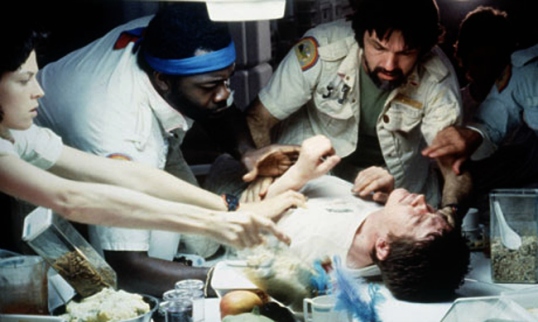
Just when you’re comfortable with the possiblity of facehuggers crawling around, the movie switches gears and introduces us to the Chestburster, a phallic snake of a creature (thanks again to Giger). . The scene was fantastic. Although the cast was told what was supposed to happen with Kane (John Hurt), they weren’t completely filled in on how it was supposed to occur. It was a two part process. The first involved trying to hold down Kane, and the second was setup with John Hurt in the table to have the “push through”. So, when Kane lets out that one big scream, everyone’s reactions are real. You can see that both Parker (Yaphet Kotto) and Dallas (Tom Skerritt) are completely stunned. Veronica Cartwright (and her character Lambert) caught the worst of all this and also had the best reaction. When the Chestburster appears, the effects blood pumps caught Cartwright full on and it was all kept on film. I’m told that the scene in its initial run had people curling in their seats, standing to move to the back of the theatre (for some distance) or walking out altogether. What I wouldn’t give for a Time Travelling DeLorean and an Opening Night movie ticket to that.
So now, there’s a snake running loose on the ship. The film spares very little time before our newborn becomes an adult. Mostly sleek and skeletal, the adult Alien is the stuff of nightmares, but thanks to Scott, and Cinematographer Derek Vanlint, we don’t see much of the Alien until the last act of the movie. Like the Batman, we only see it pounce, and that’s a testament both to the lighting used and the editing of shots. Scott’s close-ups on the Alien’s mouth and forehead doesn’t give anyone enough time to fully make out what it is entirely. Credit also goes to Bolaji Badejo, who portrayed the Alien. At 6’10”, Badejo was perfect for the creature sense of stature and movement, particularly with Harry Dean Stanton’s Brett having to stare up at him in shock.
The production wasn’t without an issue here or there. Giraud’s suits – which had a samurai feel to them – had problems with the ventilation, so some of the actors nearly experienced exhaustion while working in them. This was later remedied, of course.
Alien remains one of Jerry Goldsmith’s best scores, though it’s also a simple one. The music isn’t so much horrific as it just classical. The music in Alien isn’t really used to imply any kind of horror (save for perhaps one sequence), but perhaps that’s a good thing. The music lets the movie do the talking instead of throwing zingers. There’s very little I can say about the score outside of that.
Alien would go on to spawn seven extra films, though personally, only James Cameron’s Aliens (1986) and Ridley Scott’s Prometheus (2012) are the two worth seeing. Alien 3 (1992) is beautiful, thanks to David Fincher and Cinematographer Alex Thomson, but also kind of damaged the timeline.
So, turn out the lights, settle in with the food of your choice and enjoy Alien Day.
The Space Jockey. Much of Giger’s designs looked like bone.
* – A thank you goes out to Kevin Carr of Fat Guys At the Movies. He once featured It! The Terror From Outer Space years ago during the weekend Live Tweets he used to host. It was a treat to watch.
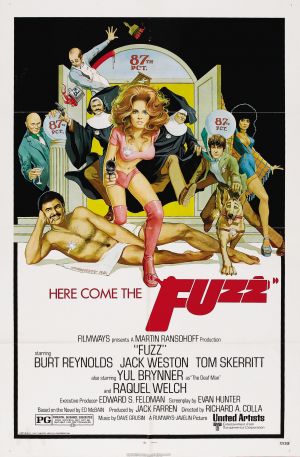
Detective Eileen McHenry (Raquel Welch) has just been given her new assignment and she is about to find out that there is never a dull day in the 87th Precinct. How could there be when the precinct’s top detectives are played by Burt Reynolds, Tom Skerritt, and Jack Weston? Or when Boston’s top criminal mastermind is played by Yul Brynner? There is always something happening in the 8th Precinct. Someone is stealing stuff from the precinct house. Someone else is attacking the city’s homeless. Even worse, Brynner is assassinating public officials and will not stop until he is paid a hefty ransom!
Based on the famous 87th Precinct novels that Evan Hunter wrote under the name Ed McBain, Fuzz has more in common with Robert Altman’s MASH than The French Connection. (Skerritt and Bert Remsen, who plays a policeman in Fuzz, were both members of Altman’s stock company.) Much like Altman’s best-regarded films, Fuzz is an ensemble piece, one that mixes comedy with tragedy and which features several different storylines playing out at once. Scenes of homeless men being set on fire are mixed with scenes of Reynolds and Weston going undercover as nuns. (Of course, Burt does not shave his mustache.) Since it was written by Hunter, the film’s script comes close to duplicating the feel of the 87th Precinct novels. Unfortunately, Richard A. Colla was a television director and Fuzz feels more like an extended episode of Police Story or Hill Street Blues than a movie. Unlike Altman’s best films, Fuzz‘s constantly shifting tone and the mix of comedy and drama often feels awkward. Fortunately, Fuzz does feature good performances from Reynolds, Westin, Skerritt, and Brynner, along with a great 70s score from Dave Grusin. Raquel Welch is never believable as cop but she’s Raquel Welch so who cares?
The time is 1982. The place is Hell on Earth, also known as Philadelphia. Crime is out of control and the police are powerless to stop it. When deli owner John D’Angelo (Tom Skerritt) and his wife, Lisa (Patti LuPone), confront a pimp named Eldorado (Pete Richardson), he rams his car into the back of their car, causing the pregnant Lisa to lose her unborn child. At almost the exact same time, John’s mother (Gina DeAngles) is mugged by two thugs who chop off her ring finger.
In the grand tradition of Charles Bronson, John decides to fight back. But he doesn’t go it alone. With his best friend, a police officer named Vince (Michael Sarrazin), John starts the People’s Neighborhood Patrol. The PNP is going to clean up Philadelphia, one street at a time. The media (represented by David Rasche) make John into a celebrity. The black community (represented by Yaphet Kotto) suspect that John and the PNP are guilty of racial discrimination. The Mafia wants to bring John over to their side. John runs for city council but he still has time to drop a grenade in a pimp’s car.
Fighting Back was one of the many urban vigiliante films to come out after the success of Death Wish. Fighting Back‘s producer, Dino De Laurentiis, also produced Death Wish but made the mistake of later selling the rights to Cannon. Fighting Back was not the box office success that either Death Wish or its sequels were, even though Fighting Back is actually the better movie. That’s because Fighting Back was directed by the underrated Lewis Teague. Teague does a good job of making Philadelphia look like a war zone and the scenes of vigilante justice are enjoyable but, overall, Teague takes a far more ambiguous approach to vigilantism than Michael Winner did when he directed Death Wish. As vile as Philadelphia criminals may be, John D’Angelo isn’t always that likable himself. When Kotto accuses John and the all-white PNP of being racially prejudiced, Teague suggests that he has a point. Tom Skerritt gives a good performance, playing John as a proud, blue collar guy who wants to do the right thing but gets seduced by his newfound celebrity.
Better acted than Death Wish and smarter than The Exterminator, Fighting Back is an underrated vigilante gem.
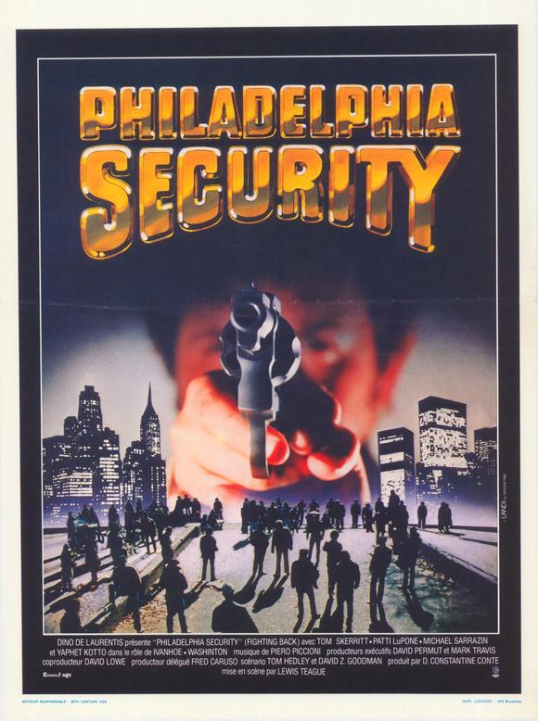
Fighting Back is also known as Philadelphia Security and Death Vengeance.
We found out tonight that the great Sir John Hurt passed away at the age of 77.
For some their memory of him was in the role of the Elephant Man. For the younger set it might be as Hellboy’s adopted father Professor Broom. Some might even remember him as Chancellor Sutler from V for Vendetta. They were all great roles, but my very first memory of him is from a film that helped shaped my love for horror and sci-fi. It was a film that was influenced the impressionable mind of a pre-teen.
This film is and will always be Ridley Scott’s haunted house in space sci-fi horror film, Alien.
Sir John Hurt as the doomed crew-member Kane would make such an impact in my impressionable mind as a child not when he first appears on-screen, but when the titular creature makes it’s first appearance in what I can only describe as an explosive birthing scene.
(Lisa is currently in the process of trying to clean out her DVR by watching and reviewing all 40 of the movies that she recorded from the start of March to the end of June. She’s trying to get it all done by July 11th! Will she make it!? Keep visiting the site to find out!)
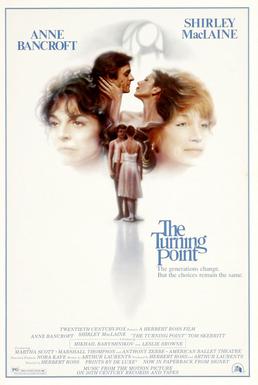
The 28th film on my DVR was the 1977 film The Turning Point. I recorded it off Indieplex on June 3rd.
I guess I should start this review by admitting that I really have no excuse. As someone who grew up dreaming of being a prima ballerina and who unknowingly caused her mother to spend an incalculable amount of money of dance classes, dance outfits, dance shoes, dance trips, and all the medical bills that go along with having a klutzy daughter who is obsessed with ballet and as someone who continues to love to dance today, I really have no excuse for not having seen The Turning Point before last night. Along with The Red Shoes and my beloved Black Swan, The Turning Point is one of three ballet movies to have been nominated for best picture. It’s a film that, as a result of its box office success, established many of the clichés that continue to show up in dance movies to this day.
Seriously, how had I not seen it before?
And make no mistake about it — The Turning Point is a dance movie. Don’t get me wrong. There’s a plot. Actually, there’s several plots and it’s not incorrect to describe The Turning Point as being something of a soap opera. But ultimately, all the plots are just window dressing. Director Herbert Ross started his career as a choreographer with the American Ballet Theater and the characters in The Turning Point are fictionalized portraits of people that he actually knew. Ross’s love for both ballet and the dancers comes through every frame of The Turning Point and the film’s best moments are when the melodrama takes a backseat to the performances onstage.
But I guess we actually should talk about the melodrama. Okay, here goes:
Many years ago, DeeDee (Shirley MacClaine) and Emma (Anne Bancroft) both belonged to the same New York ballet company. DeeDee was the star of the company and was set to play the lead in Anna Karenina when another dancer with the company, Wayne (Tom Skerritt), got her pregnant. DeeDee not only dropped out of the company but she married Wayne and moved back to his home state of Oklahoma. (The film suggests, in an oddly regressive moment, that Wayne only slept with DeeDee in order to prove that, despite being a male dancer, he wasn’t gay.) DeeDee and Wayne opened a dance studio in Oklahoma City while Emma got the lead in Anna Karenina and went on to become a prima ballerina.
18 years later, Wayne and DeeDee’s daughter, Emilia (Leslie Browne), is invited to join the company. Because Emilia is shy and somewhat naive, DeeDee accompanies her to New York while Wayne stays behind in Oklahoma with their younger children.
Once in New York, DeeDee starts to wonder if she made the right decision when gave up ballet for domesticity. She run into an old friend, conductor Joe Rosenberg (Anthony Zerbe, not playing a villain for once) and has an affair with him. Meanwhile, Emma is having an affair with a married man named Carter (Marshall Thompson) and is struggling to accept that she’s getting older and will soon have to retire. Just as DeeDee regrets giving up dancing, Emma regrets never having children.
Meanwhile, Emilia slowly starts to come into her own and blossom as a dancer. She even ends up having an affair with the self-centered and womanizing Yuri (Mikhail Baryshnikov), one of the stars of the company. Emilia and Emma start to grow close, with Emma treating Emilia like her own daughter. DeeDee finds herself growing jealous of both her daughter and her former best friend.
Needless to say, it all leads to Emma throwing a drink in DeeDee’s face and the two of them having a cat fight on the streets of New York…
The Turning Point is no Black Swan or Red Shoes. Leslie Browne (who was playing a character based on herself) was a great dancer but not much of an actress so you never care about her the way that you do Natalie Portman in Black Swan. The dancers are amazing in both films but Darren Aronofsky literally put the audience in Portman’s ballet slippers while Herbert Ross keeps the audience at a distance, allowing them to watch and appreciate the dancers’s passion but not necessarily to experience it with them.
But, with all that in mind, I still enjoyed The Turning Point. What can I say? I love dance movies! Both Shirley MacClaine and Anne Bancroft give excellent performances. Bancroft apparently had no dance experience before shooting The Turning Point (and it’s hard not to notice that, whenever Emma is performing, the camera focuses on those moving around her as opposed to Emma herself) but she still does a good job of poignantly capturing Emma’s fear of getting older and her joy when she realizes that Emilia looks up to her. MacClaine, meanwhile, has an amazing scene where she watches her screen daughter perform and, in just a matter of seconds, we watch as every emotion — pride, envy, regret, and finally happiness — flashes across her face.
And, of course, there’s that cat fight. It’s a silly scene, to be honest. But seriously, if there was any actress who could convincingly throw a drink in someone else’s face, it was Anne Bancroft.
The Turning Point was nominated for 11 Oscars and it ended up setting a somewhat dubious record when it managed to win exactly zero. (This perhaps shouldn’t be surprising when you consider its competition included Annie Hall and the first Star Wars.)
Today is Angie Dickinson’s 84th birthday. One of Angie’s best remembered films is Big Bad Mama, an entertaining and fast-paced gangster film that was produced by Roger Corman.
The year is 1932 and the setting is Texas. Wilma McClatchie (Angie Dickinson) is a poor single mother with two teenage daughters (Susan Sennett and Robbie Lee) to support. When Wilma’s bootlegger lover, Barney (Noble Willingham), is killed by the FBI, Wilma takes over his route. Wilma wants her daughters to be rich like “Rockefeller and Capone” and soon, they graduate from bootlegging to bank robbery. During one robbery, they meet and team up with Fred (Tom Skerritt). Wilma and Fred are lovers until Wilma meets alcoholic con man, Baxter (William Shatner). With Fred and Baxter competing for her affections and her youngest daughter pregnant, Wilma plans one final job, the kidnapping of a spoiled heiress (Joan Prather).
Big Bad Mama is one of the many Bonnie and Clyde rip-offs that Roger Corman produced in the 70s. (Corman also gave us Bloody Mama and Crazy Mama.) Big Bad Mama is a typical Corman gangster film, with fast cars, blazing tommy guns, Dick Miller, and plenty of nudity. Angie was in her 40s at the time and, justifiably proud of her body, her full frontal nude scenes created a lot of publicity for the film. William Shatner also strips down for the film and his sex scene with Angie is just as weird to watch as you would expect it to be.
The whole film changes as soon as William Shatner makes his first appearance. He may be speaking with a Southern accent and he may be playing a sniveling coward but he is still William Shatner, with all that implies. Watching Shatner, it is hard not to imagine that Big Bad Mama is actually a lost Star Trek episode where Kirk goes back in the past and meets special guest star Angie Dickinson. Far more effective is Tom Skerritt, who is thoroughly believable as a Dillinger-style bank robber.
In the style of Bonnie and Clyde, Big Bad Mama presents its outlaws as being counter-culture rebels. Every authority figure that Wilma meets — from a preacher played by Royal Dano to a corrupt sheriff to Dick Miller’s incompetent FBI agent — is presented as being hypocritical and arrogant. Angie plays Wilma as a strong-willed and sexually liberated woman who refuses to allow anyone to tell her how to live her life or raise her daughters. In the gang, both Fred and Baxter are subservient to her. Big Bad Mama’s tag line was “Hot lead! Hot legs! Hot damn!” and that is a perfect description of Angie Dickinson’s performance.
So, it seems like every time that I write a review of any film based on a novel by Stephen King, I always have to start out by explaining that I think, while King’s success is undeniable, the fact that he’s overrated is also undeniable. It’s a comment that I always make and then I have to deal with people going, “But, Lisa, everyone loves Stephen King! He’s the most commercially successful author ever! He’s a modern-day Charles Dickens!”
Bleh.
Make no mistake, I think that Stephen King is a talented writer. However, I don’t think that he’s the greatest writer that has ever lived and that’s where I often come into conflict with King’s fans. (Stephen King fans tend to be like religious fanatics when it comes to defending their belief.) Having read both King’s earlier work and his more recent books, it’s hard for me not to feel that Stephen King has been growing steadily complacent. There’s a certain self-importance to his prose and his plotting that, for me, is the literary equivalent of nails on chalk board. If anyone is guilty of believing the most fawning praise of his biggest fans, it would appears to be Stephen King who, to judge from his twitter feed, appears to also believe that he’s our most important cultural critic as well.
(To be honest, I’d probably have more tolerance for King’s attempts at cultural and political criticism if he wasn’t so predictable about it all. Stephen King may write best sellers but that doesn’t mean he has anything interesting or unique to say about current events.)
Anyway, since I don’t feel like having to deal with all of that shit all over again, I’m not going to start this review by saying that I think Stephen King is overrated. In fact … whoops.
Okay, so much for that plan.
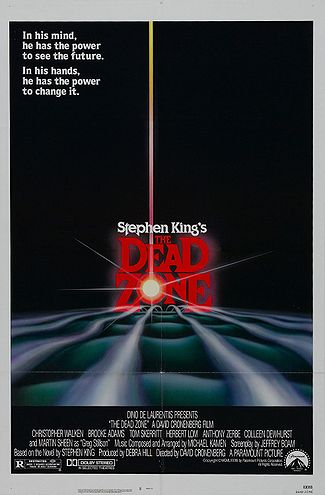
Even I have to admit that The Dead Zone is one of Stephen King’s better books. First off, it’s less than a 1,000 pages long. Secondly, the hero isn’t a writer who spends all of his time whining about the political preferences of his neighbors. Third, it deals with all of the “big” issues of faith, destiny, and morality but it does so in a far less heavy-handed manner than most of King’s books.
The Dead Zone is also the basis for one of the better films to be adapted from a Stephen King novel. Directed by David Cronenberg and starring Christopher Walken, the film’s plot closely follows the novel. Johnny Smith (Christopher Walken) is a high school teacher who, after a horrific car crash, spends five years in a coma. When he finally wakes up, he discovers that his girlfriend, Sarah (Brooke Adams), has married another man. His mother has become a religious fanatic. And, perhaps most importantly, whenever Johnny touches anyone, there’s a good chance that he’ll see either the person’s past or a possible future.
Needless to say, Johnny struggles with how to deal with his new powers. After he helps to catch a local serial killer, Johnny goes into seclusion. However, when he discovers that Sarah is now volunteering for ambitious politician Greg Stillson (Martin Sheen), Johnny goes to a Stillson rally, shakes the man’s hand, and has a vision. Johnny discovers that, if Stillson is elected to the senate, he’ll eventually become President and then he’ll destroy the world.
Much like The Shining, The Dead Zone benefits from being directed by a filmmaker who was both confident and strong enough to bring his own individual style to the material. (Usually, when a King adaptation fails, it’s because it followed the source material too closely, as if the film’s producers were scared of upsetting any of King’s constant readers.) Though the film’s plot may closely follow the novel, the movie itself is still definitely more of a product of David Cronenberg than Stephen King. Whereas King’s novel devoted a good deal of time to Johnny and Sarah’s relationship, it’s treated as almost an afterthought in Cronenberg’s film. Whereas King’s novel presented Johnny Smith as being an everyman sort of character, Cronenberg’s film gives us a Johnny who, from the start of the film, is a bit of an outsider even before he starts to see the future. Whereas King put the reader straight into Johnny’s head, Cronenberg approach is a bit more detached and clinical. Cronenberg’s Johnny is a bit more of an enigma than King’s version.
Fortunately, Cronenberg was fortunate enough to be able to cast Christopher Walken in the role of Johnny Smith. King’s preference for the role was Bill Murray. As odd as it may sound, you can actually imagine Bill Murray in the role when you read King’s book. But, for Cronenberg’s more detached vision, Walken was the perfect choice. People tend to spend so much time focusing on Christopher Walken’s quirky screen presence that there’s a tendency to forget that he’s actually a very talented actor as well. He’s very likable and sympathetic as Johnny and brings a humanity and a sense of humor to the role, which provides a good balance to Cronenberg’s sense of detachment.
The Dead Zone is a good book and it was later turned into an occasionally good (and, just as often, not-so-good) television series. However, the film is still the best.
Let’s continue to get caught up with 6 more reviews of 6 more films that I saw in 2014!
At Middleton (dir by Adam Rodgers)
“Charming, but slight.” I’ve always liked that term and I think it’s the perfect description for At Middleton, a dramedy that came out in January and did not really get that much attention. Vera Farmiga is a businesswoman who is touring colleges with her daughter (Taissa Farmiga, who is actually Vera’s younger sister). Andy Garcia is a surgeon who is doing the same thing with his son. All four of them end up touring Middleton College at the same time. While their respective children tour the school, Vera and Andy end up walking around the campus and talking. And that’s pretty much the entire film!
But you know what? Vera Farmiga and Andy Garcia are both such good performers and have such a strong chemistry that it doesn’t matter that not much happens. Or, at the very least, it doesn’t matter was much as you might think it would.
Hence, charming but slight.
Barefoot (dir by Andrew Fleming)
Well, fuck it.
Sorry, I know that’s not the best way to start a review but Barefoot really bothered me. In Barefoot, Scott Speedman plays a guy who invites Evan Rachel Wood to his brother’s wedding. The twist is that Wood has spent most of her life in a mental institution. Originally, Speedman only invites her so that he can trick his father (Treat Williams) into believing that Speedman has finally become a responsible adult. But, of course, he ends up falling in love with her and Wood’s simple, mentally unbalanced charm brings delight to everyone who meets her. I wanted to like this film because I love both Scott Speedman and Evan Rachel Wood but, ultimately, it’s all rather condescending and insulting. Yes, the film may be saying, mental illness is difficult but at least it helped Scott Speedman find love…
There’s a lot of good things that can be said about Divergent. Shailene Woodley is a likable heroine. The film’s depiction of a dystopian future is well-done. Kate Winslet has fun playing a villain. Miles Teller and Ansel Elgort are well-cast. But, ultimately, Divergent suffers from the same problem as The Maze Runner and countless other YA adaptations. The film never escapes from the shadow of the far superior HungerGamesfranchise. Perhaps, if Divergent had been released first, we’d be referring to the Hunger Games as being a Divergent rip-off.
However, I kind of doubt it. The Hunger Games works on so many levels. Divergent is an entertaining adventure film that features a good performance from Shailene Woodley but it’s never anything more than that. Considering that director Neil Burger previously gave us Interview with the Assassin and Limitless, it’s hard not to be disappointed that there’s not more to Divergent.
Gimme Shelter (dir by Ron Krauss)
Gimme Shelter, which is apparently based on a true story, is about a teenage girl named Apple (Vanessa Hudgens) who flees her abusive, drug addicted mother (Rosario Dawson). She eventually tracks down her wealthy father (Brendan Fraser), who at first takes Apple in. However, when he discovers that she’s pregnant, he demands that she get an abortion. When Apple refuses, he kicks her out of the house. Apple eventually meets a kindly priest (James Earl Jones) and moves into a shelter that’s run by the tough Kathy (Ann Dowd).
Gimme Shelter came out in January and it was briefly controversial because a lot of critics felt that, by celebrating Apple’s decision not to abort her baby, the movie was pushing an overly pro-life message. Interestingly enough, a lot of those outraged critics were men and, as I read their angry reviews, it was hard not to feel that they were more concerned with showing off their political bona fides than with reviewing the actual film. Yes, the film does celebrate Apple’s decision to keep her baby but the film also emphasizes that it was Apple’s decision to make, just as surely as it would have been her decision to make if she had chosen to have an abortion.
To be honest, the worst thing about Gimme Shelter is that it doesn’t take advantage of the fact that it shares its name with a great song by the Rolling Stones. Otherwise, it’s a well-done (if rather uneven) look at life on the margins. Yes, the script and the direction are heavy-handed but the film is redeemed by a strong performance from Vanessa Hudgens, who deserves to be known for more than just being “that girl from High School Musical.”
Heaven is For Real (dir by Randall Wallace)
You can tell that Heaven is For Real is supposed to be based on a true story by the fact that the main character is named Todd Burpo. Todd Burpo is one of those names that’s just so ripe for ridicule that you know he has to be a real person.
Anyway, Heaven Is For Real is based on a book of the same name. Todd Burpo (Greg Kinnear) is the pastor of a small church in Nebraska. After Todd’s son, Colton, has a near death experience, he claims to have visited Heaven where he not only met a sister who died before he was born but also had a conversation with Jesus. As Colton’s story starts to get national attention, Todd struggles to determine whether Colton actually went to Heaven or if he was just having a hallucination.
You can probably guess which side the movie comes down on.
Usually, as a self-described heathen, I watch about zero faith-based movies a year. For some reason, I ended up watching three over the course of 2014: Left Behind, Rumors of War, and this one. Heaven is For Real is not as preachy (or terrible) as Left Behind but it’s also not as much fun as Rumors of War. (Rumors of War, after all, featured Eric Roberts.) Instead, Heaven Is For Real is probably as close to mainstream as a faith-based movie can get. I doubt that the film changed anyone’s opinion regarding whether or not heaven is for real but it’s still well-done in a made-for-TV sort of way.
The Other Woman (dir by Nick Cassavetes)
According to my BFF Evelyn, we really liked The Other Woman when we saw it earlier this year. And, despite how bored I was with the film when I recently tired to rewatch it, we probably did enjoy it that first time. It’s a girlfriend film, the type of movie that’s enjoyable as long as you’re seeing it for the first time and you’re seeing it with your best girlfriends. It’s a lot of fun the first time you see it but since the entire film is on the surface, there’s nothing left to discover on repeat viewings. Instead, you just find yourself very aware of the fact that the film often substitutes easy shock for genuine comedy. (To be honest, I think that — even with the recent missteps of Labor Day and Men, Women, and Children — Jason Reitman could have done wonders with this material. Nick Cassavetes however…) Leslie Mann gives a good performance and the scenes where she bonds with Cameron Diaz are a lot of fun but otherwise, it’s the type of film that you enjoy when you see it and then you forget about it.


 Today is 4.26, also known as “Alien Day”, and named after the planet in James Cameron’s Aliens (LV-426 / Acheron). It’s a celebration of the entire Alien Franchise, but I’m only focused on the first film as I finally saw it in the theatre in 2017.


 Detective Eileen McHenry (Raquel Welch) has just been given her new assignment and she is about to find out that there is never a dull day in the 87th Precinct. How could there be when the precinct’s top detectives are played by Burt Reynolds, Tom Skerritt, and Jack Weston? Or when Boston’s top criminal mastermind is played by Yul Brynner? There is always something happening in the 8th Precinct. Someone is stealing stuff from the precinct house. Someone else is attacking the city’s homeless. Even worse, Brynner is assassinating public officials and will not stop until he is paid a hefty ransom!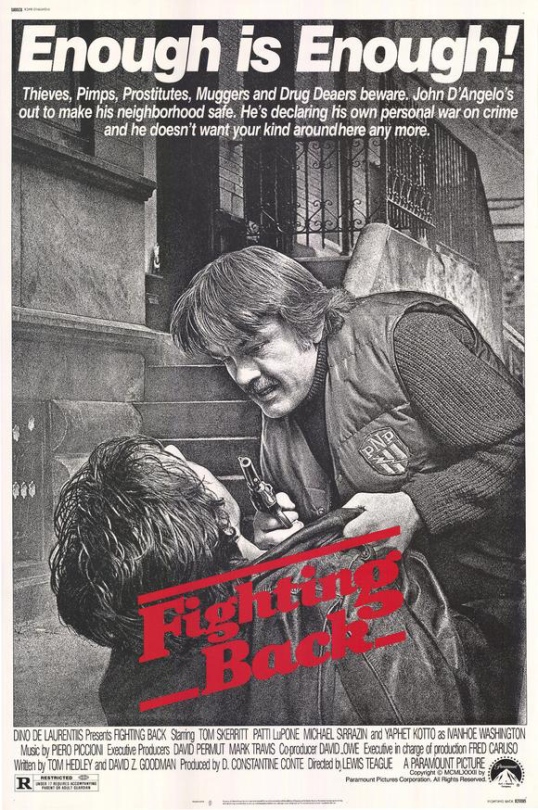


 Through the Shattered Lens