April Noir: Thief (dir by Michael Mann)


1981’s Thief tells the story of Frank (James Caan).

Frank is a professional diamond thief, one of the best in the business.  He’s so cool that he even has his own Tangerine Dream soundtrack.  After doing a stint in prison, Frank lives his life very carefully and with discipline.  He’s determined not to return to prison.  His mentor (played by Willie Nelson) is still behind bars and will probably die there.  In fact, Frank has even found himself thinking about abandoning his criminal lifestyle.  He’s got two front businesses, both of which are doing well.  (Frank’s used car lot looks like some sort of alien world.)  He’s fallen in love with a cashier named Jessie (Tuesday Weld) and it’s starting to seem like now would be a good time to settle down and become a family man.  The only problem is that Frank is working for Leo (Robert Prosky) and Leo has absolutely no intention of allowing Frank to walk away.  As Leo puts it, Frank belongs to him.  That’s not a smart thing to say to someone like Frank.

Frank’s an interesting character.  He’s the film’s hero, not because he’s a good guy but because he’s a smidgen better than most of the other bad guys.  He’s a professional, one who goes out of his way avoid unnecessary complications.  When we see him on the job, it’s impossible not to admire just how good he is at stealing stuff.  When he uses a blowtorch to break into a store or a safe, the screen is full of sparks and, for a few minutes, Frank looks like some sort of cosmic super hero brought to life.  We admire Frank but we discover early on that he’s willing to get violent.  He’s willing to pull a gun and threaten his way out of a situation.  Frank is loyal.  He visits his mentor in prison.  He takes care of his partner-in-crime, Barry (Jim Belushi, making his film debut).  He truly loves Jessie.  But, at heart, he’s a criminal who doesn’t hesitate to pull the trigger when he has to.  The question the film asks is whether one can just go straight, after years of breaking the law and living in the shadows.  Can Frank abandon the lifestyle, even for love?  Or is he destined to always be a thief?

Thief was Michael Mann’s feature film debut.  (The Jericho Mile was Mann’s directorial debut but it was made for television.)  Thief is full of the usual Mann themes and also Mann’s signature style, showing that Mann knew exactly what type of films he wanted to make from the start of his career.  The nights are full of shadows.  The days are deceptively calm.  The neon of Frank’s car lot glows like another dimension.  The final bloody shoot out takes place at night, in the type of suburban neighborhood in which most people would probably love to live.  And holding the film together is James Caan, giving a coolly centered performance as a man who has learned to hold back his emotions and who won’t be controlled by anyone.  Halfway through the film, Caan delivers a seven-minute monologue about life in prison and it’s an amazing moment, one in which Caan shows just how good of an actor he truly was.  Thief is an effective and stylish neo-noir, one that sticks with you as the end credits roll.
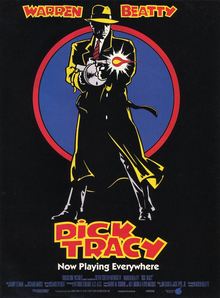
 

Dick Tracy (1990, directed by Warren Beatty)


The year is 1937 and “Big Boy” Caprice (Al Pacino) and his gang of flamboyant and often disfigured criminals are trying to take over the rackets.  Standing in their way is ace detective Dick Tracy (Warren Beatty), the yellow trench-wearing defender of the law.  Tracy is not only looking to take down Caprice but he and Tess Trueheart (Glenne Headly) are currently the guardians of The Kid (Charlie Korsmo), a young street kid who witnessed one of Caprice’s worst crimes.  Tracy’s investigation leads him through a rogue’s gallery of criminals and also involves Breathless Mahoney (Madonna), who has witnessed many of Caprice’s crimes but who also wants to steal Tracy’s heart from Tess.

Based on the long-running comic strip, Dick Tracy was a labor of love on the part of Warren Beatty.  Not only starring but also directing, Tracy made a film that stayed true to the look and the feel of the original comic strip (the film’s visual palette was limited to just seven colors) while also including an all-star cast the featured Madonna is an attempt to appeal to a younger audience who had probably never even heard of Dick Tracy.  When Dick Tracy was released, the majority of the publicity centered around Madonna’s participation in the film and the fact that she was dating Beatty at the time.  Madonna is actually probably the weakest element of the film.  More of a personality than an actress, Madonna is always Madonna no matter who she is playing and, in a film full of famous actors managing to be convincing as the members of Dick Tracy’s rogue gallery, Madonna feels out of place.  Michelle Pfeiffer would have been the ideal Breathless Mahoney.

It doesn’t matter, though, because the rest of the film is great.  It’s one of the few comic book films of the 90s to really hold up, mostly due to Beatty’s obvious enthusiasm for the material and the performances of everyone in the supporting cast who was not named Madonna.  Al Pacino received an Oscar nomination for playing Big Boy Caprice but equally good are Dustin Hoffman as Mumbles, William Forsythe as Flaptop, R.G. Armstong as Pruneface, and Henry Silva as Influence.  These actors all create memorable characters, even while acting under a ton of very convincing makeup.  I also liked Dick Van Dyke as the corrupt District Attorney.  Beatty knew audience would be shocked to see Van Dyke not playing a hero and both he and Van Dyke play it up for all its worth.  Beatty embraces the comic strip’s campiness while still remaining respectful to its style and the combination of Danny Elfman’s music and Stephen Sondheim’s songs provide just the right score for Dick Tracy’s adventures.  The film can be surprisingly violent at times but the same was often said about the Dick Tracy comic strip.  It wasn’t two-way wrist radios and trips to the Moon.  Dick Tracy also dealt with the most ruthless and bloodthirsty gangsters his city had to offer.

Dick Tracy was considered to be a box office disappointment when it was originally released.  (Again, you have to wonder if Beatty overestimated how many fans Dick Tracy had in 1990.)  But it holds up well and is still more entertaining than several of the more recent comic book movies that have been released.

Retro Television Review: Miami Vice 2.6 “Buddies”


Welcome to Retro Television Reviews, a feature where we review some of our favorite and least favorite shows of the past!  On Mondays, I will be reviewing Miami Vice, which ran on NBC from 1984 to 1989.  The entire show can be purchased on Prime!

This week, Crockett discovers that one of his oldest friends has a secret.

Episode 2.6 “Buddies”

(Dir by Henry Mastrogeorge, originally aired on November 1st, 1985)

When sleazy stand-up comedian Morty Price (a youngish Nathan Lane) attempts to sexually assault a cocktail waitress named Dorothy (Eszter Balint), he ends up getting fatally stabbed with a steak knife.  Dorothy flees from the crime scene, taking her baby and grabbing a bunch of random papers that, unknown to her, prove that Morty Price was placing illegal bets with mobster Frank Doss (Frankie Valli).  This information could keep Doss from being able to get a casino license in Florida.

Because Doss and his partner, Johnny Cannata (Tom Signorelli), are mob-connected, Castillo and Vice take over the investigation of Price’s murder.  Sonny and Tubbs learn, from an informant (Karla Tamburrelli), that Price took Dorothy up to his room before he was murdered.  While Crockett and Tubbs search for Dorothy to find out what happened with Price, Doss and Cannata send their men to track down Dorothy and keep the papers from reaching the police.

During the investigation, Sonny is stunned to come across security footage of one of his oldest friends, Robbie Cann (James Remar), meeting with Doss and Cannata.  Robbie not only served in Vietnam with Sonny but he has also recently asked Sonny to be his son’s godfather.  Robbie has just opened up a club and, as he explains to Sonny, he finally feels like he’s something more than just a loser.  When Sonny confronts Robbie about meeting with the gangsters, Robbie admits that he borrowed money from them to start the club but he insists that he doesn’t have any other type of relationship with them.  However, when Sonny attends the christening of Robbie’s son, he discovers that Robbie’s name is actually Robert Cannata.  He is Johnny Cannata’s son!  Robbie insists that he has nothing to do with his father’s business but Sonny is forced to ask just how much he can trust one of his closest friends.

This episode is a bit of a mess.  On the plus side, fans of character actors will enjoy this episode.  James Remar’s nervy performance keeps you guessing and it’s undeniably interesting to see Nathan Lane playing someone that sleazy.  Frankie Valli and Tom Signorelli make for convincing gangsters.  It’s also the first episode of the series to really feature Sonny talking about what it was like to serve in Vietnam and it deserves some credit for attempting to explore the difficulty that many veterans face when trying to adjust back to civilian life.  Robbie has not had an easy life after returning to the U.S. but now, he finally has a wife, a child, and a business.  Sonny may feel betrayed by Robbie but he’s also aware that his investigation is going to potentially ruin Robbie’s life.

On the other hand, the episode attempts to take on so much that it stretches itself a bit then.  It requires a real suspension of disbelief to accept that Sonny would just happen to be assigned to an investigation that would involve his best friend.  I mean, what are the chances?  The episode also can’t seem to decide if it wants to focus on Robbie or if it wants to focus on Dorothy and her child.  As a result, neither story really feels as if it gets all of the attention that it deserves.

Next week, the Vice Squad investigates jazz legend Miles Davis!