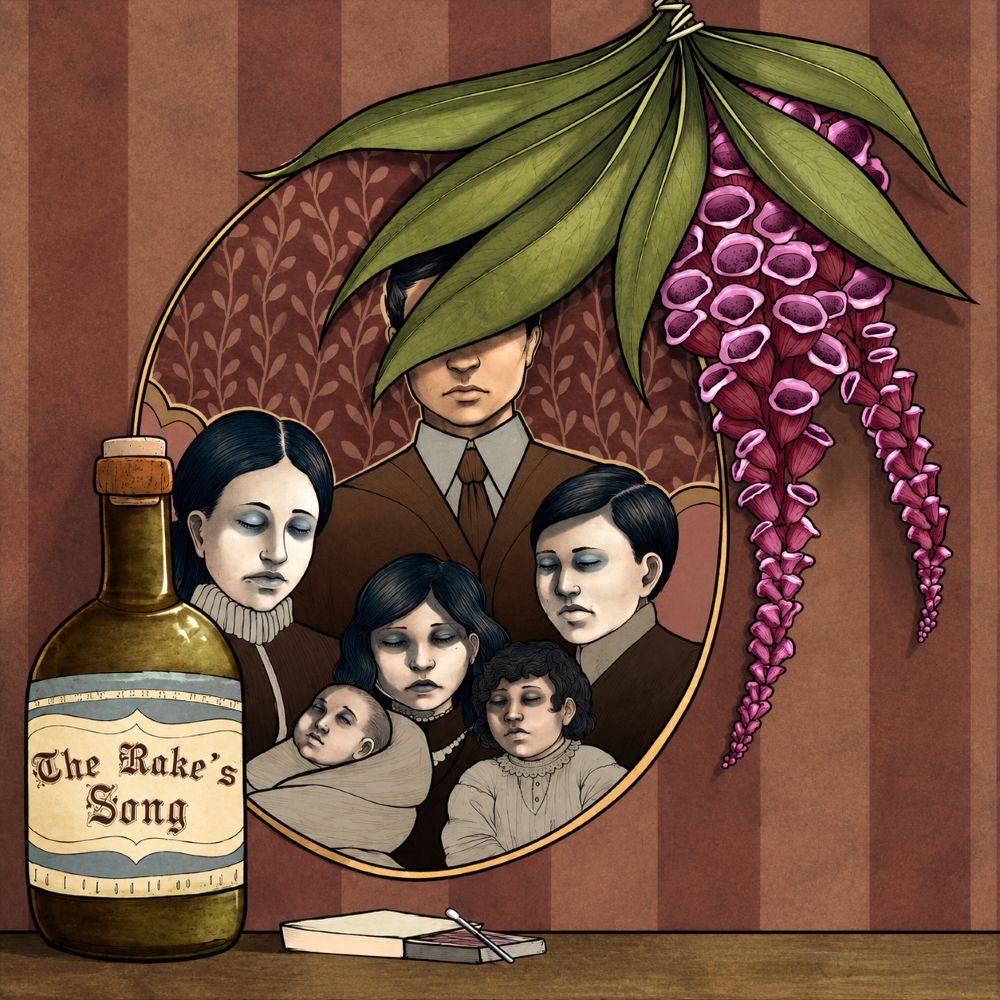
Horror Song of the Day: The Rake’s Song (by The Decemberists)


“The Rake’s Song” is one of those Decemberists tracks that lures you in with a tune that sounds almost cheerfully old-fashioned, then casually reveals that you have been listening to a confession from an absolute monster. The arrangement has that familiar Decemberists blend of indie-folk and story-song theatricality: a bouncy, rustic pulse, memorable vocal phrasing, and a melody that feels made for a communal singalong. On the surface, it has the energy of a rowdy little folk number you might hear in a pub or at a campfire.

That folk-horror quality fits especially well because “The Rake’s Song” comes from The Decemberists’ 2009 concept album The Hazards of Love, whose songs collectively tell one continuous, start-to-finish narrative. The album follows the romance between Margaret and William, the supernatural influence of the forest-dwelling Queen, and the violent figures who threaten them along the way. Within that larger story, the Rake is not just a random murderous narrator; he is a dark obstacle in the tale, and his song gives the album one of its most unsettling detours.

But Colin Meloy uses that inviting sound as camouflage. The narrator matter-of-factly explains how he murdered his own children after their mother dies, treating each death less like a tragedy than another inconvenient task to be handled. That emotional disconnect is what makes the song genuinely chilling. There is no dramatic musical shift that announces, “Now this is the horrifying part.” The story just keeps moving, jaunty and almost playful, while the details get progressively more grim.

That contrast makes “The Rake’s Song” feel like a horror folktale that has somehow survived for generations because people kept singing it. It would not feel out of place as a warning whispered around a campfire about the cruel old man who lived beyond the tree line, or as a cautionary tale passed between children in some isolated backwoods cabin: beware the charming song, beware the smiling storyteller, and definitely beware the man who says his family is gone. Its folksiness gives the violence a strange sense of age and inevitability, as if this is not merely one man’s atrocity but an old evil wearing the shape of a traditional ballad.

The Decemberists have always been good at turning literary, historical, and gothic material into catchy songs, and “The Rake’s Song” may be one of their sharpest examples of that trick. It is funny in the bleakest possible way, but the humor never fully softens the horror; if anything, it makes the narrator’s cruelty worse. You can enjoy the hook, tap along to the rhythm, and then suddenly realize you are humming a song about something monstrously cruel—which is exactly why it sticks with you.

The Rake’s Song

I had entered into a marriage
In the summer of my twenty-first year
And the bells rang for our wedding
Only now do I remember it clear
Alright, alright, alright

No more a rake and no more a bachelor
I was wedded and it whetted my thirst
Until her womb start spilling out babies
Only then did I reckon my curse
Alright, alright, alright

First came Isaiah with his crinkled little fingers
Then came Charlotte and that wretched girl Dawn
Ugly Myfanwy died on delivery
Mercifully taking her mother along
Alright, alright, alright

What can one do when one is widower
Shamefully saddled with three little pests
All that I wanted was the freedom of a new life
So my burden I began to divest
Alright, alright, alright

Charlotte I buried after feeding her foxglove
Dawn was easy, she was drowned in the bath
Isaiah fought but was easily bested
Burned his body for incurring my wrath
Alright, alright, alright

And that’s how I came your humble narrator
To be living so easy and free
Expect you think that I should be haunted
But it never really bothers me
Alright, alright, alright
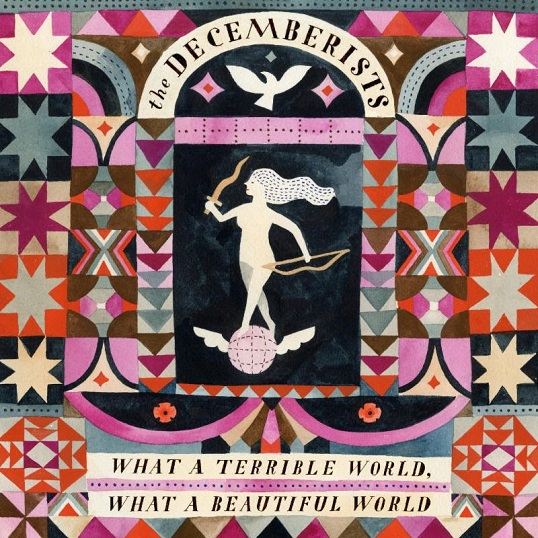
Review: The Decemberists – What a Terrible World, What a Beautiful World


I was basking in the golden glow of San Francisco’s Great American Music Hall when I first laid eyes on The Decemberists. It was Summer 2004, and it was a day I still remember well. I arrived alone, but I ended up befriending two girls about my age from Sacramento. It was a pretty thing–three kids too young to buy drinks and too engaged to harbor ulterior motives, thrilled to witness a band that seemed to capture every novelty of a world we were only barely old enough to traverse independently. It wasn’t particularly crowded–we walked right up to the front of the stage–but there wasn’t a stranger in the audience. “Billy Liar” was a hall-wide sing-along. On “Red Right Ankle” you could hear a pin drop. Chris Funk dawned a fake beard and marched through the audience pounding a drum strapped to his chest for “A Cautionary Song”. “California One / Youth and Beauty Brigade” was a swaying dream that will resonate in me until the day I die. I wanted to marry those girls by the end of it–both of them, and I never bothered asking their names.

Austin Texas, fall 2006, I stumbled into Stubb’s BBQ in a daze. “Indie rock” had become the musical movement of the decade, and I felt like a king in the middle of it all. It was a crazy two-week stretch: The Album Leaf, The Mountain Goats, a trek out to Houston for Built to Spill, a return to my metal roots for Between the Buried and Me, and somewhere in the midst of it all I found my sleepless self in a sea of humanity as Colin belted “Culling of the Fold” outdoors to a sold-out crowd. He was exhausted but elated, grinning from ear to ear the whole set, and so was I. The irony of “I was Meant for the Stage” was not lost on either of us.

Pittsburgh, 2009, I took my seat at the Byham Theater to witness The Decemberists in a traditional performance hall. I had traded in faded proofs of attendance for garb with actual buttons, and the band was decked out in full suit and tie. The Hazards of Love was larger than life–Shara Worden striding across the stage like a spidery temptress to a majestic display of lights and an unprecedented rock opera. The Decemberists rose to their fame as only they could, and the result was in one breath a self-aware mockery of their grandiose ambitions and a brilliant realization of the same.

…I wrote of The King is Dead‘s simple folk rock sound that it seemed like The Decemberists were “coming down off their own high. I imagine it’s difficult to be as… musically intelligent as they are without some fear of becoming pretentious.” The album title might even hint at this, and the band’s subsequent three year hiatus seemed to confirm it. Now it is 2015, more than a decade since that wonderful night in San Francisco, and What a Terrible World, What a Beautiful World is due out in just over a week. I don’t really know what I expected, but I know what I was feeling. It certainly wasn’t the grandeur of The Hazards of Love, nor epic ballads reminiscent of “The Mariner’s Revenge Song” and “The Island”. I was waxing nostalgic on Colin at his sweetest. “Grace Cathedral Hill”, “Shiny”, “Red Right Ankle”, “Of Angels and Angles”… Because The Decemberists were no longer a novel in their own right. That beautiful rise ended with The Hazards of Love, and the hiatus laid it all to rest. Theirs was a tale to look back on fondly; the story had come to an end.

What a Terrible World, What a Beautiful World gives me that sweetness, in a way. Tracks like “Lake Song”, “Make You Better”, and “12/17/12” are absolutely beautiful. All of the songs fall somewhere between these mellow numbers, blues/folk tracks like “Carolina Low” and “Better Not Wake the Baby”, and upbeat pop like “The Wrong Year”, “Cavalry Captain”, and “Philomena”. I could live without the latter three, but suffice to say the album is generally pleasing to listen to, though Jenny Conlee’s accordion has sadly all but left us. “Lake Song”, “Make You Better”, and “12/17/12” definitely steal the show for me, but I won’t soon forget the catchy choruses of “Anti-Summersong” or “Mistral”, nor the lulling blues melancholy of “Till the Water is All Long Gone”.

But this album breaks my heart. Through it all, I can’t escape the feeling that some fell force sucked away Colin’s joie de vivre, substituting mellow content to lead a normal life where once the world had been a playground. The music is still great, but I can’t feel the synergy between it and the lyrics anymore. At least “Lake Song” has been spared this fate. Here is what I can understand of “Mistral”: “So we already wrecked the rental car, and I’ve already lost my way. I feel entombed in this tourist bar, for a day anyway. So lay me out on the cobblestone, and unfurl this aching jib. The streets are built on ancient bones, and the crib of the rib. Won’t a mistral blow it all away? Won’t a mistral blow away? So it’s me and you and the baby boy, and a ? shed away, reeking out a little joy. What a waste. Bad mistakes. Won’t a mistral blow it all away? Won’t a mistral blow away?” I don’t know. It’s just… kind of shallow–a bit of babbling around the surface of a theme–and it’s pervasive through much of the album. “Better Not Wake the Baby” is packed with creative one-liners, all tied by a refrain of “but it better not wake the baby“. What does that mean? Plenty of Decemberists tracks have sent me to Wikipedia in the past, but I’m not going to find an answer here, and for that the song means nothing to me. “12/17/12”, my favorite track, still totally jars me out of my happy daze when Colin appears to rhyme “grieving” with “grieving” and “belly” with “belly”.

Go ahead. Crucify me. Point out the most obvious meanings; remind me that Colin still has a robust vocabulary; explain how it’s none of my business to criticize someone else’s creativity; note that it’s still better than 90% of popular music; tell me to shut my mouth and go listen to something else if I don’t like it. I don’t care, because the sad fact is I will go listen to something else. I spent more time on Castaways and Cutouts than on What a Terrible World, What a Beautiful World while writing all this. I don’t want that. I want to love this album and hold it dear, but I can’t. I listen to the lyrics and more often than not I just hear Colin going through the motions without any of the magic. From the 5 Songs EP all the way to The Hazards of Love it was a constant indulgence, and now it is gone.

The opening track, “The Singer Addresses His Audience”, is the reason I can still listen with a faint smile. It is not one for the album, but for the memory of all that The Decemberists have meant to me over the years. In almost a parting farewell to Colin’s old stage persona, he sings in classic form: “We know, we know we belong to ya. We know you built your lives around us. Would we change? …We had to change some. We know, we know we belong to ya. We know you threw your arms around us in the hopes we wouldn’t change… But we had to change some, you know, to belong to you.”

And they still do, and I still love them, and I still look forward to catching them on their upcoming tour, but What a Terrible World, What a Beautiful World is a bittersweet experience.

Review: The Decemberists – The King is Dead


Apparently this leaked in mid-December, but with all the holiday hassle I’ve only this weekend been able to start catching up on music again.

So, I’m on my third listen through this at the moment, and I’m kind of stumped on how to discuss it without revisiting their entire discography. I think if any other band released The King is Dead I wouldn’t give it the time of day. At face value it’s a standard countrified rock album that doesn’t present anything particularly special. I’ll even go so far as to say if The Decemberists released it five years ago it would have marked their end as the kings of indie rock. (Pun slightly intended?) But it has to be considered in its proper place and time.

Colin Meloy’s lyrical brilliance has been present since the get-go. Anyone who’s heard their “5 Songs” EP from 2001 should recognize in My Mother was a Chinese Trapeze Artist the same wit that prevailed in later, more famous works.

What did change over the years was their quality as musicians and song-writers. “5 Songs” boasted nothing comparable in musical creativity to 2002’s Cataways and Cutouts. With each new album a higher bar was set, and practically every song that followed rose to the challenge. Lyrically, Meloy probably peaked in 2005, with The Mariner’s Revenge Song on Picaresque.

From there the comedy act was cut back; Meloy returned to a more subtle cleverness. The band took the same turn musically, and with 2006’s The Crane Wife reached what might be the highest point in indie music. If not the most inspired album of the genre–I reserve that title for Neutral Milk Hotel’s In the Aeroplane Over the Sea–I have to consider it the all-around best. Here are Yankee Bayonet and Sons and Daughters as examples.


Then, in 2009, The Hazards of Love happened. It wasn’t completely unprecedented; in 2004 they released The Tain EP, an experimental break from their standard sound, which attempted, quite successfully I think, to create something far more thematic and sophisticated than mere indie rock. The Hazards of Love added to this 18 minute experiment five years of experience, and produced what can only really be described as a rock opera. Coming in at just under an hour, the album is a single piece, not a collection of independent songs. It deserves to go down in history as one of the greatest musical accomplishments of all time. It can’t be captured in a single movement, but here are two excerpts to give you an idea.


Now it’s 2011, about time for a new album, and I don’t think the band need be too full of themselves to ask “Where the hell do we go from here?” They surely knew they couldn’t top what they’d just accomplished any time soon, so they didn’t even bother trying. Is The King is Dead a “safe” album? A sort of “sorry guys” to the fans who just weren’t prepared for the intensity and complexity of Hazards of Love? Hardly, though it could be misconstrued as such. I think it’s The Decemberists coming down off their own high. I imagine it’s difficult to be as… musically intelligent as they are without some fear of becoming pretentious. Getting back to some good old country rock was the natural thing to do. I don’t imagine anyone expected to hear another Hazards of Love, but don’t be disappointed that it’s not another Crane’s Wife either. It’s pretty damn good for what it is, it just doesn’t reach for the stars.

I’ll post up four songs from the new album. Don’t Carry It All is the opening track. It’s worth noting that the fiddle and accordion interlude in Rox in the Box is from the Irish traditional song Raggle Taggle Gypsy (see variations by The Irish Descendants and The Chieftains). It’s not worth noting that This is Why We Fight, which I decided not to post, sounds like it’s straight off an Our Lady Peace album, and furthermore that my obsession with Our Lady Peace is a very embarrassing secret.

Don’t Carry It All

Rox in the Box

Rise to Me

Down by the Water