A new feature that I thought was a nice way to introduce not just our readers, but also fellow site writers to some films we love, admire and think worthy of checking out.
It won’t be any sort of review or recap of what the film is about, but just a simple, single shot from the film itself that the individual writer considers an worthy and interesting glimpse of the film.
To start off “4 Shots From 4 Films” here’s the first 4 shots. Moving forward it will be just 4 screenshots and the title of the film they belong to.
For this final edition, we take a look at horror films that were nominated for Oscars. Because of their Oscar pedigree, these films are rarely referred to as being exploitation films. However, have no doubt — at heart, these films all belong in the grindhouse.
1) The Exorcist (1973)
Among other nominations, The Exorcist was the first horror film to ever receive a nomination for best picture of the year. The Exorcist, however, lost the Oscar to The Sting.
2) Jaws (1975)
Jaws was nominated for best picture in 1975 but lost to One Flew Over The Cuckoo’s Nest.
3) The Silence of the Lambs (1991)
The Silence of the Lambs was the first horror movie to win best picture.
4) The Sixth Sense (1999)
The Sixth Sense was nominated for best picture but lost to American Beauty.
5) Rosemary’s Baby (1968)
Ruth Gordon won the Oscar for best supporting actress for her performance in this film.
6) Shadow of the Vampire (2000)
Willem DaFoe was nominated for best supporting actor but lost to Benicio Del Toro in Traffic.
The previous “Song of the Day” was Polymorphia and comes courtesy of one Krzystof Penderecki. Why stop a good thing and go with someone else for the latest one when Penderecki continues to bring in the horror.
“Kanon For Orchestra and Tape” was also used in William Friedkin’s The Exorcist and one could tell just from listening to it that it fit perfectly. Like Polymorphia, this particular piece uses the string section to help create that encroaching dread and horror while adding some nontraditional sounds to keep the listener off-balance.
Just listening to this piece one could be made to believe that there is a Hell and the Devil’s just waiting to get out and play.
A couple weeks ago site music writer necromoonyeti wrote up quite an article about what just makes a piece of music a “horror music”.
Using some of what necromoonyeti wrote about I decided to look at some horror and non-horror films with music that evokes that sense of terror and horror that sometimes come from music that we wouldn’t associate with such emotions. It’s a much more difficult task than one would think. Yet, while I didn’t find one of those non-traditional pieces of horror music I did come across one that I should’ve used in this segment a long time ago.
The latest “Song of the Day” is a piece of disturbing music titled “Polymorphia” by Polish composer Krzysztof Penderecki.
This musical composition has been used in two classic horror films (some would say some of the best in their genre) to help build the sense of horror and dread for the audience. The two films in question would be William Friedkin’s The Exorcist and Stanley Kubrick’s The Shining. I know that in the former it more than added to that film’s creeping dread from the moment the song came on. It made one feel like Hell itself was about to break through the screen. It’s that sense that one’s skin was sensing something evil was afoot.
I found a particular youtube video that used this song and the chosen imagery to great effect. I dare anyone to watch the video, listen to the music in a dark room and in the middle of the night while alone.
I suppose if I asked most people what music they identified with horror, John Carpenter’s “Halloween Theme” and Mike Oldfield’s “Tubular Bells” (The Exorcist) would come up first. After that, you’d get a lot of Rob Zombie and Glenn Danzig. So right off the bat, you’re looking at an enormous variety of sounds and styles connected mainly by association. While John Carpenter’s work was intentionally composed for the film in which it appeared, “Tubular Bells” was originally a 50 minute progressive rock opus that was anything but sinister or foreboding in its full form. Misfits was a goth punk band that happened to favor horror themes. White Zombie’s horror imagery was more a matter of crudeness and vulgarity in the spirit of GWAR; their sound was a frontrunner in the emergence of industrial groove metal, and the greatest “horror” associated with Rob was the countless terrible nu metal spinoffs. A couple of “top ten horror songs” lists I stumbled upon even list Bobby Boris Pickett’s “Monster Mash” and Richard O’Brien’s “Time Warp”. I mean, “Monster Mash” is a fun Halloween song, sure, but horror? Really? And the Rocky Horror Picture Show does make me want to vomit, but we have to draw the line somewhere.
Suffice to say, “horror” music is not a genre at all. Simply associating a song with a scene or theme is enough to relate them; Huey Lewis and the News will probably make me smile and think of Christian Bale chopping people to bits in his apartment for the rest of my life. But there are definitely certain musical attributes that conjure in us a less glitzy feeling of dread than Hellbilly Deluxe. That skittering cockroach beat in the background of Halloween is completely unnerving; Carnival music is way creepier than Stephen King’s It; Black Sabbath’s appreciation for diabolus in musica virtually invented heavy metal; and it took a firm dose of the blues in 1988 for Danzig to capture a sense of the sinister that Misfits could never convey.
I don’t believe that any particular musical formula is the coalescence of evil. The music we find most haunting is derived from association too, but it connects in more subtle ways than say, the fact that a particular song appears in a horror film or mentions witches in the chorus. The real deal distorts what comforts us, denies our sense of order, and pries upon our innocence. Through a musical medium as through any other, horror focuses on shattering the lens through which we perceive reality as an ordered, logical construct. It reminds us of the real nightmares in life while nullifying our means to counteract them. It takes us to the world of the child, where emotional extremes enhance our senses of comfort and terror alike.
The carnival tune and music box are prime targets, conjuring in our minds a time when fear was more potent. The brief piano loop, the simple hum, the monotone drone–these bring us to solitude and isolation through minimalism. Effective horror themes offer no comforting symphony or rock ensemble to encase us in a nuanced world. They surround us with something singular and far from warm, or with nothing at all. The wind chimes warn of a storm; when none is coming, the darkness is all the more unnatural. The cathedral bell, a sign of fellowship on a Sunday morning, also tolls for death. A twitch, a buzz, a repeated knocking, a bit of static–things that would otherwise annoy us–exploit the close connection between discomfort and tension.
Or else we can completely overwhelm the senses with noise that strips away the familiarity which typically diminishes extreme music’s effect, leaving us a nervous wreck. When Blut Aus Nord chose to employ programmed, industrial blast beats in their 777 trilogy, they effectively eliminated the one element of the music that would have sounded too familiar to disturb. Instead, the epileptic guitar finds companionship in a persistent, unnatural clatter designed to place us permanently on edge.
Other bands have found other means to the same end. Peste Noire’s unique “black ‘n’ roll” sound enlivens a standard formula for “evil” music with a pep and a grin, giving the brutalizer a human face in the spirit of medieval sadism. Sunn O))) are inclined to drone on for ages, developing a false sense of comfort before infusing their deep buzz with a caterwaul of shrill pitches and clattering chimes. (I actually had a guy start freaking out on me at work one day when “Cry For The Weeper”, which he didn’t even notice playing, hit the 3:55 mark.)
And lastly, we can’t forget the power of lyrics to render a song gruesome. The stereotypical lines of a black metal song–nonsense about necromoonyetis and an appeal to Satanism far less disturbing than the average Christian commentator on Fox News–are pure cheese, and they entertain us in a manner similar to your typical zombie flick. But when you first heard Smashing Pumpkin’s “x.y.u.”, you probably got a feeling more akin to Henry: Portrait of a Serial Killer.
Horror in lyrics is something a bit the opposite of horror in sound; it strikes us most deeply when we can be convinced that there is absolutely nothing supernatural about it. There are certainly a few exceptions–Townes Van Zandt’s tall tale in “Our Mother the Mountain” chills me to the bone–but generally speaking, the real atrocities committed throughout human history far exceed the limits of our imaginations. Vlad Tepes was worse than any vampire, and from Elizabeth Bathory and Ariel Castro to Hernando Cortes and Adolf Hitler, we are flooded by examples of direct personal cruelty and dehumanized mass slaughter. When a song manages to make us think of these individuals and events beyond the safety blanket of historical narrative, an authentic feeling or horror is hard to deny.
When I first read Arleigh’s idea that we devote October to reviewing horror films, I knew immediately that there was no way I could let the month pass without saying a few words about one of the true classics of the horror genre, the 1973 best picture nominee The Exorcist.
Based on an equally scary novel by William Peter Blatty and directed by William Friedkin, The Exorcist is one of those films that has become so iconic that even people who have never seen it know what the movie is about. Chris McNeil (Ellen Burstyn) is an agnostic actress who is shooting a film about student protestors on a college campus. Her 12 year-old daughter, Regan (played by the future Grindhouse queen Linda Blair), spends her time playing with a Ouija Board and talking to her friend “Capt. Howdy.” Unfortunately, Capt. Howdy is actually a Sumerian demon who proceeds to posses Regan. Soon, Regan is levitating, cursing, and masturbating with a crucifix. After trying (and failing with) all the conventional methods of treatment, Chris desperately turns to the God she doesn’t believe in and tries to convince a troubled priest (Jason Miller) to perform an exorcism on Regan. Unfortunately, this priest has begun to question his faith and he fears that he might not be strong enough to “cure” Regan. An elderly priest (Max Von Sydow) is called in to help with the exorcism and, faster than you can say, “The power of Christ compels you,” the two priests are locked in mortal combat for Regan’s soul.
The ultimate test of any horror films is whether or not it’s still unsettling even after you already know what’s going to happen and when all the evil is going to come jumping out of the shadows. In short, the test is whether or not the film holds up to repeat viewings. This is a test that The Exorcist easily passes. I’ve seen this film enough times that I now know exactly when Linda Blair’s head is going to do that 360 degree turn and I now know exactly when to divert my eyes so I don’t have to see possessed Regan puking on the priests. (For all the terrible physical manifestations of Regan’s possessions, it’s always the vomiting that gets to me.) Most of the film’s “shock” sequences aren’t that scary any more because we’ve all seen far worse. However, watching this film remains, for me, a truly unsettling experience. This is due largely to director William Friedkin. Today’s aspiring filmmakers could learn a lot from Friedkin because, for all the attention the film’s grotesque effects received, Friedkin actually devotes more time to setting up the situation and establishing a palpable atmosphere of doom. This is a film full of grainy, almost gray images, the perfect visual suggestion of a world that has perhaps been abandoned by its God. It takes more than an hour before Ellen Burstyn meets Jason Miller and Max Von Sydow doesn’t show up until the final 30 minutes of the film. At first, it seems as if the movie itself is moving slowly but, by the end of it, you realize that what Friedkin has done is that he’s sucked us into the reality of his film. For all the special effects and metaphysical concerns, The Exorcist almost feels like a documentary. He’s also helped by a talented cast that makes the situation feel real, regardless of how extreme things may get. I’ve read that a lot of people decided they needed to be exorcised after seeing this film and I can understand why.
The Exorcist is a film that benefits from debate and it’s also one that is open to multiple interpretations. Quite a few critics have argued that the Exorcist is actually a very reactionary film in that Regan’s possession can be seen as a metaphor for adolescent rebellion and her exorcism is actually more about the establishment regaining control than any attempt to save her eternal soul. I actually think this interpretation is pretty much spot on correct though I also don’t think the filmmakers were intentionally trying to deliver that message. Instead, I think that the Exorcist — like all great films — is simply filled with the subtext of its time. While the filmmakers may have unintentionally created a document of then-contemporary fears, I think the film is even more interesting as an argument about the origin of sin and evil.
Ultimately, for a horror film to be truly timeless, it has to do more than just scare you. The supernatural and/or otherworldly forces have to serve as more than just a cinematic threat; they have to stand-in for our own universal fears and concerns. The Exorcist attempts to answer one of the most basic questions: why is there evil in the world and why do people sometimes behave in such terrible ways? For all of the film’s notoriety, the answers it provides are surprisingly simple. Evil is because of the devil and people behave the way they do because they’re not individually strong enough to resist the lure of sin. The only way to defeat the world’s demons is through sacrifice, suffering, and martyrdom. You don’t have to come from a Catholic background to “get” the Exorcist but it helps. (To be honest, it probably helps even more to be a “fallen” Catholic like me because wow, this movie really knows how to exploit all that lingering guilt.) Thanks to this film, it sometimes seems the only time that priests (and Catholicism in general) are portrayed positively in the movies is when they’re exorcising someone (which, contrary to popular belief, doesn’t really happen all that much). Fortunately, you don’t have to agree with the answers provided by the Exorcist in order to find both the questions and the film itself to be intriguing.
As part of my mission to view every film — good or bad — ever nominated for best picture, I spent last night watching 1953’s The Robe (which was nominated for best picture but lost to From Here To Eternity.) The Robe is an old school biblical epic, the type of film that used to regularly get nominated for best picture but which you don’t see much of anymore. If you’re wondering why that genre hasn’t stood the test of time, I’d suggest watching The Robe.
Richard Burton stars as Marcellus, a womanizing Roman centurion who falls in love with young, pure noblewoman Diana (Jean Simmons). Unfortunately, Diana is set to marry the decadent Caligula (Jay Robinson). (Yes, that Caligula…) Burton’s rivalry with Caligula leads to him being reassigned to Jerusalem where he not only witnesses the crucifixion but also wins Jesus’ robe in a dice game. However, Marcellus soon finds himself being haunted by nightmares of the crucifixion and he discovers that he can’t even wear the robe without having a seizure. His slave, Demetrius (played by musclebound Victor Mature) has secretly become a Christian and steals The Robe before disappearing into the Holy Land. As Marcellus, who believes that only by destroying the robe can he free himself from his guilt, searches for Demetrius, he is reunited with Diana and, since this is an old school biblical epic, he also ends up converting as well. Unfortunately, he does all this around the same time that Caligula becomes Emperor and (in this film if not in actual history) begins to persecute the early Christians.
The Robe was the first film to made in “Cinemascope” and, while that may have been an amazing development back in 1953, when watched today, it’s obvious how much of the film is really just made up of filler designed to show off the new process. Again, it may have been amazing at the time but today, it just seems like a slow movie. Even more importantly, The Robe itself is so reverent and respectful of its subject that it’s just not that interesting. Speaking as a nonbeliever, I’ve still sometimes feel that a lot of contemporary films make it a point to ridicule Christians because they’re an easy target. Unlike a certain other world-wide religion, most Christians aren’t going to blow you up just because you featured an image of Jesus in your movie. However, movies like The Robe were not only extremely reverent and respectful but they went out their way to let you know how reverent and respectful they were being. The result is a film that lack any hint of nuance or anything that might actually challenge the audience. It’s like Avatar with Jesus.
Since he’s best known for being an alcoholic and marrying Elizabeth Taylor, Richard Burton might seem like an odd choice to play an idealistic Christian martyr. And, quite frankly, he is. Throughout the film, he’s visibly uncomfortable and, quite frankly, he didn’t have the legs necessary to pull off the ancient Roman look either. Jean Simmons is also stuck playing a stock character — the virtuous maiden. As with a lot of the old school biblical epics, the lead characters are so boring that you can’t help but feel they had more fun as pagans. Meanwhile, poor Victor Mature wanders through the film struggling to show anything resembling emotion. I mean, he tries so hard that its impossible not to like him. At the very least, The Robe proves that any film featuring Victor Mature will have some sort of camp value.
(As I watched The Robe, I kept thinking about a comment that Groucho Marx supposedly made. Apparently, he said he wouldn’t watch any movie starring Victor Mature because “I won’t watch any movie where the guy’s tits are bigger than the girl’s.”)
The Robe does feature some interesting supporting performances from several wonderful B-movie character actors. Jay Robinson is obviously having the time of his life playing the Emperor Caligula. Robinson’s version isn’t quite as effective as Malcolm McDowell’s but Robinson is a lot more fun to watch. Richard Boone is effectively slovenly in the role of Pilate and there’s a nice little throw-away scene where Pilate absent-mindedly washes his hands twice. Meanwhile Ernest Thesiger (who played Dr. Pretorious in the Bride of Frankenstein) is an oddly benevolent Emperor Tiberius while Michael Rennie, the alien from the original The Day the Earth Stood Still, plays none other than St. Peter. Even Jeff Morrow (from This Island Earth) has a small role.
Like most of the old school Hollywood biblical epics, The Robe seems pretty hokey when viewed today and I get the feeling it probably seemed hokey when it was first released back in 1953. Still, I remember that my Grandma Meehan used to love to watch these movies whenever they would show up on television. She would have deep theological debates with the images that flickered across the screen. I can still remember spending multiple Easters listening to her argue with The Ten Commandments. I don’t know if Grandma ever saw The Robe but I do know that she believed that the Holy Tunic was presently located in France and not at the Cathedral of Trier in Germany. Seriously, you did not want to question her on this point.
To be honest, watching this type of film is always an odd experience for me. Up until recently, I described myself as a “fallen Catholic” and I always felt so proud of myself afterward. I could spend hours telling you why I no longer believed in the faith of my childhood and I could get quite smug about it. I guess I still can but, as of late, I’ve discovered that humility goes well with a lack of faith. I’ve also been forced to admit that when you’re raised Catholic, you’re a Catholic for life regardless of whether you believe in the Holy Trinity or not. If pressed, I guess I’d call myself “an agnostic Catholic.” I’m the type of nonbeliever who still feels the need to go to confession after a long weekend. It’s not so much that I doubt my doubt as much as I wish that I could still go back to a time in my life when I actually could have faith without feeling like I was in denial. So, even as I openly scoff at these films, there’s always that small part of my heart that wants to embrace the film in all of its simplistic and hokey glory.
That said, it’s also true that The Robe is a lot easier to resist than a film like Pasolini’s The Gospel According to Saint Matthew or, for that matter, The Exorcist.
Before I talk about this trailer, allow me to share a few facts: my family used to live in Fouke, Arkansas! I’ve been down to Boggy Creek! I never saw the famous Fouke Monster but I went out looking for him a few times! Anyway, this is the trailer for The Legend of Boggy Creek, which is a documentary about an apeman that supposedly lives in the area (though, according to Wikipedia, he hasn’t been spotted since ’98 so maybe he drowned or moved to Missouri). This film is somewhat infamous because it features reenactments of various monster sightings, some of which star people who actually lived in Fouke at the time and who play themselves (and a few of them later sued once the film came out). It was also the first film directed by Charles B. Pierce, who directed a lot of independent films in Arkansas and North Texas, including the classic The Town That Dreaded Sundown. Sadly, Pierce passed away last year at the age of 71.
This is one of those trailers that I discovered while randomly searching Youtube and, I have to be honest, my first thought was that it was a parody trailer. But no, after researching the manner, I can say that Mean Mother is a real movie. It was apparently yet another one of the cinematic offerings of the late Al Adamson.
This Italian film is one of the countless Omen/Exorcist rip-offs that came out in the 70s. Actually, The Night Child is an indirect rip-off of those two films as it’s actually a rip-off of a previous Italian version of the Exorcist, Beyond The Door. What I especially love about this trailer is the “Keeping telling yourself, she’s only a child,” line which is obviously meant to recall the “Keep telling yourself, it’s only a movie…” tagline from Last House On The Left.
“Meet today’s women…beautiful, liberated, and ready for action! They’re the young nurses and they’re growing up fast!” I love the narrator of this trailer. I’ve heard his voice in several exploitation trailers from the early 70s and he just has a way of delivering the sleaziest lines in the most cheerful, harmless way. I’d love to know who he was and if he’s still with us.
Oh. My. God. Okay, I saw this movie a few years ago and I was watching it by myself at 3 in the morning with all the lights off while there was a thunderstorm going on outside and there was this howling wind that kept on making all the windows shake. I got so scared, it’s not even funny. This is a remake of the silent classic. It stars Klaus Kinski, Bruno Ganz, and Isabelle Adjani and was directed by the one and only Werner Herzog.
“Why don’t you come along and see me this week? And bring your girlfriend…” This trailer was specifically designed to promote this film in Australia. Needless to say, that’s not actually Sylvia Kristel providing the voice over.
Now that Thanksgiving has come and gone, it’s time for another installment of Lisa Marie’s Favorite Exploitation and Grindhouse Trailers. Today, all 6 of our trailers come from the 70s. That’s actually kind of a coincidence but it’s as close to a theme as I could find so let’s go with it.
Let’s start things off on a positive, empowering note with the trailer for Superchick. This appears to be an only-in-the-70s type film. For one thing, the narrator says “stewardess” instead of “flight attendant.” What a pig. (Just kidding…I think stewardess has kind of a nice retro sound to it, to be honest…)
“Are you kidding? I’m no maiden. I’ve been a cheerleader for three years…” Would I find this trailer as amusing if my older sister hadn’t been a cheerleader at the same time that I was going through my whole goth ballerina phase? Probably. I haven’t seen the actual film but, for whatever reason, I suspect it doesn’t quite live up to the trailer.
Ingrid Pitt, who died on the 23rd on the month, helped to bring Hammer films fully into the 20th Century with this film and the Vampire Lovers. Here she plays the infamous Elisabeth Bathory.
This is not a trailer to watch if you’re in a paranoid state-of-mind. This is a pretty bad movie but it does feature one of the best “psycho” performances of all time from the late character actor, Nicholas Worth.
I have mixed feelings about including this one because it’s a TV spot as opposed to an actual theatrical trailer. But I’m including it anyway because it is the epitome of everything I love about 70s exploitation. The film is actually an English film that was entitled Scream and Die! which, in all honesty, sounds like a pretty good title to me. However, by the time it was released in the States, Wes Craven’s Last House On The Left was making a lot of money and every horror film was retitled with a House-themed title. Also, the “it’s only a movie…” chant is lifted directly from the advertising campaign for Last House On The Left.
Finally, let’s end with Ruby. This is yet another one where I haven’t seen the actual movie but from the trailer, it appears to be a proud part of the grindhouse tradition in that it not only rips off Carrie but The Exorcist as well.
BONUS TRAILER:
Yes, I’m including a bonus trailer! Why? Because I love you, that’s why.
This is for Michael Almereyda’s haunting and odd vampire film, Nadja. Nadja was released in 1994 but it features Peter Fonda so it might as well be from the 70s.
And, since I have to end everything on an even number (it’s a long story), here’s another bonus trailer just so we end up with 8 trailers instead of 7. This is another unconventional, New York vampire tale — Vampire’s Kiss. This is also known as the movie where Nicolas Cage actually ate a live cockroach while being filmed. (Personally, I think of it as being the precursor to Mary Harron’s American Psycho.)
I remember being very young and getting the chills and scares whenever I heard the opening notes to the fifth entry to the week-long horror-themed “Song of the Day” feature for the site. Even now into my third decade I still get a bit of the willies whenever this song comes on TV, cable or I happen to click on the video on YouTube. The song I’m speaking of is the opening theme to William Friendkin’s horror masterpiece, The Exorcist.
The theme was composed by English musician Mike Oldfield in 1973. “Tubular Bells” is actually an epic piece of progressive rock music which is actually split into two parts. It’s the first part which was chosen and slightly reworked by Oldfield himself to become the opening theme to The Exorcist. This particular theme has become one of the most iconic film themes in cinema history. I’m not just talking about in the horror genre but in all of film.
A person who has never seen Friedkin’s masterpiece about a young girl possessed by the Devil and the ritual which happens soon after will know the theme once they hear it. The theme is literally played on the same name musical intruments. While the original has a more baroque sound with some synth manipulation added to the overall tone, the one used for the film definitely has a more progressive/synth rock to its tempo and tone.
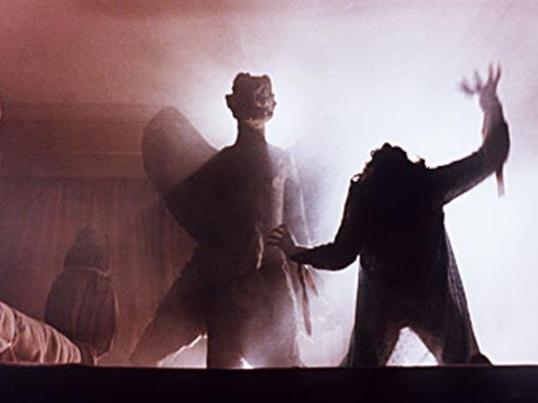
In the end, this chosen theme for the day will be continue to scare and terrify old and new audiences of The Exorcist. Just looking at the video above with just the fog-shrouded Georgetown brownstone in the foreground and Father Merrin just standing there looking up at the home then having the theme playing would make even the most God-less person want to start praying for their eternal soul.





 Through the Shattered Lens