Halloween Horrors 2013 : “Carrie” (1976)


Carrie-Poster


Over at my “main” site — http://trashfilmguru.wordpress.com , for those who don’t know, don’t care, either, or both — I’ve been doing what every other goddamn movie blog in the universe does in the month of October: namely, review a bunch of random horror flicks. But come on — you didn’t think I was just gonna sit back and let Lisa Marie, Arleigh, Leonard Wilson, and everybody else have all the fun here on TTSL, did you?

Nah. I just had to muscle in and opine on a few macabre movie delights on these digital “pages” before the month was out, as well. And I might as well start with the one everybody’s talking about right now, Carrie, the 1976 classic directed, in his inimitable style, by Brain DePalma, based on the runaway best-seller by Stephen King, and starring Sissy Spacek as quite likely the most hapless horror heroine in history.

This film is significant for a number of reasons, not the least of which being that it was the first King “property” to be adapted for the big screen, thus announcing the arrival of a major new player on the scene who would go on, of course, to have a veritable industry of celluloid “translations” of his work sprout up over the ensuing decades, some of which were clearly — oh, wait, people these days are talking about a different Carrie altogether? One that just came out last week?

Well, I saw that one, too, but fuck it — I feel like reviewing this one first.

carrie_mother


Let’s backtrack to that “horror’s most hapless heroine” claim for a minute, shall we? It might sound like a bold claim, but I swear it’s true — think about it for a minute : poor Carrie White starts the movie by having her first period in the shower at school, she thinks she’s dying because her religious whack-job of a mom is too chickenshit to tell her about menstruation, she gets teased mercilessly by all the girls who witness her uncomfortable (to say the least) entry into womanhood, she has no friends to speak of, she’s stuck with a bunch of telekinetic powers that she doesn’t understand or know how to effectively control, she’s the butt of every cruel joke her classmates play, she has to listen to her idiot mother blather nonsense 24/7,  she gets invited to the prom as by the most popular kid in school strictly as an act of misguided charity, and then, just when she’s granted one moment of respite from the nonstop parade of tragedy that comprises her existence when she’s crowned world’s most unlikely  prom queen, she gets a bucket full of pig blood dumped all over her, freaks out and kills everybody with her “mind powers,” and goes home from the best/worst night of her life to find that mommie dearest has decided to kill her in Jesus’ name.

Talk about a gal who just can’t catch a break.

carrie1976-0372


Sure, it all seems a bit over the top — okay, it all is a bit over the top — but DePalma pulls out all the stops to draw you into this sordid little world of revival tent-reject parents (Piper Laurie), evil high school bitches (Nancy Allen), pussy-whipped wannabe-tough guys (John Travolta), well-meaning but ultimately ineffectual teachers (Betty Buckley), semi-guilt-ridden classmates (Amy Irving), jocks with out of control white-guy ‘fros (William Katt), and grounds the whole heady mixture in a turn-for-the-ages performance by Spacek that really makes you feel for the poor kid even — maybe especially — when she finally snaps. His always-stylish-and-inventive use of sound, split screen, and slow-burn tension keep you pretty well fixated on the proceedings throughout, and all in all you’ve just gotta say this still holds up as a pretty impressive cinematic achievement.

Of course, King hit on a fairly inventive little gimmick from the outset here — plenty of horror stories, fairy tales, fables, and probably even  nursery rhymes are little more than thinly-disguised metaphors for the onset of puberty and the scary transition from childhood into the ‘adult” world, but here he just dispensed with the pretense and doubled-down by ripping the mask off and piling the real, actual, non-metaphorical point on top of the , as we say in modern parlance, “genre trappings,” and as a result ended up penning a scary story for the ages.

Sissy_Spacek_as_Carrie_White,_1976


Classic visuals — you know, like the one reproduced directly above — hammer the point home in memorable fashion, to be sure, and what Carrie lacks in subtlety it definitely makes up for in sheer, shock-ya-senseless power. Audiences went wild for this flick back in ’76, and while that might not be saying much because they also went apeshit for every cheesy “patriotic” bicentennial gimmick, knick-knack, gee-gaw, and useless item of “home decor” that came out that year, in this case they were absolutely right — this is a nifty little barnburner of a movie that has aged as well as any wine you care to mention.

Carrie is aviailable on DVD and Blu-Ray from MGM, and it’s also currently playing on Netflix’s instant streaming queue, where it can be found under no less than three category headers — “horror,” “Halloween favorites,” and “cult movies.” So go check it out already — or check it out again already, as the case may be — and we’ll talk about that other  movie with the same title next time around.

Quick Review: Carrie (dir. by Kimberly Peirce)


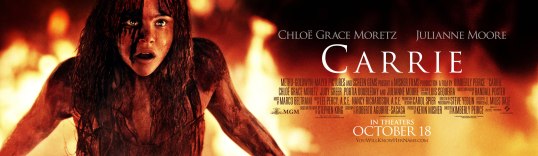
carrie2013bannerHigh School can be a rough time. Growing up, we always had Freshman Day, where bullies spent the first Friday of the new semester terrorizing the newbies. I spent at least one of those years either writing in the Library for lunch or on the run between classes until a poem/love letter I wrote on behalf of a member of the Varsity Football team left me in their good graces and under their protection. Needed to tell your girl she was the best thing since Ham & Pineapple pizza, but in an eloquent way? Go ask that geek in the back row of English reading Christine with the big round glasses. Oh, the joys of High School. I can’t even imagine how intense bullying can get today with all of the social media we have. It’s easy to imagine what you could do to protect yourself if you could be as cool as Nightcrawler and make yourself teleport, fight off your foes like Batman or best of all, Force Choke the crap out of someone like Darth Vader.

In that sense, the story of Carrie is still kind of cool, and mildly disturbing.

There was a point in Stephen King’s life where Carrie almost never happened. It was because of his wife, Tabitha that the story was ever finished and that the parts focused on women and their “monthlies” (as members of my family would say) were written the way they were. Carrie got King his foot in the door and set him for other releases like The Shining, Christine and Salem’s Lot. I think next to The Shining, it might be his most remade film.

I’m not sure if there’s anyone who never saw Brian De Palma’s Carrie from 1978 with Sissy Spacek. If not, Kimberly Peirce’s version is not bad at all as an introduction to the story. It actually has at least one element from the book that was never featured in the original film (though part of me does wish that it contained the newspaper format – something like John Larroquette’s narration for The Texas Chainsaw Massacre). Carrie is simply the tale of a young girl in high school who discovers she has telekinetic powers. Eventually, she gets pushed and loses it, unleashing her abilities against anyone in her way. No version of the story has ever gone into detail on how she got them outside of the puberty angle – they’re just there.

Peirce’s version moves just as well as De Palma’s, which is interesting because supposedly they happen to be friends. The main differences lie in DePalma’s choice of nudity versus Peirce’s lack of it, and DePalma’s lack of blood (a sign of the times) compared to Peirce’s extended usage of it. Other than that, it’s roughly the same film, any closer and you’d end up with Gus Van Sant’s shot for shot version of Psycho. Half of me wonders why it needed to be remade (again), the other half says, “You know what, it wasn’t half bad.” There’s nothing essentially wrong with Carrie, but it’s really hard to talk about the Peirce Carrie Film without going back to the DePalma one.

First, Carrie’s biggest strength by far comes in it’s casting. As the leads, both Chloe Grace Moretz and Julianne Moore are great in their roles – almost better than the film deserves. Granted, it’s kind of difficult to imagine anyone messing up something as simple as this. When it comes to young horror starlets, the first two names that come to my mind are Silent Hill’s Jodele Ferland and The Hunger Games’ Isabelle Fuhrman, both of which I thought would be interesting fits here. If Katharine Isabelle was just a little younger, that would have worked too. However, I forgot that Moretz had both The Amityville Horror and Let Me In under her belt (and we won’t speak of Dark Shadows – That wasn’t horror. That wasn’t even comedy. I can’t even identify what that was). Her role as Carrie is somewhat similar to Let Me In, being more reserved here than the Kick Ass films and with good reason.

Moore’s version of Margaret White spends some time self harming herself, which was a little eerie and reminded me of Paul Bettany’s character in The DaVinci Code, punishing themselves for their sins. She’s good here, but after coming off winning an Emmy for playing Sarah Palin in “Game Change”, she looks like she’s underused here. It’s like having an actor play a superhero after becoming a great director and winning tons of accolades. A job is a job, and Moore does a great one here given what she has to work with.

The supporting cast was interesting. I didn’t expect to like Judy Greer’s gym teacher as much as I did, and Ansel Angort’s Tommy Ross was good. I hope that this film leads to bigger and better roles for him. A surprise was Chronicle’s Alex Russell as Billy Nolan, the character originally played by John Travolta. He pulls off a villain well. Portia Doubleday’s version of Kris Hargensen may actually be better than Nancy Allen was, though this could also be in part due to the way the story is written.

So, on with the plot. Carrie White (Moretz) is a reclusive loner, living with her overprotective mother (Moore). In the school shower, she has her period for the first time and not realizing what’s occurring to her (and having never been told just what to expect), naturally panics. This leads to an all out humiliation by her peers that’s even recorded. Carrie later learns about her abilities, while her nemesis, Kris is kicked from the prom and vows to take her vengeance against Carrie. Some of the main sequences are actually expanded upon, which I thought were actually good.

I think the only problem I had with Carrie was the technique used for the Telekinesis. It almost seems a little CGI heavy, but when I think about it, I’m not sure how else they could have pulled off much of what they did here without it. Additionally, Moretz’s version of Carrie uses her hands a lot, which almost makes it seems like she’s either dancing or is trying to conjure up something. It’s not a terribly bad thing and you may actually get used to it after she does it once or twice. Part of me kept expecting her to scream “Unlimited Power!” at one point but it was just a minor “Wow, that’s kind of weird.” Reaction, at least for me.

Carrie’s not really meant for little kids. Anyone who’s a fan of Moretz by way of Diary of a Wimpy Kid might not be ready to handle Carrie, but if you’ve followed any of the Kick Ass films, Carrie’s actually lighter than those. Overall, it’s one of the better remakes out there and a very short film (I’m writing this while watching the Nightmare on Elm Street remake, so I like to think I have a good basis of comparison). If you never saw the original, it might be worth a try. If you don’t wish to spend the money for the ticket, you can always watch one of the other versions and wait for this to come out on Blu-Ray.

R.I.P. Richard Matheson


Richard-Matheson-author

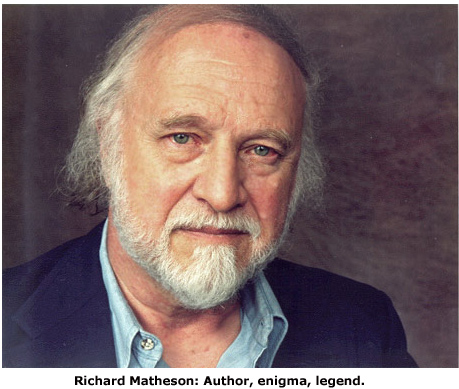
News hit the internet today that legendary author Richard Matheson passed away at the age of 87.

Matheson has been instrumental and influential in horror and dark fantasy pop culture of the 60 or so years. Stephen King and George A. Romero, undoubtedly two of the most recognizable masters of horror of their generation, has called Matheson a major influence in their work. Where would the zombie genre of today be without Matheson’s groundbreaking vampire novel, I Am Legend, which gave Romero the idea to make his Night of the Living Dead. It is also this very same vampire novel whose influence could be seen throughout King’s own classic vampire tale with Salem’s Lot. Even King’s own foray into a zombie novel, Cell, would be dedicated to Matheson.

Yet, Matheson’s influence wouldn’t just be felt in the literary world. He would pen some of the best Twilight Zone episodes and would also provide Roger Corman with screenplay adaptations of Edgar Allen Poe’s short stories and novellas. He would also provide Hollywood with screenplays based on his own stories that would become classic horror and dark fantasy films in their own right.

There’s no way to quantify just how many people Richard Matheson has touched and influenced with his work, but one would be hard pressed not to find someone who hasn’t come across something that had Matheson’s fingerprint whether it was one of his stories, films based on his works or a tv episode that he didn’t have a hand in writing. Then there’s those who have seen or read something that had been influenced by his work.

Today the world has lost of the giant’s in his field of work. Yet, as his best known work says as it’s ending, Matheson will survive far longer than he had lived: HE IS LEGEND.

On a personal note, I count Matheson as one of the biggest influences in my life. Everything he has done or touched have had a hand in showing me the power of the written word. Much of what I watch and read has been influenced by his work. Where would horror and dark fantasy be without him to set the path for future writers and filmmakers. Whether they care to admit it or not they, just like myself, owe Richard Matheson a debt of gratitude for work in the field.

A giant of a man has passed into legend and it’s now up to us, his admirers and fans, to continue on his work of providing the world with quality genre entertainment.

Horror Scenes I Love: Misery


Our next horror-themed “Scenes I Love” entry comes courtesy of Rob Reiner’s film adaptation of the Stephen King novel to celebrity stalkers everywhere.

Misery was one of those novels that was actually much better when adapted to the film screen. Maybe it was the performances of the small cast with Kathy Bates’ star-turning role as Annie Wilkes who happens to be Paul Sheldon’s (James Caan) Number 1 fan. I’m not a huge Rob Reiner fan, but he hits on all cylinders with this adaptation and the scene which cements this film as one of my favorite horror films is the one many have simply called “The Hobbling”.

The scene itself was actually much more graphic in the novel since Annie uses an axe instead of the sledgehammer in the film. Yet, the lack of blood and chopped flesh and bone didn’t keep the scene from being wince-inducing. In fact, the use of the sledgehammer and the wooden block and the slow build-up to the money shot made the entire sequence almost hard to stomach and bear. I think I’m not the only one who ended up having phantom pains as soon the Annie went to town on Paul’s legs.

Horror Trailer: Carrie (by Kimberly Peirce)


We finally have the first trailer in the upcoming horror remake Carrie starring Chloe Grace Moretz and directed by Boys Don’t Cry filmmaker Kimberly Peirce.

When news came out that the classic Brian De Palma film adaptation of the Stephen King novel was being remade there wasn’t much of a positive reaction to the news. The usual grumbling about another horror remake being put into production and how Hollywood was running out of ideas was heard throughout the blog land. Then more details surface of who would play the title role which was made famous in the original film by Sissy Spacek. When it was announced that Chlie Grace Moretz would take on the Carrie role then grumbling subsided somewhat.

While there will always be detractors of the film even while it’s still in production the word coming out that the film will not be a straight out remake of the film but more of a faithful adaptation of the novel has made me cautiously optimistic. The fact that the last horror remake Moretz was involved in turned out quite well (Let Me In) is another reason to hope. Plus, Peirce as the director should help put the focus of the film’s narrative on where King originally intended it to be and that’s the social divide between the popular kids in the dangerous world of high school who end up bullying the weaker outcasts.

The teaser trailer gives a hint at how the film looks to follow the novel more than the De Palma film by showing the town in flames and not just the school. Carrie is set for a March 15, 2013 release date.

Horror Scenes I Love: Christine


Here we are again ghouls and ghoulettes. Time for another one of my favorite horror scenes. Some might say that the film I chose my latest favorite scene from is not truly a horror film but more a thriller are so definitely wrong. Both in it’s original novel form and in Carpenter’s film adaptation, Christine is definitely a horror film that eschews overt scenes of gore and violence and goes about it’s scares in a more round-a-bout way. It’s a horror film of a Boy-meets-Girl gone wrong. My own review of the film over a year ago show’s my positive take on this 80’s classic.

One of my favorite scenes from Christine happens midway through the film that also serves as the final clue that something may just be a tad different with Archie’s car named Christine. While the scene itself is not one of horror it does show the supernatural side of this film’s plot (a bit more simplified than the original novel’s but still keeping the theme of possessed inanimate objects giving life to itself). The combination of Christine showing Archie just what she’s capable of and Carpenter’s electronic film score as it segues into a seductive tune adds to the awesomeness of this scene.

Once this scene is over the audience now knows that Archie is fully gone over to Christine’s side and that the story will end not in a very happy note, but until that happens we see just how much this particular Boy seem to have finally met his ideal Girl.

Review: The Shawshank Redemption (dir. by Frank Darabont)


“Remember, Red. Hope is a good thing, maybe the best of things, and no good thing ever dies.” — Andy Dufresne

1994 was the year that men finally got their version of Fried Green Tomatoes and Beaches. We men we’re always perplexed why so many women liked those two films. Even when it was explained to us that the film was about the bond of sisterhood between female friends and how the march of time could never break it we were still scratching out heads. In comes Frank Darabont’s film adaptation of the Stephen King novella Rita Hayworth and Shawshank Redemption.

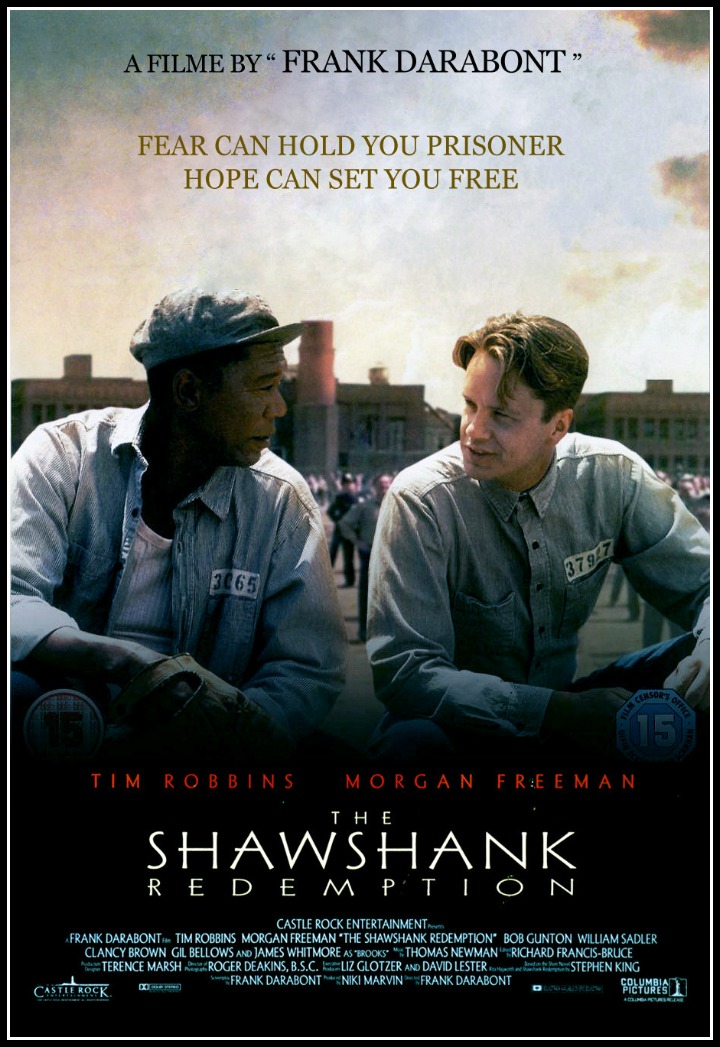
Using a script written by Darabont himself, the film just takes the latter half of the novella’s title and focuses most of the film’s story on the relationship between the lead character of Andy Dufresne (played by Tim Robbins) who gets sent to Shawshank Penitentiary for the crime of killing his wife and her lover and that of another inmate played by Morgan Freeman. The film doesn’t try to prove that Andy is innocent even though we hear him tell it to the convicts he ends up hanging around that he is. The relationship between Andy and Red becomes a great example of the very same bond of sisterhood, but this time a brotherhood who are stuck in a situation where their freedom has been taken away and hope itself becomes a rare and dangerous commodity.

Darabont has always been a filmmaker known for his love of Stephen King stories and has adapted several more since The Shawshank Redemption, but it would be this film which has become his signature work. It’s a film that’s almost elegiac in its pacing yet with hints of hope threaded in-between scenes of men clinging to sanity and normalcy in a place that looks to break them down and make them less human. It’s nothing new to see prison guards abusive towards inmates in films set in prisons, but in this film these scenes of abuse have a banality to them that shows how even the hardened criminal lives and breathes upon the mercy and generosity provided by the very people who were suppose to rehabilitate them.

While the film’s pacing could be called slow by some it does allow for the characters in the film, from the leads played by Robbins and Freeman to the large supporting cast to become fully formed characters. It doesn’t matter whether it’s Clancy Brown playing the sadistic Capt. Byron Hadley to James Whitmore as Brooks Hatlen the inmate who has spent most of his life in Shawshank and whose sudden parole begins one of the most heartbreaking sequences in the film. The whole cast did a great job in whatever role they had been chosen to play. Freeman and Robbins as Red and Andy have a chemistry together on-screen that makes their fraternal love for each other very believable that the final scenes in the film doesn’t feel too melodramatic or overly sentimental.

The Shawshank Redemption was a film that lost out to Forrest Gump for Best Picture, but was a film that would’ve been very deserving if it had won the top prize at the Academy Awards. It was a film that spoke of hope even at the most degrading setting and how it’s the very concept of hope and brotherhood that allows for those not free to have a sense of freedom and camaraderie. Darabont’s first feature-length film remains his best work to date and one of the best Stephen King adaptations which is a rarity considering how many of his stories have been adapted. So, while the fairer sex may have their Fried Green Tomatoes, Beaches and the like, we men will have ours in the fine film we call The Shawshank Redemption.

Horror Review: Christine (dir. by John Carpenter)


During the late 1970s and early 1980s, one could hardly step into a theater during the fall or winter movie season without seeing a trailer for the newest Stephen King adaptation. His name had become synonymous with cinematic horror, and nearly every year brought a new film promising supernatural terror or psychological unease.

Among this wave of adaptations came a 1983 film that united two masters of the genre—Stephen King, the reigning literary giant of horror, and John Carpenter, the filmmaker who had already cemented his reputation with Halloween and The Thing. Their collaboration resulted in the sleek, deadly story of a boy and his car: Christine.

The film opens on the assembly line of a Plymouth factory in 1957, immediately signaling that something is off about this particular 1958 Plymouth Fury. From the first note of the retro rock soundtrack to the gleam of that deep crimson paint, Carpenter frames the car with both nostalgia and menace. The lighting in this opening feels almost clinical—bright, sterile, mechanical—yet Christine’s red sheen cuts violently through it, a visual omen that this machine is infused with something beyond metal and chrome. Carpenter wastes no time making it clear that this car is not an inanimate prop; it’s a living entity from the moment it’s born.

We’re soon introduced to the film’s human core—Arnie Cunningham (Keith Gordon), a shy, bookish teenager tormented by bullies and smothered by his controlling parents, and his best friend Dennis Guilder (John Stockwell), the confident star athlete who often looks out for him. One afternoon, during their drive home from school, Arnie spots a rusting, decrepit Plymouth Fury in the front yard of an old man named Roland D. LeBay. Where Dennis sees a heap of junk, Arnie sees perfection. Ignoring his friend’s concerns—and later, his parents’ outrage—Arnie buys the car and names it Christine.

As Arnie begins restoring Christine to her former glory, a transformation occurs—not just in the car, but in Arnie himself. The once timid, acne-scarred teenager grows into a confident, even arrogant young man, donning slicker clothes, sharper speech, and a darker aura. Christine becomes his obsession, his refuge, and ultimately, his identity.

Carpenter crafts this metamorphosis with eerie precision, pairing the car’s physical renewal with Arnie’s psychological decay. The cinematography shifts accordingly—the lighting grows darker, drenched in neon reds and shadowy blues, mirroring Christine’s two faces: seductive allure and demonic possession. Carpenter’s score, a pulsing blend of electronic rhythm and minimalistic dread, underscores these shifts. It functions almost like Christine’s heartbeat—steady, mechanical, and ominously sensual.

Between the vintage rock tracks that accompany Arnie’s moments of infatuation and the electronic motifs that follow Christine’s predatory stalks, Carpenter manipulates sound to blur the lines between teenage romance and supernatural horror. Every rev of the engine feels rhythmic, almost musical, as if the car itself communicates through vibration and tone rather than words.

Arnie’s newfound confidence even earns him Leigh Cabot (Alexandra Paul), the most desired girl in school—a relationship that initially feels like a symbol of his triumph. But Christine is no fairy tale. When Arnie’s bullies vandalize his beloved car, the story turns from eerie to vengeful.

In a now-iconic sequence, Christine repairs herself before Arnie’s stunned eyes—the crumpled metal expands, glass re-forms, headlights ignite like eyes opening from a nightmare. Carpenter lights the scene with a soft, golden underglow that turns mechanical resurrection into a hauntingly beautiful transformation. It’s both horrifying and hypnotic—a perfectly scored ballet of vengeance set to the hum of machinery and the director’s unmistakable electronic pulse.

What follows is a furious killing spree. Christine prowls the night streets for retribution, a creature of fire and gasoline more alive than metal should ever be.

While Carpenter’s adaptation diverges from King’s novel, it remains faithful to its emotional and thematic essence. King’s book delves deeply into the idea of objects absorbing the evil of their owners, suggesting that malevolence can linger in things as much as in people. Carpenter, however, turns the focus inward.

His version becomes a tragic character study—a battle for Arnie’s soul between the cold, seductive power of obsession and the fragile warmth of human connection. In one corner stands Christine, the car that offers Arnie unconditional love but demands total possession. In the other are Dennis and Leigh, desperate to save the friend they’re rapidly losing to something they can’t fully understand.

Carpenter’s signature touches—his electronic score, minimalist framing, and cynical tone—imbue the film with a dark romanticism. Christine is less a haunted object than a femme fatale: a mechanized embodiment of jealousy and desire. The film’s atmosphere bridges two eras, combining the nostalgic vibe of 1950s Americana with the grim realism of Reagan-era suburbia.

By the end, Christine becomes both a story of supernatural obsession and a commentary on teenage identity—the hunger to shed weakness, to command respect, and to control one’s fate, even at the cost of one’s soul.

Upon its release in December 1983, Christine performed modestly at the box office but was far from a failure. Over time, it has developed a strong cult following, cherished by both Carpenter devotees and Stephen King fans. Though often overshadowed by Carpenter’s heavier-hitting works like The Thing or Escape from New York, Christine remains one of his most technically polished films. It also stands as a fascinating bridge between studio horror and Carpenter’s independent sensibilities—where the shine of a Hollywood production mingles with the grit of a B-movie heart.

If Christine teaches any lesson, it’s that love and possession are two sides of the same coin. Arnie’s tragedy lies not in falling for the wrong woman, but in falling for one that burns with literal hellfire. In Carpenter’s vision, the road to damnation isn’t paved with good intentions—it’s lined with chrome, lit by headlights, and always hungry for one more ride.

Scenes I Love: Salem’s Lot (Part 1)


Stephen King’s novels and short stories were mined relentlessly during the late 70’s and through the 80’s and the early 90’s. For the most part the film and tv adaptations of his work were adequate and passable. Some were downright awful and made one wonder if King was just trying to cash as many of his work for licensing paychecks or if he really thought the studios who purchased the rights would actually do a good job adapting them. One such studio which seemed to have done a very good job adapting one of King’s greatest works, Salem’s Lot, was Warner Brothers who adapted the classic vampire novel to become a mini-series for CBS.

I never saw the mini-series when it first aired in 1979, but I did see it a few years later when it re-aired on TV and then many more times on VHS and then on DVD. Tobe Hooper directed the hell out of this mini-series and turned what was a very complex modern retelling of Bram Stoker’s Dracula into a 3-hour mini-series that was both gothic and downright terrifying despite the restraints of TV.

While the mini-series does seem dated now it still retains that creepiness, foreboding atmosphere and scares which made Hooper’s Salem’s Lot one of the better King adaptations. The scene which will always stick with me and still gives me the chills whenever I watch it is when Danny Glick’s younger brother visits him in the hospital. This scene is just downright scary whether watching it as a 9 year-old or one in their 30’s.

Stephen King’s The Stand to Trip Up Onto the Big-Screen


Stephen King properties sure has been heating up around Hollywood of late. For the past month or so we’ve had almost weekly news about Ron Howard’s plans for King’s massive book series, The Dark Tower. Today news that the role of Roland Deschain, the Gunslinger, has been offered to Spanish-actor Javier Bardem shows that the planned film adaptation of The Dark Tower is moving forward.

Now, according to The Hollywood Reporter blog Heat Vision, Warner Brothers and CBS Films are planning to co-produce the film adaptation of another Stephen King property and one many of his fans consider as their favorite. I consider myself one of those fans and I’m actually quite excited that these two studios are looking to adapt the epic, apocalyptic novel The Stand.

The novel already was adapted into a mini-series by Mick Garris in 1994, but that adaptation didn’t satisfy the book’s fans as its producers were hoping for. This planned film adaptation looks to give The Stand a grand stage to be shown to its old and new fans. While trying to adapt a novel that is over 1200 pages long might seem daunting the same was said about trying to adapt a novel that was three times it’s length and that one succeeded beyond anyone’s expectations. If Peter Jackson can take The Lord of the Rings and create an epic masterpiece out of such a dense piece of literature I think King’s The Stand should make just as good a transition.

Here’s to hoping that this particular apocalyptic project gets on the fast track and doesn’t get bogged down in development hell the way another apocalypse-themed film project has found itself in: Max Brook’s zombie epic novel, World War Z.

Source: The Hollywood Reporter