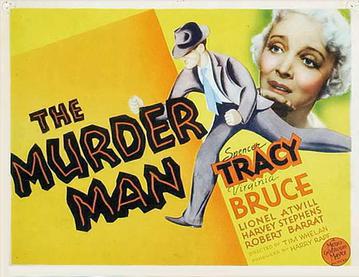
Film Review: The Murder Man (dir by Tim Whelan)


Seven minutes into the 1935 film, The Murder Man, 27 year-old James Stewart makes his film debut.

He’s playing a reporter named Shorty and, since this is a 30s newspaper film, he’s first seen sitting at a table with a bunch of other cynical reporters, the majority of whom seem to be alcoholics and gambling addicts.  Suddenly, words comes down that a corrupt businessman named Halford has been assassinated, shot by an apparent sniper.  (It is theorized that he was shot from one of those carnival shooting gallery games, which was somewhat oddly set up on a street corner.  Maybe there was shooting galleries all over place in 1935.  I supposed people had to do something to keep their spirits up during the Depression.)  While the other reporters run to the scene of the crime, Shorty is on the phone and calling his editors to let them know that a huge story is about to break.

Steve Grey (Spencer Tracy) is the reporter assigned to the story.  Crime is his beat and everyone agrees that no one’s better at covering criminals and understanding what makes them tick.  Unfortunately, it’s not always easy to track Steve down.  He’s a hard drinking reporter and lately, he’s been concerned about the collapse of his father’s business.  Still, when Steve is finally tracked down, he throws himself into covering the story and speculating, in print, about who could have killed Halford.  In fact, his girlfriend (Virginia Bruce) worries that Steve is working too hard and that he’s developing a drinking problem.  She suggests that Steve needs to take some time off but Steve is driven to keep working.

It’s largely as a result of Steve’s actions that a man named Henry Mander (Harvey Stephens) is arrested and convicted of Halford’s murder.  Steve should be happy but instead, he seems disturbed by the fact that he is responsible for Mander going to jail.  When his editor requests that Steve go to Sing Sing to interview Mander, a shocking truth is revealed.

Admittedly, the main reason that I watched The Murder Man was because it was the feature film debut of James Stewart.  (Stewart previously appeared in a comedy short that starred Shemp Howard.)  Stewart is only in a handful of scenes and he really doesn’t have much to do with the main plot.  To be honest, Shorty’s lines could have been given to anyone.  That said, Stewart still comes across as being a natural on camera.  As soon as you hear that familiar voice, you can’t help but smile.

Even if Stewart hadn’t been in the film, I would have enjoyed The Murder Man.  It’s fast-paced mystery and it has a decent (if not totally unexpected) twist ending.  It’s one of those films from the 30s where everyone speaks quickly and in clipped tones.  Casual cynicism is the theme for the day.  Spencer Tracy gives a wonderful performance as the hard-drinking and troubled Steve Grey and the scene where he meets Mander in prison is surprisingly moving.  Clocking in at only 68 minutes, The Murder Man is a good example of 30s Hollywood.
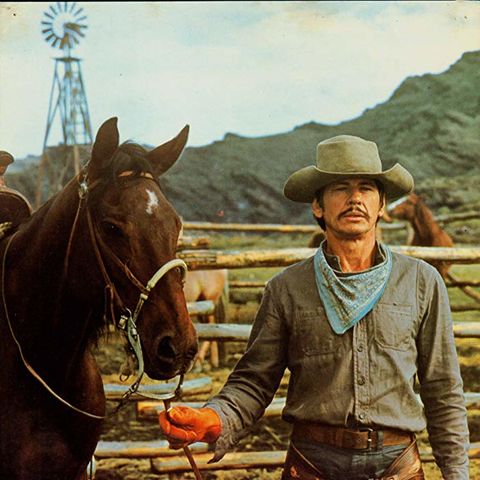
Happy Birthday in heaven to Director John Sturges! 🎉


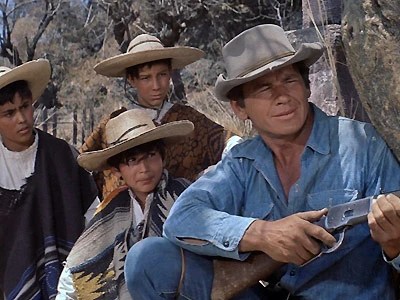
Director John Sturges was born on January 3rd, 1910. He directed some of my favorite movies, and many of them starred my movie hero, Charles Bronson. The picture above is from 1973’s CHINO!

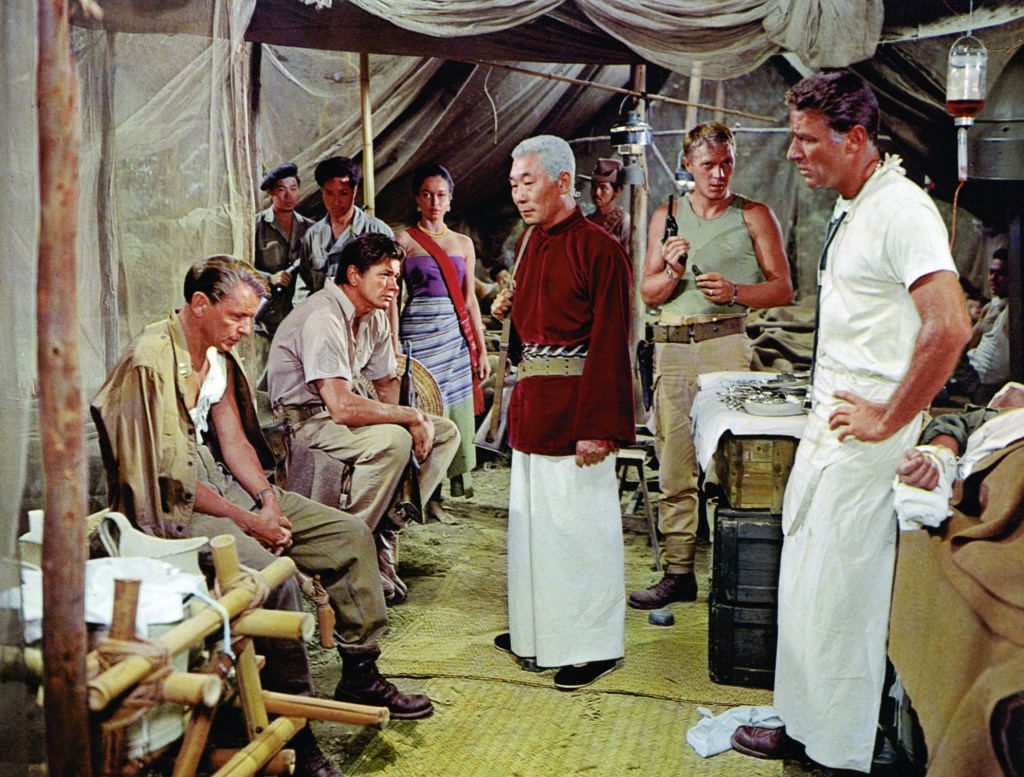
Charles Bronson’s second role in a film was in Sturges’ THE PEOPLE AGAINST O’HARA from 1951, starring Spencer Tracy. The picture below isn’t a very good picture as Bronson was only in one scene. Can you spot Bronson??

In 1959, Sturges would direct Charles Bronson in NEVER SO FEW, which co-starred Frank Sinatra and Steve McQueen.

Just a year later in 1960, Sturges would direct Bronson and an all star cast that included Yul Brynner, Steve McQueen, James Coburn and Robert Vaughn in THE MAGNIFICENT SEVEN, a remade of the Akira Kurosawa classic THE SEVEN SAMURAI. Bronson’s role as Bernardo O’Reilly is one of the best in the entire film.

John Sturges would direct Charles Bronson again in 1963 in the classic film THE GREAT ESCAPE, which also starred Richard Attenborough, Steve McQueen, James Garner, James Coburn and Donald Pleasence. Charles Bronson drew on his experience in the coal mines of Pennsylvania when he played “The Tunnel King” in the classic World War II film. Charles Bronson is one of the characters who actually escapes, which made me very happy!

John Sturges would direct Charles Bronson one more time in the underrated western from 1973, CHINO (pictured at the top). Sturges was a phenomenal director, and Charles Bronson was in some of his very best work! As Charles Bronson’s biggest fan, Sturges will always be one of my favorite directors!!

Man of the People: John Ford’s THE LAST HURRAH (Columbia 1958)


gary loggins's avatarcracked rear viewer

This post has been preempted as many times as tonight’s State of the Union Address! 


John Ford’s penchant for nostalgic looks back at “the good old days” resulted in some of his finest works. The sentimental Irishman created some beautiful tone poems in his 1930’s films with Will Rogers, and movies like HOW GREEN WAS MY VALLEY and THE QUIET MAN convey Ford’s sense of loss and wistful longing for simpler times. The director’s THE LAST HURRAH continues this theme in a character study about an Irish-American politician’s final run for mayor, running headfirst into a new era of politics dominated by television coverage and media hype instead of old-fashioned boots-on-the-ground handshaking and baby-kissing. It’s not only a good film, but a movie buff’s Nirvana, featuring some great older stars and character actors out for their own Last Hurrah with the Old Master.

Based on Edwin O’Connor’s 1956 novel, the…

View original post 818 more words

Four Star Fun: LIBELED LADY (MGM 1936)


gary loggins's avatarcracked rear viewer

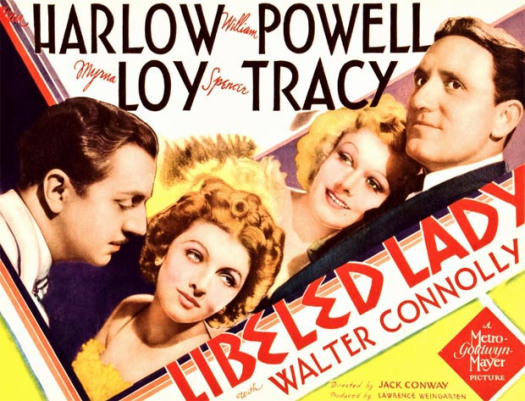
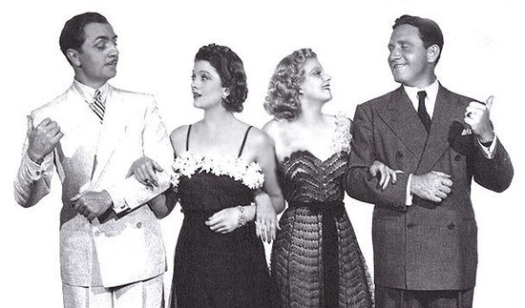
Jean Harlow ! Spencer Tracy ! William Powell ! Myrna Loy ! Four top stars at the top of their game shining bright in LIBELED LADY, a screwball comedy directed by Jack Conway with that trademark MGM gloss. Despite the zany improbability of the script by Maurine Watkins, Howard Emmett Rogers, and George Oppenheimer, the crackling, witty dialog gives all four stars (and supporting actor Walter Connolly) plenty of good material.

Here’s the plot: rich heiress Connie Allenbury (Loy) is suing the New York Evening Star for printing a story about her being a husband stealer. Her price: five million! Editor Warren Haggerty (Tracy), after once again blowing off his nuptials to long-time flame Gladys Benton (Harlow), recruits ex-reporter and frenemy Bill Chandler (Powell) in a crazy scheme involving marrying him off to Gladys (and is she pissed!), hop an ocean liner to London, and return with Connie, using his…

View original post 310 more words

Lisa Reviews An Oscar Nominee: How The West Was Won (dir by Henry Hathaway, George Marshall, John Ford, and Richard Thorpe)


(With the Oscars scheduled to be awarded on March 4th, I have decided to review at least one Oscar-nominated film a day.  These films could be nominees or they could be winners.  They could be from this year’s Oscars or they could be a previous year’s nominee!  We’ll see how things play out.  Today, I take a look at the 1963 best picture nominee, How The West Was Won!)

How was the west won?

According to this film, the west was won by the brave men and women who set out in search of a better life.  Some of them were mountain men.  Some of them worked for the railroads.  Some of them rode in wagons.  Some of them gambled.  Some of them sang songs.  Some shot guns.  Some died in the Civil War.  The thing they all had in common was that they won the west and everyone had a familiar face.  How The West Was Won is the history of the west, told through the eyes of a collection of character actors and aging stars from Hollywood’s Golden Age.

In many ways, How The West Was Won was the Avatar of the early 60s.  It was a big, long, epic film that was designed to make viewers feel as if they were in the middle of the action.  Avatar used 3D while How The West Was Won used Cinerama.  Each scene was shot with three synchronized cameras and, when the film was projected onto a curved Cinerama screen, it was meant to create a truly immersive experience.  The film is full of tracking shots and, while watching it on TCM last night, I tried to imagine what it must have been like to see it in 1963 and to feel as if I was plunging straight into the world of the old west.  The film’s visuals were undoubtedly diminished by being viewed on a flat screen and yet, there were still a few breath-taking shots of the western landscape.

The other thing that How The West Was Won had in common with Avatar was a predictable storyline and some truly unfortunate dialogue.  I can understand why How The West Was Won was awarded two technical Oscars (for editing and sound) but, somehow, it also picked up the award for Best Writing, Screenplay or Story.  How The West Was Won is made up of five different parts, each one of which feels like a condensed version of a typical western B-movie.  There’s the mountain man helping the settlers get down the river story.  There’s the Civil War story.  There’s the railroad story and the outlaw story and, of course, the gold rush story.  None of it’s particularly original and the film is so poorly paced that some sections of the film feel rushed while others seem to go on forever.

Some of the film’s uneven consistency was undoubtedly due to the fact that it was directed by four different directors.  Henry Hathaway handled three sections while John Ford took care of the Civil War, George Marshall deal with the coming of the railroad, and an uncredited Richard Thorpe apparently shot a bunch of minor connecting scenes.

And yet, it’s hard not to like How The West Was Won.  Like a lot of the epic Hollywood films of the late 50s and early 60s, it has its own goofy charm.  The film is just so eager to please and remind the audience that they’re watching a story that could only be told on the big screen.  Every minute of the film feels like a raised middle finger to the threat of television.  “You’re not going to see this on your little idiot box!” the film seems to shout at every moment.  “Think you’re going to get Cinerama on NBC!?  THINK AGAIN!”

Then there’s the huge cast.  As opposed to Avatar, the cast of How The West Was Won is actually fun to watch.   Admittedly, a lot of them are either miscast or appear to simply be taking advantage of a quick payday but still, it’s interesting to see just how many iconic actors wander through this film.

For instance, the film starts and, within minutes, you’re like, “Hey!  That’s Jimmy Stewart playing a mountain man who is only supposed to be in his 20s!”

There’s Debbie Reynolds as a showgirl who inherits a gold claim!

Is that Gregory Peck as a cynical gambler?  And there’s Henry Fonda as a world-weary buffalo hunter!  And Richard Widmark as a tyrannical railroad employee and Lee J. Cobb as a town marshal and Eli Wallach as an outlaw!

See that stern-faced settler over there?  It’s Karl Malden!

What’s that?  The Civil War’s broken out?  Don’t worry, General John Wayne is here to save the day.  And there’s George Peppard fighting for the Union and Russ Tamblyn fighting for the Confederacy!  And there’s Agnes Moorehead and Thelma Ritter and Robert Preston and … wait a minute?  Is that Spencer Tracy providing narration?

When Eli Wallach’s gang shows up, keep an eye out for a 36 year-old Harry Dean Stanton.  And, earlier, when Walter Brennan’s family of river pirates menaces Karl Malden, be sure to look for an evil-looking pirate who, for about twenty seconds, stares straight at the camera.  When you see him, be sure to say, “Hey, it’s Lee Van Cleef!”

How The West Was Won is a big, long, thoroughly silly movie but, if you’re a fan of classic film stars, it’s worth watching.  It was a huge box office success and picked up 8 Oscar nominations.  It lost best picture to Tom Jones.

(By the way, in my ideal fantasy world, From Russia With Love secured a 1963 U.S. release, as opposed to having to wait until 1964, and became the first spy thriller to win the Oscar for Best Picture.)

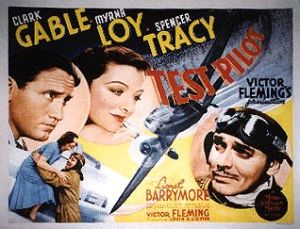
Lisa Reviews An Oscar Nominee: Test Pilot (dir by Victor Fleming)


(With the Oscars scheduled to be awarded on March 4th, I have decided to review at least one Oscar-nominated film a day.  These films could be nominees or they could be winners.  They could be from this year’s Oscars or or they could be a previous year’s nominee!  We’ll see how things play out.  Today, I take a look at the 1938 best picture nominee, Test Pilot!)

Test Pilot is all about charisma.

It tells a fairly simple story.  I imagine that the plot seemed just as familiar in 1938 as it does in 2018.  Jim Lane (Clark Gable) is a test pilot.  In the early days of aviation, long before people took the idea of flight for granted, Jim Lane is a hero and celebrity.  Whenever a new aviation technique is developed, Jim is the one who tests it.  He’s the one who makes sure that it’s safe.  Every day, when Jim goes to work for Mr. Drake (Lionel Barrymore), there’s a chance that he might not make it home.  Not surprisingly, he’s cocky, reckless, and not prone to commitment.  He’s also handsome, charming, manly, and quick with a quip.  In short, he’s Clark Gable.

When the movie starts, Jim has only one real friend.  Gunner (Spencer Tracy) is his mechanic.  Gunner is a by-the-book, no-nonsense professional.  He might enjoy a drink every now and then but Gunner knows his job and he knows his planes and, even more importantly, he knows Jim.  Gunner’s a man of unimpeachable integrity, the type who will always call things as he sees them.  In short, he’s Spencer Tracy.

One day, while on a test flight, Jim is forced to make an emergency landing on a farm in Kansas.  That’s where he meets Ann Barton (Myrna Loy).  Ann is beautiful and outspoken.  She quickly proves that she can keep up with Jim, quip-for-quip.  In short, she’s Myrna Loy and, before you know it, she and Jim are in love.  Just as quickly, Jim and Ann are married.

The movie starts out as a bit of domestic comedy.  Jim may know how to fly a plane but it quickly becomes obvious that he doesn’t know much about commitment or being a husband.  When Jim attempts to buy his wife a nightgown, he doesn’t even know how to pronounce the word lingerie.  (He asks a store clerk for help in finding the “lonjur department.”)  However, Jim soon starts to find that married life agrees with him.

Of course, that’s a problem when your job requires you to defy death on a daily basis.  Ann worries that Jim is going to go to work and never come home, fears that are intensified after a race with another airplane ends in a terrible and (for the other pilot) fatal crash.  Gunner, meanwhile, starts to fear that there’s only so many times that Jim can cheat fate.  Both Ann and Gunner promise that they will never leave Jim’s side.

Well, you can probably already guess everything that’s going to happen.  Test Pilot is not exactly the most narratively adventurous movie ever made but, when you’ve got Gable, Tracy, Loy, and Barrymore all in the same film, you don’t really need to break any new ground, storywise.  Test Pilot is an example of the power of pure movie star charisma.  It’s watchable because the performances are just as entertaining today as they were in 1938.  The film features Gable doing what he did best and Tracy doing what he did best and Loy and Barrymore all doing what they did best.  In this case, that’s more than enough.

When it comes to the film’s numerous flight sequences, it’s perhaps best to try to put yourself in the shoes of someone seeing the film in 1938.  Today, of course, we’ve been spoiled by CGI.  We tend to assume that literally anything can happen in a movie.  In the 30s, however, people couldn’t take special effects for granted.  When they watched the flight footage in Test Pilot, they did it with the knowledge that it was filmed by people who actually were putting their lives at risk to get it.  At a time when commercial aviation was considered to be a luxury, Test Pilot provided audiences with a view of the world in the sky and of the world below, a view that they probably wouldn’t have gotten a chance to see otherwise.

A huge box office success, Test Pilot was nominated for best picture but lost to another film featuring Lionel Barrymore, Frank Capra’s You Can’t Take It With You.

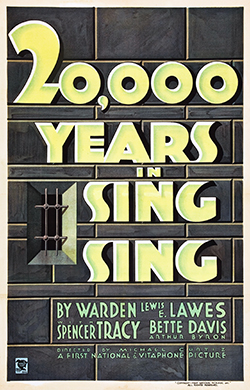
Lisa Cleans Out Her DVR: 20,000 Years in Sing Sing (dir by Michael Curtiz)


(I am currently in the process of cleaning out my DVR.  I recorded the 1932 film, 20,000 Years In Sing Sing, off of TCM on January 31st.)

I was somewhat surprised to discover that I had this 1930s prison film on my DVR.  I’m not sure what led to me deciding to record it though, if I had to guess, I’d say that it was probably the title.  I probably assumed it was about a prisoner who served a 20,000 year sentence.  I mean, that sounds interesting, right?

It turns out I was wrong though.  The film starts with a shot of a line of prisoners walking into a prison, with their sentence superimposed over their heads.  One guy is in for 7 years.  Someone else has a 50 year sentence.  Another person has a 33 year sentence.  I’m guessing that if you added all of the sentence up, you would end up with 20,000 years.

That’s a lot of angry men, all trapped in one location.  Fortunately, Sing Sing Prison has a compassionate warden.  Paul Long (Arthur Byron) is a good man, a criminal justice reformer who believe that prison should be about more than punishment.  He is tough but fair and he runs his prison on the honor system.  Break the rules and you’ll be tossed into solitary.  Respect the rules and the Warden might even let you leave the prison for a day or two.  The press and the bureaucrats may think that Warden Long is naive but prison guards love him.  “We’re behind you,” the head guard says when it appears that Long might be about to lose his job.  And the prisoners respect him, even if few of them are willing to admit it.

Tommy Connors (Spencer Tracy) is the newest prisoner.  He’s been sentenced to 5 to 30 years for robbery and assault with a deadly weapon.  Tommy’s a tough guy, the type who speaks in the rat-a-tat manner that will be familiar to anyone who has ever watched a 30s gangster film.  He’s a tough guy so he ends every sentence with “see?,” as in, “No prison is going to break me, see?” Tommy’s the type of guy who brags that, even if they send him to solitary, he can do his time standing on his head.  When he gets called into the Warden’s office, he tosses a lit cigarette on the floor.  Can the Warden reform even as rough a customer as Tommy Connors!?

It doesn’t help, of course, that Tommy has a friend named Joe Finn (Louis Calhern) and, even though Joe is on the outside, he’s constantly encouraging Tommy to break the rules.  Joe has an ulterior motive for wanting to keep Tommy in prison for as long as possible.  That motive is his desire for Fay (Bette Davis), Tommy’s loyal girlfriend.  When Fay is injured in an accident, the Warden agrees to let Tommy visit her on the condition that Tommy return in 24 hours.  However, when Tommy’s visit leads to murder, the Warden is blamed.  It gets even worse when the Warden announces that he is sure that, despite the charges against him, Tommy will honor his word and return to the prison.

Will Tommy do the right thing?  Or will he flee and destroy the Warden’s career?

20,000 Years in Sing Sing was produced by Warner Bros and it features the studio’s typical pre-code combination of a B-movie action and progressive politics.  Seen today, it’s a watchable but minor film, one that often seems dated in its view of criminal behavior.  (Even I, a huge believer in the need for criminal justice reform, thought the warden was being incredibly naive when he put the convicts on the honor system.)  That said, it’s always interesting to see Bette Davis in the days before she became the Bette Davis and was just another ingenue trying to make an impression while surviving the studio system.  As well, since Spencer Tracy eventually became best known for portraying wise, plainspoken men, it’s interesting to see him playing the cocky and disrespectful Tommy.

Still, I think there is a place for a movie about someone spending 20,000 Years in Sing Sing.

(I imagine that, after the first 10,000 years, it gets easier.)


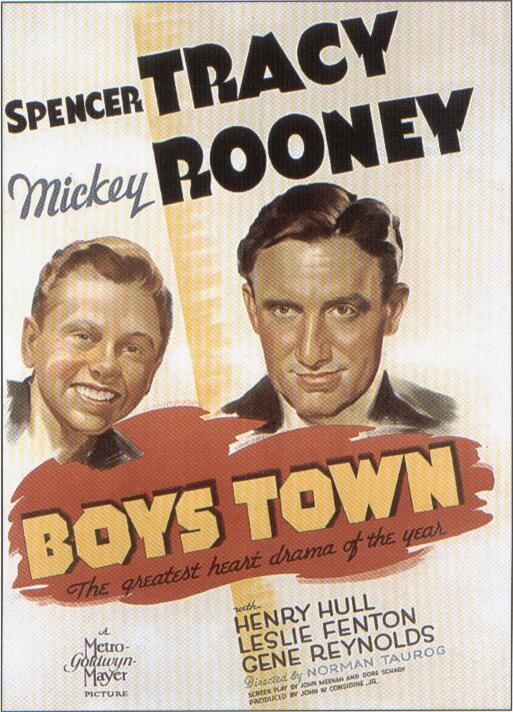
Lisa Reviews An Oscar Nominee: Boys Town (dir by Norman Taurog)


boys_town

Before writing about the 1938 film Boys Town, I want to share a story that might be false but it’s still a nice little story.  Call this an Oscar Urban Legend:

Boys Town is about a real-life community in Nebraska, a home for orphaned and homeless boys that was started by Father Edward Flanagan.  In the film, which was made while Father Flanagan was still very much alive, he was played by Spencer Tracy.  Boys Town was a huge box office success that led to the real Boys Town receiving a lot of favorable publicity.  When Tracy won his Oscar for Boys Town, his entire acceptance speech was devoted to Father Flanagan.

However, a problem arose when an overeager PR person at MGM announced that Spencer Tracy would be donating his Oscar to Boys Town.  Tracy didn’t want to give away his Oscar.  He felt that he had earned it through his acting and that he should be able to keep it.  Tracy, the legend continues, was eventually persuaded to donate his Oscar on the condition that he would get a replacement.

However, when the replacement arrived, the engraving on the award read, “Best Actor — Dick Tracy.”

That’s a fun little story, one that is at least partially true.  (Tracy’s Oscar — or at least one of them — does currently reside at the Boys Town national headquarters.)  It’s also a story that, in many ways, is more interesting than the film itself.

Don’t get me wrong.  Boys Town is not a bad movie.  For me, it was kind of nice to see a movie where a priest was portrayed positively as opposed to being accused of being a pederast.  In a way, Boys Town serves as a nice counterbalance to Spotlight.  But, with all that said, there’s not a surprising moment to be found in Boys Town.  It’s pretty much a standard 1930s juvenile delinquency melodrama.

The movie opens when Father Flanagan giving last rites to a man who is about to be executed.  (Boys Town takes a firm stand against the death penalty, which is one of the more consistent and laudable stands of the modern Church.)  The man says the he never had a chance.  From the time he was a young boy, he was thrown into the reform school system.  Instead of being reformed, he just learned how to be a better criminal.  Father Flanagan is so moved by the doomed man’s words that he starts Boys Town, under the assumption that “there’s no such thing as a bad boy.”

Father Flanagan’s techniques are put to the test when Whitey Marsh (Mickey Rooney ) arrives.  Whitey is angry.  He’s rebellious.  He tries to run away every chance that he gets and, during one such escape attempt, he even gets caught up in a bank robbery.  Can Father Flanagan reach Whitey and prove that there’s no such thing as a bad boy?

Well, you already know the answer to that.  As I said, there’s really nothing surprising to be found in the plot of Boys Town.  It’s just not a very interesting movie, though there is a great shot of a despondent Whitey walking past a several lines of former juvenile delinquents, all kneeling in prayer.  As Father Flanagan, Spencer Tracy is the ideal priest but his role is almost a supporting one.  Believe it or not, the film is dominated by Mickey Rooney, who gives a raw and edgy performance as the angry Whitey Marsh.

(That said, it’s hard to take Whitey seriously as a future gangster when he’s always wearing a bowtie.  Then again, that may have been the height of gangster style in 1938.)

Boys Town was nominated for best picture but lost to You Can’t Take It With You.

Cleaning Out The DVR #31: Libeled Lady (dir by Jack Conway)


(For those following at home, Lisa is attempting to clean out her DVR by watching and reviewing 38 films by the end of this Friday.  Will she make it?  Keep following the site to find out!)

http://www.youtube.com/watch?v=JI-eY-bU9qg

In the 1936 comedy Libeled Lady, tabloid newspaper editor Warren Haggerty (Spencer Tracy) has a problem.  His newspaper has just published a story accusing wealthy heiress Connie Allenbury (Myrna Loy) of being the other woman in a scandalous divorce.  The problem is that Connie was not the “other woman” and she is now suing the newspaper for $5,000,000.

“5 million dollars!” an astonished Warren declares, “nobody has that type of money!”

(It was 1936, after all.)

However, Warren has a plan and, since this is a screwball comedy, it’s an unneccesarily complicated plan.  He hires a former reporter, the suave Bill Chandler (William Powell, the suavest man alive in the 30s) to meet with Connie.  Warren believes that there’s no way that Connie won’t fall in love with Bill.  (Perhaps Warren had recently seen The Thin Man…)  Once Connie does fall in love, Warren will arrange for Bill’s wife to catch the two of them together.  In order to avoid the scandal, Connie will drop the suit.

The problem is that Bill isn’t married.  However, Warren has a solution for that as well.  Warren arranges for Bill to marry Warren’s fiancée, Gladys (Jean Harlow).  Gladys is not happy about the arrangement but goes along with it because, despite his behavior, she truly loves Warren and Warren promises her that the marriage will only last for 6 weeks.

(When the minister says that he hopes he’ll be invited to the new couple’s silver anniversary, Gladys replies, “It better be in six weeks.”)

And, at first, things go as planned.  Bill meets Connie on a luxury cruise and she quickly falls in love with him.  However, Bill finds himself falling in love with her too.  Soon, he no longer wants to frame her.  However, that’s not the only complication.  Finally fed up with Warren’s behavior, Gladys has started to think that maybe it would be better to be married to Bill.  Soon, she decides that she has no intention of getting a divorce…

Libeled Lady is a minor but enjoyable screwball comedy.  The plot is thoroughly implausible but, fortunately, William Powell was one of those actors who could get you to believe almost anything.  As anyone who has seen any of the Thin Man films can tell you, Powell and Myrna Loy had great chemistry together.  Spencer Tracy seems a little uncomfortable with the role of Warren but Jean Harlow is a lot of fun as Gladys.  She doesn’t have a big role but, at the same time, you can still understand why she was such a huge star and why her tragic death a year later was such a shock.

(At the time the movie was made, Harlow was dating William Powell.  She wanted to play Connie but MGM was determined to repeat the formula of previous William Powell/Myrna Loy comedies and Harlow settled for the secondary role of Gladys.)

As enjoyable as the film is, it still does seem a bit strange that it was nominated for best picture.  It lost the Oscar to The Great Ziegfeld, another MGM film that starred William Powell and Myrna Loy.

Cleaning Out The DVR #1: Captains Courageous (dir by Victor Fleming)


Captains_Courageous_poster

For the last few days, I’ve been desperately trying to clean out my DVR.  Ever since this year began, I have been obsessively recording movies and now, I suddenly find myself with just a few hours of space left!  Now, I know that the simple solution would be to just start erasing stuff but that’s just not the way I do things.  I recorded that stuff so you better believe I’m going to watch and review every single minute of it!

Last night, I did a quick count and discovered that I have 38 movies to watch before I can officially declare the DVR to have been “cleaned out.”  While that may sound like a lot, it’s not if you consider that — by watching and reviewing 4 movies a day — I can have the whole job done by the end of the next week!  That’s my plan and my challenge to myself.  Can I watch and review 38 movies in 10 days?

Let’s find out!

So, I started things out by watching the 1937 film, Captains Courageous.  Captains Courageous was aired on TCM as a part of their 31 Days of Oscar.  Not only was Captains Courageous nominated for best picture but it won Spencer Tracy his first Oscar.  Tracy was one of the quintessential American actors so it’s interesting to note that he won his first Oscar for playing a Portuguese fisherman who speaks in exaggeratedly broken English.

Spencer Tracy may have won the Oscar for Best Actor but his role is really a supporting one.  Instead, Captains Courageous is about an extremely spoiled, obnoxious, and annoying 15 year-old named Harvey Cheyne (Freddie Bartholomew).  From the minute that Harvey first appears on screen, it’s difficult to like him.  The son of a rich businessman (Melvyn Douglas), Harvey is hated by everyone.  His family’s butler rolls his eyes whenever Harvey calls for him.  His classmates (and, of course, Harvey attends a snooty private school) want nothing to do with him.  When his father takes him on a trans-Atlantic cruise, even the sailors seem like they want to toss him overboard.

However, before they get a chance to give him one quick shove over the railing, Harvey does their job for them.  He falls overboard and he nearly drowns before being rescued by a fisherman named Manuel (Spencer Tracy).  Manuel takes him back to the fishing schooner, where that ship’s captain (Lionel Barrymore) refuses to believe that Harvey is rich.  Since the rest of the crew quickly decides that they dislike Harvey as much as everyone else does, the captain saves Harvey from being thrown back overboard by “hiring” him as a fisherman.  And, of course, the captain makes Manuel responsible for him.

Though initially hostile, Harvey and Manuel slowly start to bond.  Harvey learns about the importance of hard work and starts to grow up.  And, eventually, it all leads to tragedy.  That’s just how things work in the movies.

As you can probably guess from the plot description above, there’s not a subtle moment to be found in Captains Courageous but, as is so often the case with 1930s Hollywood, that’s actually what makes the film appealing.  Captains Courageous wears its sentiment on its sleeve and it makes for an interesting contrast to the more cynical films of today.  While it takes a while to get used to seeing Spencer Tracy giving such a theatrical performance, he does eventually win you over.  Freddie Bartholomew is vulnerable enough to you can forgive his character for being so obnoxious.  Meanwhile, Lionel Barrymore and Mevlyn Douglas are well-cast in their supporting roles and, if you keep an eye open, you’ll see everyone from John Carradine to a young Mickey Rooney working on the schooner.  Ultimately, Captains Courageous is a well-made and likable coming-of-age film that still holds up today.