Horror Review: Day of the Dead (dir. by George A. Romero)


“You want to put some kind of explanation down here before you leave? Here’s one as good as any you’re likely to find. We’re bein’ punished by the Creator…” — John “Flyboy”

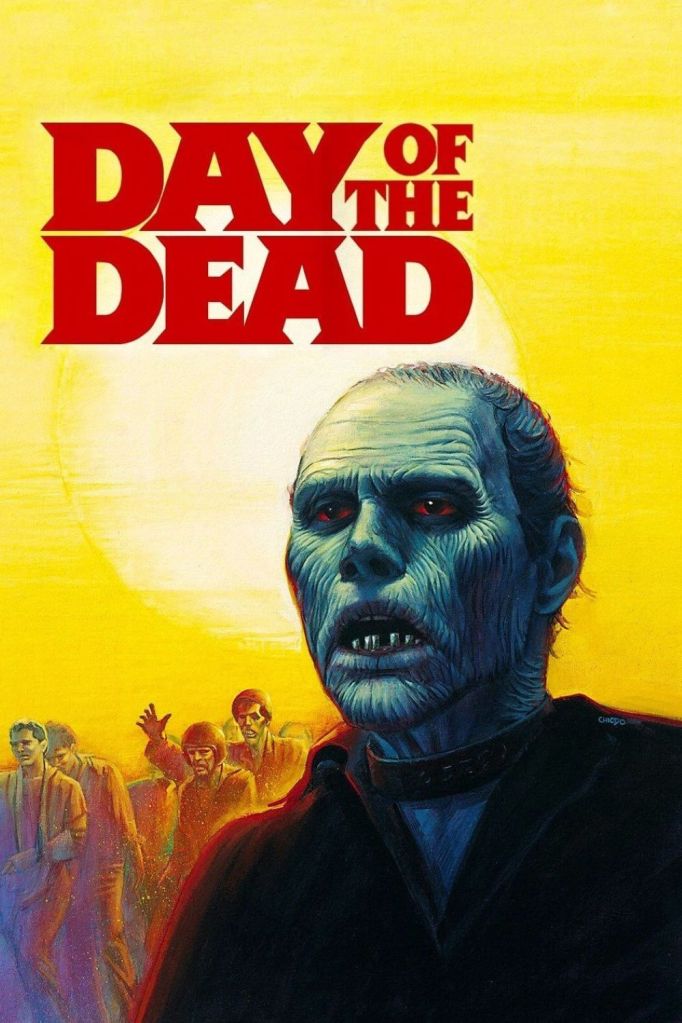
George A. Romero’s 1985 film Day of the Dead stands as an unflinching and deeply cynical meditation on the collapse of society amid a relentless zombie apocalypse, intensifying thematic and narrative complexities first introduced in Night of the Living Dead (1968) and Dawn of the Dead (1978).

Originally, Romero envisioned the film as an epic, describing it as “the Gone with the Wind of zombie films.” His screenplay featured above-ground scenes and a more expansive narrative, but budget cuts halved the original $7 million budget to $3.5 million, forcing a drastic paredown. While much grandiosity was lost, the trimming resulted in a tighter narrative and heightened the nihilistic tone, deepening the film’s focused exploration of humanity’s darkest aspects during apocalypse.

Set after civilization has collapsed, Day of the Dead places viewers in the suffocating confines of a missile silo bunker in Florida, where scientists and soldiers struggle for survival and solutions amid encroaching undead hordes. The claustrophobic atmosphere—born partly from the abandonment of Romero’s broader original sequences—intensifies the tension between the hopeful scientific pursuit of salvation and the harsh pragmatism of military authority. These competing ideologies escalate into authoritarian violence, embodying the fractured microcosm of a dying society.

Within this claustrophobic world, a third group—composed of characters Flyboy and McDermott—emerges as a stand-in for the rest of humanity. They observe the scientists and soldiers—institutions historically symbols of security and innovation—but witness how these deeply entrenched ways of thinking only exacerbate problems instead of solving them. This third faction characterizes humanity caught between rigid orders and doomed pursuits, reflecting Romero’s broader commentary on societal stagnation and fragmentation.

Central to this conflict are Dr. Logan, or “Frankenstein,” a scientist obsessed with controlling the undead through experimentation, and Captain Rhodes, the hardened soldier who believes survival demands ruthless control.

Logan’s controversial research seeks to domesticate and condition zombies, notably through his most celebrated subject, Bub—the undead zombie capable of rudimentary recognition and emotion—challenging assumptions about humanity and monstrosity.

Here the film benefits greatly from the extraordinary practical effects work of Tom Savini, whose contributions on Day of the Dead are widely considered his magnum opus. Savini’s makeup and gore effects remain unsurpassed in zombie cinema, continually influencing horror visuals to this day. Drawing from his experience as a combat photographer in Vietnam, Savini brought visceral realism to every decomposed corpse and violent injury. The close-quarters zombie encounters showcase meticulous practical work—detailed wounds, biting, and dismemberment—rendered with stunning anatomical authenticity that predates CGI dominance.

Bub, also a masterclass in makeup and animatronics, embodies this fusion of horror and humanity with lifelike textures and movements that blur the line between corpse and creature, rendering the undead terrifyingly believable.

The film captures the growing paranoia and cruelty as resources dwindle—food, ammunition, and medical supplies—and the fragile social order begins to shatter. The characters’ mounting desperation illustrates Romero’s thesis that humanity’s real enemy may be its own incapacity for cooperation.

The moral and social decay is vividly portrayed through characters like Miguel, whose mental breakdown sets destructive events in motion, and Rhodes, whose authoritarian survivalism fractures alliances and moral compass alike. Logan’s cold detachment and experiments push ethical boundaries in a world on the brink.

Romero’s direction combines claustrophobic dread with stark psychological terror, further amplified by Savini’s effects. The cinematography’s low lighting and tight framing create an oppressive environment, while graphic violence underscores a world irrevocably broken. The unsettling sound design—moans, silences, sudden outbreaks—immerses viewers in a relentless atmosphere of decay and fear.

Romero described Day of the Dead as a tragedy about how lack of human communication causes chaos and collapse even in this small slice of society. The dysfunction—soldiers and scientists talking past each other, eroding trust, spirals of paranoia—serves as a bleak allegory for 1980s America’s political and cultural fragmentation. Failed teamwork, mental health crises, and fatal miscommunication thrive as the bunker metaphorically becomes a prison of fractured humanity.

Though not as commercially successful as its predecessors, Day of the Dead remains the bleakest and most nihilistic entry in Romero’s Dead series. Its overall grim tone, combined with mostly unlikable characters, establishes it as the most desolate and truly apocalyptic film of the series. The characters often appear fractured, neurotic, and unable to escape their own destructive tendencies, making the story’s world feel even more hopeless and devastating.

Far beyond a simple gore fest, Day of the Dead serves as a profound social critique infused with psychological depth. It explores fear, isolation, authority abuse, and the ethical limits of science, reflecting enduring anxieties about society and survival. The film’s unsettling portrayal of humanity’s failings, embodied in broken relationships and moral decay, presents a harsh reckoning with what it means to be human when humanity itself is the ultimate threat to its own existence. This thematic complexity, combined with Romero’s unyielding vision and Savini’s unparalleled effects, crafts a chilling and unforgettable cinematic experience.

Late Night Retro Television Review: Pacific Blue 2.16 “Soft Targets”


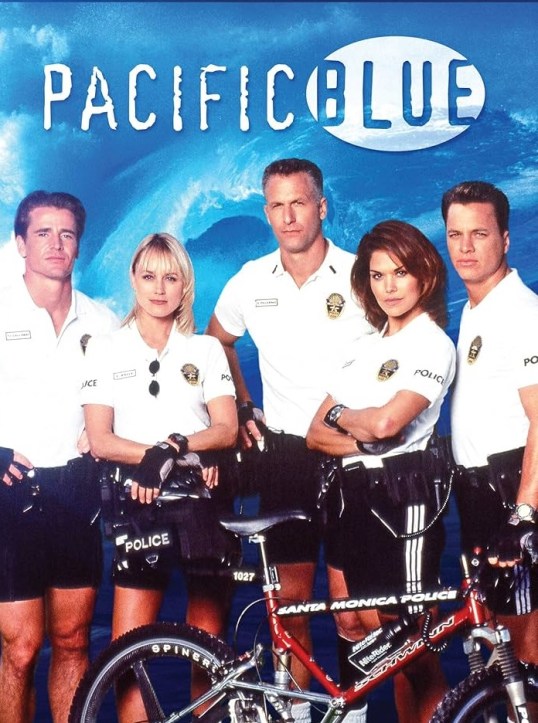
Welcome to Late Night Retro Television Reviews, a feature where we review some of our favorite and least favorite shows of the past! On Tuesdays, I will be reviewing Pacific Blue, a cop show that aired from 1996 to 2000 on the USA Network!  It’s currently streaming everywhere, though I’m watching it on Tubi.

This week, a crazed gunman takes over the beach.  Good thing the Bike Patrol’s there….

Episode 2.16 “Soft Targets”

(Dir by Ron Satlof, originally aired on January 12th, 1997)

Zack Torrance (Terence Knox, a.k.a. St. Elsewhere‘s Dr. White) is a former soldier who claims that he has information about the CIA smuggling drugs into the U.S. as a way to help raise money to defeat the communists in Central America.  This is a conspiracy theory that I’m very familiar with.  I don’t quite buy it because it assumes a bit too much competence on the part of the CIA.  That said, it’s a popular conspiracy theory amongst some.  All I know is that communism sucks.

Kind of like this show!

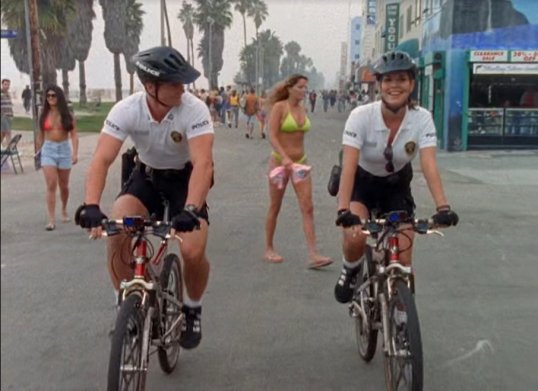
Anyway, Zack opens fire on a beach and holds everyone hostage because he wants to get his story out.  For some reason, the job of securing the beach and negotiating with Zack falls to these dorks:

The CIA shows up in the form of Franklin Quill (Sherman Howard).  Quill takes over the negotiations and, while TC and Chris glower in the background, he proceeds to shoot and kill Zack.  Zack dies and the story doesn’t get out.  TC looks upset but he doesn’t really do anything to stop Quill so you know what?  Get bent, TC.

Seriously, this episode …. ugh.  First off, hostage episodes are boring to begin with.  There’s only so many times you can watch some sweaty guy barking out orders before you get bored with the whole thing.  Pacific Blue makes things worse by bringing in the Bike Patrol.  We’re supposed to dislike Quill but actually, Quill shows up, takes charge of the situation, and brings things to a close.  The fact that TC spends the whole episode standing around with an annoyed expression on his face doesn’t make Quill any less effective.  For this entire episode, TC whines and bitches about Quill’s tactics but TC never actually develops any tactics of his own.  If anything, the Bike Patrol is kind of superfluous in this episode.

Terence Knox was believably desperate as Zach.  Holly Robinson Peete showed up as a woman who was wounded by Zach’s initial attack on the beach.  She survived and then married a lifeguard (Robert Joseph).  Palermo was not in this episode.  Instead, he left to train a Bike Patrol in another country and left TC in charge of the Santa Monica’s Bike Patrol.  Big mistake, if you ask me.

If there was any pleasure to be found in this episode, it came from just how poorly the Bike Patrol came across.  Seriously, they couldn’t catch Zach.  They couldn’t control the beach.  What exactly do we need these people for?  Bike Patrol, what is it good for?  Absolutely nothing.

Casualties of War (1989, directed by Brian DePalma)


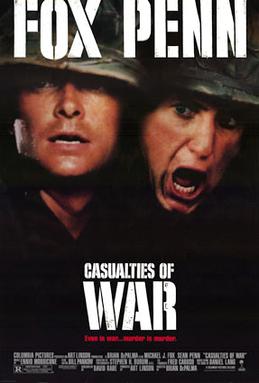
Private Max Eriksson (Michael J. Fox) is a new arrival in Vietnam, a young infantryman who is called a “cherry” by his fellow soldiers.  No one wants to get close to Eriksson because everyone knows that it’s the new guy who is most likely to make a mistake and get himself killed.  The only person who seems to care whether Eriksson lives or dies is Sgt. Tony Messerve (Sean Penn), a squad leader who is so tough and battle-worn that it is easy to forget that he is only 20 years old.  After a member of Messerve’s squad is killed in a firefight and Messerve’s squad had been denied leave despite all of the stress and pressure that they’ve been under, Messerve decides that, during their next mission, the squad is going to kidnap a woman from a village and take her with them.

Eriksson, who is still naive enough to sincerely say, “We’re supposed to be here to help these people,” is horrified by Messerve’s actions.  At first, only he and Diaz (John Leguizamo) refuse to take part in raping the terrified woman (Thuy Thu Le).  Diaz soon caves to the pressure from the rest of the squad and joins in.  Only Eriksson continues to refuse but his attempt to help the woman escape fails when the members of the squad murder her during a firefight with the Viet Cong.  After the battle, the wounded Eriksson discovers that no one in command wants to hear about what happened.  Messerve’s second-in-command, Clark (Don Patrick Harvey), targets Eriksson, trying to shut him up permanently.

One of the many Vietnam films to come out after the success of Platoon, Brian De Palma’s Casualties of War is an intense and disturbing recreation of a true story.   After years of being accused of making misogynistic and exploitive films, De Palma made an effective and sensitive anti-war film, one that did not exploit the suffering of the kidnapped woman but instead portrays the depravity of war and the courage it takes to do the right thing when everyone around is ordering you not to.  While it always takes a while to get used to Michael J. Fox in a serious role (and, at the start of the film, he really does seem to be miscast), he eventually gives the best performance of his career in Max Eriksson and, by using a framing device of Eriksson back in the United States after completing his tour, both De Palma and Fox show how the Eriksson, like countless other veterans, is still haunted by what he saw in Vietnam even after he returns home.  Sean Penn is equally impressive as Messerve, playing him as someone who sacrificed his soul in order to survive in Vietnam.  Messerve has come to view the entire country with contempt and, in his twisted way, he sees kidnapping the woman as a way to reward his squad for all that they’ve endured.  The rest of the cast is also strong, with John C. Reilly making his acting debut as a member of the squad.

Not surprisingly, the dark and disturbing Casualties of War was a box office disappointment.  It’s still one of most harrowing films made about Vietnam and one of De Palma’s best.

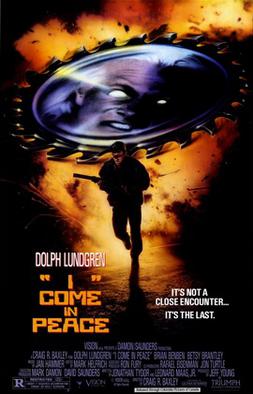
I Come In Peace (1990, directed by Craig R. Baxley)


“I come in peace.”

“And you go in pieces.”

How have I not reviewed this one yet?

Dolph Lundgren is Jack Crain, a Houston cop who teams up with FBI agent Larry Smith (Brian Benben) to investigate who is killing criminals in H-town.  The killer is a drug dealer but not your everyday drug dealer.  He’s an alien named Talec (Matthias Hues) and he’s figured out how to say “I come in peace,” but the rest of the English language is beyond him.  “I come in peace,” turns out to be the scariest phrase you can hear when you’re being pursued by a white-haired, intergalactic mass murderer.  His targets include Jesse Vint and Michael J. Pollard.  This terminator wannabe is after character actors!

On the second-tier action stars of the 90s, Lundgren was the one who could actually act.  Van Damme could actually do all the acrobatic stunts his characters did but he couldn’t show emotion like Lundgren.  Steven Seagal seemed like he could handle himself in a fight but he lacked Lundgren’s self-aware humor.  Lundgren plays Jack as almost being a parody of the type of hard-boiled cop who is always getting yelled at by the commissioner for wasting the city’s money.  Brian Benben is remembered, by some, as the star of HBO’s Dream On, the sitcom that convinced a generation of young men that there’s nothing women love more than obscure pop cultural obsessions.  Benben is actually pretty funny in I Come In Peace.  He’s the everyman who can’t believe he’s having to deal with an intergalactic drug dealer.  Good heroes need a good villain and Matthias Hues is just right as the drug dealing alien who literally doesn’t know what he’s saying.

If you want to see a Terminator rip-off with nonstop action, a memorable villain, frequently (and intentionally) funny dialogue, an Al Leong cameo, and Dolph Lundgren as a hero who pushes people around just because he feels like it, I Come In Peace is the movie for you!