Late Night Retro Television Review: Pacific Blue 2.21 “The Last Ride”


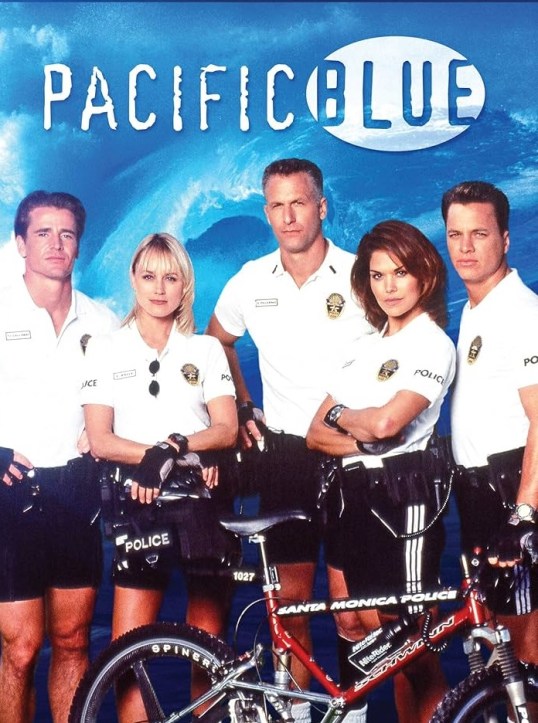
Welcome to Late Night Retro Television Reviews, a feature where we review some of our favorite and least favorite shows of the past! On Tuesdays, I will be reviewing Pacific Blue, a cop show that aired from 1996 to 2000 on the USA Network!  It’s currently streaming everywhere, though I’m watching it on Tubi.

This week, wild things are happening in Malibu.

Episode 2.21 “The Last Ride”

(Dir by Michael Levine, originally aired on April 13th, 1997)

Mahmoud (Shaun Toub) has promised everyone that he will be going straight as soon as he completes his community service.  However, we all know better than to trust Mahmoud!  It turns out that he’s gotten involved in an elaborate con job to sell Malibu Pier to some naive investors.  Oh, that Mahmoud!

What was that?  What did you ask?  Oh, who is Mahmoud?

I asked that exact same question when I watched this episode.  I had no idea who Mahmoud was or why exactly he was at the center of an episode of a show about bicycle cops.  Chris and Cory did show up occasionally to harass him but, still, it really did seem like Mahmoud belonged on a different show.  After this episode ended, I did a search of my previous reviews and discovered that Mahmoud actually has appeared on the show before.  As a vendor on the beach, he sold Chris a necklace that made her neck turn green.  But that was about eight episodes ago and it was a rather minor subplot, all things considered.

As for Mahmoud in this episode, he was annoying.  His dialogue was overwritten, his story felt cartoonish, and Shaun Taub’s overacting didn’t help things.  Still, it’s interesting to think that the regular characters were so boring that the show’s writers decided they would rather do a show about a minor supporting character than actually try to come up with anything for Chris and Cory to do.

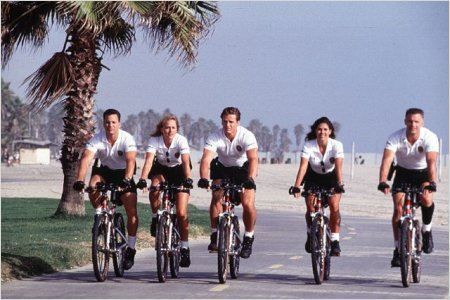
The episode’s other subplot actually does feature the bicycle cops.  Victor’s childhood friend has been released from prison and is now the head of a violent car theft ring.  Victor is forced to deal with his own guilt over being a juvenile delinquent as he and TC try to take down the car thieves.  This was pretty standard stuff but it did feature one scene that was just stupid enough to be entertaining.  With the car thieves opening fire on them, Victor and TC ride their bikes straight toward the thieves.  Eventually they both stand up on their still-moving bikes and, leaning forward against the handle bars, they start shooting their guns back at the bad guys.  Somehow, they’re able to do this and aim well-enough to take out the car thieves while also keeping their bikes rolling forward.  (TC does get shot but it turns out the bullet only grazed his forehead.  “He’ll just have a headache for a while,” Chris says.  Yeah, I would think so.)  This is one of those moments that would have been really badass if not for the fact that Victor and TC were still wearing their dorky bike cop uniforms during it.  The blue shorts, the white polo shirts, the bicycle helmets — sorry, you just can’t look cool when you’re wearing all that.  Nice try, guys!

Next week, season 2 ends!

Late Night Retro Television Review: Pacific Blue 2.13 “Outlaw Blues”


Welcome to Late Night Retro Television Reviews, a feature where we review some of our favorite and least favorite shows of the past! On Tuesdays, I will be reviewing Pacific Blue, a cop show that aired from 1996 to 2000 on the USA Network!  It’s currently streaming everywhere, though I’m watching it on Tubi.

This week, there’s way too much happening on the Boardwalk.

Episode 2.13 “Outlaw Express”

(Dir by Michael Levine, originally aired on December 8th, 1996)

Mahmoud (Shaun Toub) is selling cheap jewelry on the boardwalk.  He gives Chris a “silver” necklace that makes her neck turn green.  Uh-oh, someone’s allergic to tin!

Palermo’s daughter is hanging out with some extreme athletes who are pressuring her to take part in increasingly dangerous pranks on the boardwalk so that they can film them for their web site!

Two criminals are hijacking trucks and then forcing merchants to sell stolen goods!  When they see that one truck driver is wearing a tie-dyed t-shirt, they shoot him in the back and then tell him, “Say hi to Jerry for me.”  (I’m guessing they were referring to Jerry Garcia and not Jerry Springer but who knows with this show.)

Finally, Victor’s mother is staying at his apartment which means Victor can’t get laid!

Wow, there’s a lot to deal with this week.  When a show tries to juggle this many plots, it really does remind you of the importance of having clearly defined and compelling characters.  Pacific Blue doesn’t have any of that so this episode kind of sucked.  We are 24 episodes into this stupid show and I still can’t tell the difference between Victor, TC, and Palermo whenever they’re riding their bikes.  That’s a problem.  24 episodes in and Chris still doesn’t have a personality beyond being annoyed by everyone she talks to.  That’s another problem.

(“I didn’t catch your first name Officer Kelly,” Mahmoud says.  “Officer,” Chris replies, deploying the power glare.)

Seriously, just think about how much it would suck to be a victim of the crime, call 911, and then have these douchebags show up.

Film Review: Executive Decision (dir by Stuart Baird)


In 1996’s Executive Decision, terrorists hijack an airplane.  Their leader, Nagi Hassan (David Suchet) demands that the U.S. government not only give him and his men safe passage but that they also release Hassan’s commander, Jaffa (Andreas Katsulas).

In Washington D.C., it is decide to use a stealth plane to transport Col. Austin Travis (Steven Seagal) and his men into the passenger plane.  Accompanying them will be Dr. David Grant (Kurt Russell), a consultant for U.S. Intelligence.  Dr. Grant is the world’s leading expert on Hassan, even though neither he nor anyone else is even sure what Hassan looks like.  Travis distrusts Grant because he’s a civilian and also because he holds Grant responsible for a botched raid on a Russian safehouse in Italy.  Dr. Grant is going to have to prove himself to Col. Travis because Travis doesn’t have any time for people who can’t get the job done.  And Travis is determined to get on that plane and save all those passengers.

In other words, Travis is a typical Steven Seagal character and, for the first fourth of this movie, Seagal gives a typical Steven Seagal performance.  He delivers his line in his trademark intimidating whisper, he glares at everyone else in the film, and essentially comes across as being a total douchebag who can still handle himself in a fight..  However, when it’s time to board the airplane through a docking tunnel, something goes wrong.  Everyone — even nervous engineer Dennis Cahill (Oliver Platt) is able to slip through the stealth plane’s docking tunnel and get into the hijacked airplane cargo hold without being detected.  But the two planes are hit by severe turbulence.  Suddenly, it becomes apparent the one man is going to have to sacrifice his life and close the hatch before the docking tunnel decompresses.

David, already in the cargo hold, looks down at Austin in the tunnel.  “We’re not going to make it!”

“You are!” Austin replies before slamming the hatch shut and getting sucked out of the tunnel.  (There’s your Oscar Cheers Moment of 1996!)  After all that build-up, Steven Seagal exits the film early and now, it’s up to Kurt Russell and what’s left of Austin Travis’s men to somehow stop the terrorists.  Not only do they have to stop Hassan but they also have to do it before the Air Force — which has no way of knowing whether or not any of their men were able to get on the plane before the tunnel fell apart — shoots down the airliner.

(If the airplane looks familiar, that’s because Lost used the same stock footage whenever it flashed back to the plane crash that started the show.)

It’s actually a rather brilliant twist.  When this film came out, Seagal was still a film star.  He played characters who always got the job done and who were basically infallible.  He wasn’t a very good actor but he did manage to perfect an intimidating stare and that stare carried him through a lot of movies.  No one would have expected Seagal to die within the first 30 minutes of one of his movies and when Col. Travis, who the film has gone out of its way to portray as being the consummate warrior, is suddenly killed, there really is a moment where you find yourself wondering, “What are they going to do now?”  In just a matter of minutes, Executive Decision goes from being a predictable Steven Seagal action film to a genuinely exciting and clever Kurt Russell thriller.  For once, Russell is not playing a man of action.  He’s an analyst, a thinker.  And, to the film’s credit, he uses his mind more than his brawn to battle Hassan’s terrorists.  With excellent support from Halle Berry (as a flight attendant who discreetly helps out David and the soldiers), Oliver Platt, B.D. Wong, Whip Hubley,  David Suchet, Joe Morton, and even John Leguizamo (as Travis’s second-in-command), Executive Decision reveals itself to be an exciting and ultimately rewarding thrill ride.

And to think, all it took was sacrificing Steven Seagal.

Embracing the Melodrama #53: Crash (dir by Paul Haggis)


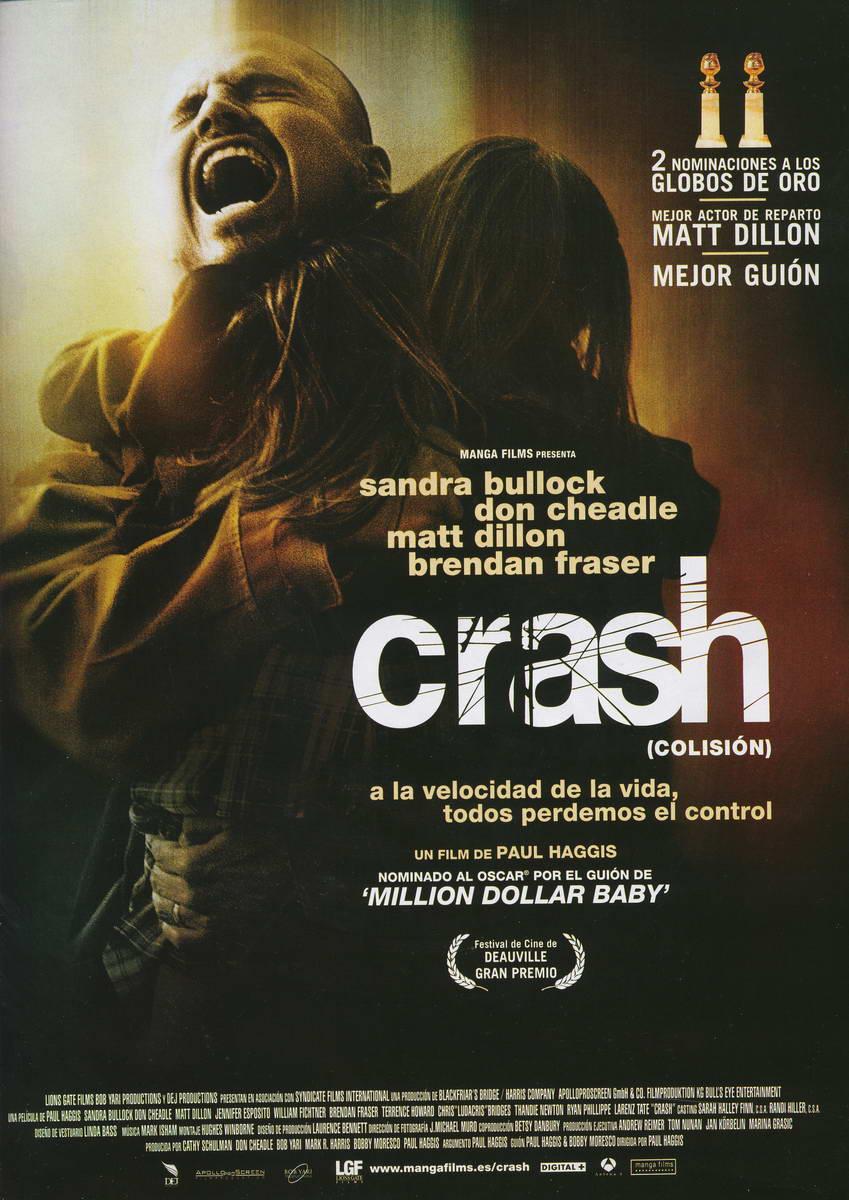
crash-2004-poster

For the past two weeks, I’ve been reviewing, in chronological order, some of the most and least memorable melodramas ever filmed.   We started way back in 1916 and now, after 52 reviews, we’ve finally reached the year 2004.  And that can only mean that it is time to review the worst film to ever win an Oscar for best picture of the year.  I am, of course, talking about Crash.

Crash is an ensemble piece that follows a multi-racial cast of characters as they deal with issues of race, crime, and — well, that’s about it.  In Crash, everyone’s life revolves around race and crime.  Well, I take that back,  There is at least one character whose life revolves around being a good maid to the white woman who employs her.  But otherwise, it’s all about race and crime.  The film is set in Los Angeles which, from what I’ve read, is actually a pretty big city but you really wouldn’t know that from watching Crash.  All of the characters in Crash are constantly and randomly running into each other.  I think director/screenwriter Paul Haggis is trying to make a statement about the power that coincidence plays in the world but, often times, it just feels like lazy plotting.

Anyway, here are the characters who are meant to bring Los Angeles to vivid cinematic life:

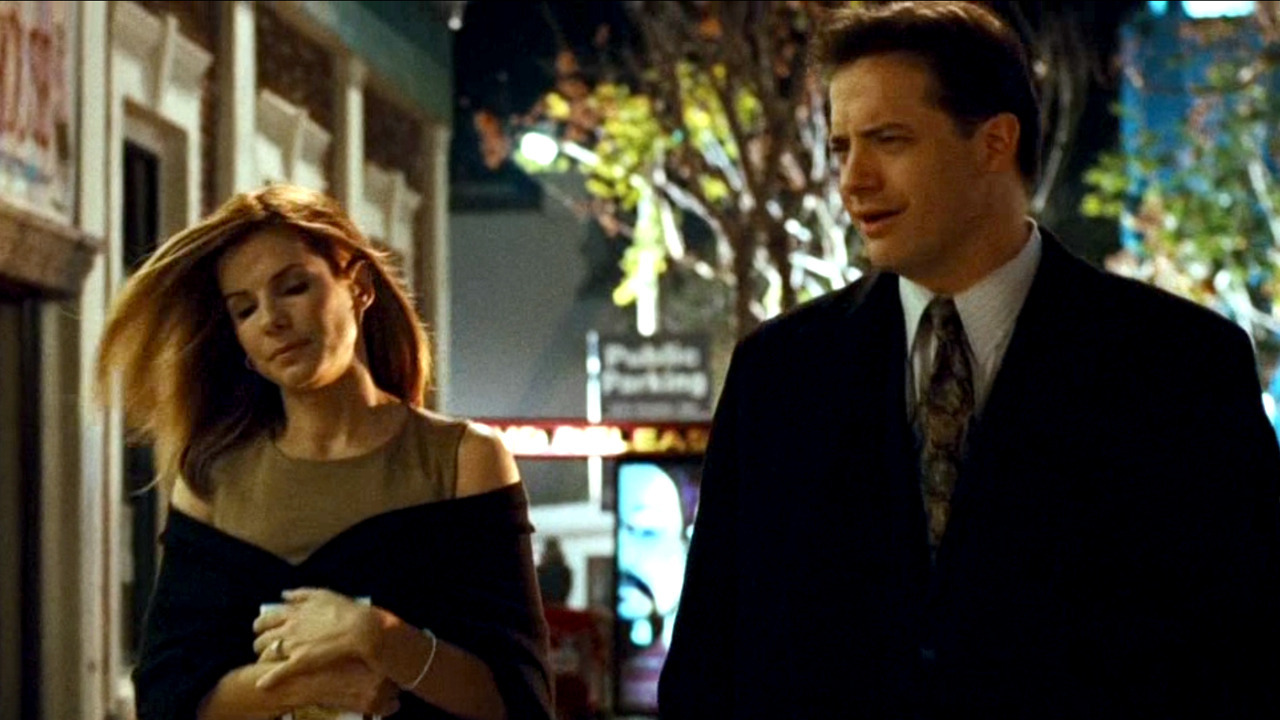
Brendan Fraser and Sandra Bullock play rich white people Rick and Jean Cabot.  Rick Cabot has just been elected District Attorney of Los Angeles County.  (Because when I think of a successful urban politician, I automatically think of Brendan Fraser…)  Jean is his materialistic wife.  At the start of the film, they’re carjacked by two young black men, which leads to Jean suspecting that every non-white she sees is secretly a gang member.  Later, Jean falls down a flight of stairs but she’s helped by her maid, who happens to be — surprise, surprise — not white!  Apparently, this teaches Jean an important lesson about tolerance.  The message, I guess, is that white people can be redeemed by interacting with their minority servants.

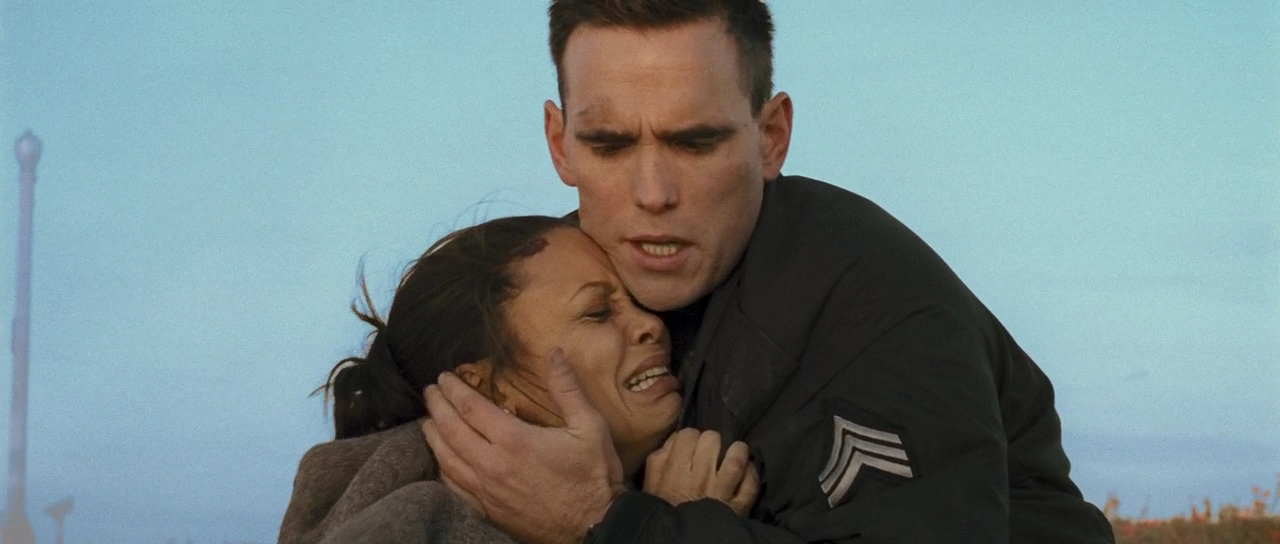
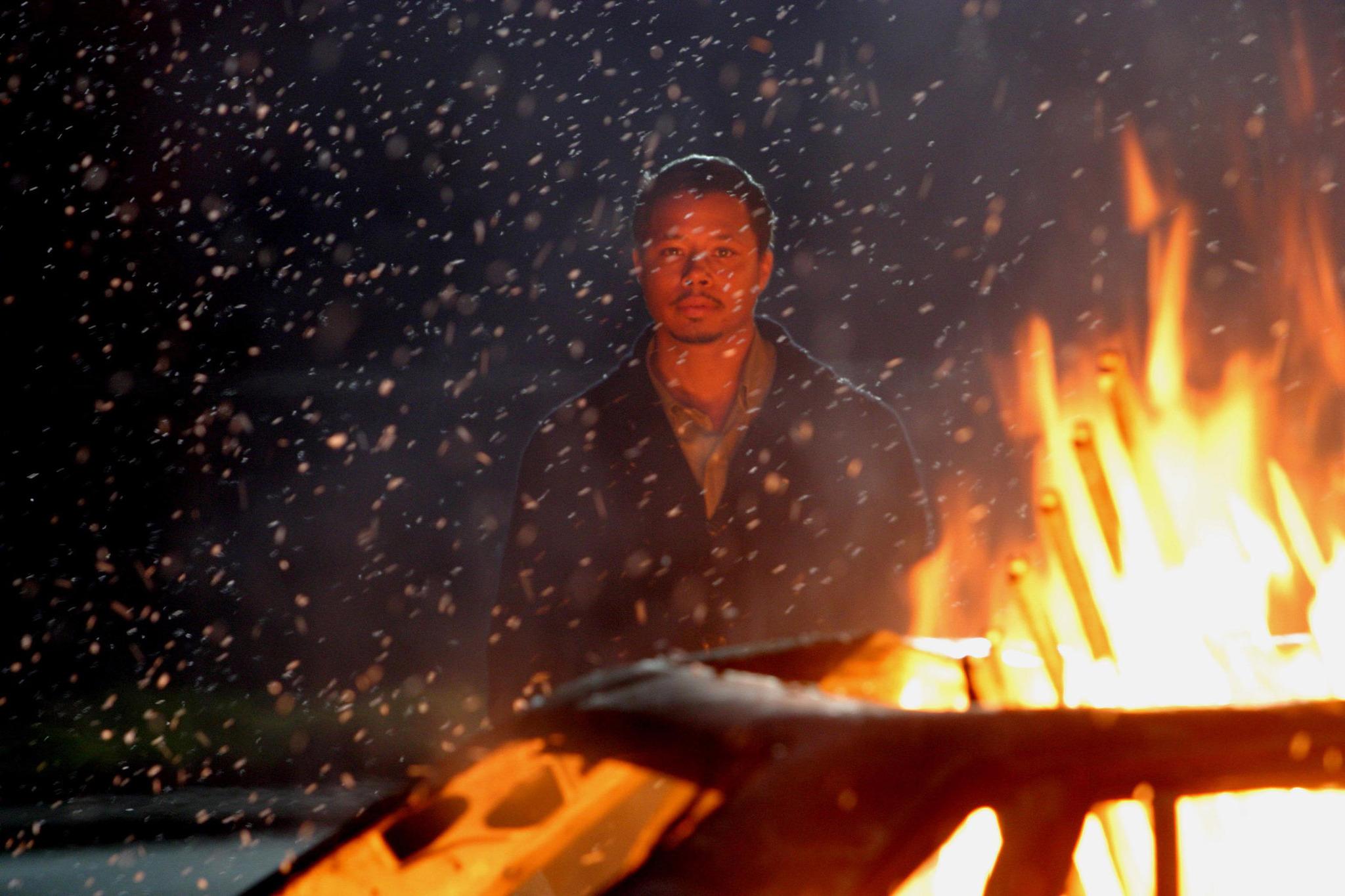
And then there’s Cameron (Terrence Howard) and his wife Christine (Thandie Newton) who are upper class and black.  Cameron directs sitcoms for a living and, at work, he has to deal with Fred (Tony Danza) constantly double guessing him and demanding that he reshoot scenes.  One night, as they leave an awards ceremony, Cameron and Christine are pulled over by two white cops — the racist Ryan (Matt Dillon) and his idealistic partner Hansen (Ryan Phillippe).  Ryan proceeds to molest Christine while giving her a pat down.  The next day, Christine is involved in a car accident on the freeway and is pulled from the burning car by none other than Officer Ryan.  The point here, I suppose, is that the same pervert who finger rapes you one night is just as likely to be the same guy who comes across your overturned car on the freeway.  For that scene alone, Crash deserves the title of worst best picture winner ever.

crash-2004 4

But that’s not all!

There’s also Detective Graham Waters (Don Cheadle), who has been assigned to investigate a police corruption case that would not be out of place in an episode of … well, just insert your own generic cop show title here.  Graham also visits his mentally unstable mother who demands that Graham find his younger brother.  Now, of course, as soon as we hear this, we know that Graham’s brother is going to have to turn out to be one of the other characters in the film.  Since there are only three other black males in this film (and since Cameron appears to be the same age as Graham), it’s not difficult to figure out who it’s going to be.

It’s either going to be Anthony (Ludacris) or Peter (Larenz Tate), who also happen to be the same two men who carjacked the Cabots’ car at the start of the film.  Larenz Tate probably gives the best performance in this whole sorry mess of a film, even if his role is ultimately a thankless one.

There’s also a locksmith named Daniel (Michael Pena), who finds himself being stalked by an angry Middle Eastern man.  Daniel’s story contains a hint of magic realism, presumably because Paul Haggis was reading something by Gabriel Garcia Marquez while writing the script.

Crash

You can fault Crash for many things but you also can’t deny that it’s far more ambitious than the typical bad film.  In the space of 112 minutes, Paul Haggis attempts to say everything that needs to be said about race and class in America.  Unfortunately, while watching the film, it quickly becomes obvious that Haggis really doesn’t know much about race and class in America.  Hence, the film becomes a collection of scenes that think they mean something while actually meaning nothing.  Crash is less about race in America and more about how other movies have traditionally portrayed race in America.  Unfortunately, director Haggis does not have the self-awareness to truly bring the subtext of screenwriter Haggis’s script to life.

The main theme of Crash seems to be that everyone has a good side and a bad side and that you can the hero of one story while being the villain of another.  That’s not a bad theme, it’s just an incredibly mundane one.  The film illustrates this theme by continually having a character say something racially offensive just to then have him do something heroic in the very next scene.  As a result, the characters don’t come across as being so much complex as just incredibly inconsistent.  Crash is never as deep as it thinks it is.

Reportedly, Crash was inspired by Paul Haggis’s own experience of getting carjacked.  Haggis has said that being a victim of crime led to some intense soul searching on his part.  Hopefully, Haggis got something better than just Crash out of the whole experience.

still-of-terrence-howard-in-crash-(2004)-large-picture

Review: Iron Man 3 (dir. by Shane Black)


IronMan3

“You can take away my suits, you can take away my home, but there’s one thing you can never take away from me: I am Iron Man.” — Tony Stark

[WARNING: SPOILERS WITHIN]

Iron Man 3 review by Leonard Wilson

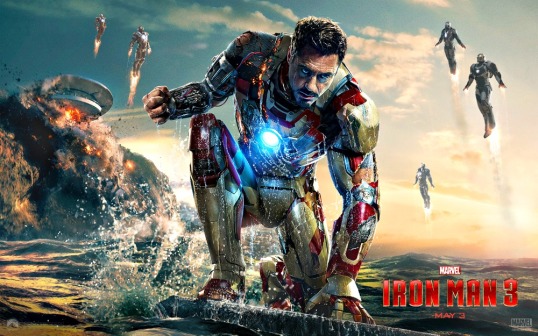
That line above would make such a great send-off for what could be the final Iron Man film. In a perfect world, having Shane Black’s Iron Man 3 as the final one in the franchise wouldn’t be such a bad thing. This doesn’t mean that Iron Man will not appear in any future Marvel Studios endeavors, but as a solo franchise a series couldn’t have found a better way to fly into the Malibu sunset. I say this because in over 5 years Marvel Studios has created a trilogy that took a character in Tony Stark and put him through a character journey encompassing four major film releases and one cameo. They did so in such a way that we saw the character grow from a rich genius dilletante, to a desperate asshole trying to find his identity as Iron Man to finally realizing that he’s the hero with or without the Mark suits he’s has created.

Iron Man 3 is the culmination of what Jon Favreau began with Iron Man in 2008 and Joss Whedon expanded on in 2012’s Marvel’s The Avengers. It took a writer of renown such as Shane Black (who also replaced Favreau as director) to get to the heart of what makes Iron Man ticks. It helped that the returning cast led by Robert Downey, Jr. as Tony Stark and Iron Man once again did a great job in their roles with some characters even getting to do some surprising heroic stuff on the screen.

IronMan3

Iron Man 3 starts off with a flashback scene just hours before the arrival of the new millennium. This is just Tony Stark before he becomes Iron Man so we see the character in full charming asshole mode. This sequence is important in that it sets up the whole plot of the film and, in my opinion, the overall story for the entire trilogy. We’re introduced to the geeky Aldritch Killian (played with equal amounts of geeky desperation and overconfident megalomania by Guy Pearce) who sees in Stark the mentor he needs to get his think tank going. With only sex with brilliant scientist Maya Hansen (played by Rebecca Hall) on his mind Killian is soon forgotten and humiliated by Stark.

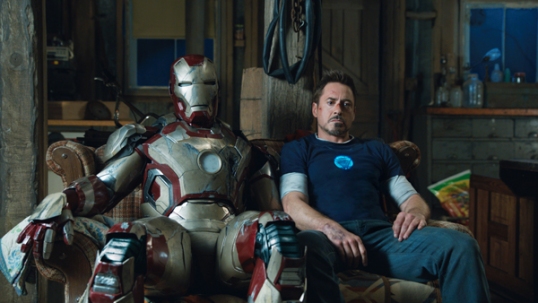
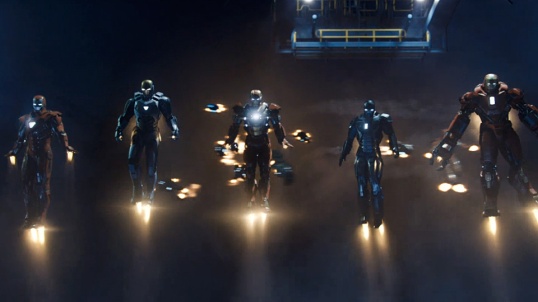
The rest of the film sees Tony Stark having to pay a steep price for his behavior towards Killian in that flashback and, in conjunction, with his days and nights haunted by the events in New York with the invading Chitauri invasion having given him a case of the PTSD the film looks to bring Tony Stark at his most vulnerable and lowest. It’s a return to the proverbial “Cave” for Tony Stark as he must contend not just with the elusive terrorist mastermind The Mandarin, but also solve the mystery of who or what’s causing the inexplicable explosions and bombings occurring around the nation. All this he must do through most of the film without the use of his Iron Man suits and relying mostly on his own genius intellect and skill with making weapons and gadgets out of anything readily available.

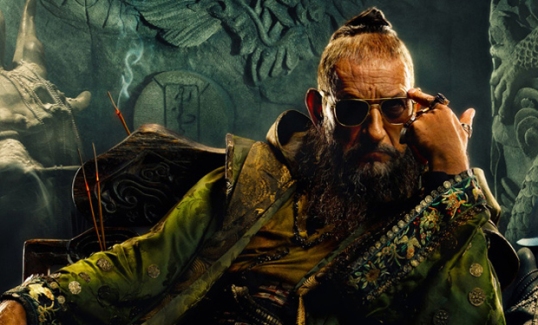
Speaking of The Mandarin (in an excellent performance by Sir Ben Kingsley), Shane Black and co-writer Drew Pearce made a controversial decision (for comic book fanboys at least) to make the iconic Iron Man villain more than he appears to be. It’s a decision that won’t sit well with the more vocal and rabid comic book fans who sees any deviation from Iron Man lore as an affront worth of loud, vociferous rabble, rabble, rabbling that would make Randy Marsh and the people of South Park proud.

mandarin-iron-man-3

To say that the twist in the story that explains who The Mandarin was such a surprise would be quite the understatement. The most important and iconic nemesis of Tony Stark comes out with both barrels of deliberate menace and sociopathic showmanship. We’re meant to see this character as the face of all the evils and troubles that has plagued Tony Stark since the first film. Kingsley plays this part of the character in the film to the hilt. Yet, it’s not until the second half of the film when we find out just who exactly The Mandarin really was and is that Black and Pearce finally put to rest whether the producers and writers would be able to handle a character that’s been seen as a racial caricature from a less than enlightened time.

Whatever howls and apoplectic ravings fanboys might be having about changing the traiditional character of The Mandarin into the pill-popping, drunk British wanna-be actor Trevor Slattery as a bait-and-switch was a brave move on the parts of Black and Pearce. To find out that The Mandarin was just a conjuration by Aldritch Killian to keep the eyes of the world’s governments and superheroes on someone else was very Bond-like. The fact that Killian himself is the true Mandarin and the Ten Rings terrorist organization his creation to have his revenge on Stark for humiliating him on the even of the new millennium closes the circle on what was begun all the way back in the first Iron Man.

This so-called “twist” was so unexpected (the internet scouring for any tidbits about the film’s plot having found nary a hint of this change) that it seemed like some sort of gimmick but as the film barreled on through the second half into it’s explosive conclusion one had to admire the massive stones by Black and Pearce to change such an iconic character knowing how it could easily alienate and anger fans of comic book. It’s this thinking outside the box by this franchise’s new director and screenwriter which makes me feel like Marvel Studios (especially studio head Kevin Feige) have their Phase 2 plan set to spring surprises on comic book and non-comic book fans alike as it marches on towards Avengers 2.

originalIron Man 3 was a definite improvement over the bloated second film in the series. It also manages to reach the high bar set by the first film, though as an origin story it still comes away as being the best of the trilogy, but not by much. There was much trepidation from fans of the film franchise when Favreau was replaced by Marvel Studios as director by one Shane Black. While Black was well-known for being a top-notch screenwriter who literally redefined the buddy cop genre his work as a filmmaker was just still only the suprise film Kiss, Kiss, Bang, Bang. While this third film still had some holes in it’s plot that was explained rather conveniently by some brief bits of dialogue it still managed to tell a compelling story of actions and consequences and the discovery that our hero finally makes about just who is the hero of the saga: the man or the machine.

If there’s to be another film bearing the title of Iron Man I would surely hope that Feige and the powers-that-be over at Marvel Studios and Walt Disney just speed-dial Shane Black’s name and to also bring back his co-conspirator Drew Pearce. The franchise is well and good in their keeping. As the final moments of the end credits tick by we’re promised that Tony Stark will return. I sure hope so.