Review: Planet Dune (dir. by Glenn Campbell & Tammy Klein)


“We came here for a rescue mission, and now we’re just something on the menu.” — said by someone, maybe.

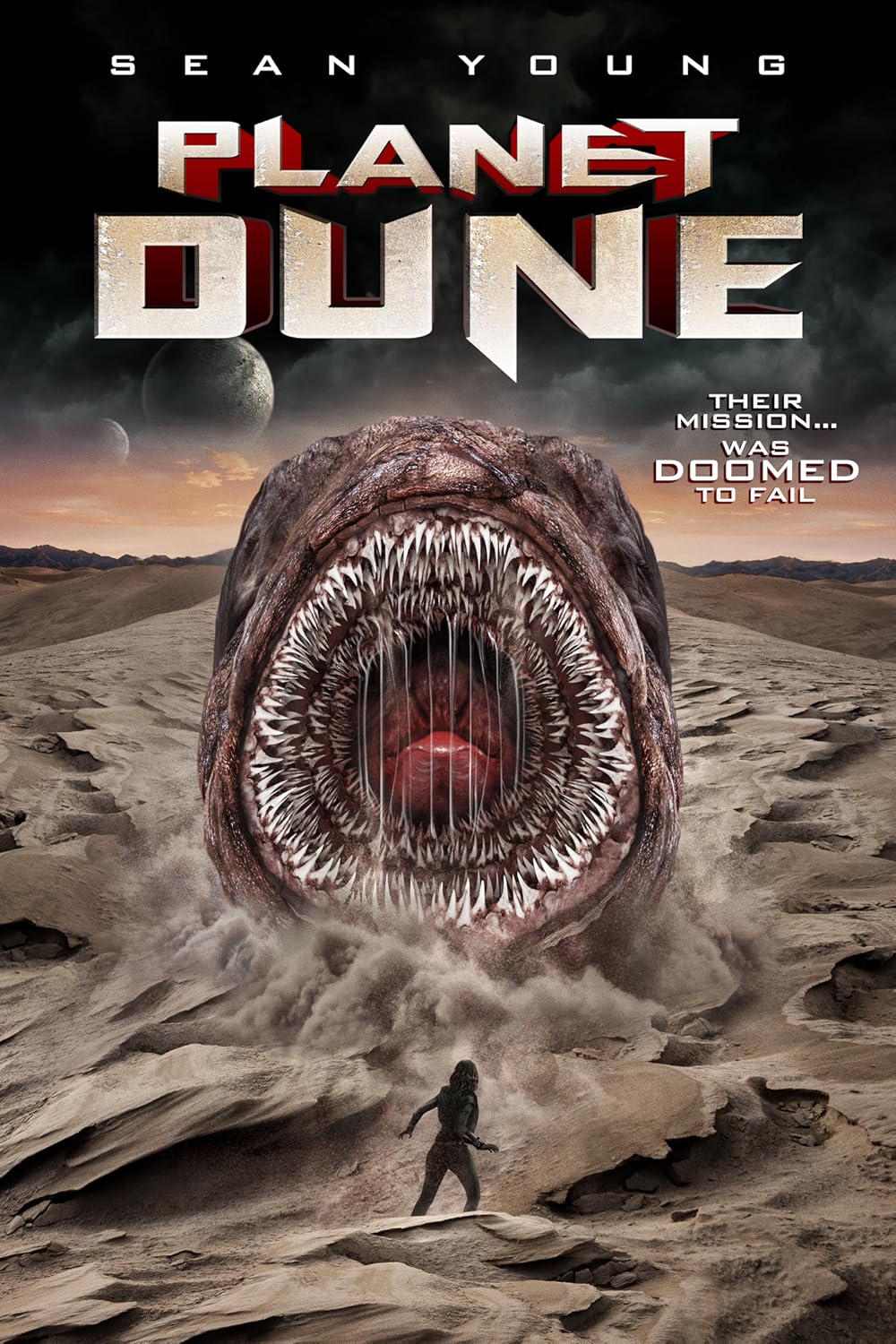
Planet Dune is a scrappy, low‑budget sci‑fi creature feature that knows exactly what it is, and that self‑awareness helps it go down easier. It is not a polished prestige production, but it does deliver a simple survival story, some intentionally goofy monster‑movie energy, and enough visual invention to keep genre fans from completely checking out. It also practically announces itself as another in‑name‑only knock‑off in the vein of The Asylum’s mockbuster factory, clearly trying to ride the coattails of Denis Villeneuve’s Dune: Part One. The timing, the desert‑planet setting, the sand‑worm menace, and the threadbare plot all feel calculated to cash in on the renewed mainstream buzz around the Dune name, rather than to build something original.

From the start, Planet Dune leans hard into its B‑movie identity. The setup is straightforward: a rescue mission heads to a desert planet, only to find itself trapped in a fight for survival against giant sand worms. That premise is thin, but the movie understands the appeal of the concept and does not waste time pretending to be deeper than it is. The result is a film that moves quickly, stays focused on its basic threat, and mostly avoids getting bogged down in overcomplicated mythology. At the same time, every decision feels like a stripped‑down version of choices made in Villeneuve’s Dune—just without the budget, scope, or attention to subtext. It’s the kind of project that exists because someone saw a big‑budget, heavily marketed Dune release and realized they could slap a vaguely similar title on a sand‑worm actioner and sell it to undiscerning genre fans.

What works best is the movie’s commitment to its own absurdity. The sand worms are the obvious attraction, and the film uses them as a constant source of danger rather than saving them for a single big reveal. That gives the story a pulpy urgency, and in a movie like this, momentum matters more than subtlety. The effects are clearly on a modest budget, but they are used with a certain charm, and the film often benefits from embracing cheapness instead of trying to hide it. That kind of approach can make a low‑budget creature feature feel more fun than fake grandeur ever could, even if it never comes close to matching the visual or thematic richness of Villeneuve’s work.

There is also a strange meta‑layer in the casting of Sean Young, who played Chani in David Lynch’s Dune (1984). Her presence turns Planet Dune into a weird echo chamber of the Dune universe: it’s a cheap, micro‑budget knock‑off trading on the name and imagery of a franchise, while also bringing in a legacy face from one of the older big‑screen adaptations. That gives the film a faintly nostalgic, almost self‑aware vibe, as if it’s winking at fans who know the history of Dune on screen, even while it rushes through a script that’s functionally just a monster‑survival thriller with a desert‑planet paint job. It’s a choice that underscores how this movie is less about telling its own story and more about trading on the weight of other people’s Dune work.

The pacing is also one of the movie’s stronger points. A lot of smaller sci‑fi films spend too much time explaining the world or padding out the runtime with empty dialogue, but Planet Dune keeps things relatively lean. It gets in, sets up the threat, and lets the characters deal with one problem after another. That makes it easier to forgive some of the rough edges, because the film does at least understand that the audience is here for monster attacks, not a lecture on space politics. Compared with Villeneuve’s slow‑burn world‑building and political maneuvering, Planet Dune feels like a stripped‑down amusement‑park version of the same concept: same core idea, none of the fuss.

That said, the movie is not above criticism. The biggest issue is that the characters are more functional than memorable. They do what the plot requires, but they are not written with enough personality to make every relationship or loss land with real weight. When the film pauses for emotional beats, those moments can feel undercooked because the script has not given the cast enough room to become more than survival‑movie placeholders. In a genre piece like this, that does not automatically sink the experience, but it does limit the impact, especially when viewers are already thinking of how Villeneuve’s Dune strained and expanded its characters across multiple films.

The performances are mixed in the way you would expect from a project like this. Nobody seems to be phoning it in, and that effort matters, but the material does not always give them much to build on. Some scenes benefit from the actors treating the material seriously, while others feel a little stiff because the dialogue is plainly there to move people from one danger zone to the next. The movie works best when it leans into the adventure and stops pretending it is a character drama. Sean Young gives a more grounded presence, but even that can’t fully offset how thin the script is; her casting feels more like a symbolic nod to Dune’s cinematic history than a way to deepen this particular story.

Visually, Planet Dune has the same plus‑and‑minus quality common to many independent sci‑fi films. The desert setting gives the movie a strong sense of scale, and even when the effects are rough, the barren environment helps sell the idea of isolation. At the same time, there are moments where the limitations are obvious, and the production does not always disguise them elegantly. Still, the film’s look is consistent enough that it rarely becomes distracting in a way that breaks the whole experience. Compared with Villeneuve’s meticulously composed frames and sweeping desert vistas, Planet Dune feels like a backyard‑budget cousin: same basic palette, significantly smaller scale.

There is also a pleasant lack of pretension here. Some genre movies try to compensate for weak writing by becoming self‑important, but Planet Dune seems content to be a monster chase with a space wrapper. That honesty is refreshing. It does not make the movie great, but it does make it easier to enjoy on its own terms. If you approach it like a serious epic, it will probably disappoint you, especially with the memory of Villeneuve’s Dune still fresh in your mind. If you approach it like a scrappy midnight movie—one that exists mainly because someone saw Dune in theaters and figured they could sell a knock‑off soundtrack on the same name—it has a better shot at working.

The film’s weaknesses are still hard to ignore. The story is very familiar, and viewers who have seen enough desert‑planet sci‑fi will recognize the beats immediately. There is also some repetition in how the danger is staged, and not every sequence feels equally inspired. A tighter script and a stronger sense of character could have lifted the whole thing a few notches. As it stands, Planet Dune is more effective as a mood piece and monster showcase than as a fully satisfying drama. It never reaches for the political, religious, or ecological weight of Villeneuve’s Dune, and it never really tries; it’s closer to a DVD‑rack detour for genre fans who just want sand worms and a vaguely Dune‑adjacent name.

What saves it is that it rarely feels cynical. Even when it is clumsy, it is trying to entertain rather than impress. That gives the movie a bit of personality, and personality goes a long way in low‑budget genre cinema. The casting of Sean Young, the desert‑planet premise, and the obvious Dune name‑play all point to a project that knows exactly what it is: a small‑scale, opportunistic creature feature that wants to surf the wave of a bigger franchise without the heavy lifting. It may not be the kind of film that wins over skeptical viewers, but it is also not a total write‑off. For viewers in the mood for a cheap, goofy, sandworm‑infested sci‑fi ride—one that openly trades on the legacy of both Villeneuve’s and Lynch’s DunePlanet Dune gets the job done on its own very modest terms.

Trailer: M3GAN 2.0


M3GAN in 2022 was a surprise hit that no one saw coming. What would’ve been a a nice little horror film from Blumhouse that would’ve come and gone with little fanfare suddenly became a major hit due to the viral marketing of the titular character’s dancing shown in the initial trailer becoming a huge internet meme.

Now we are back with the sequel (I don’t think anyone was surprised that Blumhouse quickly greenlit a follow-up) and it looks like the original team of director Gerard Johnstone and writer Akela Cooper are back to headline M3GAN 2.0.

The sequel looks to be bigger and a bit more ambitious with more than just a bit of a Terminator 2 vibe with the title character looking to be more of the savior and not just an overprotective killing AI doll.

Will M3GAN 2.0 be able to replicate the viral success of the first film? We shall find out on June 27, 2025.

Scenes I Love: Alien


alien-chestburster

We found out tonight that the great Sir John Hurt passed away at the age of 77.

For some their memory of him was in the role of the Elephant Man. For the younger set it might be as Hellboy’s adopted father Professor Broom. Some might even remember him as Chancellor Sutler from V for Vendetta. They were all great roles, but my very first memory of him is from a film that helped shaped my love for horror and sci-fi. It was a film that was influenced the impressionable mind of a pre-teen.

This film is and will always be Ridley Scott’s haunted house in space sci-fi horror film, Alien.

Sir John Hurt as the doomed crew-member Kane would make such an impact in my impressionable mind as a child not when he first appears on-screen, but when the titular creature makes it’s first appearance in what I can only describe as an explosive birthing scene.

Rest In Peace good sir.

Horror Quickie Review: Virus (dir. by John Bruno)


Virus

Not every comic book film is about superheroes. There’s been quite a bit of comic books adapted to film that has no superheroes, capes and superpowers at all. One such film came out in 1999. It was a film adapted from Chuck Pfarrer’s Dark Horse Comics mini-series titled Virus. This was a comic book that had a unique art-style to it that lent itself well to its scifi and body horror tale.

The film itself skews close enough to the comic book with some minor changes. Instead of a Chinese research vessel where most of the story takes place we find the film set on a derelict Soviet research ship. Even with the changes from comic book to film they both shared one common denominator and that would be the alien lifeform that has decided to systematically kill all humans aboard the ship.

Virus stars Jamie Lee Curtis and Donald Sutherland in two roles they probably wish they took a pass on or asked more money to do. While the film has some imaginative set pieces involving the melding of robotics and scavenged human body parts to create something bigger and homicidal the majority of the film involves pretty much every cast member in one stage or another of hysteria, incredulity and denial. Really, the only person in the whole film who seemed to go through the story with a clear and level head was Cliff Curtis’ seaman Hiko. All this means was that he would be one not to survive to the end of the film.

While the comic book itself was a nice piece of scifi horror storytelling then film stumbles right out of the gate not just because of the terrible acting, but just a dull and boring adaptation of the story. While, as stated earlier, some of the robotic designs were quite good and the use of practical effects made the killer robots something terrible behold, director John Bruno didn’t seem to have any ideas on how to put together an exciting sequence to take advantage of these inventive pieces at his disposal.

Virus was one film that comic book fans who read the mini-series were quite excited to see when it was first announced as a film in production. Stills of gruesome effects work would be admired and just add to the high expectations. What we got instead was a huge pile of a mess that was neither horrific, terrifying or remotely entertaining. Virus is one such film that I wouldn’t even bother catching on TV being shown for free.

Horror Review: The Colony (dir. by Jeff Renfroe)


TheColony

“You’re going to need every bullet.”

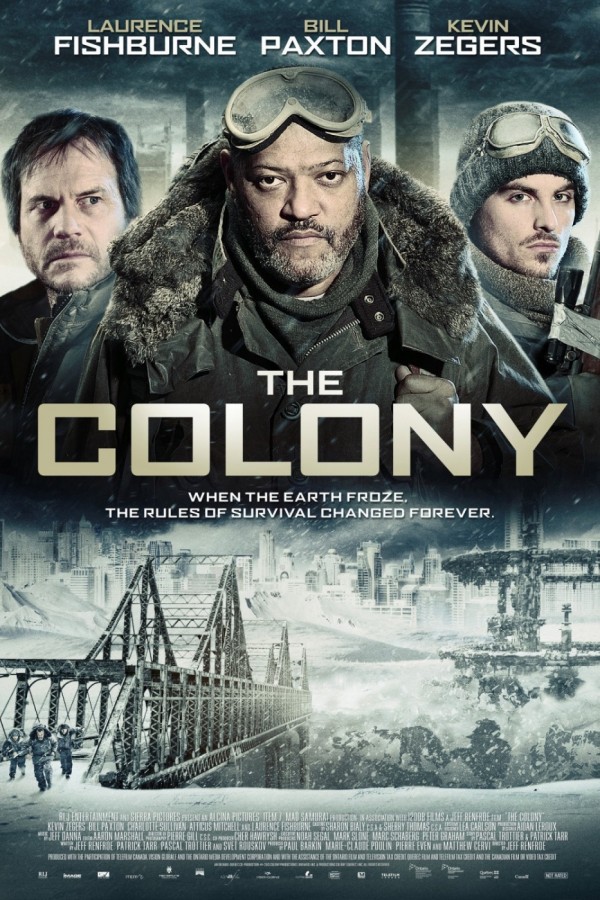
The Colony was this little-seen horror film that came out in early 2013. From the trailers shown it looked like it was going to be a decent looking post-apocalyptic, scifi-horror that looked to evoke the sort of icy desolation and paranoia that Carpenter’s The Thing did so perfectly. Under Canadian-filmmaker Jeff Renfroe’s command the film’s high, lofty horror goals didn’t exactly come to fruition.

The film itself wasn’t awful by any stretch of the imagination, but it does suffer a lot from having it look like it was one of those mid-2000 SyFy film productions. At times some of the sequences even looked like it was copied off from one of those the SyFy “New Ice Age” disaster flicks starring Dean Cain. Yet, there’s some genuine tense moments in The Colony that should make this film a look-see if there’s nothing else to see.

Yes, the film is about the planet going through a sort of artificially-created Ice Age due to weather tampering. It’s a story that could’ve been lifted from early Twilight Zone episodes. Humanity barely survives inside spread out colonies using former factories and government bunkers. These colonies don’t just have the danger or dwindling supplies, simple diseases and the cold weather to deal with, but as we soon find out there’s now a new danger that’s much closer to home.

The Colony’s ad campaign and trailers have focused on it’s two American stars in Laurence Fishburne and Bill Paxton to sell the film. Both actors do some workman-like performances which helps anchor the ensemble cast’s performance. It’s the cast’s performances that elevates The Colony above it’s SyFy counterparts and one of it’s few saving graces. The other being the filmmakers’ success in creating a sense of freezing isolation through the use of arctic-like location shoots and some very well-done CGI icy landscapes.

The horror part of the film comes from the so-called “other” survivors who have adjusted to the scarcity of food by turning on the only abundant source of nourishment left in a world where there are no more growing things. Yes, The Colony tries to revive that old horror staple of the late 70’s and early 80’s which we know of as the cannibal-subgenre.

Cannibal films never truly went away but they remained mostly in the very outer fringes of the horror scene. They tended to be quite awful affairs that went for extreme shocks to bring in the horror crowd, but that only works when there’s a semblance of a narrative to explain things. With The Colony the film does a good enough job to try and explain why some have turned to a diet of the so-called other “white meat”. To add a new wrinkle to these feral antagonists the filmmakers they decided to update them for the modern audiences by giving them free-running skills that makes them seem more than human once they enter the screen. If the film has any sort of lesson to impart it could be that eating “long pig” might just give one parkour-like abilities.

The Colony definitely tried to be one of those scifi-horror that wanted to elevate itself to something beyond it’s grindhouse and exploitation roots, but it’s trying to be somethng it wasn’t meant to be that became it’s biggest flaw. The set-up of an Ice Age created by man is a time-tested story and the reintroduction of the cannibal thread to the film’s storyline was ripe for a grandg uignol-like production that could’ve been done using practical effects. But the filmmakers tried to mimic the CGI-smorgasbord of the Roland Emmerich-style, but they just barely distinguished themselves from what amounted to be an enhanced SyFy-production.

It’s a film that has enough entertaining moments, but overall it was a nice try that that just failed short of it’s goals.

Horror Scenes I Love: Scanners (by David Cronenberg)


[SPOILERS!!!!]

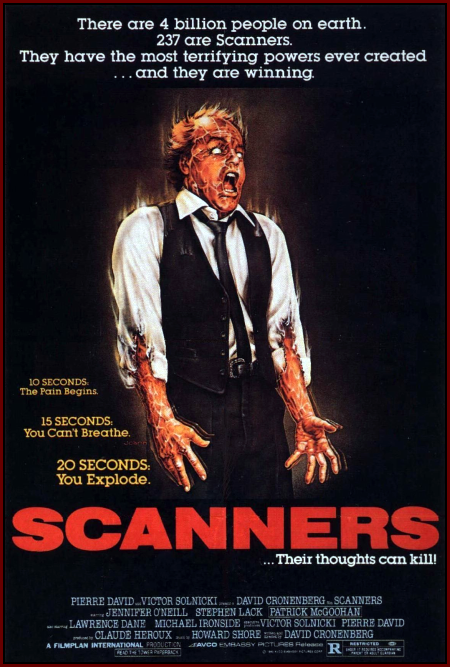
I’ve already shared a favorite scene from David Cronenberg’s landmark scifi/horror film Scanners over a year ago that saw a head explode. For October’s horror-themed month I picked another great scene from this film that always stuck with me long after I’ve finished watching the film each and every time.

The scene I’m talking about is the climactic showdown between Good Scanner Cameron and Evil Scanner Revok. This scene was filmed before the advent of CGI-effects and Cronenberg never had the sort of big-budgets to hire the top FX make-up artists to work on his films. Yet, Cronenberg ended up creating one of the best scenes ever put on film about two people fighting each other using their minds. We never see their mental abilities shooting off psychic blasts at each other but the performance by both Michael Ironside as Revok and Stephen Lack as Cameron was so believable that it made the scene work when it could’ve turned so cheesy and disastrous in the hands of a different filmmaker and other actors.

The battle ends but we’re left to believe the good guy lost and evil triumphs. This feeling pretty much plays out right up to the final scene before fade to black and even then we’re not sure if the final reveal is true or not. Either way there’s no better way to bookend the exploding head intro than with two psychic beings duking it out mentally with blood, spontaneous combustion and creepy white eyes added in for style.

Trailer: Resident Evil: Retribution


The Resident Evil film franchise seems to be the franchise that just keeps on going and going. Like the undead which forms the bulk of the danger to the characters in the film, this film series just won’t die. It’s success has both confounded critics and audiences alike. It’s turned Milla Jovovich into an action star whether we like it or not. It’s also a series that despite some major flaws continues because it makes it’s studios money.

We now have the first teaser trailer for the 5th film in the series, Resident Evil: Retribution, and just like the 4th film in the series it will be in 3D. It will also have several characters from past films who we saw die make appearances in the film. Whether they come back as themselves in the film’s present storyline or in flashbacks has yet to be determined. The trailer itself looks like a major advert for Sony smartphones, PS Vita and tablet products. In fact, I’d say that almost 40% of this teaser is all about pushing Sony products.

If that’s the case then this trailer does teach me one thing: Sony products will lead to a global zombie apocalypse. I think this event would never happen if people bought iPhones and iPads.

Resident Evil: Retribution is set for a September 14, 2012 release date.