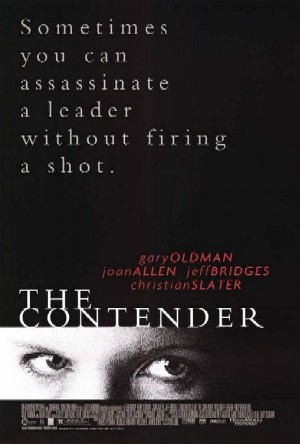
Shattered Politics #67: The Contender (dir by Rod Lurie)


Contenderposter(Spoilers)

The 2000 political melodrama The Contender is one of the most hypocritical films that I’ve ever seen.

The Contender tells the story of what happens when U.S. Sen. Laine Hanson (played by Joan Allen) is nominated to be vice president by President Jackson Evans (Jeff Bridges).  During Laine’s confirmation hearings, Rep. Shelly Runyon (Gary Oldman) dredges up rumors that, at a college frat party, Laine took part in a threesome in exchange for money.

When Runyon asks Laine about the rumors, she replies that she refuses to answer any questions about what she may or may not have done while she was younger.  She replies that it is “simply beneath my dignity” and you know what?  She’s absolutely right.  First off, if someone could be disqualified just because of what they did in college then nobody would eve be eligible to be President.  Secondly, and far more importantly, nobody would care about Laine’s sexual history if she was a man.

For over two hours, Laine refuses to answer any questions about the allegations and instead, she turns the tables on her attackers.  And while this alone would not have made The Contender a good film (because, after all, The Contender was written and directed by Rod “Straw Dogs” Lurie), it at least would have been a film that I could respect.

But, Rod Lurie being Rod Lurie, he just couldn’t help but fuck it all up.

Towards the end of the film, Laine is attending a White House reception.  She and President Evans sit down on the White House lawn and, as the stars shine above them, Evans says, “Just between us, is it true?”

Now, there’s two things that Laine could have said here that would have kept this film from falling apart.  Laine could have said, “It’s none of your business.”  And that would have been the right thing to say because, quite frankly, it is none of the President’s business.  The whole point of the movie has been that it’s not anyone’s business.

Or, if the film actually had any guts, Laine could have said, “Yes, it’s totally true.  Like most people, I experimented when I was in college.  But that doesn’t have anything to do with whether or not I’m qualified to be your vice president.”

But no.  Instead, Laine smiles and says, “Nothing happened.  Two guys propositioned me, I said no, and they spread rumors.”

So, basically, the film is saying, “It’s nobody’s business if Laine was sexually active in college but don’t worry, Mr. and Mrs. American Audience, she was a virgin until she turned 30.  So, it’s still okay for you to like her…”

And that’s the thing about The Contender.  It’s a film that doesn’t have the courage of its own convictions.  It’s a film that drags on for over two hours and it expects you to forgive it just because it pretends to have good intentions.  As a woman, there’s nothing I hate more than being pandered to and, for all of its attempts to come across as being feminist, The Contender is all about pandering.

What makes The Contender an interesting bad film — as opposed to just your usual bad film — is how even the littlest details feel false.  It’s obvious that Lurie knew all of the legal details that go into confirming a Vice President but he didn’t know how to make any of those details dramatically compelling.  So, the film becomes a bit of a know-it-all lecture.  By the time that Saul Rubinek popped up and said, “Do you know what Nelson Rockefeller said about the vice presidency?,” I found myself snapping back, “No, what did Nelson Rockefeller say about the Vice Presidency?  Please tell because ah am so sure that it is just goin’ to be the most fascinatin’ thang that ah will ever hear in mah entire life!”

(The more annoyed I get, the more pronounced my Texas accent.)

There’s a lot of weird little things about The Contender that just don’t work.  They may not sound like major problems but when combined together, they start to add up.  For instance, there’s a long shot where we see U.S. Rep. Reginald Webster (Christian Slater) and his blonde wife at a White House reception and the shot just lingers on them for no particular reason.  Long after you would expect the shot to end, it’s still going.  This wouldn’t be an issue if there was some narrative reason for that shot.  Instead, it’s just randomly dropped in there.

And then, after Laine is nominated, we see the front page of a newpaper and there, in the middle of the page, is a headshot of Joan Allen.  Underneath it, a small headline reads, “It’s Laine!”  It just feels so fake.  Wouldn’t the nomination of the first female vice present actually rate a bigger headline and a more dynamic picture?

Speaking of fake, towards the end of the film, President Evans picks up a framed magazine cover and stares down at it.  The magazine, itself, looks like one of those joke “Man of the Year” pictures that people pose for at a state fair.  On the cover is a picture of Last Picture Show era Jeff Bridges.  The headline on the magazine reads: “President Jackson Evans.  His ideas have changed the world.”  Not his actions, mind you.  Not his policies.  Instead, his ideas have changed the world.  But the film shows us no evidence of this and, during Laine’s confirmation hearings, everyone spends the whole time debating the same old shit that they always seem to be debating in Washington.

(Of course, if you’re lucky enough to have a name like Jackson Evans, I guess you might as well become President.)

Of course, when it looks like Laine might not be confirmed, President Evans speaks before Congress.  “For the first time, a woman will serve in the executive!” he declares, which seems like a hilariously awkward way to put it.  (People in this film don’t talk like human being as much as they talk like characters in some fucked up Washington D.C. fanfic.)  He then adds, “There are traitors among us!”

So, I guess the message here is yay for demagogues.

And don’t even get me started on Kathryn Morris, as the cheerful FBI agent who investigates Laine’s past and who, at one point, announces, “Laine is hope!”  Would a male FBI agent ever have to deliver a line that stupid?

And also don’t even get me started on the subplot about Gov. Jack Hathaway (William Petersen), who stages an auto accident in an attempt to convince President Evans to nominate him for vice president.

The Contender is not a good film but it could have at least been a respectable film.  But then, Rod Lurie had to have President Evans ask whether it was true or not.

Perhaps being a hypocrite was the idea that changed the world.
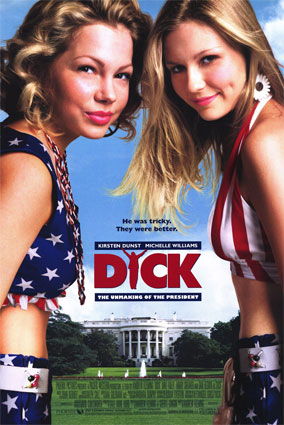


Shattered Politics #64: Dick (dir by Andrew Fleming)


Theatricalposterdick

I wouldn’t necessarily say that I love Dick but I still think it’s a pretty good film.  (Ha ha, see what I did there?)  Of course, to really appreciate this 1999 comedy, it helps to know a little something about political history.  For instance, it helps to know that the Dick of the title is President Richard Nixon (played here by a hilariously paranoid Dan Hedaya).  In 1973, as the result of his attempt to cover up White House involvement of a burglary at the Watergate Hotel, Nixon became the first President to resign from office.

A lot of the credit for Nixon’s downfall was given to two reporters for the Washington Post, Bob Woodward and Carl Bernstein (played, in this film, by Will Ferrell and Bruce McCulloch).  While Woodward and Bernstein investigated the Watergate break-in, they were reportedly fed information by a highly placed informant who was referred to as being Deep Throat.  For years, the identity of Deep Throat was a closely held secret.  Countless books were written that speculated as to who Deep Throat may have been.  (In the film All The President’s Men, he was played by Hal Holbrook.)  Finally, in 2005, it was revealed that Deep Throat was a FBI agent named Mark W. Felt, who was upset because he was passed over for a promotion.

And, quite frankly, that’s kind of a disappointing solution.  When you think about someone who brought down the government, you hope that he or she will turn out to be something more than just a disgruntled employee whose previous work consisted on running counter intelligence operations against domestic political activists.

In fact, it’s hard not to wish that, perhaps, Deep Throat could have been two 15 year-old girls who just happened to stumble across one of the biggest political scandals in American history.

Well, fortunately, this is the theory proposed in Dick.  Betsy (Kirsten Dunst) and Arlene (Michelle Williams) are two friends who, one night in 1972, sneak out of Arlene’s apartment so that they can mail a fan letter to singer Bobby Sherman.  While doing so, they happen to stumble across the Watergate burglars and get a good look at White House aide G. Gordon Liddy (Harry Shearer).

The next day, while on a field trip to the White House, the two girls are spotted by Liddy.  Liddy arranges for them to be pulled to the side and questioned by chief-of-staff H.R. Haldeman (Dave Foley), who determines that the girls barely know who Nixon is and that they don’t understand what they witnessed.  However, before Haldeman can send the girls on their way, Nixon himself enters the office and complains about how poorly planned the break-in was.

This leads to an unlikely relationship between Nixon and Betsy and Arlene.  Hoping to win their loyalty (and their silence), Nixon arranges for them to be his official dog walkers.  Betsy and Arlene, meanwhile, still don’t have the slightest idea of what’s going on.  They accidentally bring pot cookies to the White House (which Nixon particularly enjoys) and Arlene even develops a mad crush on Nixon.

But, of course, Nixon eventually shows his true colors and Betsy and Arlene take down the government….

In many ways Dick is a one-joke film, in which Betsy and Arlene regularly find themselves blissfully unaware while history literally unfolds around them.  But it’s actually a pretty clever joke and it’s also a very plausible one.  People are often unaware that anything important is happening when it’s actually happening.  Often times, it’s only in retrospect that historical moments are seen to be truly historical.  And, ultimately, Watergate itself is such a bizarre scandal that it’s the perfect moment in history to be reinterpreted as a comedy.

Dick is ridiculous enough to be funny but plausible enough to be memorable.

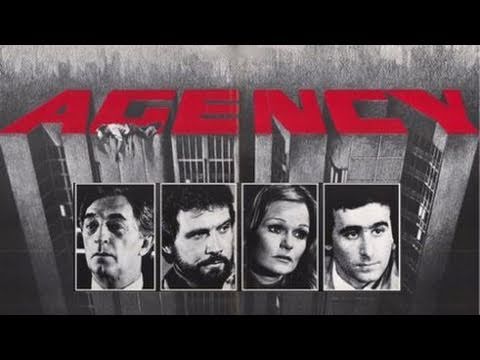
Shattered Politics #47: Agency (dir by George Kaczender)


Agency

“Who are the other two lugs on this poster? And who’s the dame? Baby, I just don’t give a damn…” Robert Mitchum in Agency.

Like a lot of writers who occasionally have issues when it comes to balancing ambition with time management, I’ve discovered that it helps if I listen to music while I write.  For instance, while writing the majority of the reviews for Shattered Politics, I’ve been listening to Big Data’s Dangerous.

And that choice of music has actually turned out to be extremely appropriate.  No, not just because it’s dangerous to write about politics.  But also because the official music video for Dangerous deals with advertising and, more specifically, how sex and violence are used to sell everything from shoes to politicians.

Now, I don’t know about you but, whenever I see that video, I feel like I’m ready to put on a sports bra, running shorts, and of course my Big Data running shoes so that I can take control and headbutt my way through life!  A good commercial can do that.  (And don’t even get me started on what I’m going to do to the next person I see eating a hot dog…)

Interestingly enough, the 47th film that I’m reviewing for Shattered Politics also deals with the power of advertising.  First released in 1980, Agency stars Robert Mitchum as Ted Quinn, the mysterious new owner of a major ad company.  Out of all of the old school movie stars, Robert Mitchum is one of my favorites because he was not only a great actor but he was also a very honest one.  If he didn’t give a damn about a role, he wasn’t going to try to fool the audience otherwise.  Instead, he was going to deliver his lines and kind of smirk with his eyes, his way of subliminally asking the audience, “Are you actually watching this shit?”  And while this may have led to Mitchum giving several performances that were unworthy of his talent, it also means that if you see Robert Mitchum actually invested in a role than that means the film must be something really special.

Unfortunately, Agency is not one of those “something really special” films.  And Mitchum’s bored performance reflects that fact.

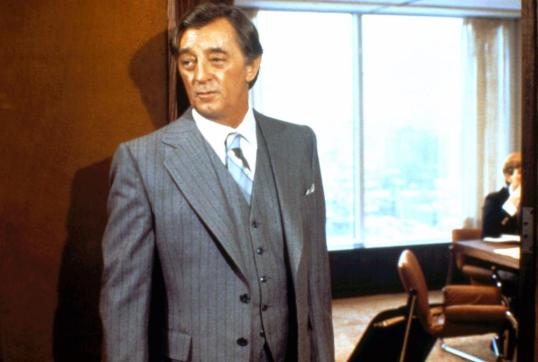
"Just try to make me care." Robert Mitchum in Agency.

“Just try to make me care.” Robert Mitchum in Agency.

Anyway, under Ted Quinn’s leadership, the ad agency is doing commercials for all the usual clients.  The movie starts with one of those commercials — a leather-themed, disco-scored short film extolling the virtues of No Sweat deodorant.  And then there’s also the big chocolate energy drink commercial.  However, copywriter Sam Goldstein (Saul Rubinek) suspects that Ted might have sinister motives.  After a right-wing  candidate comes out of nowhere to win a seat in the U.S. Senate, Sam suspects that the deodorant commercial may have contained subliminal messages…

That’s right!  It’s exactly like that episode of Saved By The Bell where Zack Morris brainwashed Mr. Belding by giving him that subliminally-spiked tape of the Beach Boys.

Well, before you can say “Zack Morris is a blonde Tom Cruise,” Sam has been murdered and it’s up to Sam’s best friend, Philip Morgan (Lee Majors), to reveal the truth about Ted’s sinister agenda…

Like many U.S.-set thrillers from the 1980s, Agency was actually a Canadian film.  Montreal stands in for an unnamed American city where it frequently snows and the supporting cast is full of actors with noticeable Canadian accents.  Mind you, that’s not a complaint.  I love Canada, I love Canadians, and I especially love Canuxploitation films.

That said, Agency is probably one of the least interesting Canadian thrillers that I’ve ever sat through.  (I should add, of course, that I saw Agency on a very low-quality DVD that was released by Miracle Pictures.  And I really do have to say that this was absolutely one of the worst transfers that I’ve ever seen.  It appears that the DVD was copied from an old VHS tape.)  It’s not so much that it’s a terrible film as much as it’s just not a very interesting one.  With the exception of Rubinek, the actors go through the motions with little enthusiasm and the story plods along.  Maybe back in 1980, the whole idea of subliminal advertising seemed exciting and relevant.  But seen today, it just all seems incredibly silly.

So, in the end, Agency did not make me want to headbutt my way through life.

Sorry.

(I still love you, Canada!)

(And you too, Robert Mitchum!)

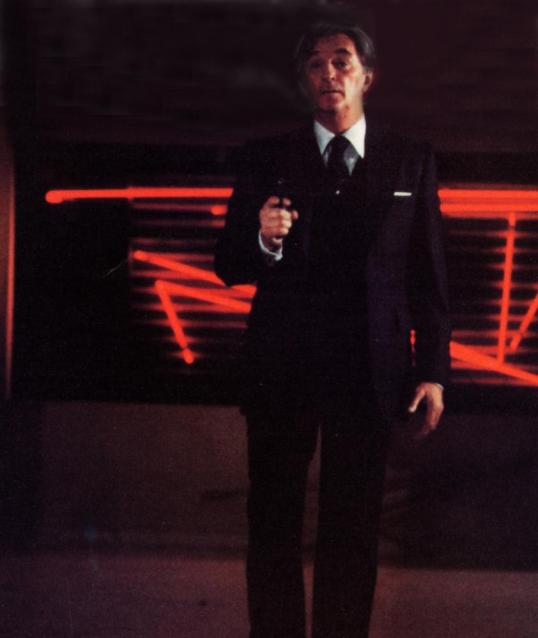
"Baby, I just don't give a damn."  Robert Mitchum in Agency.

“Baby, I just don’t give a damn.” Robert Mitchum in Agency.


44 Days of Paranoia #30: Nixon (dir by Oliver Stone)


For our latest entry in the 44 Days of Paranoia, we take a look at Oliver Stone’s 1995 presidential biopic, Nixon.

Nixon tells the life story of our 37th President, Richard Nixon.  The only President to ever resign in order to avoid being impeached, Nixon remains a controversial figure to this day.  As portrayed in this film, Nixon (played by Anthony Hopkins) was an insecure, friendless child who was dominated by his ultra religious mother (Mary Steenburgen) and who lived in the shadow of his charismatic older brother (Tony Goldwyn).  After he graduated college, Nixon married Pat (Joan Allen), entered politics, made a name for himself as an anti-communist, and eventually ended up winning the U.S. presidency.  The film tells us that, regardless of his success, Nixon remained a paranoid and desperately lonely man who eventually allowed the sycophants on his staff (including James Woods) to break the law in an attempt to destroy enemies both real and imagined.  Along the way, Nixon deals with a shady businessman (Larry Hagman), who expects to be rewarded for supporting Nixon’s political career, and has an odd confrontation with a young anti-war protester who has figured out that Nixon doesn’t have half the power that everyone assumes he does.

Considering that his last few films have been W., Wall Street: Money Never Sleeps, and SavagesI think it’s understandable that I’m often stunned to discover that, at one point in the distant past, Oliver Stone actually was a worthwhile director.  JFK, for instance, is effective propaganda.  Nixon, which feels a lot like an unofficial sequel to JFK, is a much messier film than JFK but — as opposed to something like Savages — it’s still watchable and occasionally even thought-provoking.  Thanks to Hopkins’ performance and, it must be admitted, Stone’s surprisingly even-handed approach to the character, Nixon challenges our assumptions about one of the most infamous and villified figures in American history.  It forces us to decide for ourselves whether Nixon was a monster or a victim of circumstances that spiraled out of his control.  If you need proof of the effectiveness of the film’s approach, just compare Stone’s work on Nixon with his work on his next Presidential biography, the far less effective W.

(I should admit, however, that I’m a political history nerd and therefore, this film was specifically designed to appeal to me.  For me, half the fun of Nixon was being able to go, “Oh, that’s supposed to be Nelson Rockefeller!”)

If I had to compare the experience of watching Nixon to anything, I would compare it to taking 10 capsules of Dexedrine and then staying up for five days straight without eating.  The film zooms from scene-to-scene, switching film stocks almost at random while jumping in and out of time, and not worrying too much about establishing any sort of narrative consistency.  Surprisingly nuanced domestic scenes between Anthony Hopkins and Joan Allen are followed by over-the-top scenes where Bob Hoskins lustily stares at a White House guard or Sam Waterston’s eyes briefly turn completely black as he discusses the existence of evil.  When Nixon gives his acceptance speech to the Republican Convention, the Republican delegates are briefly replaced by images of a world on fire.  Familiar actors wander through the film, most of them only popping up for a scene or two and then vanishing.  The end result is a film that both engages and exhausts the viewer, a hallucinatory journey through Stone’s version of American history.

Nixon is a mess but it’s a fascinating mess.

Other Entries In The 44 Days of Paranoia 

  1. Clonus
  2. Executive Action
  3. Winter Kills
  4. Interview With The Assassin
  5. The Trial of Lee Harvey Oswald
  6. JFK
  7. Beyond The Doors
  8. Three Days of the Condor
  9. They Saved Hitler’s Brain
  10. The Intruder
  11. Police, Adjective
  12. Burn After Reading
  13. Quiz Show
  14. Flying Blind
  15. God Told Me To
  16. Wag the Dog
  17. Cheaters
  18. Scream and Scream Again
  19. Capricorn One
  20. Seven Days In May
  21. Broken City
  22. Suddenly
  23. Pickup on South Street
  24. The Informer
  25. Chinatown
  26. Compliance
  27. The Lives of Others
  28. The Departed
  29. A Face In The Crowd

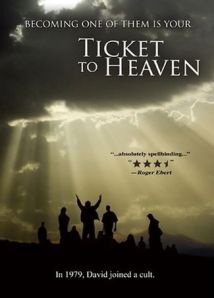
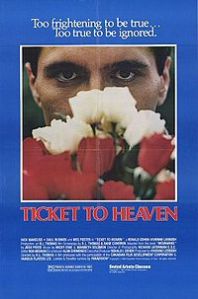
Review: Ticket to Heaven (dir. by Ralph L. Thomas)


At the start of 1980’s Ticket To Heaven, we’re introduced to David (Nick Mancuso), a normal young man from an upper middle class background.  David is likable enough but, when we first meet him, is still feeling depressed after breaking up with his longtime girlfriend.  He handles his loneliness by meeting up with Karl, a friend from college.  Karl, who is accompanied by an almost unbelievably positive young woman (played by a very young Kim Cattrall), invites David to come spend the weekend at a religious “retreat.”  For reasons that have more to do with Cattrall than with any interest in religion, David agrees.

The retreat turn out to be a camp where everyone is extremely friendly and extremely positive.  From the minute David arrives, everyone is smiling at him and telling him how thrilled they are to meet him.  It’s such a positive experience that David doesn’t even complain when he’s given little to eat, allowed very little sleep, and forced to endure hours of talk about the great spiritual leader who set up the camp.  When David does eventually decide that he’d like to leave, all of his friendly campmates are so wounded by his rejection that he changes his mind.  Who wouldn’t?  After all, they’re so nice and idealistic and positive.

Needless to say, David never leaves the camp.  When his best friend (played by Saul Rubinek)  happens to run into David on the street, he’s shocked to discover that David has become a blank-eyed zombie whose life now revolves around selling flowers in the street and making money for his new friends.  However, David’s old friends aren’t quite ready to give him up and the rest of the film details the battle between the two groups for David’s mind and soul.

Ticket to Heaven is a genuinely unsettling film.  As directed by Ralph Thomas, the entire film seem to ooze a very real creepiness that stays with you even after the end credits have rolled.  The film is at its best when it shows, in painfully believable detail, just how easy it is for someone to become brainwashed and to set aside everything that makes them unique in the name of a “greater good.”

The film’s cast is made up of a talented group of mostly Canadian character actors and, down to the smallest role, they’re all disturbingly believable.  Kim Cattrall is probably the most recognizable face in the cast, though Michael Wincott (he of the sexy, gravelly voice) also shows up in a tiny role.  Nick Mancuso and Saul Rubinek are believable as best friends and Mancuso is such a likeable presence that it makes his transformation into soulless zombie all the more disturbing.  Meg Foster — who looks like a thin, somewhat stable version of Kirstie Alley — gives an excellent and chilling performance as one of the cult’s leaders.

However, for me, the film’s best performance was given by an actor named R.H. Thomson.  Playing a cult deprogrammer named Linc Strunc (what a great name), Thomson is only in a handful of scenes but he dominates every one of them.  Speaking through clenched teeth and giving off an attitude of weary cynicism, Thomson takes a role that could have been a stereotype and makes it instead very compelling.  If I choose to believe Wikipedia, Thomson is still active as an actor and, after seeing his work in Ticket to Heaven, I may have to track down his other films.

Despite having won a Genie (the Canadian version of the Oscar), Ticket to Heaven is something of an obscure film.  I have to admit that I bought the DVD on something of a whim and that was mostly because I was intrigued by the words “In 1979, David joined a cult…” on the DVD’s cover.  I’ve long been fascinated by cults and just how easily some people can surrender everything the makes them a unique and individual human being.

During my first semester away at college, there used to be a small handful of students who, every night, would gather together outside the student union.  Since I’ve always been a night person, I’d often find myself walking by their little group and I always felt a little bit anxious whenever I saw them.  They all looked perfectly normal but there was still something off about them.  As my roommate Kim put it, they all looked like they had wandered out of a toothpaste commercial.  There was also the fact that they obviously considered themselves to be a part of an exclusive club that the rest of us had not been invited to join.

One night, Kim and I went down to the student union to check our mail.  As we were heading back to our dorm, we passed this little group and I noticed that one of them appeared to be holding a microphone.  I guess he saw me looking because he held the microphone up to his lips and said, his voice booming, “HEY YOU, DO YOU KNOW THE LORD!?”  At the time, Kim and I both considered ourselves to be decadent Pagans so we answered by sharing a long kiss in front of them and then laughing at the dead glares that greeted our response before we then ran, hand-in-hand, back to the dorms.   In retrospect, I guess that was my invitation to join the club and I’m glad I was too busy trying to be worldly to accept it. 

 A few nights later, I found myself suffering from the insomnia that’s plagued me for as long as I can remember.  Around 3:00 a.m., I was sitting down in the dorm’s lobby, trying to write angsty poetry.  On the other side of the lobby was this guy that we’ll call “Rich.”  You’ve probably known someone like Rich.  He’s one of those guys who was always smiling a little bit too much, who was always almost desperately friendly.  Rich was someone who, for whatever reason, was obviously lost and looking at him, you got the sense that he’d never been truly happy a day in his life.  I always felt sorry for Rich but I was also a little scared of him.

That night, I was happy that he wasn’t trying to talk to me.  Instead, he was just quietly sitting in a corner with a blank stare.  Suddenly, he was approached by three men who greeted him by name and, visibly shaking, Rich stood up to greet them.  It took me a few minutes but then I recognized that two of the guys were from that same group that always gathered outside the union.  Standing in between them was a balding, bearded man who I’d never seen before or since.

The four of them sat down and they were soon leaning forward in huddled conversation.  I found myself straining to hear what they were saying but I could only pick up a few words.  I could see that Rich was still shaking and that he had started to cry.

Suddenly, the bearded man spoke in a voice that snapped through the entire lobby.  “You little shit,” he said, “You pathetic motherfucker!”

As the two others sat there impassively, the bearded man leaned forward until his face was inches in front of Rich’s.  From where I was sitting, it looked almost as if Rich’s face was being eclipsed by the back of the man’s head.  The man continued to speak but now his voice was low and I couldn’t make out the exact words.  But I could tell from his body language and his gestures that he was giving Rich more of the same.

After about an hour of this, Rich started nodding and, tears flowing down his face, he started to say, “Praise God!  Praise God!  Thank you!  Praise God!”

The four of them stood up and, as I watched in disbelief, they stood there hugging each other as Rich continued with his “Praise God!”  The three guys then headed out and Rich, smiling even though his face was still slick with tears, skipped out of the lobby.

Rich graduated at the end of that semester.  A few years later, when I was about to graduate, I heard someone say that Rich had recently committed suicide.  I don’t know if that’s true and it’s almost too obvious an ending to his story. 

I thought a good deal about Rich and that night after I finished watching Ticket to Heaven.

Admittedly, Ticket to Heaven is not a “perfect film.”  Strong as Mancuso’s performance is, David is still something of a sketchy character.  The film does a good job showing the techniques that the cult uses to brainwash David but it’s never quite clear why David was so susceptible to those techniques to begin with.  There are hints, of course.  David is shown to be upset over breaking up with his girlfriend and there are hints that his safely middle class existence has left with him with little sense of having an individual existence of his own.  That doesn’t change the fact that David ultimately comes across as less of a real person and more as a way for the film to preach its anti-cult message.

Indeed, the film’s biggest flaw is that it is essentially a message film.  As well-acted and intelligently scripted as it often is, the movie exists to deliver a message.  Fortunately, it’s a good message but that doesn’t stop the film from sometimes rather heavy-handed.  This is most obvious in the movie’s final scene in which things are tied up just a little bit too neatly. 

Still, flaws aside and despite having been made 30 years ago, Ticket to Heaven remains a relevent film.  We live in a world that, for the most part, is made up of brainwashed people and, watching the movie, I had to wonder how much difference there really was between the overbearingly positive cultist played by Kim Cattrall and the grim-faced jihadists that currently haunt our nightmares.  When you consider just how much evil is justified, on a daily basis, in the name of the greater good, its becomes obvious that the movie’s warning against becoming a living zombie is just as important today as when the film was made.

The film’s cult is based on an actual, real-life group that was apparently very active in the late 70s and who are still around today, the Unification Church.  I vaguely remember them being in the news back in 2004 when the head of the church was declared to be “the prince of peace” at a ceremony that was attended by a few congressmen.  Type “Unification Church” into google and you’ll end up with links to a lot of stories that would seem to suggest that the real cult is even more creepy than the fictionalized version in Ticket to Heaven.