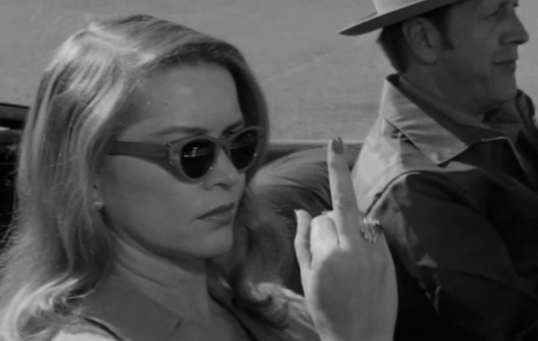
Lisa Marie Reviews An Oscar Nominee: Apocalypse Now (dir by Francis Ford Coppola)


1979’s Apocalypse Now reimagines the Vietnam War as pop art.

Jim Morrison sings The End in the background as slow-motion helicopters pass in front of a lush jungle.  The jungle erupts into flame while in a dingy hotel room, Captain Benjamin Willard (Martin Sheen) gets drunks, practices his karate moves, and smashes a mirror before collapsing to the floor in tears.  The next morning, the hung-over and bandaged Willard ends up at a U.S. military base where he has a nice lunch with Lt. General Corman (G.D. Spradlin) and Col. Lucas (Harrison Ford) and a nearly silent man wearing an undone tie.  Willard is asked if it’s true that he assassinated an enemy colonel.  Willard replies that he did not and that the operation was classified, proving that he can both lie and follow military protocol.  Willard is told that a Col. Walter Kurtz (Marlon Brando) has gone rogue and his mission is to go into Cambodia and terminate his command with “extreme” prejudice.  It’s a famous scene that features G.D. Spradlin delivering a brilliant monologue about good and evil and yet it’s often missed that Willard is getting his orders from Roger Corman and George Lucas.

(Roger Corman was the mentor of director Francis Ford Coppola while the pre-Star Wars George Lucas was Coppola’s business partner.  Indeed, Apocalypse Now was originally somewhat improbably planned to be a George Lucas film.)

Up the river, Willard heads on a patrol boat that is populated with characters who could have come out of an old World War II service drama.  Chief (Albert Hall) is tough and no-nonsense.  Lance (Sam Bottoms) is the goofy comic relief who likes to surf.  Clean (Laurence Fishburne) is the kid who is obviously doomed from the minute we first see him.  Chef (Fredric Forrest) is the overage, tightly-wound soldier who just wants to find mangoes in the jungle and who worries that, if he dies in a bad place, his soul won’t be able to find Heaven.  The Rolling Stones are heard on the boat’s radio.  Soldiers on the other patrol boats moon the boat and toss incendiary devices on the roof.  It’s like a frat prank war in the middle of a war.

Colonel Bill Kilgore (Robert Duvall) is a badass calvary officer whose helicopter raids are legendary amongst the enemy and a dedicated surfer who tries to turn every night into the equivalent of an AIP Beach Party film.  He’s a brilliant warrior who speaks with Malibu accent (“Charlie don’t surf!”) and who doesn’t flinch when a bomb goes off near him.  “I love the smell a napalm in the morning,” he says and, for a few moments, you really wish the film would just abandon Willard so we could spend more time with Kilgore.  “Some day this war is going to end,” he says with a reassuring nod, showing a non-neurotic attitude that is the opposite of Kurtz’s.  Willard says that he could tell Kilgore was going to get through the war without even a scratch and it’s true.  Kilgore doesn’t try to rationalize or understand things.  He just accepts the reality and adjusts.  He’s a true surfer.

The film grows progressively more surreal the closer the boat heads up the river and gets closer to Cambodia.  A USO show turns violent as soldiers go crazy at the sight of the Playboy Bunnies, dressed in denim outfits and cowboy hats and twirling cap guns like the love interest in a John Wayne western.  A visit to a bridge that is built every day and blown up every night is a neon-lit, beautiful nightmare.  Who’s the commanding officer?  No one knows and no one cares.

The closer Willard gets to Kurtz, the stranger the world gets.  Fog covers the jungles.  A tiger leaps out of nowhere.  Dennis Hopper shows up as a photojournalist who rambles as if Billy from Easy Rider headed over to Vietnam instead of going to Mardi Gras.  Scott Glenn stands silently in front of a temple, surrounded by dead bodies that feel as if they could have been brought over from an Italian cannibal film.  Kurtz, when he shows up, is an overweight, bald behemoth who talks in riddles and who hardly seem to be the fearsome warrior that he’s been described as being.  “The horror, the horror,” he says at one point in one of the few moments that links Apocalypse Now to its inspiration, Joseph Conrad’s Heart of Darkness.

Directed by near-communist Francis Ford Coppola and written by the unapologetically right-wing John Milius, Apocalypse Now is actually less about the reality of Vietnam and more about how the images of the war shaped pop culture the world over.  It’s a reminder that Vietnam was known for being the first television war and that counterculture was not just made up of dropouts but also of writers, actors, and directors.  Kurtz may say that Willard’s been sent by grocery store clerks but actually, he’s been sent by the B-movie producers who first employed and mentored the directors and the actors who would eventually become the mainstays of the New Hollywood.  The film subverts many classic war film cliches but, at the same time, it stays true to others.  Clean dying while listening to a tape recording of his mother telling him not to get shot and to come home safe is the type of manipulative, heart-tugging moment that could have appeared in any number of World War II-era films.  And while Coppola has always said the film was meant to be anti-war, Col. Kilgore remains the most compelling character.  Most viewers would probably happily ride along with Kilgore while he flies over Vietnam and plays Wagner.  The striking images of Vietnam — the jungle, the explosions, the helicopters flying through the air — stay in the mind far more than the piles of dead bodies that appear in the background.

It’s a big, messy, and ultimately overwhelming film and, while watching it, it’s hard not to get the feeling that Coppola wasn’t totally sure what he was really trying to say.  It’s a glorious mess, full of stunning visuals, haunting music, and perhaps the best performance of Robert Duvall’s legendary career.  The film is too touched with genius to not be watchable but how one reacts overall to the film will probably depend on which version you see.

The original version, which was released in 1979 and was nominated for Best Picture, is relentless with its emphasis on getting up the river and finding Kurtz.  Willard obsesses on Kurtz and really doesn’t have much to do with the other people on the boat.  It gives the story some much-needed narrative momentum but it also makes Kurtz into such a legendary badass that it’s hard not to be disappointed when Willard actually meets him.  You’re left to wonder how, if Kurtz has been living in the jungle and fighting a brutal and never-ending guerilla war against the communists, he’s managed to gain so much weight.  Brando, who reportedly showed up on set unprepared and spent days improvising dialogue, gives a bizarre performance and it’s hard to view the Kurtz we meet as being the Kurtz we’ve heard about.  As strong as the film is, it’s hard not to be let down by who Kurtz ultimately turns out to be.

In 2001 and 2019, Coppola released two more versions of the film, Redux and The Final Cut.  These versions re-inserted a good deal of footage that was edited out of the original cut.  Most of that footage deals with Willard dealing with the crew on the boat and it’s easy to see why it was cut.  The scenes of Willard bonding with the crew feel out of character for both Willard and the rest of the crew.  A scene where Willard arranges for Clean, Lance, and Chef to spend time with the Playboy bunnies seems to go on forever and features some truly unfortunate acting.  Worst of all, Redux totally ruins Kilgore’s “I love the smell of napalm in the morning” monologue by having Willard suddenly steal his surf board.  Again, it’s out of character for Willard and it actually feels a bit disrespectful to Duvall’s performance to suddenly turn Kilgore into a buffoon.

But then there are moments that do work.  I actually like the lengthy French Plantation scene.  By the time Willard, Lance, and Chef stumble into the plantation,  the journey upriver has gotten so surreal that it makes a strange sort of sense that they would run into a large French family arguing politics while a clown tries to keep everyone distracted.  The new versions of the film are undeniably disjointed but they also shift the focus off of finding Kurtz and place it more on Willard discovering how weird things are getting in Vietnam.  As such, it’s less of a disappointment when Kurtz actually shows up.  Much as with the French Plantation scene, the journey has become so weird that Kurtz being overweight and pretentious feels somehow appropriate.

What all the versions of the film have in common is that they’re all essentially a neon-lit dream of pop cultural horror.  Is Apocalypse Now a horror film?  Critic Kim Newman argued that it owed a lot to the genre.  Certainly, that’s the case when Willard reaches the temple and finds himself surrounded by corpses and and detached heads.  Even before that, though, there are elements of horror.  The enemy is always unseen in the jungle and, when they attack, they do so quickly and without mercy.  In a scene that could almost have come from a Herzog film, the boat is attacked with toy arrows until suddenly, out of nowhere, someone throws a very real spear.  Until he’s revealed, Kurtz is a ghostly figure and Willard is the witch hunter, sent to root him out of his lair and set his followers on fire.  If the post-60s American horror genre was shaped by the images coming out of Vietnam then Apocalypse Now definitely deserves to be considered, at the very least, horror-adjacent.

Apocalypse Now was controversial when it was released.  (It’s troubled production had been the talk of Hollywood for years before Coppola finally finished his film.)  It was nominated for Best Picture but lost to the far more conventional Kramer vs Kramer.  Robert Duvall was the film’s sole acting nominee but he lost the award to Melvyn Douglas’s turn in Being There.  Douglas was very good in Being There and I imagine giving him the Oscar was also seen as a way of honoring his entire career.  That said, Duvall’s performance was amazing.  In his relatively brief screen time, Duvall somehow managed to take over and ground one of the most unruly films ever made.  The Oscar definitely should have gone to him.

As for the film itself, all three versions, flaws and all, are classics.  It’s a film that proves that genius can be found in even the messiest of productions.

Film Review: Bronco Billy (dir by Clint Eastwood)


In 1980’s Bronco Billy, Clint Eastwood plays Billy McCoy.

Billy is an aging cowboy, a trick-shooter who owns Bronco Billy’s Wild West, a traveling circus that has definitely seen better days.  Bronco Billy and his friends travel the country, going from small town to small town and putting on a show.  Billy is definitely the star and the highlight of each show is him shooting balloons and tossing a knife while his female assistant is strapped on a revolving disk.  Unfortunately, Billy’s latest assistant flinches and gets a knife in her leg.  Billy needs a new assistant and, wouldn’t you know it, Antoinette Lily (Sondra Locke) needs a job!

Antoinette is a runaway bride.  She married John Arlington (Geoffrey Lewis), not because she loved him but because she needed to get married by the time she turned 30 or she would lose her inheritance.  After the ceremony but before the wedding night, Antoinette fled.  The police assume that John murdered her and promptly arrest him.  John, suspecting that his wife is still alive, pleads insanity so that he can avoid the electric chair.

As Billy’s assistant, Antoinette challenges the way that Billy has always done the show, often to such an extent that you really have to wonder why she sticks around.  Since this is a Clint Eastwood film, there a bar brawl where Billy rescues her from being assaulted by a couple of rednecks.  Unfortunately, Antoinette’s arrival coincides with a string of accidents and other unfortunate incidents.  The other members of the show start to suspect that Antoinette might be bad luck.  Myself, I’m not superstitious and I don’t think that people can bring bad luck.  I think people make their own luck.  However, it’s hard to overlook the fact that Antoinette finds out that her husband is facing the death penalty due to her disappearance and her reaction is to basically shrug it off.  Sondra Locke gives a rather flat performance was Antoinette, suggesting none of the quirkiness necessary to make her anything more than a very childish and very self-centered person.  Antoinette is a role that demands the eccentricity of a young Sissy Spacek or Shelley Duvall or even Beverly D’Angelo, who did such a good job in Every Which Way But Loose.  Sondra Locke gives a boring performance and it drags down the film.

That said, there is a lot to like about Bronco Billy.  In many ways, this film feels like Clint Eastwood’s take on a Robert Altman film.  The plot is episodic and casual and the best scenes are the ones the emphasize the members of the circus as being a family of misfits.  (Indeed, one reason why Locke’s performance feels so jarringly wrong is because both she and Antoinette never seem to be interested in the other members of the show.)  Billy may be their leader and their main attraction but every member of the show plays a role in keeping Billy’s Wild West alive.  Scotman Crothers, Sam Bottoms, Bill McKinney, Dan Vadis, and Sierra Pecheur all give likable performances that bring the film’s world to life.  The film becomes about more than just the aging Billy trying to find his place in a changing world.  It’s a film about a group of people who have come together to form their own community and, by the end of the movie, it’s a community that you can’t help but love.  In many ways, this film features both Eastwood the director and Eastwood the actor at his gentlest and most humanistic.  Billy and his show bring the old west to a new America and, in the end, you’re happy they did.

Film Review: The Outlaw Josey Wales (dir by Clint Eastwood)


Towards the end of 1976’s The Outlaw Josey Wales, Josey (played by Clint Eastwood) says, “I guess we all died a little in that damned war.”

He’s referring to the American Civil War and the film leaves you with no doubt that Wales knew what he was talking about.  A farmer living in Missouri, Josey Wales wasn’t involved in the Civil War until a group of guerillas, the Redlegs, raided his home and killed his family.  Seeking vengeance, Wales joined the Bushwackers, a group of Confederate guerillas that were led by the infamous “Bloody Bill” Anderson.  After Anderson’s death and the South’s surrender, Senator James H. Lane (Frank Schofield) offers amnesty to any of the Bushwackers willing to surrender and declare their loyalty to the United States.  Fletcher (John Vernon), the leader of the surviving Bushwackers, thinks it’s a good idea and his men eventually agree to surrender.

Everyone except for Josey Wales.

Fletcher tells Josey that he’ll be an outlaw and that Lane will send his men to capture and execute him.  “I reckon so,” Josey Wales replies.  It’s not that Josey was particularly a fan of the Confederate cause.  Instead, having lost his family and his home and having seen hundreds of men killed, Josey no longer cares.  He’s got a death wish, something that becomes apparent when he later sneaks over to Lane’s camp and discovers that the leader of the Redlegs, Terrill (Bill McKinney), has been made a captain in the Union Army.  The surrendering Bushwackers, with the exception of Fletcher and a young man named Jamie (Sam Bottoms), are gunned down as they swear allegiance to the United States.  Joey springs into action, hijacking a Gatling gun and mowing down soldiers.  It’s a suicidal move and Josey appears to be willing to die, until he sees that Jamie has been wounded.  Josey and Jamie go on the run, pursued by soldiers and bounty hunters.

It sounds like the start of typical Clint Eastwood film and, make no mistake about it, The Outlaw Josey Wales features everything that most people have come to expect from Eastwood.  Josey Wales is an expert shot, often firing two guns while charging forward on his horse.  Josey has a way of words, explaining the purpose of getting “plain man dog mean” and telling a bounty hunter that there are better ways to make a living.  The main difference, though, is that Josey is no longer seeking revenge.  He’s lost his family and his home and he knows nothing is going to bring them back.  He sought revenge during the Civil War and saw so many people killed that, much like Jimmy Stewart in Broken Arrow, he just wants to disappear from civilization.

The problem is that men like Lane and Terrill have no intention of letting Josey Wales disappear.  The sociopathic Terrill sees it as almost being his God-given duty to kill Josey Wales and anyone else that he dislikes.  The bounty hunters are also after Josey Wales.  As Fletcher explains it, bounty hunting is the only way that many former soldiers can make money and feed their families.  As Josey moves through the southwest, his legend grows.  Every town that Josey stops in, he hears stories about the growing number of men that he has supposedly killed.

Josey also discovers that he can’t do it all alone.  He soon finds himself as a part of a new family, a collection of misfits that don’t have a home in Senator Lane’s America.  Lone Waite (Chief Dan George) is an elderly Cherokee man who suggests that Josey head for Mexico.  Little Moonlight (Geraldine Keams) is a Navajo woman who Josey rescues from two bounty hunters.  Sarah Turner (Paula Trueman) and her granddaughter, Laura Lee (Sondra Locke), are rescued from Comancheros.  Josey negotiates the release of two of Sarah’s ranch hands and befriends Chief Ten Bears (Will Sampson) while doing so.  Slowly, Josey comes out of his shell and starts to embrace life once again.  Josey goes from searching for death to searching for peace.

It’s one of Eastwood’s best films, ending on a note of not violence but instead sad regret.  It’s not only a portrait of a man learning to embrace life but it’s also a portrait of a country trying to figure out how to come back together after the bloody savagery of the Civil War.  Some, like Fletcher and Josey, want to move on.  Others, like Terrill, don’t have an identity beyond fighting and killing.  Eastwood gives a good performance but, as a director, he gives every member of the cast a chance to shine.  If you only know John Vernon as Dean Wormer from Animal House, his sad-eyed performance here will be a revelation.

Originally, The Outlaw Josey Wales was meant to be directed by Phillip L. Kaufman but Eastwood felt that Kaufman was taking too long to set up his shots and worrying about details that really didn’t matter.  Reportedly, while Kaufman was away from the set, spending hours searching for a historically-correct beer bottle to be used in a bar scene, Eastwood directed the scene himself and then convinced producer Robert Daley to fire Kaufman and allow Eastwood to direct the film.  (Kaufman also objected to the script’s anti-government subtext but seriously, that’s pretty much the subtext of every film that Eastwood has ever been involved with.)  The DGA later instituted a rule that, on productions in which the director was fired,  the replacement could not be a member of his crew or an actor in the cast but that was too late to help out Kaufman.

(Rumor has it that another reason Kaufman was fired was because he and Eastwood both “liked” Sondra Locke.  This was the first of six films that Eastwood and Locke would do together.)

To be honest, I think it worked out in the film’s favor.  It’s a little surprising that someone other than Eastwood was ever considered as director to be begin with, so perfectly does the story and the lead character fit with Eastwood’s persona.  Eastwood captures both the beauty of the untouched land and also the bloody violence of combat.  In many ways, this film almost feels like a prequel to UnforgivenThe Outlaw Josey Wales is Eastwood at his best.

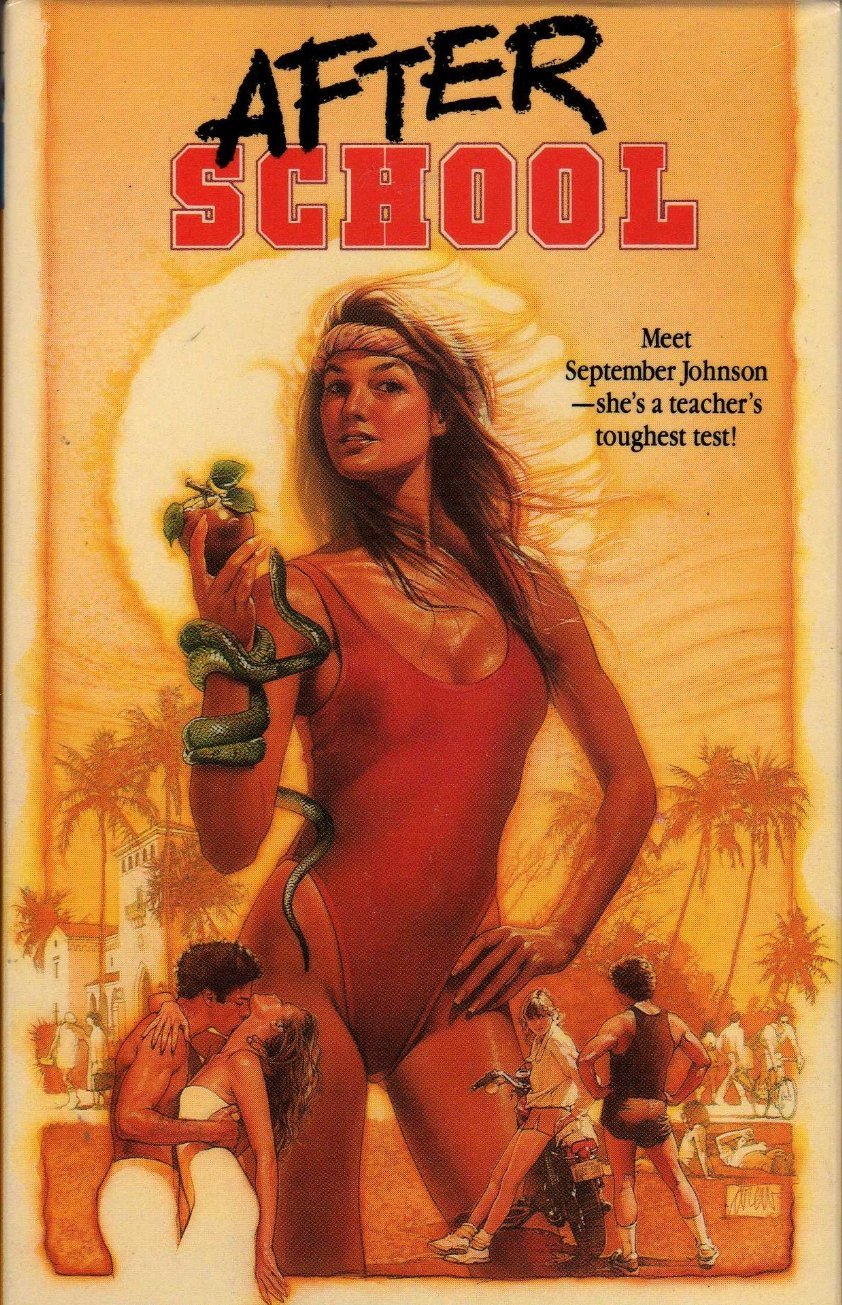
After School (1988, directed by William Olsen)


After School is a strange “what were they thinking?” type of movie.  It’s also probably the only movie to end with a religious debate that’s moderated by Dick Cavett.

Cavett plays himself.  In this film, he still has a talk show and one of his guests is going to be C.A. Thomas (Robert Lansing), a former priest who has written a novel claiming that man created God and not the the other way around.  Cavett has reached out to the Catholic Church to ask them to send someone to represent their views on the show.

For reasons that are never clear, the Church selects Father Michael McClaren (Sam Bottoms), who teaches at a college in Florida.  Father McClaren is youngish and he rides a motorcycle, which the monsignor thinks will appeal to younger viewers of Cavett’s show.  (Did The Dick Cavett Show have younger viewers?)  Because Dick Cavett is legendary for investigating the pasts of all of his guests (that’s what they say in the movie, anyway), another priest is sent down to Florida to make sure that Father McClaren does not have any skeletons in his closet.

At first, Father McClaren seems to be perfect but it turns out that he’s having a crisis of faith.  It’s not just that the local bikers don’t have much respect for a priest, even when who does ride a bike.  It’s also that he’s become attracted to one of his students, the improbably-named September Lane (Renee Coleman).  It doesn’t take the movie long to settle into a familiar pattern of September coming on Father McClaren and then Father McClaren having to run off so that he can pray for strength.

So far After School might sound like a typical movie about a priest being tempted to break his vows.  However, what sets After School apart from other films of its type is that there are frequent scenes featuring a group of cavemen living in prehistoric times.  It’s never really made clear why the cavemen are in the film.  The main caveman yells a lot and there’s a scene with a snake that suggests that he might live in the Garden of Eden.  (The movie was originally released under the title Return to Eden.)  There’s also several naked cavewomen who are in the film so that they can be ogled by the cavemen.  Oddly, the cavepeople scenes are full of broad comedy while the rest of the movie takes itself fairly seriously.

Why are the caveman there and what does it have to do with Dick Cavett?  Who knows?  That’s one of the many unanswered questions to be found in After School.  When C.A. Thomas and Father McClaren do finally meet on the Dick Cavett Show, they debate the origins of mankind.  Neither one has nothing new to say on the subject.  Even though everything that C.A. Thomas says sounds like New Age gobbledygook, Father McClaren proves himself to be incapable of countering him.

I don’t know what the point of After School was.  There were so any scenes, like one in which Father McClaren attends an aerobics class, that didn’t seem to have any purpose.  September’s lust for Father McClaren never makes any sense and his sudden declaration of love makes even less.  Even if you can make sense of all that, there’s still the cavemen and Dick Cavett to deal with.

After School thinks that it is about something but who knows what?

Escape From Mayberry: Savages (1974, directed by Lee H. Katzin)


Ben (Sam Bottoms) is a gullible college student working at a gas station in the Mojave desert.  Horton Madec (Andy Griffith) is a wealthy attorney from Los Angeles who walks with a limp and who fancies himself a big game hunter.  Madec hires Ben to serve as his guide through the desert.  Madec says that he’s hunting a ram but instead, he ends up shooting and killing an old prospector.  Even after Madec offers to pay him off, Ben wants to go to the police.  Madec gives it some thought and decides to hunt Ben himself.
After forcing Ben to strip down to his shorts, Madec sets him loose in the desert.  As Ben tries to make his way back to civilization, Madec follows close behind and uses his rifle not to kill Ben but instead to keep him from drinking water or taking shelter from the sun.

Savages deserves to better known than it is.  The film does a good job of making you feel as if you’re trapped out in the desert with Ben, trying your damndest to survive while some maniac follows close behind, taunting you and refusing to allow you to get any relief.  Horton Madec is pure evil, a maniac who brags about how he can do anything he wants because he has money and he knows people.  That he’s played by Andy Griffith makes him even more dangerous because you know there’s no way anyone would believe that Andy Griffith took you out to the desert tried to kill you.

After playing the folksy and friendly Andy Taylor for nine seasons on The Andy Griffith Show, Griffith tried to leave Mayberry behind by taking on villainous roles in made-for-TV movies like this one and Pray For The Wildcats.  Though he actually started off his film career by playing a villain in A Face In The Crowd, it was still probably a shock for audiences in 1974 to turn on Savages and see Andy Griffith cruelly drinking a martini while another man nearly died of dehydration in front of him.  Griffith goes full psycho in the role of Horton Madec and is totally convincing.  (Of course, audiences preferred the folksy side of Griffith which is why, even after ten years straight of playing bad guys, Griffith still ended up starring in Matlock.)

Even though it’s Griffith’s show, Sam Bottom does okay in the role of Ben.  He has the right look for the character and that’s really all that the part requires.  For the majority of the movie, it’s just Griffith and Bottoms but eventually, James Best shows up as Sheriff Bert Williams.  Five years later, Best would achieve a certain immortality when he was cast as Sheriff Roscoe P. Coltrane on The Dukes of Hazzard.

Savages has never gotten an official DVD release but it can be viewed on YouTube, along with Griffith’s other villainous turn from 1974, Pray for the Wildcats.

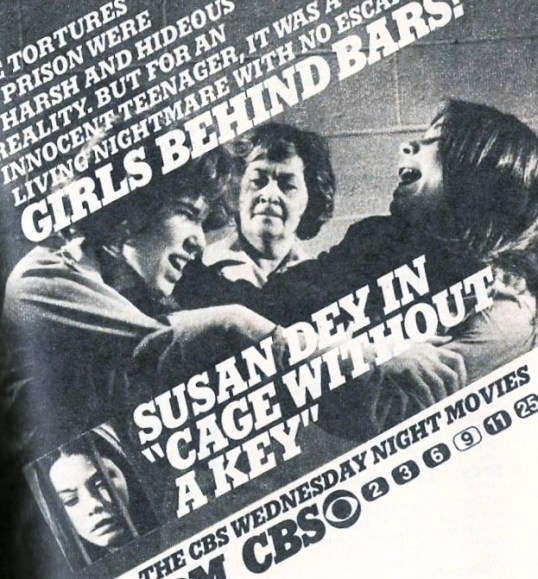
Back to School Part II #7: Cage Without A Key (dir by Buzz Kulik)


Cage-without-a-key_tv-guide-poster

For the fifth film in my Back To School series of reviews, I watched Cage Without A Key, a made-for-TV movie from 1975.

17 year-old Valerie Smith (Susan Dey) would appear to have everything.  She has a loving mother and a loyal best friend.  She just graduated from high school and has been accepted to a good college.  She’s looking forward to going down to San Francisco for the weekend before starting her summer job.  The future look great and, of course, that means that she’s about to make the biggest mistake of her life.

And she’s going to do it 70s style!

When her car breaks down on the way to San Francisco, she makes the mistake of accepting a ride from a long-haired guy in a Volkswagen microbus.  Buddy Goleta (Sam Bottoms, in full 70s weirdo mode) went to high school with Valerie and appears to have a crush on her.  Buddy also appears to be a little bit crazy himself as he tells everyone that he meets that Valerie is “my old lady.”  Finally, Buddy pulls over to a convenience store and kills everyone inside.  Since Valerie’s in the microbus, she gets arrested along with Buddy.  Since Buddy claims that he and Valerie are lovers, she’s convicted of being an accessory and is sentenced to a … REFORM SCHOOL!

(Cue dramatic music.)

The warden — Mrs. Little (Katharine Helmond) — insists that she’s not running a prison.  Instead, she’s running a very progressive school where the students all happen to be thieves and murderers.  The school even has pleasant euphemisms for all the standard prison film elements.  For instance, no one is put in solitary confinement.  Instead, they’re sent to meditation.

Anyway, while Valerie waits for her dedicated public defender (David Brandon) to prove her innocence and get her out of reform school, she finds herself being approached by the various gangs who run the school.  Valerie says she doesn’t want anything to do with any of that.  She just wants to fly under the radar until she’s set free.  But then she’s approached by a predatory lesbian and, as we all known from watching other prison films, nothing will make you join a gang faster than being approached by a predatory lesbian…

Okay, Cage Without A Key is not exactly Orange Is The New Black.  What it is, however, is a time capsule of the time it was made.  Everything from the slang to the clothes to the attitudes to the squishy, upper class liberalism of Valerie’s lawyer practically screams 1970s.

Add to that, classic film lovers will appreciate the fact that the evil gang leader is named Suzy Kurosawa!

Incidentally, Cage Without A Key was written by Joanna Lee, who readers of this site will probably best remember for playing one of the alien invaders in Plan 9 From Outer Space.

http://www.youtube.com/watch?v=8jU37bRN5t0

Embracing the Melodrama Part II #66: Desperate Lives (dir by Robert Michael Lewis)


DL-cov2YouTube, my old friend, you have failed me.

For the longest time, the 1982 anti-drug melodrama Desperate Lives has been available for viewing on YouTube.  I first watched it two years ago, after I read an online article about a scene in which a teenage Helen Hunt takes PCP and jumps through a window.  And, when I watched it, I was stunned.  I knew that the film was going to be over-the-top and silly, largely because it’s hard to imagine how a film featuring a teenage Helen Hunt taking PCP could be anything other than that.  But, even with my experience of watching over the top message movies, nothing could have quite prepared me for Desperate Lives.

So, I figured, for this review, that I’d say a few snarky words about Desperate Lives and then I’d just add something like, “And you can watch it below!”  And then I would embed the entire movie and all of y’all could just click on play and watch a movie on the Lens.

Unfortunately, Desperate Lives has been taken off of YouTube.  I assume the upload violated some sort of copyright thing.  And really, it’s kinda stupid because seriously, Desperate Lives is one of those films that really deserves to be seen for free on YouTube.

Oh well.  You can still watch a video of Helen Hunt jumping through that window.  The video below also features some additional elements from Desperate Lives.

For instance, you get to see Diana Scarwid playing the angriest high school guidance counselor in the world.  Scarwid knows that students like Helen Hunt are using drugs and that her fellow faculty members are turning a blind eye to everything’s that’s happening.  From the minute she first appears on screen, Scarwid is shouting at someone and she doesn’t stop screaming until the film ends.

And you also get to see Doug McKeon, playing Helen Hunt’s brother.  McKeon goes for a drive with his girlfriend, who has just taken PCP herself.  As their car goes flying off a mountain, she says, “Wheeee!”

In the video below, you also get to see that the only reason Helen Hunt used drugs was because her boyfriend begged her to.  That’s a scenario that seems to show up in a lot of high school drug films and it’s strange because it’s something that I’ve never actually seen happen or heard about happening in real life.  In fact, in real life, most users of hard drugs are actually very happy to not share their supply.

Unfortunately, the video below does not feature any scenes of Sam Bottoms as the world’s most charming drug dealer and that’s a shame because he gives the only good performance in the entire film (sorry, Helen!).

Even worse, the video doesn’t include any scenes from the film’s memorably insane conclusion, in which Scarwid searches every single locker in the school and then interrupts a pep rally so she can set everyone’s stash on fire in the middle of the gym.  Making it even better is that all the students are so moved by Scarwid’s final speech that they start tossing all of the drugs that they have on them into the fire.

Which means that the film essentially ends with the entire school getting high off of a huge marijuana bonfire.

No, that scene cannot be found in the video below.  But you can find Helen Hunt jumping through a window so enjoy.

http://www.youtube.com/watch?v=rEpyLzHeozY

Back To School #11: The Last Picture Show (dir by Peter Bogdanovich)


Monday is the first day of school down here in Dallas so it seems only appropriate that this latest entry in our Back to School series should be a look at one of those most quintessential Texas films ever made, the 1971 best picture nominee, The Last Picture Show.

http://www.youtube.com/watch?v=3YQomR5xJ_Y

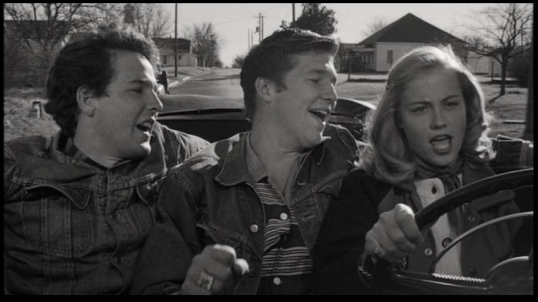
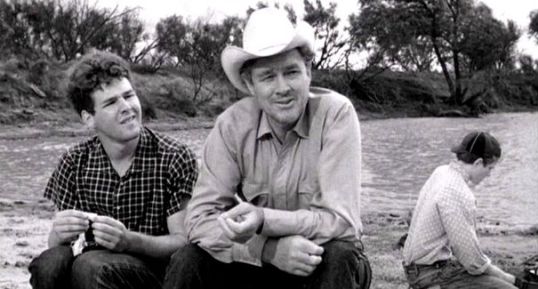
Directed by Peter Bogdanovich and based on a novel by Larry McMurtry, The Last Picture Show takes place in 1951 and tells the story of two high school seniors, best friends Sonny Crawford (Timothy Bottoms) and Duane Jackson (Jeff Bridges, reminding us once again why everbody loves him).  Sonny and Duane live in the rural town of Anarene, Texas.  With little to look forward to in the future, beyond perhaps getting a job working in the oil fields, Sonny and Duane are both intent on enjoying their final year of high school.  Sometimes, that means driving down to Mexico for the weekend.  Sometimes, it means going to the only theater in town and seeing a movie.  Most of the time, however, it means hanging out in a pool hall owned by the strict but fatherly Sam (Oscar winner Ben Johnson).  Often times they are accompanied by the intellectually disabled Billy (Sam Bottoms), who responds to everything with a blank smile and spends most of his spare time wandering around with a broom, futilely trying to sweep the dusty streets.

last-picture-show

The charismatic and impetuous Sonny is dating the beautiful and self-centered Jacy Farrow (Cybil Shepherd), who is the daughter of the wealthiest woman in town.  Jacy knows that her cynical mother (Ellen Burstyn) is having an affair with an oil worker named Abilene (Clu Gulager) but she’s more concerned with her own future.  Even though she’s dating Sonny, Jacy still accepts an invitation from the awkward Lester Marlow (played by a memorably goofy Randy Quaid) to attend a naked indoor pool party.  At the party, she meets Bobby Sheen (Gary Brockette), who is rich and will be able to provide her with the future that Duane never will.  However, Bobby tells Jacy that he isn’t interested in her because she’s a virgin.  If nothing else, this gives Jacy a reason to stay with Duane, at least until after they have sex.

Meanwhile, the far more sensitive Sonny ends up having an affair with Ruth Popper (Cloris Leachman, who won an Oscar for her performance in this film), the wife of the high school football coach.  It appears that Sonny truly cares about Ruth but then he finds himself being tempted by none other than his best friend’s girlfriend…

Sonny and Ruth

At heart, The Last Picture Show really is basically a small town soap opera, a Texas version of Peyton Place.  The difference between the two films — beyond the fact that The Last Picture Show just happens to be a 1oo times better than Peyton Place — is that The Last Picture Show doesn’t take place in a beautiful, idealized small town.  Instead, the town of Anarene is a believably bleak location, one that will be familiar to anyone who, like me, grew up in the American southwest.  A good deal of the success of The Last Picture Show is due to the fact that it was actually filmed on location in Archer City, Texas.

(Nothing annoys me more than when I see the mountains of California in the background of a movie that’s supposed to be taking place in North Texas.  We don’t have mountains up here.  For the most part, we don’t even have hills.  The land is flat.  You can see forever, if you know where to look.)

Of course, you can’t talk about The Last Picture Show without talking about Robert Surtees’s stunning black-and-white cinematography.  Not only does the black-and-white remind us that this is a film about a fading way of life but it drives home the fact that Sonny and Duane don’t have much to look forward to.  Growing up in Anarene means they are destined for lives without color or excitement.  In the end, can you really blame them for occasionally acting before they think?

Ben Johnson

Ultimately, the success of The Last Picture Show is due to a lot of things.  This was Peter Bogdanovich’s second film as a director and he did such an excellent job here that he’s basically spent the rest of his career trying to live up to this one film.  (That said, Bodganovich also left his wife for Cybill Shepherd — despite the fact that his wife was the one who suggested that he make this film and cast Cybill in the first place!  Don’t worry though — Polly Platt got her revenge by having a far more successful career than her ex-husband and she even produced Say Anything, a film that we will soon be looking at.)  The screenplay, by McMurtry and Bogdanovich, is full of sharp dialogue and memorable characters.  As for the performers, this is probably one of the best acted films ever made.  Jeff Bridges and Timothy Bottoms play off each other well, Cybill Shepherd is the epitome of casual destructiveness, and Ben Johnson is brilliantly cast as the film’s moral center.  My favorite performance comes from Ellen Burstyn, who delivers every line with just the right combination of contempt and ennui.

Ellen Burstyn in The Last Picture Show

Ellen Burstyn in The Last Picture Show

If you’re a Texan, The Last Picture Show is one of those films that you simply have to see.  And if you don’t enjoy it and if you don’t relate to at least a few of the characters (I related to Jacy, though I like to think that I’m a lot nicer in the way I treat people), then you’re not a real Texan.

It’s as simple as that.

the-last-picture-show-poster