Film Review: Any Which Way You Can (dir by Buddy Van Horn)


In this 1980 sequel to Every Which Way But Loose, Philo and his orangutan Clyde are still living next door to Orville (Geoffrey Lewis) and his mother (Ruth Gordon).  Philo is still working as a truck driver but he’s becoming far better known as a bare-knuckles brawler.  In fact, when another famous fighter named Jack Wilson (William Smith), moves to the area, everyone assumes that Jack wants to challenge Philo.  It turns out that Jack’s actually a pretty nice guy.  He and Philo become jogging buddies.

Remember Lynn Halsey-Taylor (Sondra Locke), the extremely self-centered singer who broke Philo’s heart in the first film?  Well, she’s back and she’s changed her ways.  When she and Philo meet in a bar, Lynn apologizes to him for her past behavior and soon, she and Philo are a couple again.  Booo!  Seriously, Eastwood and Locke somehow have even less chemistry here than they did in the first film.  (Again, Locke and Eastwood were in a relationship at the time, which makes their total lack of chemistry even more interesting to consider.)  Everyone in the film is surprisingly forgiving of Lynn, considering that she was portrayed as being nearly sociopathic in the previous film.  Even Clyde seems to be happy to have her back.  Of course, Clyde gets to have a romance of his own, with another orangutan.  Clyde has sex with his partner while Philo and Lynne fool around in the room next door.  It’s …. kind of weird.

Anyway, the Mafia really wants Philo and Jack to fight so they decide to kidnap Lynn in order to force the fight to happen.  Instead, Jack and Philo team up to rescue Lynn and to put those gangsters in their place.  That might sound dramatic but this film is very much a redneck comedy so these are probably the least intimidating mafia soldier that I’ve ever seen.  Just as the previous film’s outlaw bikers (and they also make a return appearance in this film) were too buffoonish to be truly menacing, the same is true of the Mafia in this film.

In the end, Philo and Jack do have a fight but it’s under their own terms and, afterwards, they accompany each other to the hospital.  It’s kind of a nice moment, really.  Even after beating the hell out of each other and causing more than a few broken bones, Philo and Jack are still friends.  It’s a nice touch that Jack was played by William Smith, who was a bit of a low-budget version of Clint Eastwood.

Indeed, with Geoffrey Lewis relegated to a supporting role and Sondra Locke abducted by the mafia, the friendship between Philo and Jack becomes the heart of the film and if there is really anything that makes this film memorable, it’s the scenes that Eastwood shares with William Smith.  These two tough guys actors seem to have a natural understanding of each other and their friendship and mutual respect feels real.  They may fight but it’s only out respect for each other.  It’s a shame that Eastwood and Smith didn’t team up for more films.

Any Which Way You Can is an amiable comedy.  It’s not as much fun as Every Which Way But Loose.  Beverly D’Angelo’s Echo is missed but she was presumably busy filming Coal Miner’s Daughter at the time.  The film works best as a buddy movie.  Clint Eastwood, William Smith, Geoffrey Lewis, and an orangutan.  What a team!

Film Review: Every Which Way But Loose (dir by James Fargo)


In 1978’s Every Which Way But Loose, Clint Eastwood plays Philo Beddoe.

Philo’s an ordinary guy with beautiful hair and a way with throwing punches.  He’s a truck driver.  He enjoys a cold beer.  He enjoys country music.  He makes some extra money by taking part in bare-knuckle brawls.  Everyone says that he could be the next Tank Murdock, a legendary fighter.  Philo is just a simple, blue collar guy who lives in a small house, next door to his best friend Orville (Geoffrey Lewis) and Orville’s profanity-loving mother (Ruth Gordon).  Philo also owns an orangutan named Clyde.  He saved Clyde from being sent to live in a “desert zoo.”

(Actually, now that I think about it, most blue collar guys don’t own monkeys but whatever.  Clyde’s cute and Eastwood’s Eastwood.)

When Philo meets a country singer named Lynn Halsey-Taylor (Sondra Locke), he is immediately smitten.  When Lynn disappears and leaves Philo a cryptic note, Philo decides to go looking for her.  Clyde, Orville, and Philo hit the road.  Along the way, Orville meets and picks up a woman named Echo (Beverly D’Angelo).  This is a road movie so, of course, Clyde, Orville, Philo, and Echo have their adventures on the way to Colorado.  They end running afoul both a corrupt cop and a gang of buffoonish bikers.  Philo enters a fight whenever they need money and one occasionally gets the feeling that Eastwood took this role to show off the fact that, for someone approaching 50, he still looked good without a shirt on.  And good for him!  Because, seriously, Clint does look good in this movie….

I have to admit that, for all of my attempts at sophistication, my roots are in the country and I’ve traveled down enough dirt roads that I find it hard to resist a good redneck story.  And really, there aren’t many films that as proudly and unashamedly redneck than Every Which Way But Loose.  It’s a film that has a laid back, take-it-as-it-comes vibe to it.  Philo may be looking for Lynn but he seems to be okay with taking a few detour along the way.  There’s no real sense of urgency to any part of the movie.  Instead, Every Which Way But Loose was made for people who like a cold beer at the end of the day and who find Ruth Gordon to be hilarious when she curses.  Myself, I don’t drink.  That’s one part of the country lifestyle that passed me over.  But I did enjoy seeing Ruth Gordon cuss out the Nazi biker gang.

Eastwood, Lewis, and D’Angelo have a likable chemistry and the monkey’s cute.  Unfortunately, Sondra Locke isn’t particularly well-cast in the role of Lynn.  (Considering that she was in a relationship with Eastwood, it’s amazing how little chemistry they have in this movie.)  As I watched the film, it occurred to me that it probably would have worked better if Locke and D’Angelo had switched roles.  Locke’s character is supposed to be a femme fatale type but she gives a boring performance and, as a result, the revelation that Philo has misjudged her doesn’t really carry any emotional weight.

That said, this film features some beautiful shots of the wilderness, a charming romance between Lewis and D’Angelo, and a shirtless Clint Eastwood beating folks up.  That’s more than enough to please this secret country girl.

Retro Television Reviews: The Love Boat 1.6 “The Joker Is Mild / Take My Granddaughter, Please / First Time Out”


Welcome to Retro Television Reviews, a feature where we review some of our favorite and least favorite shows of the past!  On Wednesdays, I will be reviewing the original Love Boat, which aired on ABC from 1977 to 1986!  The series can be streamed on Paramount Plus!

Come aboard, we’re expecting you….

The Love Boat 1.5 “The Joker Is Mild / Take My Granddaughter, Please / First Time Out”

(Dir by Richard Kinon and Alan Rafkin, originally aired on October 29th, 1977)

This week’s cruise is all about remaining true to yourself!

For instance, Julie makes what appears to be a big mistake when she agrees to let a washed-up comic named Barry Keys (Phil Foster) do a show in the ship’s lounge.  Throughout the cruise, Barry gets on everyone’s nerves with his old-fashioned jokes and his vaudeville stylings.  Captain Stubing gives Julie an annoyed look whenever Barry starts to speak.  Julie knows that her career is on the line but she made a promise.  And Barry, it turns out, know what he’s doing.  When it comes time for his performance, he asks for a stool so that he can sit in the middle of the stage and talk about the generation gap.  (“Let’s rap, as the kids say,” Barry says.)  Hooray!  Barry has revived his career and Julie still has a job.

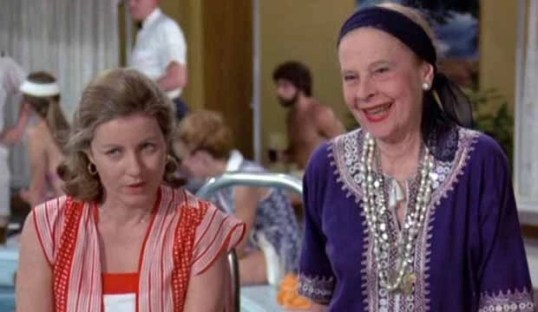
Meanwhile, Mrs. Warner (Ruth Gordon) is determined to find a husband for her granddaughter, Shirley (Patty Duke, who spends the entire episode looking as if she’s wondering how she could go from winning an Oscar to this).  Shirley would like to hook up with the pleasantly bland Dave King (played by Tab Hunter).  Mrs. Warner wants her to go out with Dr. Bricker!  In the end, Shirley stands up for herself, as any single 30 year-old should.  (To be honest, I thought Patty Duke’s character was closer to 40 but that’s mostly the fault of whoever in the costume department decided to make her wear some of the least flattering outfits available.)  It’s all for the best.  Dave is a nice guy and Doc has an exam room full of pornographic magazines to take care of.

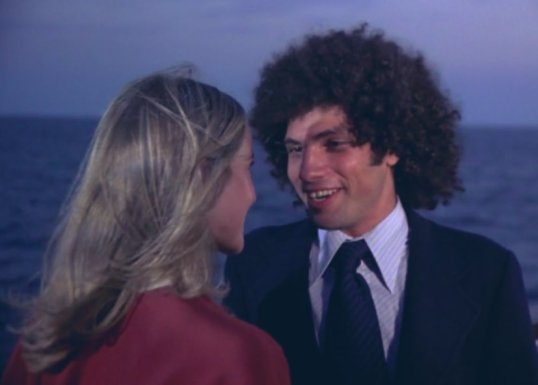
Finally, a group of college students board the ship with one mission in mind.  They want their friend Dan (Robert Hegyes, who has a truly impressive head of hair) to lose his virginity.  Dan, it turns out, is not only shy but he also has no idea how to talk to women.  Fortunately, her runs into Marcia Brady (Maureen McCormick) and it turns out that Marica likes shy, socially awkward guys with a lot of hair.  Okay, technically Maureen is playing Barbara Holmes but seriously, we all know that Barbara was actually Marcia.

This was a majorly uneven episode.  Barry’s revised act didn’t seem any funnier than his old stuff and it was kind of hard to sympathize with Shirley and her inability to make her own decisions.  That said, Maureen McCormick and Robert Hegyes made for a cute couple and their storyline was the most satisfying of the episode.  Personally, I think this episode would have worked better if Ruth Gordon had played Maureen McCormick’s grandmother as opposed to Patty Duke’s.  McCormick was young enough that it would have been a bit less pathetic for her to be bossed around by her grandmother and one can imagine how Ruth Gordon would have reacted to McCormick picking hairy Dan over a doctor.

Oh well!  The important thing is that everything worked out in the end and love won’t hurt anymore.

A Movie A Day #114: Scavenger Hunt (1979, directed by Michael Schultz)


When game designer Milton Parker (Vincent Price) dies, all of his greedy relatives and his servants gather for the reading of his will.  Parker’s lawyer, Benstein (Robert Morley), explains that Parker is leaving behind a $200 million dollar estate to whoever can win an elaborate scavenger hunt.  Dividing into five teams, the beneficiaries head out to track down as many items as they can by five o’clock that evening.  Among the items that they have to find: a toilet, a cash register, an ostrich, a microscope, and an obese person.  Hardy har har.
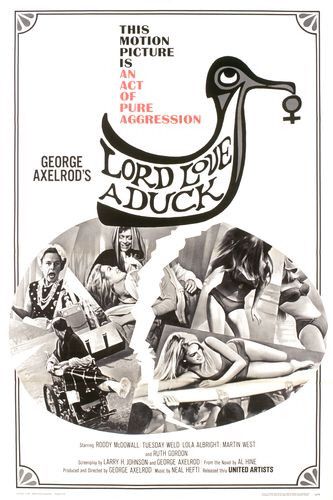
The five teams are made up of a who’s who of sitcom and television actors who had time to kill in 1979.  The Odd Couple‘s Tony Randall is Henry Motely, who is Parker’s son-in-law and who works with his four children.  Soap‘s Richard Mulligan plays a blue-collar taxi driver named Marvin Dummitz (because funny names are funny) who teams up with his friend, Merle (Stephen Furst).  The Mary Tyler Moore Show‘s Cloris Leachman (an Oscar winner, no less) gets stuck with the role of Milton’s greedy sister, Mildred.  She works with her conniving lawyer (Richard Benjamin) and her stupid son (Richard Masur).  Maureen Teefy plays Milton’s niece while his nephews are played by Willie Aames and Dirk Benedict.  Cleavon Little, James Coco, Roddy McDowall, and Stephanie Faracy play the servants.

It doesn’t stop there, though.  Avery Schreiber plays a zookeeper.  Meat Loaf plays a biker who beats up Richard Benjamin.  Ruth Gordon, Stuart Pankin, Pat McCormick, and Scatman Crothers all have cameos.  Even Arnold Schwarzenegger makes an appearance as a gym instructor who knocks Tony Randall out of a second story window.

There are a lot of famous people in Scavenger Hunt.  It’s just too bad that the movie itself is barely watchable and not at all funny.  It tries to go for the zaniness of It’s A Mad, Mad, Mad, Mad World but, unless watching Willie Aames steal a clown head from Jack in the Box is your idea of hilarity, the film never comes close to succeeding.  Michael Schultz directed some classic films (like Car Wash) during the 1970s but, unfortunately, he also directed Sgt. Pepper’s Lonely Hearts Club Band and this.

Scavenger Hunt used to show up on a late night television, where it was always advertised as starring Arnold Schwarzenegger.  (He barely has five minutes of screentime.)  It was released on DVD/Blu-ray earlier this year but watching for the cameos is the only reason to take part in this Scavenger Hunt.

Back To School Part II #3: Lord Love A Duck (dir by George Axelrod)


Lordloveaduck

For my third Back to School review, I watched the 1966 satire, Lord Love A Duck!

Hey hey hey!

I have to admit that, because I’m writing this review in a hurry and because the D and the F key are located right next to each other, I keep accidentally calling this film Lord Love A Fuck.  Somehow, that seems appropriate because Lord Love A Duck is a very odd and subversive little movie that deals with people who are largely motivated by lust and I’m pretty sure that, at one point, Roddy McDowall is seen saying, “Fuck off!” but, of course, we don’t actually hear him say it.  But seriously, Lord Love A Duck is a weird movie.

Hey hey hey!

Roddy McDowall plays Alan Musgrave, a student at a “progressive” high school in California.  Roddy was about 37 years old when he played a high school senior and he doesn’t look like a teenager at all but somehow, it’s appropriate.  After all, Alan is no ordinary teenager!  He’s smarter than everyone else.  He’s wittier than everyone else.  He’s more clever than everyone else.  He’s also totally obsessive and willing to do just about anything to get what he wants.  And you can be sure of one thing: whenever Alan does something borderline insane, you’ll hear a group of singers harmonizing, “Hey hey hey!” in the background.

Hey hey hey!

See, it’s happening already.  It doesn’t matter what Alan’s doing.  He could be kicking a skateboard in the way of a romantic rival.  He could be interrupting the graduation ceremony with a tractor.  He could be going to prison for life.  No matter what it is, it will always be accompanied by:

Hey hey hey!

Anyway, Alan is in love with the innocent, sweet, and constantly flirtatious Barbara Anne Greene (Tuesday Weld).  In fact, almost everyone in the film is in love with (or, at the very least, turned on by) Barbara.  The only person who doesn’t seem to be in love with Barbara is her mother (Lola Albright), a former-beauty-turned-cocktail-waitress whose world-weary cynicism seems to offer a depressing hint of what’s in store for Barbara once she gets older.

Hey hey hey!

But everyone else loves Barbara.  Especially Alan!  In fact, Alan is so in love with her that he swears that he’s going to make sure that she gets everything that she wants.  When she needs 12 cashmere sweaters so that she can join an exclusive girl’s club, Alan helps her to convince her father (Max Showalter) to pay for them.  When Barbara needs a job after dropping out of school, Alan helps her get one as a secretary for the high school’s progressive principal (Harvey Korman).  When Barbara decides she wants to marry the boring but respectable Christian youth leader, Bob (Martin West), Alan keeps Bob’s mother (Ruth Gordon) so drunk that she doesn’t get a chance to reprimand her son for falling in love with a girl from a divorced family.  (As Bob’s mother explains it, she doesn’t believe in divorce.  “We don’t leave our husbands.  We bury them.”)  Eventually, a movie producer decides that he wants Barbara to star in his beach films but Bob says no.  No wife of his is going to be a movie star!  So, of course, Alan decides to murder Bob so that Barbara can again have what she wants…

Hey hey hey!

Lord Love A Duck is a manic comedy that satirizes everything that mainstream audiences in 1966 would have held sacred.  Teenagers, conservatives, liberals, love, hate, murder, justice, marriage, divorce, morality, sex, religion, television, movies — it’s all thoroughly ridiculed in this film.  (It’s not surprising that the film’s director also wrote the script for The Manchurian Candidate, a satire disguised as a thriller.)  To be honest, it’s probably a little bit too manic for its own good.  At times, the film run the risk of becoming exhausting.  But then there’s even more times when the film is absolutely brilliant.

Hey hey hey!

Speaking of absolutely brilliant, Lord Love A Duck makes brilliant use of Roddy McDowall’s eccentric screen presence but, even better, it features one of Tuesday Weld’s best performances.  Weld was a talented actress whose performances often revealed that a fragile soul is often the price that is payed for great beauty.  (There’s no greater insecurity than wondering whether people are responding to who you are or to how you look.  Would you still care if I was ugly is not a question we’re supposed to ask but it’s one that we’ve all wondered.)  It would have been far too easy to make Barbara either totally innocent or totally manipulative.  Wisely, the film does neither.  Barbara may occasionally be manipulative but she always means well.  It’s not her fault that everyone around her is either idiotic or insane.

Hey hey hey!

Though Lord Love A Duck is obviously a time capsule of the culture of mid-60s, it’s also a film that remains relevant even today.  Culturally, we’re still obsessed with fame, youth, and beauty.  In many ways, the satire of Lord Love A Duck still feels more extreme that anything that any contemporary filmmaker would dare to attempt.  I can only imagine what audiences in 1966 thought as they watched this subversive teen film.

Hey hey hey!

Horror on The Lens: Don’t Go To Sleep (dir by Richard Lang)


For today’s horror on the lens, we present Don’t Go To Sleep!

In this TV movie from 1982, a little girl is killed in a horrific car crash.  Her family blames themselves for her death and they really should.  The father (Dennis Weaver) was drunk.  The mother (Valerie Harper) didn’t keep her drunk husband from driving.  Finally, the girl’s brother (Oliver Robins) and sister (Robin Ignico) were playing a prank on her when the car crashed.  By tying her shoe laces together, they made it impossible for her to get out of the car.

However, they’re not the only ones who blame themselves.  The dead girl blames them as well.  When the family moves out to the country and attempts to heal, the girl’s ghost goes with them.  And soon, she is encouraging her sister to kill the other members of the family.

And that’s just what happens.

Seriously, this movie took me by surprise.  For a movie that made for network television in 1982, it’s a surprisingly dark film that doesn’t shy away from graphically killing off most of the cast.  It’s a surprisingly effective little film and you can watch it below!

(Thank you to my wonderful cousin, Toni Posados, for recommending this film!)

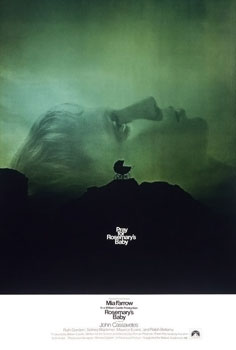
Horror Film Review: Rosemary’s Baby (dir by Roman Polanski)


Rosemarys_baby_poster

“This is no dream!  This is really happening!”

— Rosemary Woodhouse (Mia Farrow) in Rosemary’s Baby (1968)

Yes, Rosemary, it is.

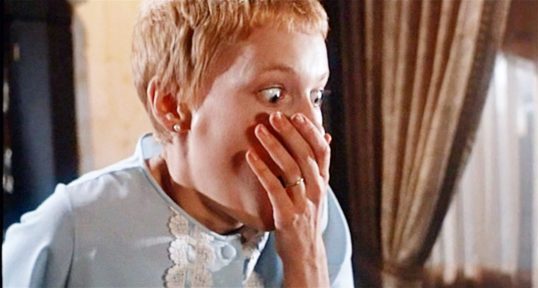
The classic 1968 horror movie Rosemary’s Baby is probably best remembered for a lengthy and wonderfully surreal “dream” sequence in which naive newlywed Rosemary Woodhouse (Mia Farrow) is raped by the Devil while a bunch of naked old people stand around her and chant.  At one point, she sees her husband, Guy (John Cassavetes), saying that she’s awake and that she knows what’s going on.  Their neighbor, Minnie Castevet (Ruth Gordon), tells him that Rosemary can’t hear anything and that it’s like she’s dead and then snaps at him, “Now, sing!”  It’s a great sequence, one of the greatest of Roman Polanski’s career, a perfect blending of horror and dark comedy.

For me, the most interesting part of that dream sequence comes at the start.  Rosemary envisions herself naked on a boat and, as she tries to cover herself, who is sitting next to her?  None other than John F. Kennedy!  Suddenly, Rosemary is wearing a bikini and she’s relaxing out on the deck with a glamorous group of people who I assume were meant to be Kennedy relatives.  As the boat leaves the dock, Rosemary sees that her friend and protector, Hutch (Maurice Evans), is standing on the dock.

“Isn’t Hutch coming with us?” Rosemary asks.

“Catholics only,” John F. Kennedy hisses in that famous accent, “I’m afraid we are bound by these prejudices.”

“I understand,” a dazed Rosemary replies.

And it’s a wonderful little moment, though I have to wonder if I’d react as strong if my own background wasn’t Irish Catholic.  But still, there’s something so wonderfully subversive about a bunch of elderly Satanists pretending to be the Kennedys.

And really, Rosemary’s Baby is a wonderfully subversive film.  I imagine it was even more subversive when it was first released back in 1968.  It’s been ripped off and imitated so many times that it has undoubtedly lost some of its impact.  (That’s one reason why I wish I had a time machine, so I could go back in the past and see it was truly like to see a classic film for the first time.)  But still, 47 years after it was initially released, Rosemary’s Baby is still a surprisingly effective horror film.

The film opens with newlyweds Rosemary and Guy moving into the Bramford, an exclusive New York apartment building.  Guy is an actor who, despite having appeared in two off-Broadway shows (one of which was entitled Nobody Likes An Albatross and really, that is so true) and a few motorcycle commercials, is still waiting for his big break.  There are hints that, before she married Guy, Rosemary had a very active and interesting life (when we briefly meet her old friends, they all seem to be a lot more exciting than boring old Guy) but, when we meet her, Rosemary appears to have happily settled into a life of domesticity.

Life at the Bramford is strange.  For one thing, Guy and Rosemary appear to be the only young people living in the entire building.  (There is a young woman named Terry but she ends up jumping out of a window.)  The Woodhouses befriend elderly Minnie Castevet and her husband, Roman (Sidney Blackmer.)  Roman claims to have traveled all over the world and embarrasses the Catholic Rosemary by criticizing the Pope.  Minnie, meanwhile, is the noisiest person in the world.  Guy makes fun of both of them and, yet, he still decides to spend his free time with Roman.

One day, Guy gets a role that he had previously lost.  Why?  Because another actor is struck by a sudden case of blindness.  Shortly afterward, Rosemary has her “dream.”  She wakes up and discovers that her body is covered with red scratches.  Guy claims that he had sex with her while she was asleep and promises to cut his fingernails.

Soon, Rosemary is pregnant but the Castevets insist that she use their doctor, the firm and sinister Dr. Saperstein (Ralph Bellamy, who just 8 year earlier had played FDR in Sunrise at Campobello).  Rosemary knows that something is wrong with the baby but she can’t get anyone to listen to her.  It all leads to one of the best and most iconic endings in the history of horror cinema.

Rosemary’s Baby is a classic of fear and paranoia and it holds up surprisingly well.  See it this October, whether you’re Catholic or not.

(However, do not see the needless 2014 remake.  Seriously, what the Hell was up with that?)

http://www.youtube.com/watch?v=PewtQsgN5uo

(By the way, is anyone else amazed that I made it through this entire review without making a single joke about either Ronan Farrow or Mia’s lame Sharknado live tweet?  I am shocked.)