Since Sunday is a day of rest for a lot of people, I present #SundayShorts, a weekly mini review of a movie I’ve recently watched.
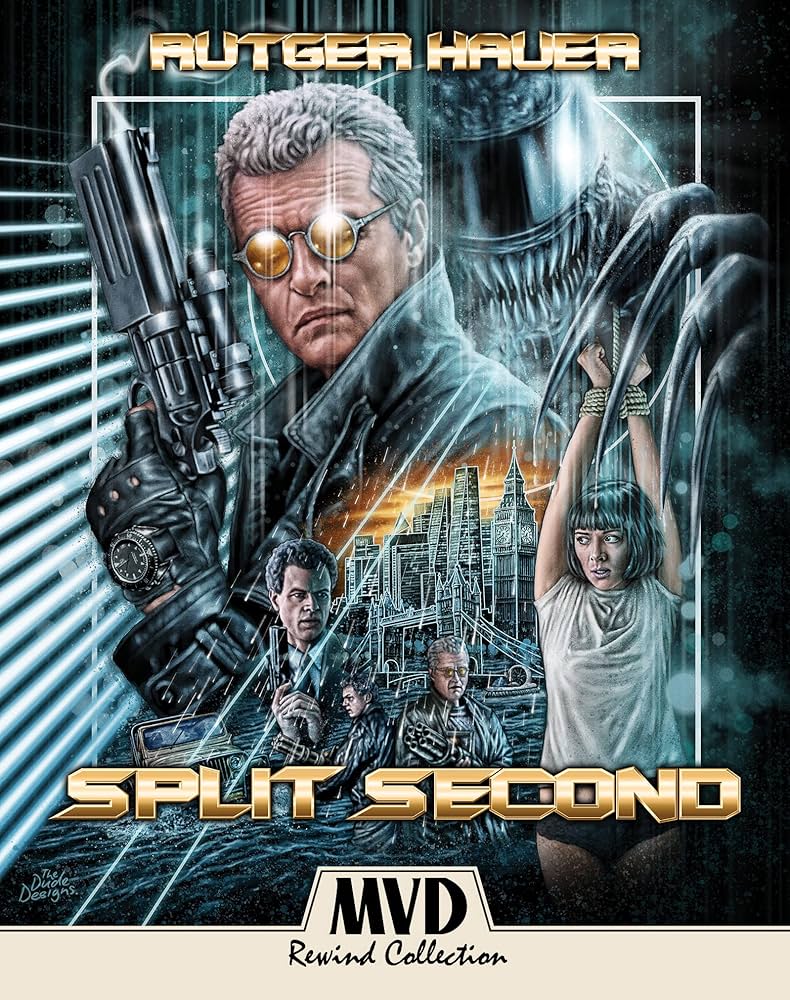
Rutger Hauer chews the scenery in grand style as a badass London cop on the trail of a serial killer who rips the hearts out of the chest of its victims, is about 10 feet tall, and whose teeth appear to be that of a beastly monster. SPLIT SECOND is a fun mishmash of genres….part action, part horror, part comedy, and all entertainment! It’s especially enjoyable for fans of Hauer like me. It’s currently streaming on Amazon Prime, Pluto and Tubi.
Fast Facts:
I saw SPLIT SECOND in a movie theater in Conway, Arkansas in 1992. I was the only person in the theater. It’s a fun movie, but it did not perform well at the box office, only earning $5.4 Million on a $7 Million budget.
1992 was a good year for Rutger Hauer. Not only did he star in SPLIT SECOND, he also starred as the head vampire Lothos in the movie version of BUFFY THE VAMPIRE SLAYER. Written by Joss Whedon, Hauer’s co-stars included Kristy Swanson, Luke Perry, Donald Sutherland & Paul Reubens (PeeWee Herman).
Detective Dick Durkin is played by actor Alistair Duncan. When the movie was originally released in 1992, he was credited as Neil Duncan. Whatever his name, Mr. Duncan is absolutely hilarious in the film. His reaction when he first sees the creature is so good… “We need to get bigger guns. BIG F’ING GUNS!”
The original script took place in Los Angeles and involved a ritualistic serial killer who murders five people every five years during the last quarter-century. The producers decided the script needed to be changed because the story was too similar to a film called THE FIRST POWER starring Lou Diamond Phillips. The script that was ultimately used for the movie was set in London, which was half under water due to global warming.
If you like Kim Cattrall from SEX AND THE CITY, she’s in this. My wife thought that was interesting.
Since Sunday is a day of rest for a lot of people, I’m introducing #SundayShorts, a weekly mini review about a movie I’ve recently watched.
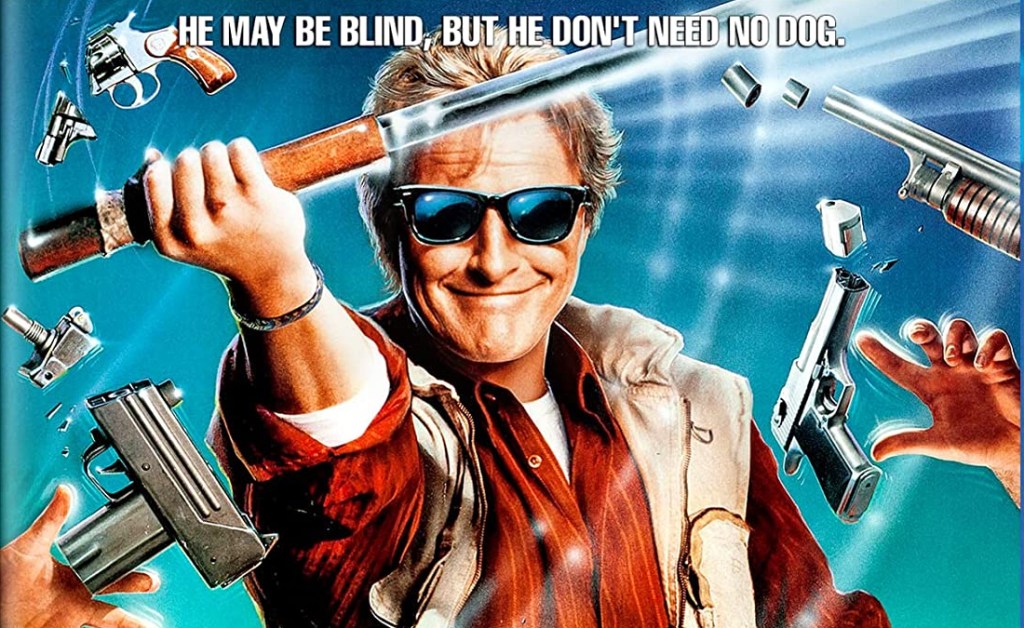
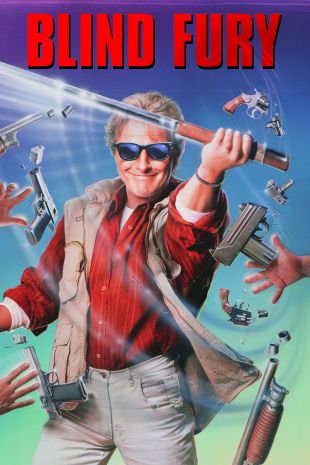
In BLIND FURY, Rutger Hauer does his best Zatoichi impersonation in a loose remake of a 1967 Japanese film called ZATOICHI CHALLENGED. The movie’s strongest quality is its ability to be both a kickass action film and a comic action film. That’s a fine line to walk and BLIND FURY does it exceedingly well.
Fast Facts:
Star Rutger Hauer is probably the greatest Dutch actor of all time where he often starred in the films of director Paul Verhoeven. My favorite of Hauer’s foreign movies is SOLDIER OF ORANGE.
ZATOICHI CHALLENGED, the inspiration for BLIND FURY, stars legendary Japanese actor Shintaro Katsu as a blind masseuse named Zatoichi. Katsu would play this amazing character in 26 films and 100 TV episodes between 1962 and 1989. You owe it to yourself to search out these films.
Former heavyweight boxer Randall “Tex” Cobb plays a heavy in BLIND FURY. In his time, he beat Leon Spinx and went the distance with Larry Holmes.
Australian director Phillip Noyce directed BLIND FURY. He’s an underrated director whose other credits include DEAD CALM, PATRIOT GAMES, and THE BONE COLLECTOR.
At the start of 2011’s The Reverend, the Devil (Rutger Hauer) pulls up in front of a luxurious hotel. He gets out of his limo, enters the hotel, and finds God (Giovanni Lombardo Radice) sitting at his desk, surrounded by armed priests.
God asks the Devil what he’s been doing. The Devil says he’s been traveling the world and tempting men to do evil. The Devil says that he wants permission to ruin the life of one man who is virtuous and God-fearing, saying that the man will reject his faith as things get worse and worse. God agrees, as long as the man is not killed….
Does this sound familiar? Yep, this is yet another adaptation of the Book of Job. Or, I should say, this film pretends to be an adaptation of the Book of Job. The nameless Reverend (Stuart Brennan) is a God-fearing man whose life goes downhill after he’s bitten by a vampire. That said, there’s really not much of a comparison to be made between the Reverend and Job. Job lost everything, including his land and his family and the majority of his friends. The Reverend doesn’t really have any friends to lose and he actually gets better at his job after he is turned into a vampire and proceeds to take out his village’s criminal element.
In fact, the entire prologue between God and the Devil feels as if it was tacked on at the last minute. It really doesn’t connect to the rest of the film and we certainly don’t learn whether it was God or the Devil who won the bet. Hauer and Radice only appear in that one scene and then they are never heard from again. That’s a shame because, to be honest, the only reason I watched this movie was for the chance to see Hauer and Radice together. They were both incredible character actors and tragically, both of them are no longer with us. Hauer passed away in 2019 and Radice died last year. Neither one of them looks particularly healthy in the prologue, though it is nice to see the two of them sharing the screen together, albeit for just a few minutes.
As for the rest of the film, it did have potential. There’s a lot of blood spilled and that’s always a plus when it comes to a vampire movie. Doug Bradley gives a good performance as the Reverend’s enigmatic superior. Stuart Brannen is himself likable enough as the Reverend and the scene where he’s first bitten has a kinetic energy to it that briefly gave me some hope for the rest of the film.
Unfortunately, with the exception of the aforementioned scenes, The Reverend is a rather slow movie and one that never succeeds in building up any sort of narrative momentum. (I guess that’s a polite way of saying that it’s kind of boring.) As a character, The Reverend is likable but he’s never compelling and the film ends on a rather anticlimactic note. The film had potential but sadly, most of it went unrealized.
Corbin Nash (Dean S. Jagger) is a New York cop who has been suspended for shooting a rapist. While he and his stepfather (Bruce Davison, making a cameo appearance) sit in a bar and talk about how much the world sucks, they are approached by a mysterious man (Rutger Hauer, also making a cameo appearance) who explains that Corbin’s father was not just a minor league baseball player but he was also a demon hunter who was murdered by his enemies in Los Angeles. Jack confirms that what the stranger says is true.
Corbin does what anyone would do. He moves to Los Angeles, joins the LAPD, and starts to investigate cases of missing children. This leads to Corbin being captured and held prisoner by two vampires, a drag queen named Queeny (Corey Feldman, camping it up to a cringe-worthy degree) and Queeny’s lover, Vince (Richard Wagner). Queeny and Vince force their prisoners to participate in cage matches until finally feeding on them. Corbin escapes but, as the Blind Prophet (Malcolm McDowell, collecting a paycheck) reveals, Corbin is now a vampire. Like a less memorable version of Blade, vampire Corbin sets out to battle evil.
The film’s overall tone is grim and serious, which makes Corey Feldman’s mincing performance as Queeny feel all the more out-of-place. Watching him in films like this, it can be easy to forget that Feldman was actually a fairly good actor before his career went off the rails in the 90s. As a child, he appeared in some classic films and, as a teenager, he often redeemed otherwise subpar material. But he never made the transition into adult roles. Being one of “The Two Coreys” didn’t help and he had the misfortune of struggling with drugs before Robert Downey, Jr. made rehab cool. Well into his 20s, he was still playing high school students and, even today when he’s in his 50s, Corey Feldman still comes across as being the world’s oldest teenager. That’s certainly the impression that I got from Corbin Nash, where Feldman seems like a high school theater student who is more interested in showing off than actually acting.
Of course, Feldman’s self-indulgence is still more interesting than the rest of the film, which feels like an origin story for a super hero who never really took off. There are a few interesting idea to be found in the film but mostly, it just feels like a cut-rate version of Blade and a dozen other recent vampire films. Corbin Nash never creates an identity of its own.
Nick Parker (Rutger Hauer) may have lost his sight in Vietnam but he gained something else. With the help of surprisingly friendly villagers, Nick learned how to master his other senses. He also became a proficient and deadly swordsmen. Why would the villagers go out of their way to help an American soldier who, in all probability, they viewed as an intruder?
Does it matter?
Of course not! All that matters is that 1990’s Blind Fury features Rutger Hauer as a blind swordsman who, 20 years after returning home from Vietnam, decides to to go to Florida to pay a visit on his old service buddy, Frank (Terry O’Quinn). Frank, however, has developed a gambling problem and is currently in Reno, Nevada. While Nick is getting to know Frank’s ex-wife, Lynne (Meg Foster), and Frank’s bratty son, Billy (Brandon Call), Slag (Randall “Tex” Cobb) shows up with two corrupt cops. As you can probably guess from his name, Slag is a bad guy. He’s looking for Frank. Nick manages to kill the cops and run off Slag but, in the process, Lynne is killed. With her dying breath, Lynne asks Nick to take Billy to his father. Nick, of course, agrees.
The rest of this fast-paced film follows Nick and Billy as they head across the country. Following them along the way is Slag and his men. Frank has obviously made some pretty big mistakes and gotten on the bad side of some pretty dangerous people and it’s now up to Nick to save Frank, if just so Billy doesn’t end up an orphan. At first, Billy is resentful and does things like demanding a window seat on the bus that they’re taking to Nevada. (As Billy rather rudely puts it, it’s not like Nick has any use for the window.) Billy also laughs when Nick trips in a puddle and then tries to trick Nick into eating a rock. However, Nick soon proves himself to be more than capable of defending both himself and Billy. Soon, Billy is calling him “Uncle Nick” and Nick …. well, Nick still seems to be wondering what he ever did that was so wrong that a part of his punishment was to get stuck with such a little brat. But, that is a part of Nick’s charm.
And, indeed, Nick has a lot of charm. That’s not particularly surprising, given that he’s played by the charismatic Rutger Hauer. Hauer is convincing as both a blind man and a fighter and he bring a lot of sly humor to the role. Nick may be a warrior but he’s definitely a warrior with a certain joie de vivre. Beyond his own talents as an actor, Hauer was just one of those performers who had enough natural athleticism to look totally credible while swinging a sword at his enemies. One of the things that makes Blind Fury so enjoyable is that you never doubt that Hauer could actually do all of the things that we see him do.
Blind Fury is a fast-paced and entertaining film. Director Philip Noyce keeps the action moving quickly and he’s smart enough to avoid getting bogged down with trying to convince the audience that film’s plot makes any more sense than it does. Blind Fury is a B-action movie that’s proud to be a B-action movie and, as a result, it’s a lot of fun. The film ends with a battle between Hauer and Sho Kosugi that is genuinely exciting to watch. It also ends with the promise of a sequel, one that was sadly never made.
As I watched the film tonight (and, with the temperature currently being below freezing and a good deal of ice still being on the ground outside, I definitely enjoyed the escape that the film provided), it occurred to me that I’ve recently viewed many Rutger Hauer films. I’ve seen a few bad films starring Rutger Hauer but I have never seen a bad Rutger Hauer performance. Hauer always gave 100%, regardless of what else might be going on with the movie. That’s why he was a great actor and one who is definitely missed today.
Blind Fury is definitely a very good Rutger Hauer film. Watch it the next time you need to see that, with a little determination, anything is possible.
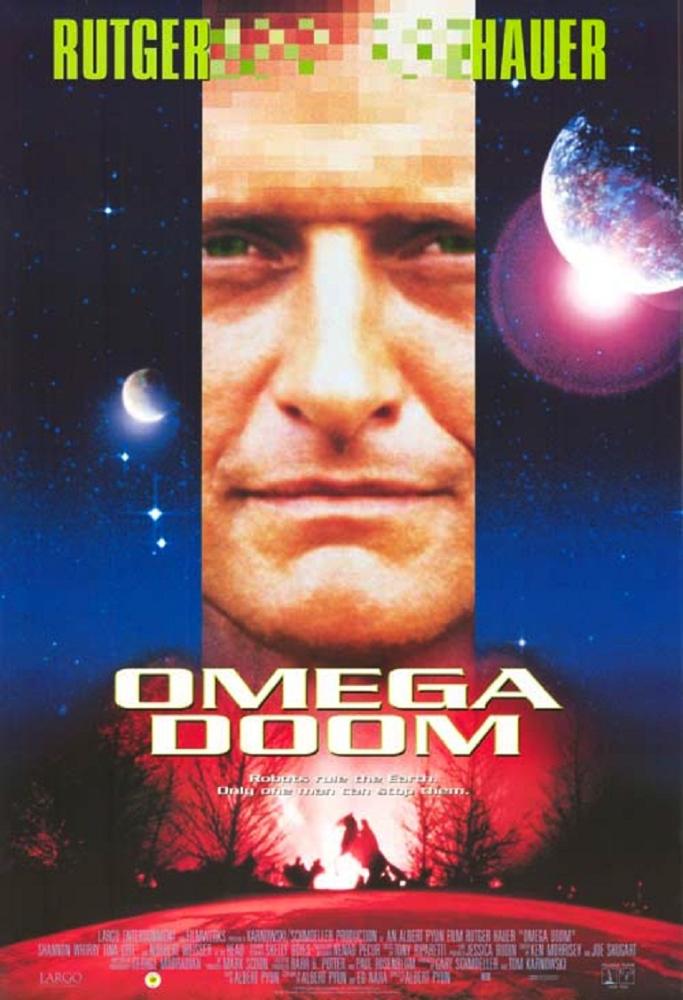
Seriously, don’t ask me. I just watched this Albert Pyun-directed, 1996 sci-fi epic and I’m stil a bit confused as to what exactly was actually going on in the movie. This is a movie that opens with a totally blank screen and then, eventually, two red suns appear in the sky. The film takes place in the future, at a time when humans have nearly wiped themselves out of existence through their endless wars and the planet is now controlled by robots and cyborgs. Omega Doom (Rutger Hauer) was a cyborg programmed to kill humans until he got shot in the head. Apparently, taking a bullet to his cranium changed Omega’s programming and now….
Well, that’s the thing, isn’t it? It’s kind of hard to say what exactly it is that Omega does now. We do know that he spends a lot of time walking around because there’s a lot of scenes of him doing just that. Eventually, he stumbles upon the ruins of a town that is now controlled by two warring bands of robots. Before you can say Yojimbo or even AFistfulofDollars, Omega is playing both sides against each other and …. well, I don’t know what the preferred outcome here is. What is Omega Doom’s motivation? He’s not making any money out of it because robots don’t need money and it’s not like there’s anything left to buy. And he doesn’t seem to be interested in ruling the town himself because it’s kind of a dead end of a town. I mean, there’s dead bodies and robotic parts all over the place. It’s suggested that he might be looking for a secret stash of weapons that can be used to either kill or protect the remaining humans but, at the same time, we don’t ever really see any remaining humans and there’s no reason why Omega would care enough about them to get caught up in a war between robots on their behalf.
So, don’t ask me what’s going on. I guess it really doesn’t matter because it’s not like you watch a film like this for the plot. You watch it for the action! Unfortunately, there’s not a whole lot of action to be found. There’s a lot of scenes of robots talking about various exciting things that they could, in theory, be doing but no one ever seems to actually get around to doing any of that stuff. Instead, all of the robots stay in their separate sections of the town and wait for everyone else to make the first movie. Eventually, Omega makes a few moves but, even then, they’re not particularly exiting moves. Omega carries a gigantic sword on his back and how I anticipated seeing what he was going to finally do with that sword. Well, it turns out that Omega didn’t do very much with it at all.
Actually, the main reason you’re going to want to watch OmegaDoom is because Rutger Hauer plays the title role and Hauer was always cool, even when he was appearing in a less than memorable film. In OmegaDoom, Hauer does a passable Clint Eastwood impersonation, delivering his lines with just the right amount of weary condescension. Though you’re never quite sure why Omega is doing anything, Rutger Hauer is always watchable.
And, to be honest, I actually didn’t dislike OmegaDoom as much as it may sound like I did. It’s a slow movie and not much happens but, at the same time, I did like the look of the bombed-out city and, though the dialogue was largely forgettable, there was still the occasional line that suggested that Omega Doom had existential ambition, albeit unrealized ones. “God took a vacation,” Omega says at one point and, for a split second, you get a hint of what OmegaDoom could have been if it had a bigger budget and a better script. It’s a film that had potential and it’s somewhat fascinating to consider how little of that potential was realized.
Of course, in the end, it all comes down to this: How can you possibly resist Rutger Hauer as a cyborg?
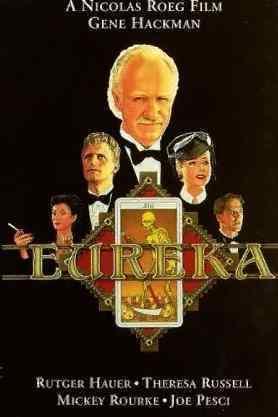
In this 1983 film, Gene Hackman plays Jack McCann, a prospector who is determined to either get rich or freeze to death as he wanders around Alaska in the 1920s. When he’s not having sex and philosophical discussions with the local witch, Freida (Helena Kallianiotes), Jack desperately searches for gold. Jack is convinced that gold is all that he needs to be happy, though Freida counsels him that it’s also important to pursue more Earthly delights. Everywhere Jack looks, he sees people dying in the snow. In fact, Jack nearly dies himself until he stumbles across a mountain full of gold. As gold dust pours down on him, he celebrates while having flashbacks to Freida writhing in ecstasy. It’s just that type of film. When Jack tells Freida about his claim, he asks what’s going to happen next. Freida tells him that it’s both the end and the beginning. Once again, it’s just that type of film.
At this point, Eureka jumps ahead 20 years. The year is 1945. World War II is coming to an end. Jack is no longer freezing and starving to death in Alaska. Now, he is one of the world’s richest men. He even owns his own island in the Caribbean. Jack has a huge house, a beautiful view of the ocean, and all the money in the world. One could even say that his life has become an exclusive beach vacation, an eternal Spring Break, if you will. And yet, even with all of his money, Jack has fallen victim to ennui. He was happier when he was poor and starving and seeking warmth from Freida. Now, he’s got an alcoholic wife (Jane LaPotaire) and his daughter, Tracy (Theresa Russell), is in love with a dissolute aristocrat named Claude (Rutger Hauer), to whom Jack takes an instant dislike. Claude claims that Jack has stolen his wealth from the Earth. Claude is the type who eats gold and then promises to return it to Jack as soon as he can. That’s something that actually happens. It’s kind of silly but Rutger Hauer is such a charmer that he nearly pulls it off.
Claude and Tracy aren’t the only thing that Jack has to worry about. An American gangster named Mayakofsky (Joe Pesci) wants to take over Jack’s island so that he can build a casino on it. However, despite the best efforts of Mayakofsky’s attorney (Mickey Rourke), Jack is still not willing to sell. When hitman Joe Spinell shows up outside the estate, are Jack’s days of ennui numbered?
Of course, they are! That’s not really a spoiler. Eureka is (loosely) based on the real-life murder of Sir Harry Oakes, an American-born prospector who was thought to be one of the world’s richest men when he was brutally murdered in the 40s. Jack is, of course, a stand-in for Oakes while Mayakofsky is based on Meyer Lansky, the mobster who many people suspect ordered Oakes’s murder. Lansky was never charged with the crime. Instead, Oakes’s son-in-law, Count Alfred de Marigny, was arrested and charged with the crime. After a trial that made international news and was described as being “the trial of the century,” de Marigny was acquitted and the murder of Harry Oakes remains officially unsolved.
It’s an interesting story and it seems like one that should perfectly translate to film. Surprisingly though, Eureka doesn’t really do it justice. The film was directed by one of the masters of cinematic surrealism, Nicolas Roeg. Roeg, of course, is probably best remembered for films like Performance, Don’t Look Now, Walkabout, and The Man Who Fell To Earth. As one might expect from a Roeg film, Eureka is visually stunning but, as a director, Roeg can’t seem to decide whether he’s more interested in Jack’s ennui or in all the soapy melodrama surrounding Jack’s murder. As such, neither element of the film gets explored with any particular depth and the resulting film, while always watchable, still feels rather shallow and disjointed. (After taking forever to reach the end of Jack’s story, Eureka then turns into a rather conventional courtroom drama. Theresa Russell does get to utter the immortal line, “Did you cut off my father’s head?” but otherwise, it’s kind of dry.) The film is at its strongest when Jack is just a prospector in Alaska. The harsh landscape and the crazed dialogue is perfect for Roeg’s dream-like style. Once the film moves to the Caribbean, it suffers the same fate that befell Jack when he become rich. It loses its spark.
That said, Eureka has its moments. Any film that features Gene Hackman, Mickey Rourke, Joe Pesci, Rutger Hauer, and Joe Spinell all acting opposite of each other is going to have at least a few scenes worth watching. I particularly liked Pesci’s surprisingly subdued performance as Mayakofsky. With everyone else in the film chewing every piece of scenery on the island, Pesci wisely underplays and is all the more menacing for it. While Eureka ultimately doesn’t add up too much, it’s worth watching at least once for the cast.
Finally, my personal theory is that Harry Oakes’s murder had more to do with the Duke and Duchess of Windsor (formerly King Edward VIII and Wallis Simpson) than it did with Meyer Lansky. (The Duke was the governor of the Bahamas at the time of Oakes’s murder.) But that’s just my opinion.
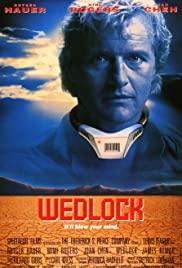
This HBO film opens with a shot of an urban skyline and a title card that reads “somewhere in the future.” However, the city looks like a present-day city and the cars don’t fly and all of the clothing is 90s fashionable and the people in the movie use pay phones. Since Wedlock was made in 1991, I guess the movie takes place in … 1992? Maybe 1993.
Frank (Rutger Hauer), Noelle (John Chen), and Sam (James Remar) are professional thieves who have just managed to make a big score. They’ve stolen several million dollars worth of diamonds. Unfortunately, Sam tripped an alarm during the theft so Frank had to make off with the diamonds. After he hides them, Frank goes to the rendezvous point to meet up with Sam and Noelle. His partners betray him, shooting Frank and, after discovering that he doesn’t have the diamonds him, leaving him for dead.
However, Frank survives. He ends up getting sent to Camp Holliday, a prison run by Warden Holliday (Stephen Tobolowsky, who you’ll recognize as Ned Ryerson from Groundhog Day). The Warden explains that his prison is more progressive than most. Not only is the prison co-ed but prisoners are allowed more freedom to move around. The only catch is that all the prisoners wear an explosive dog collar. Each prisoner has a randomly selected mate, someone to whom they are wedlocked, if you will. Move more than 100 yards away from your partner and boom! Both collars go off and two prisoners end up losing their heads.
The Warden wants to know where the diamonds are hidden so he sets about torturing Frank (who has been given the prison name of Magneta) but he soon discovers that it won’t be easy to break Frank Warren. Even after Frank gets locked in a sensory deprivation tank, he just laughs and says the diamonds are with Santa at the North Pole. Another prisoner, Ivory (Mimi Rogers) approaches Frank and says that she’s figured out that she’s his partner. She wants to escape and she needs Frank to come with her. But can Frank trust her and, if she’s wrong, won’t both of their heads explode? Then again, who in the near future of the 1990s would turn down a chance to run off with Mimi Rogers? Meanwhile, Frank’s partners are waiting for him to escape from the prison so that they can follow him to wherever the diamonds are located.
Though the plot may be ludicrous, Wedlock works because it has a good cast (even Danny Trejo has a small role) and it was directed by Lewis Teague, who started his directorial career under Roger Corman and who has always understood how to put together a good B-movie. The prison scenes are more interesting than the scenes that take place in the outside world but the exploding head effects are cool and Rutger Hauer, James Remar, and Mimi Rogers are always enjoyable to watch no matter what they’re doing.
DaSilva (Sylvester Stallone) and Fox (Billy Dee Williams) are two tough New York cops who just want to be left alone so that they can arrest muggers and purse snatchers. However, because they both have a background in the military, they are assigned to work with an international anti-terrorism task force that is being headed up by Detective Inspector Peter Hartman (Nigel Davenport). Rumor has it that the notorious terrorist Wulfgar (Rutger Hauer) is coming to New York and Hartman tells DaSilva and Fox that they must be prepared to do whatever is necessary to take Wulgar down, even if it means taking a shot while he is hiding behind a hostage. DaSilva says he’s not sure that he could shoot an innocent person, even if it meant stopping Wulfgar from escaping.
Wulfgar has no such moral qualms. Wulfgar is a terrorist-for-hire who claims to be fighting for the people but whose main interest is remaining employable. Unfortunately, Wulfgar has become so ruthless and so cavalier about killing civilians (including children) that most terrorist groups have started to refuse to hire him. He brings too much bad publicity to his employers. Wulfgar has come to New York to lead a bombing campaign, with the hope of once again making himself employable. Wulfgar’s partner in all of this is the equally ruthless Shakka Kapoor (Persis Khambatta).
Nighthawks was one of the films that Stallone made after he found stardom as Rocky but before he redefined his career by playing John Rambo. Stallone actually gives a surprisingly good performance as DaSilva. DaSilva may be another tough cop who plays by his own rules but the script still gives the character some unexpected shadings and Stallone plays him as being more cerebral than you might expect. It’s interesting to see Stallone play a character who is worried about using excessive force to do his job and, to the film’s credit, it actually takes DaSilva’s conflicted feelings seriously. Billy Dee Williams, unfortunately, is not given as much to do as Stallone and his character is far more one-note than Stallone’s. He’s the loyal partner and, with his natural charisma, Williams deserved a role with more depth. Also appearing in small roles are Joe Spinell (as Stallone’s boss), Lindsay Wagner (as Stallone’s ex-wife), and the legendary pornographic actor Jamie Gillis (as Wagner’s boss).
Not surprisingly, the film is stolen by Rutger Hauer, who gives a performance that, in many ways, anticipates his more acclaimed work in Blade Runner. As played by Hauer, Wulfgar is a charismatic sociopath who knows exactly the right thing to say but who, because of his own arrogance, is still vulnerable to allowing his emotions to get the better of him. He and Stallone both play-off each other well and their face-to-face confrontations are intense. It probably helped that Hauer and Stallone did not personally get along during the filming. (Both, however, were very complimentary towards each other in the years that followed Nighthawks, with Hauer especially saying that there was nothing personal about their on-set arguments.)
Nighthawks is hardly an in-depth look at the realities of international terrorism but it has a handful of exciting action scenes and two excellent performances from Stallone and Hauer. It’s currently on Netflix and worth watching.
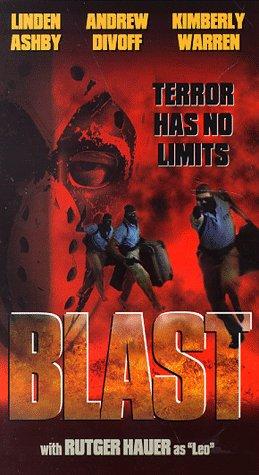
Blast opens with a title card telling us that what we’re about to see is based on a true story except that it’s not. In the days leading up to the 1996 Atlanta Olympics, the FBI thwarted many potential terrorist plots. Only one of the plots was a domestic terror plot. Blast is the story of what would have happened if that plot had not been disrupted.
(What about Eric Rudolph and the Olympic Park bombing? That’s not mentioned, probably because this film went into production before the Atlanta Olympics actually began.)
Omodo (Andrew Divoff of Wishmaster fame) is a terrorist who does evil things because he’s evil. He and his group have taken the American Olympic swim team and their coach, Diane Colton (Kimberly Warren), hostage in an Atlanta gym. They’re demanding money and an opportunity to escape. The police (led by Tim Thomerson) don’t know what to do. The FBI (represented by Rutger Hauer with braided hair) are not much help either. Fortunately, the gym’s janitor, Jack Bryant (Linden Ashby), is a former Olympic gymnast who is a master of Tae Kwon Do! Jack also happens to be Diane’s ex-husband!
Blast comes from us the time when every action movie was a blatant rip-off of Die Hard and we were all cool with that because Die Hard was so awesome that it deserved to be remade a thousand times. Blast is more of the usual. Jack sneaks around the facility, defuses bombs, and picks the terrorists off. Omodo kills two hostages in cold blood. Shannon Elizabeth of American Pie fame plays one of the hostages but she doesn’t get many lines beyond, “Help us!” Why does Rutger Hauer have his hair in braids? Because he was Rutger Hauer and everyone was probably so happy to have him on set for a few hours that they were willing to let him do whatever he wanted to do with his hair. Rutger Hauer only gets about five minutes of screentime but he makes the most of them.
Lindsen Ashby is convincing in the fight scenes but I think the movie would have been better if he had just been an ordinary janitor, instead of a Tae Kwon Do supstar who has fallen on hard times. That would have added some suspense to the story because, as it is, Jack is so obviously superior to his opponents that there’s never really any question as to whether or not he’s going to succeed. Andrew Divoff is a good actor but his villain isn’t given any good lines and the people working for him are all pretty bland. One of the best things about the first three Die Hard films was that the villains were just as interesting as the hero but the same cannot be said for Blast.
Blast is forgettable but still, five minutes of Rutger Hauer is better than no Rutger Hauer at all.



 Through the Shattered Lens