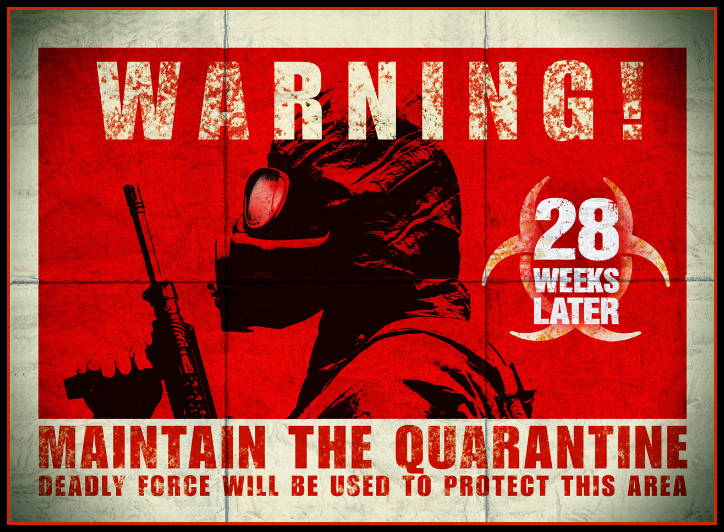
Horror Review: 28 Weeks Later (dir. by Juan Carlos Fresnadillo)


Danny Boyle and Alex Garland’s 28 Days Later was made in such a way that any sequel was almost destined to struggle in its shadow. Their film was not only one of the most influential horror films of the early 2000s, but also an exercise in experimental filmmaking and cinematic reinvention. It fused realism and terror through its digital photography, unconventional pacing, and minimalist score. Any follow-up would have to contend not just with its fresh twist on the zombie mythos (despite the infected not technically being zombies) but also its unique atmosphere, music, and stripped-down aesthetic. Against those odds, 28 Weeks Later manages to stand as an impressive and worthy successor—one that in some respects even surpasses the original.

Spanish director Juan Carlos Fresnadillo approaches the material with a clear reverence for Boyle and Garland’s vision while imprinting his own stylistic and emotional signature on the sequel. From the very first scene, Fresnadillo establishes a tone that blends despair and dread with human frailty. The film opens on a stunningly tense prologue in which Don (a gaunt and haunted Robert Carlyle) and Alice (Catherine McCormack) are living with several others in a rural cottage outside London during the first weeks of the Rage virus outbreak. In this sequence, Fresnadillo distills the central moral dilemma that runs through both films: whether to preserve one’s humanity through compassion or to surrender to pure survival instinct. When Don is forced to choose between rescuing his wife and saving himself, his decision—while horrifying to watch—feels horribly plausible. The following chase through open fields as he flees dozens of Rage-infected attackers captures the raw panic that made Boyle’s original so memorable, yet Fresnadillo shoots it with a sharper sense of chaos and movement. It sets the tone for a story that is both intimate in its human tragedy and apocalyptic in its reach.

Following this intense opening, the film transitions through an introductory credits montage that fills in the aftermath. Don’s escape was not the end of the story but the beginning of a grim reconstruction effort. The British Isles, we are told, were swiftly quarantined when it became clear the infection could not be contained. Twenty-eight weeks later, with the infected population presumed dead from starvation, a U.S.-led NATO force spearheads an ambitious effort to repopulate and rebuild. Led by General Stone (played with austere calm by Idris Elba), the military has converted London’s Isle of Dogs into a heavily fortified safe zone. This enclave represents both restoration and repression—a fragile bubble of civilization built atop the bones of horror.

Within this environment lives Don, now employed as a maintenance manager and struggling to suppress the guilt from his past. The arrival of his two children, Tammy (Imogen Poots) and Andy (Mackintosh Muggleton), who were abroad in Spain during the initial outbreak, reopens emotional wounds he had hoped were sealed. Their reunion, though heartfelt, carries an undercurrent of deception. Don’s explanation of their mother’s fate does not align with what the audience has already witnessed. This dishonesty propels the children into dangerous territory when they decide to sneak out of the Green Zone to retrieve personal belongings from their old cottage. While this act of recklessness fits with youthful impulses and emotional longing, it also feels like the film’s only contrived lapse in logic—an inevitable but frustrating horror trope that sets off the story’s next catastrophe.

What the children discover at the cottage reintroduces the virus in a shocking way. Without realizing it, they bring the Rage infection back into the supposedly secure refuge of London. As soon as containment is broken, the military response escalates with brutal efficiency. General Stone declares a “Code Red,” authorizing the use of extreme measures to eradicate the infected—including indiscriminate firebombing of civilian areas. These scenes echo not only classic apocalyptic tropes but also resonate as a grim reflection of post-9/11 militarism. Many viewers and critics interpreted this act of mass destruction as allegory for the United States’ War on Terror and the ethical corruption of occupation forces. Fresnadillo’s direction, while hinting at this reading, avoids heavy-handed political critique. His portrayal of military overreaction feels less ideological than tragic—a manifestation of fear, confusion, and the blunt-force nature of institutional power. The armed forces are not villains so much as desperate men trapped in an impossible moral quagmire. As in George A. Romero’s The Crazies, which 28 Weeks Later strongly recalls, the destructive consequences stem not from malice but from the futility of trying to maintain order amid chaos.

Where 28 Days Later focused on a small group of survivors and the intimate erosion of morality under crisis, 28 Weeks Later expands the scale dramatically. Fresnadillo transforms Boyle’s compact nightmare into a large-scale urban apocalypse. The sweeping aerial shots of a deserted London—bridges empty, streets silent—hammer home the desolation. When the city is engulfed in flames and gas clouds during the firebombing sequence, the imagery becomes both terrifying and grimly beautiful, a vision of civilization consuming itself. The sequel’s tone is darker and more nihilistic than Boyle’s film, which allowed a trace of optimism in its ending. Here, even innocence becomes a catalyst for doom: it is the children’s actions, driven by love and loss, that inadvertently reignite the infection and condemn the survivors to another wave of horror. This subversion of the “innocent child” trope underscores Fresnadillo’s bleak worldview—where sentiment and humanity, however noble, can still create destruction.

In several ways, 28 Weeks Later aligns more closely with Romero’s Living Dead films than with Boyle’s original. Though Boyle borrowed some of Romero’s thematic DNA, Fresnadillo fully embraces it. The infected may not be reanimated corpses, but the societal collapse, moral ambiguity, and recurring cycles of violence all trace back to Romero’s legacy. One of the sequel’s most striking qualities is its unflinching pessimism: even individuals acting out of love or duty become agents of devastation. The so-called survivors are reduced to primal instincts—running, hiding, killing—in a landscape where institutional power and human decency dissolve together. Fresnadillo makes the action kinetic without glamorizing it. His camera work, switching between chaotic handheld intensity and precise, panoramic destruction, keeps the viewer off balance, mirroring the unpredictability of the apocalypse itself.

The performances elevate the material beyond genre expectations. Robert Carlyle’s portrayal of Don is both gut-wrenching and terrifying. His character’s transformation—from remorseful father to infected embodiment of pure rage—serves as the film’s emotional and thematic anchor. Imogen Poots, in an early standout role, conveys resilience and vulnerability in equal measure, while Jeremy Renner delivers a strong supporting turn as Sergeant Doyle, the soldier torn between obedience and morality. Their performances, though sometimes confined within the film’s relentless pace, enrich its exploration of guilt, loyalty, and the futility of control.

Despite sacrificing some character depth for momentum, the film’s taut editing and grim atmosphere sustain tension throughout. Fresnadillo’s direction never loses sight of his central message: that humanity’s efforts to rebuild are perpetually haunted by its capacity for self-destruction. Even as the few surviving characters reach supposed safety, the final scenes undermine any hope of resolution. The closing image—infected sprinting through the streets of Paris—reminds viewers that, although the city itself appears intact and bustling in daylight, the Rage virus has now breached mainland Europe. This ending shifts the scale of threat from the quarantined British Isles to the broader continent, making containment and redemption feel like dangerous illusions.

As a sequel, 28 Weeks Later earns its place alongside 28 Days Later by honoring the original’s DNA while pushing its boundaries. It retains the visceral dread and societal commentary but broadens the lens to encompass collective failure rather than individual struggle. Fresnadillo’s approach feels colder and more apocalyptic, transforming the story into a study of fear’s infectious nature—social, political, and biological. While his film might not achieve the same creative purity as Boyle’s indie landmark, it succeeds in redefining the tone, expanding the mythology, and pushing the series toward a darker, more cinematic landscape.

In the end, 28 Weeks Later is both a continuation and an escalation—a relentless, despairing study of human fragility under crisis. Its pacing, performances, and imagery combine to create an experience that’s not only horrifying but profoundly unsettling in its realism. If 28 Days Later showed us the collapse of civilization, its sequel reveals the hopeless struggle to rebuild it. Few horror sequels accomplish that much, and fewer still end with such haunting inevitability.

Scene I Love: Sunshine (dir. by Danny Boyle)


The scene in Danny Boyle’s “Sunshine” where the crew reaches Mercury is one of my favorites. It may not be as powerful as Kaneda’s Death, but this is one of those moments I can watch and smile at. There are no words, but visually, It’s an awesome moment of reflection in the scheme of things. John Murphy and Underworld’s music add a nice touch to this.

Review: X-Men: First Class (dir. by Matthew Vaughn)


The name Matthew Vaughn should be familiar with comic book fans everywhere. In 2005, Vaughn was introduced as the director to replace Bryan SInger for the third film in the X-Men franchise. The news was met with some cautious optimism. This was a filmmaker who had quite the loyal and growing following for his work on Stardust and Layer Cake. Months after he was picked my 20th Century Fox news came down that he was backing out of the project due to personal reasons and the film scrambled for a replacement which ended up being Brett Ratner. History was made that day as the beginning of the franchise’s decline began and steep plummet which recently reached it’s nadir with 2009’s Wolverine: Origins.

It’s has now been five years since X-Men: The Last Stand made it to the big-screen and now we have a new film in the franchise. X-Men: First Class has a familiar name behind the director’s seat and it looks like Matthew Vaughn stayed this time around (after directing a smaller superhero film in Kick-Ass for 2010) to craft what could become the best film in the X-Men/Wolverine film franchise. This film is a prequel/reboot of sorts (more on that later) and brings a fresh set of eyes and take on the origin story of this franchise.

X-Men: Last Stand actually begins the film exactly how the first X-Men film began with the 1944 World War II concentration camp setting where a young Erik Lensherr (later to become Magneto) finally manifests his power over magnetic fields as he watches his parents torn from his side. The first film ended that sequence once Erik was knocked out, but this time around it continues with a mysterious man named Schmidt (aka Sebastian Shaw and played with James Bond villainous-flair by Kevin Bacon) taking great interest in Erik and his ability which Erik could only use during bouts of pain and anger. The film continues this slight change in the series’ origins by switching over to Westchester County and into the expansive home of a young Charles Xavier who finds a certain young, blue-skinned shapeshifter named Raven who he invites to stay and become his friend once he realized he wasn’t the only one who was different and with abilities.

These two sequences continue to move the film forward as the we see these two “leaders in the making” adults and trying to find their place in the world of the free-swinging lifestyle and the Cold War culture of the 1960’s. Charles Xavier (played like a well-meaning cad and good-natured naivete about the world by James McAvoy) is a student working on his doctorate in Oxford on genetic theories while his “sister” Raven (Jennifer Lawrence) accompanies him. This is a Xavier who still hasn’t found the patient benevelonce of Patrick Stewart’s Professor X and uses his considerable telepathic abilities to help him pick up on beautiful coeds instead. It’s during such a scene where we see Raven show just a hint of jealousy as Xavier tries his lines and moves on a beautiful British lass. It would seem Raven’s feelings for her ‘brother” may go beyond sibling affection though Xavier doesn’t see her as anything other than a sister for him to protect.

Erik Lensherr’s time as an adult was shown as having become a life of obsession over his treatment at the hands of the Nazi’s and those of Schmidt’s as he travels the world in search of escaped Nazi war criminals. Erik takes him throughout South America as he finds the trail of Nazis hiding out in that region since the end of the war. We see this adult Erik hardened by his anger and single-minded need for revenge on Schmidt and those he worked for. He’s not above using his abilities to kill in order to get the information he requires and there’s a hint of satisfaction when he does kill those he sees as responsible for his tragic upbringing with his magnetic abilities. These two adult sequences continues the film’s theme of the ideological difference between Xavier and Erik being formed through nature and nurture as their lives moved down diverging paths from an early beginning until it convergence for a small, brief period around the time of the Cuban Missile Crisis.

The film’s second act begins with Moira McTaggart (Rose Byrne), now a covert CIA Agent, investigating a certain Col. Hendry who she suspects as having betrayed the nation to the Soviets, but instead finds out that the true nature of Hendry’s associations were much more insidious and dangerous. The iconic Hellfire Club of the comics finally make their appearance with Schmidt who actually happens to be Sebastian Shaw (whose powers grant him the ability to absorb all kinetic energy which he uses to keep himself young and can release with explosive results), Emma Frost (January Jones) who’s a telepath with the ability to turn body in a sort of diamond-form, Riptide who can create tornado-like abilities and finally the demonic-looking Azazel whose ability to teleport might give people not well-versed in the “X-Men Universe” a clue as to one-half of parents who may be responsible for Nightcrawler in the second film.

X-Men: First Class spends much of this second act like it was Ocean’s 11 as Xavier and Erik get recruited by the CIA to find other mutants and create their own mutant team to counter Sebastian Shaw’s Hellfire Club and his goal of initiating World War III between the US and the USSR and thus destroy all of humanity and leave the planet for the mutants to rule over. Yeah, it is this part of the film’s plot which may strain the suspension of disbelief for some audiences who never grew up reading the comics, but it shouldn’t. Ian Fleming’s James Bond series used scenarios just as ludicrous with villains just as Machiavellian in the form of SPECTRE so X-Men: First Class and it’s world domination plans shouldn’t be too farfetched to fans of that British superspy and his adventures.

This middle section of the film is where X-Men: First Class actually begins to lag after a strong first act. I don’t know if the sequences of the new recruits training, bonding and learning how to use their powers could’ve been written to move much faster without losing some of the character building scenes. From how this second act played it seemed to look like scenes were actually cut out to try and keep the film from being too long (it’s final cut being just a tad over two hours already upon release), but I wouldn’t be surprised if the DVD/Blu-Ray release actually has a director’s or uncut version that actually expands this middle section to really give life to it instead of having it play out like a perfunctory training montage with a dash of character beats.

The film hits it’s action-film stride with the third and final act as Xavier and Erik’s team of young mutants must now use their abilities to stop Shaw and his Hellfire Club and at the same time prevent World War III from beginning and not freaking out the humans who are still unaware of their existence as a whole. It’s this third section which we see too much of it in the trailers and tv spots that one might say we’ve seen it all before we even see the film as a whole, but it still kept back a lot from those ads to make the whole final twenty minutes of the film thrilling and action-packed.

All of this could just mean that X-Men: First Class was just your run-of-the-mill superhero action film that we get on a yearly basis come summertime, but it’s a testament to Matthew Vaughn’s direction and the strength of the script by Vaughn, longtime collaborator Jane Goldman and Thor scribes Ashley Edward Miller and Zack Stentz that the film goes beyond being just an action film with all it’s sturm und drang coupled with fancy special effects. The previous films in the series always explored important cultural and moral themes that’s always been the bread-and-butter of the X-Men stories in the comic books. We just don’t see the film explore the ideological difference between Xavier’s peaceful co-existence between humans and mutants alike, but also we get more detail on why Magneto finally comes to the conclusion that war between humans and mutants was an inevitability and why his stance doesn’t fall under the aegis of being evil, but something that anyone could understand and even support whether one was human or mutant.

The story also doesn’t just pay lip-service to the idea of how mutants view themselves and how even within the mutant community there’s a visible rift between those whose abilities are invisible to the general population and those whose abilities and genetic mutation physically manifest themselves in such ways that to many might not look to appealing. This idea really gets a major exploration in the subplot involving Raven (soon to be Mystique), Hank McCoy and, to a certain degree, Xavier and Erik. We see how those like Xavier whose abilities don’t show in a physical manner have a sort of “don’t ask, don’t show” about those like Raven when it comes to their power when in public.

Raven (played beautifully by Jennifer Lawrence) is caught between Xavier who wants her to remain incognito so as not to shock the world too soon in realizing that mutants exists and that of Erik who sees Raven’s original blue-skinned form as beauty and perfection and how she should never hide who she truly is. This tug and pull between her two mentors makes for a convincing subplot in how Raven comes to the conclusion which would take her to the side of Magneto in later films, but also highlight how the two sides in later films have so much intertwining bonds of friendship and relationship that seeing them against each other becomes a tragedy on its own. Civil wars are not just a thing of humans but those who sees themselves apart from them.

The great performances by most of the leads add to the film’s strength. McAvoy and Fassbender, at first, look to be unconvincing in terms of their appearance as the younger versions of Patrick Stewart and Ian McKellen, respectively. This becomes a non-issue once they’ve established themselves through their performances which gives new layers to the personalities of Professor X and Magneto. Many people always saw these two as the comic book version of Martin Luther King, Jr and Malcolm X, but that’s an oversimplification. The film and the performances by McAvoy and Fassbender digs deeper into both their characters’ motivations and ideologies and how their past experiences and upbringing couple with their time together as brothers-in-arms and friends show more about these two than just being mutant-proxies of MLK and Malcolm X. The other young mutants do an adequate enough job that they don’t seem lost in the film. Nicholas Hoult as the young Hank McCoy and how he plays off Lawrence’s Raven during their little subplot in the film is one stand-out that I hope gets explore even more in any follow-up sequel.

There’s a nice burgeoning young love chemistry between him and Lawrence as Beast and Raven that doesn’t seem too tacked on to create a the prerequisite love couple in any film. Their common trait of having physical mutations and how they seem to both feel apart even from their fellow mutants develop their characters in ways the previous films in the series never did. They never want to rid themselves of their mutant powers. They just want to look normal and still keep their abilities. It’s a having your cake and eat it too mentality that has some surprising results for both Raven and Hank.

X-Men: First Class has had some fans of the series put in a very difficult situation. The film definitely is a prequel to the previous films, but it also does a major time in rewriting continuity in the series. I was one of those fans and thought it would ruin the film in the context of the franchise. I’m surprised that in the end I didn’t really care and actually hope that this film actually is a reboot of the franchise. I see this film and forget the previous three as being part of it. This film was just too good and fun in it the end for continuity issues to become the major flaw that sinks it. I liken this film as similar to Christopher Nolan rebooting the Batman film franchise. That film honored the contributions to the character, but went on it’s own way to tell that character’s tale. I see Vaughn doing the same with this film. He has done something which many thought was a near-impossible task and that’s make the X-Men franchise relevant once more in a pop-culture landscape that seems to have left the franchise behind after the disastrous Wolverine: Origins of 2009.

This film delivered on the ideas that made the comic books so beloved by millions of fans for almost a half-century. It made great use of the 1960’s time and setting to tell a story of these characters beginnings as heroes and villains (though the latter shouldn’t be seen as them being truly just evil bad guys). Even the inclusion of real-world historical event like the Cuban Missile Crisis was a nice touch which gave the film a foundation in realism. Again, this film played off like a superhero, Marvel version of an Iam Fleming James Bond story. For those who are huge fans of the previous films there’s even two brief cameos of those films two favorite characters that appear in this film. They don’t come off as cheesy and unnecessary and actually come off as great additions. I won’t mention who these cameos were but the audience’s reaction to them was very vocal and very positive. I say the same should be said for X-Men: First Class as a film that resuscitates the franchise.

X-Men: First Class (2nd Official Trailer)


Today we saw the release of the second official trailer for the upcoming X-Men prequel/reboot helmed by British director Matthew Vaughn.

X-Men: First Class looks to show the early days when Professor X and Magneto were still friends and allies instead of the adversarial relationship they had in the first three films in the franchise. This new trailer shows more of the characters who will be involved in this film. It also shows the mutants and their powers in action. I must admit that I wasn’t too thrilled with the previous trailers shown about this film, but this latest shows more action and finally reveals it’s summer blockbuster pedigree. The sequence with Magneto lifting the submarine out of the water was really cool.

It’s still not the superhero film this summer that tops my must-see list, but this trailer has put this film in the running as one of the films I must-see.

X-Men: First Class is still slated to have a June 3, 2011 release.

Film Review: Insidious (dir. by James Wan)


I wasn’t expecting much from Insidious, the new horror film that’s recieved a surprising amount of critical acclaim over the past month.  After all, the film is the product of a collaboration between the makers of Saw and Parnormal Activity, two of the most overrated horror films ever.  Add to that, the movie is rated PG-13 and the lesson I took away from seeing The Roommate earlier this year was that PG-13 dooms horror.  Insidious might be the proverbial exception that proves the rule.

As with all good horror films, Insidious starts with a deceptively simple premise.  Patrick Wilson and Rose Byrne play a married couple whose marriage is thrown into choas when their oldest son slips into what appears to be a coma.  After three months of being in the hosptial, their son is moved back into their house where he spends his days lying in bed, hooked up to ominous medical equipment. 

(Speaking for myself, there is no more disturbing sound than the sound of heart monitor, because for every beep, there’s that moment of deafening silence between beeps.  The film’s director James Wan knows this too because he makes brilliant use of sound in this film.)

While Wilson deals with things by finding excuses to stay late at work, Byrne is soon seeing shadowy figures running through the house and hearing voices coming from empty rooms.  Even as Wilson continues to insist that its just her imagination (that’s something all men seem to have in common — they never ask for direction and they always refuse to accept that the house is haunted), Byrne becomes more and more convinced that its not.  Eventually, with a help of an eccentric psychic (well-played by Lin Shaye), Wilson and Byrne are forced to confront the evil forces that have taken control of their lives.

Let’s get the most important thing out of the way first.

Insidious is one scary movie.  It’s scarier than any movie rated PG-13 has any right to be.  It scared me when I was sitting in the theater watching it and, even more importantly, it’s still scary a day later.

Let me set the scene for you.  As I sit here writing this, it is nearly 3 in the morning.  I live in a two-story house that is full of random cold spot and which, for some reason, never seems to be totally lit even with all the lights on.  My friends are with their families for Easter.  My sister Erin is currently in Arlington, visiting with our other sister, Melissa.  I’m in this house alone with only my overactive imagination keeping me company.  Oh, did I mention that, because of some foundation issues, this house tends to randomly creak?

About two hours ago, I had just taken a shower and I was sitting, wrapped in a towel and a blow dryer, on the edge of my bed.  I have this antique floor  mirror that sits a few feet in front of my bed and I was about to start drying my hair when it suddenly occured to me — what if I looked at the mirror and I suddenly saw a dark shadow — like the ones in Insidious — sitting on the bed directly behind me?

And yes, I knew that was a silly thought just like I know, despite what the Insidious might tell us, there’s no such thing as ghosts and demons.  I knew that if I rasied my head, I would not see anything but isolated, vulnerable little me reflected in the mirror.

But, God help me, I could not bring myself to look.  Because, even though I knew that there was 99.9% chance that nothing would be sitting behind me, I knew that there was 0.1.% chance that something would be.  I sat there, almost paralyzed with my heart pounding so hard I could almost hear it.  I realized I was starting to breathe faster, knowing that if there was something there, it was there with me at that exact moment, siting behind me, waiting to strike…

Finally, realizing that I was on the verge of giving myself a very real panic attack over a very unreal possibility, I forced myself to look up at the reflection in the mirror.

A dark shadow was sitting directly behind me.

And I screamed and jumped off that bed so quickly that I’m amazed I actually managed to stay on my feet.  I swung around, cluthing that blow dryer like a weapon, prepared to do whatever…

Nobody was sitting on the bed. 

Slowly, I creeped across the room.  Cautiously, I stuck a foot underneath my bed to feel if anything was hiding underneath it.  I opened the closests and pushed my clothes to the side to confirm that nobody was hiding behind them. 

Finally, after I somehow found the courage to sit back down on the bed, I realized that there had indeed been a shadow behind me and that shadow, because of the angle of the lights in my room, had been mine.

That’s the type of film Insidious is.  It’s the type of film that uses the simple things that scare us — the unexplainable noises, the things that you sometimes think you see out of the corner of your eye — to creates a truly macabre experience that sicks with you.  At its best, its a truly creepy film that works its way into your imagination through a perfect combination of atmosphere and paranoia.  One reason why the haunted house genre has remained such a dependable horror set up is because it perfectly reflects one of our most basic fears — the fear of having no control, of knowing that there is no place to hide, that the forces of chaos and evil can even get to us in the sanctuary of our own homes.  Especially during its first half, Insidious exploits this fear perfectly.  James Wan’s camera prowls through the otherwise unremarkable suburban home like a creature possessed and you find yourself spotting shadowy figures and sudden movements in every frame that flickers before your eyes.  Wan makes remarkably good use of sound here.  I realize that sound of silence may be an oxymoron but if silence can make a sound, then director Wan manages to capture it in Insidious.

A lot of critics and filmgoers have been rather critical of the film’s second half and it is true that the second half if remarkably different from the first.  If the first half finds Wan concentrating on atmopshere then the second half concentrates on shock and, as a result, it feels a lot more conventional. During the 2nd half of them, we learn just what exactly is happening and why and unfortunately, no possible solution could hope to compete with the sense of dread that the first part of the movie generated.  That doesn’t mean that the second half of the movie isn’t well-executed.  It is.  It’s just not as surprising as the first half.

(However, there is one scene in that 2nd half — a red-skinned demon cheerfully sharpening his finger nails — that is just so bizarre and disturbing that it borders on genius.)

Now, I will admit (POSSIBLE SPOILER COMING UP DEPENDING ON HOW ANAL YOU ARE) that I was not a huge fan of the film’s ending.  It’s not that the ending didn’t work or that it wasn’t well-exectued.  It’s just that it’s the same type of ending that we’ve come to expect from all horror films, the type of thing that used to be considered a twist but now is just a cliche.

Still, ending aside, Insidious is an effective, little horror film.  While it is true that the film rather liberally borrows from a lot of previous horror films (most blatantly from Poltergiest, Mario Bava’s Shock, an Australian film called Patrick, and an excellent Canadian shocker called The Changeling), Wan still takes all of those familiar elements and molds them into a genuinely scary experience.

X-Men: First Class Official Trailer


Of all the Marvel Comic book films coming out this summer it is the one not being made by Marvel themselves which seems to be getting the biggest amount of negative press and buzz from the fans. The last couple weeks has seen pictures from the set either leaked by accident or on purpose to gauge fan reaction. To say that reaction has been underwhelming would be an understatement.

The film is 20th Century Fox Studios latest film on the X-Men franchise. A franchise which is now batting 2-for-4. The first two films in the franchise were thought of as being very good to great and the last two seen as a major mess or just plain awful. Now the fifth film has just released it’s first official trailer and from the look of things it looks to be retconning all the vents which occurred in the first four films. The scenes used for the trailer looked very good and the looks of the many (people complaining about the amount of characters in the third Nolan/Batman film will be apoplectic once they see First Class) characters gives me some hope.

The film has Matthew Vaughn just fresh off of Kick-Ass and it will be up to him to create a gem out of the rough stone people seem to be judging the film at the moment. X-Men: First Class is set for a June 3, 2011 release.