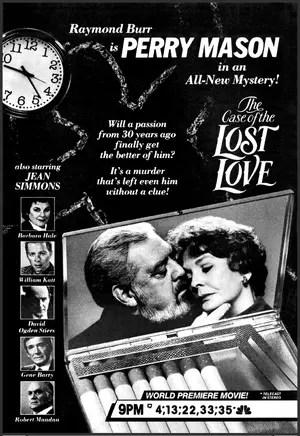
Perry Mason’s ex-girlfriend, Laura Robertson (Jean Simmons), is about to be appointed to the Senate when blackmailer Pete Dixon (Jonathan Banks) threatens to reveal that she once underwent shock treatment after having a nervous breakdown. When Dixon is murdered, Laura’s husband (Gene Barry) is arrested. Laura hires Perry (Raymond Burr) to serve as his attorney.
At first, this movie felt weird to me because it didn’t seem right for Perry to have an ex-girlfriend when we all know that he and Della (Barbara Hale) were in love. When Laura is at the office waiting to see Perry, she and Della have a conversation and it’s obvious that each is jealous of the other. When Laura asks, “What about you and Perry?,” Perry shows up before Della can answer. We all know what the answer was though. Della loves Perry and, probably because she was so upset over Perry dating Laura, she threw herself at Paul Drake, Sr. and that’s how we got Paul Drake, Jr.
As for Paul Drake, Jr. (William Katt), he flirts with two different women in this movie but he doesn’t get to do as much investigating as he did in the first few films. This movie is almost all Perry Mason interrogating people. Raymond Burr uses a cane in this movie and there’s a few scenes where it’s obvious that he was in pain but he still gives a very good performance. The movie is very talky but it also has the best courtroom confession scene yet and Raymond Burr really sells Perry’s ambivalent feelings. The identity of the killer actually took me by surprise!
It was weird to see Perry in love with someone oter than Della but this was still an excellent entry in the series.
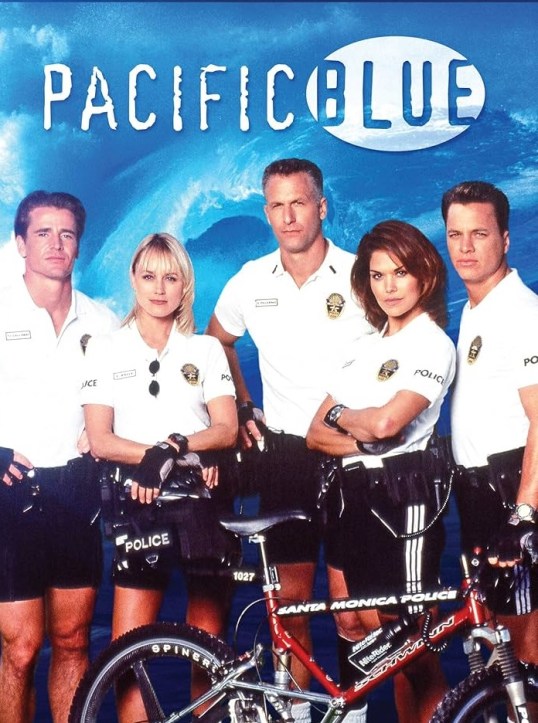
Welcome to Late Night Retro Television Reviews, a feature where we review some of our favorite and least favorite shows of the past! On Tuesdays, I will be reviewing Pacific Blue, a cop show that aired from 1996 to 2000 on the USA Network! It’s currently streaming everywhere, though I’m watching it on Tubi.
This week, the bicyclists continue to get in everyone’s way.
Episode 3.6 “Sandman”
(Dir by Terrence H. Winkless, originally aired on Sept. 21st, 1997)
A hitman named Robert “Sandman” Enright (John Michael Bolger) has been released from prison. Because Enright was previously arrested by TC, TC decides to start harassing him as soon as he gets out of jail. For a bunch of dorks on bikes, the Pacific Blue folks sure do enjoy abusing their power.
Anyway, Sandman is out for revenge against the three men who framed him. And, since TC is tailing him everywhere, Sandman is able to manipulate TC into basically becoming his bodyguard. The main theme of this episode is that TC is an idiot.
Speaking of idiots, Cory’s boyfriend, FBI Agent Tim Stone (David Lee Smith), confessed that he was thinking of getting back together with his ex. With Chris’s support, Cory fought for her man. Myself, I just struggled with the fact that Stone, TC, Palermo — and their actors, Smith, Jim Davidson, and Rick Rossovich — all basically looked like the same guy at different stages of his life.
Finally, Palermo, TC, and Victor played volleyball! That was at the end of the episode and it went on for a while. The whole scene felt like the show’s way of saying, “Hey, remember when Rick Rossovich was in Top Gun? That was cool.”
As usual, this episode featured a lot of tough talk and intense looks, all of which were negated by the presence of grown-ups on bicycles. Even when TC was spying on the Sandman, he did while sitting on his bicycle. It just looked dumb.
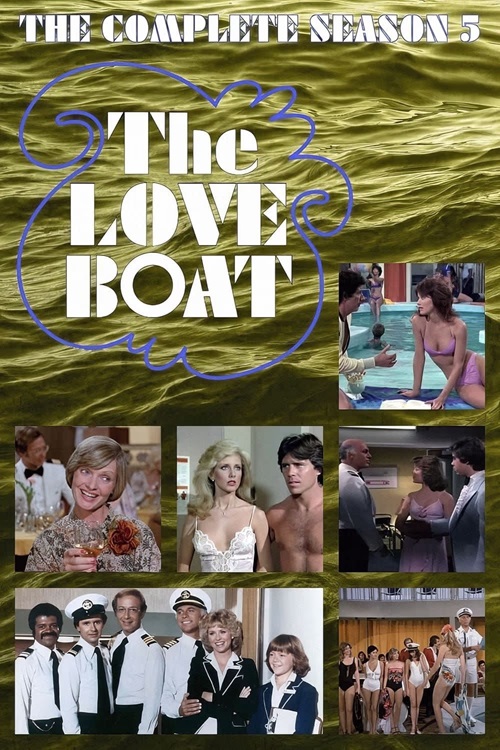
Welcome to Retro Television Reviews, a feature where we review some of our favorite and least favorite shows of the past! On Wednesdays, I will be reviewing the original Love Boat, which aired on ABC from 1977 to 1986! The series can be streamed on Paramount Plus!
This week, The Love Boat hosts a special event!
Episode 5.3 “Two Grapes On The Vine/Aunt Sylvia/Deductible Divorce”
(Dir by Bob Sweeney, originally aired on October 17th, 1981)
This week, the Love Boat is hosting a wine tasting competition!
Basically, the contestants sit in the ballroom. They take a sip of wine. They then write down what type of wine they think they just tasted. All of the members of the crew and the majority of the passengers watch them. Seriously, it looks like the most boring thing ever. I mean, I get why the competitors are into it. The winner gets a lot of money. But why would you want to watch people drink? I mean, if you’re crazy into wine, it seems like you’d want to drink it yourself. What fun is there in watching other people drink something? I’ll just say that, if I was on a cruise, I would want to do other things. I would want lay out by the pool or look at the ocean or maybe solve a murder. What I would not want to do would be to spend hours watching other people drink and then spit.
Also, I have to wonder about the wisdom of hosting a wine tasting competition on a ship that’s captained by a recovering alcoholic. Did the show forget this key part of the captain’s character? Merrill Stubing is a recovering alcoholic and he lives his life with the rigorous discipline of someone who is trying to avoid falling back into old habits. It would seem like Captain Stubing would at least mention his alcoholic past in this episode, especially after Vicki says that she wishes she could take part in the contest. Wouldn’t this be a good time for Stubing to explain that an addictive personality can be hereditary?
I know, I know. I’m overthinking. It’s just because I found this episode to be remarkably dull. I mean, I love The Love Boat but this episode was just boring. The whole wine tasting thing just put me to sleep.
It didn’t help that the three stories weren’t particularly interesting.
Robert Guillaume and Leslie Uggams played the two finalists in the wine tasting competition. They each lied to the other about why they needed the money. Then they fell in love and they each threw the competition so the other could win the money. But since they both got the last wine wrong, no one won and no money was awarded. Wow, wine tasting is a harsh sport!
Tanya Tucker and Michael Goodwin played a married couple who got divorced every year so that they could get a tax break. This time, they sailed to Mexico for a quickie divorce. Tucker’s ex-boyfriend, Robert Walden, was on the cruise and Tucker was tempted to stay divorced. However, she and Goodwin eventually decided to get married a sixth time and to never get divorced again. I liked this story solely because it was about screwing over the IRS.
Finally, Betty White wanted to marry Douglas Fairbanks, Jr. but he instead fell for Betty White’s friend, Carol Channing. No worries though! Fairbanks gave Betty White a job so that she would no longer have to marry for money.
It was all pretty boring. As I said, I love this show but this episode tasted as flat as a French wine from 1178.
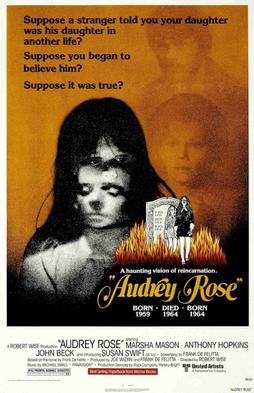
The 1977 film, Audrey Rose, tells the story of an annoying little girl named Ivy (Susan Swift), who is the daughter of annoying Janice (Marsha Mason) and annoying Bill (John Beck). Everything seems to be perfectly normal in an annoying way until, one day, they notice that they’re being followed around by an annoying man named Elliott (Anthony Hopkins). Elliott explains that Ivy is the reincarnation of his daughter, Audrey Rose, who was herself kind of annoying. Whenever Elliott says, “Audrey Rose,” Ivy going into a trance and starts screaming, which gets a bit annoying after a while. Elliott explains this is because Audrey died in a fiery car crash and was apparently reincarnated too soon after her death. Therefore, anytime Elliott shows us, Ivy relives the crash and tries to burn herself. Annoying!
To me, it seems like there’s a simple solution to all of this. Elliott could just go away or, at the very least, stop saying, “Audrey Rose” every ten seconds. Anyway, at one point, Ivy starts screaming so Elliott rushes into the apartment and makes her stop. However, Elliott is accused of attempting to abduct Ivy, arrested, and put on trial.
Elliott’s defense is that he couldn’t abduct his own daughter so therefore, if Ivy is the reincarnation of Audrey Rose, then he’s innocent. Somehow, this leads to the trial becoming about proving reincarnation. Hindu holy men are called to the stand. Elliott smirks and tells his lawyer to call Janice to the stand because he’s figured out that Janice believes him. Meanwhile, Ivy finds herself drawn towards every fire that she sees…
Audrey Rose was directed by a legitimately great director, Robert Wise. Unfortunately, Wise takes the material way too seriously. Just when you think the film is going to be an over the top possessed child flick, it suddenly turns into a turgid and serious debate about reincarnation. The movie is so busy trying to be realistic that it forgets to be fun.
There’s also a lot of yelling in Audrey Rose. In between Ivy screaming and Elliott continually calling his dead daughter’s name and Bill arguing with Janice and random characters screaming whenever Ivy gets to close to a fire, it’s easy to get a headache while watching this film.
Mason and Beck are pretty lousy in the roles of Janice and Bill. Hopkins brings an occasionally neurotic edge to the role of Elliott. You never quite trust him, even though the movie wants you to. The best performances in the film come from the performers in the minor roles, character actors like Norman Lloyd, Robert Walden, and John Hillerman. None of them are required to pretend like they’re taking their dialogue seriously and, as such, they’re a lot more fun to watch.
All in all, Audrey Rose is a fairly silly movie. For some reason (probably the presence of Hopkins), it does seem to show up on TCM fairly regularly but I wouldn’t recommend watching. If you want to see a good Robert Wise horror movie, check out The Haunting.
(Lisa is currently in the process of trying to clean out her DVR by watching and reviewing all 40 of the movies that she recorded from the start of March to the end of June. She’s trying to get it all done by July 11th! Will she make it!? Keep visiting the site to find out!)
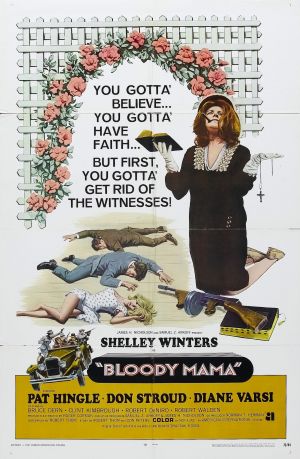
The 24th film on my DVR was the 1970 Roger Corman-directed gangster film, Bloody Mama. I recorded it off of TCM on May 27th.
Bloody Mama opens with a cheerful song that goes, “Maaaaaama…Bloody maaaaama….” and it’s such an unapolegetically over the top song that it perfectly sets the tone for what’s to follow. Bloody Mama is violent, occasionally perverse, and totally unashamed. It doesn’t pretend to be anything that it isn’t. It’s bloody and it’s about a mother and, in the best Corman tradition, it makes no apologies!
The film tells the heavily fictionalized story of the Barkers, a group of brothers who robbed banks and killed people in the 1920s and 30s. The majority of them were killed in a gunfight with the FBI. Also killed in the gunfight was their mother, Kate Barker. Always aware of the danger of bad publicity, the director of the FBI, J. Edgar Hoover, announced that Ma Barker was actually the mastermind of the Barker gang and that she was even more dangerous than her sons. Ever since, historians have debated whether Ma Barker was the criminal mastermind described by Hoover or if she was just the innocent woman described by … well, by everyone who actually knew her.
Bloody Mama, of course, leaves no doubt. From the minute that we discover that Shelley Winters will be playing Ma Barker, we know that she’s the most dangerous woman alive. As played by Winters, Ma Barker is a ruthless bank robber, one who has no fear of gunning down innocent bystanders and who never lets her love for her sons get in the way of ordering them to kill a witness. As opposed to a lot of gangster films made in the late 60s and early 70s, the film never attempts to portray its title character as being a heroic or particularly sympathetic character. Instead, what makes the character compelling is just how thoroughly Winters commits to the role. It doesn’t matter what Ma Barker is doing or saying, Shelley Winters totally sells it. When the gang is cornered by the police and one associate makes the mistake of yelling that he’s not a Barker, Ma reacts by gunning him down herself and you can’t help but appreciate the lengths that Ma will go to defend her family’s name.
As for her sons, they are an interesting group of perverts and drug addicts and they’re played some of the best character actors of the 1970s.
Herman Barker (Don Stroud) is a sadist but he’s also one of Ma’s favorites. He travels with a prostitute (played by Diane Varsi), who quickly tires of the Barkers’s violent way of life.
Arthur Barker (Clint Kimbrough) is the most practical of the Barkers and therefore, he’s also the least interesting.
Fred Barker (Robert Walden) is bisexual, which is a fact that the film handles with all the sensitivity that we’ve come to expect from a film made in 1970 (which is to say, not much at all). Fortunately, Fred’s lover is Kevin and Kevin is played by Bruce Dern and Bruce Dern is always a lot of fun to watch, especially when he’s appearing in a Corman film.
And then there’s Lloyd who sniffs glue and shoots heroin and who is played by an obscure young actor named Robert De Niro and … wait, Robert De Niro! That’s right! One of the pleasures of Bloody Mama is getting to see De Niro at the start of his career. Unfortunately, he doesn’t really get to do much, though he does occasionally flash the same unhinged smile that would later show up in Taxi Driver.
Roger Corman has repeatedly cited Bloody Mama as being one of his favorites of the many movies that he directed over the course of his long career. I don’t blame him. It’s a thoroughly shameless and totally entertaining film!
Keep an eye out for Bloody Mama!
Just remember, the real-life Ma Barker was probably innocent.
(I wrote an earlier version of this review for HorrorCritic.Com.)
Occasionally, on twitter, I would take part in the Drive-In Mob live tweet session. Every Thursday night, a group of exploitation, grindhouse, and horror film fans gog together and watched the same film and, via twitter, provided their own running commentary track. It was always terrific fun and a good opportunity to discover some films that you might have otherwise missed. It was through the Drive-In Mob that I first discovered a low-budget cult classic from 1978, Blue Sunshine.
Blue Sunshine (directed by the underrated horror director Jeff Lieberman) opens in the late 1970s. Across California, people are suddenly going bald and turning psychotic. At a party, singer Frannie Scott (played by Richard Crystal) has a nervous breakdown when another reveler playfully pulls off his wig and reveals Frannie to be hairless. Frannie responds by tossing half of the guests into the fireplace and then running out into the night. He’s pursued by his best friend Jerry Zipkin (played by future director Zalman King) but when Frannie is accidentally killed while running away, Jerry finds himself accused of being a murderer. Even as the police pursue him, Jerry starts his own investigation. He quickly discovers that there’s an epidemic of bald people suddenly murdering those closest to them. The one thing that these people have in common: they all attended Stanford University in the late 1960s and they all used a powerful form of LSD known as “blue sunshine.” Now, ten years later, they’re all having the worst flashback imaginable.
And, perhaps most dangerously, the campus drug dealer, spoiled rich kid Edward Fleming (Mark Goddard), is on the verge of being elected to the U.S. Congress. Not only it is possible that Edward may have taken the acid himself but Edward and his campaign manager have their own reasons to try to make sure that Jerry never reveals the truth behind Blue Sunshine.
Blue Sunshine is probably one of the best of the old grindhouse films, a film that embraces the conventions of both the horror and the political thriller genres while, at the same time, neatly subverting our expectations. Director Jeff Lieberman emphasizes atmosphere over easy shocks and the film’s cast does a pretty good job of making us wonder who is normal and who has dropped the blue sunshine. Wisely, Lieberman doesn’t resort to giving us any easy villains in this film. Much like the best horror films, the monsters in Blue Sunshine are as much victims as victimizers. I especially sympathized by one poor woman who was driven to rip off her wig by the sound of two particularly obnoxious children chanting, “We want Dr. Pepper!” over and over again. Seriously, that’s enough to drive anyone crazy.
Blue Sunshine is one of those wonderfully odd little cult films that makes me thankful that I own a DVD player. First released in 1978, Blue Sunshine mixes psychological horror with political conspiracy and the end result is an unusually intelligent B-movie that remains relevant even when seen today. Blue Sunshine was originally released on DVD by Synapse Entertainment and it has since been re-released by the New Video Group. I own the Synapse edition, which features a very entertaining director’s commentary with Jeff Lieberman as well as a bonus CD of the film’s haunting and atmospheric score.
Last night, the temperature plunged here in Texas. When I woke up this morning, I was confronted with a world that was literally frozen. Needless to say, nobody in Dallas went to work today. Instead, we all sat in our houses and tried to keep ourselves entertained. I kept myself occupied by watching a film that was initially released way back in 1978 and which takes place in my home state.
The name of that film was Capricorn One and it’s the latest entry in the 44 Days of Paranoia.
Capricorn One begins with three astronauts preparing to take the fist manned space flight to Mars. James Brolin is the stoic leader. Sam Waterston is the guy who has a joke for every occasion. And O.J. Simpson is … well, O.J. really doesn’t have much of a personality. He’s pretty much just along for the ride.
However, it turns out that there really isn’t going to be a ride. Just as the countdown begins, the astronauts are ordered to leave the capsule. They are then transported to secret base in the Texas desert. It’s here that they have a meeting with the Head of NASA, who is played by Hal Holbrook. (It’s simply not a 70s conspiracy film if Hal Holbrook isn’t somehow involved). Holbrook proceeds to deliver a stirring monologue where he talks about how he and Brolin have always dreamed of sending a manned flight to Mars. However, as Holbrook explains, the life support system on the crew’s ship was faulty. If Holbrook had allowed them to be launched, they would have died as soon as they left the Earth’s atmosphere. However, if the mission had been canceled then there was a chance that the President would use that cancellation as an excuse to cut NASA’s funding.
So, as Holbrook explains, an empty spaceship has been launched into space. As far as the American public is concerned, the three astronauts are currently on their way to Mars. Now, in order to save the space program, they are going to have to fake the mission. In a studio, a fake alien landscape has been set up and it’s from that studio that Brolin, Waterston, and Simpson will pretend to explore Mars.
Brolin, Waterston, and Simpson reluctantly agree to cooperate with the plan. However, after doing the first fake broadcast, Brolin starts to have second thoughts. Realizing that he can’t trust the three astronauts to keep a secret, Holbrook announces that the capsule’s heat shields failed during re-entry and that the crew of Capricorn One is now dead. Now, all he has to do is have the three of them killed for real.
Meanwhile, a NASA technician (Robert Walden) stumbles onto evidence of the deception. He subsequently vanishes but not before he tells reporter Elliott Gould about his suspicions. While the three astronauts try to escape from Holbrook’s agents, Gould tries to find out what really happened to Capricorn One.
It’s probably half-an-hour too long, the plot is full of holes (the least of which being why Holbrook waited until after he had announced the fake deaths to order the real deaths), and director Peter Hyams allows a few scenes to run on and on while others seem to end with a jarring abruptness. However, for the most part, Capricorn One is a well-acted and solidly entertaining film. However, there are two things that make Capricorn One especially memorable.
First off, Capricorn One features one of the most exciting action sequences that I have ever seen. It occurs while Gould is investigating Walden’s disappearance. After visiting Walden’s apartment and discovering that it’s inhabited by a woman who claims to have never heard of his friend, Gould is driving away when he discovers that his brakes have been disabled. The car then starts to accelerate and Gould finds himself desperately trying to regain control as the car careens through the streets of Houston. The scene is shot almost entirely from Gould’s point-of-view and, for five minutes, we watch as everything from other cars to unlucky pedestrians come hurtling towards the car. For those few minutes, when the viewer and Gould become one, Capricorn One is not only exciting but it feels genuinely dangerous as well.
Secondly, Capricorn One features some of the oddest dialogue imaginable. Peter Hyams not only directed the film but he also wrote the screenplay as well. Watching the film, one gets the feelings that Hyams was so in love with his dialogue and with all of his quirky characters that he simply could not bring himself to cut anything or anyone. As a result, the film is full of lengthy monologues. When the characters speak to each other, they don’t have conversations as much as they trade quips. Characters like Gould’s ex-wife (played by Karen Black) and his editor (David Doyle) show up for a scene or two, deliver monologues that are only tangibly related to the film’s plot, and then vanish. Sam Waterston ends up telling the world’s longest joke while he climbs a mountain in the desert. Towards the end of the film, Telly Savalas (who was in my favorite Mario Bava film, Lisa and the Devil) shows up as a foul-tempered crop duster and engages in a long argument with Gould who, despite being a reporter, never bothers to question why Savalas would have a crop dusting business in the middle of the desert.
But here’s the thing — it works. As odd as some of the dialogue may be and as superfluous as some of the action is to the overall plot, it still all works to the film’s benefit. The constant quirkiness works to keep the audience off-balance and to give Capricorn One its own unique rhythm.
Capricorn One — see it now before Michael Bay remakes it.
During my sophomore year of college, I had a political science professor who, every day of class, would sit on his desk and ramble on and on and on about his past as a political activist. He protested Viet Nam, he hung out with revolutionaries, he loved Hugo Chavez, and I assume he probably had a Che Guevara poster hanging in his office. Whenever he wanted to criticize George W. Bush, he would compare him to Richard Nixon and then pause as if he was waiting for the class to all start hissing in unison. He always seemed to be so bitterly disappointed that we didn’t. What he, and a whole lot of other people his age, didn’t seem to understand was that Richard Nixon was his boogeyman. The rest of us could hardly care less.
That was the same problem that faced the 2008 best picture nominee Frost/Nixon.
Directed rather flatly by Ron Howard, Frost/Nixon tells the true story about how a light-weight English journalist named David Frost (played by Michael Sheen) managed to score the first televised interview with former President Richard Nixon (Frank Langella). Both Frost and Nixon see the interviews as a chance to score their own individual redemptions while Frost’s assistants (played by Oliver Platt and Sam Rockwell) see the interview as a chance to put Richard Nixon on trial for Watergate, the Viet Nam War, and every thing else under the sun. That may not sound like a very exciting movie but it does sound like a sure Oscar contender, doesn’t it?
I’ve always secretly been a big history nerd so I was really looking forward to seeing Frost/Nixon when it was first released in 2008. When I first saw it, I was vaguely disappointed but I told myself that maybe I just didn’t know enough about Richard Nixon or Watergate to really “get” the film. So, when the film later showed up on cable, I gave it another chance. And then I gave it a chance after that because I really wanted to like this film. Afterall, it was a best picture nominee. It was critically acclaimed. The word appeared to be insisting that this was a great film. And the more I watched it, the more I realized that the world was wrong. (If nothing else, my reaction to Frost/Nixon made it easier for me to reject the similarly acclaimed Avatar a year later.) Frost/Nixon is well-acted and slickly produced but it’s not a great film. In fact, Frost/Nixon is epitome of the type of best picture nominee that inspires people to be cynical about the Academy Awards.
Before I get into why Frost/Nixon didn’t work for me, I want to acknowledge that this was a very well-acted film. By that, I mean that the cast (Frank Langella, Michael Sheen, Kevin Bacon, Sam Rockwell, and Oliver Platt) all gave very watchable and entertaining performances. At the same time, none of them brought much depth to their characters. Much like the film itself, nobody seems to have much going on underneath the surface. Frank Langella may be playing a historic figure but, ultimately, his Oscar-nominated performance feels like just a typically grouchy Frank Langella performance. Michael Sheen actually gives a far more interesting performance as David Frost but, at the same time, the character might as well have just been identified as “the English guy.” In fact, a better title for this film would have been The Grouchy, the English, and the Superfluous.
For all the time that the film devotes to Rockwell and Platt blathering on about how they’re going to be giving Richard Nixon “the trial he never had,” this film is ultimately less about politics and more about show business. Ron Howard devotes almost as much time to the rather boring details of how the interviews were set up and sold into syndication as he does to the issues that the interview brings up. Unfortunately, for a movie about show business to succeed, the audience has to believe that the show is one that they would actually enjoy watching, This, ultimately, is why Frost/Nixon fails. While the filmmakers continually tell us that the Frost/Nixon interviews were an important moment in American history, they never show us. Yes, everyone has hideous hair and wide lapels but, otherwise, the film never recreates the period or the atmosphere of the film’s setting and, as a result, its hard not to feel detached from the action happening on-screen. For all the self-congratulatory claims made at the end of the film, it never convinces us that the Frost/Nixon interviews were really worth all the trouble. Much like my old poli sci professor, Frost/Nixon never gives us a reason to care.
For a far more interesting and entertaining look at the Watergate scandal, I would recommend the 1976 best picture nominee All The President’s Men. Recreating the story of how two Washington Post reporters (played by Robert Redford and Dustin Hoffman) exposed the Watergate scandal that eventually led to Nixon’s resignation, All The President’s Men is the movie that Frost/Nixon wishes it could be. Despite being made only two years after Watergate, All The President’s Men doesn’t take the audience’s interest for granted. Instead, director Pakula earns our interest by crafting his story as an exciting thriller. Pakula directs the film like an old school film noir, filling the screen with menacing shadows and always keeping the camera slightly off-center. Like Frost/Nixon, All The President’s Men is a well-acted film with a bunch of wonderful 70s character actors — performers like Ned Beatty, Jason Robards, Jack Warden, Martin Balsam, and Robert Walden, and Jane Alexander — all giving effectively low-key and realistic performances. The end result is a film that manages to be exciting and fascinating to those of us who really don’t have any reason to care about Richard Nixon or Watergate.
Both of these two films were nominated for best picture. Frost/Nixon quite rightly lost to Slumdog Millionaire. All The President’s Men, on the other hand, lost to Rocky.

 Through the Shattered Lens