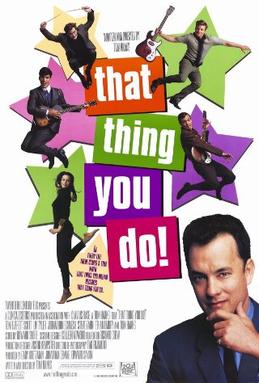
That Thing You Do! (1996, directed by Tom Hanks)


That Thing You Do! is the story of a one-hit wonder.

In 1964, an aspiring Jazz drummer named Guy (Tom Everett Scott) is a last minute addition to the a local band called the Oneders.  (It’s meant to sound like Wonders but almost everyone mispronounces it as O-Needers.)  The band’s egotistical leader, James (Jonathon Schaech) has written a slow ballad called That Thing You Do! but when Guy’s drumming causes the band to perform the song at a faster tempo, they end up with a local hit on their hands.  That local hit becomes a national hit when The Oneders are signed by Play-Tone Records.  First, Mr. White (Tom Hanks), their new manager, officially changes the name to The Wonders.  Secondly, he makes sure that every teen in America is dancing to That Thing You Do!  Third, he tells Guy to always wear sunglasses.  Fourth, he tells James that he will record and perform what Play-Tone tells him to.  Guitarist Lenny (Steven Zahn) and the unnamed Bass Player (Ethan Embry) are happy to be along for the ride but James chafes at his lack of artistic freedom.  Guy, meanwhile, falls for James’s girlfriend (Liv Tyler, at her loveliest) and dreams of meeting his idol, jazzman Del Paxton (Bill Cobbs).

That Thing You Do! was Tom Hanks’s directorial debut and, with its careful recreation of a bygone era and its collection of authentic sounding early 60s rock on the soundtrack, it was obviously a labor of love.  Considering the number of times that the song is played in the movie, it helps that it is a very good song.  That Thing You Do! is a catchy tune, one that you can’t help but tap your feet to.  At the same time, it also sounds like a one hit wonder.  It’s good but not so great as to make you expect much else from The Wonders.

Not surprisingly, Tom Hanks gets great performances from the entire ensemble cast.  Johnathon Schaech and Tom Everett Scott have never been better.  Liv Tyler is lovely and vulnerable as James’s unappreciated girlfriend.  Familiar faces like Peter Scolari, Kevin Pollak, Chris Isaak, and Clint Howard make welcome appearances.  Hanks himself is surprisingly intimidating as Mr. White.  When he says that the band will cover something the Play-Tone catalogue, it’s obvious that he’s not making a request.

The film is a tribute to being young and to loving music bit it’s also a study in the disillusionment of discovering that everything is ultimately a business.  James is frequently an arrogant jerk and he treats his girlfriend terribly but it’s hard not to sympathize with him when he says that he wants to do more than just cover songs from the Play-Tone catalogue.  To James and Guy, the Wonders are about self-expression and their love of music.  To Mr. White, the Wonders are just another band that came up with one catchy tune and who probably aren’t ever going to be heard from again.   That Thing You Do! pays tribute to all of the one-hit wonders out there, the bands who you forget about until you just happen to hear that one song on the radio or in a movie and suddenly, all the memories come flooding back.
 

Love on the Shattered Lens: Something Wild (dir by Jonathan Demme)


1986’s Something Wild opens with Charlie Driggs (Jeff Daniels) eating lunch in a New York diner.

Charlie is a stockbroker.  He wears a suit.  He’s quiet and mild-mannered.  He just got a promotion at work.  He carries a picture of his kids in his wallet.  Everything about Charlie shouts that he’s a nice guy who is extremely conventional in his outlook and behavior.  But then, Charlie sneaks out of the diner without paying and is spotted by a woman (Melanie Griffith) who says that her name is Lulu.

Dressed in black and with a brunette bob that makes her look like Louis Brooks (and which is later revealed to be a wig), Lulu chases after Charlie.  She offers him a ride back to his job, downtown.  However, when Charlie gets in the car, Lulu instead speeds off towards New Jersey.  Lulu grabs Charlie beeper and throws it away.  (I guess that was the 80s equivalent of stealing someone’s phone.)  She stops off at a liquor store and robs the place while Charlie unknowingly waits out in the car.  She takes him to a motel and, after handcuffing to the bed, has sex with him and calls his office….

And then the film takes an unexpected turn.  What started out as one of those NSFW stories that occasionally cropped up on Internet message boards suddenly turns into a quirky slice of Americana.  Lulu and Charlie head to Pennsylvania for Lulu’s high school reunion.  Lulu reveals that her real name is Audrey and she’s actually blonde.  Audrey introduces Charlie to her family as being her husband and Charlie plays along with her.  At the reunion, Charlie turns out to be just as skillful a liar as Audrey.  But there’s nothing particularly mean-spirited about their lies.  Audrey wanted to be able to brag about having a wonderful husband at her reunion and Charlie, whose wife left him for a dentist, wanted to pretend that he was still married and still a regular part of his children’s lives.  The reunion itself is a masterful set piece, one in which director Jonathan Demme balances his trademark quirky humor with a genuine love for small town American.  With the old school bands playing in front of an American flag, Demme transforms the reunion into a metaphor for everything good about this country.  It’s a place where two lonely people can find each other.  The weekend may have started out like a middle-aged man’s fantasy but Charlie finds himself falling in love with the real Audrey.  It’s very sweet and humorous and it makes you feel good about life in general….

And then Ray shows up and the film takes another unexpected turn.  Played by Ray Liotta, Ray is Audrey’s ex-husband.  He’s a charmer, as one might expect from a character played by a young Ray Liotta.  Ray is friendly with Charlie, telling him stories about how wild Audrey was in high school.  It’s only as the night progresses that it becomes obvious that Ray is a sadistic sociopath and he wants Audrey back.

The violence in the film’s second half is a bit jarring.  After the good-natured, screwball comedy of the film’s first 50 minutes, it’s shocking to suddenly see Ray pistol-whipping a clerk and then breaking Charlie’s nose.  At the same time, meeting Ray allows us to know what it was that attracted Audrey to Charlie.  Charlie is the opposite of Ray, a good man who truly cares about other people.  Ray is the type of bad boy who is very attractive when you don’t know any better.  Charlie is the guy who seems conventional but, underneath it all, turns out to be something wild as well.

Directed by Jonathan Demme, Something Wild has a good eye for the quirkiness of America.  It portrays the world out of New York with love and none of the condescension that tends to show up in so many other road trip movies.  Daniels, Griffith, and the much-missed Ray Liotta all gives performance that take the viewer by surprise.  None of them are who we originally assume them to be and Griffith’s deconstruction of the type of character who would later be termed a “manic pixie dream girl” is probably her best and most honest performance.  Even Ray, for all his violent tendencies, has moments of humanity.  Something Wild is a celebration of life, rebellion, and love.  Like Charlie and Audrey, it’s more than worth taking a chance on.

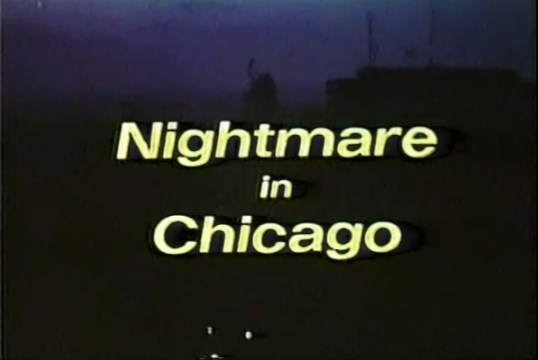
Made-for-TV Movie Review: Nightmare in Chicago (dir by Robert Altman)


Taking place over the course of one very long day and night in December, this 1964 made-for-television movie opens with the discovery of a murdered woman in Indiana.  She is the latest victim of a killer that the press has nicknamed “Georgie Porgie.”

Georgie Porgie, who has killed five blondes in the Midwest, is actually a nondescript man named Myron Ellis (Philip Abbott).  Myron is middle-aged, short, and fairly normal-looking.  That, along with the fact that he’s always moving, is one reason why he has yet to be captured.  The only thing that really stands out about Myron is that, due to a medical condition, he is extremely sensitive to light and always wears dark glasses, even at night.  When Myron isn’t murdering someone or stealing a car, he’s haunted by the voice of his dead sister.

Because he is a nomadic killer, the authorities in Chicago are worried that Myron is coming to their town next and it turns out that they’re correct.  Myron is already in Chicago and he’s looking for his next victim.  In a rather disturbing scene, he strangles a woman that he meets at a strip club, managing to do so without any of the many people around them even noticing.  Myron wanders up and down the streets of Chicago, looking for his next victim.  With his polite manners and his bland appearance, no one suspects that the polite man on the street corner is actually a murderer.

Police Commissioner Lombardo (Ted Knight) and Detectives McVea (Robert Ridgley) and Brockman (Charles McGraw) decide that the best way to catch the killer would be to set up a dragnet on the highway, stopping cars and shining flashlights at the drivers to see who has the weakest eyes.  The only problem is that there is also a nuclear missile convoy scheduled to move through the city at the same time.  With the highways congested and the killer not above wrecking his own car to throw the police off his trail, Lombardo tries to both capture the killer and make sure nothing happens to the convoy.

Nightmare In Chicago is a short and efficient thriller.  It’s well-acted and rather serious in its approach.  Especially when compared to more recent films with similar plots, Nightmare In Chicago deserves some credit for not trying to turn its serial killer into some sort of diabolical mad genius.  Myron, like all serial killers in real life, is a maladjusted and rather stupid person who has only gotten away with his crimes due to pure luck.  He’s not a Hannibal Lecter-style supergenius.  Instead, he’s just a creep who has many, many issues.  The film also does a good job of capturing the manic energy and eventual exhaustion of pulling an all-nighter.  It’s an effective little film with a memorably sordid story.

For modern audiences, probably the most interesting thing about Nightmare in Chicago is that it was directed by Robert Altman and was, in fact, his second non-documentary film after The Delinquents.  At the time he made this film, Altman was largely working in television.  Nightmare In Chicago was one of the first made-for-TV movies and it was a ratings and critical success.  Seen today, it’s easy to spot Altman’s trademark attention to detail in the film.  While it’s far more straight-forward than the majority of his feature films, Nightmare in Chicago still displays the talent that eventually led to Robert Altman become one of Americas most important filmmakers.

Life Stinks (1991, directed by Mel Brooks)


Goddard Bolt (Mel Brooks), the massively wealthy CEO of Bolt Enterprises, wants to buy up a huge area of Los Angeles’s slums and tear them down, transforming the area into a chic neighborhood and moving all of the poor residents and street people out.  Rival businessman Vaughn Craswell (Jeffrey Tambor), who grew up in the slum and dreams of destroying it himself, has the same plan.  He and Bolt make a bet.  If Bolt can survive for 30 days on the streets, Craswell will allow Bolt to have the property.  Bolt agrees and soon, he is penniless and sleeping in alleys.  While Bolt befriends Sailor (Howard Morris) and Fumes (Theodore Wilson) and falls in love with a former dancer named Molly (Lesley Ann Warren), Craswell schemes to take over Bolt’s company and keep Bolt on the streets permanently.

Life Stinks was one of Mel Brooks’s attempts to make a straight comedy that wasn’t a parody and which had a serious message underneath the laughs.  The mix of comedy and drama doesn’t really gel,  because the drama is too dark and the comedy is too cartoonish.  Life Stinks is often guilty of romanticizing living on the streets.  With the exception of two muggers, everyone whom Bolt meets is a saint.  It is still interesting to see Brooks creatively at his most heartfelt and humanistic.

Life Stinks does feature some of Mel Brooks’s best work as an actor and it’s also features an excellent turn from Lesley Anne Warren.  At first, I thought Warren would be miscast as a woman who spent her days in a soup kitchen and her nights sleeping in an alley.  But she actually gives a very sweet and believable performance.

No matter what else, Mel Brooks is a true mensch.


Scenes That I Love: The Awards Ceremony From Boogie Nights


I would like to think that when the Palme d’Or is awards in Cannes, it’ll be half as exciting as when Dirk Diggler (Mark Wahlberg) picked up his second Best Actor trophy in Paul Thomas Anderson’s Boogie Nights.

Now, the scene below is actually the extended version of the scene that actually appeared in the movie.  In the movie, you just see Jack Horner (Burt Reynolds) watching his latest film and then cut to Dirk picking up his award.  In the extended version, we get to see everyone’s reaction to Dirk winning.  They’re all there — Burt Reynolds, William H. Macy, Nina Hartley, John C. Reilly, Melora Waters, Luis Guzman, Julianne Moore, Heather Graham, Don Cheadle, Robert Ridgely (as the memorably corrupt Colonel), and, of course, the dearly missed Philip Seymour Hoffman.

I can understand why Anderson chose to go with a shortened version of this scene.  Boogie Nights is a long film and obviously, it wasn’t totally necessary to see how everyone reacted to Diggler’s victory.  (By that point, in the film, we already knew how everyone felt about him.)  That said, I do prefer the extended version.  If nothing else, it’s a reminder that Boogie Nights was more than just the story of Dirk Diggler.  Instead, it was the story of a group of outcasts who became a family.

Anyway, let’s hope that whoever wins the Palme d’Or will be a bit more enthusiastic about it than Dirk.

Film Review: Prime Time (1977, directed by Bradley R. Swirnoff)


Prime TimeThe great character actor Warren Oates appeared in a lot of fairly obscure movies but none are as obscure as Prime Time.

With a running time of barely 70 minutes, Prime Time is a comedic sketch film that was meant to capitalize on the then-recent success of The Groove Tube, Tunnelvision, The Kentucky Friend Movie, and the first season of Saturday Night Live.  According to the Unknown Movies Page, Prime Time was financed independently and was picked up for distribution by Warner Bros.  After the Warner execs saw the finished film, they decided it was unreleasable so the film’s production team sold the film to Cannon Pictures, who were famous for being willing to release anything.  The movie played in a few cities under the terrible title American Raspberry and then went straight to VHS obscurity.

Sketch comedies are usually hit-and-miss and Prime Time is definitely more miss than hit.  The majority of the film is made up of commercial parodies but, since most of the commercials being parodied are no longer on the air, the humor has aged terribly.  There is also a wrap-around story.  The President (George Furth) and a general (Dick O’Neill) try to figure out where the commercial parodies are coming from and stop them before the broadcast leads to a riot.   There are a few funny bits (including Harry Shearer as a stranded trucker looking for a ride and Kinky Friedman singing a song about “Ol’ Ben Lucas who has a lot of mucus”) but, for the most part, the film is epitomized by a skit where people literally get shit dumped on their head.  The film’s opens with an incredibly racist commercial for Trans Puerto Rican Airlines and it’s all downhill from there.

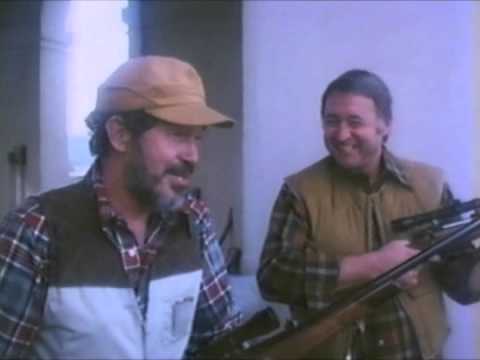
As for Warren Oates, he appears in an early skit.  He and Robert Ridgely (best known for playing Col. James in Boogie Nights) play hunters who take part in the Charles Whitman Celebrity Invitational, climbing to the top of the Tower on the University of Texas campus and shooting at the people below.  It’s even less funny now than it probably was in 1977.

How did Warren Oates end up in a movie like Prime Time?  Even great actors have bills to pay.  As for Prime Time, it is the one Warren Oates film that even the most dedicated Warren Oates fan won’t regret missing.

Warren Oates and Robert Ridgely in Prime Time

Warren Oates and Robert Ridgely in Prime Time

Embracing the Melodrama Part II #93: Boogie Nights (dir by Paul Thomas Anderson)


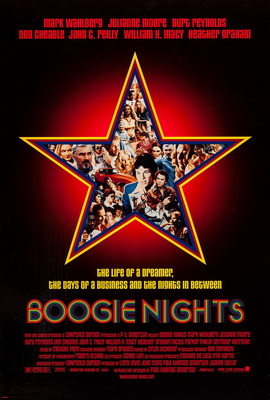
Boogie_nights_ver1The 1997 film Boogie Nights (which, amazingly enough, was not nominated for best picture) is a bit of an overwhelming film to review.  It’s a great film and, if you’re reading this review, you’ve probably seen Boogie Nights and you probably already know that it’s a great film.  And if you haven’t seen Boogie Nights, you really should because it’s a great film.  So, this review, in short, amounts to: Great film.

Boogie Nights takes place in the late 70s and the early 80s.  Eddie Adams (Mark Wahlberg) is a high school dropout who works as a busboy, lives with his parents, and has a really big cock.  (Indeed, one of the film’s most famous lines is, “This is a giant cock.”)  When we first meet Eddie, he’s likable and cute in a dumb sort of way.  Then he meets adult film director Jack Horner (Burt Reynolds) and becomes a star.  At first, everything is great.  Eddie changes his name to Dirk Diggler and no longer has to deal with his abusive mother (a chilling Joanna Gleason).  Jack and Amber Waves (Julianne Moore) become his new parents.  He gets a cool older brother in the form of actor Reed Rothschild (John C. Reilly, totally nailing the “People tell me that I look like Han Solo,” line).  He makes friends with other adult film actors, like the desperately unhip Buck (Don Cheadle), the free-spirited (and secretly very angry) Rollergirl (Heather Graham), and the poignantly insecure Jessie St. Vincent (Melora Walters).  He gets new admirers, like Scotty J. (Philip Seymour Hoffman).  He also gets addicted to cocaine.  And while Dirk falls from stardom, the adult film industry is taken over by gangsters like Floyd Gondolli (Philip Baker Hall) and self-styled artists like Jack Horner find themselves pushed to the side.

And you may have noticed that I mentioned a lot of actors in the paragraph above.  That’s because Boogie Nights is a true ensemble piece.  It’s full of great performances and memorable characters.  Along with everyone that I mentioned above, the cast also includes William H. Macy as cinematographer “Little Bill” Daggett.  From the minutes we first meet Little Bill, we get the feeling that he might be a little bit too uptight for pornography.  Maybe that’s because his wife — played by the inspiring sex positive feminist and veteran adult film star Nina Hartley — is constantly and publicly cheating on him.  Macy and Hartley do not have as much screen time as the rest of the cast but, ultimately, their characters are two of the most important in the film.

And then there’s Robert Ridgely, who is marvelously sleazy as the paternal but ultimately icky Col. James.  When we first meet the Colonel, he’s almost a humorous character.  But then, suddenly, there’s one chilling scene where he opens up to Jack Horner and we are forced to reconsider everything that we had previously assumed about both the Colonel and his business.

And how can we forget Luis Guzman, as a club owner who desperately wants to appear in one of Jack’s films?  Or Ricky Jay as a plain-spoken cameraman?  Or how about Thomas Jane, playing one of those tightly wound characters who you know is going to be trouble as soon as you see him?  And finally, nobody who has seen Boogie Nights will ever forget Alfred Molina, singing along to Sister Christian and running down the street, clad only in black bikini briefs and firing a shotgun.

But it’s not just the actors who make Boogie Nights a great film.  This was Paul Thomas Anderson’s second film and, under his direction, we feel as if we’ve been thrown straight into Dirk’s exciting and ultimately dangerous world.  When the film begins, the camera almost seems to glide, capturing the excitement of having everything that you could possibly want.  But, as things go downhill for Dirk, the camerawork gets more jittery and nervous.   A sequence where Anderson cuts back and forth between Jack trying to shoot a movie on video (as opposed to his beloved film) and Dirk nearly being beaten to death in a parking lot remains one of the best sequences that Anderson has ever directed.

And then there’s the music!  Oh my God!  The music!

And the dancing!

And the singing!

I’ll be the first admit that I have no idea whether or not Boogie Nights is a realistic portrait of the adult film industry in the 70s and 80s.  But ultimately, Boogie Nights is not about porn.  It’s about a group of outsiders who form their own little family.  At the end of the film, you’re happy that they all found each other.  You know that Dirk will probably continue to have problems in the future but you’re happy for him because, no matter what happened in the past or what’s going to happen in the future, you know that he’s found a family that will always love him.

As I mentioned at the start of this appreciation, Boogie Nights was not nominated for best picture.  Titanic was named the best picture of 1997.  As I’ve said before, I loved Titanic when I was 12.  But, nearly 18 years later, Boogie Nights is definitely the better picture.

It has stood the test of time.