Retro Television Review: Fantasy Island 1.1 “Escape” / “Cinderella Girls”


Welcome to Retro Television Reviews, a feature where we review some of our favorite and least favorite shows of the past!  On Tuesdays, I will be reviewing the original Fantasy Island, which ran on ABC from 1977 to 1996.  The entire show is currently streaming on Tubi!

Smiles, smiles, everyone….

Episode 1.1 “Escape/Cinderalla Girls”

(Directed by Don Weis, originally aired on January 28th, 1978)

Last week, while reviewing the Fantasy Island pilot, I commented on the fact that Mr. Roarke seemed to be a bit sinister, almost as if he took delight in the idea of mortals discovering that their fantasies weren’t as wonderful as they were expecting.

In the first regular episode of Fantasy Island, it’s made clear that, while Mr. Roarke may occasionally act like he doesn’t care, it’s only to teach a lesson.
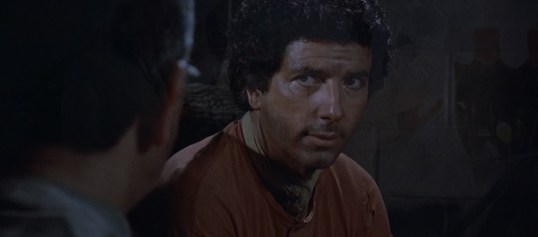
When internationally renowned stage musician Gregory Udall (Bert Convy) requests that he be allowed to perform the world’s greatest escape, Mr. Roarke doesn’t appear to be the least bit concerned when Udall is transported to Devil’s Island, the infamous French island prison.  Devil’s Island was known for being escape proof.  It was also known for being harsh even by the prison standards.  75% of the people sentenced to Devil’s Island died before their sentence ended.  When Udall reaches the island, he discovers that the Warden (Reggie Nadler, best-known for playing the vampire in Salem’s Lost) doesn’t care whether he lives or dies.  He’s also told, by another prisoner named Ipsy Dauphin (Robert Clary), that Mr. Roarke regularly abandons people at the prison!

After Udall’s first escape fails, he is visited in the island’s infirmary by Mr. Roarke himself.  Udall says that he’s ready to give up and opt out of the fantasy.  Mr. Roarke informs him that failure is not an option.  He also suggests that Udall enjoy his cigarette because….
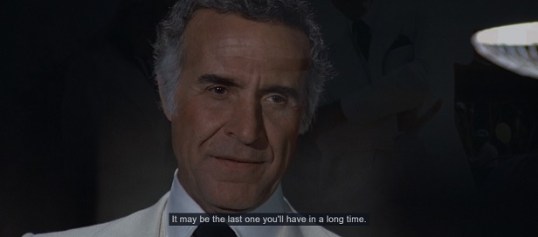
Agck!

Fear not, though, Mr. Roarke is not evil.  Instead, he’s just giving Udall the extra push that he needs to not only successfully escape from the prison but to take Ipsy with him as well.  Udall not only gets his confidence back but he also saves another human being.  Mr. Roarke may have seemed harsh but it was only to make sure that everyone got something out of the fantasy.  As well, it’s revealed that Ipsy was not actually prisoner but was instead Fantasy Island’s head chef.
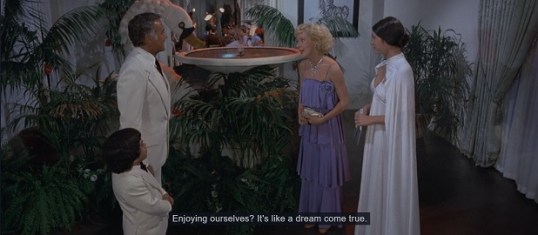
Mr. Roarke is far more cheerful in the episode’s other fantasy.  Georgia Engel and Diana Canova want to know what it’s like to be wealthy so they not only get makeovers but they also get a lot of new clothes.  Of course, being wealthy also means that they’ll be expected to bid at a charity auction that is being held on Fantasy Island.  (Apparently, Fantasy Island also doubles as a resort for people who don’t have fantasies but just want to spend the weekend hanging out by the pool.)  Georgia Engel ends up running away with a prince.  Diana Canova falls in love with an idealistic doctor who is played by John Saxon.  Does the doctor care that she doesn’t actually have any money?  Fortunately, it turns out that the doctor is poor himself.  Yay!

As you may have guessed, the first episode was a strange mismash of tones.  On the one hand, you had a silly but sweet story about two friends who wanted to pretend to be rich.  On the other hand, you’ve got a harsh prison story featuring Reggie Nadler as a desiccated villain and uber-70s actor Bert Convy as a stage musician.  It really shouldn’t work but it does, largely because the idea of the island is so appealing and Ricardo Montalban seems to be having fun in the role of Mr. Roarke.  Plus, who can resist John Saxon pretending to be from Texas?

The premiere episode got Fantasy Island off to a good start!  Would that continue next week?

Insomnia File #51: Ira & Abby (dir by Robert Clary)


What’s an Insomnia File? You know how some times you just can’t get any sleep and, at about three in the morning, you’ll find yourself watching whatever you can find on cable or Netflix? This feature is all about those insomnia-inspired discoveries!

Oh Lord.

So, if you were having trouble getting too sleep last night, you could have turned over to one of the many Showtime channels you could have watched the 2006 film, Ira & Abby.

I doubt it would have helped though.  Ira & Abby is one of those extremely cutesy little love stories where a neurotic guy meets a quirky woman and they spend the entire film having so many easily solved relationship problems that it’ll drive your anxiety through the roof just watching them.

Ira (Chris Messina) is the son of two psychologists (Judith Light and Robert Klein).  Ira is planning on becoming a psychologist himself and, of course, he’s in therapy.  At the start of the film, his therapist tells him that he’s beyond help and that he needs to do something spontaneous for once.  Ira takes this to mean that he should go the gym.

At the gym, Ira meets Abby (Jennifer Westfeldt), who is quirky and universally beloved by everyone who meets her.  (Westfeldt also wrote the script, which …. might explain a little.)  Abby has a positive attitude and lives with her musician parents (Fred Willard and Frances Conroy).  After Ira sees Abby somehow talk a mugger out of robbing everyone on a subway car, he decides that they have to get married.  Free-spirited Abby agrees.

Marriage follows!  Complications follow!  Annulment and remarriage and more follows!  Everyone ends up seeing a different therapist while, at the same time, Ira’s mom has an affair with Abby’s dad.  And yes, it eventually does end with every character in the film gathering in one room and taking part in a giant therapy session.  It’s exhausting to watch, largely because it just seems like all of the problems could be solved by people not being stupid or foolishly impulsive.  Ira is neurotic to the point of no longer being sympathetic.  Abby is so perfect and wonderful that you soon get sick of her and her positive attitude.  Even Ted Lasso would tell her to turn it down a notch.

The most frustrating thing about the movie is that it features good actors like Chis Messina but it goes out of its way to sabotage them every chance that it gets.  Out of the large and impressive cast, only Fred Willard and Judith Light manage to transcend the script.  I would have loved to have watched a movie just about their characters.

Previous Insomnia Files:

  1. Story of Mankind
  2. Stag
  3. Love Is A Gun
  4. Nina Takes A Lover
  5. Black Ice
  6. Frogs For Snakes
  7. Fair Game
  8. From The Hip
  9. Born Killers
  10. Eye For An Eye
  11. Summer Catch
  12. Beyond the Law
  13. Spring Broke
  14. Promise
  15. George Wallace
  16. Kill The Messenger
  17. The Suburbans
  18. Only The Strong
  19. Great Expectations
  20. Casual Sex?
  21. Truth
  22. Insomina
  23. Death Do Us Part
  24. A Star is Born
  25. The Winning Season
  26. Rabbit Run
  27. Remember My Name
  28. The Arrangement
  29. Day of the Animals
  30. Still of The Night
  31. Arsenal
  32. Smooth Talk
  33. The Comedian
  34. The Minus Man
  35. Donnie Brasco
  36. Punchline
  37. Evita
  38. Six: The Mark Unleashed
  39. Disclosure
  40. The Spanish Prisoner
  41. Elektra
  42. Revenge
  43. Legend
  44. Cat Run
  45. The Pyramid
  46. Enter the Ninja
  47. Downhill
  48. Malice
  49. Mystery Date
  50. Zola

Film Review: The Hindenburg (dir by Robert Wise)


80 years ago, on May 6th, 1937, the Hindenburg, a German airship, exploded in the air over New Jersey.  The disaster was not only covered live by radio reporter Herbert Morrison (whose cry of “Oh the humanity!” continues to be parodied to this day) but it was also one of the first disasters to be recorded on film.  Looking at the footage of the Hindenburg exploding into flame and sinking to the ground, a mere skeleton of what it once was, it’s hard to believe that only 36 people died in the disaster.  The majority of those who died were crew members, most of whom lost their lives while helping passengers off of the airship.  (Fortunately, the Hindenburg was close enough to the ground that many of the passengers were able to escape by simply jumping.)

Not surprisingly, there was a lot of speculation about what led to the Hindenburg (which has successfully completed 63 flights before the disaster) exploding.  The most commonly accepted explanation was that it was simply an act of God, the result of either lightning or improperly stored helium.  Apparently, there was no official evidence found to suggest that sabotage was involved but, even back in 1937, people loved conspiracy theories.

And really, it’s not totally implausible to think that the Hindenburg was sabotaged.  The Hindenburg was making its first trans-Atlantic flight and it was viewed as being a symbol of Nazi Germany.  One of the ship’s passengers, Captain Ernest Lehman, was coming to the U.S. in order to lobby Congress to give Germany helium for their airships.  With Hitler regularly bragging about the superiority of German industry, the theory was that an anti-Nazi crewman or passengers planted a bomb on the Hindenburg.  Since no individual or group ever stepped forward to claim responsibility, the theory continues that the saboteur must have perished in the disaster.

At the very least, that’s the theory put forward by a film that I watched earlier today, the 1975 disaster movie, The Hindenburg.

A mix of historical speculation and disaster film melodrama, The Hindenburg stars George C. Scott as Col. Franz Ritter, a veteran of the German air force who is assigned to travel on the Hindenburg and protect it from saboteurs.  Ritter is a Nazi but, the film argues, he’s a reluctant and disillusioned Nazi.  Just a few weeks before the launch of the airship, his teenage son was killed while vandalizing a synagogue.  Ritter is a patriot who no longer recognizes his country and George C. Scott actually does a pretty good job portraying him.  (You do have to wonder why a seasoned veteran of the German air force would have a gruff, slightly mid-Atlantic accent but oh well.  It’s a 70s disaster film.  These things happen.)

Ritter is assigned to work with Martin Vogel (Roy Thinnes), a member of the Gestapo who is working undercover as the Hindenburg’s photographer.  Tt soon becomes obvious that he is as much a fanatic as Ritter is reluctant.  Vogel is a sadist, convinced that every Jewish passenger is secretly a saboteur.  Thinnes is chilling in the role.  What makes him especially frightening is not just his prejudice but his casual assumption that everyone feels the same way that he does.

And yet, as good as Scott and Thinnes are, the rest of the cast is rather disappointing.  The Hindenburg features a large ensemble of actors, all playing characters who are dealing with their own privates dramas while hoping not to burn to death during the final 15 minutes of the film.  Unfortunately, even by the standards of a typical 70s disaster film, the passengers are thinly drawn.  I liked Burgess Meredith and Rene Auberjonois as two con artists but that was mostly because Meredith and Auberjonois are so charming that they’re fun to watch even if they don’t have anything to do.  Anne Bancroft has one or two good scenes as a German baroness and Robert Clary does well as a vaudeville performer who comes under suspicion because of his anti-Nazi leanings.  Otherwise, the passengers are forgettable.  Whether they die in the inferno and manage to make it to the ground, your main reaction will probably be to look at them and say, “Who was that again?”

Anyway, despite all of Ritter and Vogel’s sleuthing, it’s not much of mystery because it’s pretty easy to figure out that the saboteur is a crewman named Boerth (William Atherton).  Having seen Real GeniusDie Hard and the original Ghostbusters, I found it odd to see William Atherton playing a sympathetic character.  Atherton did okay in the role but his attempt at a German accent mostly served to remind me that absolutely no one else in the film was trying to sound German.

Anyway, the main problem with The Hindenburg is that it takes forever for the airship to actually explode.  The film tries to create some suspense over whether Ritter will keep the bomb from exploding but we already know that he’s not going to.  (Let’s be honest.  If you didn’t already know about the Hindenburg disaster, you probably wouldn’t be watching the movie in the first place.)  The film probably would have worked better if it had started with the Hindenburg exploding and then had an investigator working backwards, trying to figure out who the saboteur was.

However, the scenes of the explosion almost make up for everything that came before.  When that bomb goes off, the entire film suddenly switches to black-and-white.  That may sound like a cheap or even sensationalistic trick but it actually works quite well.  It also allows the scenes of passengers and crewmen trying to escape to be seamlessly integrated with actual footage of the Hindenburg bursting into flame and crashing to the ground.  The real-life footage is still shocking, especially if you’re scared of fire.  Watching the real-life inferno, I was again shocked to realize that only 36 people died in the disaster.

In the end, The Hindenburg is flawed but watchable.  George C. Scott was always at his most watchable when playing a character disappointed with humanity and the real-life footage of the Hindenburg disaster is morbidly fascinating.

Oh, the humanity indeed!