Crazy Joe (Peter Boyle) is a gangster with a chip on his shoulder and a self-taught intellectual who can (misquote) Sartre and Camus with the best of them. Sick of being taken for granted, Joe and his brother, Richie (Rip Torn), attempt to challenge the Mafia establishment. The mob sets Joe up and gets him sent to prison. While doing time, Joe befriends a Harlem gangster named Willy (Fred Williamson). Refusing to associate with the other Italian prisoners, Joe allies himself with the black inmates and even helps to start a riot over the prison’s inhumane conditions. When he is released, Joe hits the streets of New York with a vengeance, now backed up by Willy and his criminal organization.
Crazy Joe is based on the life of Joey Gallo, who was briefly a New York celebrity, hobnobbing with actors like Jerry Orbach and writers like Norman Mailer before he was gunned down at Umberto’s Clam Shop in Little Italy. Though the names were changed to protect the guilty, Eli Wallach plays Vito Genovese, Charles Cioffi plays Joe Columbo, and Luther Adler is Joe Profaci. Fred Williamson’s character is based on the infamous Nicky Barnes.
Crazy Joe is a good and violent mix of the gangster, prison, and blaxploitation genres. Despite wearing an unfortunate toupee, Peter Boyle is great at putting the crazy in Crazy Joe and Fred Williamson ups the coolness factor of any movie he appears in. Keep an eye out for Henry Winkler, giving a very un-Fonzie performance as Joe’s right-hand man.
Like any newly inaugurated President, Manfred Link (Bob Newhart) faces many new challenges. The biggest challenge, though, is keeping control of his family and his White House staff. His wife (Madeline Kahn) is an alcoholic. His 28 year-old daughter (Gilda Radner) is so desperate to finally lose her virginity that she is constantly trying to sneak out of the White House. General Dumpson (Rip Torn) wants to start a war. Press Secretary Bunthorne (Richard Benjamin), Ambassador Spender (Harvey Korman), and Presidential Assistant Feebleman (Fred Willard) struggle and often fail to convince everyone that all is well.
President Link needs to form an alliance with the African country of Upper Gorm, a country that speaks a language that only one man in America, Prof. Alexaner Grade (Austin Pendleton), can understand. The President of Upper Gorm (John Hancock) orders that the kidnapping of Link’s daughter. Holding her hostage, he demands that Link send him several white Americans so that the citizens of Upper Gorm can know what it is like to have a minority to oppress.
First Family not only featured a cast of comedy all-stars but it was also directed by one of the funniest men in history, Buck Henry. So, why isn’t First Family funnier? There are a few amusing scenes and Newhart can make a pause hilarious but, for the most part, First Family feels like an episode from one of Saturday Night Live‘s lesser seasons. Reportedly, Henry’s first cut of First Family tested badly and Warner Bros. demanded that certain scenes, including the ending, be reshot. Perhaps that explains why First Family feels more like a sitcom than a satire conceived by the man who wrote the script for The Graduate and whose off-center perspective made him one of the most popular hosts during Saturday Night Live‘s first five seasons. Famously, during one SNL hosting gig, Henry’s head was accidentally sliced open by John Belushi’s samurai sword. Without missing a beat, Henry finished up the sketch and performed the rest of the show with a band-aid prominently displayed on his forehead. Unfortunately, there’s little sign of that Buck Henry in First Family.
Francis Ford Coppola was still a UCLA film student when he made YOU’RE A BIG BOY NOW, the 1966 coming of age comedy he used as his MFA thesis. The young Coppola was 27, and had gained experience working for Roger Corman ; indeed, Corman gave him his first break when he hired Coppola to write and direct the horror quickie DEMENTIA 13. But YOU’RE A BIG BOY NOW was his first major studio release, and put him on the map as a talent to keep an eye on.
Bernard Chanticleer is a 19 year old nerd with a way-overprotective mother and disinterested, authoritarian father. He works for Dad at a New York City library, and is constantly goofing up on the job. Dad thinks it’s time for Bernard to spread his wings and move on his own, much to Mom’s displeasure. She finds him a room at a house owned by Miss Thing, who’s tenants include conservative…
(Lisa recently discovered that she only has about 8 hours of space left on her DVR! It turns out that she’s been recording movies from July and she just hasn’t gotten around to watching and reviewing them yet. So, once again, Lisa is cleaning out her DVR! She is going to try to watch and review 52 movies by the end of Tuesday, December 6th! Will she make it? Keep checking the site to find out!)
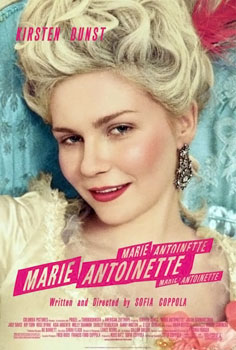
On November 12th, I recorded 2016’s Marie Antoinette off of Starz.
Before I review Marie Antoinette, I think it’s important that you know that I am an unapologetic Sofia Coppola fan. I love every film that she’s made and I look forward to her upcoming remake of The Beguiled. At the same time, I can also understand why some people feel differently. Sofia Coppola’s films are not for everyone. For one thing, almost all of her films deal with rich people. The existential angst of the wealthy and/or famous is not a topic that’s going to fascinate everyone. When you watch a Sofia Coppola film, you never forget that you’re watching a film that’s been directed by someone who largely grew up in the spotlight and who knows what it’s like to have money. An ennui born out of having everything and yet still feeling empty permeates almost every scene that Sofia Coppola has ever directed. (If you have to ask what ennui is, you’ve never experienced it.) Many viewers look at Sofia Coppola’s filmography and they ask themselves, “Why should we care about all these materialistic people?”
However, while Sofia Coppola may not know what’s it’s like to be poor (or even middle class for that matter), she does understand what it’s like to feel lonely. Her filmography could just as easily be called “the cinema of isolation.” It doesn’t matter how much money you may have or how famous you may or may not be, loneliness is a universal condition. A typical Sofia Coppola protagonist is someone who has everything and yet still cannot connect with the rest of the world. More often that not, they turn to excessive consumption in order to fill the void in their life. To me, the ultimate Sofia Coppola image is not, regardless of how much I may love them, Bill Murray and Scarlett Johansson in Lost in Translation. Instead, it’s Stephen Dorff (playing a far less likable version of Bill Murray’s Translation character) standing alone in the desert at the end of Somewhere.
Marie Antoinette, which was Sofia’s follow-up to Lost in Translation, is technically a historical biopic, though it makes little effort to be historical or accurately biographical. Kirsten Dunst plays Marie Antoinette, the final queen of France before the French Revolution. It was Marie Antoinette was accused of dismissing starving French peasants by announcing, “Let them eat cake!” (For the record, it’s probable that Marie Antoinette never said that. It’s certainly never heard in Coppola’s film.)
Marie Antoinette opens with the title character arriving in France at the age of 14. She’s an Austrian princess who has been sent to marry the future king of France, Louis XVI (Jason Schwartzman). From the minute we meet her, Marie Antoinette is portrayed as being a pawn. Her mother arranges the marriage as a way to seal an alliance with France. The king of France (played by Rip Torn) expects Marie Antoinette to get produce an heir to the throne as quickly as possible. Meanwhile, her new husband is an infantile and immature fool who doesn’t even know how to make love. Marie Antoinette finds herself isolated in a strange country, expected to be all things to all people.
And so, Marie Antoinette does what I always do whenever I’m feeling unsure of myself. She hangs out with her girlfriends. She throws expensive parties. She gambles. She flirts. She shops. She has fun, regardless of whether it’s considered to be proper royal behavior or not. Occasionally, she is warned that she is losing popularity with the French people but she’s not concerned. Why should she be? She doesn’t know anything about the French people. All she knows about is the life that she was born into. She didn’t choose to be born in to wealth and power but, since she was, why shouldn’t she have a good time?
The French Revolution doesn’t occur until near the end of Marie Antoinette and when it does happen, it happens quickly. And yet, the shadow of the revolution hangs over the entire film. We watch the knowledge that neither Marie Antoinette nor her husband possess: eventually, they are both going to be executed. And knowing that, it’s hard not to cheer Marie Antionette on. She may be destined for a tragic end but at least she’s having a little fun before destiny catches up with her.
Kirsten Dunst makes no attempt to come across as being French or Austrian but then again, neither does anyone else in the film. After all, this is a movie where Rip Torn plays the King of France without once trying to disguise his famous Texas accent. Coppola isn’t necessarily going for historical accuracy. Instead, in this film, Marie Antoinette serves as a stand-in for countless modern celebrities. In the end, Marie Antoinette is portrayed as not being much different from Paris Hilton or Kardashian. Meanwhile, the people who eventually show up outside the palace, carrying torches and shouting threats, are the same as the viewers who loudly condemn reality television while obsessively watching every episode of it.
Coppola’s stylized direction results in a film that is both thought-provoking and gorgeous to look at and which is also features several deliberate anachronisms. (In many ways, Marie Antoinette blatantly ridicules the very idea that history can be accurately recreated.) Perhaps because it was following up the beloved Lost In Translation, Marie Antoinette has never got as much praise as it deserves but I think it’s a film that is totally deserving of a reevaluation.
(Sidenote: Fans of Italian horror should keep an eye out for Asia Argento, who has a small but very important supporting role.)
What’s an Insomnia File? You know how some times you just can’t get any sleep and, at about three in the morning, you’ll find yourself watching whatever you can find on cable? This feature is all about those insomnia-inspired discoveries!
Last night, if you were awake at one in the morning, you could have turned on FLIX and watched the 1993 film Beyond The Law.
Now, you may look at the title and think to yourself, “That movie sounds way too generic for anyone to watch.” And, to a certain extent, you’re right. Based, so the narrated epilogue insists, on a true story, Beyond The Law is about a troubled cop who goes undercover and joins a biker gang. After gaining the trust and friendship of the gang’s ruthless leader, the cop struggles to maintain a between order and chaos. Sometimes, he succeeds. Sometimes, he doesn’t. Largely, his success is dependent on whatever the narrative requires at the moment.
It’s totally predictable but, at the same time, it’s hard not to watch. When a film starts with an Indian shaman telling Charlie Sheen that his dark side is going to destroy him, how can you not keep watching?
That’s right … the undercover cop is played by Charlie Sheen. Fortunately, since Beyond the Law was made in 1993, we’re talking about the sexy and dangerous Charlie Sheen who showed up at the end of Ferris Bueller’s Day Off and not the sad and bloated Charlie Sheen who co-starred on Two And A Half Men.
Charlie’s a deputy in Arizona who, as a result of his traumatic childhood, has a violent temper. After he gets into a fist fight with another deputy (played by Rip Torn), he is told that he can either quit the force or he can go undercover. He chooses to go undercover. Fortunately, he knows an informant (Leon Rippy) who can teach him how to pass for a biker. The informant’s nickname is Dildo (no, really) but later, we find out that his given name is Virgil. And he’s Charlie’s guide through the Hell of the Arizona underworld, just as another Virgil led Dante through another Hell…
Yes, it’s totally heavy-handed but somehow, it’s appropriate. The title may be generic but, within the first 30 minutes of the film, Beyond the Law gives us Indian wisdom, strange flashbacks, references to Dante, a guy named Dildo, and Charlie Sheen. But that’s not all! Beyond the Law also has Michael Madsen!
Michael Madsen plays Blood, the leader of the biker gang that Charlie has to infiltrate. And he gives a classic Michael Madsen performance, full of random squints, arched eyebrows, menacing pauses in the middle of dialogue, and that famous Michael Madsen half-smirk. Predictable as its plot may be, Beyond The Law is your only chance to see Charlie Sheen and Michael Madsen compete to see who can chew the most scenery. Charlie does his crazy eyes. Madsen does his half-smirk. In the end, I would say that Madsen wins.
Charlie also ends up having a relationship with an photojournalist (Linda Fiorentino). Before going undercover, he gave her a speeding ticket and, when they later meet at a biker gathering, she immediately recognizes him but keeps his secret. She doesn’t really get to do much in the film but I still liked the character because she was tough and she was the only person in the film who could outsmirk Michael Madsen.
Beyond The Law is nothing special but it’s worth watching just for the chance to see Michael Madsen and Charlie Sheen acting opposite each other.
The 2004 film comedy Welcome to Mooseport would probably be totally forgotten if not for one thing. This is the film that was supposedly so bad that co-star Gene Hackman looked at the final cut and then probably looked over at the Oscars he won for The French Connection and Unforgiven and then probably looked back at the final cut and then announced, “I quit!” There’s a reason why Hackman now spends his time writing novels and, according to most accounts, Welcome to Mooseport is that reason.
In Welcome to Mooseport, Gene Hackman plays Monroe “Eagle” Cole, the former President of the United States. From the minute we first hear the President’s name, we know exactly what type of film Welcome to Mooseport is going to be. It’s not enough to give Hackman’s a character a totally over-the-top name like Monroe Cole. He also has to have a cutesy nickname. The entire time I watched the film, I found myself wondering if Monroe Cole was listed on the presidential ballots as being Monroe “Eagle” Cole. Personally, I always find it funny when people feel the need to include their nickname in the credits. Is it really important for every William out there to let everyone know that some people call him Billy?
Anyway, Eagle is apparently the most popular president ever. However, he’s also recently divorced and his ex-wife (Christine Baranski, playing the same role that she played in Bulworth) wants all of his property. Eagle is forced to retire to one of the few residences that he has left, his vacation home in Mooseport, Maine. In order to keep his wife from claiming that home, Eagle decides to run for mayor of Mooseport…
Now, right here, we’ve got a huge issue. Eagle’s only motivation for running for mayor is because he doesn’t want to have to give over his vacation home to his wife. But that could be anyone’s motivation. One does not have to be President to want to keep the house in a divorce. It would have been more interesting if Eagle, now out of office and struggling to adjust to no longer being the most powerful man in the world, ran for mayor because he really wanted the job.
But anyway, Eagle is not the only person running for mayor. Hardware store owner Hardy Harrison (Ray Romano) is also running. At first, Hardy wants to withdraw but then he sees Eagle flirting with Hardy’s longtime girlfriend (Maura Tierney) and Hardy suddenly decides that he’s going to run and he’s going to win.
I actually like Ray Romano as an actor and he doesn’t give a bad performance here. But, at the same time, it’s obvious that his scenes were written to capitalize on his TV persona. It’s easy to imagine stumbling across a rerun of Everybody Loves Raymond where Ray runs for mayor and has a panic attack when he loses. The difference, of course, is that Ray Barone would not have been running against Gene Hackman (much less a former President).
Needless to say, Welcome to Mooseport has a sitcom feel to it. After every line, you find yourself waiting for a laugh track. Gene Hackman feels incredibly out-of-place in the film and there’s a discomfort to his performance. Watching him in this film, you can see the wheels turning in his brain. You can literally see Gene Hackman thinking, “I’m too old for this shit.”
And I guess he was because, in the 11 years since Welcome to Mooseport was first released, Gene Hackman has not appeared in another film. Which is bad news for everyone waiting for Welcome to Mooseport Part II…
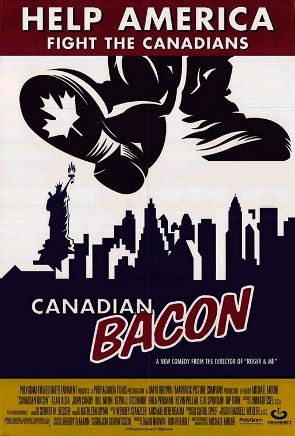
I have mixed feelings about the 1995 films Canadian Bacon.
On the one hand, Canadian Bacon is the only non-documentary to have been directed by Michael Moore. And I’m just going to admit right now that I don’t care much for Michael Moore. I think he’s fake. I think he’s the epitome of the type of limousine liberal who exclusively preaches to the converted and who, when all is said and done, does more harm to his causes than good. Just because he doesn’t shave, dresses like a slob, and apparently has never been to a gym, that doesn’t change the fact that he’s worth $50 million dollars. Just because he may claim to be for the workers, that doesn’t keep him from notoriously overworking and underpaying his own employees. Just because he may make films critical of capitalism, that certainly hasn’t stopped him from investing millions in the very same companies that he claims to oppose. And, quite frankly, it’s hard for me to take seriously a man who rails against income inequality when that man happens to own 9 mansions, none of which are exactly housing the homeless right now.
On the other hand, I love Canada! Canada has produced some of my favorite actors. It’s the country that created Degrassi. It’s the home of Lindsay Dianne and the Becoming A Bolder Being blog! Seriously, how can you not love Canada?
In fact, if a war ever broke out between American and Canada, I’m not sure who I’d support. Then again, hopefully Texas will have seceded from the U.S.A. before that happens. I’m keeping fingers crossed about that. Hopefully, once we have seceded, our first action will be to declare war on Vermont. (Not the rest of America, though. Just Vermont.)
The plot of Canadian Bacon is that the President of the United States (Alan Alda) is suffering from low approval ratings so he decides that America needs to find a new country to be enemies with. Mind you, the President doesn’t necessarily want to go to war. Instead, he just wants to have an enemy that he can always be on the verge of going to war with. After a riot breaks out at a hockey game, the President’s advisors realize that Canada would be the perfect enemy!
(And, while this is played for laughs, there actually is a historical precedent here. The War of 1812 was basically a result of America’s desire to conquer Canada.)
Anyway, American airwaves are soon full of anti-Canada propaganda and, since Michael Moore thinks everyone in America is an idiot except for him, gun-toting rednecks are soon preparing to do whatever it takes to defend America. A patriotic sheriff named Boomer (John Candy) decides to invade Canada on his own. Needless to say, things get even more complicated from there and soon a crazy weapons manufacturer (G.D. Spradlin) is plotting to launch a missile attack on Russia and … oh, who cares?
When Canadian Bacon tries to satirize politics and blind patriotism, it falls flat. Michael Moore has somehow earned a reputation for being a satirist but, if you actually look at his work, it quickly becomes apparent that he really doesn’t have much of a sense of humor. The humor in his documentaries is pretty much based on Moore saying, “Look how stupid everyone is except for me!” Since the people who watch Michael Moore documentaries are usually people who already agree with Michael Moore, they naturally find that to be hilarious because they already think anyone who disagrees with them is a joke. However, that doesn’t mean that Moore himself is a comic genius. He’s just a guy telling a joke to an audience that already knows the punchline.
Canadian Bacon is long on righteous indignation but it’s short on anything that would make you want to spend 90 minutes listening to the same point being made over and over again. Moore did make one good decision, in that he selected Rip Torn to play a crazed general. Rip Torn can deliver militaristic insults with the best of them.
The few times that Canadian Bacon actually works is when it gently (as opposed to indignantly) satirizes Canada’s reputation for being the most polite (and most hockey-obsessed) place on Earth. Dan Aykroyd has a great cameo as a Canadian police officer who pulls over Boomer’s truck and politely reprimands him for not including French translations for all of the anti-Canadian graffiti on the side of the vehicle.
Canadian Bacon could have used more scenes like that.
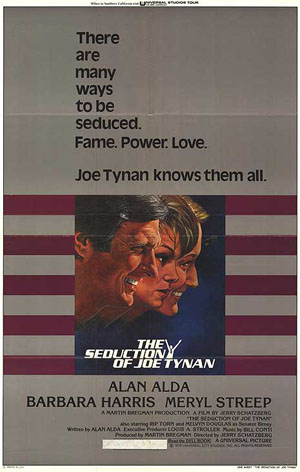
You know how sometimes you see a film and you can just tell that it was probably a big deal when it was first released but now, in the present day, it’s just not that interesting? That’s the way that I felt when I saw 1979’s The Seduction of Joe Tynan on Netflix. This is one of those film’s that you just know was probably praised for being adult and mature when it was first released but seen today, it’s just kinda bleh.
Joe Tynan (Alan Alda) is a Democratic senator from New York, a committed liberal who is also an ambitious pragmatist. As quickly becomes apparent, Joe is happiest when he’s at work. He struggles to talk to his rebellious teenage daughter (Blanche Baker). While he may love his wife (Barbara Harris), she’s also one of the few people in his life who isn’t always telling him how great he is and, to an extent, she resents having to live in his shadow. At times, it seems like the only thing holding Joe’s family together is the possibility that Joe could soon be nominated for the presidency.
When a Southern judge is nominated for the Supreme Court, Joe is asked by his mentor, Sen. Birney (a great Melvyn Douglas), to not oppose the nomination. While Joe originally agrees to keep quiet, he soon changes his mind when he’s approached by lobbyists who make it clear that, if he goes back on his word to Birney, they’ll be willing to support Joe for President.
Leaving behind his family, Joe heads down south where he meets a researcher named Karen Traynor (Meryl Streep). With Karen’s help, Joe discovers that the judge actually is a racist. He also discovers that, politically, he has a lot more in common with Karen than he does with his own wife and soon, they’re having an affair.
The Seduction of Joe Tynan is an odd film. As written, Tynan is a decent but flawed man. He may do the right thing but he does so largely because of his own ambition. That’s not a problem, of course. If anything, that would seem to be the making of a great political film. Some of the greatest film characters of all time have been morally ambiguous. But then, Alan Alda (who also wrote the script) gives a performance that would seem to indicate that he was scared of being disliked by the audience. Alda is believable when he’s being a self-righteous crusader but, whenever he has to play up the pragmatic and ruthless side of Joe Tynan, he almost seems to have zoned out. It’s interesting to compare Alda’s lukewarm performance here with the far more nuanced performance that he would give, as a less idealistic Senator, decades later in The Aviator. As far as the film’s senators are concerned, Melvyn Douglas and Rip Torn (playing a libertine colleague) are far more believable than Alda.
The film’s best performance is delivered by Meryl Streep. That might not sound shocking but actually, Streep’s performance here is surprising because it’s far more natural and less mannered than some of her more acclaimed performances. Believe it or not, you actually forget that you’re watching Meryl Streep.
Ultimately, you have to respect the fact that the film attempted to tell an adult and mature story about politics but that doesn’t make The Seduction of Joe Tynan any less forgettable.
If you ever find yourself on the campus of the University of North Texas and you need to kill some time, stop by the UNT Library, go up to the second floor, find the biographies, and track down a copy of Peter Manso’s Mailer: His Life and Times.
Back in December of 2007, at a time when I really should have been studying for my finals, I spent an entire afternoon in the library reading Manso’s book. I didn’t know much about Norman Mailer, the Pulitzer prize-winning writer and occasional political candidate, beyond the fact that he died that previous November and that a lot of older people who I respected apparently thought highly of his work. Though Manso’s book had been written 20 years earlier, it still provided an interesting portrait of the controversial author. It was largely an oral history, full of interviews with people who had known Mailer over the years. As I skimmed the book, it quickly became apparent that, among other things, Mailer was a larger-than-life figure.
For me, the book was at its most interesting when it dealt with Mailer’s attempts to be a filmmaker. In the 1960s, Mailer directed three movies. All three of them also starred Norman Mailer and featured his friends in supporting roles. All three of them were largely improvised. And, when released into theaters, all three of them were greeted with derision.
Maidstone, Mailer’s 3rd film, was filmed in 1970. In the film, Mailer played Norman Kingsley, an avante garde film director who is running for President. Over the course of one weekend, while also working on a movie about a brothel, Norman meets with potential supporters and debates the issues. And, of course, shadowy figures plot to assassinate Norman, not so much because they don’t want him to be President as much as they want him to be a martyr for their vaguely defined cause.
Just based on what I read in Manso’s book, it’s hard not to feel that the making of Maidstone could itself be the basis of a good movie. Mailer essentially invited all of his friends to his estate and they spent 5 days filming, with no script. It was five days of drinking, drugs, and bad feelings.
At one point, actor and painter Herve Villechaize (who would later play Knick Knack in The Man With The Golden Gun) got so drunk and obnoxious that he was picked up by actor Rip Torn and literally tossed over a fence. The unconscious Villechaize ended up floating face down in a neighbor’s pool. After fishing Villechaize out of the pool, the neighbor tossed him back over the fence and shouted, “Norman, come get your dwarf!”
Eventually, after five days, filming fell apart. Some members of the cast were okay with that. And one most definitely was not..
Fortunately, Maidstone is currently available on YouTube so I watched it last night. Unfortunately, the film itself is never as interesting as the stories about what went on behind the cameras. Maidstone is essentially scene after scene of people talking and the effectiveness of each scene depends on who is in it. For instance, Norman’s half-brother is played by Rip Torn, a professional actor with a big personality. The scenes with Torn are interesting to watch because Rip Torn is always interesting to watch. However, other scenes feature people who were clearly cast because they happened to be visiting the set on that particular day. And these scenes are boring because, quite frankly, most people are boring.
And then you’ve got Norman Mailer himself. For an acclaimed writer who was apparently quite a celebrity back in the day, it’s amazing just how little screen presence Norman Mailer had as an actor. Preening for the camera, standing around shirtless and showing off his hairy back along with his middle-aged man boobs, Mailer comes across as being more than a little pathetic. He’s at his worst whenever he tries to talk to a woman, giving off a vibe that’s somewhere between creepy uncle and super veiny soccer dad having a midlife crisis.
It’s an uneven film but, for the first half or so, it’s at least interesting as a time capsule. For those of us who want to know what rich intellectuals were like in the late 60s, Maidstone provides a service. However, during the second half of the film, it becomes obvious that Mailer got bored. Suddenly, all pretense towards telling an actual story are abandoned and the film becomes about Mailer asking his cast for their opinion about what they’ve filmed so far.
And then, during the final 15 minutes of the film, Norman Mailer decides to have the cameramen film him as he plays with his wife and children. This is apparently too much for Rip Torn who, after spending an eternity glaring at Mailer and undoubtedly thinking about everything he could have been doing during those five day if he hadn’t been filming Maidstone, walks up to Mailer, says, “You must die, Kingsley,” and then hits Mailer on the head with a hammer.
This, of course, leads to a long wrestling match between Mailer and Torn and, as the cameras roll, blood is spilled and insults are exchanged. There’s a lot of differing opinions about whether this final fight was spontaneous or staged. Having seen the footage, I get the impression that Mailer was caught off guard but that Torn probably let the cameraman know what he was going to do ahead of time.
Regardless, it’s hard to deny that the pride of Temple, Texas, Elmore “Rip” Torn, appears to be the one who came out on top. After the fight, Mailer and Torn have a lengthy argument that amounts to Rip saying that he had to do it because it was the only way that the film would make sense while Mailer replies with some of the least imaginative insults ever lobbed by a Pulitzer winner.
(So basically, Rip Torn won both the physical and the verbal rounds of the fight.)
Anyway, you can watch the entire Rip Torn/Norman Mailer confrontation below.
Now, while the fight is really the only must-see part of Maidstone, it still has considerable value as a time capsule of the time when it was made. You can watch it below!
When I first decided to feature episodes of televised horror, I very much wanted to include the classic Twilight Zone episode, Nightmare At 20,000 Feet. However, the full episode wasn’t available on YouTube and that was truly unfortunate. Along with being a scary episode of classic show, Nightmare at 20,000 Feet was all about flying, which is something that scares me.
However, as I was searching through YouTube, I did come across an episode of Ghost Stories entitled Last Flight Out, which also deals with this very primal fear that so many of us have. It’s no Nightmare at 20,000 Feet but it’s effective in its own way.
As for Ghost Stories, it was a horror anthology series that aired from 1996 to 1997 on the Fox Family Channel. As you can probably guess, each episode told a story about ghosts and, in the great anthology tradition, each story ended with a twist. Each episode was narrated by Rip Torn.
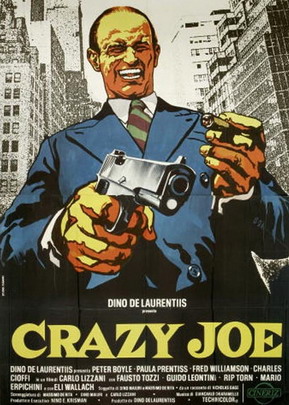 Crazy Joe (Peter Boyle) is a gangster with a chip on his shoulder and a self-taught intellectual who can (misquote) Sartre and Camus with the best of them. Sick of being taken for granted, Joe and his brother, Richie (Rip Torn), attempt to challenge the Mafia establishment. The mob sets Joe up and gets him sent to prison. While doing time, Joe befriends a Harlem gangster named Willy (Fred Williamson). Refusing to associate with the other Italian prisoners, Joe allies himself with the black inmates and even helps to start a riot over the prison’s inhumane conditions. When he is released, Joe hits the streets of New York with a vengeance, now backed up by Willy and his criminal organization.
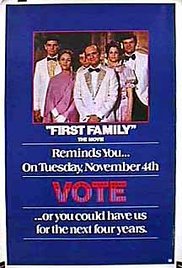 Like any newly inaugurated President, Manfred Link (Bob Newhart) faces many new challenges. The biggest challenge, though, is keeping control of his family and his White House staff. His wife (Madeline Kahn) is an alcoholic. His 28 year-old daughter (Gilda Radner) is so desperate to finally lose her virginity that she is constantly trying to sneak out of the White House. General Dumpson (Rip Torn) wants to start a war. Press Secretary Bunthorne (Richard Benjamin), Ambassador Spender (Harvey Korman), and Presidential Assistant Feebleman (Fred Willard) struggle and often fail to convince everyone that all is well.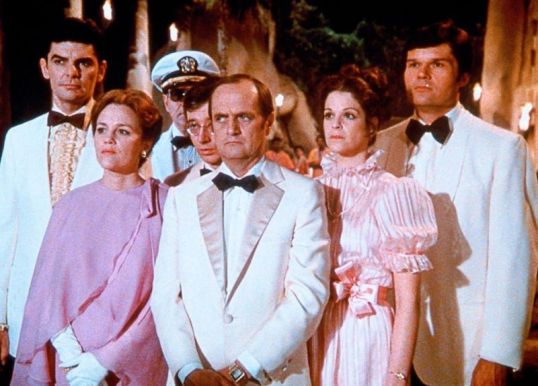





 Through the Shattered Lens