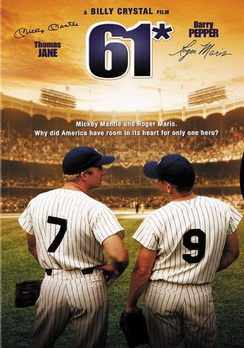
61* is about two baseball player and two friends who couldn’t seem to be more different.
Roger Maris (Barry Pepper) is an introverted family man who doesn’t like it when reporters show up at his house in search of a story or a quote. He’s a good ball player, one of the best, but he doesn’t want to be a celebrity. Mickey Mantle (Thomas Jane) is a larger-than-life personality, a beloved figure on the field and in the dugout. Mickey loves being famous and the fans love him. Both Maris and Mantle are members of the New York Yankees. Because Mantle is struggling with his drinking, he becomes Maris’s roommate when they’re on the road. In 1961, the two friends both go after Babe Ruth’s record of 60 home runs in a season. The press presents their season as a battle, a race to see who will be the first to hit the sixty-first home run of the season. Mantle and Maris, though, are just swinging the bat and making plays.
I really enjoyed 61*, which is a baseball film made by and for people who love baseball. I liked the contrast between the quiet Maris and the charismatic Mantle. Even though Maris is a hard worker and a good ballplayer, Mantle is the fan favorite and the one that people actually want to break the record. I appreciated that Maris and Mantle remained friends even when the press tried to turn them into rivals. That’s what teamwork is all about. Barry Pepper and Thomas Jane were great as Maris and Mantle and the movie showed how each man dealt with the stress of possibly breaking Babe Ruth’s record.
(Why is there an asterisk in the title? Babe Ruth set his record in a season that only had 154 games. The 1961 baseball season was 8 games longer. The asterisk was added as a reminder that Maris and Mantle had 8 more games than Ruth did to try to break the record. Baseball fans understand how important accurate statistics are to a player’s career and a team’s season.)
61* celebrates the way baseball used to be, a game played by athletes who had to depend on skill and teamwork instead of performance enhancing drugs. The movie opens with Maris’s family watching as Mark McGuire closes in on breaking the record. McGuire would only briefly hold the record. He would lose it, for 48 minutes, to Sammy Sosa and then, three years after winning it back, he would lose it a second time to Barry Bonds. Of course, Roger Maris won the record without using steroids so, as far as I’m concerned, it still belongs to him.
If you’re a baseball fan, 61* is a film that you have to see.
Every Monday night at 9:00 Central Time, my wife Sierra and I host a “Live Movie Tweet” event on X using the hashtag #MondayMuggers. We rotate movie picks each week, and our tastes are quite different. Tonight, Monday March 17th, we celebrate Kurt Russell’s 74th birthday by watching THE MEAN SEASON (1985) co-starring Mariel Hemingway, Richard Jordan, Richard Masur, Richard Bradford, Joe Pantoliano, and Andy Garcia.
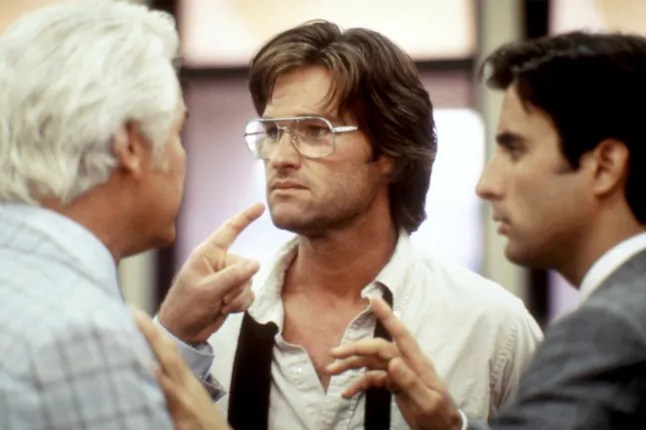
Kurt Russell plays Malcolm Anderson, a reporter for a Miami newspaper. He’s had enough of reporting the local murders, so he promises his school teacher girlfriend (Mariel Hemingway) that they’ll move away soon. Before Malcolm can hand in his notice, the murderer (Richard Jordan) from his latest article phones him. The murderer tells Malcolm that he’s going to kill again. The phone calls and murders continue, and soon Malcolm finds that he’s not just reporting the story, he is the story.
We thought it would be fun to join The Shattered Lens and make Kurt Russell our centerpiece for the day. There’s absolutely nothing more enjoyable to me than watching movies with friends. And If you enjoy Russell, Miami, and serial killer thrillers, you should like this one. So, join us tonight for #MondayMuggers and watch THE MEAN SEASON! It’s on Amazon Prime.
The trailer for the THE MEAN SEASON is included below:
That was one of my main thoughts as I watched 1993’s And The Band Played On.
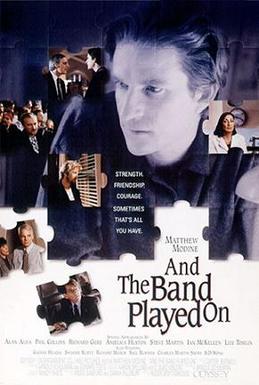
Directed by Roger Spottiswoode and featuring an all-star cast, And The Band Played On deals with the early days of the AIDS epidemic. It’s a film that features many different characters and storylines but holding it all together is the character of Dr. Don Francis (Matthew Modine), an epidemiologist who is haunted by what he witnessed during the Ebola epidemic in Africa and who fears that the same thing is going to happen in America unless the government gets serious about the mysterious ailment that is initially called “gay cancer” before then being known as “GRID” before finally being named AIDS. Dr. Francis is outspoken and passionate about fighting disease. He’s the type who has no fear of yelling if he feels that people aren’t taking his words seriously enough. In his office, he keeps a track of the number of HIV infections on a whiteboard. “Butchers’ Bill” is written across the top of the board.
Throughout the film, quite a few people are dismissive of Dr. Francis and his warnings. But we, the audience, know that he’s right. We know this because we know about AIDS and but the film also expects us to trust Dr. Francis because it’s specifically stated that he worked for the World Health Organization before joining the Center For Disease Control in Atlanta, Georgia. As far as the film is concerned, that’s enough to establish his credentials. Of course, today, after living through the excesses of the COVID pandemic and the attempts to censor anyone who suggested that it may have begun due to a lab leak as opposed to some random guy eating a bat, many people tend to view both the WHO and the CDC with a lot more distrust than they did when this film was made. As I said, we live in a cynical time and people are now a lot less inclined to “trust” the experts. To a large extent, the experts have only themselves to blame for that. I consider myself to be a fairly pragmatic person but even I now find myself rolling my eyes whenever a new health advisory is issued.
This new sense of automatic distrust is, in many ways, unfortunate. Because, as And The Band Played On demonstrates, the experts occasionally know what they’re talking about. Throughout the film, people refuse to listen to the warnings coming from the experts and, as a result, many lives are lost. The government refuses to take action while the search for a possible cure is hindered by a rivalry between international researchers. Alan Alda gives one of the best performances in the film, playing a biomedical researcher who throws a fit when he discovers that Dr. Francis has been sharing information with French scientists.
It’s a big, sprawling film. While Dr. Francis and his fellow researchers (played by Saul Rubinek, Glenne Headly, Richard Masur, Charles Martin Smith, Lily Tomlin, and Christian Clemenson) try to determine how exactly the disease is spread, gay activists like Bobbi Campbell (Donal Logue) and Bill Kraus (Ian McKellen) struggle to get the government and the media to take AIDS seriously. Famous faces pop up in small rolls, occasionally to the film’s detriment. Richard Gere, Steve Martin, Anjelica Huston, and even Phil Collins all give good performances but their fame also distracts the viewer from the film’s story. There’s a sense of noblesse oblige to the celebrity cameos that detracts from their effectiveness. All of them are out-acted by actor Lawrence Monoson, who may not have been a huge star (his two best-known films are The Last American Virginand Friday the 13 — The Final Chapter) but who is still heart-breakingly effective as a young man who is dying of AIDS.
Based on a 600-page, non-fiction book by Randy Shilts, And The Band Played On is a flawed film but still undeniably effective and a valuable piece of history. Director Roger Spottiswoode does a good job of bringing and holding the many different elements of the narrative together and Carter Burwell’s haunting score is appropriately mournful. The film ends on a somber but touching note. At its best, it’s a moving portrait of the end of one era and the beginning of another.
I’m actually kind of alone amongst my family as far as that’s concerned. All three of my sisters enjoy spending the night outdoors, listening to sounds of nature and looking up at the stars. They know how to set up tents and make campfires and they enjoy hiking and rafting and exploring the great outdoors. Myself, I do enjoy occasionally spending the weekend up at Lake Texoma and I like the fact that, even though we live in the city, we still occasionally get to see wildlife running around. I think possums are cute. A few days ago, I squealed with delight when I saw that there was a raccoon hanging out in one of our backyard trees. (“Don’t go near that thing, Lisa Marie!” Erin snapped as I reached for the den door.) Growing up, I spent time in both the country and the city. While I love living in the city, there’s still a part of me that’s still a country girl. That said, I definitely prefer sleeping inside to outside. The inside is safe. The inside is comfortable. The inside is free of creepy bugs that crawl on the ground.
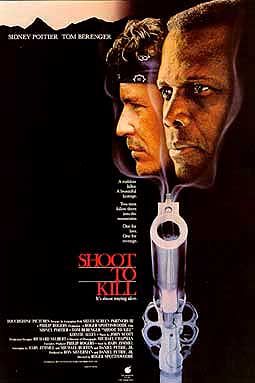
Watching 1988’s Shoot to Kill definitely did not do much to change my opinion about camping. In this thriller from director Roger Spottiswoode, Sidney Poitier plays Warren Stantin, an FBI agent who is obsessed with capturing a sadistic criminal who blackmails people into doing his work for him. At the start of the film, the extortionist has forced a jeweler to break into his own jewelry store by taking the jeweler’s wife hostage. Stantin’s attempt to capture the extortionist leads to the jeweler’s wife taking a bullet in the eye. (AGCK! Seriously, this guy is mean!) Stantin traces the man to Washington State, where he discovers that the extortionist has committed another murder and stolen the victim’s identity. The extortionist is now a member of a five-man fishing party that is being led by a local guide, Sarah Renell (Kirstie Alley). Stantin teams up with Sarah’s partner, Jonathan Knox (Tom Berenger), and the two of them attempts to track down the group before the murderer among them makes his move.
The action cuts back-and-forth, between Sarah’s party and Knox and Stantin. Most viewers will probably be able to quickly figure out which member of Sarah’s party is the killer but director Spottiswoode still creates a little suspense by casting actors like Richard Masur, Andrew Robinson, and Clancy Brown as the suspects. All three of the actors have played their share of sinister characters. (Andrew Robinson was the Scorpio Killer, for God’s sake!) While Sarah leads the murderer though the wilderness, Knox teaches Stantin how to survive in the great outdoors. As is typical with films like this, Knox and Stantin go from disliking each other to depending on each other. Have you ever wanted to see Sidney Poitier get into a verbal altercation with a bear? This is the film for you!
Shoot to Kill is a superior genre film. The story’s predictable but it’s told so well that it doesn’t matter. Kirstie Alley, Tom Berenger, and Sidney Poitier all give good performances as sympathetic characters. As for the actor who turns out to be the killer, he gives a performance that is, at times, absolutely terrifying. Shoot to Kill is an entertaining thriller. Just don’t watch it if you’re going camping the next day.
Everyone’s an expert on the Panama Canal nowadays.
Largely, that’s a result of President-elect Donald Trump openly musing about taking the canal back from Panama. As soon as Trump uttered those words, every self-appointed pundit on every social media site in existence immediately jumped over to Wikipedia and skimmed over the articles on Panama, the Panama Canal, and Teddy Roosevelt. Then, after Jimmy Carter died, those same people jumped onto Wikipedia and skimmed articles about Carter selling the canal to Panama for a dollar and the controversy that followed. For weeks, it has been impossible to look at Twitter or Bluesky or even Mastodon without seeing someone giving their opinion on the canal, the 1989 American invasion of Panama, and the connection between the CIA and Manuel Noriega, the man who served as Panama’s military dictator for most of the 80s before being deposed and tossed into prison for being a drug smuggler.
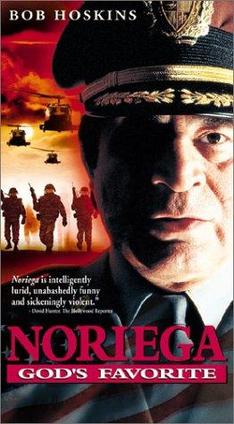
Myself, I know better than to get my information from Wikipedia. Instead, I get my information from movies. For that reason, I attempted to educate myself on Panama and the canal by watching 2000’s Noriega: God’s Favorite.
Directed by Roger Spottiswoode, Noriega: God’s Favorite opens with a title card informing us of the story so far. Manuel Noriega was born in the slums of Panama. He grew up in poverty and was shunned because his mother was not married to his father. Noriega spent his youth doing whatever he had to do in order to survive. He was clever and ruthless but it wasn’t until he entered the Panamanian National Guard that he was able to really use those skills to his advantage. Noriega became a CIA asset and worked his way through the ranks. In 1983, with the support of American intelligence, Noriega became the de facto dictator of Panama, even though he never officially held any sort of title or executive position.
The film follows Manuel Noriega (Bob Hoskins) over the course of his final years as Panama’s dictator. He’s portrayed as being a ruthless man who often pretends to be a buffoon in order to get his enemies to underestimate him. He works with the CIA but still passes along intelligence to Fidel Castro (Michael Sorich), who is seen hitting on Noriega’s wife (Denise Blasor) during a visit to Cuba. Noriega presents himself as a family man while having a number of mistresses. He claims to an ally in the United States’s War on Drugs while attending cocaine-fueled parties. He presents himself as being a pragmatist while actually being very superstitious. A CIA agent (Edward Ellis) wins Noriega’s trust by manipulatively interpreting Bible verses for him. When an army officer (played by Nestor Carbonell) tries to lead a coup against Noriega, he can only watch helplessly as Noriega personally executed all of his co-conspirators, going so far as to even chop off one man’s hands. By the end of the scene, Noriega is drenched in blood but he’s undeniably happy. Everyone knows that Noriega is an impulsive and dangerous dictator but the CIA allows him to stay in power until he starts to become an inconvenience. Once Noriega’s notoriety starts to overshadow his usefulness, the U.S. promptly invades and Noriega’s power crumbles around him.
Bob Hoskins might seem like a strange choice to play a South American dictator but he does a good job in Noriega, playing the title character as being both a charismatic dictator and also an overgrown child who has never gotten over the struggles of his youth. (Early on in the film, he is seen getting treatments to smooth his pockmarked skin, an indication that all the power in the world can’t cure lifelong insecurity.) In the end, Noriega has much in common with the gangster that Hoskins played in The Long Good Friday. Noriega is ruthless enough to become powerful but he ultimately falls victim to his own hubris. When you’re in charge of something as valuable as the Panama Canal, the last thing you should do is anger the country that built it.
First released in 1981 and then re-released in several different versions since then, Heaven’s Gate begins at Harvard University.
The year is 1870 and the graduates of Harvard have got their entire future ahead of them. At the graduation ceremony, Joseph Cotten gives a speech about how, as men of cultivation, they have an obligation to help the uncultivated. Student orator Billy Irvine (John Hurt) then gives a speech in which he jokingly says the exact opposite. Amongst the graduates, Billy’s friend, Jim Averill (Kris Kristofferson), laughs at Billy’s speech. It’s a bit of a strange scene, if just because all of the graduates appear to be teenagers except for Hurt and Kristofferson, who are both clearly in their 30s. The graduates of Harvard sing to their girlfriends and dance under a tree and, for a fleeting moment, all seems to be right with the world.
Twenty years later, all seems to be wrong with the world. Averill is now the rugged and world-weary marshal of Johnson Country, Wyoming. Cattle barons are trying to force immigrant settlers to give up their land. Gunmen, like Nate Champion (Christopher Walken) and Nick Ray (Mickey Rourke), are accepting contracts to execute immigrants who are suspected of stealing cattle. When Averill stands up for the people of Johnson Country, the head of the Wyoming Stock Grower Association, Frank Canton (Sam Waterston), hires a group of mercenaries to ride into Johnson County and execute 125 settlers. Billy Irvine, who now is dissolute alcoholic who works with Canton, warns his old friend Averill. Averill, who has fallen in love with Ella (Isabelle Huppert), the local madam, announces that he will defend the immigrants. Nate, who is also in love with Ella, considers changing sides.
Heaven’s Gate is loosely based on an actual event. I actually have three distant ancestors who traveled to Wyoming to take part in the Johnson County War. All three of them survived, though one of them was shot and killed in an unrelated manner shortly after returning to Ft. Smith, Arkansas. That said, director Michael Cimino is clearly not that interested in the historical reality of the Johnson County War or the issues that it raised. Just as he did with Vietnam in The Deer Hunter, Cimino uses the Johnson County War as a way to signify a loss of national innocence. Averill and Irvine start the film as hopeful “young” men with the future ahead of them. By the end of the film, one is dead and the other is living on a yacht and dealing with what appears to be crippling ennui.
Heaven’s Gate is a bit of an infamous film. Though the film was pretty much a standard western, Cimino still went far over-budget and turned in a first cut that was over six hours long. A four hour version was briefly released in 1980 but withdrawn after a week, due to terrible reviews and audience indifference. A studio-edited version that ran for two hours and 35 minutes got the widest release in 1981. Since then, there have been several other versions released. Cimino’s director’s cut, which was released as a part of the Criterion Collection in 2012, runs for 212-minutes and is considered to now be the “official” version of Heaven’s Gate.
For years, Heaven’s Gate had a terrible reputation. It’s failure at the box office was blamed for bankrupting United Artists. After the excesses of the Heaven’s Gate production, studios were far more reluctant to just give a director a bunch of money and let him run off to make his movie. (They should have learned their lesson with Dennis Hopper and The Last Movie.) Described by studio execs as being self-indulgent and even mentally unstable, Michael Cimino’s career never recovered and the director of The Deer Hunter went from being an Oscar-winner to being an industry pariah. (Some who disliked The Deer Hunter’s perceived jingoistic subtext claimed that Heaven’s Gate proved The Deer Hunter was just an overrated fluke.) However, the reputation of Heaven’s Gate has improved, especially with the release of Cimino’s director’s cut. Many critics have praised Heaven’s Gate for its epic portrayal of the west and, ironically given the controversy over The Deer Hunter, its political subtext. It’s anti-immigrant villains made the film popular amongst the Resistance-leaning film historians during the first Trump term.
So, is Heaven’s Gate a masterpiece or a disaster? To be honest, it’s somewhere in between. Whereas it was once over-criticized, it’s now over-praised. Visually, it’s a beautiful film but those who complained that the film was too slow had a point. As with The Deer Hunter, Cimino takes the time to introduce us to and immerse us in a tight-knit immigrant community. Personally, I like the much-criticized scenes of the fiddler on skates and Averill and Ella dancing in the roller rink. Overall though, as opposed to The Deer Hunter, the members of the film’s victimized community still feel less like individual characters and more like symbols. As for the political subtext, I think that any subtext of that sort is accidental. (I feel the same way about The Deer Hunter, which I like quite a bit more than Heaven’s Gate.) Cimino is more interested in the loss of innocence than whether or not the Johnson County War can be fit into some sort of nonsense Marxist framework.
The main problem with the film is that there is no center to keep everything grounded. Kris Kristofferson had a definite screen presence but, as an actor who was incapable of showing a great deal of emotion, he lacks the gravitas necessary to keep from being swallowed up by Cimino’s epic pretensions. Isabelle Huppert, an otherwise great actress, also feels lost in the role of Ella and Sam Waterston is not necessarily the most-intimidating villain to ever show up in a western. Christopher Walken, as the enigmatic and intriguing Nate Champion, gives the best performance in the film but his character still feels largely wasted.
There are some brilliant visual moments to be found in Heaven’s Gate. I even like the Harvard prologue and the ending on the boat, both of which are not technically necessary to the narrative but still add an extra-dimension to both Averill and Irvine. But, in the end, Heaven’s Gate is big when it should have been small and epic when its should have been intimate. It’s a misfire but not a disaster. Even great directors occasionally have a film that just doesn’t work. Speilberg had his 1941. Scorsese has had a handful. Coppola’s career has been a mess but no one can take his successes away from him. Michael Cimino, who passed away in 2016, deserved another chance.
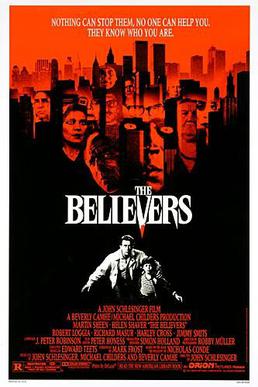
When it comes to unfortunate and dumb ways to die, getting electrocuted while standing in a puddle of spilled milk would seem to rank fairly high on the list. Unfortunately, it’s exactly what happens to the wife of Cal Jamison (Martin Sheen) during the first few minutes of 1987’s The Believers.
Traumatized by his wife’s death (and probably also by all of the people asking, “Wait a minute, she was standing in milk?”), Cal relocates from Minneapolis to New York City. Accompanying him is his young son, Chris (Harley Cross). Upon arriving in New York, Cal starts a tentative new relationship with artist Jessica Halliday (Helen Shaver) and he also gets a job working a psychologist for the NYPD.
And several members of the NYPD are going to need a good psychologist because they are investigating a series of brutal and ritualistic murders. All of the victims are children around Chris’s age and the murders are so grisly that even a hardened cop like Lt. Sean McTaggart (Robert Loggia) finds himself traumatized. When Detective Tom Lopez (Jimmy Smits, in one of his first roles) discovers one of the bodies, he has an apparent mental breakdown and starts to rant and rave about an all-powerful cult that Tom claims is committing the murders.
After Tom commits suicide, his ravings are dismissed as being the product of a mentally ill man. However, Cal is not so sure and starts to investigate on his own. What he discovers is a cult made up of a motely mix of wannabe gangsters and members of high society. While his friends and lovers either die or lose their minds around him, Cal discovers that the cult is actually closer to both him and his son than he ever realized.
An odd film, The Believers. On the one hand, there’s plenty of creepy scenes, including one in which Jessica gets a truly disturbing skin condition. The scenes in which Cal discovers that his friends have lost their minds as a result of the Cult are frequently sad and difficult to watch. Robert Loggia has scene that brought tears to my eyes. The mix of street witchery and upper class power lust is nicely handled and, as always, Harris Yulin makes for an effective villain. The Believers creates an ominous atmosphere of paranoia, one in which you really do come to feel that no one in the film is quite who they say they are.
And yet, it’s obvious that director John Schlesinger — whose previous films included Darlingand the Oscar-winning Midnight Cowboy — had more on his mind than just making an effective Omen-style horror film. He also tries to deal with Cal coming to terms with the death of his wife and Chris coming to terms with the idea of Cal dating someone new and all of those scenes of straight-forward domestic drama feel out-of-place in what should have been an energetic and grisly B-movie. In those ploddingly earnest scenes, Schlesinger seems to be trying almost too hard to remind us that he’s not really a horror filmmaker and they just feel out of place.
If there was ever a movie that called for the unapologetic and wickedly sardonic directorial vision of David Cronenberg, it was The Believers. As it is, The Believers is an intriguing but frustratingly uneven mix of paranoia, witchcraft, and domestic melodrama.
Welcome to Retro Television Reviews, a feature where we review some of our favorite and least favorite shows of the past! On Sundays, I will be reviewing the made-for-television movies that used to be a primetime mainstay. Today’s film is 1981’s Fallen Angel! It can be viewed on Tubi.
Jennifer Phillips (Dana Hill) is 12 years old and struggling to find her place in the world. Sometimes, she wants to be a gymnast. Sometimes, she wants to be an actress. She misses her late father. She has a difficult time communicating with her mother, an often-exhausted waitress named Sherry (Melinda Dillon). She is definitely not happy that Sherry is dating the well-meaning but rather dorky Frank Dawson (Ronny Cox). Jennifer wants to watch an awards show. Frank changes the channel to a baseball game. That pretty much sums up their relationship.
One night, Jennifer escapes the unhappiness of her home life by going to an arcade. That’s where she is approached by Howard Nichols (Richard Masur), a seemingly friendly older man who takes her picture and then tells her that she’s just as beautiful as Farrah Fawcett and Olivia Newton-John. Jennifer replies that she doesn’t think that she should talk to Howard because he’s a stranger. Howard tells her that’s very smart of her and then explains that he coaches the local girls softball team and that he thinks Jennifer would make a great shortstop.
You can probably guess where this is going and you’re absolutely right. Soon, Jennifer is spending all of her time with Howard, who tells her that he understands what she’s going through even if her parents don’t. Howard’s an amateur photographer and he’s constantly asking Jennifer to pose for him. He tells Jennifer that she probably shouldn’t tell any adults about their “special friendship” because they just wouldn’t understand. He even buys Jennifer a puppy, one that he threatens to take back to the pound whenever it appears that Jennifer is trying to step away from him.
Howard is not only a pedophile but he also works for a pornography ring and, as Jennifer soon finds out, he’s actually got several young people living with him and posing for pictures. Jennifer’s mother eventually becomes concerned about what Jennifer is doing when she leaves the house and she even comes to suspect that friendly old Howard is not quite as friendly as he pretends to be. But is it too late?
Yikes! I watched this film on Tubi and I cringed through the whole thing. Of course, that’s the reaction that Fallen Angel was going for. This is a film that was made to encourage parents to maybe be a little concerned about with whom their children are spending their free time. Jennifer is fortunate that her mom eventually figures out what is going on but, as the film makes clear, a lot of victims are not so lucky. This film is pure paranoia fuel but in the best way possible. There are some things that every parent should be paranoid about and the adult who only spends time with people 20 years younger than him is definitely one of those things. The film is well-made, well-written, and well-acted. Richard Masur, with his friendly manner and his manipulate tone, will give you nightmares.
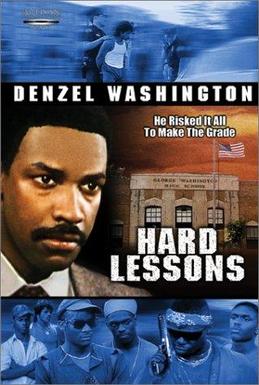
Welcome to Retro Television Reviews, a feature where we review some of our favorite and least favorite shows of the past! On Sundays, I will be reviewing the made-for-television movies that used to be a primetime mainstay. Today’s film is 1986’s The George McKenna Story! It can be viewed on Netflix, under the title Hard Lessons!
George Washington High School is a school that has defeated many well-meaning principals. The hallways are full of drugs and gang members. A good deal of the student body never shows up for class. Fights are frequent. The police are a common sight. The majority of the teachers are men like Ben Proctor (Richard Masur), burned-out and content to hide in the teacher’s lounge.
New Orleans-raised George McKenna (Denzel Washington) is the latest principal and, from the minute that he shows up at the school, he seems a bit more confident than the other principals that the school has had. He barely flinches when a raw egg hits his suit. When he hears a fight occurring, he doesn’t hesitate to head down the hall to investigate. McKenna is determined to make George Washington High into a worthwhile institution and that means inspiring both the students and the teachers.
When it comes to films about dedicated educators trying to reform a troubled school, most films tend to take one of two approaches. One approach, the well-intentioned but not always realistic liberal approach, features the teacher or the principal who demands respect but who also treats the good students and teachers with equal respect and who turns around the school through the power of benevolence. The other approach is the one where the principal or teacher grows frustrated and turns into an armed vigilante who forces the students to shut up and learn. Think of The Principal or The Substitute or Class of 1984. The first approach is the one that most teachers claim that they try to follow but I imagine that, for most of them, there’s an element in wish-fulfillment to be found in watching the second approach. In the real world, of course, neither approach is as automatically successful as it is in the movies.
The George McKenna Story was made for television and it’s based on a true story so, not surprisingly, it follows the first approach. Denzel Washington plays McKenna as someone who could probably handle himself in a fight if he ever got into one but, for the most part, the film portrays McKenna as succeeding by treating his students with more empathy and respect that they’ve gotten from anyone else in their lives. Though cranky old Ben Proctor thinks that McKenna’s methods are foolish and that he’s asking the teachers to do too much, McKenna starts to turn the school around. One student, whose father was threatening to make him drop out, ends up getting nearly straight A’s and reciting Shakespeare. Unfortunately, not everyone can be rescued. One student is arrested for murder and taken away by the cops but McKenna is still willing to be there for that student. McKenna doesn’t give up on his students and, unlike that music teacher in The Class of 1984, he doesn’t allow them to fall through a skylight either.
The George McKenna Story is a predictable film. It’s easy to guess which student will be saved by McKenna’s approach and which student will end up getting stabbed in a gang fight and which student will end up in prison. That said, the film definitely benefits from Denzel Washington in the lead role. Washington exudes confidence from the minute that he appears on screen and you’re left with little doubt that if anyone could reform a school simply through good intentions, it would definitely be Denzel Washington.
From the very first few scenes of the 1985 film, The Mean Season, one thing is abundantly clear. People are dying in Florida.
In itself, that’s probably not a shock. Death is a part of life, after all. Add to that, the majority of The Mean Season takes place in Miami, the seventh most populous area of the United States. It makes sense that the more people you have living in one area, the more people are also going to end up dead. That’s just the way things work.
Still, Malcolm Anderson is getting tired of all the death. Played by a youngish and sexy Kurt Russell, Malcolm’s a journalist. He covers the crime beat for the Miami Herald. He spends all day reporting on death and violence and he’s finally reached the point where he’s burned out. He and his girlfriend, a teacher named Christine (Mariel Hemingway), are even planning on moving to Colorado. Malcolm says that he could be very happy working at a small town newspaper. His editor (Richard Masur) doesn’t believe him and, quite frankly, neither do we. Malcolm may say that he wants peace and quiet but it’s hard not to feel as if he’s fooling himself.
One day, Malcolm gets a phone call. The voice on the other line (which belongs to character actor Richard Jordan) is deceptively calm. The caller explains that he’s a fan of Malcolm’s work. The caller also claims to be responsible for a series of murders that have recently taken place. At first, Malcolm is skeptical. After all, he gets calls from crazy people all the time. That’s one reason why he wants to leave Miami, after all. But then the caller starts to give Malcolm details about the crimes, details that haven’t been released to general public…
The killings continue and, after every murder, the caller contacts Malcolm. Soon, Malcolm is appearing on the national news, giving carefully calculated interviews about what it’s like to be a celebrity. Malcolm is soon on the front page of all the papers. Malcolm’s happy. His editor is happy. But you know who isn’t happy? The killer. He didn’t go to all the trouble to kill those people just so Malcolm could get famous off of his hard work! Soon, the killer is no longer content to just call Malcolm. Now, he wants to meet face-to-face and maybe even get to know Christine as well…
The Mean Season is one of those movies that starts out well but then falls apart towards the end. It’s not a spoiler to tell you that the killer eventually ends up kidnapping Christine. You probably figured out that was going to happen as soon as I told you that Malcolm had a girlfriend. (It doesn’t help that Christine is such an underwritten character that it feels like the only reason she was put in the film was so she could be used for one gratuitous nude scene and then get kidnapped.) Once the killer kidnaps her, he goes from being a genuinely intriguing menace to just being a typical and overly verbose movie psycho.
That’s a shame because the first half of The Mean Season is really quite good. The film makes excellent use of its locations, capturing the humid atmosphere of Florida in the summer. As the killer, Richard Jordan alternates between being coldly calculating and surprisingly vulnerable without missing a beat. (Interestingly, he appears to be personally hurt when he realizes that Malcolm doesn’t consider him to be a friend.) Not surprisingly, Kurt Russell is likable as the conflicted Malcolm but his best moments are the ones where he suggests that Malcolm has become so addicted to fame that he’s almost hoping that the killer strikes again. As the two homicide detectives who are assigned to keep an eye on Malcolm, both Richard Bradford and Andy Garcia are perfectly cast. A scene where Bradford tries to comfort a child who accidentally gets in the middle of the search for the killer is the best in the film. “We’re just looking for the bad guys,” he tell the traumatized child. It’s small moments like this that elevates The Mean Season above the typical mid-80s serial killer film.
Seen today, The Mean Season — with its emphasis on newspapers — feels like a historical artifact. If the film were made today, Russell would definitely work for either a 24-hour cable news channel or an online news site. It actually would be interesting to see this story updated and retold for the age of clickbait. Somebody needs to get on that and, while they’re at it, come up with the type of ending that an otherwise intriguing story like this deserves.


 Through the Shattered Lens