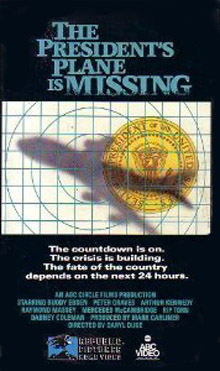
President Jeremy Harris (Tod Andrews) has a lot on his plate. With America and China inching closer and closer to war, Secretary of State Freeman Sharkey (Raymond Massey) is advocating for diplomacy while National Security Advisor George Oldenburg (Rip Torn) feels that America must be more aggressive and ready to launch the first nuclear missile. Of course, no one pays much attention to Vice President Kermit Madigan (Buddy Ebsen). Kermit is viewed with such contempt that he’s never even been given a briefing on what’s going on with China. However, when Air Force One crashes in the California desert and the President cannot be definitively identified as one of the bodies found in the wreckage, Vice President Madigan finds himself with a very difficult decision to make.
That’s quite a crisis. Personally, though, I’m more interested in how the United States ended up with Secretary of State named Freeman Sharkey. I mean, that’s just an amazing name for a diplomat. Why didn’t they elect that guy President? No one messes with Sharkey!
The majority of 1973’s The President’s Plane Is Missing follows a reporter named Mark Jones (Peter Graves) as he tries to get to the bottom of what has happened to President Harris. As usual, Graves is likably stoic. Mark Jones doesn’t show much emotion but, at the very least, he does seem to be trying to do a good job as an old school journalist. What’s interesting is that Mark has an editor (played by Arthur Kennedy) who is constantly yelling at him and threatening to fire him. There’s something very odd about seeing Peter Graves taking order from someone who isn’t intimidated by him.
Mark Jones does learn the truth about why the President has gone missing and he also learns why he, as the reporter assigned to follow the President, wasn’t allowed to board Air Force One when it initially took off. Unfortunately, the solution is a bit anti-climatic. In fact, it’s so anti-climatic that it’s actually kind of annoying. All of the drama ultimately feels rather unnecessary and pointless.
By today’s standards, The President’s Plane Is Missing is a bit on the dull side. There are so many obvious plot holes that I get the feeling that it was probably a bit boring when it originally aired in 1973 as well. The most interesting thing about the film is that it was directed by Daryl Duke, who also directed Payday, a harrowing film about a self-destructive country-western singer. Rip Torn, the star of Payday, appears here as a calm and collected intellectual who advocates for nuclear war without a hint of ambivalence. Torn is a bit miscast as a man without emotions but it’s still always nice to see him in a film.
Who gives the best performance in The President’s Plane Is Missing? Believe it or not, Buddy Ebsen. Ebsen is totally believable as the vice president who, after years of being ignored, is suddenly thrust into a position of power. I’d vote for Kermit Madigan but only if he wasn’t running against Freeman Sharkey.
“Don’t count on me to make you feel safe.” — The Stranger
High Plains Drifter stands as one of the bleakest, most enigmatic entries in Clint Eastwood’s filmography—a Western that bleeds unmistakably into the realms of psychological and supernatural horror. This 1973 film is not just another dusty tale of lone gunfighters and frontier justice. It’s a nightmare set in broad daylight, a morality play whose hero is more monster than man.
Eastwood’s Stranger comes riding into the town of Lago from the shimmering desert, a silhouette both akin to and apart from his famed Man With No Name persona. The townsfolk are desperate, haunted by fear—less afraid of imminent violence, more of the sins they’ve half-buried. This is a place where a lawman was brutally murdered by outlaws while the townspeople looked away, their silence paid for with cowardice and greed. When the Stranger assumes command, he does so with often-gleeful sadism—kicking people out of their hotel rooms, replacing the mayor and sheriff with the dwarf Mordecai, and ordering that the entire town be painted red before putting “Hell” on its welcome sign.
There’s a surface plot: the Stranger is hired to protect Lago from the same three outlaws who once butchered its marshal. But he’s there for far more than that. The story unspools through dreamlike sequences, flashbacks that suggest the Stranger may well be an avenging spirit or a revenant—the dead lawman, spectral and merciless, returned to claim what the townsfolk owe to Hell itself.
The horror here isn’t about jump scares or gothic haunted houses. The supernatural lurks everywhere and yet nowhere. The Stranger moves with the implacable calm—and violence—of a slasher villain, transforming Lago into his personal stage for retribution. His nightmares, full of images of past atrocities, are painted with the same vivid brutality as the daytime violence. Eastwood’s use of silence, the squint of a face, the twitch of a pistol replaces musical cues in amplifying dread. The sound design evokes otherness—a howling wind, footsteps echoing across empty streets—that builds a shadow of terror around the Stranger’s presence.
This violence is hurried and brutal; its sexual politics unflinching. When the Stranger enacts revenge, he punishes not just the outlaws, but the townsfolk complicit in their crimes. There is little comfort in his sense of justice—the pleasures he takes border on sadistic. The film’s moral ambiguity cuts deeper than most Westerns or horrors: this is not a clear-cut tale of good versus evil, but a brutal reckoning of collective guilt, cowardice, and corruption.
Lago itself acts almost like a town stuck in purgatory—a holding pen between redemption and eternal damnation. The infamous “Welcome to Hell” sign the Stranger paints at the town’s entrance serves as a grim message. It’s no welcome to law and order, but a symbolic beacon to the very outlaws the Stranger is hired to confront, suggesting that Lago is a place where sin festers and punishes itself. The town’s dance with Hell is both literal and metaphorical. The inhabitants aren’t just awaiting judgment; they have invited it in their desperate attempts to hide their cowardice and greed under the guise of civilization.
This notion of Lago as purgatory stands in sharp contrast to other recent horror Westerns, which serve as prime examples of the genre’s thematic spectrum. These films tend to focus on the primal terror of nature barely held at bay by the fragile veneer of civilization the settlers claim. They pit human beings against the ancient, untamed forces of the wilderness—whether monstrous creatures or surreal phenomena—emphasizing that the supposed order and progress of the West remain fragile and constantly threatened. This dynamic symbolizes the uneasy balance between civilization’s reach and nature’s primal power, often revealing how thin and tenuous that barrier truly is.
Among these, Bone Tomahawk and Ravenous stand out as vivid examples. Bone Tomahawk confronts menacing cannibals lurking in the wild, reminding viewers that the West’s order is fragile and under perpetual threat from untamed wilderness. Ravenous uses cannibalism and survival horror as metaphors for nature’s savage predation hidden beneath the polite façade of civilization—nature’s horrors masked but not erased.
By contrast, High Plains Drifter directs its horror inward, exposing the corruption that manifest destiny imposed on settlers themselves. Instead of fearing nature as an external force, the film presents settlers as haunted by their own moral failures and complicity in violence and betrayal. The Stranger’s vengeance is a reckoning with the darkness festering inside the community, a brutal meditation on guilt, collective cowardice, and the price of greed disguised as progress.
Eastwood’s film strips away the mythic promises of the American West as a land of freedom and opportunity, revealing instead the brutal reality of communities locked in complicity, violence masquerading as justice, and the moral rot at the heart of manifest destiny. This moral ambiguity and psychological depth give High Plains Drifter a unique position in the horror Western subgenre, elevating it beyond simple scares to a profound exploration of American cultural myths.
The Stranger is not a traditional hero but a spectral judge, embodying divine or supernatural retribution. His calm yet ruthless punishment exposes the cruelty, cowardice, and malevolence within Lago’s population, meting out a justice that is neither neat nor forgiving. His supernatural aura and sadistic tendencies make him an unforgettable figure of terror and fate.
Visually, the film’s harsh daylight contrasts with the romanticized Western landscapes of earlier films. Instead of shadows hiding evil, blinding light exposes the town’s moral decay. Characters are reduced to symbols of greed, fear, and cruelty, highlighting that the true horror lies within human nature and the failure to uphold justice.
High Plains Drifter operates on multiple levels—a Western, a ghost story, a horror film, and a dark morality play. It is a relentless meditation on justice and punishment and a dismantling of the traditional Western hero myth. Through layered narrative, stark visuals, and Eastwood’s chilling performance, it remains an essential entry in the horror Western canon.
For those seeking a Western that doesn’t just entertain but unsettles and challenges, High Plains Drifter offers an unforgiving descent into darkness. It strips away the comforting myths of the frontier and exposes the raw, rotting core beneath. Unlike other modern horror Westerns such as Bone Tomahawk and Ravenous, which confront external terrors lurking in the wilderness, this film turns its gaze inward—on the moral decay, guilt, and violence festering within the settlers themselves. It’s a brutal, haunting reckoning, and Eastwood’s Stranger is the cold, relentless agent of that reckoning. This is a journey into a hell both literal and psychological, where justice is merciless and safety is a long-forgotten promise.
Welcome to Late Night Retro Television Reviews, a feature where we review some of our favorite and least favorite shows of the past! On Thursdays, I will be reviewing Highway to Heaven, which aired on NBC from 1984 to 1989. The entire show is currently streaming on Tubi and several other services!
This week, Mark is abandoned in the park.
Episode 4.13 “A Mother’s Love”
(Dir by Michael Landon, originally aired on January 6th, 1988)
It’s time for Jonathan and Mark to start a new assignment! This week, Jonathan gets to be a teacher (again!) and Mark gets to be …. homeless.
Seriously, Mark is dropped off in the park and told to live there. Eventually, Jonathan shows up and gives Mark a tent and some cooking supplies. That was nice of him but still, you have to wonder why Mark always seems to get assignments that are designed to aggravate him. “Thanks for giving up your independence to work with my angel,” the show’s version of God seems to be saying, “Now, here …. go live in the park.”
Also living in the park are four brothers whose mother has recently died. They’re living in a van and are trying to not get sent to foster care. Fortunately, there’s a teacher at Jonathan’s new school who regrets that she never had a family. Guess who is going to end up adopting four kids!
This was pretty much the epitome of Highway to Heaven, sweet-natured, sentimental, shamelessly manipulative, and so earnest that it worked even when it shouldn’t have. That said, I hope Jonathan will put a good word in for Mark. The guy deserves at least one easy week!
In 1973’s High Plans Drifter, Clint Eastwood plays …. The Stranger.
No, not the Man With No Name. The Stranger has a name but he chooses not to share it. That said, when one person says that he doesn’t even know the Stranger’s real name, the Stranger replies, “Yes, you do.” The Stranger appears to emerge from the heat of the desert, riding into the small mining town of Lago and gunning down the three bullies that the townspeople hired to protect them after the murder of their town marshal. With no other option, the townspeople accept the Stranger as the town’s new protector.
The Stranger is drawn to the town and the townspeople but he doesn’t seem to particularly like any of them, with the exception of Mordecai (Billy Curtis), the dwarf that the Stranger appoints as the town’s new sheriff. The townspeople, the majority of whom are cowardly and motivated by greed, aren’t particularly likable themselves. The Stranger rules the town like a dictator, kicking everyone out of the hotel so that he can have it for himself and ordering that every building in the town be painted red. Over the town’s welcome sign, he paints one word: “Hell.” When the townspeople see how well the Stranger can shoot, they celebrate in the belief that they’ll always be safe. The Stranger responds by leaving town just as three sadistic outlaws, led by Stacey Bridges (Geoffrey Lewis), approach. The Stranger may be looking for revenge on Bridges but he also seems as if he wants to make the town suffer for its sins as well.
Much as with the case of The Man With No Name, the Stranger is not motivated by kindness or any sort of concern for the safety of the townspeople. He often shows a cruel-streak when it comes to dealing with the cowardly townspeople. He doesn’t attack unless he’s attacked first but once you’re on his bad side, he’ll gun you down without a hint of emotion. When the Stranger sleeps, he is haunted by nightmares of the previous marshal (played by Buddy Van Horn, Clint Eastwood’s stunt double) being murdered by Bridges and his men while the townspeople stood by and did nothing. We learn that the townspeople, worried that it might be bad for their business interests, didn’t even give the late marshal a decent headstone after his death. One woman mentions that spirits can’t rest unless they have a proper marker….
Getting the idea?
High Plains Drifter is probably the closest that Eastwood has ever come to making a supernatural horror film. The Stranger may or may not be a vengeful ghost (the movie leaves that for you to decide) but he turns the small town of Lago into his own personal version of Hell and, when he attacks the men who killed the marshal, he moves with the ruthless determination of a slasher villain. The scene where Bridges and his men ride into the town is like a filmed nightmare. This is a dark film, one in which Eastwood’s Stranger is not the hero because he’s particular heroic but just because everyone else in the film is so bad.
This was also Eastwood’s second film as a director (following Play Misty For Me) and also the first of many westerns that Eastwood would direct. The imagery is often haunting, all the more so because some of the most violent scenes take place in broad daylight. The scenes where the Stranger seems to materialize out of the desert’s heatwaves perfectly capture the mythology of the old west and its “heroes.” Eastwood gets good performances out of his ensemble cast and, even more importantly, he shows that Eastwood the director had a perfect understanding of Eastwood the actor. As the Stranger, Eastwood says more with a snarl or a half-smile than most actors could say with a multi-page monologue.
High Plains Drifter is violent, often disturbing, and ultimately unforgettable.
In this comedic western, gambler Benjamin Calhoun (Dale Robertson) wins big in a poker game. Not only does he walk away with several thousand dollars but he also now owns his own railroad, the BP;S&D. Calhoun celebrates the biggest win of his career by tossing ten dollar bills at the townspeople, recruiting a worshipful young assistant (Bob Random), and commandeering a private railcar that belongs to wealthy Burton Standish (John Anderson). In the car, he finds Marta Grenier (Diana Hyland), a “working woman,” who has been hired to provide company for Standish.
Calhoun and Marta ride off to check out Calhoun’s new railroad. What he discovers is that the railroad that he won is not only not completed but the workers are striking because they haven’t been paid in two weeks. The quick-thinking Calhoun offers to make all of the workers part-owners of the railroad. With construction once again starting, Calhoun tries to figure out how to keep his new business open. He also meets a strong-headed storekeeper named Joanna Royce (Sandra Smith).
When Standish finally shows up, it turns out that he was originally planning on buying the BP;S&D. Will Calhoun hold onto the railroad and honor the promise he made to the workers or will he sell out to Standish?
For all the talk about completing the railroad, Scalplock ends with most of the work undone. That’s because Scalplock was a pilot for The Iron Horse, a television series that lasted for two seasons in the 60s. Scalplock (and The Iron Horse) is mostly a showcase for Dale Robertson, a low-key but always convincing actor who specialized in westerns. Usually, Robertson was cast as an upstanding citizen and law enforcement agent. In Scalplock, he’s playing the type of genial rogue that James Garner played on Maverick and later in The Rockford Files. Robertson is likable in Scalplock and even convinces us that Calhoun would choose his workers over a quick payday. Fan of the genre will enjoy Scalplock, as long as they don’t get too invested in witnessing that last track of rail laid into the ground.
Dale Robertson, who started his career in the 40s, continued to act through the 90s, though usually as a guest star instead of a series lead. Robertson eventually retired to Oklahoma where he owned a ranch that was home to over 200 horses. He passed away in 2013 at the age of 89.
Welcome to Late Night Retro Television Reviews, a feature where we review some of our favorite and least favorite shows of the past! On Thursdays, I will be reviewing Highway to Heaven, which aired on NBC from 1984 to 1989. The entire show is currently streaming on Freevee and several other services!
This week, season one concludes with a two-part episode.
Episodes 1.24 and 1.25 “Thoroughbreds”
(Dir by Michael Landon, originally aired on May 1st and 8th, 1985)
For their last assignment of the first season, Jonathan and Mark are sent to work at a stable owned by the wealthy Mr. Armstong (Stephen Elliott). Lizzy MacGill (a young Helen Hunt) is the daughter of one of Amrstrong’s employees (Noble Willingham) and has practically grown up at the stables. She loves horses and, as the first episode progresses, she also falls in love with Mr. Armstrong’s spoiled son, Garth (John Hammond).
Garth falls in love with Lizzie as well, learning how to be both a better horseman and just a better man from his interactions with her. Despite his father’s threat to disown him, Garth breaks off his engagement to Ms. Richy McSnobby Snob (that may not have been her actual name) and he elopes with Lizzie.
Yay!
Except …. Lizzie has cancer and she doesn’t know it! The test comes back on the exact same day that she runs off with Garth. Part one ends with two fathers in tears, though each for different reasons.
At the start of Part Two, Jonathan tracks down Lizzie and informs her of her diagnosis. Without telling Garth what’s going on, she returns home and is informed that 1) she must start chemotherapy immediately and 2) she’s pregnant. Her doctor (Richard Bull) tells Lizzie that she’ll have to have an abortion if she wants to start treatment. Lizzie runs from the hospital.
As for Garth, he naturally wants to know what’s going on. Lizzie lies to him and tells him that she only wanted him for his father’s money and since he’s now cut-off, they might as well just call off the marriage as well. Heart-broken, Garth decides to marry RIchy McSnobby Snob.
Worst ending ever, right? Well, don’t worry, it’s not over yet. Jonathan and Mark crash the wedding (and Jonathan tells a lie to get into the church, which I thought was a no-no for angels) and Jonathan causes A FIRE TO BREAK OUT IN THE CHURCH’S BASEMENT! Again, this does not seem like good angel behavior. Anyway, all the smoke gives Garth time to realize that he actually does love Lizzie and, after Mark informs him about why Lizzie actually left him, Garth rushes back to Lizzie and they go to the local Justice of the Peace to get married. Fortunately, Jonathan is able to convince Mr. Elliott to come to that wedding as well.
The episode ends with a flashforward, in which we see Lizzie and Garth’s toddler son playing outside while an apparently healthy Lizzie watches.
Yay!
It’s not a bad way to end the first season, though I do think the story could have just as easily been told in one episode as opposed to two. (The first episode especially feels padded out.) Helen Hunt and John Hammond made for a perfectly adorable couple and their chemistry ensured that the show’s signature mix of sentimentality and melodrama never felt too cloying. All in all, this was a good ending to a fairly strong first season.
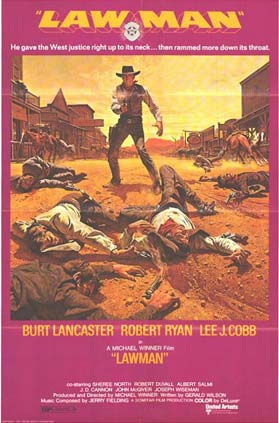
In the 1880s, Jared Maddox (Burt Lancaster) is the marshal of the town of Bannock. After a night of drinking and carousing leads to the accidental shooting of an old man, warrants are issued for the arrest of six ranch hands. Maddox is determined to execute the arrest warrants but the problem is that the six men live in Sabbath, another town. They all work for a wealthy rancher (Lee J. Cobb) and the marshal of Sabbath, Cotton Ryan (Robert Ryan), does not see the point in causing trouble when all of the men are likely to be acquitted anyway. Maddox doesn’t care. The law is the law and he does not intend to leave Sabbath until he has the six men.
Lawman starts out like a standard western, with a stranger riding into town, but then it quickly turns the western traditions on their head by portraying Marshal Maddox as being a rigid fanatic and the wealthy rancher as a morally conflicted man who does not want to resort to violence and who continually tries and fails to convince Maddox to leave. In the tradition of Sergio Leone and Sam Peckinpah, there are no real heroes to be found in Lawman and, even when Maddox starts to reconsider his strict adherence to the law and refusal to compromise, it is too late to prevent the movie from ending in a bloody massacre. Since Lawman was made in 1971, I initially assumed it was meant to be an allegory about the Vietnam War but then I saw that it was directed by Michael Winner, a director who specialized in tricking audiences into believing that his violent movie were deeper than they actually were.
Even if Lawman never reaches the heights of a revisionist western classic like Pat Garrett and Billy the Kid, it is still pretty good, with old pros Lancaster, Ryan, Cobb, and Albert Salmi all giving excellent performances. The cast is full of familiar faces, with everyone from Robert Duvall to Richard Jordan to Ralph Waite to Joseph Wiseman to John Beck showing up in small roles. In America, Winner is best remembered for his frequent collaborations with Charles Bronson. Chuck is not in Lawman, though it seems like he should have been and Lee J. Cobb’s rancher is named Vincent Bronson. Winner would not make his first film with Charles Bronson until a year later, when he directed him in Chato’s Land.
Judging from the films that the decade produced, the 1970s were truly a paranoid time. (Of course, 2015 is a paranoid time as well, which is probably why so many of the classic films of the 70s still feel incredibly relevant.) Some weekend, you should watch a marathon of 1970s films and I guarantee that, by the time Monday rolls around, you will be looking for lurkers in every shadow and automatically distrusting any and all authority figures. The 1970s were a good time to be paranoid.
And it’s really not surprising at all. The previous decade was a time of turmoil and upheavel, a time when some people feared protestors and some people feared the establishment but, ultimately, everyone was afraid of someone. When you think of the 1960s, you think about all the leaders who were violently assassinated — John F. Kennedy, Malcolm X, Martin Luther King, Robert F. Kennedy, and more. (And that’s just in America!) And then the 70s came along, with Watergate and the revelations about the CIA partnering up with the Mafia to try to kill Fidel Castro.
The 70s were a good time to be paranoid and the films of the 70s reflected that fact.
Take for instance, 1974’s The Parallax View. The Parallax View opens and ends with assassination. In both cases, the victims are U.S. politicians who are running for President and whose ambitions have caused concern for the shadowy and rarely seen leaders of the established order. In both cases, the official story is that the assassin was a lone gunman, a nut with a gun and absolutely no political or religious motivations. Of course, both accused assassins were apparently involved with the shadowy Parallax Corporation and, over the course of the film, anyone who knows anything about Parallax ends up dying. Reporter Joe Frady (Warren Beatty) goes undercover to investigate the group but, as he does so, he grows increasingly paranoid and unstable, until finally it’s easy to mistake him for any other paranoid madman, ranting in the street and, in many ways, indistinguishable from the accused assassins that he’s been investigating. In many ways, Joe becomes like a character in a H.P. Lovecraft short story who, upon laying eyes on Cthulhu, is driven mad as punishment.
It’s a good film, one that’s enhanced by Gordon Willis’s trademark shadowy cinematography and the convincing desperation of Warren Beatty’s performance. In the film’s best scene, Frady applies for a job with the Parallax Corporation. As a part of his job interview, he’s taken a dark room and he’s told to watch a short film. His reactions will help to determine what role he could possibly play at Parallax.
Needless to say, The Parallax View feels just as relevant today as it did when it was first released. We still live in paranoid times and hints of conspiracy are still everywhere to be seen. Perhaps the only thing that has changed is that, back in 1974, conspiracies could still take people be surprise.
 President Jeremy Harris (Tod Andrews) has a lot on his plate. With America and China inching closer and closer to war, Secretary of State Freeman Sharkey (Raymond Massey) is advocating for diplomacy while National Security Advisor George Oldenburg (Rip Torn) feels that America must be more aggressive and ready to launch the first nuclear missile. Of course, no one pays much attention to Vice President Kermit Madigan (Buddy Ebsen). Kermit is viewed with such contempt that he’s never even been given a briefing on what’s going on with China. However, when Air Force One crashes in the California desert and the President cannot be definitively identified as one of the bodies found in the wreckage, Vice President Madigan finds himself with a very difficult decision to make.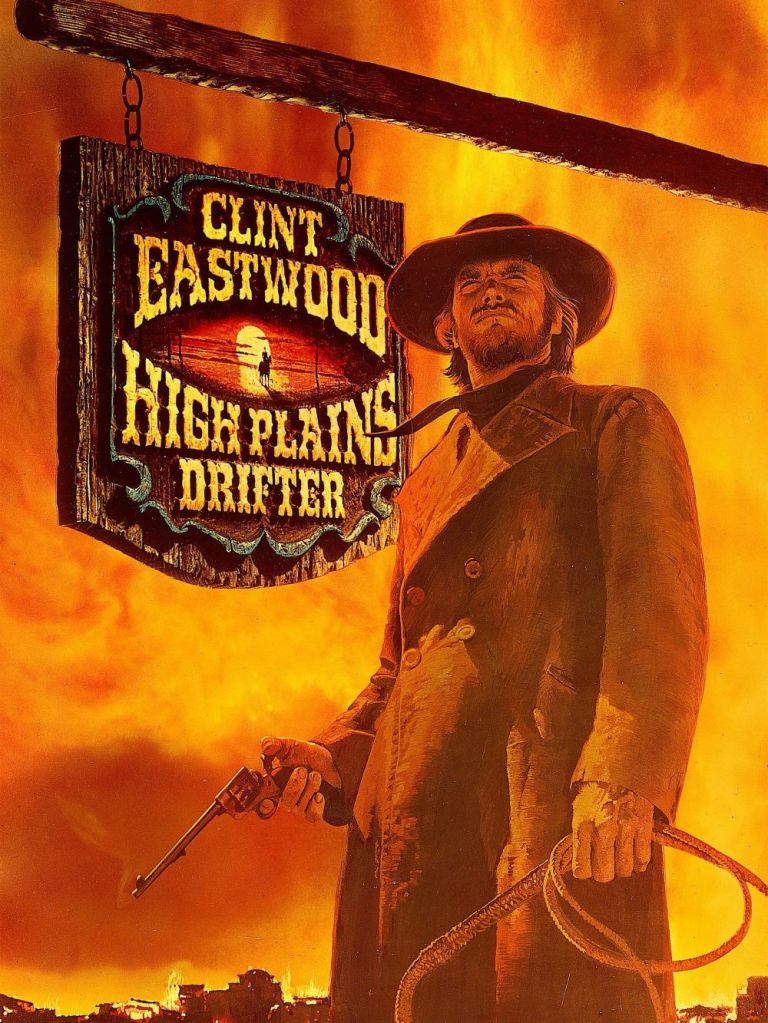


 In the 1880s, Jared Maddox (Burt Lancaster) is the marshal of the town of Bannock. After a night of drinking and carousing leads to the accidental shooting of an old man, warrants are issued for the arrest of six ranch hands. Maddox is determined to execute the arrest warrants but the problem is that the six men live in Sabbath, another town. They all work for a wealthy rancher (Lee J. Cobb) and the marshal of Sabbath, Cotton Ryan (Robert Ryan), does not see the point in causing trouble when all of the men are likely to be acquitted anyway. Maddox doesn’t care. The law is the law and he does not intend to leave Sabbath until he has the six men.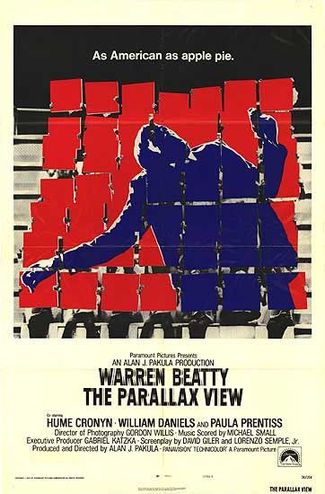
 Through the Shattered Lens