Tennesse (John Payne) is an old west gambler who co-owns a saloon (and bordello) with Elizabeth Farnham (Rhonda Fleming). When Tennessee is ambushed after a poker game, he’s saved by a local man who goes by the name of Cowpoke (Ronald Reagan). Tennessee and Cowpoke become fast friends but when Tennessee realizes that Cowpoke is about to marry a golddigger (Coleen Gray), Tennessee puts the woman on the next boat out of town. Cowpoke vows to get vengeance but Tennessee has bigger things to worry about. Rival businessman Turner (Tony Caruso) has framed Tennessee for the murder of a local prospector, Grubstake McNiven (Chubby Johnson).
Very loosely based on a short story by Bret Harte, Tennessee’s Partner has surprisingly high production values for a B-western. Director Allan Dwan started his career in the 1910s and directed over 200 westerns. He knew how to keep the action moving. Tennessee’s Partner is also the only film that old friends John Payne and Ronald Reagan made together. Reagan, whose days as a major studio leading man had ended by the time he made this film, gives one of his better performances in the role of the simple but honest Cowpoke and shows the likability that he was later able to translate into a political career. Reagan could be a stiff actor but his naturally amiable manner made him perfect for best friend and sidekick roles, like in this movie. Payne also gives a good performance as the gambler with a moral code. However, the best thing about the film is Rhonda Fleming, giving a tough and sexy performance as Elizabeth. Because this film came out in 1955, it couldn’t really come out and say that Elizabeth was a madam and the saloon was a bordello but Fleming’s performance and a few lines of innuendo left little doubt about what was actually going on upstairs from the bar. Keep an eye out for Angie Dickinson, playing one of Elizabeth’s girls.
The performance elevate Tennessee’s Partner, making it a B-western that can be enjoyed even by people who aren’t necessarily into westerns.
The 1945 Best Picture nominee, Spellbound, tells the story of Dr. Constance Petersen (Ingrid Bergman), a psychoanalyst at a mental hospital in my least favorite state, Vermont.
Constance has fallen in love with a man (Gregory Peck) who she believes to be Dr. Anthony Edwardes, the newly appointed director of the hospital. Dr. Edwardes is youngish and handsome and idealistic and authoritative …. well, he’s Gregory Peck. However, he also has an intense phobia about seeing any set of parallel lines. Curious to discover the reason for Edwardes’s phobia, Constance does a little digging on her own and discovers that Dr. Anthony Edwardes is not a doctor at all! Instead, he’s a guilt-stricken amnesiac who is convinced that he murdered Dr. Edwardes and took his place!
Constance, however, doesn’t believe that the Amnesiac is a murderer. She thinks that he is suffering from some sort of deep-rooted guilt that had led him to believe that killed the doctor. She wants a chance to psychoanalyze him and discover the truth about his background. Unfortunately, the police do think that the Amnesiac is a murderer and their determined to arrest him.
Constance and the Amnesiac go on the run, heading to the home of Constance’s mentor, Dr. Alexander Brulov (Michael Chekhov, the nephew of Anton Chekhov). With Brulov’s help, Constance analyzes a dream that the Amensiac had, one involving curtains decorated with eyes, the faceless proprietor of a casino, and a man falling off a mountain. Can Constance and Brulov solve the mystery of the Amnesiac’s identity before the police take him away to prison?
Spellbound was the last of the four Hitchcock best picture nominees and it was also the last film that Hitchcock made for producer David O. Selznick. Selznick was quite a fan of psychoanalysis and he insisted that Hitchcock not only make a movie about it but that he also use Selznick’s own therapist as a technical advisor on the project. Hitchcock, for his part, was able to bring in the surrealist Salvador Dali to help design the Amnesiac’s dream sequence but Selznick felt that the 20-minute sequence was too long and too weird and, as a result, it was cut down to two minutes for the final film. All this considered, it’s not a surprise that, despite the fact that Spellbound was a hit with critics and audiences, Hitchcock himself didn’t care much for it and considered it to be more of a Selznick film than a Hitchcock film. And it is true that the film’s total faith is psychoanalysis feels more like something one would expect to hear from a trendy producer than from a director like Hitchcock, who was known for both his dark wit and his rather cynical attitude towards anyone in authority.
For a film like Spellbound to truly work, there has to be some doubt about who the Amnesiac is. For the suspense to work, the audience has to feel that there’s at least a chance, even if it’s only a slight one, that the Amnesiac actually could be a murderer, despite the attempts of Constance and Brulov to prove that he’s not. And Spellbound is full of scenes that are meant to leave the audience wondering about whether or not the Amnesiac should be trusted. However, because the Amnesiac is played by Gregory Peck, there’s really no doubt that he’s innocent. Hitchcock was not particularly happy with Gregory Peck as his leading man. Peck projected a solid, middle-American integrity. It made him ideal for heroic and crusading roles but made him totally wrong for any role that required ambiguity. It’s difficult to believe that the Amnesiac is suffering from a guilt complex because it’s difficult to believe that Gregory Peck has ever done anything for which he should feel guilty. Cary Grant could have played the Amnesiac. Post-war Jimmy Stewart could have done an excellent job with the role. But Peck is just too upstanding and stolid for the role. In a role that calls from neurosis, Peck is kind of boring.
That said, the rest of the cast is fine, with Ingrid Bergman giving one of her best performance as Constance and Michael Chekhov bringing some needed nuance to a role that could have turned into a cliché. Leo G. Carroll has a small but pivotal role and he does a good job keeping the audience guessing as to his motivation. Even at a truncated two minutes, the Dali dream sequence is memorably bizarre and the famous shot of a gun pointed straight at the camera still carries a kick. This is a lesser Hitchcock film but, that said, it’s still a Hitchcock film and therefore worth viewing.
As I mentioned previously, this was the last of Hitchcock’s films to be nominated for Best Picture. Ironically, his best films — Rear Window, Vertigo, and Psycho among them — were yet to come. Spellbound was nominated for six Oscars but only won for Miklos Rozsa’s score. (Ingrid Bergman was nominated for Best Actress that year, not for her role in Spellbound but instead for The Bells of St. Mary’s.) The big Oscar winner that year was Billy Wilder’s The Lost Weekend.
Welcome to Retro Television Reviews, a feature where we review some of our favorite and least favorite shows of the past! On Wednesdays, I will be reviewing the original Love Boat, which aired on ABC from 1977 to 1986! The series can be streamed on Paramount Plus!
Let’s set sail for adventure!
Episode 2.11 “Heads or Tails/Mona of the Movies/The Little People”
(Dir by George Tyne, originally aired on November 25th, 1978)
The Love Boat crew is super excited because the glamorous movie star, Mona Maxwell (Rhonda Flemming), is going to be on the cruise. Apparently, this is not her first time to sail on the Love Boat. Captain Stubing can’t wait to get reacquainted with her. The walking HR nightmare that is Doc Bricker can’t wait to flirt with her. Artie D’Angelo (Orson Bean), a passenger who owns a chain of garages, is shocked to see that his favorite movie star in on the boat.
Artie may be a big fan of Mona’s but, whenever he tries to talk to her, he finds that he simply cannot find the words. With Doc’s help, Artie finally works up the courage to ask Mona to have dinner with him. Mona accepts and the two of them soon find themselves falling in love. The only problem is that Artie just cannot bring himself to believe that a big movie star like Mona would be interested in a guy like him. Really, Artie is being way too hard on himself. He’s a likable guy! And, fear not, he and Mona leave ship arm-in-arm.
Meanwhile, two frat dudes — Alex (Adam Arkin) and Wally (Richard Gilliand) — have made a bet over who will be the first to sweep Julie off of her feet. When they start the betting, it’s for money but eventually, they decide to just bet a pizza. Julie spends time with both of them and has fun, especially with Alex. But then a jealous Wally reveals the truth about the bet and Julie announces that she doesn’t want anything else to do with either of them. Gopher tells Julie that she should actually be flattered that the two guys were both so determined to date her. Apparently deciding that she’s not really bothered by the fact that both of her suitors just spent an entire weekend lying to her, Julie forgives them and then says that she’s going to spend an equal amount of time with both Alex and Wally so neither one of them will win or lose the bet.
Finally, Doug Warren (Edward Albert) is on the cruise with his parents, who are celebrating their anniversary. Coincidentally, Doug’s co-worker, Beth (Patty McCormack), is also on the cruise! Doug and Beth quickly fall in love but then Beth is freaked out when she sees two little people in the ship’s lounge. She explains to Doug that little people make her nervous. She always worries about what would happen if her child turned out to be a little people. What she doesn’t know is that the little people — Ralph (Billy Barty) and Dottie (Patty Maloney, who also guest-starred on the famous disco-themed episode of The Brady Bunch Hour) — are Doug’s parents!
Without telling Beth why, Doug says that he can no longer see her. A heart-broken Beth goes to the Acapulco Lounge where she gets into a conversation with Ralph and Dottie. She discovers that Ralph and Dottie are just like everyone else and she also finds out that Doug is their very tall son. She tells Doug that she’s no longer worried about their potential children being little people and …. you know, this plot line is just ridiculous. Beth is prejudiced against people based on their height and she’s basically told Doug that she would freak out if her child was anything other than “normal.” And yet, Doug and his parents act all excited when Beth announces that she still loves Doug, regardless of who his parents are. Doug, sweetie — you can do better!
I definitely had mixed feelings about this episode. Orson Bean and Rhonda Fleming were both perfectly charming in their storyline but the other two stories were both pretty icky. I spent the entire episode waiting for Julie to tell off Alex and Wally and for Doug to tell off Beth and, in both cases, it didn’t happen. This was definitely not one of the better cruises of the Pacific Princess.
Hopefully, next week’s destination will be a bit nicer.
The Killer is Loose opens with the robbery of a savings and loan. At first, it seems like meek bank teller Leon Poole (Wendell Corey) behaved heroically and kept the robbery from being far worse than it could have been. How meek is Leon Poole? He’s so meek that his nickname has always been Foggy. People have always made fun of him because of his glasses and his bad eyesight. Everyone assumes that Poole is just one of those quiet people who is destined to spend his entire life in obscurity.
However, the police soon discover that Leon Poole is not the hero that everyone thinks that he is. Instead, he was involved in the robbery! When Detective Sam Wagner (Joseph Cotten) leads a group of cops over to Poole’s house to arrest the bank teller, Poole’s wife is accidentally shot and killed. At the subsequent trial, Poole swears that he’ll get vengeance. And then he’s promptly sent off to prison.
Jump forward three years. Leon Poole is still in prison. He’s still deceptively meek. He still wears glasses. Everyone still assumes that he’s harmless. Of course, that’s what Poole wants them to believe. He’s still obsessed with getting his vengeance. Meanwhile, Detective Wagner and his wife, Lila (Rhonda Fleming), are living in the suburbs and have a somewhat strained marriage. Lila wants Wagner to find a less dangerous and less stressful job. Wagner wants to keep busting crooks.
When Poole see a chance to escape from prison, he does so. That’s not really a shock because even the quietest of people are probably going to take advantage of the chance to escape from prison. What is a shock is that Poole ruthlessly murders a guard while making his escape. He then kills a truck driver and steal the vehicle. He then tracks down his old army sergeant and guns him down while the man’s wife watches. Always watch out for the quiet ones, as they say.
Now, Poole has just one more target. He wants to finish his revenge by killing Lila Wagner.
The Killer is Loose is a tough and, considering the time that it was made, brutal film noir. (Seriously, the scene where Poole kills his former sergeant really took me by surprise.) While both Rhonda Fleming and Joseph Cotten give good performances in their roles, it’s Wendell Corey who really steals the film. Corey plays Poole not as an outright villain but instead as a man who has been driven mad by years and years of taunts. After spend his entire life being told that he was a loser, Poole finally decided to do something for himself and, as a result, his wife ended up getting killed by the police. Now that Poole’s managed to escape from prison, he’s willing to do anything just as long as he can get his final revenge. Corey plays Poole with a smoldering resentment and the performance feels very real. (If the film were made today, it’s easy to imagine that Poole would be an anonymous twitter troll, going through life with a smile on his face while unleashing his anger online.) It brings a very real spark and feeling of danger to a film that would otherwise just be a standard crime film.
The Killer Is Loose also makes good use of its suburban setting, suggesting that both Fleming and Cotten have allowed themselves to get complacent with their life away from the obvious dangers of the big city. You can buy a new house, the film seems to be saying, but you can’t escape the past.
To take my mind off the sciatic nerve pain I was suffering last week, I immersed myself on the dark world of film noir. The following quartet of films represent some of the genre’s best, filled with murder, femme fatales, psychopaths, and sleazy living. Good times!!
I’ll begin chronologically with BOOMERANG (20th Century-Fox 1947), director Elia Kazan’s true-life tale of a drifter (an excellent Arthur Kennedy ) falsely accused of murdering a priest in cold blood, and the doubting DA (Dana Andrews ) who fights an uphill battle against political corruption to exonerate him. Filmed on location in Stamford, CT and using many local residents as extras and bit parts, the literate script by Richard Murphy (CRY OF THE CITY, PANIC IN THE STREETS, COMPULSION) takes a realistic look behind the scenes at an American mid-sized city, shedding light into it’s darker corners.
For today’s horror on the lens, we have the 1946 suspense film, The Spiral Staircase!
In this film, Dorothy McGuire plays Helen, a young mute woman who has been hired to serve as a caretaker for wealthy old Mrs. Warren (Ethel Barrymore, who was nominated for an Oscar for this film). At the same time, someone is murdering women in the same town. Are they all connected? Of course, they are! The fun of the movie is discovering how they’re connected.
I was introduced to The Spiral Staircase by my friend and fellow member of the Late Night Movie Gang, Chris Filby. It’s a gothic murder mystery, full of atmosphere and menace. I think you’ll like it so, if you have 80 minutes to spend on it, please watch and enjoy!
I first got my DVR service from DirecTV just in time for last year’s TCM Summer of Darkness series, and there’s still a ton of films I haven’t gotten around to viewing… until now! So without further ado, let’s dive right into the fog-shrouded world of film noir:
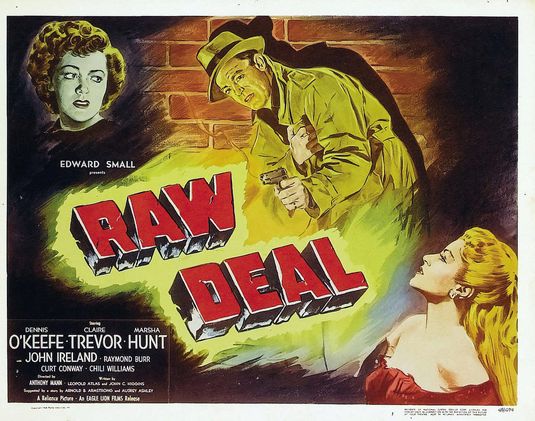
RAW DEAL (Eagle-Lion 1948, D: Anthony Mann)
This tough-talking film seems to cram every film noir trope in the book into its 79 minutes. Gangster Dennis O’Keefe busts out of prison with the help of his moll ( Claire Trevor ), kidnaps social worker Marsha Hunt, and goes after the sadistic crime boss (Raymond Burr) who owes him fifty grand. Director Mann and DP John Alton make this flawed but effective ultra-low budget film work, with help from a great cast. Burr’s nasty, fire-obsessed kingpin is scary, and John Ireland as his torpedo has a great fight scene with O’Keefe. The flaming finale is well staged…
One of my favorite actors, the laconic, iconic Robert Mitchum was born August 6, 1917 in Bridgeport, Connecticut. Rugged Robert had a wandering spirit, riding the rails in the days of the Depression, and even did time on a Georgia chain gang. Mitchum eventually ended up in California , and was bitten by the acting bug. After small roles in Laurel & Hardy comedies and Hopalong Cassidy oaters, Mitchum got noticed in a series of B-Westerns based on the novels of Zane Grey. His big break came as a tough sergeant in 1945’s THE STORY OF G.I. JOE, which he received an Oscar nomination for Best Supporting Actor. But the role that made him a star was world-weary private eye Jeff Bailey in the film noir classic OUT OF THE PAST.
We meet Bailey running a gas station in the small town of Bridgeport, California (an homage to Mitchum’s hometown, perhaps?) He has a mute…
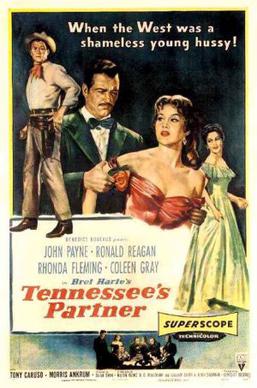 Tennesse (John Payne) is an old west gambler who co-owns a saloon (and bordello) with Elizabeth Farnham (Rhonda Fleming). When Tennessee is ambushed after a poker game, he’s saved by a local man who goes by the name of Cowpoke (Ronald Reagan). Tennessee and Cowpoke become fast friends but when Tennessee realizes that Cowpoke is about to marry a golddigger (Coleen Gray), Tennessee puts the woman on the next boat out of town. Cowpoke vows to get vengeance but Tennessee has bigger things to worry about. Rival businessman Turner (Tony Caruso) has framed Tennessee for the murder of a local prospector, Grubstake McNiven (Chubby Johnson).



 Through the Shattered Lens