Brad reviews JACK REED: A SEARCH FOR JUSTICE (1994), starring Brian Dennehy!


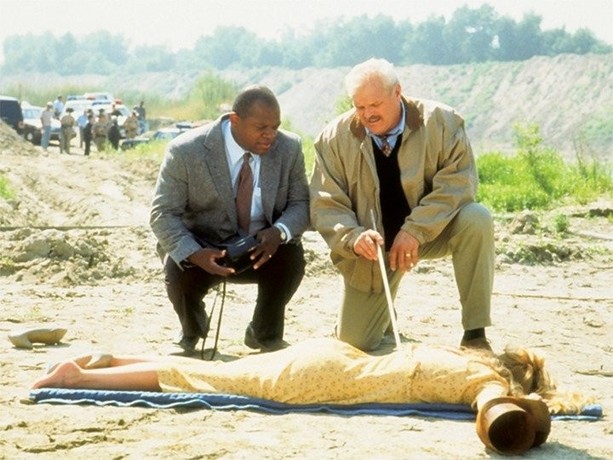
Brian Dennehy directed, co-wrote and starred in this made-for-TV movie about Chicago homicide detective Jack Reed. This is the third TV movie based on Reed’s exploits, following 1992’s DEADLY MATRIMONY, and 1993’s BADGE OF HONOR. In A SEARCH FOR JUSTICE, Jack Reed (Brian Dennehy) investigates the murder of pregnant stripper Lorelei Bradley (Marjorie Monaghan), who also happens to love children, even running a daycare center in the trailer park she lives in. Reed’s investigation quickly identifies the politically connected businessman and strip club owner, Win Carter (Miguel Ferrer), as the prime suspect. As if trying to solve the murder isn’t tough enough, Reed must also deal with corrupt superiors within his own department and train his new boss Charles Silvera (Charles S. Dutton), the latest in a long line of men to be promoted over him. No matter what obstacles Reed encounters, he remains determined to bring the killer to justice!

JACK REED: A SEARCH FOR JUSTICE, is my first “Jack Reed” film, and I enjoyed it. The character of Jack Reed is based on real life Cook County, Illinois Sheriff John “Jack” Reed, with each of the different movies loosely based on cases that Reed investigated throughout his career. As you might imagine, Brian Dennehy is excellent in the lead role as the tough, principled cop who will stop at nothing to catch criminals. The Chicago backdrop adds a nice wrinkle to the proceedings with its strong reputation for corruption, something that plays strongly into this installment and makes Reed’s job that much harder. I also really like Charles S. Dutton’s character, Lieutenant Charles Silvera. Initially promoted due to the color of his skin, and as a way to stick it to Reed, Silvera turns out to be an incorruptible lawman who develops a great working relationship with Reed. I’ve always been a fan of Dutton as an actor, mainly because of his ability to project decency and integrity on screen, and I’m looking forward to seeing them work together in future installments. Miguel Ferrer is also a good villain. He doesn’t go over the top here, rather he plays the part as low key, politically connected, amoral, and ultimately, very dangerous. It’s a good choice.

The fact that JACK REED: A SEARCH FOR JUSTICE is based on real life cases helps bring a little more realism than you might get in most TV movie cop movies of the time. As an example, our cops are more concerned about putting together solid evidence and getting a conviction over anything else. There is some action, but after watching this installment, I realize that these movies are just as likely to end with lawyers cutting a deal than with a big shootout. On the flip side, there are elements of the story that don’t seem realistic at all, such as Reed’s wife Arlene (Susan Ruttan) doing her own undercover work at one point, and our victim’s unlikely dual life as a stripper and daycare operator. What can I say, it’s not a perfect movie, but if you enjoy 90’s TV cop dramas like I do, you should enjoy this film and this series. The cast is good, and the characters are men of integrity trying to bring justice to a corrupt world. That’s a recipe for enjoyment as far as I’m concerned, and I’m looking forward to watching the rest of the film series! 
RUSH HOUR – 1998, a special year for this fan of Hong Kong action cinema!


1998 was certainly a special year for me as a fan of Hong Kong cinema but first let me provide a little context… After 150 years of British rule, Hong Kong was being handed over to communist China on July 1, 1997. This left a lot of uncertainty in Hong Kong’s local film industry. Because of that uncertainty, many of Hong Kong’s most popular filmmakers decided it was time to take their talents abroad. Director John Woo had already left for America in the early 90’s and had made successful films like HARD TARGET, BROKEN ARROW and FACE/OFF. This gets us to 1998, the year that many of Hong Kong’s biggest action stars would release their first American films. Chow Yun-fat would reprise his popular, honorable hitman role in his first American film, THE REPLACEMENT KILLERS, which was produced by John Woo and directed by Antoine Fuqua. Jet Li would make a strong impact as the badass villain in the 4th installment of the LETHAL WEAPON franchise. And then there’s Jackie Chan, probably the biggest of all the Hong Kong movie stars. Jackie had been banging around Hollywood as early as 1980 without a lot of fanfare in the west. But in 1996 Chan had a solid American box office hit when his Hong Kong production RUMBLE IN THE BRONX was dubbed and released in America. Armed with that success and a sizable budget provided by an American studio, Chan would get his own big release in 1998, the action-comedy RUSH HOUR!

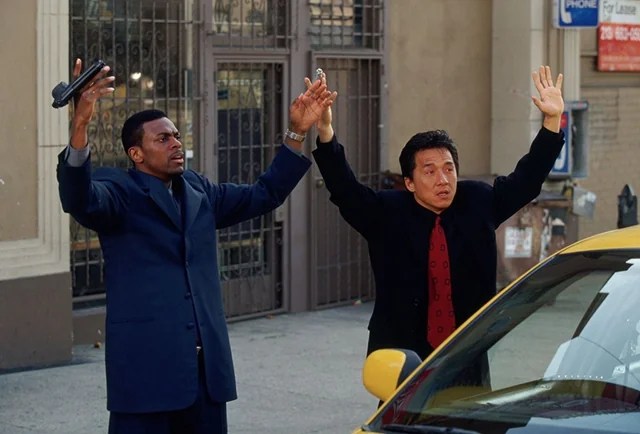
In RUSH HOUR, Jackie Chan plays inspector Lee, a Hong Kong police detective who’s also a friend to Chinese Consul Han (Tzi Ma), currently serving in Los Angeles. When Consul Han’s daughter Soo Yung is kidnapped, he asks Lee to come to America to assist him and the FBI in rescuing her. The FBI doesn’t really want Lee’s help so they ask the Los Angeles police department to assign someone, anyone, to stay with Lee and keep an eye on him so he doesn’t get in the way of their investigation. Enter fast-talking, LAPD Detective James Carter. After some initial clashes and disagreements, the mismatched duo eventually begins working together to find the criminal mastermind behind the kidnapping, Juntao.

I watched RUSH HOUR at the movie theater on my birthday in 1998. I loved every second of it. A few weeks later I was on a business trip in Chicago, I told my boss how good the film was, and we went to see it as well. I enjoyed it just as much the 2nd time. I’m a big fan of “buddy cop” films like LETHAL WEAPON and BAD BOYS, and RUSH HOUR is an excellent addition to that sub-genre of action films. Jackie Chan and Chris Tucker have an excellent chemistry together. Their comedic interplay is hilarious and entertaining. It’s one of the main reasons I enjoy the movie so much. Jackie Chan was 44 years old when RUSH HOUR was released, but he was still extremely athletic so his brand of martial arts action and comedy still worked. The movie would go on to gross just short of $250 million at the worldwide box office and establish Jackie Chan as a bonafide star in the American film market. 2001’s RUSH HOUR 2 would be an even bigger hit, making almost $350 million worldwide. No one works harder or gives more of himself to his film productions than Jackie Chan, and it was nice seeing him achieve the truly worldwide success that he had earned! 

THE LONG KISS GOODNIGHT (1996) – the $4 Million script!


Shane Black wrote a couple of my favorite action movies during my teenage years, LETHAL WEAPON and THE LAST BOY SCOUT. His scripts are characterized by strong violence balanced out by a healthy amount of comedic banter. That lethal (pun intended) combination made Shane Black a star in his own right, with his work being very much in demand. In 1994 he sold his script for THE LONG KISS GOODNIGHT for the unheard price of $4 Million. After hitting this payday, Black would go dark for the next decade and not release another screenplay until 2005’s KISS KISS BANG BANG, which was also his directorial debut. 

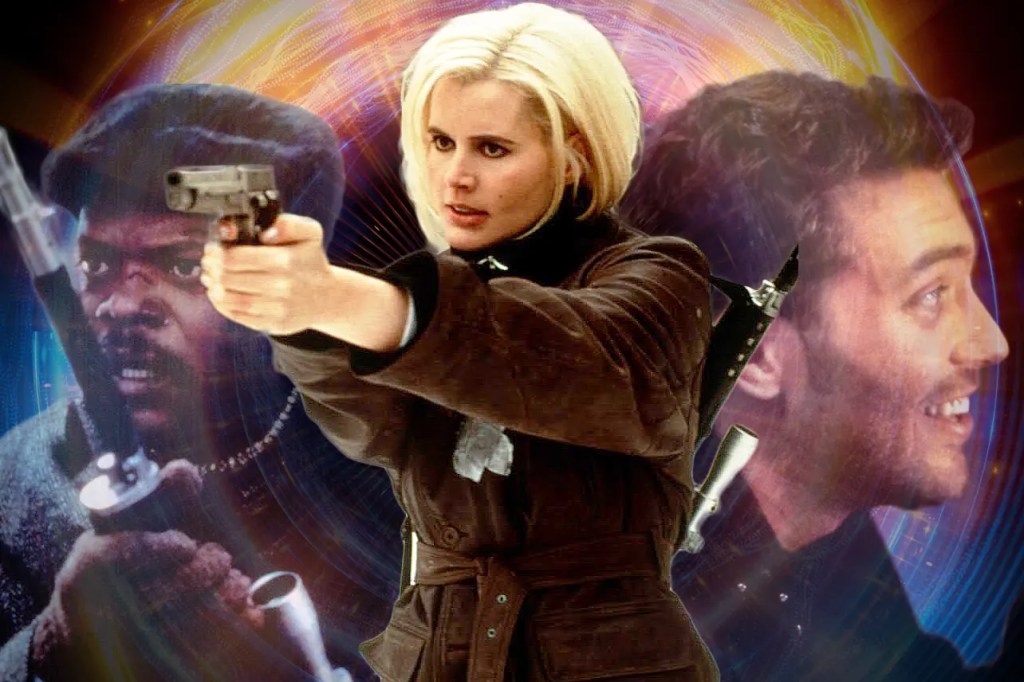
THE LONG KISS GOODNIGHT opens with Samantha Caine playing Mrs. Claus in her small town’s Christmas parade. She has a nice boyfriend, an 8 year old daughter, and she’s a member of the PTA. This is pretty good for a lady that doesn’t remember a damn thing about her life prior to 8 years ago. After celebrating her friends at a Christmas party, she’s driving a soused old man (Alan North) home when she hits a deer and flies right through the window and lands on a snowbank. This wakes up some of her memories and she starts having a few quick flashbacks and some odd dreams from her past, including the name Charly Baltimore. She also learns that she can easily break a buck deer’s neck and handle knives like a champ! Around this same time, low-rent private detective Mitch Hennessy (Samuel L. Jackson) who has been paid a retainer by Ms. Caine to be on the lookout for any clues related to her past, gets lucky and finds a letter from Caine to a supposed former lover. He heads her way to give her the update. When a local news program shows the beautiful Ms. Caine in the parade, some enemies from her past see the story and head to town to try to kill her. Surviving the attempt on her life, and now with Hennessy by her side, Samantha leaves to find out who she really is and unravel the secrets of her past. Is she a chef? Is she a school teacher? Is she a badass hit woman named Charly Baltimore? The fun is in finding out! 

Geena Davis is so good in her role as Samantha Caine / Charly Baltimore. She’s simultaneously beautiful, funny, sexy, cute as a button, and badass. She was married to the director, Renny Harlin, when the film was made and they both went all out to create a strong, female action hero. I think they succeeded admirably. Samuel L. Jackson is just so good in this type of role. He’s sarcastic and funny, a little sleazy, and very much a reluctant hero who does the right thing when he has to. In 2019, Jackson would go so far as to tell late night host Jimmy Fallon that Mitch Hennessy is his personal favorite role. The remainder of the cast is fine, with Brian Cox particularly standing out. His declarative statement about the ultimate results of a small lapdog continually licking his asshole really hit home for me and is reason enough alone to watch this film.  

Ultimately, even though I personally went to see it during its theatrical run, THE LONG KISS GOODNIGHT underwhelmed at the box office in 1996. It grossed around $90 million worldwide on a budget of around $65 million. But that’s fine to me, I enjoyed it in 1996, and I enjoyed it again when I watched it today! 

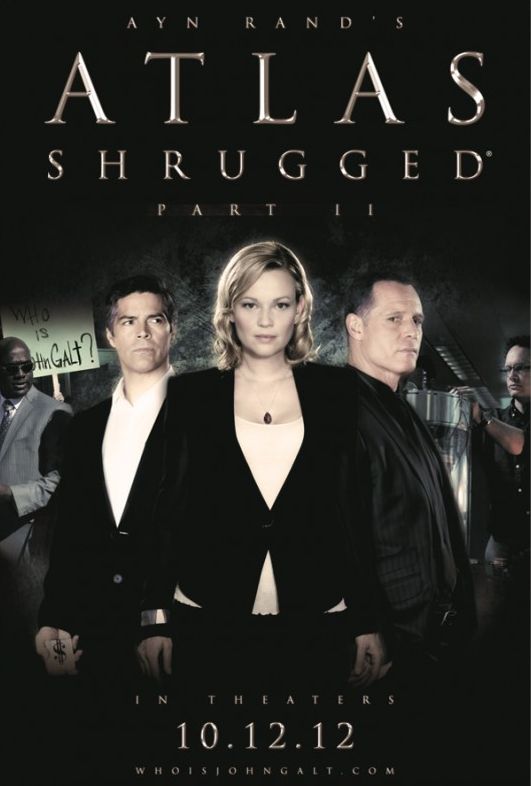
Film Review: Atlas Shrugged, Part II (dir by John Putch)


2012’s Atlas Shrugged: Part II picks up where Part I left off.

The time is still the near future.  (Part I specifically set the story as taking place five years into the future.  Part II declines to use a specific date but it does feature some news personalities playing themselves so it’s still clearly only meant to be a few years from 2012.)  The economy has gotten even worse.  The poor are only getting poorer while the rich are getting richer.  Under the direction of Head of State Thompson (Ray Wise) and his main economic advisor, Wesley Mouch (Paul McCrane), the government has nationalized nearly every business.  Halfway through the film, Thompson declares a national emergency and uses the Fair Share Law to invoke Directive 10-289.  All inventors, businessmen, and other creative people are required to sign their patents over to the government and to stop trying to develop now techniques.  Wages are frozen.  No one can be fired and no one can be hired.  Creative thinking is discouraged.  Asking questions or expressing doubt is forbidden.  People are encouraged to snitch on anyone not following the Directive.  Thompson and Mouch insist that it’s for the “good of the people,” and anyone who disagrees runs the risk of being dragged into court and sent to prison for ten years.  Meanwhile, gas now costs $42.00 a gallon.  One of the funnier moments of the film features someone paying $865.72 to fill up a truck.

Dagny Taggart (Samantha Mathis), the Vice President of Taggart Transcontinental Railways, is still trying to discover who invented an experimental motor that she found hidden away in a mine.  The motor could potentially change the way that goods are transported but it appears to be missing one component.  Unfortunately, all of the great scientists and inventors have been vanishing, with many of them leaving behind notes that ask, “Who is John Galt?”  Meanwhile, Dagny’s lover, Hank Rearden (Jason Beghe), fights to protect Rearden Metal from being taken over by the government and Dagny’s brother, James (Patrick Fabian), sells out to Wesley Mouch with the end result being that there’s no one left at Taggart Transcontinental with the intelligence or the experience necessary to keep two trains from colliding in a tunnel.

Given that Ayn Rand herself was an atheist who wrote very critically of religion, it’s interesting how much of Atlas Shrugged: Part II feels like one of those evangelical films where the Rapture comes and the entire world falls apart because all of the believers have suddenly vanished.  In the case of Atlas Shrugged, the world falls apart because all of the creatives and all of the leaders of industry and all of the innovative thinkers have abandoned it so that they can create a new community with John Galt.  (They’ve “stopped the motor of the world.”)  In many ways, this is the ultimate in wish fulfillment, a way of declaring, “They’ll miss me when I’m gone!”  Indeed, the majority of people who keep a copy of Rand’s novel displayed on their bookcase do so because they believe that they would be one of the lucky ones who was approached by Galt.  No one expects that they’ll be the person left behind to try to run the railroad.  It’s a bit like how like the most strident Marxist activists always assume they’ll be the ones organizing the workers as opposed to being a worker themselves.

Not surprisingly, the same critics who attacked Part I didn’t care much for Atlas Shrugged Part II.  When I first saw it, I thought the film was a bit too long and I was annoyed that, with the exception of a few minutes at the end, the film didn’t really seem to move the story forward.  At the same time, just as with the first film, I appreciated the fact that the second film was proudly contrarian in its portrayal of the government as being inherently incompetent.  After all, this was 2012, back in the “good government” era, when a lot of people still reflexively assumed that the government was staffed only by hyper-competent policy wonks who knew what they were doing and who were only concerned with making sure that “the trains ran on time,” to borrow an old expression.

Rewatching the film this weekend, I have to say that I actually appreciated Atlas Shrugged Part II a bit more than the first time I watched it.  Yes, Part II was still a bit too long and the domestic drama between Hank and his wife fell flat but Part II is still a marked improvement on the first film.  Some of that is because Part II had a higher budget than Part I and, as a result, it didn’t look as cheap as the first film.  The corporate offices looked like actual corporate offices and the factories looked like real factories.  Secondly, the second film had an entirely different cast from the first film.  Samantha Mathis, Jason Beghe, and especially Patrick Fabian were clear improvements on the actors who previously played their roles.  That’s especially important when it comes to Mathis and Beghe because, as opposed to the first film, Part II convinces the viewer that  Dagny and Hank actually are as important as they think they are.  When the trains collide in the tunnel, the viewer never doubts that Mathis’s Dagny could have prevented the disaster if not for the government’s attempts to force her out of her own company.  As well, the viewer never doubts that Beghe’s Hank would fight to the end to protect his business, even if it means prison.  One wouldn’t have necessarily believed that while watching the first film.

Finally, having lived through the COVID era, the film’s portrait of government overreach and incompetence feels a lot more plausible when watched today.  One doesn’t have to be a fan of Rand’s philosophy or agree with her solutions to see the parallels between Directive 10-289 and the policies that led to children being kept out of schools and numerous small business having to shut their doors.  In an era when most people’s faith in governmental institutions has been broken to such an extent that it might never be fixed in our lifetime, Atlas Shrugged Part II resonates.  Whereas the film once felt subversive, now it feels downright prophetic.

Film Review: Cutthroat Island (dir by Renny Harlin)


Today is Talk Like A Pirate Day which, let’s just be honest, is an extremely stupid holiday that mainly exists to remind us that “doubloon” is a deeply silly word.

Doubloons were a currency that were popular in Europe and South America back in the 18th century and pirates were always looking for doubloons.  If you listen to enough pirate talk, you’ll quickly discover that there’s a lot different ways to say the word doubloon.  Some people put the emphasis on the fist syllable while others emphasize the second.  Some people say Due-bloon while others say Duh-bloon.  Either way, it’s impossible to listen to pirates talk about doubloons without thinking that they sound very, very silly.  The secret behind the success of The Pirates of the Caribbean franchise is an understanding that it’s impossible to take pirates seriously.

Unfortunately, I chose not to watch The Pirates of the Caribbean for Talk Like A Pirate Day.  Instead, I watched 1995’s Cutthroat Island.

Cutthroat Island is a story of pirates, a lost treasure, and one big sea battle that literally seems to go on and on.  There is occasional talk of doubloons, though not enough for my liking.  Instead, most of the film deals with the efforts of Morgan (Geena Davis) to find a hidden treasure before her uncle, Dawg (Frank Langella), discovers it.  Morgan has one-third of a map.  It was originally tattooed on her father’s head.  After he died, she scalped him and took over his boat.  She also purchased a swashbuckling slave named Shaw (Matthew Modine) because Shaw is capable of reading Latin, the language in which the map is written.  Needless to say, Shaw and Mogan fall in love while Dawg teams up with corrupt colonial officials to not only track down the treasure but to also capture his niece.

The film starts out as a romance with a dash of comedy before eventually transforming into a standard action movie.  That means that boats get blown up and there’s a lot of scenes of people fencing.  There’s also a lot of slow motion footage of bodies plunging into the ocean.  The climatic battle goes on forever and it actually features Morgan hissing, “Bad dawg!” at her uncle.

(Amazingly, “Bad Dawg” isn’t the worst of the dialogue to be heard in Cutthroat Island.  Morgan has a habit of saying stuff like, “I will maroon you on a rock the size of this table, instead of splattering your brains across my bulkhead” and “Since you lie so easily and since you are so shallow, I shall lie you in a shallow grave.”)

Throughout the film, there are hints of what Cutthroat Island could have been, if it hadn’t been such a by-the-numbers action flick.  The fact that it was Morgan who was continually rescuing Shaw was a nice change-of-pace from the usual damsel-in-distress clichés that one finds in most pirate movies.  When Morgan effortlessly breaks the neck of a soldier and sets free her crew, it’s a great moment, comparable to Angelina Jolie taking out Liev Schreiber in Salt or Milla Jovovich kicking zombie ass in a Resident Evil film.  Unfortunately, director Renny Harlin (who was married to star Geena Davis, at the time) is usually too concerned with getting to the next action set piece to truly take advantage of the film’s subversive potential.

Frank Langella is smart enough to bellow his way through his villainous role while Matthew Modine appears to be so amused by the film’s terrible dialogue that it’s impossible not to like him.  Geena Davis is convincing when she’s breaking necks and swinging swords but she delivers her dialogue like someone who has already figured out that the movie was a bad idea and resigned herself to the fact that her film career will never recover.  She doesn’t appear to be having any fun, which kind of defeats the purpose of being a pirate.

Cutthroat Island was a huge and notorious box office flop and it’s still considered to be one of the biggest financial disasters in film history.  Apparently, Hollywood was so traumatized that it would be another 8 years before there was another major pirate production.  That production, of course, was Pirates of the Caribbean, a film that captured the fun that was so lacking in Cutthroat Island.

A Movie A Day #217: Wyatt Earp (1994, directed by Lawrence Kasdan)


Once upon a time, there were two movies about the legendary Western lawman (or outlaw, depending on who is telling the story) Wyatt Earp.  One came out in 1993 and the other came out in 1994.
The 1993 movie was called Tombstone.  That is the one that starred Kurt Russell was Wyatt, with Sam Elliott and Bill Paxton in the roles of his brothers and Val Kilmer playing Doc Holliday.  Tombstone deals with the circumstances that led to the Gunfight at the O.K. Corral.  “I’m your huckleberry,” Doc Holliday says right before his gunfight with Michael Biehn’s Johnny Ringo.  Tombstone is the movie that everyone remembers.

The 1994 movies was called Wyatt Earp.  This was a big budget extravaganza that was directed by Lawrence Kasdan and starred Kevin Costner as Wyatt.  Dennis Quaid played Doc Holliday and supporting roles were played by almost everyone who was an active SAG member in 1994.  If they were not in Tombstone, they were probably in Wyatt Earp.  Gene Hackman, Michael Madsen, Tom Sizemore, Jeff Fahey, Mark Harmon, Annabeth Gish, Gene Hackman, Bill Pullman, Isabella Rossellini, JoBeth Williams, Mare Winningham, and many others all appeared as supporting characters in the (very) long story of Wyatt Earp’s life.

Of course, Wyatt Earp features the famous Gunfight at the O.K. Corral but it also deals with every other chapter of Earp’s life, including his multiple marriages, his career as a buffalo hunter, and his time as a gold prospector.  With a three-hour running time, there is little about Wyatt Earp’s life that is not included.  Unfortunately, with the exception of his time in Tomstone, Wyatt Earp’s life was not that interesting.  Neither was Kevin Costner’s performance.  Costner tried to channel Gary Cooper in his performance but Cooper would have known better than to have starred in a slowly paced, three-hour movie.  The film is so centered around Costner and his all-American persona that, with the exception of Dennis Quaid, the impressive cast is wasted in glorified cameos.  Wyatt Earp the movie tries to be an elegy for the old west but neither Wyatt Earp as a character nor Kevin Costner’s performance was strong enough to carry such heavy symbolism.  A good western should never be boring and that is a rule that Wyatt Earp breaks from the minute that Costner delivers his first line.

Costner was originally cast in Tombstone, just to leave the project so he could produce his own Wyatt Earp film.  As a big, Oscar-winnng star, Costner went as far as to try to have production of Tombstone canceled.  Ironically, Tombstone turned out to be the film that everyone remember while Wyatt Earp is the film that most people want to forget.

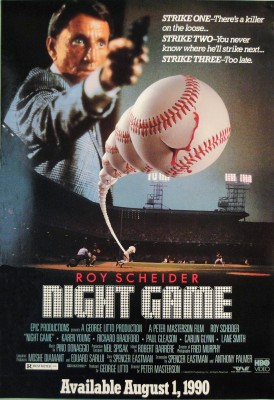
The TSL’s Grindhouse: Night Game (dir by Peter Masterson)


Apparently, today is the opening day of the 2017 baseball season.  The only reason that I know that is because of my sister Erin.  I don’t know much about baseball, to be honest.  I know that my city’s team is the Texas Rangers and they were once owned by George W. Bush.  I know that Houston has a team called the Astros.  But, really, the main thing that I know about baseball is that my sister absolutely loves it.

So, when Erin asked me to review a baseball movie today, how could I say no?  I mean, I may know next to nothing about baseball but I certainly know something about movies!

For that reason, I’m going to take a few minutes to tell you about a 1989 film called Night Game.  Night Game is many things.  It’s a movies that features a lot of baseball, even though it’s not really a sports film per se.  It’s a police procedural, though the film itself suggests that the police often don’t have the slightest idea what they’re actually doing.  It’s a serial killer film, though its killer is never quite as loquacious as we’ve come to expect in this age of Hannibal Lecter and Dexter Morgan.  At times, it’s a slasher film, though it’s never particularly graphic.  Mostly, Night Game is a Texas film.

Directed by native Texan Peter Masterson, Night Game is like the original Texas Chainsaw Massacre in that it is one of those rare films that not only takes place in Texas but was actually filmed on location.  To be exact, Night Game was filmed in both Galveston and Houston.  The entire film has a friendly and quirky Texas feel to it.  Masterson may not have been a great visual director (If not for some language and nudity, Night Game could pass for a TV movie) but Night Game is a movie where the plot is less important than capturing the little details of a time. a location, and the people who lived there.  Though Night Game is 28 years old, it’s portrait of my home state still seemed very contemporary to me.  I guess Texas hasn’t really changed that much over the past few decades.

As for the film’s plot, someone is murdering young women in Galveston and leaving their bodies on the boardwalk.  Obviously, that’s not going to be good for attracting Spring Break revelers.  The film doesn’t make any effort to keep the murderer’s identity a secret.  We see his face fairly early on.  We also see that he has a hook for a hand.  Eventually, we do learn the murderer’s motives.  They’re pretty silly but then again, individual motives rarely make sense to anyone other than the guy with the hook for a hand.

Detective Mike Seaver (Roy Scheider) has been assigned to solve the case.  One thing that I really liked about Night Game was that Mike was pretty much just a normal guy with a job to do.  He wasn’t self-destructive.  He wasn’t always drunk.  He wasn’t suicidal.  He wasn’t always lighting a cigarette and staring at the world through bloodshot eyes while the lighting reflected off of his artful stubble.  He was just a detective trying to do his job and get home on time.  After sitting through countless films about self-destructive cops and criminal profilers, the normalcy of Mike was a nice change of pace.

Mike does have a backstory.  He used to play baseball and he still loves the game.  He goes to every Astros home game in Houston.  He’s in love with Roxy (Karen Young), who works at the stadium.  Things are only slightly complicated by the fact that Mike had a previous relationship with Roxy’s mother (Carlin Glynn).  Don’t worry, Mike’s not secretly Roxy’s father or anything like that.  It’s not that type of movie.

Anyway, Mike is such a fan of baseball that he realizes something.  The killer only strikes on nights that the Astros win a game.  And he only strikes if a certain pitcher was throwing the ball.  The obvious solution would be to shoot the pitcher in the arm and end his athletic career.  However, Mike’s too nice a guy to do that.  Instead, he just tries to track down the killer…

And, as I said, Night Game actually isn’t a bad little movie.  Make no mistake, it’s a very slight movie.  At no point are you going to say, “I’m going to remember that scene for the rest of my life!”  That said, it’s a surprisingly good-natured film and Roy Scheider’s performance is likable and unexpectedly warm.  With all that in mind, Night Game is an entertaining and (mildly) bloody valentine to my home state.

Plus, it’s a baseball movie!  I don’t know much about baseball but, if my sister loves it, it has to be a good thing!

Zombeavers Is The Best Zombie Beaver Film Ever!!!!


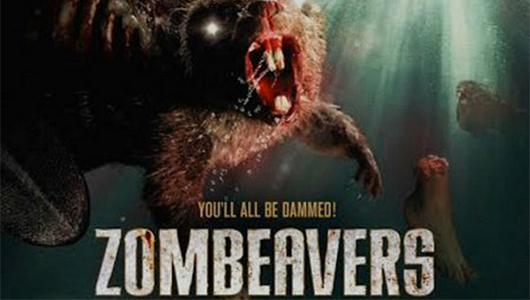
ZombeaversOf the many deliberately ludicrous and over-the-top nature-gone-made films to be released in the wake of Sharknado, Zombeavers is one of the most impressive.  Certainly, it’s probably the best film that will ever made about zombie beavers.

The film takes place in one of those isolated areas of rural America where cell phones don’t work, everyone drives a pickup truck, and nobody would dare be seen without a shotgun in his hands.  Of course, if you’ve ever seen a horror movie before than you know that any area this isolated is going to inevitably be ground zero in a mutant beaver attack.

Perhaps not surprisingly, it’s all John Mayer’s fault.  Yes, that’s right, John “Your Body Is A Wonderland” Mayer.  He makes his feature film acting debut here, playing a dumbass trucker who, after his truck collides with a deer, ends up losing a barrel of toxic waste.  That barrel rolls into a nearby lake where it turns the local beaver population into zombeavers!

(Whenever I watch anything on Netflix, I always turn on the closed captioning.  One of the joys of watching Zombeavers came from getting to read sentences like “Zombeavers growl,” at the bottom of the screen.)

Meanwhile, three sorority sisters are spending the weekend at a nearby cabin.  Jenn (Lexi Atkins) is depressed because she caught her boyfriend cheating on her.  Zoe (Cortney Palm) is sarcastic, uses “bitch” as a term of affection, and owns a puppy named Gosling.  (I related to Zoe, despite being a cat person.)  Mary (Rachel Melvin) owns the cabin and is determined to have the perfect girls weekend.  Unfortunately, those plans are ruined by both the surprise arrival of their boyfriends and a sudden zombeaver attack…

Fortunately, there is a potentially crazy but helpful hunter wandering around the woods.  His name is Smyth (“Smyth with a y,” he says upon introducing himself) and he’s played by veteran character actor Rex Linn.  Linn doesn’t get much dialogue but he still manages to make every line memorable as he gives a performance that strikes a perfect balance between drama and parody.  At one point, Linn delivers a monologue about how, in the 1970s, everyone in the county got “beaver fever.”  It’s  ludicrous and the joke is so obvious but Linn bring so much commitment to the monologue and to his performance that he sells it.

And really, the same can be said for Zombeavers as a movie.  It’s ludicrous.  It’s silly.  There’s not a single beaver joke that doesn’t, at some point, get made.  And yet, the film works.  It’s a parody that somehow manages to remain credible.  Yes, the zombeavers are intentionally designed to look fake but you still would not necessarily want to come across one at the foot of your bed in the middle of the night.  Yes, the characters say a lot of silly things but the cast delivers those lines with both a straight face and a lot of conviction.  (In fact, all three of the lead actresses are totally natural and convincing in their roles.)  Everyone involved with the film — from the cast to crew — is so committed to the material that it works even when it shouldn’t.

Zombeavers is currently available on Netflix and should be watched by anyone who loves insane monster movies.  It’s the best movie about zombie beavers ever made.

Film Review: Devil’s Knot (dir by Atom Egoyan)


After having spent close to a year hearing only negative things about it, I finally watched Atom Egoyan’s Devil’s Knot last night.  On the basis of what a lot of critics had said about the film, I have to admit that I was mostly watching it to see if I needed to include it on my upcoming list of the 16 worst films of 2014.

But you know what?

Devil’s Knot really isn’t a bad film.  It’s just an extremely unnecessary one.

Devil’s Knot opens with a title card that reads, “Based on a true story.”  Honestly, the title card could have just as easily read, “Based on a true story and if you doubt it, there’s four other movies you can watch.”  The trial, conviction, and subsequent imprisonment of the West Memphis Three is perhaps the most famous miscarriage of justice in recent history precisely because so many documentaries have been made about it.  Paradise Lost and Paradise Lost Part Three are two of the most disturbing true crime documentaries ever made.

(As for Paradise Last Part Two, it displays a stunning lack of self-awareness as it attempts to prove the guilt of John Mark Byers by using many of the same techniques that were used to convict the West Memphis Three.  The less said about it, the better.)

The story is so well-known that I almost feel like retelling it would be like taking the time to inform you that George Washington was our first president.  But here goes — in 1993, 3 eight year-old boys were murdered in the small town of West Memphis, Arkansas.  Three teenagers were arrested for the crime and, on the flimsiest of evidence, were convicted.  As is seen in the documentaries, their conviction had more to do with community hysteria and paranoia than anything else.  The supposed leader of the West Memphis Three, Damien Echols, was accused of being a Satanist.  Why?  Mostly because he wore black clothing.

Eventually — and largely as a result of the documentaries made about the case — the West Memphis Three would be freed from prison.  (However, their convictions would still legally stand, meaning that their exoneration would be limited to the court of public opinion.)  Devil’s Knot, however, doesn’t deal with any of that, beyond a lengthy scroll of “this is what happened after the movie” information that rolls up the screen after the final scene.  Instead, Devil’s Knot deals with the first trial of the West Memphis Three and the small town atmosphere of fear and hysteria that led to them being convicted in the first place.

And — though the film is surprisingly conventional when you consider the reputation of director Atom Egoyan — it’s all fairly well-done.  As a former resident of and frequent visitor to Arkansas, I was happy to see that Egoyan didn’t indulge in as many stereotypes as I feared he would.  (One need only watch the self-important Northern activists in Paradise Lost Two to see the attitude that I feared Egoyan would bring to the project.)  Reese Witherspoon is perfectly cast as the mother of one of the murdered boys.  Kevin Durand is properly intimidating at John Mark Byers.  Even Colin Firth manages to make for a convincing Arkansan.

But, ultimately, Devil’s Knot just feels so unnecessary.  It doesn’t bring anything new to the story and there’s ultimately nothing here that you couldn’t have learned from the original Paradise Lost.

Probably the best thing that I can say about Devil’s Knot is that it’s better than Paradise Lost Part Two.

The Walking Dead: “Torn Apart” 6-Part Webisodes


It’s just 13 days more days til the season 2 premiere of AMC’s The Walking Dead series. The show has been a runaway hit for the network and for all involved. The past summer has seen some major turmoil within the creative team (mostly the firing of show-runner Frank Darabont halfway through the season 2 filming), but the show still remains one of the most awaited ones for 2011 with millions of fans waiting to see what’s in store for Rick Grimes and his small group of survivors.

Leading up to the show’s October 16 premiere the people at AMC and the show decided to create six webisodes showing the life of the first zombie Rick comes across in the first season. Yes, these 2.5 minute webisodes details the life of the “Bicycle Girl” before she joined the ranks of the undead. The webisodes were directed by the show’s lead make-up effects guru in Greg Nicotero.

One would think that AMC would release one webisode every other day until the seasoon 2 premiere but they’ve tortured fans of the show enough with all the drama this past summer and decided to release all 6 webisodes at the same time.

From what I saw these webisodes were well-done and added an extra but of tragic backstory to one of the iconic figures of the first season. Here’s to hoping this becomes a regular practice with each new season for the show.

Part 1: “A New Day”

Part 2: “Family Matters”

Part 3: “Domestic Violence”

Part 4: “Neighborly Advice”

Part 5: “Step-Mother”

Part 6: “Everything Dies”

Comment on what you’ve just watched. Do you think the family’s decisions made things worse or were things just too far gone for them to reach safety? What would you do differently if in their shoes?

Source: AMC TV: The Walking Dead