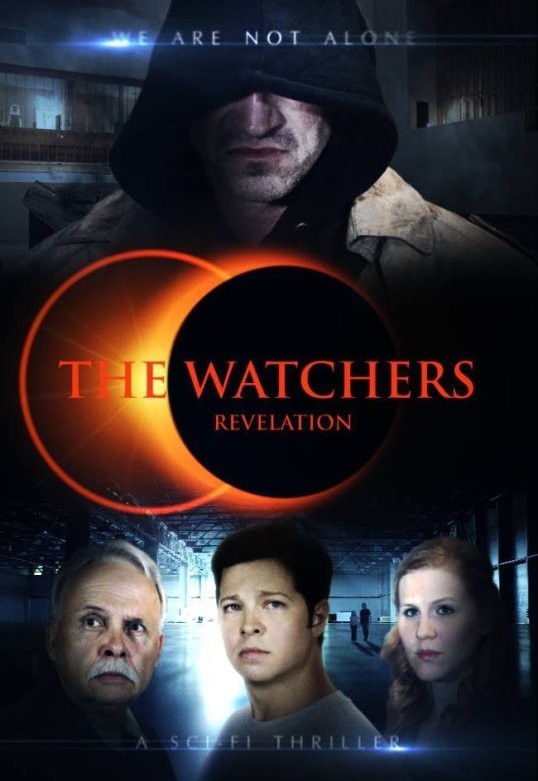
Film Review: The Watchers — Revelation (dir by Tom Dallis)


As I watched the 2013 film, The Watchers: Revelation, three words kept going through my head:

Threat Level Midnight

Yes, I was thinking about Michael Scott’s infamous amateur film from The Office, in which the fact that Michael obviously knew how to move a camera and compose a shot could not cover up a ton of awkward dialogue and a plot that appeared to have been made up on the spot.  Like Threat Level Midnight, The Watchers: Revelation is very ambitious and even features not one but two presidential meetings.  (The film opens in the 50s with someone who I guess is meant to be Dwight Eisenhower and it ends in the near future, with a President named Connolly.)  Like Threat Level Midnight, the film features some rudimentary special effects that are actually kind of impressive when you consider the fact that the film was obviously made for very little money.  And, like Threat Level Midnight, the story is next to impossible to follow.

The film makes the familiar case that, since at least the 1950s, otherworldly beings have been meeting with world leaders and supplying them with weaponry and technological advances.  In this case, there’s two sets of beings.  One group is evil and one group is good and the challenge of the film is to keep track of which is which.  The film also suggests that these beings are not, as many assume, aliens but are actually the Watchers, the angels who were assigned to watch over Earth and who betrayed God’s trust by sleeping with human women and creating the Nephilim.  (It’s in the Books of Enoch, people!  Not to mention Darren Aronofsky’s Noah.)

Anyway, in this one, Ambassador Addon (Eugene Pridgett) leaves Earth in 1955 after warning President Eisenhower that his people are not happy about mankind’s warlike nature and or their ambitions to leave the planet and explore the universe.  Much as in The Day The Earth Stood Still, Addon warns about spreading Earth culture to other planets.  We then jump forward several decades, to the discovery of an ancient tablet that appears to prove that aliens did visit Earth and did share technology with early humans.

Dr. Peter Kenner (Titus Young Wolverton) is a scientist who has no faith in God but does believe in ancient alien visitation.  His uncle, Joshua Sanders (David Gaylor), is a scientist who retains his faith in God and, as a result, he and Peter don’t really have much to do with each other.  However, they are brought together by nine year-old Kara Pennington (Carissa Dallis), who can read ancient Hebrew and who, for some reason, the aliens want to abduct.  Seeking to protect Kara is her mother (Katlin Lory) and a mysterious man named Ethan (Tyler Trent).  It all eventually leads to a battle in a warehouse because these things always do….

To be honest, the plot is pretty much impossible to follow.  There’s a lot of scenes of people chasing each other but you’re never quite sure why.  There’s also some political conspiracy intrigue that never really seems to come together.  At the same time, the film is made with such enthusiasm and is so earnest in its attempts to be a sci-fi epic despite not having an epic budget that, much like Threat Level Midnight, it’s hard not to like it.  Sometimes, you really do have to appreciate the effort.
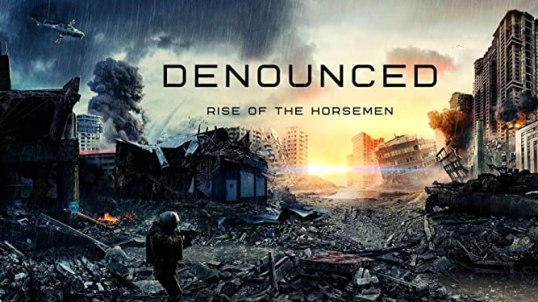
Film Review: Denounced: Rise of the Horsemen (dir by Stephen C. Bortsalas)


The 2017 film, Denounced, opens with a man named Paul (Sean Hart) in the wilderness.

Just one look at Paul is all you need to know that he’s seen some stuff.  He’s tall and physically imposing with a haunted stare and a scarred face.  He’s wearing a dark uniform, one that identifies him as being a member of some sort of paramilitary force.  Because Paul is now alone, it’s easy to guess that he must be a deserter of some sort.  But what did he desert and why?

Paul eventually meets two other people in the wilderness, a man and a woman.  They’re all trying to escape from something.  The man talks about how, on the night of an event that’s referred to as being “the vanishing,” he was on the verge of committing suicide.  The woman talks about how she was a drug addict. And finally, Paul starts to open up about his past life….

And, at this point, you’ve probably already guesses what this movie is about, haven’t you?  Yes, “the vanishing” was the Rapture and yes, Paul was a part of a paramilitary force that was working for the Antichrist.  Motivated by the anger of losing his entire family (they all vanished while he didn’t), Paul joined the Horsemen and spent months killing believers and other dissidents.  After finally coming to realize that he had surrendered himself to his hate, Paul refused to continue killing.  Now, Paul is hiding in the wilderness and obsessing on whether or not someone who has done the evil things that he’s done can ever truly be redeemed.

I know that at least a few of our readers are probably rolling their eyes already but Denounced is actually a surprisingly well-made film.  While the low-budget is evident in nearly every frame, director Stephen C. Bortsalas is still able to create a properly ominous and paranoid atmosphere throughout the film.  He gets a lot of help from Sean Hart, who comes across as being genuinely haunted in the lead role.  Including this film, Hart only has two credits on the imdb so I don’t know if he’s a trained actor or if he’s just a talented amateur but, in the role of Paul, he has the haunted eyes of someone who has lost everything that he once cared about.  He’s sympathetic in the present-day scenes and intimidating in the past scenes and you do hope for the best for his character.

Denounced is also a surprisingly brutal film, though every act of violence is justified by the film’s storyline.  One lengthy scene features more dismemberment than you would probably ever expect to see in a low-budget, faith-based film.  Heads and hands are graphically chopped off and it’s far more effective than I would have expected it to be.  So many films would have just had Paul say that he had done some terrible things and left it that.  This film shows you in details just what exactly those things were but it’s not gratuitous violence.  Instead, it’s very necessary to our understanding of who Paul is and why he’s now so haunted by his actions.

Though I imagine it will be best appreciated by people who already share its world-view, Denounced is a surprisingly effective apocalyptic film.

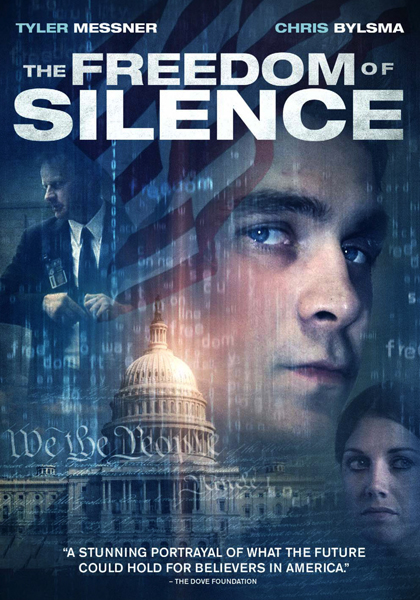
Film Review: The Freedom of Silence (dir by Richard Robertson)


If there’s anything that I’ve learned from watching several politically-themed films over the past few weeks, it’s the easiest way to win an argument is to have the screenwriter on your side.  Seriously, as long as you can control what the opposition says, it’s very easy to stump them with your arguments.

The other thing that I’ve learned is that apparently no one ever disagrees solely because they have a different opinion or way of looking at the world.  Instead, there’s an ulterior motive to every disagreement.  If a businessperson says that we need to keep taxes low, it’s never because they sincerely believes that lower taxes will encourage economic growth.  No, in the movies, it’s always because they’re just greedy and not willing to pay their fair share.  Of course, it’s never really explored as to what exactly “paying your fair share” means but that’s not important.  Not when there’s someone who would rather see people die than pay their taxes.

By that same token, any military leader who argues for more defense spending isn’t doing so because they sincerely believe that a strong defense will keep America safe from its enemies.  Instead, it’s always a case where they just want a war because ….. well, why not?

If the film is religious in nature, you can rest assured that no skeptic will be a skeptic just because they happen to have a different set of beliefs or because they were maybe just raised in a nonreligous environment.  Instead, in the movies, every skeptic is a skeptic because something traumatic happened to them in the past and it led to them getting so angry with God that they renounced their faith.  This, of course, always leads to the question of, “How can you be angry at a God that you don’t believe in?” and a moment of awkward silence as the skeptic realizes that he doesn’t have an answer.

The 2011 film, The Freedom of Silence, is built around scenes of a man named Zack Thompson (Tyler Messner) being tortured by one such skeptic.  The skeptic is Captain Johansen (Jeffrey Staab) and it’s not enough that he’s a fascistic authoritarian who uses his position to legally indulge in his own sadistic impulses.  He also has to be a Hollywood atheist, a man whose disdain of religion is all linked back to a past tragedy in his own life.  To a certain extent, I think he would have been a more believable character if he had just been motivated by his own need to create pain.  There’s been enough real-life examples of sadists-in-power that I think that no one would have doubted that a character like Captain Johansen could exist in the real world.  After all, a world that gave us Klaus Barbie, Lavrentiy Beria, Joseph Mengele, and Pol Pot could certainly give us as a Captain Johansen.  By making him a Hollywood atheist, the film reminds us that Captain Johansen is just a fictional strawman, a character created specifically to be outargued by the story’s hero.  It makes him less effective as a character, despite the fact that Staab does a good job playing the role.

The Freedom of Silence takes place in 2030 and imagines an America where the first amendment has, for all intents and purposes, been outlawed.  Since this is a faith-based film, the film focuses on the idea of Christianity being banned (or, as the government argues, replaced by a new unified, national religion) and bibles being forbidden.  Have other religions also have banned?  Can having a copy of the Koran get you thrown in prison?  The Freedom of Silence doesn’t say but I think it might have been a stronger film if it had.

Anyway, Zack has a plan to broadcast the word of God despite the government’s rules.  He’s going to need the help of Aaron (Chris Bylsma) but Aaron has a new girlfriend named Trisha (Lauren Alfano) and Trisha is secretly working for the government and you can tell where this is going already, can’t you?

And the thing is — I’m a bit of a free speech absolutist and I’m certainly no fan of government regulation and I do believe that free speech is under attack, by both the Left and the Right, in this country.  And yes, I did enjoy the scenes of brainwashed American citizens blandly talking about how they had to follow the law no matter what.  Unfortunately, the film itself has some serious pacing issues and, with the exceptions of Staab and Lauren Alfano, the acting is a bit inconsistent.  I think we’re supposed to excuse the filmmaking deficiencies because of the self-declared righteousness of the film’s message but the film is so disjointed that, at times, it’s nearly impossible to follow the plot.  That’s not something you can just ignore.

This is one of those films where, if you’re on the film’s side, you’ll enjoy it because you know it’s the type of thing that would annoy people who disagree with you.  But if you’re not already predisposed to agree with the film’s point, The Freedom of Silence is not going to convince you to change your mind.  This is a film that solely exists to own the other side.  And sometimes, that’s enough.  Audiences do tend to like films and books and songs and shows that confirm their already held beliefs.  But I don’t know.  Sometimes, when it comes to important issues like free speech, you want and the issue demands something more than jut a heavy hand and strawman arguments.

Anyway, if you just want to own the other side, you might get a kick out of certain parts of The Freedom of Silence.  If you’re looking for more, look elsewhere.

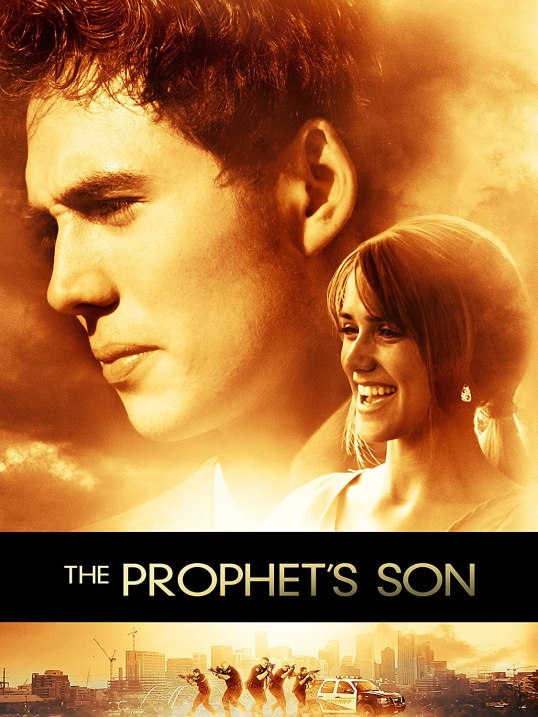
Film Review: The Prophet’s Son (dir by Paul Anthony McClean, Maurice Sparks, and Josiah David Warren)


As I’ve mentioned on this site in the past, I’ve always been fascinated by amateur feature films.  These are films that were made totally outside of the Hollywood system.  For the most part, they’re made by filmmakers with little to no formal training and they feature a cast of nonprofessionals.  Many of these films are passion projects for the people involved.  It’s not uncommon to hear about them being made by an all-volunteer cast and crew.  Sometimes, these films are surprisingly effective and sometimes — well, most times — they’re just really bad.

The 2012 film, The Prophet’s Son, is one of those largely amateur films and sad to say, it’s not a particularly good film.  If Tommy Wiseau decided to follow up The Room with an evangelical film that attempted to deal with almost every single issue facing the world today, the end result might be something like The Prophet’s Son.

It’s an odd film.  I have to admit that one of the main reasons that I watched it was because I had seen the film described as being about the end of the world and I have a weakness for cheaply made apocalypse films.  While The Prophet’s Son does feature a very brief nuclear attack on the city of Denver, it’s not really an apocalypse film because 1) the world doesn’t end, 2) the rapture doesn’t occur, and 3) the Antichrist never makes an appearance.  Instead, the nuclear attack just kind of comes out of nowhere and I will admit that it’s impossible for me not to have just a little admiration for a film that would toss a random nuclear war into an already cluttered storyline.  One minute, writer Juliet Oscar (played by Alexandra Harris) is sitting outside and the next minute, there’s missiles raining down on Denver.  Juliet and her boyfriend, musician and movie star Abel Benjamin (Josiah David Warren), get to safety and pray and the newly elected President of the United States appears on television and announces that America has survived.

Abel, incidentally, is the prophet’s son of the title.  Or, at least, I think he is.  He also has brother named Obadiah (Taurean Cavins-Flores), who I guess could just as easily be the prophet’s son.  Their father is the pastor of a church and he keeps saying that dark times are ahead, which I guess makes him a prophet, though he could just be one of those people who spends too much time on social media.  The film is a bit difficult to follow, to be honest.  At one point, Obadiah foils a robbery at a coffeeshop by telling the thief that he needs to get right with God.  The thief responds by shooting Obadiah in the leg.  Obadiah survives and Abel later learns that the thief loved Abel’s last movie so Abel visits him in jail, forgives him, and then performs an impromptu exorcism on him.  (It’s a super quick exorcism, too.  I’m used to longer exorcisms.)

Meanwhile, Juliet’s brother, Jason (Peter Lugo), says that he’s not going to waste his time with church until he turns 18.  Unfortunately, he then gets caught up in the middle of a surprisingly graphic school shooting rampage.  This leads to Jason’s twin brother, Isaac (Brad Spiotta), running away and getting lost in Denver.  Juliet and Abel search for him with the help of a some gang members.  When Juliet spots Isaac, she runs to him.  Abel, meanwhile, stays behind to give some money to a homeless woman.

Eventually, Abel ends up in Manila, where he witnesses people being kidnapped off the streets.  He tells the maid at his hotel that she needs to pay more.  While this is going on, Juliet is being pursued by Caleb (Jared Haley), who is a loud and proud atheist.  “Get me a beer and hamburger!” he shouts at one point.

What does all of this have to with the nuclear attack on Denver?  It’s hard to say.  The Prophet’s Son covers a lot of ground but the script and the direction are so disjointed that it’s basically impossible to follow the film’s story.  In fact, the film is such a disorganized mess that it becomes oddly fascinating to try to keep track of what’s actually happening.  For whatever reason, it took me forever to figure out that Abel and Obadiah were supposed to be brothers.  When Isaac mentioned that he and Jason were twins, I literally shouted at the TV, “No, you’re not!” because, seriously, there’s nothing about them that would lead you to suspect that they were even related, not to mention twins.  Characters come and go throughout the film.  The school shooters appear out of nowhere.  The coffeeshop bandit disappears after the jailhouse exorcism.  Abel has a manager who appears to be in love with him but who he treat rather coldly.  Despite being the biggest superstar in the world, Abel can wander around Denver without anyone recognizing him.  Denver, itself, is remarkably undamaged after being nuked.  It’s a strange, strange film, even if the world doesn’t actually end.

And you can watch it on Prime if you want!

Film Review: Threads (dir by Mick Jackson)


Yesterday, after I watched the 1984 film, Threads, I sat on my couch for about ten minutes trying to catch my breath and trying to vanquish a sudden wave of anxiety.  I then watched old episodes of The Office and King of the Hill because I desperately needed to laugh.  I needed to get my mind off what I had just seen.

Threads is one of the most depressing films that I’ve ever seen.  It’s also one of the most disturbing.  The film opens a few days before a nuclear attack on the UK and it ends thirteen years later.  We meet two families, the Kemps and the Becketts.  The two families live in Sheffield, the fourth largest city in England.  The Kemps are working class while the Becketts are middle class.  They both seems like nice enough families.  Due to an unplanned pregnant, Ruth Beckett (Karen Meagher) and Jimmy Kemp (Reece Dinsdale) are planning on getting married.

While the two families get to know each other, we hear news stories in the background.  Russia has invaded Iran.  America has said that this act of aggression will not stand.  The world is heading towards war but hardly anyone seems to notice.  People are used to bad news and besides, what can be done about it?  The best assurance that the British government can offer its citizens is a series of out-dated public service announcements.  The Kemps build a makeshift bomb shelter out of a door and a mattress.  The Becketts prepare to head into the basement.  Over the radios and the television, an official voice informs listeners that, in case of a bombing, the safest thing to do is to lie down and be perfectly still.  The Sheffield emergency management board sets up operations in an underground bomb shelter, located underneath the city hall.  The members of the board chain smoke and argue.  No one really seems to know who is in charge.

Though the war starts with America and Russia launching missiles at each other, it’s not long before the UK is hit.  Sheffield is bombed because of its steel and chemical factories and the fact that a nearby airfield would probably be used to house American forces.  When we last see Jimmy, he’s running down a road, trying to get to Ruth.  The city becomes an inferno.  Those who aren’t killed in the fires are left to try to survive the nuclear winter, the radioactive fallout, the looters, and the heavily armed policemen who attempt to maintain order through fear, intimidation, and executions.

Ruth is the first to explore the remains of the city and her exploration becomes a literal walk through Hell.  Charred corpses and dead animals litter the rubble.  A woman sits in a corner, holding a dead baby.  A trip to the infirmary reveals people screaming agony as limbs are amputated with anesthetic.  Angry survivors demands to be given food, just to have tear gas fired at them by scarred policemen.  Every minute of the film, society collapses just a little bit more until soon, Ruth has gone from being a hopeful soon-to-be bride to being just another person desperate for a piece of bread.  Indeed, for me, one of the most disturbing parts of the film was that, after the bomb dropped, Ruth largely stopped speaking.  It makes sense, though.  What’s the point of talking when there’s nothing left to say?

But it doesn’t just end with Sheffield.  We follow Ruth as she leaves the city and then we watch over the next 13 years as the UK is reduced back to medieval levels.  Ruth gives birth to a daughter named Jane (Victoria O’Keefe), who grows up in a world where there is no structure or education.  How bad do things get?  At one point, we see Ruth prostituting herself in exchange for three dead rats, just so she and her daughter can eat.  Jane, for her part, is so poorly educated that she can barely speak in coherent sentences.

And the thing is, it just keeps going.  Every moment when you think that things can’t possible get any worse, Threads keeps going and shows you that things can and do get worse.  It’s a relentlessly grim film, a vision of a future that offers up zero hope.  It’s a thoroughly bleak film, one that’s made all the more powerful by the fact that all of the characters just seem like ordinary people who you could meet on any street corner.  As opposed to something like The Day After, in which the main characters included a doctor and a soldier, the characters in Threads have no idea what’s happening to them or what the future might hold.  (One character talks himself into eating a dead sheep despite the fact that it probably died due to radiation poisoning by pointing out that it’s possible that it died of something else.  The Day After at least had John Lithgow around to explain to everyone how radioactivity works.)  Instead, the Becketts and the Kemps simply have to try to survive day-to-day.  Most of them don’t make it.

Threads left me drained and exhausted.  It’s one of those incredibly powerful and grim films that I’ll probably never be able to bring myself to watch again.

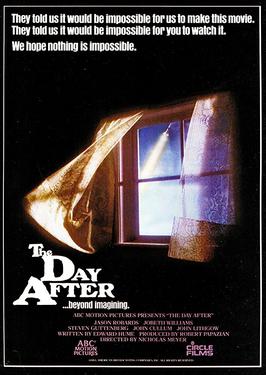
Film Review: The Day After (dir by Nicholas Meyer)


“This is Lawrence. This is Lawrence, Kansas. Is anybody there? Anybody at all?”

The words of Joe Huxley (John Lithgow) hang over the ending of The Day After, a 1983 film that imagines what the aftermath of a nuclear war would be like not on the East or the West Coasts but instead in the rural heartland of America.  Huxley is a professor at the University of Kansas and, as he explains early on in the film, Kansas would be an automatic target in any nuclear war because it houses a number of missile silos.  When he explains that, it’s in an almost joking tone, largely because the missiles haven’t been launched yet.  Instead, the only thing we’ve heard are a few barely noticed news stories about growing tensions between America and Russia.  About halfway through The Day After, the bombs go off and there are suddenly no more jokes to be made.

When the bombs drop over Kansas, we watch as cities and field and people burst into flames.  In a matter of minutes, several thousands are killed.  I’m almost ashamed to admit that I was probably more upset by the image of a horse being vaporized than I was by the death of poor Bruce Gallatin (Jeff East), the college student who was planning on marrying Denise Dahlberg (Lori Lethin).  I guess it’s because horses — really, all animals — have nothing to do with the conflicts between nations.  Humans are the ones who take the time to build bigger and better weapons and The Day After is one of the few films about war that’s willing to acknowledge that, when humans fight, it’s not just humans that die.

The bombing sequence is lengthy and I have to admit that I was a bit distracted by the fact that I recognized some of the footage from other movies.  A scene of panicked people running through a building was taken from Two-Minute Warning.  A scene of a building exploding and a construction worker being consumed by flames was lifted from Meteor.  As well, there’s some stock footage which should be familiar to anyone who has ever seen a documentary about the early days of the Cold War.  Still, despite that, it’s an effective sequence simply because it’s so relentless.  Some of the film’s most likable characters are vaporized before our eyes.  Steve Guttenberg, of all people, is seen ducking into a store.

Guttenberg plays Stephen Klein, a pre-med student who manages to survive the initial attack and takes shelter with the Dahlberg family at their ranch.  At first, it’s a bit distracting to see Steve Guttenberg in a very serious and very grim film about the nuclear apocalypse but he does a good job.  The sight of him losing both his teeth and his hair carries a punch precisely because he is reliably goofy Steve Guttenberg.

If the film has a star, it’s probably Jason Robards, the doctor who witnesses the initial blast from the safety of his car and then treats the dying in Lawrence, Kansas.  He does so, despite the fact that he doesn’t know if his wife, son, and daughter are even still alive.  He continues to do so until he also falls ill with radiation poisoning.  Knowing that he’s dying, he heads home just to discover that there is no home to return to.

Home is reccuring theme throughout The Day After.  Everyone wants to return to their home but everyone’s home has been wiped out.  “This is my home,” Jim Dahlberg (John Cullum) tries to explain before he’s attacked by a group of feral nomads.  Home no longer exists and trying to pretend like life can go back to the way it once was is an often fatal mistake.

Real happy film, right?  Yeah, this isn’t exactly a film that you watch for fun.  I have to admit that I made a joke about how I wouldn’t want to die while wearing the unfortunate blue jumpsuit that Jason Robards’s daughter chooses to wear on the day of the nuclear attack and I felt guilty immediately.  (Well, not that guilty.  Seriously, it was a terrible fashion choice.)  The Day After is a film that gives audiences zero hope by design.  It was made at a time when it was generally assumed that nuclear was inevitable and it was designed to scare the Hell out of everyone watching.  And while I can’t attest to how audience may have reacted in 1983, I can say that, in 2020, it’s still a powerful and disturbing film.

“Is anybody there? Anybody at all?” Joe Huxley asks and by the end of the film, the answer doesn’t matter.  The damage has already been done.

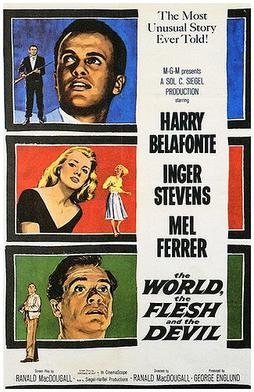
Film Review: The World, the Flesh, and the Devil (dir by Ranald MacDougall)


The 1959 film, The World, the Flesh, and the Devil, opens with a mine cave-in in Pennsylvania.  Trapped in the cave-in is a mine inspector named Ralph Burton (Harry Belafonte).  Despite being trapped underground, Ralph remains in surprisingly good spirits.  (In fact, as the movie progresses, Ralph’s tendency to joke when faced with bleak reality will become a recurring theme.)  Ralph sings to himself.  Ralph tells jokes.  Ralph listens to the sound of the men who are digging a tunnel to rescue him.  Except, one day, Ralph can no longer hear anyone digging.  Realizing that he’s going to have to save himself, Ralph manages to dig his way out of the cave.  Once again above ground, Ralph discovers that he’s alone.

The world has changed.  Cars and buildings sit deserted.  Everything that was made by mankind is still there but it’s all now empty.  Confused but understanding that something huge has happened, Ralph makes his way from Pennsylvania to New York.  During his journey, he comes across old newspapers and a recording in a radio station and he’s able to piece together what’s happened.  Some country — no one was ever sure which one — released a radioactive isotope into the atmosphere.  For five days, the air was poisoned.  Everyone who didn’t get to shelter died.  The only reason Ralph survived was because he was trapped underground.

At first, New York appears to be as deserted as Pennsylvania.  (The film was shot on location in Manhattan, reportedly in the early morning hours before rush hour, when there was no one on the streets.  The visuals of the empty city are often hauntingly bleak.)  Struggling to maintain his own sanity, Ralph steals two mannequins and spends his days talking to them.  He comes up with projects to pass the time.  He’s able to get the power flowing in Times Square.  And he even meets another survivor!

Sarah Crandall (Inger Stevens) was one of three friends who hid in a bunker when the world started to end.  Sarah’s two friends left the bunker after two days and were killed by the radioactive cloud.  Sarah waited the entire five days and survived.  Though we don’t learn much about her background, it’s heavily suggested that Sarah was rich and didn’t have a care in the world before society collapsed.  Now, she and Ralph are just happy to have found each other.

Sarah and Ralph quickly become friends.  Sarah has obvious romantic feelings towards Ralph but, to her frustration, he keeps his distance.  When Sarah asks why they don’t just live together instead of maintaining separate apartments, Ralph nervously jokes that if they got a place together, people would talk.  Sarah is white and Ralph is black.  When Sarah says that doesn’t matter anymore, Ralph tells her that it does matter and that she has no idea what his life was like before the world ended.  When a frustrated Sarah says that she can move in with Ralph because she’s “free, white, and 21 and I can do whatever I want,” Ralph looks like she’s just slapped him.  Later, Ralph tells her that, because she’s white, she will never be able to understand the pain that her words caused him.  I can only imagine how audiences in 1959 reacted to this scene.

Eventually, Ralph discovers that there are scattered survivors across the world.  One of them, Benson Thacker (Mel Ferrer), even comes to New York and joins Ralph and Sarah.  With the arrival of the white Thacker, Ralph suddenly finds himself being treated like a servant.  Thacker not only attempts to take over the group but he also tells Ralph that Sarah belongs to him.  When Thacker, a self-described “former idealist,” tells Ralph, “I have nothing against Negroes,” Ralph coldly replies, “That’s mighty white of you,” and again, the modern viewer cannot help but wonder how audiences in 1959 reacted to hearing those words uttered on a movie screen.

The World, the Flesh, and the Devil is a frequently fascinating film.  Belafonte brings a lot of charm and wit to the role of Ralph but he also doesn’t shy away from portraying Ralph’s anger at still being limited by the conventions of a society that, for all intents and purposes, has destroyed itself.  Ralph brings New York back to life, just to watch as Thacker moves in and claims it for himself.  Significantly, Thacker doesn’t view himself as being a racist.  Instead, in his mind, he’s simply living the way that he’s always lived.  By treating Ralph like a second class citizen, he’s keeping society alive.  Sarah, meanwhile, is torn between her desire to create a new world and the temptation to return to her spoiled and privileged upbringing.  While the film is dominated by Belafonte’s performance, both Inger Stevens and Mel Ferrer bring some shadings to characters that, in lesser hands, could have been extremely flat and predictable.

The film falls apart a bit during the third act.  The World, the Flesh, and the Devil spends a good deal of time building up to a rather downbeat climax just to suddenly reverse itself.  The film ends on a hopeful note that just doesn’t feel realistic after everything that we’ve just seen.  The film’s conclusion brings a promise of renewal that feels like it was tacked on at the last moment.  Still, up until that moment, it’s a compelling and intelligent film and one that’s feels ever more relevant today than it probably did in 1959.

Film Review: Murder on the Orient Express (dir by Sidney Lumet)


There’s been a murder on the Orient Express!

In the middle of the night, a shady American businessman (Richard Widmark) was stabbed to death.  Now, with the train momentarily stalled due to a blizzard, its up to the world’s greatest detective, Hercule Poirot (Albert Finney), to solve the crime.  With only hours to go before the snow is cleared off the tracks and the case is handed over to the local authorities, Hercule must work with Bianchi (Martin Balsam) and Dr. Constantine (George Coulouris) to figure out who among the all-star cast is a murderer.

Is it the neurotic missionary played by Ingrid Bergman?  Is it the diplomat played by Michael York or his wife, played by Jacqueline Bisset?  Is it the military man played by Sean Connery?  How about Anthony Perkins or John Gielgud?  Maybe it’s Lauren Bacall or could it be Wendy Hiller or Rachel Roberts or even Vanessa Redgrave?  Who could it be and how are they linked to a previous kidnapping, one that led to the murder of an infant and the subsequent death of everyone else in the household?

Well, the obvious answer, of course, is that it had to be Sean Connery, right?  I mean, we’ve all seen From Russia With Love.  We know what that man is capable of doing on a train.  Or what about Dr. No?  Connery shot a man in cold blood in that one and then he smirked about it.  Now, obviously, Connery was playing James Bond in those films but still, from the minute we see him in Murder on the Orient Express, we know that he’s a potential killer.  At the height of his career, Connery had the look of a killer.  A sexy killer, but a killer nonetheless….

Actually, the solution to the mystery is a bit more complicated but you already knew that.  One of the more challenging things about watching the 1974 version of Murder on the Orient Express is that, in all probability, the viewer will already know how the victim came to be dead.  As convoluted as the plot may be, the solution is also famous enough that even those who haven’t seen the 1974 film, the remake, or read Agatha Christie’s original novel will probably already know what Poirot is going to discover.

That was something that director Sidney Lumet obviously understood.  Hence, instead of focusing on the mystery, he focuses on the performers.  His version of Murder on the Orient Express is full of character actors who, along with being talented, were also theatrical in the best possible way.  The film is essentially a series of monologues, with each actor getting a few minutes to show off before Poirot stepped up to explain what had happened.  None of the performances are exactly subtle but it doesn’t matter because everyone appears to be having a good time.  (Finney, in particular, seems to fall in love with his occasionally indecipherable accent.)  Any film that has Anthony Perkins, John Gielgud, Lauren Bacall, Sean Connery, Ingrid Bergman, and Albert Finney all acting up a storm is going to be entertaining to watch.

Though it’s been a bit overshadowed by the Kenneth Branagh version, the original Murder on the Orient Express holds up well.  I have to admit that Sidney Lumet always seems like he would have been a bit of an odd choice to direct this film.  I mean, just consider that he made this film in-between directing Serpico and Dog Day Afternoon.  However, Lumet pulls it off, largely by staying out of the way of his amazing cast and letting them act up a storm.  It looks like it was a fun movie to shoot.  It’s certainly a fun movie to watch, even if we do already know the solution.

Book Review: Go Ask Alice by “Anonymous”


“Another day, another blow job,” writes the anonymous author of Go Ask Alice.

It’s only been a few months since she first dropped acid and smoked weed for the first time and the narrator has already run away from home and turned to prostitution to support her raging drug habit.  First published in 1971 and continuously in print since then, Go Ask Alice is presented as being the narrator’s journal, found amongst her belongings after she died of a drug overdose.  (Despite popular belief, the narrator is not named Alice.  Her name is never actually mentioned in the journal.)  That one line — “Another day, another blow job” — pretty much sums up Go Ask Alice.  It’s very dramatic.  Depending on who is reading it, it’s very shocking.  And it’s so perfectly quotable that it’s hard to believe that someone just scrawled it down in a journal.

Of course, some of that’s because Go Ask Alice isn’t actually a diary.  Though it’s never been officially confirmed, most researchers believe that it was actually written by Beatrice Sparks, a therapist who originally presented herself as being the diary’s editor.  Sparks later went on to “edit” several other anonymous diaries, all written by teenagers who had gotten involved with things like Satanism, eating disorders, and gang violence.

Even if I hadn’t read (on, I’ll admit it, Wikipedia) that Go Ask Alice was not actually written by a 15 year-old girl, it would be obvious just from some of what it is written in the diary.  I reread it a few weeks ago and the thing that immediately jumped out at me was that the narrator apparently didn’t write much about anything that didn’t have to do with drugs.  There’s none of the banal stuff that you would typically expect to find in someone’s personal journal.  The narrator doesn’t mention television or movies or music or books.  She barely even talks about the boy she likes, other than to mention that he exists and she’s not sure if he likes her back.  Instead, she pretty much goes straight from drinking a coke that’s been dosed with acid to running away to Berkeley.  She spend several hundred words meticulously detailing an acid trip but she tells us very little about anyone that she goes to school with.  (And I have to say that, for someone who has just taken acid for the first time, she’s remarkably coherent and detailed when it comes to writing about her trip.)  She also includes a lot of statistics about how how many people her age are estimated to have experimented with drugs, which doesn’t doesn’t seem like the usual behavior of a 15 year-old addict.  It’s not something that I would have done at 15 and, trust me, I was a very smart 15 year-old.  (It’s vaguely like something you would expect to hear in an old sitcom.  “Can you believe it?  That child’s 15 years old and already hooked on speed.”  “Oh, honey, it’s not that unusual.  I was reading an article that said 40% of children under the age of 16 have tried some sort of narcotic substance.”)

Another thing that I found to be interesting about Go Ask Alice is how generous everyone was with their drugs.  Even after the narrator goes through rehab, her classmates still walk up to her and casually drop drugs in front of her.  Maybe it’s a generational thing but my experience in high school was the exact opposite.  At my high school, the few people who regularly had drugs tended to be pretty stingy with them.  They certainly weren’t going to waste any just to play a joke on someone.  (Indeed, I’ve never been able to relate to people who claim that people pressured them into trying drugs because, at my high school, everyone was too greedy to share.  “You want a hit off this joint?  This is mine, get your own!”)  But I guess that maybe in 1971, drugs were cheaper and people just had a more generous spirit.

Anyway, Go Ask Alice is a quick read and it fulfills the number one rule of successful propaganda: it takes it story to the worst possible conclusion, even though a less dramatic conclusion would have been more realistic and perhaps more effective.  From the minute you start reading the diary, you know that the diarist is going to end up dead of a drug overdose because that’s the type of story that Go Ask Alice is.  Over the course of a year, our narrator goes from being sweet and innocent to being dead because stories like this don’t work unless the narrator dies at the end.  Simply having the narrator write, “I did a lot of drugs and I wish I hadn’t but now I’m going try to rebuild my life,” just does’t carry the same punch as, “A week later, the writer of this diary was found dead of an overdose.”  Go Ask Alice understands the importance of embracing the melodrama and it does so fully.  As a result, it’s not as convincing as a realistic look at drug abuse would have been but it’s considerably more entertaining.

Go Ask Alice was a huge success when it was first published.  They even turned it into a movie, which can currently be viewed on YouTube and Prime.  Somewhat inevitably, William Shatner’s in it.   The movie is actually better than the book but you should read the book as well, if just to see what frightened your grandparents back in the day.

Film Review: Testament (dir by Lynne Littman)


The 1983 film, Testament, is about death.  It’s about the death of a family, the death of a town, the death of a way of life, and the death of hope.

And you may be saying, “Well, gee, Lisa — that sounds like a really happy movie.”

Well, it’s not meant to be a happy movie.  Testament is a painfully grim movie about the end of the world.

The movie takes place in the town of Hamelin, California, which we’re told is 90 minutes away from San Francisco.  It’s a nice town, the type of place where everyone knows each other.  Mike (Mako) runs the local gas station and cares for his disabled son, Hiroshi (Gerry Murillo).  Elderly Henry Abhart (Leon Ames) spends his time on his radio, talking to strangers across the world.  Fania (Lilia Skala) offers up piano lessons.  Father Hollis (Philip Anglim) looks over the spiritual needs of the parish.  It’s a normal town.

The town is home to the Weatherlys.  Carol (Jane Alexander) is a stay-at-home mom who does volunteer work and who is directing the school play.  Tom (William Devane) is a common sight riding his bicycle through town every morning before heading off to work in San Francisco.  They have three children.  Mary Liz (Roxanna Zal) is a teenager who is taking piano lessons.  Brad (Ross Harris) is always trying to impress his father and is looking forward to his 14th birthday.  Scottie (Lukas Haas, in his first film) is the youngest and never goes anywhere without his teddy bear. They’re a normal family living a normal life in a normal town.

And then, one day, everything changes.  Scottie is watching Sesame Street when the program is suddenly interrupted by a clearly terrified anchorman who announces that New York has been bombed.  The president is about to speak but, before he can, there’s a bright flash of light, an distant explosion, and the entire town loses power.

At first, the people of Hamelin try to remain hopeful.  Though Tom works in San Francisco and San Francisco is among the many cities that have apparently been bombed (by who, we never learn), he also left a message on the family’s answer machine, telling them that he was on his way home.  Even with Tom missing, Carol continues to insist the he’ll be coming home at any minute.

Tom doesn’t come home.

The rest of the film follows the slow death of the town.  Even though the town was not damaged by the blast, the fallout soon hits.  Cathy (Rebecca De Mornay) and Phil (Kevin Costner) bury their newborn baby after it falls ill from radiation poisoning.  Mike, Henry, and Fania all start to grow physically ill and, in some cases, dementia sets in.  Father Hollis goes from being hopeful to being tired and withdrawn as he tries to attend to each and every death.  Larry (Mico Olmos), a young boy whose parents have disappeared, briefly moves in with the Wetherly family.  He disappears about halfway through the movie and we never learn if he left or if he died.  All we know is that no one mentions him or seems to notice that he’s gone.

Over the course of the film, Carol buries two of her children.  By the end of the film, her remaining child is starting to show signs of being sick, as is she.  Testament, which opened with bright scenes of a happy town, ends in darkness, with only a handful of people left among the living.  Even those who are alive are clearly dying and can only speak of the importance of remembering all of it, what they had and what they lost.

Sounds like a really happy film, right?  Well, it’s meant to be depressing.  It was made at a time when nuclear war was viewed as being not just probable but also inevitable.  Testament is a film that portrayed what a lot of people at the time were expecting to see in the future and, as a result, it’s not meant to be a particularly hopeful movie.  It’s a film that accomplishes what it set out to do, thanks to a great (and Oscar-nominated) performance from Jane Alexander and Lynne Littman’s low-key direction.  Unlike a lot of atomic war films, Testament does not feature any scenes of burning buildings or excessive gore.  That actually what makes it even more disturbing.  Even after the war, Hamelin still looks like it did beforehand, with the exception that many of the houses are now empty and that all of the residents are slowly dying.

(Would I have reacted as strongly to the film if I hadn’t watched it at a time when many people are afraid to go outside?  Perhaps not.  But this pandemic has brought extra power to a lot of films that may not have had as much of an impact in 2018.)

Testament is a powerful film, though not necessarily one that I ever want to watch again.