Welcome to Retro Television Reviews, a feature where we review some of our favorite and least favorite shows of the past! On Thursdays, I will be reviewing City Guys, which ran on NBC from 1997 to 2001. Almost the entire show is currently streaming on YouTube!
Seriously, how have we not reached the final episode yet?
Episode 5.19 “Model Behavior”
(Dir by Frank Bonner, originally aired on November 17th, 2001)
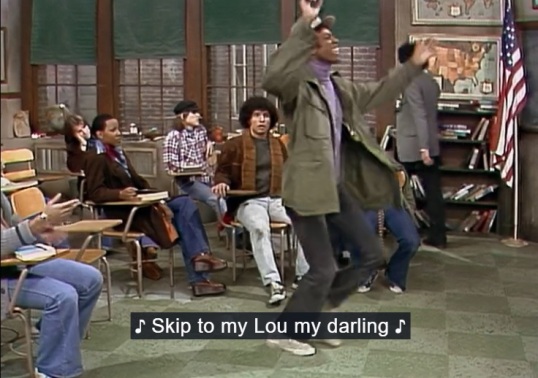
I have to admit that, with each week, it gets harder and harder for me to watch and review this stupid show. I’m currently on the final season and there’s only a few more episodes left to go but, every Thursday, I literally have to force myself to sit through whatever episodes are available on YouTube. CityGuys was never a particularly original show to begin with. I mean, the only thing that distinguishes it from every other show that Peter Engel produced for NBC was that the cast was a bit more diverse than usual. But, by the fifth season, it was obvious that the writers were out of ideas and the cast was ready to move on. I’m at the point that, whenever I hear Al call his ex-girlfriend “Dawny Dawn,” I want to throw something across the room. Whenever Ms. Noble starts to talk down to her students, I want to scream. Whenever Chris say something dorky or Jamal asks someone to “Help a brother out,” I silently groan. It’s all so predictable that I feel like I could probably just guess what happened in each episode and be correct.
As for this episode, Jamal has a girlfriend! Now, because so much of Season 5 is not streaming online, I don’t know if this episode is the first time that we’ve seen Rosie (Jenna Watson) but apparently, she and Jamal are very much an established couple. Rosie gets an opportunity to be a model and Jamal throws a fit because he doesn’t want other guys checking out his girlfriend, even though Jamal was earlier doing the same thing to Rosie’s fellow models. When Rosie calls him out on it, Jamal learns an important lessons about double standards. Personally, I’m amazed that a successful model like Rosie would waste her time with someone who can barely handle running the cash register at the Manhattan Diner.
Meanwhile, Dawn is organizing a week-long trip to Florida and one of the students who was meant to be a part of the group has to drop out after she gets mono. Ms. Noble tells Dawn that it’s up to her to select who will be the replacement. Al and L-Train suck up to Dawn and try to convince her to take them to Florida. Dawn picks some guy named Jason instead and Ms. Noble gives Al and L-Train a week of detention. In the past, this is the type of B-plot that would have been saved by the comic timing of Steven Daniel but, at this point, I’m even tired of L-Train. To be honest, I don’t know why Dawn didn’t just pick her best friend Cassidy.
This episode just felt tired. The Florida trip made no sense whatsoever while the model storyline just made me think about how much better California Dreams would have handled the whole thing. I’ve been reviewing City Guys for nearly a year now and I’m definitely ready to move on.
Episode 5.20 “Almost Fatal”
(Dir by Frank Bonner, originally aired on November 17th, 2001)
Here’s the plot description for Wikipedia:
After Chris, Jamal, and El-Train survive a car crash, they start going through some changes as they now view life in a whole new perspective. The three friends begin live to their lives on the edge by doing certain activities to the extreme.
This is one of the many season 5 episodes that is not currently streaming anywhere. That’s kind of a shame because the plot description makes it sound like this episode could have been interesting or, at the very least, memorably bad. That said, if I had to guess, I’d say that this was probably just another episode where everyone spent too much time hanging out on the roof and getting a stern talking to from Ms. Noble.
Next week, I’ll be more another episode closer to being done with this show!
Welcome to Retro Television Reviews, a feature where we review some of our favorite and least favorite shows of the past! On Wednesdays, I will be reviewing the original Love Boat, which aired on ABC from 1977 to 1986! The series can be streamed on Paramount Plus!
This week’s cruise features Cyd Charisse!
Episode 2.26 “April’s Return/Super Mom/I’ll See You Again”
(Dir by George Tyne, originally aired on May 5th, 1979)
This episode’s writers would want us to believe that the most important thing that happens during this cruise is that April Lopez (played by Charo) returns to the ship. During the first season, April was introduced as a stowaway who managed to charm the entire crew despite traveling illegally. With the help of Captain Stubing, April has gone on to become the cruise line’s most popular entertainer and this week, she’s returns to the Love Boat!
The crew is super-excited because April is such a vivacious force of energy. Or, at least, she was. When she shows up on the boat, she seems to be feeling a bit down. As she explains it to Julie, April has discovered that show business is not all that it’s cracked up to be and that it’s full of lecherous men. (Shocker!) April has decided that she would rather be a cruise director. Julie agrees to show April what the job entails and …. well, it turns out that Julie actually has a pretty easy job. She just goes to Acapulco Lounge at night, spots people who are alone or shy, and offers to dance with them. I do that on a regular basis. I should be a cruise director.
Anyway, April eventually realizes that she makes people happy by performing. Charo was a popular guest star on The Love Boat and, unlike a lot of other actors who appeared in multiple episodes, she always played April. (In this episode, she sings the show’s theme song.) In many ways, Charo was the epitome of The Love Boat, in that her act was meant to be both sexy and old-fashioned at the same time. The Love Boat was a show where everyone on the boat was constantly looking to get laid but the camera still cut away as soon as the cabin door closed and it was understood that sex on the boat would always lead to marriage on dry land. It was a show with the customs of the 70s and the morals of the 50s.
The episode spends a lot of time on April’s search for happiness. Personally, I was more excited by the fact that Cyd Charisse was on the boat. Cyd Charisse is one of my favorite dancers of all time and was one of my personal role models when I was younger. From the minute that Charisse boards the boat, the cameras are focused on her legs, which were just as spectacular as they were 20 years earlier in Singin’ In The Rain and Silk Stockings. Charisse plays Eve Mills, a former USO entertainer who, by an amazing coincidence, happens to be on the same cruise as the man that she fell in love with during World War II, Frank Pearse (Craig Stevens). By another amazing coincidence, Frank just happens to be an old friend of Captain Stubing’s!
Anyway, Frank and Eve recognize each other and they eventually work up the courage to approach each other. Eve thought Frank was killed in the war. Frank thought that Eve ignored all the letters that he sent her while he was recovering from being wounded in action. (It turns out the letters were never mailed because Frank’s nurse was in love with him.) Frank is still in love with Eve but he sees that she’s accompanied by a handsome young Frenchman named Francois (Stephen Schnetzer). Eve reveals to Frank that Francois is not her boyfriend. Instead, Francois is her son! And guess who Francois’s father is? (Really, the fact that he was named Francois should have given it away.)
Finally, Bud (Jerry Stiller) and Margaret (Anne Meara) are on their second honeymoon but, unfortunately, they’ve had to bring along their four bratty kids (one whom is played by a very young Corey Feldman). Bud wants to have a good time. Margaret keeps worrying about the kids. Bud gets a dance lesson from April, which leads to Margaret getting jealous. Don’t worry, they work it out. Jerry Stiller and Anne Meara were adorable together but this story was stressful for me to watch, just because the kids were so hyperactive and never stopped running around. Still, the image of Charo teaching Jerry Stiller how to dance feels like it should be enshrined in a museum devoted to the 1970s.
This episode seemed to exist because the show’s producers really liked Charo and it’s hard not to feel that the rest of episode’s storylines were just treated as being afterthoughts. That said, I enjoyed the Cyd Charisse/Craig Stevens story. Stevens was stiff and dull but Cyd Charisse was Cyd Charisse and that’s all that really matters!
Welcome to Retro Television Reviews, a feature where we review some of our favorite and least favorite shows of the past! On Tuesdays, I will be reviewing the original Fantasy Island, which ran on ABC from 1977 to 1986. Almost entire show is currently streaming is on Youtube!
This week, on FantasyIsland, Tattoo falls in love!
Episode 3.8 “The Handyman/Tattoo’s Romance”
(Dir by Lawrence Dobkin, originally aired on November 10th, 1979)
Following the death of his wife last week, Mr. Roarke is once again back to being his usual cranky, Tattoo-hating self. And this week, Mr. Roarke has a special reason to be annoyed with his assistant. Tattoo has gone rogue!
As Mr. Roarke explains it, he has rejected the fantasy of Donna May Calloway (Audrey Landers) twice. Donna May says that she wants to be a country-western superstar but Mr. Roarke doesn’t feel that she has the talent and he also feel that Donna May is being pushed into it by her aunt, Ellie Simpson (Carolyn Jones). Ellie had to give up her own musical dreams when she was younger and now she’s forced them onto Donna May. However, Tattoo takes it upon himself to bring Donna May to the Island and to get her an audition with country-western producer, Colonel Hank Sutton (Richard Paul). Mr. Roarke correctly perceives that Tattoo is being blinded by his own crush on Donna May.
Col. Sutton is not impressed with Donna May’s audition. (It doesn’t help that Ellie pressures Donna May to sing a corny song about losing her boyfriend to her best friend.) Still, Ellie is convinced that Tattoo can somehow talk Col. Sutton into giving Donna May another chance. Ellie tells Donna May to use Tattoo’s attraction towards her for own purposes. Though reluctant, Donna May starts to flirt with Tattoo.
Tattoo may be in love but Mr. Roarke is enraged. He confronts Ellie and Donna May in their cabin and tells them that he will not allow them to manipulate Tattoo. (Much as with last week, Ricardo Montalban is obviously energized by having the chance to play Mr. Roarke as being something other than just an enigmatic host.) Ellie goes to Tattoo and lies, claiming that Mr. Roarke told them that Tattoo is not good enough for Donna May. What a bitch!
This leads to — and I’m not joking here — a sincerely touching scene between Mr. Roarke and Tattoo. Tattoo tells Mr. Roarke what Ellie said. Mr. Roarke replies that what worries him more than Ellie saying that is the thought that Tattoo might believe it. Tattoo says that he doesn’t but that he loves Donna May and that he’s going to leave Fantasy Island to be with her. By most accounts (including their own), Ricardo Montalban and Herve Villechaize did not get along on the set but you’d never guess it from this wonderfully performed scene. Both of them deliver their lines with such sincerity and emotional vulnerability that it’s impossible not to be moved by their friendship.
Mr. Roarke confronts Donna May and Ellie in the Fantasy Island recording studio. (Yes, Fantasy Island has its own recording studio.) Donna May is stricken with guilt when she hears that Tattoo is giving up Fantasy Island for her. She tells Ellie that she’s going to live her own life from now on. After Ellie leaves in a huff, Donna May says that she must find Tattoo and apologize to him.
Suddenly, Tattoo reveals that he’s been in the recording the booth the whole time. “Apologize to the boss, first,” Tattoo orders, revealing that his first allegiance will always be to Mr. Roarke. Donna May and Tattoo then sing a country song together. No, I’m not making that up. It’s weird but kind of sweet.
As for the other fantasy, it’s far less interesting. Holly Ryan (Future Congressman Sonny Bono, who was a bit of a regular on both this show and The Love Boat) is an accountant who witnessed a murder committed by a gangster named Spider Sloat (Joey Forman). Holly’s fantasy is to hide out from Spider and, when Spider and his men suddenly show up on the Island, Holly ends up doing just that at an orphanage run by Emily Perkins (Shelley Fabares). Holly falls in love with Emily, takes care of the orphans, and puts on a dress when Spider comes looking for him. It’s a thoroughly lightweight fantasy that largely serves to remind us that no one nicknamed Spider can be convincingly intimidating.
As silly as the second fantasy may be, the first fantasy makes up for it. Much as with last week’s episode, both Ricardo Montalban and Herve Villechaize give such strong performances that this silly little show actually brought a tear to my mismatched eyes.
Welcome to Retro Television Reviews, a feature where we review some of our favorite and least favorite shows of the past! On Mondays, I will be reviewing Hang Time, which ran on NBC from 1995 to 2000. The entire show is currently streaming on YouTube!
Finally! We have reached the final season of Hang Time! While watching this season, it’s important to remember that seasons 5 and 6 were filmed at the same time and were originally meant to be one season. Just as they did with Saved By The Bell: The New Class, NBC decided to split the final season into two seasons and they also decided to air the episodes out of order. In other words, I imagine that it’s going to be a lot of fun trying to find any sort of consistent continuity over the final 12 episodes of Hang Time!
With that in my mind, I’m ready to finally move on from this show so let’s get started on season 6!
Episode 6.1 “www.eugene.trouble.com”
(Dir by Miguel Higuera, originally aired on September 23rd, 2000)
When I talk about how showing episodes out of order can lead to continuity issues, I’m talking about an episode like this one. Season 5 ended with the Tornadoes going to the championship tournament and losing to Muncie, despite the fact that they were favored to defeat Muncie. In fact, the team had been named “Team of the Decade,” which seemed like a bit of overkill on the part of the press. Obviously, the Tornadoes were a good team but it still seemed strange that they got as cocky as they did last season.
If all of the episode had been aired in the order in which they were meant to have been aired, the viewers would have understood that the Tornadoes were not only favored to win the tournament but that, until their loss to Muncie, they had been undefeated for the entire season. That would have explained why they were such heavy favorites, why they got so cocky, and why their loss truly was such an upset. Instead, the majority of the “undefeated season” episodes were moved to season 6. So now, the undefeated season happened the year after their loss to Muncie, when the players themselves were in their sixth year of high school. And, because the episode were aired out-of-order, the first episode of the sixth season features the Tornadoes already deep into their undefeated season and on the verge of making the playoffs.
In this episode, the undefeated season is briefly threatened by Eugene’s gambling problem. When Eugene loses a lot of money playing video poker, he makes the mistake of putting $500 on the Pacers game. When he loses that bet, evil bookie Bill (Kevin Sage) demands that Eugene throw his next game. Instead, Eugene puts his team first, wins the game (and yes, the Tornadoes win by one point), and then nearly gets killed in the hallway by Bill. Fortunately, Coach K comes running around a corner and tosses Bill against some lockers. I’m convinced the look of fear on Bill’s face was real because Dick Butkus may have been a retired football player but it was obvious that he could still break some bones if he wanted to. Eugene learns an important lesson and Coach K declines to kick Eugene off the team, despite the fact that Eugene violated the contract that he signed the previous season.
While this was going on, Kristy had an interview with Stanford but, after an emergency dental appointment left her unable to talk, Mary Beth took her place. Why Kristy didn’t just reschedule the meeting, I have no idea. It was dumb but Megan Parlen and Amber Barretto were always a good comedy team and I laughed every time Mary Beth said that Kristy had a “hump” (due to Kristy wearing an ice pack on her back) and Kristy shouted back, “It wasn’t a hump!”
This episode felt like a strange way to start the season. Again, that’s because of the way that NBC split the final season in two. Usually, Hang Time would start each season with the beginning of the school year. This time, Hang Time jumped into the middle of the season, with the team already talking about making the playoffs. It just didn’t feel right but at least Mary Beth and Kristy are finally, after six years of high school, thinking about college.
Episode 6.2 “That 60s Show”
(Dir by Miguel Higuera, originally aired on September 30th, 2000)
The students at Deering High are upset over the new dress code. I don’t blame them! Look at this:
I would refuse to wear that uniform too!
Pompous ex-Yippie teacher Mr. McHenry (Alan Young) tells them that they should protest the same way that Mr. McHenry protested at Chicago in 1968. (So, they should get hit with tear gas and beaten up by the cops?) The protest rally is a success. The school board drops the uniform requirement but they also fire Mr. McHenry. So, the students decide to protest that as well….
GET TO CLASS, YOU BRATS!
Anyway, the Deering basketball team sits down on the court and refuses to start their next game unless Mr. McHenry is reinstated, which puts their undefeated season at risk. Seriously, though, wouldn’t they just be ordered to forfeit the game if they refused to play?
Anyway, Mr. McHenry is reinstated, even though he’s like 80 and probably would have enjoyed his retirement.
This episode annoyed me. Let us never speak of it again.
Welcome to Retro Television Reviews, a feature where we review some of our favorite and least favorite shows of the past! On Sundays, I will be reviewing the made-for-television movies that used to be a primetime mainstay. Today’s film is 1996’s When Friendship Kills! It can be viewed on YouTube!
After the divorce of her parents, Lexi Archer (Katie Wright) moves to Seattle with her mother (Lynda Carter). Lexi is having a tough time adjusting to the divorce, especially since her father (Josh Taylor) is convinced that he’s a better parent than Lexi’s mother has ever been. Still, Lexi is hoping to make a good impression at her new high school and she gets off to an effective start by not only winning a spot on the school’s volleyball team but by also becoming friends with the most popular girl in school, Jen Harnsberger (Marley Shelton).
The wealthy Jen is a straight-A student and a star volleyball player and she appears to have a very bright future ahead of her. Jen not only shows Lexi around the high school but she also shows Jen that one way to eat without gaining weight is to throw up after every meal. Jen is bulimic and soon, Lexi is anorexic. Eventually, Lexi is collapsing on the volleyball court and Jen is angrily denying that she has a problem and the whole things leads to tragedy.
Obviously, eating disorders are a serious issue and When Friendship Kills is honest about not only the pressures that lead to so many girls and women developing body image issues but it also deals with the danger of having a relapse. Growing up attending dance classes, I met and hung out with a lot of girls who had “tricks” for keeping their weight down and I recognized all of them in the characters of Jen and Lexi. This film hits all of the usual plot points that we’ve come to expect from 90s films about eating disorders, from the volleyball coach saying that the already thin Lexi needs to lose weight to the scenes of Lexi staring in the mirror and seeing a distorted version of herself to Lexi’s father demanding that a feeding tube be used on his daughter, regardless of what Lexi’s mother might think.
That said, many viewers will find the most interesting thing about this movie to be that it features an early performance from Ryan Reynolds. Reynolds plays the role of Ben, a friendly jock who asks Lexi out on a date. Reynolds doesn’t do much in the film but he does show some hints of the amiable goofiness that would later become his trademark. If one wanted to view this film as being a part of a Deadpoolorigin story, they certainly could.
As well, Lochlyn Munro also appears in the film! It’s not really a melodramatic made-for-television movie unless Lochlyn Munro has a role. In this particular film, Munro played a sleazy photographer who approached Jen and told her that she had the perfect look to be a model and invited her back to his studio. Of course, when Jen brought Lexi to the studio with her, the photographer rather rudely announced that Lexi didn’t have the right look to be a model. This led to Lexi refusing to eat and becoming hollow-eyed and skeletal and Katie Wright, it must be said, did a wonderful job portraying Lexi’s transformation from being hopeful to being haunted by her own self-image. Marley Shelton did an equally good job of portraying Jen’s more cheerful style of self-destruction.
When Friendship Kills is an effective if predictable eating disorder film. The film originally aired under the title A Secret Between Friends, which is a far more honest title than the over-the-top When Friendship Kills. Friendship does not kill in this movie but self-starvation does.
Though the Academy of Motion Picture Arts and Sciences claim that the Oscars honor the best of the year, we all know that there are always worthy films and performances that end up getting overlooked. Sometimes, it’s because the competition too fierce. Sometimes, it’s because the film itself was too controversial. Often, it’s just a case of a film’s quality not being fully recognized until years after its initial released. This series of reviews takes a look at the films and performances that should have been nominated but were, for whatever reason, overlooked. These are the Unnominated.
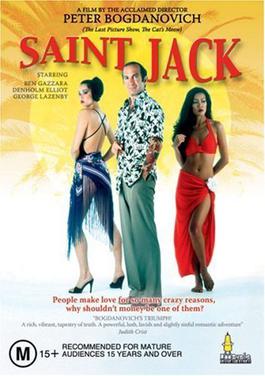
In 1979’s Saint Jack, Ben Gazzara stars as Jack Flowers. Jack was born in Brooklyn in 1931, a first-generation Italian-American. Though Jack himself prefers to keep his past something of a mystery, it’s implied that his family had less-than-savory “connections.” Jack served in the Korean War. After the war, he served in the Merchant Marine and spent a while trying to pursue a career as a writer. Now, in the early 1970s, Jack lives in Singapore.
What does Jack do in Singapore? He seems to know everyone and everyone seems to like him, with the exception of a few members of a Chinese triad who view Jack as being their competition. Jack is friendly and he knows how to talk to people. With the Vietnam War waging, Singapore is full of American soldiers on R&R and Jack is always willing to help set them up with companionship during their stay. He does the same thing for the businessmen who stop off on the island. At the same time, if someone just wants to play a game of squash, Jack can direct them to nearest health club. Whatever someone needs, Jack know how to get it.
This episodic film is largely a character study, following Jack over three eventful years of his life. We learn a lot about Jack just from watching his interactions with his friend William (Denholm Elliott), an alcoholic accountant who visits Singapore once a year and who is one of the few people with whom Jack is comfortable just being himself around. For all of his friendliness and good humor, Jack never quite lets anyone get too close to discovering who he really is. In many ways, Jack feels trapped in Singapore. He’s getting older and the world around him is changing and becoming less safe. Jack’s true goal is to open his own brothel, make a fortune, and eventually return to Brooklyn a rich man. At times, with the help of the CIA and a shady businessman (played by the film’s director, Peter Bogdanovich), it appears that Jack is going to do just that. But when his business associates put pressure on Jack to help them blackmail a gay U.S. Senator (played by George Lazenby, of On Her Majesty’s Secret Service fame), Jack is forced to finally decide how far he’s willing to go to achieve his dream.
The film works best as a showcase for Ben Gazzara, the character actor who may be best remembered for his over-the-top villainous turn in Roadhousebut who also gave excellent performances in films that rarely got the appreciation that they deserved. Starting his career as the accused killer in Anatomy of a Murder, Ben Gazzara brought his trademark intensity to several independent and mainstream films. He was a favorite of John Cassavetes. Over the course of his long career, Gazzara was never nominated for a single Oscar, though he certainly deserved to be nominated for one here. I would rate his work in Saint Jack as being superior to the performance that won that year’s Oscar, Dustin Hoffman’s rather self-satisfied turn in Kramer vs. Kramer. From the minute that Gazzara appears onscreen, he simply is Jack. The film was shot on location in Singapore and Gazzara walks through the streets with the an appealing confidence. As Jack, he’s a likable raconteur but, in the film’s quieter moments, Gazzara allows us to see just how alone Jack actually is. Jack may know every corner of Singapore but he also knows that it will never truly be where he belongs. There’s a particular poignance to Gazzara’s scenes with Denholm Elliott. Jack and Bill are two very different men but they share a desire to return to their homes.
Saint Jack should have been a comeback for Peter Bogdanovich, the film critic-turned-director who got off to a strong start with Targetsand The Last Picture Show but whose career floundered as the 70s moved on. Following the Oscar-nominated Last Picture Show and Paper Moon, Bogdanovich directed three big budget films — Daisy Miller, At Long Last Love, and Nickelodeon — that all failed at the box office. Finding himself a sudden pariah in Hollywood, Bogdanovich returned to his low-budget roots with Saint Jack, getting funding from Roger Corman and directing the film in a gritty, cinéma vérité-style. Roger Ebert loved the film, declaring that it proved that Bogdanovich was still a director worthy of appreciation. Unfortunately, the film was never widely distributed and it proved to be another box office disappointment for Bogdanovich. Sadly, the film was also ignored by the Academy, despite award-worthy performances from both Gazzara and Elliott.
Bogdanovich, who was born 84 years ago on this date, would often be cited as a cautionary tale for other directors who peaked early and spent the rest of their career on a downward slope. That’s not quite fair to Bogdanovich, who did continue to direct good films like Saint Jack, Mask, and The Cat’s Meow. Before he passed away in 2022, Bogdanovich found new popularity as both a character actor and as a frequent guest on TCM. And, fortunately, his films have come to be better appreciated with age. Saint Jack may not have gotten the attention it deserved in 1979 but it has since been rediscovered and rightfully acclaimed.
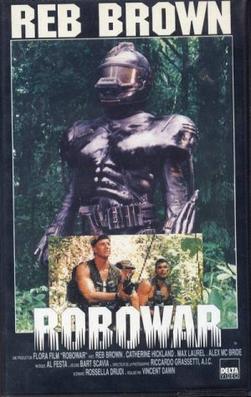
After some men go missing in the jungles of an isolated island, a group of mercenaries is assigned to search the jungle, battle the guerillas who control the island, and rescue the missing. Accompanying the mercenaries is a shifty CIA agent who seems to know more than he’s letting on. What the mercenaries soon discover is that the guerillas aren’t the only threat that they have to worry about. There’s a shadowy figure stalking them. Equipped with state-of-the-art weaponry and encased in impenetrable armor, this figure is following them like some sort of preda–
Wait. Does this sound familiar?
The 1988 film, Robowar, is an unapologetic rip-off of the Predator. Directed by Bruno Mattei and written by Troll 2 director Claudio Fragasso (who also plays this film’s version of the Predator), Robowar is such a rip-off of the Predator that it even ends with an end credits sequence in which we see clips of each actor stalking through the jungle. Reb Brown plays Murphy Black, the head of the mercenaries, and he spends a lot of his time shrilly shouting at them to “Move! Move! Move!” Catherine Hickland plays the head of a local orphanage. She introduces herself as “Virginia” and is called “Virginia” throughout the film but the end credits insist that her character was actually named “Virgin.” The other mercenaries are played by a combination of American and Italian stuntmen and some of them vaguely resemble their better-known counterparts from Predator. Max Laurel, who plays the group’s fearless tracker, looks like he could have been distantly related to Sonny Landham. Massimo Vanni and Romano Puppo play two mercenaries who have a relationship that’s similar to the friendship between Jesse Ventura and Bill Duke. Of course, in anyone really makes an impression, it’s Mel Davidson as the group’s government handler and who spends the whole movie smiling while delivering lines about how the entire group is doomed, himself included. It’s such an odd performance that it becomes rather fascinating.
What type of film is Robowar? It hits all of the same plot points as Predator but it does it with a much lower budget. Indeed, the film’s opening sequence appears to be made up of footage lifted from Mattei’s earlier film, Strike Commando. Whenever we see the action through the killer robot’s eyes, Mattei gives the action an extreme orange tint that makes it impossible to actually tell what’s going on. Reb Brown spends a lot of time yelling but the same thing could be said for the entire cast. This is one of those films where no one fires a machine gun without screaming while doing so. And yet, because it’s a Mattei film, it’s always watchable. Bruno Mattei (who born 92 years ago today in Rome) may have specialized in ripping-off other, most successful films but he was so shameless and unapologetic about it that it’s impossible to judge him too harshly. As always, Mattei keeps the action moving quickly and doesn’t worry to much about things like continuity. Mattei’s films were rarely good but they were almost always fun when taken on their own silly terms.
At times, Robowar almost feels like a parody of an American action film, with Fragasso’s script featuring dialogue that is so extremely aggressive and testosterone-fueled that even Shane Black probably would have told him to tone it down a notch. Much as with Troll 2, the film provides an interesting view into how Fragasso imagined Americans to be. Early on, we are informed that the mercenary group is known as BAM, which stands for “Big Ass Motherfuckers.” Later, one of the members of BAM insults two others by saying, “I bet they have the AIDS.” It’s as if someone programmed a computer to write an action movie and, as such, Robowar might turn out to be a surprisingly prophetic film.
Despite featuring a few Americans in the cast, Robowar was not available in the U.S. until it was released on Blu-ray by Severin Films in 2019. Though Bruno Mattei passed away in 2007, his work continues to be discovered by new audiences.
Big Brother starts next week and I’m going to have a lot less free time. (I probably should have made better use of my free time this week!) That said, I skipped the Big Brother special that CBS aired this week because I knew there wouldn’t be anything interesting revealed. Big Brother is a show that I both love and hate in equal measures. I never find myself looking forward to it but I always watch once it starts.
Anyways, here some thoughts on what I did watch this week!
I have to admit that Cole was one of the players who I thought had a really good chance of winning the game so I was a little surprised to see him leave the show this week. For the record, he was Alicia Keys’s brother. At this point, I’m just rooting for Olivia.
Degrassi High (YouTube)
I watched an episode on Sunday. Everyone was smoking weed.
Degrassi: The Next Generation (Tubi)
I watched a few random episodes on Sunday. Most of them were from the superlong tenth season, which isn’t really Degrassi’s best season but it is one that I occasionally like to revisit just because it’s not one of those seasons that really demands that you put a lot of effort into concentrating on what was happening on-screen. The tenth season of Degrassi is perfect for background noise.
The episode that I watched on Thursday was entitled “I Want My Child To Stop Listening To Marilyn Manson.” The kids loved Marilyn and the parents were panicking. Jenny Jones told her audience, “Now, you know, Marilyn Manson is a guy, right? He’s a male.” One of Jenny’s guests was a cutter. The audience booed her, which I doubt helped. “He is far from being one of the beautiful people!” one parent said, “He is a sadistic pig!” I think this episode was from 1996.
On Friday, I watched an episode in which Jenny revealed the results of DNA tests. As a host, Jenny Jones was so flustered and spent so much time stumbling over her words that I actually got a headache while watching her.
On Thursday, I watched an episode about young people with lovers who were old enough to be their grandparents. Many of them had angry family members who wanted to yell at them on national television. The audience did a lot of booing.
I followed this up with an episode in which women were encouraged to dump their “cheating boyfriends.” One of the boyfriends had cheated on his girlfriend with a 13 year-old! Hopefully, they broke up after the show.
I then watched a third episode, in which bratty teenagers talk about how much they disliked the men that their mother dated. I cringed as I was flooded by memories of my own bratty behavior whenever my mom started to date someone new.
On Friday, for reasons that even I can’t quite fathom, I watched another episode in which Sally gave updates on out-of-control teens, the majority of whom were still out-of-control. The boot camps did not work.
Stars on Mars (Monday Night, Fox)
The silliest reality show on television right now continued this week, with Rhonda Rousey asking to be sent back to Earth. Fortunately, since no one on the show had actually left Earth to begin with, it was a quick journey home. As for who I hope wins Stars on Mars …. eh, whatever the prize is, give it to William Shatner. I know he’s the host and he probably only had to spend a day or two pre-taping all of his scenes but he’s still the most entertaining part of the show.
The Steve Wilkos Show (YouTube)
I watched an episode on Thursday. Two brothers with really deep acne scars were on the show, trying to figure out which one was the father of a baby. Their annoying mother came out and screamed at everyone. It was so incredibly trashy that it become oddly fascinating.
I followed this with a second episode, in which Steve tossed an abusive boyfriend off of his stage. That was satisfying to see. Believe it or not, I do think that Steve was perhaps a bit more sincere than his fellow daily talk show hosts. The dislike that he felt towards abusers and cheaters always seemed real in a way that Maury Povich’s similar outrage did not.
On Friday morning, I watched two episodes while doing some work in my office. The first episode featured a woman with a scummy, abusive boyfriend. She dumped him at the end of the episode and the entire audience chanted her name. This was followed by an episode featuring a woman who claimed that her ex-boyfriend had stolen the ashes of her deceased and cremated child. That was weird and depressing.
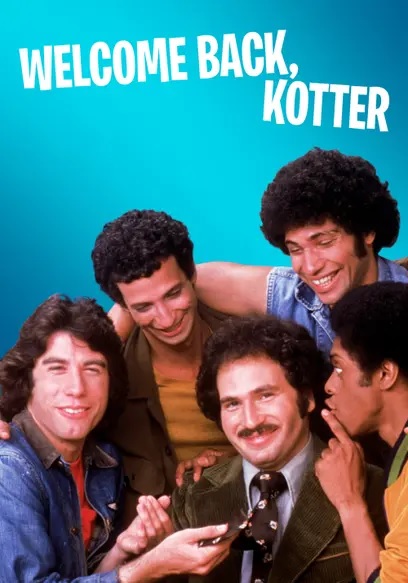
Welcome to Retro Television Reviews, a feature where we review some of our favorite and least favorite shows of the past! On Saturdays, I will be reviewing Welcome Back Kotter, which ran on ABC from 1975 to 1979. The entire show is currently streaming on Tubi!
This week, we’ve got a two-parter!
Episode 1.16 “Follow The Leader, Part One”
(Dir by Bob LaHendro, originally aired on January 20th, 1976)
“Julie,” Gabe asks as they have dinner at the apartment, “Did I ever tell you about my Uncle Sylvester, who was a real nut?” Uncle Sylvester went into a psychiatrist’s office and said, “Doc, you’ve got to help me! I’m a dog!” When asked how long he had felt like that, Sylvester replied, “Ever since I was a puppy!”
Julie is amused by the joke but she’s not amused when, the next morning, Arnold Horshack wakes her and Gabe up by tapping on their window. Apparently, Horshack has gotten into the habit of coming over to have breakfast with Gabe and Julie and Julie is sick of it! “We don’t have any privacy anymore!” Julie says, “Everywhere we go, there’s a Sweathog!”
Gabe gets upset at Julie for not appreciating the Sweathogs and announces that if Horshack wants to eat with them, Horshack is going to eat with them. He then allows Horshack into the apartment, where Julie gives him the stare of death. It seems like this might lead to trouble later….
(For the record, Julie has every right to be upset as she’s basically standing there in her bathrobe while Horshack hops up and down in her apartment. I mean, Gabe could have at least let her get dressed before letting his creepiest student climb in through the window.)
At school, Gabe teaches the class about democracy. He asks them how leaders are selected. Epstein says that leaders are elected except for Gerald Ford, who became president because he was the only person in Washington who wasn’t under arrest. Trying to reach his students, Gabe makes the mistake of saying that Vinne Barbarino is the leader of the Sweathogs.
“You’re the leader of the Sweathogs?” Freddie says to Barbarino.
“Is a bear Catholic?” Barbarino replies, “Does the Pope live in the woods?”
Gabe says that if the Sweathogs were democratic, they would have voted for who they wanted to lead them. The Sweathogs agree to vote, with Epstein assuring Barbarino that there’s no way they would ever vote him out.
“Does anyone want to challenge Vinnie Barbarino?” Gabe asks.
Freddie Washington stands up. “Hi there.”
The Sweathogs vote by raising their hands. Barbarino gets five votes. Freddie gets five votes. Oh my God, a tie! Wait a minute …. Epstein didn’t vote! After Gabe tells Epstein that it’s up to him to pick the leader of the Sweathogs, Epstein smiles and says, “Washington!”
Awwwww! Poor Barbarino! He looks heart-broken!
Epstein explains that Barbarino has been leader for a long time and that it’s time for “New Blood.”
“Hi there,” Freddie says, “I’m Boom-Boom New Blood.”
Barbarino calls the Sweathogs “punks” and then announces he’s dropping out of school before storming out the classroom.
Way to go, Gabe!
Later that day, Julie attempts to make up with Gabe be bringing him lunch at school but she’s upset when he starts to talk about Barbarino dropping out of school. “Can’t you talk about anything other than work!?” Julie demands, even though Gabe is actually at work. Julie gets even more upset when Epstein and Freddie enter the classroom, despite the fact that — again — Gabe is at work and it actually is Epstein and Freddie’s classroom.
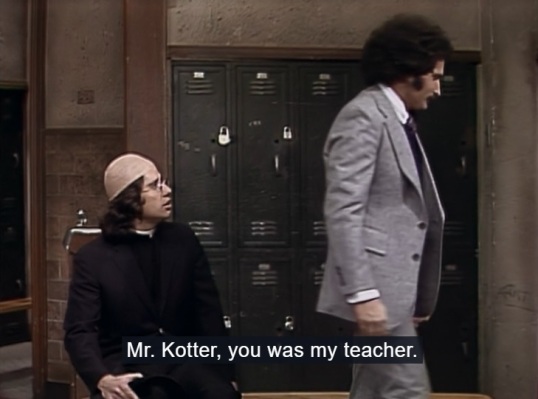
Julie storms out of class, saying that Gabe can’t take anything seriously. Stunned Gabe barely notices as the other Sweathogs return from their lunch. Then, he hears Barbarino calling for him out in the hallway. Gabe steps out in the hall, to discover Barbarino wearing a skull cap and dress like a priest. Barbarino explains that his father got so angry at Barbarino for dropping out of school that he kicked Barbarino out of the house.
“Don’t worry,” Barbarino assures Gabe, “I don’t feel this is your fault, even though most of it is.”
Barbarino says that he needs to place to stay until he can figure out what to do. Even though he has to know what’s going to happen as a result, Gabe eventually agrees to bring Barbarino home with him.
Needless to say, Julie is not amused. She yells at Gabe and Gabe yells back and, for a few moments, I remembered all the stories that I’ve heard about how Gabe Kaplan and Marcia Strassman did not get along off-screen. On-screen, Gabe Kotter tries to lighten the mood by asking Julie if he ever told her about his Aunt Ira.
“I don’t care about your jokes, Gabe,” Julie replies. Ouch!
Julie walks out on Gabe.
OH MY GOD! The 30 minutes are up! How will they resolve this? Well, let’s find out….
Episode 1.17 “Follow The Leader, Part Two”
(Dir by Bob LaHendro, originally aired on January 22nd, 1976)
I have to admit that I was really hoping that Part Two would open with Gabe telling Barbarino a joke about his uncle and Barbarino totally not getting it. Instead, it opens with a recap of Part One.
After the recap, the show begins with Gabe sleeping on his fold-out couch and …. is that Vinnie Barbarino sleeping next to him? The audience goes crazy because Barbarino isn’t wearing as shirt but me …. well, okay, Barbarino looks good and I would have totally had a crush on Young John Travolta too. Still, it already seems strange enough for a student to live with a teacher without the two of them sleeping in the same bed.
Anyway, Epstein wakes them up by knocking on the window. (The audience goes even crazier as Barbarino struts over to the window to let him in.) It turns out that Horshack is with Epstein. They both want breakfast. Barbarino pours milk and cereal on them.
Entering the apartment, Epstein and Horshack discover that Julie has left Gabe. Horshack is upset. Epstein grins. While the Sweathogs get ready for their day, Gabe calls the local hotel and, after realizing that she checked in under her maiden name, he finally talks to Julie. Julie reveals that she’s called Gabe’s cousin, who also happens to be a divorce lawyer. Gabe kicks out Epstein and Horshack and then orders Barbarino to either go to school or get a job.
“I bet you don’t think I can get a job,” Barbarino says. “Well, guess what? You don’t need brains to get a job …. and I’m going to prove it!”
Gabe calls Julie again and finally gets her to agree to meet him at the apartment at 3:30. He promises that he’ll head home right after school.
Speaking of school, Freddie has managed to alienate all of the Sweathogs by letting his power go to his head. He orders Epstein to get a haircut and he tells Gabe that the Sweathogs need a recreation period. For some reason, Freddie wants to start the day with a square dance.
To my very real surprise, Gabe manages to get back to the apartment in time to clean up before Julie arrives. When Julie does arrive, she complains that Gabe cares more about the Sweathogs than her (and she has a point) and Gabe says that Julie needs to stop always feeling sorry for herself (and, let’s just be honest here, he has a point as well). Gabe tries to make his point by punching table and has to briefly step into the bathroom so he can yell in pain.
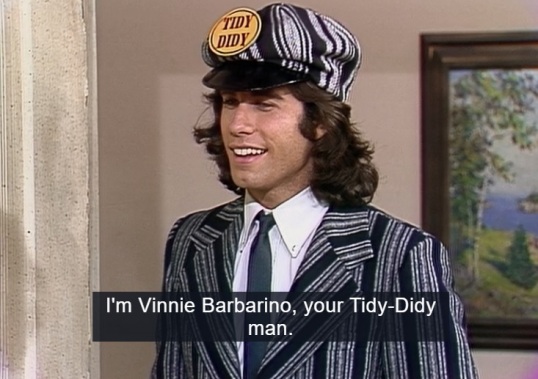
At the worst possible moment, Babarino shows up. He took Gabe’s advice and he got a job! He’s selling Tidy Didy cleaning products, door-to-door.
Gabe tells Barbarino to go back to school and tells Julie she has to build her own life instead of getting jealous of him and his job. Both Barbarino and Julie say that they’ll think about it before leaving.
At school, Gabe teaches a lesson about the two-party system and the importance of competition. Freddie admits that he doesn’t enjoy being the leader of the Sweathogs but he also doesn’t want to be a follower. Suddenly, Barbarino shows up and says that he’s back in school. Yay! He also suggests that the Sweathogs don’t need a leader. Freddie agrees. Yay!
Barbarino then says that he hopes that Gabe doesn’t mind that he asked out Julie.
“You asked my wife out?” Gabe replies.
“Yeah, just a couple of minutes ago. In the hall.”
Gabe steps out in the hall and discovers Julie waiting for him. They agree to work out their problems. Yay, I guess. Seriously, Julie seemed really miserable with Gabe. Julie does say that she would like to tell a joke once in a while.
“I can be very funny,” Julie says. The audience laughs because even they know better. “Why did the chicken cross the road? To keep his pants up. Why does the fireman wear red suspenders? To get to the other side.”
That night, back at their apartment, Gabe asks Julie if he ever told her about his Aunt Bertha.
“No, no, wait!” Julie says, “Let me tell you about Aunt Bertha.” Aunt Bertha was so fat that when she sat around the house …. she sat around the house. That’s the joke.
This two-parter wasn’t bad at all. I like the fact that Gabe and Julie were both, more or less, equally responsible for the problems in their marriage and young John Travolta got to show off his natural comedic timing. Of course, if you know anything about the behind-the-scenes issues on Welcome Back, Kotter (like the fact that Marcia Strassman hated her time on the show), a lot of what happens in this episode takes on a deeper meaning.
Next week, Epstein finally finds a career path that doesn’t involve prison!
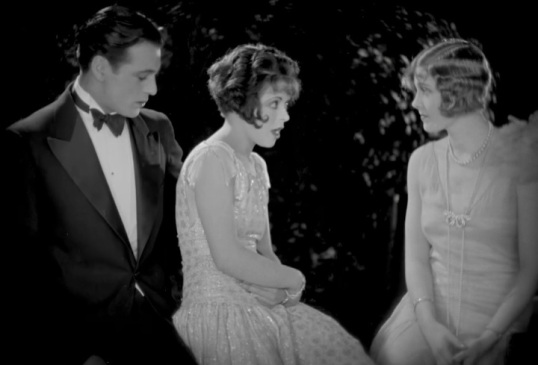
The 1927 silent melodrama, Children of Divorce, opens at a private Catholic boarding school in Paris. It’s a place for rich and idle parents to dump off their children while they enjoy the City of Lights. Jean Waddington is dropped off at the school and struggles to make friends until she meets the vivacious Kitty Flanders. Jean and Kitty bond because they are both children of divorced parents. (Kitty says that she has only one mother but that’s she’s had four different fathers.) Jean meets Ted Larrabee, who is Kitty’s neighbor back in New York and who has also been dumped off at the school by his divorced parents.
Flash forward a few years and Kitty (Clara Bow), Jean (Esther Ralston), and Ted (Gary Cooper) are all young adults. Kitty is in love with Prince Vico (Einar Hansen) but the Prince’s father refuses to allow Vico to consider marrying her because Kitty’s mother (played by future gossip columnist and Queen of Hollywood, Hedda Hopper) is not rich. Believing that the only way that she’ll ever be happy is if she marries a rich man, Kitty set her eyes on Ted. Ted, however, wants to marry Jean but Jean says that she’ll only consider marrying Ted if he gets a real job and proves that he can do something more than just live off of his father’s money.
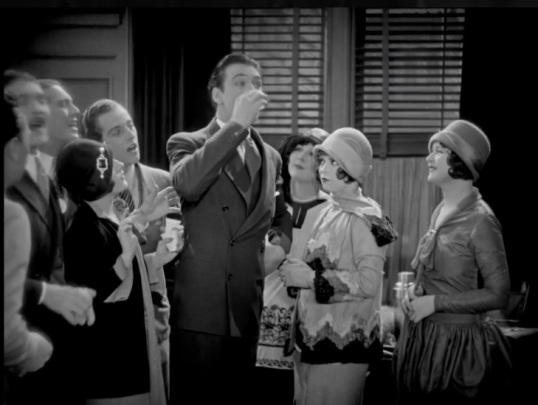
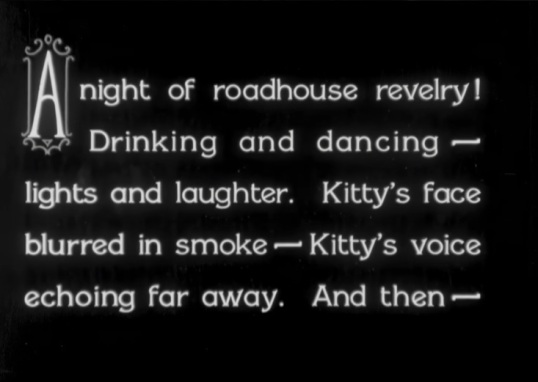
Ted starts his own architectural firm and proves that he’s capable of hard work. However, when Kitty convinces Ted to celebrate his success by going out drinking with her….
Ted wakes up with a hangover. He soon discovers that he’s also woken up with a wife! While he was drunk, he married Kitty! Ted is stunned. Jean is heart-broken. She begs Kitty to grant Ted a divorce so that she can marry him but Kitty reveals that she has no intention of ever getting divorced. As she explains it, Kitty has been raised to marry a rich man, Ted is rich, and now, she’s married to him. Why would Kitty want to give that up? When Ted says that he’ll file for the divorce, Jean tells him that she can’t marry a man who would leave his wife and then she leaves for Europe….
Of course, that’s not the end of the story. This wouldn’t be a silent melodrama if it ended that simply. Instead, years later, Kitty does come to see the error of her actions and she also discovers that her true love remains Prince Vico. But, by that point, it’s too late and, of course, Jean still refuses to marry a divorced man. Kitty seeks redemption in the most extreme was possible….
Clocking in at a brisk 70 minutes, Children of Divorce is a wonderful showcase for Clara Bow, who was born 118 years ago on this date. Gary Cooper is properly handsome and sincere as Ted and Esther Ralston is lovely if a bit boring as Jean but the film ultimately belongs to Clara Bow, who brings so much vitality and energy to her role that it doesn’t matter that Kitty tricks Ted into marrying her and destroys all of Jean’s romantic dreams. Most viewers will instantly sympathize with Kitty and, to be honest, it’s kind of hard not to be on her side. Kitty has fun. Kitty refuses to let society stand in her way. While Jean makes a list of demands about what she needs Ted to do before she can even consider marrying him, Kitty encourages Ted to loosen up and enjoy his success. Kitty is the one who I think most viewers, at the very least, would want to be friends with. While Jean tries to run away from her problems, Kitty is determined to live her best life. Indeed, Kitty’s ultimate redemption is all the more effective because, once again, Kitty is the one who is making things happen while Ted and Jean just passively accept the conventions of society.
Clara Bow was one of the greatest of the silent film stars and Children of Divorce shows why. As opposed to many of the other actresses of the day, Clara Bow was convincingly cast as women who were willing to do whatever needed to be done to find happiness. Sadly, Clara Bow’s later years were not happy ones. She deserved better than the world gave her. Watching her in films like this one and It feel like looking out a window into the past, a time when it seemed like anything was possible.