October Positivity: Patmos (dir by Jimmy Murphy)


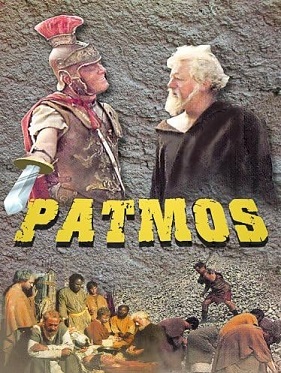
First released in 1985, Patmos imagines the final days of St. John the Evangelist.

The film opens with John (Louis Rolston), the last surviving member of Jesus’s original disciples, having been arrested by the Romans and sentenced to the penal colony of Patmos.  At Patmos, he lives in a cave and, despite being an elderly man, he is expected to take part in hard manual labor.  The commandant of Patmos is Catalinus (Mark Mulholland), an arrogant centurion who is known for his temper.  For Catalinus, being assigned to Patmos is a bit of a demotion and he’s eager to take his anger out on John.

John, however, refuses to allow Catalinus to break him and his quiet dignity starts to impress some of the Roman centurions.  (“I’m not paid to think,” one centurion replies, when asked for his opinion on John.)  It also starts to impress John’s fellow prisoners.  When John starts to have visions of the eventual apocalypse, the other prisoners help him to record them.  When Catalinus starts to execute the other prisoners and demands that John renounce his religion and his visions,  John is faced with a difficult decision.  Should he claim to have rejected God or should he stand firm in his beliefs, even in the face of Catalinus’s cruelty?

Well, there’s never really any question as to what John is going to do.  This film was made to be shown in church basements and at religious camps so there’s no way that John is going to renounce his faith.  That said, the film deserves a good deal of credit for not making it appear as if John’s decision was an easy one.  Everyday, as John is led out of his cave, he has to pass the people who have been crucified in an attempt to intimidate him into silence.  His fellow prisoners soon start to demand that John give into Catalinus’s demands, even as John tries to explain why he cannot.  Catalinus’s cruelty is actually supported by what we know about the techniques that some Romans used to keep order in their prison colonies so the idea that he would execute everyone but John is not an outlandish one.  The cruelty, as the saying goes, is the point.

(Indeed, Catalinus’s arrogance and his anger at being defied should seem familiar to anyone who has ever had to deal with a middle management bureaucrat.)

That said, when a film is called Patmos and deals with the final years of St. John the Evangelist, most people are going to be watching because they want to see how the film portrays the visions of revelation.  Patmos, being a low-budget film, goes for a simple approach.  We see horsemen riding across Patmos, each bringing a plague to Earth.  There are occasional shots of people begging for food and there’s also a sepia-toned sequence that takes place in Heaven.  As I said, it’s simple and it’s obvious that the film’s low budget played a huge role in how the apocalypse was presented.  But that simplicity is actually rather effective.  After sitting through so many flamboyant and over-the-top portrayals of the end of the world, it’s hard not to appreciate the starkness of Patmos’s imagery.

The acting is a bit uneven but Louis Rolston is appropriately wise as John and Mark Mulholland is appropriately arrogant as Catalinus.  Patmos is an effectively done apocalypse film, one that makes good use of its low budget.
Late Night Retro Television Reviews: Nightmare Café 1.4 “The Heart of Mystery”


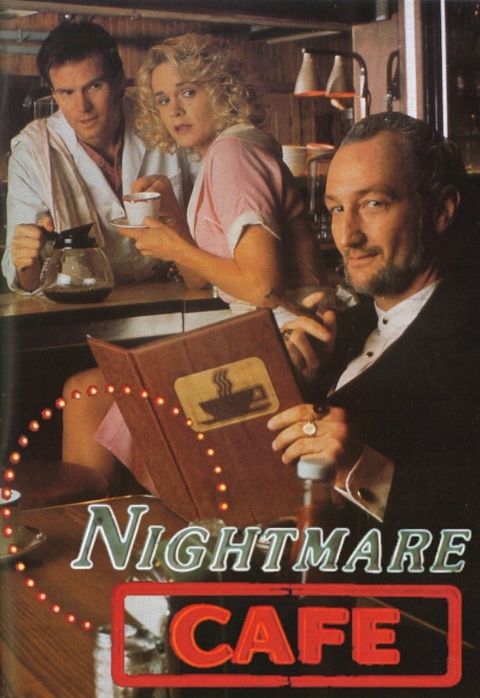
Welcome to Late Night Retro Television Reviews, a feature where we review some of our favorite and least favorite shows of the past!  On Mondays, I will be reviewing Nightmare Café, which ran on NBC from January to April of 1992.  The entire show is currently streaming on YouTube!

This week, a dying detective is allowed a chance to solve one last case.

Episode 1.4 “The Heart of Mystery”

(Dir by John Harrison, originally aired on March 20th, 1992)

This week’s episode of Nightmare Café is the first to largely focus on a guest star.  While Jack Coleman and Lindsay Frost do play roles in this week’s episode and Robert Englund’s Blackie actually gets to do more than usual, the majority of the episode is still dominated by Timothy Carhart as Detective Stan Gates.

One dark night, Stan chases a young thief (played by Alfonso Quijada) into a dark alley.  When the thief pulls a gun on him, Stan explains that he’s a police officer and he’s not trying to take the thief to jail.  He explains that he knows the young man is on drugs and is not in full control of his actions.  He asks the young man to give him the gun.

Meanwhile, in the nearby Nightmare Café, a bored Frank and Fay are playing a game of Clue.  (Colonel Mustard did it.)  Stan walks into the café and asks for a cup of coffee.  Robert Englund’s Blackie suddenly appears sitting in a booth and eating from a bag of popcorn.  He introduce himself to Stan and then leads Stan over to a window.  Looking through the window, Stan can see himself and the thief in the alley.  The thief has fired the gun and the bullet appears to be suspended in the air.  Blackie explains that the café has slowed down time to give Stan the chance to solve one last case before the bullet hits and kills him.

The case involves the death of Charlotte Bening (Laura Mae Tate), a wealthy woman with whom Stan was in love.  One night, when Stan was investigating a break-in at her mansion, Stan fired his weapon at what he believed to be the burglar.  Someone hit him from behind, knocking him out.  When Stan woke up, he discovered that the person who was actually shot was Charlotte!  While the police ruled it an accidental shooting, Stan was convinced that someone specifically set him up.  Could it have been Charlotte’s brother, a frustrated artist named Philip (Denis Forest, who also appeared in last week’s episode of Friday the 13th)?  Or could it have been …. well, there is no one else, actually.  The great Lochlyn Munro does make a brief appearance as one of Charlotte’s more aggressive suitors but he’s only onscreen for a few minutes.  There’s not much suspense to this mystery.

That said, I did enjoy this episode of Nightmare Café, which not only pays homage to film noir but which also features Robert Englund at his quippy best as he passive-aggressively pushes Stan into solving the case.  Fay does briefly leave the café so that she can pretend to be the producer of a true crime series and interview some of the people who knew Charlotte and Stan but, for the most part, this episode is centered around Timothy Carhart and Robert Englund and both of them carry things nicely.  Though the episode’s format probably confused those who, on the basis of the previous three episode, didn’t realize that Nightmare Café was originally envisioned as being an anthology series, The Heart of Mystery holds up very well.

October Hacks: Sweet Sixteen (dir by Jim Sotos)


1983’s Sweet Sixteen takes place in a small town in Texas.

Sherriff Dan Burke (Bo Hopkins) does his best to try to maintain the peace but it’s not always easy.  Not when a good majority of the town is prejudiced against the Native Americans living on a nearby reservation.  There’s a major archeological dig happening on the reservation, headed up by Dr. John Morgan (Patrick Macnee), but the town doesn’t care about any of the artifacts that Dr. Morgan and his team might discover.  They’re too busy harassing local activist Jason Longshadow (Don Shanks) for stepping into the wrong bar.

However, a distraction from all of the casual racism has arrived in the form of Dr. Morgan’s daughter, Melissa (Aleisa Shirley).  Soon, it seems like every teenage boy and young man in town is lusting after Melissa.  Melissa, for her part, is only fifteen years old and is struggling to deal with all of the attention.  Sometimes, she enjoys the attention.  Sometimes, she just wants to be left alone.  (Believe me, as someone who had adults hitting on her when she was 13, I could relate.)  Melissa’s birthday is coming up and her mother (Susan Strasberg) is planning on throwing a big party and inviting the whole town to come over and celebrate.  Sheriff Burke thinks it’s a great idea.  “This town could use something to celebrate.”

The only problem is that any boy who so much as looks at Melissa ends up getting brutally murdered.  When an old Native American man named Greyfeather (Henry Wilcoxin) is spotted near the scene of one of the crimes, the local redneck blame him for the murders and tragedy ensues.  Sheriff Burke has to find the real murderer and, whether he likes it or not, he’s going to get some help from his kids, Hank (Steve Antin) and Marci (Dana Kimmel).

Hank and Marci really are this film’s secret weapons.  In the past, I’ve been pretty critical of Dana Kimmel’s performance in Friday the 13th Part 3 and her insistence that her character be re-written to reflect her own religious beliefs and desire to be a good role model.  However, Kimmel is really likable (and perhaps more appropriately cast) as the fiercely intelligent but still relatively innocent Marci, who reads murder mysteries and is totally excited about the prospect of getting to solve a real murder.  Hank is perhaps a bit less enthusiastic about about crime-solving than Marci but he still helps out his sister because she’s his sister.  Awwwwww!

Sweet Sixteen is a bit of an untraditional slasher film, one that is as concerned with social issues as is it was stalking and slashing teenagers.  Perhaps that explains why it has a slightly better cast than the typical 80s slasher, with veteran actors like Patrick McNee, Susan Stasberg, and Bo Hopkins acting opposite equally capable but younger actors like Kimmel, Antin, and Aleisa Shirley.  It’s also a surprisingly likable slasher film, due to the Dana Kimmel and Steve Antin’s engaging lead performances.  Honestly, I think it’s kind of a shame that there weren’t a series of films featuring Marci and Hank solving crimes.  Dana Kimmel and Steve Antin make quite a team in this above average slasher.

The TSL Horror Grindhouse: Blood Thirst (dir by Newt Arnold)


Filmed in 1965 but not released until 1971, Blood Thirst takes place in Manila.  Young women, many of whom work at or near the Bario Club, are turning up dead with all of their blood drained from their body.  Inspector Miguel Ramos (Vic Diaz) thinks that the crimes are the work of one homicidal maniac but there are whispers that the women are falling victim to a cult of devil worshippers.  Hoping to solve the case before a full-fledged panic breaks out, Ramos summons a friend of his from New York, Detective Adam Rourke (Robert Winston).

Detective Rourke, who is perhaps a bit too quick to smirk, thinks that it’s going to be easy to solve this case but it turns out the opposite is true.  He goes undercover as a visiting writer and starts to hang out at the Bario Club.  He gets to know the people who work there and he introduces himself to the club’s owner, Calderone (Vic Silayan).  Calderone is immediately suspicious of Rourke, something that he ascribes to his natural concern for his employees.  However, the club’s most popular dancer — the beautiful blonde Serena (Yvonne Nielsen) — informs Rourke that Calderone murdered his previous wife.

Both Detective Rourke and Miguel’s sister, Sylvia (Katherine Henryk), suspect that the killer is Calderone.  However, the viewers have a bit more information than Rourke and Sylvia.  We know that the killer is a horrifyingly disfigured monster who always seem to emerge from the shadows.  What is the monster and why is it obsessed with draining the blood of young, beautiful women?  That’s the mystery that Rourke will eventually have to solve.

Just from the plot description, Blood Thirst might not sound that impressive and I have to admit that I went into the film with low expectations.  But I was actually surprised to discover that the film was far more effective than I was expecting.  Visually, the stark black-and-white cinematography creates an appropriately ominous atmosphere and the scenes in the club feel like they could have been lifted from the best examples of film noir.  Characters literally emerge and occasionally disappear into the darkness, with shadows often obscuring half an actor’s face as if to remind us that any one of the characters could be the murderer (and, by that same token, any of them could actually be innocent).  When Serena performs in the club, her blonde hair and pale skin almost seem to glow in the darkness.  The monster itself is effectively frightening as it makes it way through the film, moving like a crazed animal that has found itself outside of its natural habitat.

Of course, it’s hardly a flawless film.  Rourke is a remarkably unlikable character, one who smirks his way through the entire film.  The scenes where he flirts with Sylvia are cringeworthy and redeemed only by Sylvia’s habit of both slapping him and kicking him out of her car.  There are a few moments of humor that don’t quite work.  The film is at its best when it focuses on atmosphere and shadows as opposed to the characters.  Blood Thirst works as a filmed dream, a vision of dark and disturbing things.

Retro Television Reviews: Miami Vice 1.7 “One Eyed Jack”


Welcome to Retro Television Reviews, a feature where we review some of our favorite and least favorite shows of the past!  On Mondays, I will be reviewing Miami Vice, which ran on NBC from 1984 to 1989.  The entire show is currently streaming on Tubi!

This week, Vice gets a new leader!

Episode 1.7 “One Eyed Jack”

(Dir by Lee H. Katzin, originally aired on November 2nd, 1984)

Oh, that Sonny Crockett.  He’s got problems!

For one thing, animal control is still showing up at the harbor and trying to repossess his pet alligator, Elvis.  Sonny manages to talk them out of it by explaining that Elvis is actually employed by the Miami Police Department.  Sonny even flashes his badge as proof, which I found strange since I thought the whole idea of Sonny living on the boat was so that he could convince everyone that he was actually a big time drug dealer.  For someone who is supposed to be deep undercover, Sonny never seems to make much of an effort to hide the fact that he’s a cop.

Crockett and Tubbs have been assigned to stakeout a bookie in the hope that it’ll lead to the arrest of his boss, a supposedly “untouchable” gangster named Al Lombard (Dennis Farina, who was always a totally convincing gangster despite actually being a Chicago cop).  Crockett is shocked to see his ex-girlfriend, Barbara (Janet Constable), begging the bookie for more time to pay off her gambling debts.  Apparently, Barbara is so far in debt that Lombard’s second-in-command, Vince DeMarco (played by former Andy Warhol superstar, Joe Dallesandro), has stolen the tools that Barbara’s husband needs to make a living.

Seeking to help out his ex, Crockett approaches Vince and requests that he return the tools.  Vince explains that the tools have already been destroyed and then offers Crockett an envelope full of cash as payment for them.  Crockett takes the envelope and is promptly arrested by Internal Affairs Detective Schroeder (Dan Hedaya, as wonderfully sleazy as ever).  It turns out that Vince agreed to expose a dirty  cop in return for being granted immunity on some racketeering charges.

Everyone knows that Crockett has been framed.  In the past, Lou Rodriguez would have stood by Crockett but Rodriguez died two episodes ago and the new head of vice is Lt. Martin Castillo (Edward James Olmos).  Accurately described as being “Charles Bronson by way of Havana,” by Tubbs, Castillo is an enigmatic figure, one who rarely speaks or shows the slightest hint of emotion.  He has a withering stare that can be terrifying in its intensity.  When Tubbs, feeling that Castillo isn’t being properly supportive of Crockett, demands to know, “Whose side are you on?,” Castillo replies, “Don’t ever come up to my face like this again, Detective,” and the viewer is left with no doubt that Castillo is perhaps the most terrifying man in Miami.

After Barbara turns up dead, Tubbs goes undercover.  After meeting with DeMarco, Tubbs works his way up to Lombard.  Tubbs claims to be a gangster from Philadelphia who is looking to get in on the action in Miami.  (“If Miami doesn’t have it,” DeMarco assures him, “nobody’s thought of it yet.”)  Lombard takes a liking to Tubbs and hires him to deal with his Black and Spanish “clientale.”  Soon, Tubbs and DeMarco are hitting the cockfights and going to the club with Lombard.  Tubbs also frames DeMarco for the theft of $2,000.  Realizing that Lombard is probably going to try to kill him, DeMarco not only signs a paper exonerating Crockett but he also wears a wire the next time that he and Tubbs visit Lombard’s yacht.

Good news, right?  Well, it would be …. except that Barbara’s husband Jerry (Jimmie Ray Weeks) sneaks onto the yacht and shoots DeMarco dead before Lombard says anything incriminating.  Jerry goes to prison and Lombard goes free.  Crockett and Tubbs end up on Crockett’s boat, fishing at ten o’clock at night.  Crockett says that it’s the only way to stay sane.

What a dark episode!  Crockett was exonerated but his otherwise perfect plan fell apart.  This episode truly presented Miami as being a decadent playground, one that could make someone rich just as easily as it could destroy them.  While Jerry and Barbara lived in a small, run-down house, DeMarco wore expensive suits and Lombard lived on an expensive yacht and neither one gave much thought to the people whose lives were destroyed by their activities.  With Crockett sidelined by the IA investigation, Tubbs finally got his chance to shine and Philip Michael Thomas did a good job of capturing the adrenaline rush of becoming a part of Lombard’s world.  As opposed to the cynical and weary Crockett, Tubbs seems like he could be seriously tempted to switch sides in the war on crime.  In the end, Tubbs outsmarted DeMarco not by being better than him but instead by being even more ruthless.  And yet, for all the dark vibes to be found in this episode, the glamour of life in Miami was undeniably appealing.  Where else, the episode asked, can you arrest the bad guys while also working on your tan and hanging out on the beach?

Indeed, I find myself feeling a bit jealous of Gina (played by Saundra Santiago).  So far, she hasn’t gotten to do much on the show beyond being Sonny’s sometime girlfriend.  But she still gets to wear the best clothes and hang out with the coolest people and she gets to do it all while carrying a gun.  What more could one ask for?

Next week, Bruce Willis makes his television debut!

Horror Scenes That I Love: Daria Nicolodi in Deep Red


Born in Florence, the outspoken Daria Nicolodi had already appeared in a quite a few films before Dario Argento cast her as the female lead in 1975’s Deep Red.  Nicolodi would spend the rest of her career being closely associated with Argento, both as Dario’s partner and as the mother of Asia Argento.  Dario and Daria had a notoriously volatile relationship.  While one can sense Argento falling in love with Nicolodi while watching the way he films her in Deep Red, she is noticeable in her absence from Suspiria despite the fact that she is generally acknowledged as being the one who came up with the idea of the film.  (Angered that, despite the collaborative nature of their partnership, Argento did not offer her the lead role in Suspiria and instead offered a supporting role that Nicolodi felt was not particularly interesting, she instead accepted an offer from Mario Bava and gave what is generally considered to be her best performance in Shock.)  She appeared in Dario’s subsequent films, through Opera.  She eventually split with Argento and continued her film career, playing Asia’s mother in Scarlet Diva.  Daria Nicolodi also became a popular and witty interview subject, one who was always good for a few shocking quips.  While Daria could be very critical of Dario in those interviews, she was also often the quickest to defend his talent as a director.

Daria Nicolodi appeared in a lot of horrifying scene but today, I want share this rathe gentle scene from Deep Red, in which Daria’s journalist playfully challenges David Hemmings to a little arm-wrestling.  It is scenes like this that make Deep Red one of the greatest examples of the giallo genre.

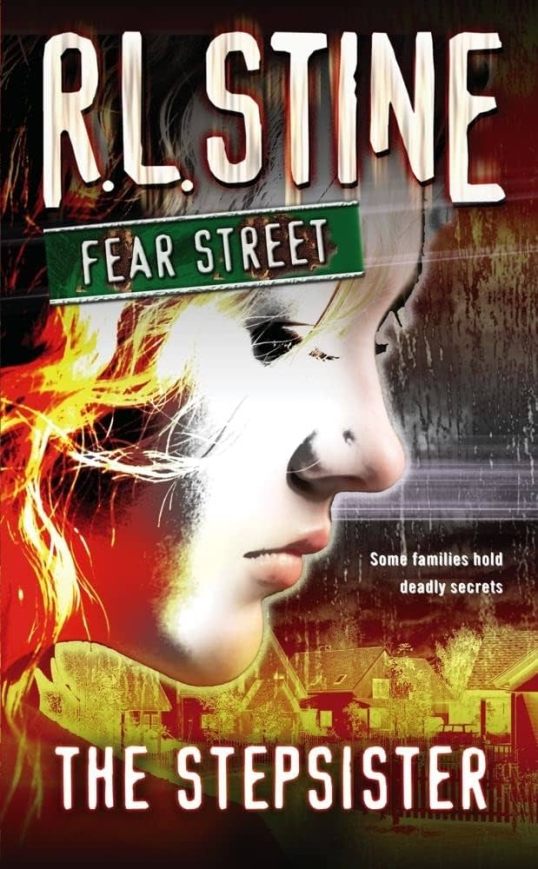
Horror Book Review: The Stepsister by R.L. Stine


Poor Emily!

The star of the 1990 novel, The Stepsister, Emily may live in a nice house on Fear Street and she may have a cool sister and a boyfriend who specifically dumped he sister so that he could date Emily (yikes!) but Emily has still had a lot of tragedy in her life.  When she was a little girl, she could only watch helplessly as her father drowned in Fear Lake.

Now, Emily is a teenager and her mother has married a guy named Hugh Wallen and everything sucks!  Hugh is a bit of a jerk, the type who brags about how happy he is to have two new stepdaughters who can help to clean the house and who refers to his family as being a harem because there’s so many women in it.  (DOUBLE YIKES!)  Hugh also gives his son, Rich, a hard time because Rich likes to read books.  In fact, Rich is a huge Stephen King fan.

Perhaps the most awkward thing about Emily’s mom marrying Hugh is that Emily now has a stepsister named Jessie.  Jessie is the type who complains about the house, complains about Emily’s dog, complains about how Emily’s biological sister has red hair (and trust me, that totally turned me against Jessie), and who will probably steal everyone’s boyfriend as soon as she gets a chance.

But is Jessie capable of murder?

That’s the question that Emily has to solve because there are strange things happening around the house, from fires getting set to innocent animals getting killed to peroxide being put in shampoo bottles.  Emily overhears Jessie on the phone, saying that “I really could kill her!’  Is Jessie being literal or is she just venting her frustrations?  When Emily reads in Jessie’s diary that she was once accused of being involved with a murder, does that….

Wait, wait, wait, WAIT!  Emily is reading Jessie’s diary?  Not cool, Emily!

Seriously, Jessie has her issues but it’s not as if Emily is the most accepting of stepsiblings.  I mean, it’s one thing to get upset because Jessie doesn’t like her dog or because Jessie makes fun of her room and her clothes.  That’s totally understandable.  Jessie seems to have issues with people with red hair so, as far as I’m concerned, Emily shouldn’t even say hello to her when they pass on the street.  But to then accuse someone of being a murderer just because you resent the fact that your mom was dumb enough enough to marry their father …. that’s going a bit too far!

Well, no worries.  Things do work out in the end.  The wannabe murderer is discovered and all of the siblings work through their issues and try to be nicer to each other.  Yay!

This book was interesting for me to read, just because after my mom and dad got divorced, I was always worried about what would happen if my mom remarried and I ended up with some stepsibling moving in with us and basically getting in the way.  I would be nice to them now but seriously, I was a brat when I was 13.

Anyway, this book was okay but it was also one of those Stine books where you could easily guess who the murderer was, just be eliminating all of the obvious red herrings.  There wasn’t really a lot of suspense to the book but I appreciated the somewhat realistic portrayal of a family trying to figure out how to adjust to their new situation.

October True Crime Bonus!: Michael Alig on Geraldo


The film Party Monster, which I just reviewed, was a very bad version of the somewhat interesting true story of how Michael Alig went from being a New York nightlight celebrity to a convicted murderer.  One of the biggest problems with the film was Macauley Culkin’s dull performance as Alig.

As bonus to my review of Party Monster, here’s a 1994 episode of — ugh —  Geraldo, featuring Alig, the Club Kids, and the soon-to-be-deceased Angel.  Alig and his club kids still come across as if they’re trying way too hard to be outrageous (they’re the ultimate conforming nonconformists) and I will warn you that watching this clip will mean spending 44 minutes with one of the most fatuous media personalities in American history.  But still, this episode does feature a look at the story that Party Monster totally screwed up.  Just two years after this episode aired, Alig would kill Angel and dismember him in a bathtub.

October True Crime: Party Monster (dir by Fenton Bailey and Randy Barbato)


Michael Alig!  He was the flamboyant, self-declared “King of the Club Kids.”  He was a club promoter in New York City in the late 80s and the 90s.  He had money.  He had fame.  He had a huge following.  He used to appear regularly on the daytime talk shows.  He was a regular feature in the gossip columns.  He also had a raging drug addiction and an ego that most people couldn’t stand.  He tried to position himself as the successor to Andy Warhol, overlooking the fact that Warhol himself actually had a bit of talent.  And, in 1996, he became a murderer.

He and his roommate killed his drug dealer, a fellow club kid who was known as Angel.  They hit him over the head and suffocated him before then dismembering him.  Everyone knew that Alig was responsible for Angel’s disappearance, largely because he wouldn’t shut up about killing him.  Alig even threw a party where the macabre and bloody decorations left little doubt that Alig had murder on his mind.  Eventually, a group of children found Angel’s remains and Alig and his roommate were arrested.  Due to a plea deal, Alig was sent to prison for manslaughter.  He served 14 years before being paroled.  Alig died of a heroin overdose in 2020.

Released in 2003 (while Alig was still in prison), Party Monster is a biopic of Michael Alig and also a look at New York club culture in the 90s.  The film got a bit of attention when it came out because it starred Macaulay Culkin and Seth Green as, respectively, Michael Alig and James St. John, who was Alig’s mentor-turned-friend-turned-enemy.  Unfortunately, the film itself isn’t very good and both Culkin and Green are lousy in their roles.  Both of them come across like middle American high school kids trying to score cheap laughs by acting as self-consciously flamboyant as possible.  At the time the film was made, Culkin did bear a passing a resemblance to Michael Alig but the same could have been said of Michael Pitt and, at the very least, we know that Pitt is capable of playing a character who is capable of murder.  Culkin, on the other hand, seems to be trying so hard to make us forget that he’s Macaulay Culkin that he instead continually reminds us that we’re watching the star of Home Alone snort cocaine and urinate in wine glasses.  (Ewwwww!)  That said, Culkin and Green aren’t the only two giving bad performances here.  I started giggling as soon as Dylan McDermott showed up wearing an eyepatch.  Only Wilson Cruz as Angel and Chloe Sevigny as one of Alig’s associates feel in any way convincing in their roles.

For a film about a group of people who claimed “fabulousness” as their defining aesthetic, Party Monster is a visually dull film.  Many scenes are overlit, to the extent that the performers look wan and washed out.  That may be a good look for the drug-addled Alig who killed Angel but, in this film, Alig looks and seems burned out from the minute he shows up in New York City.  The end result is a rather boring film that doesn’t offer up any insight into the Club Kids or the murders.

Horror Film Review: The Torture Chamber of Dr. Sadism (dir by Harald Reinl)


On Saturday night, I watched the 1967 German horror film, The Torture Chamber of Dr. Sadism.

I have to say that the film itself turned out to be quite a bit more entertaining than I was expecting it to be.  It was an entertaining and atmospheric horror film, the type where travelers rode in stage coaches to gothic castles and Christopher Lee showed up as the villain.  However, I was very disappointed to discover that, while the film did feature a torture chamber, there was not a character named Dr. Sadism anywhere to be found.  In fact, I don’t think that the word “Sadism” was even mentioned in the film.

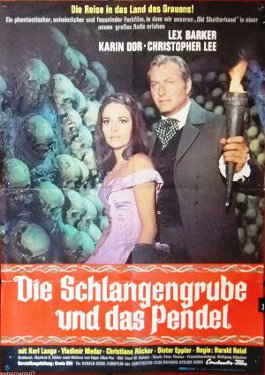
Of course, The Torture Chamber of Dr. Sadism was not the only title by which this film was released.  As was typical of horror films in the 60s (especially international horror films), this film had many different titles.  In Germany, it was known as Die Schlangengrube und das Pendel.  It was also released under titles like The Blood Demon, The Crimson Demon, The Snake Pit and the Pendulum, and The Castle of the Walking Dead.  That’s a collection of good names.  It’s just too bad that they were all given to one film as opposed to being spread out amongst several films.

The Torture Chamber of Dr. Sadism (or whatever you want to call it) opens with a public execution.  Count Regula (Christopher Lee) has been found guilty of the murder of 12 virgins.  Regula is forced to wear a gold mask with a rather awkward smiley face on the front of it.  He is then forced to lie down in the town square and his wrists and his ankles are tied to four horses.  As the red-hooded executioner looks on, the horses run in four different directions and, though we don’t actually see it, Count Regular is ripped apart.  Agck!

35 years later, Baroness Lilian von Brabent (Karin Dior, wearing a purple gown that is simply to die for) and her lawyer, Roger Mont Elise (Lex Barker) are invited to pick up an inheritance that is due to the Baroness.  The only catch is that they’ll have to ride a stagecoach all the way to a forbidding castle that the locals refer to as being Blood Castle.  On the way to the castle, they are joined by a highwayman who is pretending to be a priest (Vladimer Medar) and the Baroness’s maid (Christiane Rucker).  They are ride through a forest where the trees are full of human limbs.  They battle some mysterious robbers.  They discover a burned out church and an apparent madman living inside the ruins.  Eventually, they reach the castle where the resurrected Count Regula waits for them, along with his undead, green-blooded servant, Anatol (Carl Lange).  Count Regula is eager to sacrifice a 13th virgin so that he can become immortal.  Apparently, this will grant Regula immortality, which he does not yet have despite the fact that he’s somehow recovered nicely from being dismembered and beheaded.  Regula announces that the Baroness will be his next virgin victim.

(See, there’s actually very real advantages to not waiting.)

The Torture Chamber of Dr. Sadism is one of those films that is described as being based on the writings of Edgar Allan Poe.  In this case, that means that Roger ends up in a pit with a pendulum swinging over him.  For a film with a title like The Torture Chamber of Dr. Sadism (or even The Blood Demon), there’s not really a lot of gore in this film.  Instead, the film focuses more on creating and maintaining a properly gothic atmosphere.  It’s surprisingly entertaining, largely due to the ominous design of the torture dungeon, Christopher Lee’s villainy, Vladimer Medar’s comedic relief, the beauty of Karin Dor, and the square-jawed heroism of Lex Barker.  Lee, in particular, deserves some credit for embracing the melodrama in his role as Regula.  Lee knows exactly the type of film in which he’s appearing and he appropriately modulates his performance.

Whatever title you see it under, The Torture Chamber of Dr. Sadism will keep you entertained.