Music Video of the Day: Act a Fool by Ludacris (2003, dir by John Singleton)


Today would have been the 57th birthday of the late director, John Singleton.

Today’s music video of the day is one that Singleton directed.  This song (and Ludacris himself) were both featured in Singleton’s 2003 film, 2 Fast 2 Furious.  I can remember when 2 Fast 2 Furious first came out.  There were a lot of jokes about the stylized title and also the idea of even making a sequel to a film like The Fast and the Furious.  That shows how much people knew back then!  Today, almost all sequels have a stylized title (though perhaps Die Hard 2: Die Harder deserves as much credit for that as 2 Fast 2 Furious) and The Fast and The Furious franchise appears to be immortal.

Enjoy!

Late Night Retro Television Review: Degrassi High 4.6 “Nobody’s Perfect”


Welcome to Late Night Retro Television Reviews, a feature where we review some of our favorite and least favorite shows of the past!  On Sunday, I will be reviewing the Canadian series, Degrassi High, which aired on CBC and PBS from 1989 to 1991!  The series can be streamed on YouTube!

Oh Romeo, Romeo….

Episode 4.6 “Nobody’s Perfect”

(Dir by Eleanore Lindo, originally aired on December 5th, 1989)

This week’s episode is all about relationships, good and bad.

Patrick (Vincent Walsh), a student from Ireland, sees that Spike is wearing a Pogues t-shirt and asks her out.  Spike replies that she wants to but she can’t because she has to take care of baby Emma at night.  Patrick suggests a day date instead.  Spike agrees, even if she’s still struggling to deal with her feelings about Shane.

(Shane, having suffered brain damage after a bad LSD trip, is not enrolled at Degrassi High.  We won’t see him again until the third season premiere of Degrassi: The Next Generation.)

Meanwhile, despite having broken up with him so that she can date “Clode,” Caitlin still volunteers to be Joey’s scene partner for home room.  They’re supposed to perform a scene from Romeo and Juliet and …. yeah, there’s no way that’s going to be awkward, right?  Caitlin tells Joey that, even though they’ve broken up, she hopes they can still be friends.  Joey awkwardly says, “Yeah.”  They talk about why they broke up.  Caitlin even says, “It’s not you, it’s me.”  Those of us who know our Degrassi history know that this is a scene that’s going to be frequently repeated over the next twenty years or so.

Finally, Kathleen has convinced herself that she’s totally in love with Scott.  Afterall, Scott is always telling Kathleen how much he loves her.  He gives her jewelry.  He sends her flowers.  He wants her to spend all of her free time with him.  Of course, when Scott isn’t doing all of that, he’s beating on her and telling her that she’s stupid for wanting to have any interests outside of being his girlfriend.  When Kathleen is disappointed to discover that she hasn’t been cast in the school play, Scott informs her that she’s just not a very good actress and she shouldn’t worry about it.  When Kathleen says that she wants to try out for a play at the community center, Scott tells her that she needs to make time for him.  When Kathleen tries to have lunch with her friends, Scott drags her away so that she can have lunch with him.  When Kathleen stays after school to practice a scene with her scene partner (who happens to be Luke, the guy who gave Shane the acid), Scott goes absolutely crazy and beats her up in the classroom.

“Kathleen,” Scott insists as Kathleen finally walks away from him, “I love you!”

Kathleen turns to look at him.  We get a freeze frame of her bruised face and then the insanely cheerful Degrassi theme music starts playing.  It makes for an interesting juxtaposition.  (Combining cheerful music with depressing freeze frames was a Degrassi tradition.)

This episode deserves a lot of credit for realistically portraying Kathleen and Scott’s relationship and Scott’s abusive personality.  Everything that an abuser does — from the gaslighting to the subtle insults and the sudden accusations to the desperate begging for forgiveness — is present in this episode and Kathleen’s reactions (“I can change him!”) are all too real.  Degrassi High was a show that dealt with real issues and it usually managed to do it without resorting to melodrama or false hope.  The thing that makes this episode so powerful is that we don’t know if Kathleen had the courage to reject Scott after that freeze frame or, if like so many other girls and women in the same situation, she once again forgave her abuser.  Rebecca Haines deserves a lot of credit for her performance here, as does Byrd Dickens, who is terrifying as Scott.  This episode was Degrassi High at its best and most important.

The TSL Grindhouse: Solomon King (dir by Sal Watts)


In the early 70s, Sal Watts, the owner a popular chain of Oakland clothing stores, took a look at the “blaxploitation” films coming out of Hollywood and thought to himself, “I can do better.”

For two years, Watts worked on his film.  Originally titled Black Agent Lucky King, the film took place in Oakland and an unnamed Middle Eastern country.  When the evil Prince Hassan (Richard Scarro) overthrows the king and takes over the country’s oil fields, Manny King (played by “Little Jamie” Watts) is among the Americans who escape from the country.  Accompanying him is Princess Oneeba (Claudia Russo), who I guess is supposed to be Hassan’s sister, though it’s never really made clear in the film.

Who is Solomon King?  He’s a businessman.  He’s a social activist.  He’s a former Green Beret and a semi-retried agent of the CIA.  All the women love him.  All the men envy him.  He’s the coolest guy in Oakland and everyone assumes that he’s the perfect person to keep Oneeba safe.  Solomon and Oneeba fall in love.  They talk walks along the beach.  Oneeba is amazed that you can hear the ocean when you hold a shell up to your ear.  The entire time, a man with a high-powered rifle is following Oneeba.  Finally, when Oneeba steps out onto the balcony of Solomon’s penthouse, the sniper take his shot.  Oneeba falls in slow motion.  Solomon holds her as she dies and then, he tries to cry.  In this scene, we’re reminded that crying on cue is not as easy as it looks and that Sal Watts was definitely not a trained actor.

Solomon is out for revenge.  He wants to take down Prince Hassan and return the king to his throne.  He also wants to get back the oil wells that Hassan stole from him and his family.  (The film makes it sound like everyone owns an oil well.)  The CIA suggests that Solomon should get some of his Green Beret pals together and overthrow Prince Hasan.  Sure, why not?  I mean, look how well that thinking worked when the CIA and the Mafia tried to invade Cuba!

Eventually, Solomon puts together an army and invades the unnamed Middle Eastern country.  Even though the country is supposed to be in the Middle East, it’s hard not to notice that it looks a lot like Oakland.  Solomon gets his revenge but nothing can bring Oneeba back to life….

Solomon King was long-considered to be a lost film.  A few years ago, a damaged print was discovered and the film was partially resorted.  (The original film reportedly ran close to two hours.  The restoration clocks in at 85 minutes.)  Solomon King is definitely a work of outsider art.  What Sal Watts lacked in experience and ability, he tried to make up for with determination.  There are a few genuinely well-done shots of Solomon driving his car.   (As befits the coolest guy in Oakland, he’s even got a phone in his car!) The soundtrack features an appealing mix of jazz and funk.  And there are a few politically-charged lines of dialogue that suggest that Sal Watts had more on his mind than just making another action film.  That said, Solomon King is also, even in its shortened version, a rather slow-paced and difficult-to-follow film.  The acting is terrible and the fight scenes are haphazardly edited in a way that’s meant to keep you from noticing that no one in the film is actually hitting anyone but which actually has the opposite effect.  My favorite moment was when there was a close-up of Solomon kicking out his leg and then an abrupt jump cut of someone falling backwards, trying to look as if they had been kicked. It was so unconvincing that it was actually kind of charming.

Solomon King is proof that anyone can make a film but making a good one is significantly more difficult.

Lisa Marie Reviews An Oscar Nominee: The Power of the Dog (dir by Jane Campion)


It’s interesting how quickly a film can be forgotten.

Based on a novel by Thomas Savage, The Power of the Dog was one of the most anticipated films of 2021.  It was considered to be a front runner for Best Picture even before it was released.  Even though everyone knew 2021 was going to be the year that the Academy finally got around to giving Will Smith the Oscar, there was still a lot of excitement about the idea of Benedict Cumberbatch playing a sinister and closeted cowboy named Phil Burbank.  The first teaser featured Cumberbatch being wonderfully creepy.  I remember that I was certainly looking forward to it.

When it finally showed up in theaters and then premiered on Netflix, the reviews were …. respectful.  They were positive but they weren’t exactly enthusiastic.  This was the type of film where people noted that it was well-made and well-acted but it seemed to just be missing a little something.  The film was nominated for a lot of Oscars but, in the end, it only won one, for Jane Campion’s direction.  (And Campion, unfortunately, had to spend the days leading up to the ceremony dealing with a stupid controversy over a very mild joke she made to Serena and Venus Williams about how making a movie was more difficult than playing tennis.)  People admired the skill that went into The Power of the Dog but, in the end, it was CODA that captured the hearts of the Academy.  CODA may not have been as technically well-made as Power of the Dog but CODA was a film that made people cry.  And, in 2021, voters who had spent an entire year being told that they would die a horrible death if they even dared to leave their house without putting on a mask, decided to vote with their hearts.

Taking place in 1925 Montana, The Power of the Dog centers on two prominent ranchers, the Burbank brothers.  Phil Burbank is a man’s man, a bluff and hearty type who lives to conquer the land and who doesn’t have much use for women.  Phil looks down on anything that he considers to be a sign of weakness, like showing emotion or making paper flowers.  And yet, Phil is also fiercely intelligent and Ivy League-educated, a man who is capable of playing beautiful music but who has decided not to.  Phil is cruel and manipulative.  Perhaps the only person that he’s ever respected is his mentor, Bronco Henry.  Phil’s admiration for Henry and his collection of gay pornography tells us all we need to know about why Phil is so obsessed with maintaining his “manly” image.

His brother, George (Jesse Plemons), is a much more sensitive soul than Phil and yet, he allows himself to be dominated by his brother.  It’s not until George meets and marries a widow named Rose (Kirsten Dunst) that he starts to come out of his shell.  Angry that Rose seems to be freeing George from his domination, Phil goes out of his way to make her life miserable, even preventing Rose from playing the piano.  In her loneliness, Rose starts to drink.  Phil, meanwhile, sets himself up as a mentor (and potentially more) for Rose’s sensitive and introverted son (Kodi Smit-McPhee), who does like to make paper flowers but who also has an obsession with his late father’s medical books….

The Power of the Dog is a film that I had mixed feelings about.  On the one hand, I did respect the craft that went into making the film.  The Montana scenery was both beautiful and ominous.  And I thought that both Jesse Plemons and Kirsten Dunst gave award-worthy performances.  Dunst, especially, really captured the pain of Rose’s life on the ranch.  Plemons, meanwhile, made George’s gentle nature compelling, which is not always the easiest thing for an actor to do.  At the same time, Benedict Cumberbatch was miscast as Phil and Kodi Smit-McPhee’s performance was a bit too cartoonishly creepy for the film’s ending to really be as shocking as it was obviously meant to be.  Ultimately, the main problem with the film was that Campion, as a director, kept the audience from really connecting with the characters.  The film was well-made but almost as emotionally remote as Phil Burbank and it left the audience feeling as if they were on the outside looking in.  While the book leaves you feeling as if you’re actually in Montana and allows you into the hearts of all of the characters, even Phil, the movie leaves you feeling as if you’ve just watched a really carefully-made film that ultimately treated you as scornfully as Phil treated Rose.

Because it is such a well-made film, The Power of the Dog is a film worth watching but it’s not necessarily a film that leaves you with any desire to watch a second time.  For all the excitement that the film generated before it was released, it was largely forgotten after it lost the Oscar for Best Picture to CODA.

Retro Television Review: Homicide: Life on The Street 2.2 “See No Evil”


Welcome to Retro Television Reviews, a feature where we review some of our favorite and least favorite shows of the past!  On Sundays, I will be reviewing Homicide: Life On The Street, which aired from 1993 to 1999, on NBC!  It  can be viewed on Peacock.
This week, no one’s innocent.

Episode 2.2 “See No Evil”

(Dir by Christopher Menual, originally aired on January 13th, 1994)

Watch out!  Stanley Bolander’s whining about his divorce again!

Ned Beatty was one of the great character actors and he is certainly convincing in the role of Stanley Bolander, the veteran Baltimore homicide detective who has seen the worst that humanity has to offer and who spends most of his time annoyed with his partner, John Munch.  But, as good as Beatty is, I still groan whenever Bolander starts to talk about his ex-wife and his divorce.  His bitterness was a recurring theme during the first season.  It was annoying but it was understandable because the divorce was still recent.

But now, we’ve started the second season.  It’s time move on, Big Man!

This episode finds Bolander very reluctantly taking part in sensitivity training.  He avoids meeting with Dr. Carrie Weston (Jennifer Mendenhall) until Giardello threatens to suspend him without pay.  Bolander is stunned when Dr. Weston turns out to be sympathetic to his anger over his divorce.  Bolander ever tries to ask Dr. Weston out, just for Weston to inform him that she’s just gotten out of a bad relationship and that she believes “birds of a feather should flock together” and, speaking of birds, did you know that there are lesbian seagulls?  Bolander gets the hint.  Myself, I would probably lie about being a lesbian just to get out of having to spend any more time listening to him cry about his divorce.

Far more interesting than Bolander’s angst were the two cases at the center of this week’s episode.  Chuckie Prentice (Michael Chaban) shoots his dying father (played, in a powerful and intimidating performance, by Wilford Brimley) in the head.  Though Chuckie claims that his father committed suicide, Lewis has his doubts and takes Chuckie to the station for interrogation.  Detective Beau Felton just happens to be Chuckie’s best friend and, after Chuckie tells him that his father specifically asked to be put out of his misery, Felton tries to convince Lewis to say that the shooting actually was a suicide.  At first, Lewis refuses but eventually, he agrees to look the other way while Felton takes Chuckie to wash his hands and destroy any evidence of gunpowder residue on his skin.  Without any definite evidence proving the he fired the gun, Chuckie is free to go and his father’s death is ruled a suicide.

This was a powerful story and it was all the more effective because it refused to come down on one side or the other.  Both Felton and Lewis presented their positions well and the episode ended not on a note of triumph but on a note of weary resignation.  Chuckie is free to go on with his life and his father is no longer in pain but Lewis is going to be haunted by his decision to allow evidence to be destroyed.  Personally, I’m against assisted suicide and I felt it was selfish for Chuckie’s father to ask Chuckie to pull the trigger.  But, having spent the previous few months trying to come to terms with my own father’s passing, I could understand what Chuckie was feeling.  There really are no easy answers.

As for the other case, it involved the shooting of a drug dealer.  The dealer was shot in the back.  A patrolman claimed that he slipped and his gun accidentally fired during the pursuit of the dealer.  Pembleton had his doubts about whether the shooting was really an accident or a case of police brutality.  Even after Giardello warned him that pursuing the case would turn “brother against brother” in the police force, Pembleton insisted on asking every police officer on the scene to turn in their guns for testing.  “You son of a bitch, Pembleton,” Giardello muttered.

And again, this was a storyline that worked because it refused to present an easy solution.  The dead man was a criminal and he was shot while fleeing the cops.  Even though the cop that slipped was eventually cleared of having fired the shot that killed the dealer, it was obvious that the shot did come from a cop.  Pembleton, with his black-and-white view of his job, was determined to find the truth, regardless of the professional consequences.  Giardello, with years more experience than Pembleton, spoke from the heart when he told Pembleton that investigating the case would bring harm not just to the cop who shot the dealer but to every cop working the streets, regardless of whether they were involved or not.  Felton could convince Lewis to look the other way.  Pembleton was not willing to do the same thing.

It was a strong episode, even with all of Bolander’s nonsense.  Perfectly acted, morally ambiguous, and fiercely intelligent, this is an episode that I’ll be thinking about for a while.

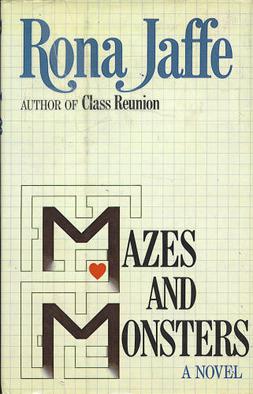
Novel Review: Mazes and Monsters by Rona Jaffe


The 1981 novel, Mazes and Monsters, tells the story of four wealthy college students who deal with the ennui of being rich and privileged by obsessively playing a role-playing game called Mazes and Monsters.

That’s right!  The game is Mazes and Monsters and most definitely not Dungeons and Dragons, even though both games are basically about people wandering around in dungeons and fighting monsters and searching for treasure.  (For the record, I’ve never played Dungeons and Dragons or any other role playing game and I’ve never really had any desire too.  That said, I did enjoy those episodes of Freaks and Geeks and Community.)  One of the four players is Robbie Wheeling, who has never recovered from the death of his brother.  When the players decide to move their game into the tunnels underneath their college, Robbie has a total break from reality and thinking that he actually is his M&M character, he flees to New York and lives on the streets.  Desperate for money and food, he turns to prostitution but ends up stabbing the first man who picks him up.  Agck!  He never should have played that game!

Mazes and Monsters is usually described as being one of the key works of the 80s Satanic Panic and there’s certainly an element of that to be found in the plot.  But the game is actually a fairly small part of the book.  The majority of the book just deals with teenagers struggling with the transition of adulthood and figuring out where they belong in the world.  The book isn’t quite as hysterical as its been described.  If anything, the book almost makes the case that the game is helpful to the players in that it gives them an escape from all the ennui.  Robbie was mentally unstable long before he played the game and it’s hard not to feel that something would have eventually set him off.

This is a rare case where the movie version is better than the book, if just because the movie features Tom Hanks as Robbie.  Robbie mistaking a man for a demon and stabbing him?  That’s really sad.  Tom Hanks doing it?  That’s cinematic magic!

Song of the Day: The Godfather by Nino Rota


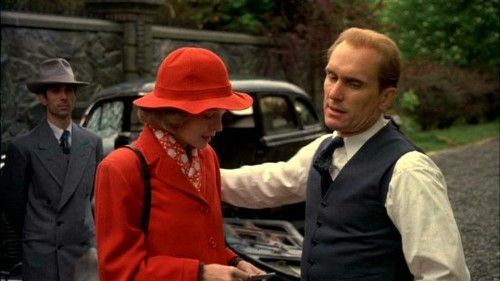
Today, the Shattered Lens wishes a happy birthday to both Robert Duvall and Diane Keaton!

Along with being two of America’s best actors, Duvall and Keaton also co-starred in the first two Godfather films.  They didn’t share many scenes in the second film (though there was at least one Duvall/Keaton scene that was filmed but not included in the final film) but, in the first film, they have a memorable moment in which Keaton (as Kay) asks Duvall’s Tom Hagen to send a letter to Michael in Sicily.  Hagen politely refuses.  When Kay notices a car that has obviously been bombed, Tom replies with bland good cheer, “Oh, that was an accident.  Luckily, no one was hurt!”

In honor of these two amazing performers and my favorite movie of all time, today’s song of the day is Nino Rota’s theme from The Godfather.

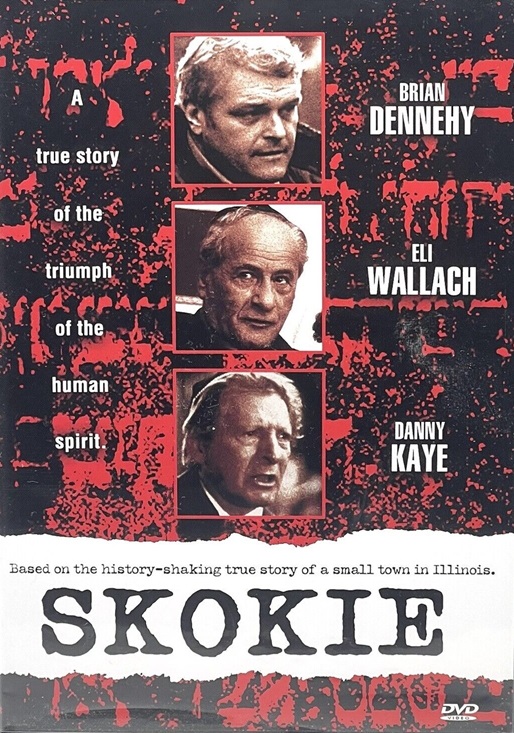
Made-For-Television Movie Review: Skokie (dir by Herbert Wise)


Skokie, a 1981 made-for-television movies, opens in a shabby Chicago office.

A group of men, all wearing brownshirts and swastika armbands, listen to their leader, Frank Collin (George Dzundza).  Collin says that they will be holding their next rally in the town of Skokie.  Collin explains that Skokie has a large Jewish population, many of whom came to the United States after World War II.  Collin wants to march through their town on Hitler’s birthday.

If not for the swastika and the brownshirt, the overweight Collin could easily pass for a middle-aged insurance salesman, someone with a nice house in the suburbs and an office job in the city.  However, Frank Collin is the head of the American National Socialist Party. a small but very loud group of Nazis who specialize in marching through towns with large Jewish populations and getting fee media attention as a result of people confronting them.  Making Frank Collin all the more disturbing is that he isn’t just a character in a made-for-television movie.  Frank Collin is a real person and Skokie is based on a true story.

The Mayor (Ed Flanders) and the police chief (Brian Dennehy) of Skokie are, needless to say, not happy about the idea of modern-day Nazis marching through their city.  Though they inform Collin that he will have to pay for insurance before he and his people will be allowed to hold their rally, they know that the courts have been striking down the insurance requirement as being a violation of the First Amendment.  While the mayor and the police chief worry about the political fallout of the rally, the Jewish citizens of Skokie debate amongst themselves how to deal with the Nazis.  Bert Silverman (Eli Wallach) and Abbot Rosen (Carl Reiner) argue that the best way to deal with Collin and his Nazis is to refuse to acknowledge them, to “quarantine” them.  As Rosen explains it, Collin is only marching to get the free publicity that comes with being confronted.  If he’s not confronted, he won’t make the evening news and his rally will have been for nothing.  However, many citizens of Skokie — including Holocaust survivor Max Feldman (Danny Kaye) — are tired to turning their back on and ignoring the Nazis.  They demand that the Nazis be kept out and that, if they do enter the city, they be confronted.

With the support of the ACLU, Collin sues for his right to march through Skokie.  The ACLU is represented by Herb Lewishon (John Rubinstein), a Jewish attorney who hates Collin and everything that he stands for but who also feels that the First Amendment must be respected no matter what.  When Lewishon is asked how he, as a Jew, can accept a Nazi as a client, Lewishon relies that his client is the U.S. Constitution.

Skokie is a thought-provoking film, all the more so today when there’s so much debate about who should and should not be allowed a platform online.  (Indeed, Collin and his Nazis would have loved social media.)  Lewishon argues that taking away any group’s First Amendment rights, regardless of how terrible that group may be, will lead to slippery slope and soon everyone’s First Amendment rights will be at risk.  Max Feldman, and others argue that the issue isn’t free speech.  Instead, the issue is standing up to and defeating evil.  The film gives both sides their say while, at the same time, making it clear that Frank Collin and his Nazis are a bunch of fascist losers.  It’s a well-acted and intelligently written movie, one that rejects easy answers.  Needless to say, at a time when so many people feel free to be openly anti-Semitic, it’s a film that’s still very relevant.

As for the real Frank Collin, he would eventually be charged with and convicted of child molestation.  After three years in prison, he changed his name to Frank Joseph and became a writer a New Age literature.  He’s looking for Atlantis but I doubt they’d want him either.

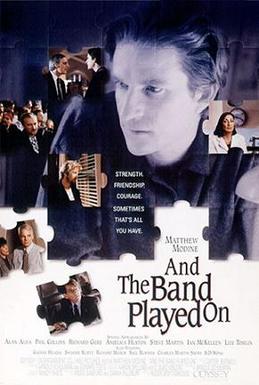
Film Review: And The Band Played On (dir by Roger Spottiswoode)


I live in a very cynical time.

That was one of my main thoughts as I watched 1993’s And The Band Played On.

Directed by Roger Spottiswoode and featuring an all-star cast, And The Band Played On deals with the early days of the AIDS epidemic.  It’s a film that features many different characters and storylines but holding it all together is the character of Dr. Don Francis (Matthew Modine), an epidemiologist who is haunted by what he witnessed during the Ebola epidemic in Africa and who fears that the same thing is going to happen in America unless the government gets serious about the mysterious ailment that is initially called “gay cancer” before then being known as “GRID” before finally being named AIDS.  Dr. Francis is outspoken and passionate about fighting disease.  He’s the type who has no fear of yelling if he feels that people aren’t taking his words seriously enough.  In his office, he keeps a track of the number of HIV infections on a whiteboard.  “Butchers’ Bill” is written across the top of the board.

Throughout the film, quite a few people are dismissive of Dr. Francis and his warnings.  But we, the audience, know that he’s right.  We know this because we know about AIDS and but the film also expects us to trust Dr. Francis because it’s specifically stated that he worked for the World Health Organization before joining the Center For Disease Control in Atlanta, Georgia.  As far as the film is concerned, that’s enough to establish his credentials.  Of course, today, after living through the excesses of the COVID pandemic and the attempts to censor anyone who suggested that it may have begun due to a lab leak as opposed to some random guy eating a bat, many people tend to view both the WHO and the CDC with a lot more distrust than they did when this film was made.  As I said, we live in a cynical time and people are now a lot less inclined to “trust” the experts.  To a large extent, the experts have only themselves to blame for that.  I consider myself to be a fairly pragmatic person but even I now find myself rolling my eyes whenever a new health advisory is issued.

This new sense of automatic distrust is, in many ways, unfortunate.  Because, as And The Band Played On demonstrates, the experts occasionally know what they’re talking about.  Throughout the film, people refuse to listen to the warnings coming from the experts and, as a result, many lives are lost.  The government refuses to take action while the search for a possible cure is hindered by a rivalry between international researchers.  Alan Alda gives one of the best performances in the film, playing a biomedical researcher who throws a fit when he discovers that Dr. Francis has been sharing information with French scientists.

It’s a big, sprawling film.  While Dr. Francis and his fellow researchers (played by Saul Rubinek, Glenne Headly, Richard Masur, Charles Martin Smith, Lily Tomlin, and Christian Clemenson) try to determine how exactly the disease is spread, gay activists like Bobbi Campbell (Donal Logue) and Bill Kraus (Ian McKellen) struggle to get the government and the media to take AIDS seriously.  Famous faces pop up in small rolls, occasionally to the film’s detriment.  Richard Gere, Steve Martin, Anjelica Huston, and even Phil Collins all give good performances but their fame also distracts the viewer from the film’s story.  There’s a sense of noblesse oblige to the celebrity cameos that detracts from their effectiveness.  All of them are out-acted by actor Lawrence Monoson, who may not have been a huge star (his two best-known films are The Last American Virgin and Friday the 13 — The Final Chapter) but who is still heart-breakingly effective as a young man who is dying of AIDS.

Based on a 600-page, non-fiction book by Randy Shilts, And The Band Played On is a flawed film but still undeniably effective and a valuable piece of history.  Director Roger Spottiswoode does a good job of bringing and holding the many different elements of the narrative together and Carter Burwell’s haunting score is appropriately mournful.  The film ends on a somber but touching note.  At its best, it’s a moving portrait of the end of one era and the beginning of another.

Film Review: The Last Innocent Man (dir by Roger Spottiswoode)


In 1987’s The Last Innocent Man, Ed Harris plays Harry Nash.

Harry is a criminal defense attorney, one who specializes in defending people who have been charged with committing murder.  He’s good at his job but he’s not sure that he’s happy with his life.  He went into the law to save people from Death Row but years of getting acquittals for guilty people have taken their toll on Harry’s psyche.  His most recent client was Jonathan Gault (David Suchet), a man accused of having killed his wife.  The verdict was “not guilty” but Harry suspects that Gault may have been guilty of both what he was charged with and also countless crimes for which he hasn’t been charged.  It doesn’t help that Gault confronts Harry in a parking lot and says he wants Harry to co-write a book about how he got Gault acquitted.  Gault proceeds to tell Harry that he did kill his wife, before suddenly laughing and saying that he’s only joking.

Despite all of the money and the fame, Harry needs a break from dealing with guilty people.  He tells his shocked partner that he will be temporarily stepping back from their practice.  Along with being burned out, Harry is also interested in pursuing a romantic relationship with Jenny Stafford (Roxanne Hart).  Jenny is married but she assures Harry that she is in the process of getting a divorce from her husband, Philip (Darrell Larson).

However, when Philip is arrested and accused of murdering a policewoman who was working undercover as a prostitute, Harry finds himself defending Philip in court.  Philip swears that he’s innocent of the crime and that he’s never even been with a prostitute.  He claims that, when the murdered occurred, he was at home with his wife.  Jenny is willing to collaborate Philip’s alibi, even though Harry suspects that she’s lying.

As you can probably guess, there are plenty of twists and turns to the plot of The Last Innocent Man.  Unfortunately, they’re not exactly shocking twists and turns.  The Last Innocent Man is a courtroom drama and it pretty much sticks to the rules of the genre, which means a lot of snarky comments between Harry and the prosecutor and also plenty of scenes of various lawyers snapping “Objection!” and demanding a recess.  This is the type of film where people fall apart on the witness stand and the audience in the courtroom murmurs whenever something shocking happens.  The Judge can’t pound that gavel hard enough to make The Last Innocent Man anything more than a standard courtroom drama.

That said, director Roger Spottiswoode keeps the action moving at a quick-enough pace and Ed Harris is ideally cast in the role of the morally conflicted Harry Nash.  As well, there’s an entertaining supporting performance from Clarence Williams III, cast here as a cocky pimp, and David Suchet is chillingly evil as the worst of Harry’s clients.  The Last Innocent Man doesn’t quite reach the Hitchcockian heights that it was reaching for but, still, fans of courtroom dramas will enjoy it or, at the very least, show a little leniency in their judgment.