You know, this is a good song by a good singer and good group of backing musicians. (The Wallflowers have had many personnel changes over the years, with Jakob remaining the one consistent member.) Jakob Dylan has always been a little overshadowed by his famous father and, while that’s understandable, it’s definitely a shame. Jakob is a talented artist in his own right and this video shows that.
That said, the main reason I like this video is because of Jakob emerging from the ocean with those big blue eyes. Hi, Jakob!
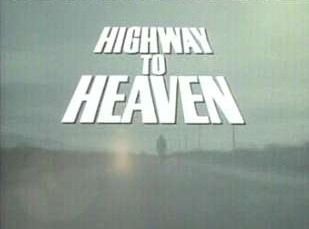
Welcome to Late Night Retro Television Reviews, a feature where we review some of our favorite and least favorite shows of the past! On Thursdays, I will be reviewing Highway to Heaven, which aired on NBC from 1984 to 1989. The entire show is currently streaming on Freevee and several other services!
This week, we’ve got a two-hour episode of Highway to Heaven.
Episode 3.7 and 3.8 “Love and Marriage”
(Dir by Michael Landon, originally aired on November 12th, 1986)
It’s Mark and Jonathan’s four-year anniversary!
For four years, they have been traveling around the country and helping people out. Mark is so excited that he makes a cake and decides not to watch the football game so that he and Jonathan can talk about old times.
“I remember the first time I met you,” Mark says at one point.
Later, Jonathan laughs and says that he remembers one really funny adventure they had.
Still later, Mark says, “Remember when Scotty proposed?”
Yay! I thought as I watched all of this unfold. It’s a clip show! This will be easy to review!
However, it turned out that only first 20 minutes of the episode was a clip show. Soon, Mark got a phone call telling him that his niece was getting married and that she wanted Mark to be the head usher. Meanwhile, Jonathan put on his collar and became Rev. Smith, the man who would perform the ceremony.
Unfortunately, not all is well at the wedding rehearsal. When the grandparents of the bride — Clarence (Bill Erwin) and Rose (Mary Jackson) — decide to get a divorce, this leads to the parents of the bride — Frank (Robert Mandan) and Carla (Barbara Stuart) — splitting up as well. Seeing her elders splitting up, Trish Kelly (Anne Marie Howard) decides that there is no way she could marry Brad (Dean Scofield).
It falls to Jonathan and Mark to bring all of the couple back together. Mark invades Clarence’s dreams and shows him how empty his life would have been if he had never married Rose. Jonathan appears to Carla and explains that he’s an angel. He gives Carla a chance to appear to Frank as a totally different woman. Calling herself Ono, Carla dates Frank for a week but Frank eventually tells her that he loves his wife too much to be unfaithful to her. Frank says that dating Ono made him realize how much he loved Carla. It’s a good thing that Carla actually was Ono or Frank probably would have gotten the heck slapped out of him.
Seeing all of the members of her family getting back together inspires Trish to go ahead and give marriage a try. Jonathan performs the wedding but now it’s a triple wedding as the grandparents and their parents join their daughter and renew their vows. Wow, you all, way to hog the spotlight on Trish’s special day.
This episode was a bit too cutesy for its own good. I think if Jonathan and Mark has only been repairing one or two relationships, it would have been fine. But three just felt like showing off and, more importantly, it left the episode feeling a bit overcrowded and overstuffed.
Fortunately, next week’s episode is one that I’ve actually seen before and I can promise you that it’s going to be a huge improvement!
I am currently sitting in my bedroom, wrapped in several blankets and watching the snow fall on the other side of my window. I love snow, mostly because I live in Texas and therefore, I don’t get to see it that often. The most snow we’ve gotten down here, at least in my lifetime, was in 2021. That was when we got hit by that blizzard and had to deal with rolling blackouts for a week straight. That’s not a good memory but still, I love to watch the snow fall. Even during that blizzard, I still loved the fact that I could use the snow as a nightlight as I read a Mickey Spillane book and waited for the power to come back on.
Down here in North Texas, snow is exotic. In other parts of the country, it’s just a part of everyday life.
Like in the Dakotas for instance….
First released in 1996 and directed by the Coen Brothers, Fargo is a film that is full of arresting images. As soon as you hear (or read) the title, those images and the sounds associated with them immediately pop into your head. You immediately visualize the desperate car salesman Jerry Lundegaard (William H. Macy) trying to trick a customer into paying extra for the trucoat and insisting that “I’m not getting snippy here!” You see the film’s two kidnappers, Carl Showalter (Steve Buscemi) and Gaear Grimsud (Peter Stomare), getting on each other’s nerves as they drive from one frozen location to another. You remember heavily pregnant Marge Gunderson (Frances McDormand) investigating a snowy crime scene and gently correcting another officer’s “police work.” You flash back to the moment when Mike Yanagita (Steve Park) suddenly breaks down in tears and tells Marge that she’s a super lady. “And it’s a beautiful day,” Marge says at one point, wondering how so many terrible things could have happened on such a lovely day. And she’s right. It was a beautiful day. It was far too beautiful a day to discover one man stuffing another into a woodchipper.
Myself, I always think of the scene where Carl attempts to find a place to hide a briefcase full of money. It’s night. Carl’s been shot in the face but he has the money that he’s gone through so much trouble to collect. He runs into a field, looking for a place to hide it. The field is covered in snow. Every inch of the ground glows a bright white. Everything looks the same. But Carl still runs around desperately before picking a place to bury the suitcase. It doesn’t seem to occur to Carl that there’s no visible landmarks or anything that would ever help him to find the money again. He’s blinded, by the snow, by the pain of the bullet, and, like most of the characters in this movie, by his own greed.
Of course, Fargo is not a film about people behaving in intelligent ways. Greed, loneliness, and desperation all lead to people doing some pretty stupid things. Jerry thinks that the best way to pay off his debts and raise the money for a real estate deal is to arrange for his wife to be kidnapped so his wealthy father-in-law (Harve Presnell) will pay the ransom. His father-in-law, who obviously despises Jerry and would be happy for him to just go away, is convinced that he’ll be able to both get back his daughter and recover his money. (If Jerry had just spent a moment really thinking about his plan before going through with it, he would have realized his father-in-law would never just part with his money.) Carl thinks that it’s a good idea to partner up with the obviously sociopathic Grimsud. When a cop pulls over Carl and Grimsud’s car, Grimsud ignores the fact that Carl was talking his way out of the ticket and instead kills the policeman and then kills several eyewitnesses. (“I told you not to stop.”) Marge figures out what is going on but even she puts her life in danger by investigating a cabin without proper backup. The characters in Fargo frequently behave in ludicrous ways and almost all of them speak with an exaggerated regional dialect (All together now: “Oh yeah,”) but they also feel incredibly real. The sad truth of the matter is that there are people as greedy, dumb, and hapless in the world as Jerry. There are people like Carl and Grimsud. Even Jerry’s fearsome father-in-law is a very familiar type of character. People do thing without thinking and inevitably, they make things worse the more overwhelmed they become. Common sense (not to mention decency) is frequently the last thing that anyone considers. Fortunately, Marge is believable too. Marge at times almost seems so gentle and polite (“No, why don’t you sit over there?” she sweetly tells Mike when he attempts to get too close to her.) that the viewer worries about what’s going to happen to her when she gets closer and closer to figuring out what’s going on. Fortunately, Marge turns out to be much stronger than anyone, even the viewer, expected. The world of Fargo can be a terrible place but there’s moments of kindness and hope as well.
Fargo is both a comedy and a drama. The opening title card says that the film is based on a true story, which is a typical Coen Brothers joke. (The film was loosely inspired by several similar crimes but the story itself is fictional.) Carter Burwell’s dramatic score is both appropriately grand and also gently satiric. Jerry does some terrible things but William H. Macy plays him as being so naive and desperate and ultimately overwhelmed that it’s hard not to have a little sympathy for him. Jerry truly thought it would be so simple to pull off a complicated crime. (The poor guy can’t even get the ice off of his windshield.) As played by Steve Buscemi, Carl Showalter talks nonstop and he makes you laugh despite yourself. His shock at how poorly everything goes is one of the film’s highlights. It’s a funny film but it’s also a sad one. I always worry about what’s going to happen to Jerry’s son. Ultimately, of course, the film belongs to Frances McDormand, who gives a wonderful performance as Marge. She’s the heart of the film, the one who reminds the viewer that there are good people in the world.
Considering the film’s cultural impact, it’s always somewhat shocking to remember that Fargo did not win the Oscar for Best Picture. It lost to The English Patient, a film about a homewrecker who helps the Nazis. Personally, I prefer Fargo.
Fargo (1996, dir by the Coen Brothers, DP: Roger Deakins)
Welcome to Retro Television Reviews, a feature where we review some of our favorite and least favorite shows of the past! On Thursdays, I will be reviewing Malibu CA, which aired in Syndication in 1998 and 1999. The entire show is currently streaming on YouTube!
This week’s episode is stupid! Let’s get to it.
Episode 1.23 “The New Cook”
(Dir by Gary Shimokawa, originally aired on May 2nd, 1999)
After a relative in Texas breaks his leg — *sigh* I can already tell you that I’m going to hate this episode — Peter announces that he has to go down to the Lone Star State to look after the ranch because, of course, everyone who lives in Texas owns a ranch. (Except for me apparently.) Peter leaves Jason and Scott in charge of the restaurant. Jason points out that he doesn’t get paid to be an assistant manager. He gets paid to be a waiter and you know what? Jason is perhaps the biggest douchebag to ever appear on a television show but, in this case, he’s absolutely correct.
Seriously, does Peter not have any adult employees that he can leave in charge? Jason and Scott are not managers. They are just his good-for-nothing sons who he hired because they were too irresponsible to be left on their own. Scott has grown a bit more responsible over the course of the season but neither he nor Jason really has the track record of someone who you would leave in charge of a complicated business. Jason and Scott do some pretty stupid things in this episode but it’s all Peter’s fault for being dumb enough to give them so much responsibility in the first place.
With Peter gone, it falls to Jason and Scott to hire a new chef for the kitchen. They hire Inga (Victoria Silvstedt) because she’s tall, blonde, and apparently comes from a country where there are no laws about nepo kids sexually harassing their new employees. Unfortunately, it turns out that Inga cannot cook. The head chef refuses to work with her and storms out of the restaurant. Because neither Jason nor Scott can work up the courage to fire her, they try to teach her how to cook. Then they try to run the kitchen themselves. A bunch of Texans are coming to the restaurant and they’re expecting lobster. Uh-oh, Traycee set all the lobsters free! She dumped them in the ocean. Hey, Traycee, you probably just killed all of those lobsters! Can no one on this show think?
(And seriously, what was this episode’s deal with Texas?)
Scott and Jason have to figure out what to do about their guests who claim to be from Texas but who all have the fakest accents that I’ve ever seen. Bleh. Screw this storyline. It’s too stupid. I’m done talking about it.
Meanwhile, in the B-plot, Murray is visited by the legendary surfer, Webfoot Wilson (Peter Flanders). Webfoot says that he’s putting together a charity for injured surfers. But, after Sam and Stads see Webfoot stealing money from the Surf Shack’s cash register, they realize that he’s just a con artist! Will they find the courage to tell Murray that his friend is a thief? Of course, they will. What a stupid B-plot but I will give credit where credit is due. Brandon Brooks’s performance as Murray was probably the only thing that worked about this episode. Murray may have started out as a standard weird sidekick but Brooks was actually able to make him into a surprisingly likeable and occasionally even funny character.
Next week …. oh, who cares? Something will happen.
Today, the Shattered Lens wishes a happy 81st birthday to the one and only Jimmy Page!
In honor of one of the world’s greatest guitarists, today’s song of the day is one of the few Led Zeppelin songs that I like. Page originally came up with the lyrics for the song while driving through Morocco but clearly, Kashmir was a better title.
Oh, let the sun beat down upon my face And stars fill my dream I’m a traveler of both time and space To be where I have been To sit with elders of the gentle race This world has seldom seen They talk of days for which they sit and wait All will be revealed
Talk in song from tongues of lilting grace Sounds caress my ear And not a word I heard could I relate The story was quite clear
Oh, baby, I been blind Oh, yeah, mama, there ain’t no denyin’ Oh, ooh yes, I been blind Mama, mama, ain’t no denyin’, no denyin’
All I see turns to brown As the sun burns the ground And my eyes fill with sand As I scan this wasted land Try to find, try to find the way I feel
Oh, pilot of the storm who leaves no trace Like sorts inside a dream Leave the path that led me to that place Yellow desert stream My shangri la beneath the summer moon I will return again As the dust that floats high in June We’re moving through Kashmir
Oh, father of the four winds fill my sails Cross the sea of years With no provision but an open face Along the straits of fear Oh, when I want, when I’m on my way, yeah And my feet wear my fickle way to stay
Ooh, yeah yeah, oh, yeah yeah, But I’m down oh, yeah yeah, oh, yeah Yeah, but I’m down, so down Ooh, my baby, oh, my baby Let me take you there Come on, oh let me take you there Let me take you there
Songwriters: James Patrick (Jimmy) Page / John Bonham / Robert Anthony Plant
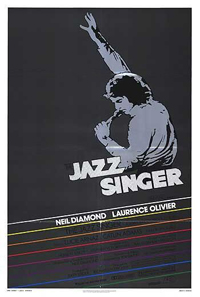
In the 1980 remake of The Jazz Singer, it only takes the film seven minutes to find an excuse to put Neil Diamond in blackface.
Of course, the film was a remake of the 1927 version of The Jazz Singer, which featured several scenes of Al Jolson performing in blackface. In fact, Al Jolson in blackface was such a key part of the film that it was even the image that was used to advertise the film when it was first released. Back in the 20s, Jolson said that wearing blackface was a way of honoring the black artists who created jazz. (As shocking as the image of Al Jolson wearing blackface is to modern sensibilities, Jolson was considered a strong advocate for civil rights and one of the few white singers to regularly appear on stage with black musicians.) Regardless of Jolson’s motives, less-progressively minded performers used blackface as a way to reinforce racial stereotypes and, to modern audiences, blackface is an abhorrent reminder of how black people were marginalized by a racist culture. You would think that, if there was any element of the original film that a remake would change, it would be the lead character performing in blackface.
But nope. Seven minutes into the remake, songwriter Jess Robin (Neil Diamond) puts on a fake afro and dons blackface so that he can perform on stage at a black club with the group that is performing his songs. The group’s name is the Four Brothers and, unfortunately, one of the Brothers was arrested the day of the performance. Jess performs with the group and the crowd loves it until they see his white hands. Ernie Hudson — yes, Ernie Hudson — stands up and yells, “That’s a white boy!” A riot breaks out. The police show up. Jess and the three remaining Brothers are arrested and taken to jail. Jess is eventually bailed out by his father, Cantor Rabinovitch (Laurence Olivier). The Cantor is shocked to discover that his son, Yussel Rabinovitch, has been performing under the name Jess Robin. He’s also stunned to learn that Yussel doesn’t want to be a cantor like his father. Instead, he wants to write and perform modern music. The Cantor tells Yussel that his voice is God’s instrument, not his own. Yussel returns home to his wife, Rivka (Caitlin Adams), and tries to put aside his dreams.
But when a recording artist named Keith Lennox (Paul Nicholas) wants to record one Yussel’s songs, Yussel flies out to Los Angeles. As Jess Robin, he is shocked to discover that Lennox wants to turn a ballad that he wrote into a hard rock number, Jess sings the song to show Lennox how it should sound. The arrogant Lennox is not impressed but his agent, Molly (Lucie Arnaz) is. Soon, Jess has a chance to become a star but what about the family he left behind in New York? “I have no son!” the Cantor wails when he learns about Jess’s new life in California.
I’ve often seen the 1980 version of The Jazz Singer referred to as being one of the worst films of all time. I watched it a few days ago and I wouldn’t go that far. It’s not really terrible as much as its just kind of bland. For someone who has had as long and successful a career as Neil Diamond, he gives a surprisingly charisma-free performance in the lead role. The most memorable thing about Diamond’s performance is that he refuses to maintain eye contact with any of the other performers, which makes Jess seem like kind of a sullen brat. It also doesn’t help that Diamond appears to be in his 40s in this film, playing a role that was clearly written for a much younger artist. Still, when it comes to bad acting, no one can beat a very miscast Laurence Olivier, delivering his lines with an overdone Yiddish accent and dramatically tearing at his clothes to indicate that Yussel is dead to him. Olivier was neither Jewish nor a New Yorker and that becomes very clear the more one watches this film. It takes a truly great actor to give a performance this bad. Diamond, at least, could point to the fact that he was a nonactor given a starring role in a major studio production. Olivier, on the other hand, really had no one to blame but himself.
Still, I have to admit that ending the film with a sparkly Neil Diamond performing America while Laurence Olivier nods in the audience was perhaps the best possible way to bring this film to a close. It’s a moment of beautiful kitsch. The Jazz Singer needed more of that.
Just for the hell of it, I went on a little Robert Duvall marathon for his birthday on January 5th. I started the marathon off with his superior western with Kevin Costner, OPEN RANGE (2003). Next up was Duvall’s excellent crime film with Joe Don Baker and Robert Ryan, THE OUTFIT (1973). Duvall was in badass mode in this one. Based on one of Richard Stark’s “Parker” books, this was my first time to watch the film and damn, it was excellent. After that, I watched the bleak THE ROAD (2009), starring Viggo Mortensen, where Duvall just had a small part. It was a downer. I finished off the marathon late in the evening with A FAMILY THING (1996). I remember when this movie came out in the 1990’s because it was co-written by Billy Bob Thornton. Thornton was still a year away from his massive success with the movie SLING BLADE, but I knew him from his writing and co-starring in the superior crime film ONE FALSE MOVE (1991), as well as his small role in TOMBSTONE (1993). As an Arkansan, I knew Thornton was from Arkansas so I had taken a particular interest in him. But I was only 22 years old when A FAMILY THING was released, and a movie about a couple of old guys resolving family issues didn’t seem that appealing to me. As a guy into his 50’s, the entire concept seems more interesting to me now, so I gave it a spin for the first time to close out the marathon.
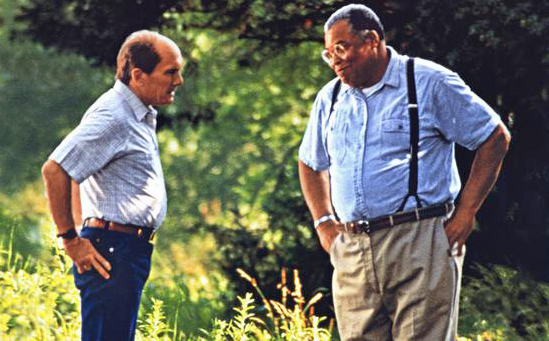
The story opens up in rural Arkansas with Earl Pilcher Jr. (Robert Duvall) getting the shock of his life when his beloved mother writes a final letter to him and instructs her local pastor to deliver it a few days after her death. The letter tells Earl that his biological mother was a black woman named Willa Mae who died in childbirth. It seems that Earl’s dad had gotten Willa Mae pregnant, and since he came out white, his “mother” was able to raise him as her own without having to tell him the truth. The letter also tells him that he has a half-brother named Ray Murdock (James Earl Jones) living in Chicago. It’s her dying wish that he meet Ray and get to know him as family. Pissed at his dad, and wanting to honor his mom, Earl heads to Chicago to meet Ray. Earl knows that Ray is a cop so he’s able to track him down. They immediately don’t like each other, but through a variety of circumstances, Earl ends up staying at Ray’s house for a couple of days. While there, he meets Ray’s wise, old Aunt T., Willa Mae’s sister (Irma P. Hall) and his sullen son Virgil (Michael Beach). Will the two men continue to push each other away, or will they eventually find the family connection that exists under all that messy past?
I was surprised how deeply I was affected by A FAMILY THING. I’d be lying if I said I didn’t get teary-eyed a couple of times. The movie may use issues of adultery and racism to get the ball rolling, but more than anything else, it seems to understand that life is messy and that people are messy. We’ll disappoint ourselves, we’ll disappoint other people, and other people will disappoint us. There’s a reason that many people find their love in dogs and cats instead of people, because real relationships can be tough. The truth about my own life is that I could not have appreciated this film in 1996 at only 22 years of age. I was too naive. That’s no longer the case in 2025, and I can now truly relate to this story of two men who share a painful history, find common ground, and decide it’s worth moving forward together because family really does matter.
A movie like A FAMILY THING has no chance of working without a great cast, and this movie is a thespian jackpot. Robert Duvall is spot on perfect as the good ole guy from Arkansas, with a little bit of a racism engrained down deep into his soul, who now has to deal with the fact that he is half black. The scene where he confronts his dad about the lies that had been told to him all his life is as good as it gets. James Earl Jones matches Duvall in the even trickier role as the man who has always known about his “white” half brother Earl. This man has buried his hatred away for Earl’s father for decades, who he blames for the death of his own mother, and now has to deal with those feelings being dredged back up to the surface when Earl shows up in Chicago. Jones perfectly balances his character’s desire to keep the past in the past, with his decency as a man who doesn’t want to just throw Earl out on the street. He eventually softens towards him no matter how much bitterness he has for Earl’s dad. And neither Duvall or Jones even give the best performance in the film. That honor goes to Irma P. Hall as the blind, but extremely perceptive Aunt T. She sees through all of their bullshit, as she states to each of them on different occasions, and encourages them to get to know each other because they’re family. As they play games of racism and bitterness, she reminds them they are brothers no matter the color of their skin. It’s the performance of a lifetime and was at least worthy of an Oscar nomination in my opinion.
Overall, A FAMILY THING may compress the amount of time and potential therapy it would take to resolve the type of family history presented here, but it does find a certain truth in the power of relationships. Earl and Ray don’t have to recognize the fact that they are brothers. As a matter of fact their lives are just fine without each other. But it’s their willingness to embrace the messy truth and find a way to connect with each other that makes the movie meaningful to me!
Welcome to Late Night Retro Television Reviews, a feature where we review some of our favorite and least favorite shows of the past! On Wednesdays, I will be reviewing Monsters, which aired in syndication from 1988 to 1991. The entire series is streaming on YouTube.
It’s Rex Manning Day on Monsters!
Episode 3.4 “Cellmates”
(Dir by Stephen Tolkin, originally aired on October 21st, 1990)
Timothy Danforth (Maxwell Caulfield) is a rich American kid who has gotten in trouble while visiting Mexico. He was arrested after hitting a kid with his car and then punching out the kid’s father, who just happened to be a cop. After Danforth was arrested, the cops looked inside his car and found a lot of drugs. Convinced (perhaps correctly) that Danforth is a drug dealer and a smuggler, the cops promptly toss him into a filthy jail cell.
The cocky Danforth is convinced that his father will soon free him from the prison. However, in the next cell, an old man (Ferdy Mayne) says that Danforth has been tossed into a special cell. It’s a cell that is reserved for the worst of the worst. The Old Man says that no one ever leaves the cell. At first, Danforth laughs off the old man’s claims but, at night, the Old Man dissolves into a puddle of liquid that enters Danforth’s cells and attempts to attack him. Danforth survives but when he tells his lawyer and his jailers about what happened, the authorities respond by chaining Danforth to a wall, leaving Danforth at the mercy of the Old Man.
It’s a pretty good thing that Danforth is such an unlikable and downright loathsome character because, otherwise, this would be a really disturbing episode. Instead, Danforth is a stereotypical rich kid who thinks that he can get away with anything and that the rules don’t apply to him. He shows no remorse about having hit a kid with his car. He’s cocky and arrogant from the minute we see him. He’s exactly the kind of guy who gives Americans abroad a bad name. In the end, it’s hard not to feel that he really doesn’t have anyone but himself to blame for his predicament. He’s a victim of his own very bad choices and he’s so confident that he’s untouchable that his final fate feels like karma.
This is a pretty simple episode. A bad guy falls victims to his own stupidity. There’s nothing likable about Timothy Danforth, though Maxwell Caulfield certainly does a good job in the role. Caulfield plays Danforth as being an incredibly spoiled brat, someone who has never been held responsible for his actions and who can’t believe that he’s actually in real trouble. Surprisingly, Caulfield almost gets you to feel sorry for Danforth at the end of the episode. Danforth really had no idea what he was getting himself involved with. That said, in the end, bad decisions are bad decisions and Danforth has no one to blame but himself.
This was an effective episode, with a lot of atmosphere and a good performance from Maxwell Caulfield. So far, Season 3 of Monsters is off to a good start.
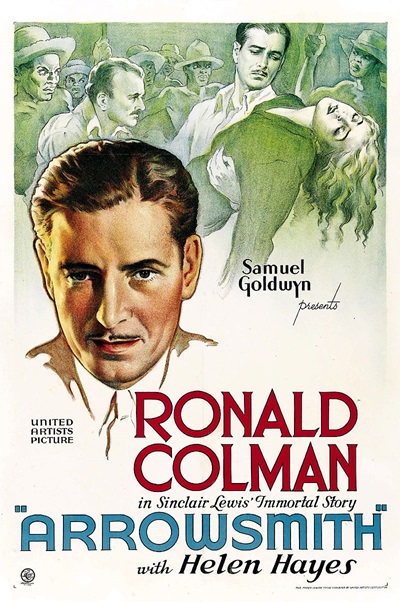
In the 1931 Best Picture nominee Arrowsmith, Ronald Colman stars as Martin Arrowsmith, a doctor who is trying to save lives without compromising his ethics.
Arrowsmith is mentored by the famed bacteriologist, Max Gottlieb (A.E. Anson) and married to a nurse named Leora (Helen Hayes). At first, Arrowsmith makes his living as the local doctor in Leora’s small hometown in South Dakota. However, Arrowsmith is ambitious and wants to do more with his life and career than just take care of a small town. He wants to cure the world of disease. When he’s offered a position at the prestigious McGurk Institute in New York, he enthusiastically accepts. Having just suffered a miscarriage, Leora supports Arrowsmith’s decision and travels to New York with him. No matter what happens, Leora is always there to support her husband, even when he doesn’t seem to appreciate it.
When Arrowsmith thinks that he’s discovered an antibiotic serum that appears to be capable of curing all sorts of diseases, he attempts to stay true to the methods taught to him by Dr. Gottlieb. He takes his time. He tests carefully. He doesn’t rush out and give the serum to everyone. However, Arrowsmith finds his methods continually sabotaged by his colleagues, who hope to raise money by telling the press about a miracle serum that can “cure all diseases!” When Arrowsmith later finds himself combatting an outbreak of the Bubonic Plague in the West Indies, he again tries to employ the scientific method but finds himself being pressured by government officials to give his untested serum to every single person on the island. Eventually, Arrowsmith’s ethics are pushed to their limits when even Leora falls ill.
Arrowsmith was based on a best-selling novel by Sinclair Lewis, though the plot was changed to make the story more palpable for film audiences. In the novel, Arrowsmith is a bit of cad who regularly cheats on his wife. In the film, Arrowsmith is passionate and driven but the exact nature of his relationship with wealthy Joyce Lanyon (Myrna Loy) is left so ambiguous that it actually leaves one wondering why the character is in the film at all. What both the film and the novel have in common is an emphasis on the importance of science and the scientific method. Arrowsmith’s idealism runs into the harsh reality of life during an epidemic. Government officials are more concerned with saying that they’ve done something as opposed to considering whether their actions have ultimately done more harm than good. In its way, Arrowsmith predicted the COVID era.
Arrowsmith was the first John Ford film to be nominated for Best Picture and its financial success allowed Ford the freedom to go on to become one of Hollywood’s most important directors. Seen today, Arrowsmith feels a bit creaky and self-important, with little of the visual flair that Ford brought to his later films. Ronald Colman’s performance as Arrowsmith seems a bit stiff, especially when compared to the much more lively (and sympathetic) performance of Helen Hayes. Arrowsmith is a big and serious film and, if we’re going to be honest, it’s a little bit boring. Still, it’s interesting to see the issues of today being debated 90 years in the past.
As for the Oscars, Arrowsmith was nominated for Best Picture, Adaptation, Cinematography, and Art Direction. It lost in all four of the categories in which it was nominated. That year, Best Picture was won by Grand Hotel, which curiously didn’t receive any other nominations at all.
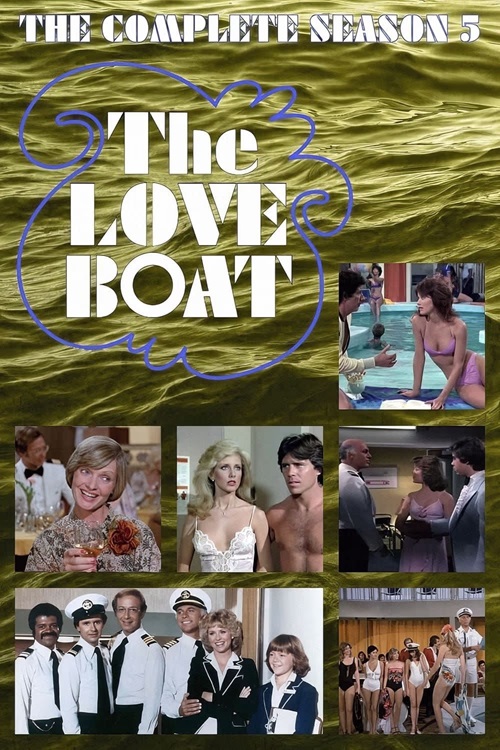
Welcome to Retro Television Reviews, a feature where we review some of our favorite and least favorite shows of the past! On Wednesdays, I will be reviewing the original Love Boat, which aired on ABC from 1977 to 1986! The series can be streamed on Paramount Plus!
Set sail for adventure, your mind on a new romance….
Episode 5.12 “Take a Letter, Vicki/The Floating Bridge Game/The Joy of Celibacy”
(Dir by Richard Kinon, originally aired on December 12th, 1981)
Captain Stubing notices that Vicki seems to be depressed. He asks his crew if they have any idea what’s wrong with her.
Actually, he could have just asked me. Why is Vicki depressed? Maybe it’s because she’s a teenage girl who spends all of her time on a boat surrounded by people who are all at least twenty to thirty years older than her? Maybe it’s because she doesn’t have any friends her own age? Maybe it’s because Julie’s now too coked up to be the surrogate mother figure that she was during the previous two seasons? Seriously, there’s a lot reasons why Vicki might be depressed but they all have on solution. Let Vicki go to school on the mainland and allow her to have some friends her own age!
The crew, however, thinks that the Captain should just hire Vicki to be his secretary. Stubing agrees. Vicki is happy to have a job and she immediately does the exact same thing that I would do under those circumstances. She rearranges the captain’s entire office. The Captain can’t find anything but personally, I think his office does look better once everything has been straightened up. A messy office leads to a messy mind and, on a cruise ship, a messy mind can lead to a collision with an ice berg.
Vicki then issues a cheerful memo, telling all the members of the crew that they should give the Captain a daily run-down of their plans for the day. Again, I think that makes total sense. The crew, however, is outraged. The Captain is worried that Vicki is taking her position too seriously but he doesn’t know how to fire her. (When did Captain Stubing become a wimp? This is a weird episode.) The crew decides to give Vicki so much work that she’ll quite out of frustration but they discover that Vicki is determined to do a good job. No one knows what to do….
LET HER HAVE FRIENDS HER OWN AGE AND A NORMAL LIFE! THAT’S THE ONLY THING YOU HAVE TO DO!
Anyway, the overworked Vicki eventually falls asleep on the job. The Captain uses that as an excuse to fire her. Vicki smiles because she didn’t really enjoy the job in the first place. Usually, the relationship between the Captain and Vicki is one of the better elements of The Love Boat but this episode left me feeling really bad for Vicki. She’s really missing out on the best years of her life.
As for the other two stories, neither was very interesting. A bridge club made up of four widows takes the cruise and are shocked when one of them (played by Nanette Fabray) decides she would rather spend time with a handsome dentist (Robert Alda) than play bridge. My question here is why would you spend money to play bridge on a cruise while you could just play at home for free. If you’re on a cruise, enjoy the scenery! Don’t just play bridge. Meanwhile, Barry Styles (Jim Trent) pretended to be a big believer in celibacy in order to get “ice queen” Linda Trent (Carlee Watkins) to fall for him. Doc and Gopher made a bet on whether or not he would be successful. DOC! GOPHER! You two know you’re better than that!
This week’s cruise was just sad. The bridge club wasted a lot of money. Linda was the center of a misogynistic bet. Vicki is still going to be lonely and depressed next week. What a sad trip on The Love Boat.





 Through the Shattered Lens