Retro Television Review: Miami Vice 2.9 “Bushido”


Welcome to Retro Television Reviews, a feature where we review some of our favorite and least favorite shows of the past!  On Mondays, I will be reviewing Miami Vice, which ran on NBC from 1984 to 1989.  The entire show can be purchased on Prime!

This week, a man from the past returns to haunt Castillo.

Episode 2.9 “Bushido”

(Dir by Edward James Olmos, originally aired on November 22nd, 1985)

This week’s episode opens with yet another intricately plotted drug bust going awry.  This time, a dealer ends up dead, a DEA Agent ends up knocked out and tied up in a bathroom, and $50,000 goes missing.  Watching the tapes of the bust, Castillo is shocked to spot a familiar face on the scene.  Castillo says that Jack Gretsky (Dean Stockwell) was his partner when he was working for the CIA in Vietnam.  Gretsky has long been thought dead but there he is, on tape and ruining Castillo’s bust.

Realizing that Gretsky was sending him a message, Castillo decides to deal with the situation personally.  After visiting two CIA agents (Jerry Hardin and Tom Bower) who work out of an adult novelty shop, Castillo tracks Gretsky down to a Buddhist temple.  The two of them talk.  Gretsky reveals that he’s married to a Russian woman and that he has a son.  He asks Castillo to watch over them if anything happens to him.  The stoic Castillo agrees and then gives Gretsky a hug.  Castillo says that he has to arrest Gretsky.  Gretsky says he knows and then pulls a machine gun, forcing Castillo to kill him.  The CIA agents are happy to no longer have to deal with Gretsky.

A day later, the coroner’s office calls Vice and says that Gretsky was terminally ill with cancer and probably only had a few days left to live.  When Crockett and Tubbs go to tell Castillo, they find his badge and a note sitting in the office.  Castillo is fulfilling Gretsky’s final wish and protecting his wife (Natasha Schneider) and his son, Marty (Robin Kaputsin).  Castillo sees it as being a part of the samurai code by which he lives his life.  Meanwhile, a rogue CIA agent named Surf (David Rasche, giving a wonderfully unhinged performance) is working with the KGB to track down Gretsky’s family.

Directed by Edward James Olmos, Bushido is a wonderfully odd episode.  With a combination of skewed camera angles and deliberately eccentric performances from Dean Stockwell and David Rasche, this episode plays out with the relentless intensity of a fever dream.  (The opening drug bust even features Zito burying himself in the sand and using a straw to breathe until its time to emerge and knock out one of the bad guys.  It’s weird but it’s great.)  Olmos contrasts Castillo’s trademark stoicism with the more verbose characters played by Stockwell and Rasche and, as a result, Castillo emerges as an honorable man who hides his emotions because he knows that’s the only way to survive in his world.  To fall in love like Jack or to get cocky like Surf can only lead to one’s downfall.

After a few uneven episodes, Bushido is a nice reminder of what Miami Vice was capable of at its best.

Late Night Retro Television Review: Degrassi Junior High 2.12 “He’s Back”


Welcome to Late Night Retro Television Reviews, a feature where we review some of our favorite and least favorite shows of the past!  On Sunday, I will be reviewing the Canadian series, Degrassi Junior High, which aired on CBC and PBS from 1987 to 1989!  The series can be streamed on YouTube!

Mr. Colby returns!

Episode 2.12 “He’s Back”

(Dir by Clarke Mackey, originally aired on March 21st, 1988)

Mr. Colby (Marcus Bruce) is back, substituting for Ms. Avery.

The last time that Mr. Colby substituted at Degrassi, he ended up sexually harassing Lucy.  Despite the attempts of L.D. and Wheels to convince her otherwise, Lucy decided not to report Mr. Colby.  She just wanted to put the experience in the past and move on.  However, this episode opens with Lucy being woken up by nightmares, in which Colby is the central figure.  When Lucy sees Colby in the office, asking for Ms. Avery’s lesson plans, she freaks out.

Still, she refuses to go to the principal about what happened.  She still just wants to move on.  After her trouble with shoplifting during the first season, Lucy has finished up her community service and is now volunteering at a daycare out of the kindness of her heart.  She’s trying to build a new life for herself but, when it becomes obvious that Colby is now grooming Susie (played by Sarah Charlesworth), Lucy realizes that she can no longer be silent.

“You want to see Mr. Lawrence?” the school secretary says when she sees Lucy, Susie, and every other girl in Colby’s class standing in front of her.  “This better be important.”

It is, Lucy replies.

This is a pivotal episode as far as Lucy’s development is concerned.  In this episode, Lucy shows that she’s gone from being spoiled and self-centered to someone who actually does care about other people and who wants to make the world a better place.  If you know the history of this show and the characters, there’s something a little sad about the scenes in which she goes to Wheels for support.  Those of us who have seen School’s Out (and this is a spoiler for those of you who haven’t so consider yourself warned) know that Wheels is destined to go to prison for killing a kid while driving drunk.  We also know that Lucy is destined to be temporarily blinded and crippled in that same accident.  In this episode, though, both Wheels and Lucy still have their entire future ahead of them.

This episode was a good example of what Degrassi Junior High did so well.  So many teen shows would have wrapped up this storyline in one episode and certainly, they would have never address Lucy’s lingering trauma.  Instead, Lucy would have done gone to the principal on her own, Colby would have been fired, and the entire thing would have never been mentioned again.  Degrassi Junior High, on the other hand, understands that it’s not always easy to do the right thing, especially when you just want to put it all behind you and get on with your life.  With its portrayal of Lucy’s lingering trauma and her reaction to seeing Mr. Colby back in the school, Degrassi Junior High proves itself to be one of the most honest shows about growing up.

Retro Television Review: The Hunted Lady (dir by Richard Lang)


Welcome to Retro Television Reviews, a feature where we review some of our favorite and least favorite shows of the past!  On Sundays, I will be reviewing the made-for-television movies that used to be a primetime mainstay.  Today’s film is 1977’s The Hunted Lady!  It  can be viewed on YouTube.

Detective Susan Reilly (Donna Mills) reluctantly teams up with a chauvinistic cop named Sgt. Arizzio (Alan Feinstein) to investigate a United States senator who has presidential ambitions.  Arizzio believes that the senator is being back by the Mafia and that it would be disastrous for the country if a mob-connected politician ended up in the White House.  (Being mob-connected didn’t seem to hurt John F. Kennedy but still….)

Now, Detective Reilly and Sgt. Arizzio working together to take down a corrupt senator sounds like an intriguing premise for a movie, right?  Well, oddly enough, that’s not what this movie is actually about.  Instead, it’s about Susan going on the run after she’s framed for Arizzio’s murder.  She escapes from police custody with the help of her father.  Though she’s still recovering from being shot earlier in the film, Susan makes her way to Reno and attempts to hide out from both the cops and the Mafia assassin that has been sent to kill her.

Susan hiding out in Reno.  Hmmm …. sound like an intriguing premise for a movie, right?  Well, don’t get to attached to Susan pretending to be a professional gambler because it turns out that bullet wound was more serious than she realized and she ends up passing out from blood loss.  When she awakens, she’s in a free clinic that is run by Dr. Arthur Sills (Robert Reed).  Dr. Sills doesn’t ask Susan too many questions about her past and even hires Susan on as a nurse.  Susan and Dr. Sills fall in love and try to clear the name of a Native American who has been accused of blowing stuff up.

Doing some research, I was not surprised to discover that The Hunted Lady was originally developed as a possible television show.  The show would have played out like a combination of Charlie’s Angels and The Fugitive, with Susan moving from town to town and getting involved with a new set of guest stars each week.  With both the police and the mob trying to track her down, Susan would try to clear her name while also helping out strangers.  Unfortunately, The Hunted Lady wasn’t exactly a hit in the ratings and Susan’s further adventures went untold.

The main problem with The Hunted Lady is an obvious one.  The idea of the Mafia trying to install one of their guys in the White House is considerably more intriguing that Susan falling in love with Dr. Sills while working at a free clinic.  The whole time that Susan was helping the doctor’s patients, I was thinking, “But what about the senator?”  Donna Mills was surprisingly convincing as a tough cop but she had next to no chemistry with Robert Reed.  If anything, Reed looked annoyed at just having to be there.

Anyway, here’s hoping that Susan cleared her name eventually.  You can only run for so long.

Late Night Retro Television Review: Check it Out! 2.1 “Getting To Know You”


Welcome to Late Night Retro Television Reviews, a feature where we review some of our favorite and least favorite shows of the past!  On Saturdays, I will be reviewing the Canadian sitcom, Check it Out, which ran in syndication from 1985 to 1988.  The entire show is currently streaming on Tubi!

Today, we start a new season of Check It Out!

Episode 2.1 “Getting to Know You”

(Dir by Alan Erlich, originally aired on October 3rd, 1986)

The second season of Check It Out! opens with some changes at Cobb’s Grocery store.

Howard now has a mustache.  Tonya Williams and Henry Beckman are no longer listed in the opening credits so I guess Jennifer and Alf have moved on from working at the store.  Gordon Clapp, however, is now listed in the opening credits so Viker, who was one of more consistently funny characters during the first season, is now a series regular.

The episode opens with zero customers in the store.  Due to a broken waterline, the store’s parking lot has been taken over by a bunch of construction workers.  Howard calls them “apes.”  Marlene is sick of them hitting on her whenever she comes to work.  Christian thinks he could take them on.  And Mrs. Cobb is demanding that Howard lay off two employees to help offset costs.

Howard could always point out that, with Jennifer and Alf gone, the store now only has seven employees but he doesn’t.  Instead, he follows Edna’s advice and sits down for one-and-one interviews with his employees and gets to know them.  Howard thinks that he’ll be able to find an employee who doesn’t really need the job but instead, he discovers that all of his employees are wonderful people.  Marlene cries about how difficult her life has been lately.  Murray talks about how both of his parents are out of work.  Leslie volunteers to give up his job and Howard is so touched that there’s no way he can possibly accept Leslie’s offer.  Jack Christian, who is usually pretty self-centered and obnoxious, seems like an easy choice but then he gets beaten up defending Marlene from the construction workers.

Finally, Howard realizes that there’s only one thing he can do.  He lays off Edna and then he lays himself off.  He announces that he and Edna are going on vacation and they’ll be back in four months.  Ummm …. look, I’ll be honest.  I’ve never been through the experience of being fired or laid off so I don’t really fully understand how it all works.  Isn’t Howard kind of taking a risk here?  I mean, I guess Howard is assuming that Christian will just fill in for four months and then Howard and Edna will return and everything will go back to normal.  But what if Mrs. Cobb hires a new manager?  What if she doesn’t want to take back Howard and Edna?  I mean, to me, it sounds like Howard basically just quit his job and forced Edna to quit her’s as well.  But everyone in the store seems to be convinced that Howard will be back in just a few months.

I guess my point is that Check it Out! doesn’t seem like it was always 100% realistic.

Anyway, this episode was okay.  It reintroduced all the characters and gave us a chance to get reacquainted with them, as any season premiere should.  Gordon Clapp, Jeff Pustil, and Kathleen Laskey all had moments that made me smile.  Those three have the ability to make even the simplest of lines funny.  During the first season, Don Adams could occasionally be a bit overly frantic as Howard.  For the second season premiere, though, his performance felt a bit toned down and it no longer felt as if he and the show were begging for laughs.  Still, I just can’t get over that ending.  Edna was so excited that her boyfriend essentially put her future employment at risk.

Next week, we’ll see if Howard still has a job.

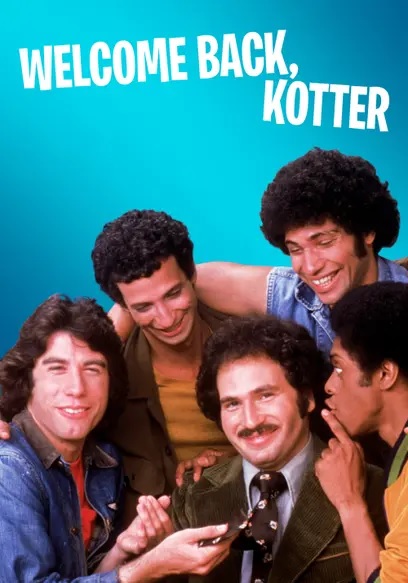
Retro Television Review: Welcome Back, Kotter 3.16 “Sweatwork”


Welcome to Retro Television Reviews, a feature where we review some of our favorite and least favorite shows of the past!  On Saturdays, I will be reviewing Welcome Back Kotter, which ran on ABC  from 1975 to 1979.  The entire show is currently streaming on Tubi!

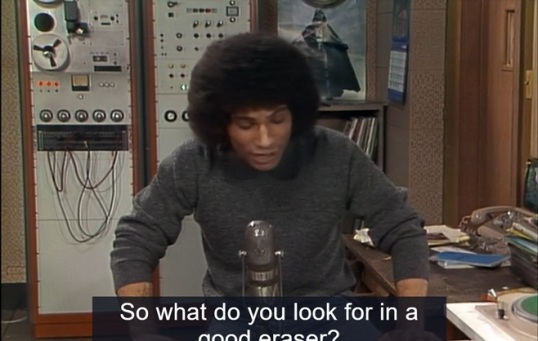
This week, Arnold Horshack becomes the mad prophet of the air waves.

Episode 3.16 “Sweatwork”

(Dir by Bob Claver, originally aired on December 22nd, 1977)

At the new apartment, Gabe tells Julie about his Uncle Herman.  “He’s a sports mechanic,” Gabe explains, “He fixes basketball games.”

Hey, that’s illegal!

Meanwhile, at the school, Woodman asks to meet with Freddie.  Freddie agrees, even though Woodman has been acting strangely.  Woodman enters the classroom and immediately asks for a high five, holding up his hand and saying, “Right on, bro.  Skin me.”

Woodman is excited because the school board is giving money to every high school to start a radio station.  And the station that gets the highest ratings will receive a trophy.  Buchanan High has never won a trophy before.  Because Freddie has radio experience, Woodman want Freddie to be in charge of Buchanan’s station.  Freddie agrees.

“That’s groovy!” Woodman says.

Juan Epstein and Darth Vader at the station

Freddie makes Epstein the consumer repairs reporter while giving Horshack the lead anchor role.  (Vinnie is also said to be a reporter but John Travolta is never actually seen in this episode.)  Unfortunately, Horshack turns out to be ratings poison.

“He reminds me of Tokyo Rose,” Woodman says, while listening to Horshack.  “Bye bye, young G.I.”

Freddie follows Woodman’s orders and fires Horshack but he does agree to allow Horshack one more broadcast to say goodbye.  Grabbing the microphone, Horshack asks his listeners to go to their windows and shout, “I’m fed up, Arnold …. AND I DON’T CARE WHO KNOWS IT!”

Suddenly, Horshack is ratings gold.  He’s the mad prophet of the air waves.  He has fans who hang on his every word.  But when Horshack announces that the teachers should not be given a raise, he is invited to the Kotter apartment.  Gabe tells Horshack that he has meddled in the primal forces of nature and “YOU WILL ATONE!”

Horshack drops his anti-teacher rhetoric and goes back to being a normal, boring broadcaster.  His ratings crash.  Woodman vengefully announces that Horshack will be kept after school.

“This has been the story of Arnold Horshack,” Gabe says, “the only man kept after school for bad ratings.”

The episode ends with Gabe telling Woodman about how his Uncle Simon was buried in a rented tux and his father has to pay $15 a month as a result.  Woodman finds the joke to be hilarious and laughs so much that even Gabe starts to get nervous.

This episode, which you’ve already guessed was a parody of Network, had its moments.  Gabe is barely in this sone but I did enjoy his take on Ned Beatty’s famous monologue.  And any episode that features a lot of Woodman is going to be enjoyable because John Sylvester White was always delightfully unhinged in the role.  In the end, how one reacts to this episode will depend on how much tolerance one has for Ron Pallilo’s performance as Arnold Horshack.  By the time the third season came around, Pallilo’s performance in the role had gone from eccentric to cartoonish and a little of Horshack tended to be a lot.  Personally, I think Epstein should have been this episode’s Howard Beale.  That said, I chuckled quite a bit while watching this episode.  It was certainly better than the radio station episodes of Saved By The Bell.

Next week, Gabe freaks out when the Sweathogs are taught by a computer!  A.I. has been around a lot longer than I thought.

Late Night Retro Television Review: Friday the 13th: The Series 1.24 “Pipe Dreams”


Welcome to Late Night Retro Television Reviews, a new feature where we review some of our favorite and least favorite shows of the past! On Fridays, I will be reviewing Friday the 13th: The Series, a show which ran in syndication from 1987 to 1990. The show can be found on YouTube!

This week, Ryan discovers that Uncle Louis’s latest victim is his own father!

Episode 1.24 “Pipe Dreams”

(Dir by Zale Dalen, originally aired on July 11th, 1988)

Ryan has been invited to the wedding of Connie (Marion Gilsenan) and Ray Dallion (Michael Constantine).  Ray is Ryan’s estranged father.  As Ryan explains it to Micki, this is only the latest of Ray’s many marriages.  Ray has spent his entire life trying to get rich and he often neglected his son while pursuing his dream.  Ray will do anything to get rich.  Ryan feels that there are more important things than money, like tracking down cursed antiques.  Ryan decides to go the wedding but he brings his cousin Micki along with him for moral support.  I mean, considering that Micki has just lost two potential husbands in a row, why wouldn’t she want to attend a wedding?

As the result of inventing a new type of gun, Ray has come into money.  Ryan is horrified that his father would get rich off of weaponry but Ray explains that he was inspired by Uncle Louis.  If Louis could get rich just by running a rinky dink antique store, why can’t Ray get rich from his inventions?  Ryan explains that Uncle Louis got rich by selling cursed antiques and selling his soul to the Devil and now, Ryan and Micki spend all of their time traveling around the country (which is totally Canada, regardless of what the show occasionally claims) and trying to undo Louis’s evil.  Ray doesn’t seem to be particularly surprised by any of this.

Ray has an antique of his own, a pipe that Louis gave to him.  Whenever Ray smokes the pipe, it produces an orange smoke that disintegrates anyone that it surrounds.  You know that gun that Ray invented?  Well, it turns out that he didn’t actually invent it.  Instead, he stole it after using his magic pipe to kill the original inventor.  When Jack shows up for the wedding and informs Ryan of all of this, Ryan cannot believe it.  He may be estranged from his father but Ryan can’t accept that he’s turned evil.  But, as we all know from previous episodes, using the cursed antiques is like getting hooked on drugs.  Once you use it once, you become addicted to using it again and again.

This is yet another episode of Friday the 13th that ends with a freeze frame of someone sobbing.  In this case, it’s Ryan crying.  As easy as it id to poke fun at how often Ryan and Micki end up either sobbing or staring at the camera with a forlorn look on their face, it’s actually a sign of the show’s intelligence that it realizes and acknowledges that dealing with cursed antiques is going to take a mental and emotional toll on someone.  Both Ryan and Micki has lost a lot of people this season.  In this episode, Ryan loses his father and, due to the performances of John D. LeMay and Michael Constantine, it definitely carries an emotional punch.  Like so many of the “villains” on this show, Ray was not inherently evil.  Instead, he was a man who lost his soul due to Louis’s evil deal with the Devil.  The best episodes of Friday the 13th are tragedies and that’s certainly the case with this episode.

Retro Television Review: T and T 3.3 “Halfway to Nowhere”


Welcome to Retro Television Reviews, a new feature where we review some of our favorite and least favorite shows of the past! On Fridays, I will be reviewing T. and T., a Canadian show which ran in syndication from 1987 to 1990.  The show can be found on Tubi!

This week, Terri and Turner take down the loathsome head of a halfway house.

Episode 3.3 “Halfway to Nowhere”

(Dir by Don McCutcheon, originally aired January 20th, 1990)

Roman (Louis Ferreira) is an angry young man who is on parole and who has been living at a halfway house that is run by Eddy (Danny Pawlick).  When Roman discovers that Eddy has been harassing Roman’s girlfriend, Sissy (Krista Bridges), Roman attacks Eddy.  Eddy kicks Roman out of the halfway house and attempts to have him sent back to prison.

Terri just happens to be in the police station when Roman is brought in and, just like Amy used to do before her mysterious disappearance, Terri declares herself to be Roman’s attorney.  (One gets the feeling that the show’s producers just crossed out Amy’s name on a bunch of scripts and wrote in “Terri.”)  Roman turns out to be a terrible client who refuses to talk to anyone, including the attorney who is trying to keep him out of jail.  Terri finally calls up T.S. Turner and asks him for help.

Turner’s reaction is to growl about how late it is.

Seriously, what’s going on with Turner this season?  He’s in an even worse mood than usual.  Maybe he’s mad because Amy has mysteriously vanished without explanation.  After all, Turner owed Amy.  Amy was the one who got him out of prison.  It made sense that Turner would always be willing to drop everything to help out Amy.  Terri is just some random lawyer who has shown up out of nowhere.

Terri, it should be said, is not a very good lawyer.  At the parole hearing, she puts Eddy on the stand and asks him a bunch of questions, despite not having a clue as to how Eddy is going to respond.  She also dramatically announces that she will be calling Sissy as a witness before she knows whether or not Sissy has agreed to testify.  When Turner steps into the courtroom without Sissy and shakes his head because Sissy refuses to testify, Terri is forced to walk back her words.  I doubt that parole board appreciated that and they probably took their frustration out on Terri’s client.

In the end, Sissy does agree to wear a wire and Eddy stupidly talks about all the crimes that he’s committed as the head of a halfway house.  Eddy ends up getting arrested and Sissy and Roman are reunited briefly.  That said, it appears that Roman is still going to go back to jail because Terri is a terrible attorney.

On the plus side, this episode featured one of the most loathsome villains to ever show up on T&T and it was satisfying to watch Terri and Turner take him down.  On the other hand, it would have been even more satisfying if Terri wasn’t terrible at her job and if Turner didn’t seem to be annoyed by even having to be in her presence.  This episode was a mixed bag but at least it looked like Eddy was going away for a long time.

Late Night Retro Television Review: Highway to Heaven 2.4 “Cindy”


Welcome to Late Night Retro Television Reviews, a feature where we review some of our favorite and least favorite shows of the past!  On Thursdays, I will be reviewing Highway to Heaven, which aired on NBC from 1984 to 1989.  The entire show is currently streaming on Freevee and several other services!

This week, Jonathan and Mark travel to Hollywood …. again.

Episode 2.4 “Cindy”

(Dir by Michael Landon, originally aired on October 23rd, 1985)

Vincent DeGeralimo (Bill Macy) is a fast-talking, good-hearted talent agent who is still trying to sell acts that were out-of-style during Vaudeville.  He wants to get a booking for a lion tamer but Jonathan appears to him and says that Vincent’s main concern should be helping out his daughter.

Cindy DeGeralimo (Hallie Todd) is an aspiring actress who is currently working as a waitress in a diner.  Her evil boss (Alice Ghostley) has three untalented daughters who all want to be actresses as well.  Cindy’s newest coworker, Mark Gordon, just wants to meet a movie star.

Pretending to work in the mailroom of a major Hollywood studio, Jonathan convinces producer Maxim Prince (Kip Gilman) that the best way to find a star for his new picture would be to hold a ball and invite every aspiring actress in town to attend.

Can you see where this is going?  Yep, it’s a remake of Cinderella, except this time Cinderella has a pushy father who keeps trying to change her before she goes to the ball.  Cindy finally gets fed up and says that she wants to be a star but she also doesn’t want to be some sort of Hollywood phony.  Vincent accepts Cindy’s feelings and everything works out in the end.

Usually, I’m pretty lenient when it comes to reviewing this show but this episode just annoyed me.  Even by the standards of Highway to Heaven, it was overly sentimental and heavy-handed.  Bill Macy gave such a frantic performance as Vincent that it was hard to watch him.  As well, Mark was so excited about being in Hollywood that I found myself wondering if he forgot about all the time he spent in Hollywood during the first season.

Indeed, this is not the first episode of Highway to Heaven to feature Jonathan dealing with the entertainment industry and I imagine it won’t be the last.  Considering how much control Michael Landon had over this show, I always get the feeling that the Hollywood episodes were personal for him, especially as they always seemed to deal with parents regretting the fact that they put work ahead of their families.  That said, the portrayal of Hollywood in this episode was so old-fashioned and idealized that I get the feeling that it was Landon’s way of showing what he wished Hollywood was like as opposed to what it actually was.  Landon’s Hollywood is a town where anyone can be a star and anyone can find a happiness.

As for this episode, it was a bit too corny for its own good.  Next week, though, Jonathan battles the Devil for Mark’s soul!  That should be fun.

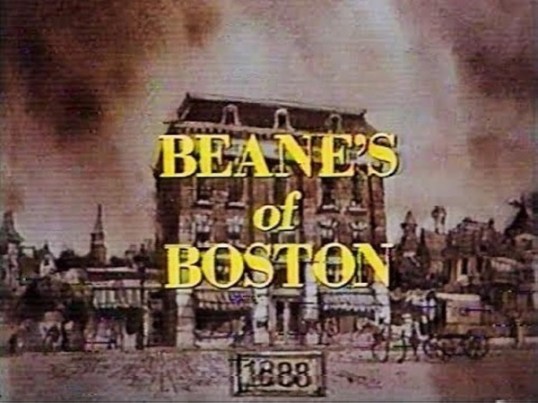
Retro Television Review: Beane’s of Boston 1.1 “German Week”


Welcome to Retro Television Reviews, a feature where we review some of our favorite and least favorite shows of the past!  On Thursdays, I will be reviewing Beane’s of Boston, which aired on CBS in 1979.  The entire show is currently streaming on YouTube!

This week, we take a look at an attempt to bring a British show to America.

Episode 1.1 “German Week”

(Dir by Jerry Paris, originally aired on May 5th, 1979)

Beane’s of Boston is a venerable department store, a landmark of Boston.  The store is housed in a multi-story building and it is run by the elderly but still horny Frank Beane (Tom Poston).  Frank takes a break from ogling his secretary and sneaking off to the strip club to demand this his nephew, Franklin Beane (George O’Hanlon, Jr.), explain why the 4th floor — which houses the Men and Ladies’ Wear Department — is losing money.

Franklin admits that sales have been off but he has a plan.  What if the store only sold German products for a week?  And what if the employees dressed in lederhosen and did German dances?

The 4th floor employees are not particularly enthused.  The head of Ladies’ Wear, Mrs. Slocum (Charlotte Rae), served as a WAC during World War II and once found herself with a German soldier on top of her after a landmine went off.  Mr. Peacock (John Hillerman), the stuffy floor manager, feels that he looks like an idiot dressed in a German outfit.  Meanwhile, in the Men’s Department, elderly Mr. Granger (Morgan Farley) sleeps while the flamboyant Mr. Humphries (Alan Sues) answers the phone in his most “masculine” voice and Mr. Lucas (Larry Bishop) hits on the just-hired administrative assistant, Ms. Brahms (Lorna Patterson).

German week is a disaster, bringing in a profit of $12.94.  But, fortunately, old Frank Beane is dating a German woman and she loves the idea.  So, no one loses their job….

If this sounds familiar and if you’re reading this in America, you’ve probably seen an episode of the infamously terrible British sitcom Are You Being Served? on PBS.  Beane’s of Boston was an attempt to do an American version of that sitcom and, just as The Office would do decades later, the pilot essentially took a script from the British series and populated it with American actors.

Setting aside the question of whether or not the world needed more than one version of Are You Being Served?, the idea of transporting that very British sitcom to Boston was not, in itself, a terrible one.  Boston is one of our oldest cities and, while it may be best-known today for its robust blue collar culture, there were still enough stuffy Protestants around to make it believable that a store like Beane’s could survive.  That said, the pilot still falls flat, largely because everyone but John Hillerman seems to be miscast and even Mr. Peacock is considerably less amusing once you take away his title of colonel.  While the British original was known for its broad comedy, it appears like a model of subtlety when compared to the performances of Alan Sues as Mr. Humphries and Larry Bishop as Mr. Lucas.  As well, why would any store do a German week in a city that is best-known for its strong Irish community?  Why not do an Irish Week?  It perhaps made sense in Are You Being Served? but, in Beane’s of Boston, it just makes Franklin seem like such an idiot that you almost feel like he deserves to lose his job.

Beane’s of Boston did not have the same success as Are You Being Served?  German Week would be the only episode aired.

Late Night Retro Television Review: Monsters 2.2 “Portrait of the Artist”


Welcome to Late Night Retro Television Reviews, a feature where we review some of our favorite and least favorite shows of the past! On Wednesdays, I will be reviewing Monsters, which aired in syndication from 1988 to 1991. The entire series is streaming on YouTube.

This week, a visit to an art gallery goes terribly wrong.

Episode 2.2 “Portrait of the Artist”

(Dir by Gerald Cotts, originally aired on October 8th, 1989)

Lucille Clay (Lucille Kennedy) visits an isolated art gallery that appears to be sitting in the middle of nowhere.  The studio is full of macabre paintings of women and children who appear to be in some sort of mortal danger.  Watching over the gallery is Hubert (Darren McGavin), who claims to be just an old farmer who was hired to look after things while the actual artist is in Nepal.

Accompanying Lucille is Roger Darcy (Beeson Carroll), a man who walks with a pronounced limp.  Lucille claims that Roger is an art critic but, as soon becomes apparent, that’s a lie.  Roger is actually the father of a missing teenage girl and he is stunned when he sees that one of the paintings looks just like her.  In fact, all of the paintings appear to be of someone who has recently disappeared.  Convinced that the artist is a serial killer, Roger demands to be taken to the artist’s cabin.  What Roger doesn’t know is that the gallery hides an even bigger threat.

This episode ends with a twist.  It’s not a bad twist and it actually took me by surprise.  Unfortunately, the rest of the episode is not as good as the twist ending.  I had high hopes when I saw that this episode was going to take place in a gallery and that it was going to star Darren McGavin.  But, and it pains me to say this, McGavin just isn’t very good in this episode.  McGavin was an actor who always had a tendency to go a little bit over the top.  That wasn’t a problem when he was playing Kolchak or the father in A Christmas Story.  But, in this episode, he’s so blustery that it’s obvious that he’s hiding something from the start and it makes Roger and Lucille seem all the dumber for trusting him.

Indeed, the other big problem with this episode is that Roger and Lucille continually do the stupidest things possible.  None of their actions make sense.  Why, if they believed a serial killer was lurking around the gallery, would they split up?  Why would they be so quick to trust Hubert?  Why, after escaping, would one of them then return without any backup?  Why does neither one of them seem to be particularly upset about the possibility that either Hubert or the artist murdered Roger’s daughter and then used her for his painting?  They both behave so stupidly that it’s hard to really care what happens to them.

This story had some potential but, unfortunately, the execution just didn’t live up to it.