Late Night Retro Television Review: Highway to Heaven 2.6 “Birds of a Feather”


Welcome to Late Night Retro Television Reviews, a feature where we review some of our favorite and least favorite shows of the past!  On Thursdays, I will be reviewing Highway to Heaven, which aired on NBC from 1984 to 1989.  The entire show is currently streaming on Freevee and several other services!

This week, Jonathan becomes the Birdman!

Episode 2.6 “Birds of a Feather”

(Dir by Michael Landon, originally aired on November 6th, 1985)

While driving down the highway, Mark is ordered to stop by Jonathan.  Jonathan gets out of the car and walks over to a nearby reservoir, where he discovers a dying bird.  In fact, he discovers several dead birds and he wastes no time in deciding that the nearby chemical plant is to blame.  Despite the fact that they are on a tight schedule and have an assignment waiting for them in another town, Jonathan decides that it’s important that he and Mark first battle against the people who poisoned the reservoir.

How does Jonathan decide to do this?  First, he tells Mark to get a job at the plant.  Mark does so, though it’s never really clear what he was hired to do.  It’s funny how Mark always gets every job that he applies for, despite not having much work experience beyond being a cop.

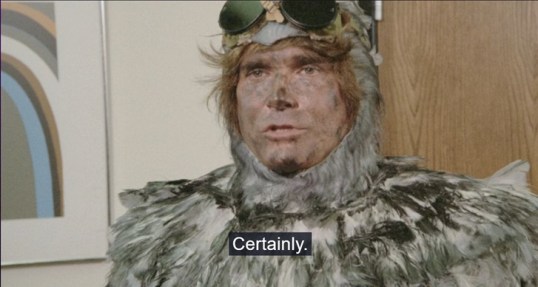
Jonathan then decides that it would be a good idea for him to 1) dress up like a bird, 2) ride a bicycle around town, 3) decorate the bicycle with balloons, and 4) continually shout things like, “Caw!  Caw!”

Now, I’m not really sure what Jonathan thinks this will accomplish.  That said, just two days ago, a bunch of idiots thought they could bring peace to the Middle East by standing on the Golden Gate Bridge and blocking traffic.  And let’s not forget those Extinction Rebellion morons who keep damaging paintings and gluing themselves to floors.  Compared to today’s protestors, Jonathan’s methods seem brilliant.

What’s odd about Jonathan’s bird costume is that he never takes it off.  Even when he’s not protesting, he wears the costume.
Evil businessman Horton Drake (Philip Abbott) doesn’t care about the dead birds because he’s evil.  Even when the children of some of his employees get sick, Drake refuses to clean up the water.  This leads to Jonathan making an ominous declaration.
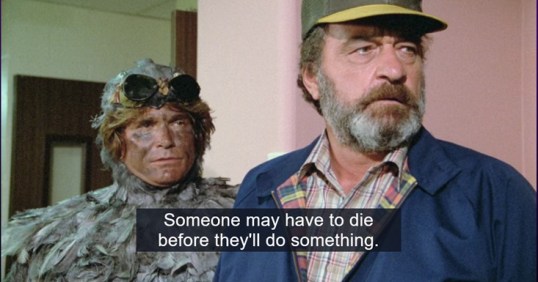
In a scene that has to be seen to be believed, Jonathan lines up all the dead birds outside of Drake’s corporate headquarters.  And then Jonathan lies down, resting his head on the contaminated birds.  By the time everyone arrives for work, Jonathan’s dead!

Realizing that an autopsy will reveal that Jonathan died due to chemical exposure, Drake sends three of his men to steal Jonathan’s body from the morgue.  However, at the morgue, Jonathan is not only alive but he’s still wearing his bird costume.  “Caw!  Caw!” Jonathan shouts as the men flee.

The next morning, Drake holds a press conference and denies dumping toxic waste in the water.  Moved by Jonathan’s sacrifice, Drake’s former administrative assistant (Marianne McAndrew) reveals the truth about how Drake has been polluting the water and paying off the health inspectors.  Incidentally, the assistant’s son is played by a young Paul Walker.

Mark goes for a walk along the beach.  He looks up to Heaven and tells Jonathan that his plan worked.  Suddenly, Jonathan walks up to Mark and Mark realizes that Jonathan is still alive.  Of course, Jonathan’s an angel so it’s not like he could have really died in the first place.  As Jonathan has pointed out in previous episodes, he already died once.

This episode was about as heavy-handed as anything I’ve ever seen.  One can support a clean environment while also acknowledging that Drake was portrayed as being cartoonishly evil.  Michael Landon’s heart was in the right place but the episode still sometimes verged on unintentional self-parody.  This is the type of thing that AI would come up with if prompted to write a stereotypical episode of Highway to Heaven.

Myself, I’m just wondering where Jonathan found the bird costume.

Retro Television Review: Veronica’s Video 1.1 “Pilot”


Welcome to Retro Television Reviews, a feature where we review some of our favorite and least favorite shows of the past!  On Thursdays, I will be reviewing Veronica’s Video, which was produced by UPN in 1998.  The entire show is currently streaming on YouTube!

I sacrificed my eyesight to review this show.

Episode 1.1 “Pilot”

(Dir by Don Scardino, originally aired on …. well, we’ll get to that.)

Aspiring filmmaker Gary Gluckin (Matt Champagne) needs a day job so he walks into a trashy, nearly deserted video store and tells the owner, Nick (Cobin Bernsen), that he wants to work for him.  Nick is an angry man who chain smokes and rolls around in a wheelchair because his wife ran him over while she was leaving him.  Nick is also Gary’s father.

Nick is only willing to hire on a Gary probationary basis and he explains that Gary will be competing for a full time job with Chandra (Shishir Kurup), a Sikh who is an expert on Indian films.  Gary and Nick make fun of Chandra’s ethnicity, religion, and name.  Chandra, meanwhile, enforces a strict policy of only allowing 21 year-olds into the porn section of the video store.  He kicks out a 51 year-old.  That’s the type of show this was.

Occasionally dropping by the video store is Mary Sue Henderson (Julie Benz) who works for her grandmother and who wears an Alice In Wonderland costume that Gary is constantly looking down.  Mary Sue is always bright and cheerful.  When she talks to Gary, Gary goes all mush-mouthed because Gary is a loser.  Gary also thinks that he may have seen Mary Sue’s picture on the cover of one of the porn videos that is in the store.

Nick eventually tortures Gary by forcing him to stand outside in 116-degree heat.  At one point, Greg gets beaten up by someone who is played by Greg Grunberg.  Frustrated, Gary announces that he doesn’t need the job and he’ll just move in with his mother.  Nick replies that Gary’s mother wants nothing to do with him.  Wow, what a fun comedy.

This is, without a doubt, one of the worst shows that I’ve ever watched.  This show was so bad that the pilot didn’t even get a pity showing.  UPN, which was famous for being the home for terrible and misguided shows, didn’t even want to mess with this thing.  Why is this show so bad?  The humor is not particularly funny, the laugh track in intrusive, and the video store itself is so dirty and ugly that it’s hard to believe that it has ever had a customer.  Corbin Bernsen, being a veteran actor, at least manages to suggest that there’s a heart underneath Nick’s rough exterior.  The rest of the cast is just bland.

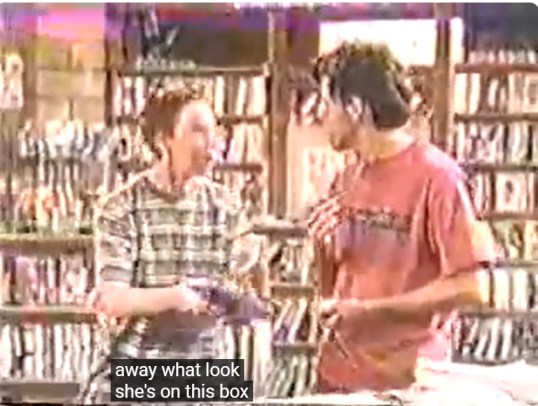
I should also admit that I watched this on YouTube and the upload was one of the worst that I’ve ever seen.  I’m surprised I still have my eyesight after being confronted with this:

And this:

I had 20/60 eyesight when I started this show.  I’m worried about what it is now.

Anyway, needless to say, only one episode of Veronica’s Video was produced.  And that episode probably should have been left in a landfill somewhere, rather than uploaded to YouTube.

Late Night Retro Television Review: Monsters 2.4 “Rerun”


Welcome to Late Night Retro Television Reviews, a feature where we review some of our favorite and least favorite shows of the past! On Wednesdays, I will be reviewing Monsters, which aired in syndication from 1988 to 1991. The entire series is streaming on YouTube.

This week, we learn about the dark side of celebrity.

Episode 2.4 “Rerun”

(Dir by John Auerbach, originally aired October 22nd, 1989)

Allison (Rachel Jones) and Max (Mitchell Whitfield) are anthropology students and roommates.  Max would like to be even more but Allison is hopelessly in love with a man who she has not only never met but who is dead!

Tony Sterling (Max Nassar) was an actor who starred on a show where he drove a motorcycle across America.  Tony recently died but Allison keeps a big poster of him hanging in her bedroom.  Allison says she isn’t worried about studying for her upcoming exam because she’s been praying to the poster.  Uhmm …. okay …. I mean, I had a huge crush on James Franco back in the day but I never prayed to him….

Suddenly, Tony appears in the bedroom and declares his love for Allison.  Allison is so overjoyed that she doesn’t care that he’s dead and that he keeps biting her neck.  Max, however, is a bit more concerned so he goes to see Tony’s agent (Kaye Ballard), who explains that Tony was a Satanist who couldn’t even ride a motorcycle!  In fact, Tony couldn’t even talk to people.  He had to have his small talk written out for him by a crack team of publicists.

Max returns to the apartment to confront Tony with proof that he’s both a talentless hack and a lamprey-in-human-form.  (Earlier, Max talked about a tribe that believed that everyone’s soul was an animal.  Apparently, Tony has the soul of a lamprey.)  Realizing the truth about Tony, Allison rejects him.  Tony attacks Max.  Can Allison flush a ring that Tony gave her down a toilet quickly enough to send Tony’s soul back to Hell?

Fear not — she can!  This is one of the few episodes of Monsters to have a straight-up happy ending and I’m glad that I did.  Allison and Max were a cute couple and it would have been unbearably cruel to not allow them to be together or to have one of them turn out to be a demon.  You want them to get together and if it takes dealing with an incubus for them to come together, so be it.

Actually, this episode is probably more relevant today than it was when it was first release.  There’s not much difference between Allison praying to her poster of Tony and the people who spend all day searching social media for any heretics who fail to worship at the altar of their favorite performers.  If this episode were made today, Allison would be praying to Timothee Chalamet and Taylor Swift.  That’s not to say that Timothee and Taylor are lampreys, of course.  It’s just that people have always worshipped those who have accomplished some sort of celebrity.  Anyone who is anyway famous has at least a few people who have devoted their lives to them.  It’s creepy but it’s the way of the world.

Retro Television Review: The Love Boat 4.12 “Doc’s Dismissal/A Frugal Pair/The Girl Next Door”


Welcome to Retro Television Reviews, a feature where we review some of our favorite and least favorite shows of the past!  On Wednesdays, I will be reviewing the original Love Boat, which aired on ABC from 1977 to 1986!  The series can be streamed on Paramount Plus!

This week, Doc’s in trouble!

Episode 4.12 “Doc’s Dismissal/A Frugal Pair/The Girl Next Door”

(Dir by Richard Kinon, originally aired on January 3rd, 1981)

Carl (Lew Ayres) and his wife, Violet (Janet Gaynor), board the boat in a good mood.  Carl has just retired from the post office and they’re about to celebrate their 50th wedding anniversary.  Awwwww!  Carl and Violet are the sweetest couple ever, frequently referring to each other by pet names.  They’re also very frugal.  Violet brings her own tea bag on board.  Carl turns down a bottle of champagne.  They are a nice old couple who know the value of pinching a penny.

But, on the morning of their anniversary, Violet tells Carl a secret and everything changes.  It turns out that Violet has been buying stock for years.  She based her purchases on whatever pet name Carl used for her that day.  If the name started with a G, she bought General Motors.  If it started with an S, she bought Standard Oil.  Once, Carl used a name that started with a “Z,” and she bought stock in Xerox.  She explains that she didn’t know how Xerox was spelled at the time.  (So, how did she buy the stock?)  Anyway, the important thing is that Carl and Violet are rich and they have been for several decades.

Carl is upset by this news.  If he had known he was rich, he wouldn’t have spent years at the post office!  I see his point though, to be honest, they’re not that rich.  The total stock portfolio is only worth $200,000.  Still, Carl and Violet stop speaking to each other.  Julie, Isaac, and Gopher jump into action and throw them an anniversary party, which causes Carl and Violet to remember how much they love each other.

Meanwhile, Charley Cole (Sal Viscuso) tells Pam Madison (Lynda Goodfriend) that he’s with the CIA so that she’ll let him stay in her cabin so that he can spy on his girlfriend (Denise DuBarry) and the guy (Stephen Shortridge) with whom she is cheating.  Got all that?  This storyline was incredibly dumb but it was saved by the frantic performance of Sal Viscuso, who managed to make even the lamest of lines seem funny.

Finally, Sally (Jessica Walter) boards the ship with her lout of a husband, Hank (Alex Cord).  Hank is the type of jerk who looks at other women while his wife is sitting right next to him.  Complaining of a headache, Sally goes to Doc Bricker’s cabin for some aspirin.  Doc, who has witnessed Hank’s bad behavior, is sympathetic to Sally.  Later, Sally tries to make Hank jealous by saying that Doc hit on her when she went to see him.

Angered, Hank calls the captain and accuses Doc of sexually harassing his wife.  The Captain is forced to suspend Doc from his duties until an investigation can be launched.  The crew is shocked.  Doc would never hit on a patient, they all say.  Except, of course, Doc does exactly that every single episode!  Seriously, Doc is a walking HR nightmare.  (Fortunately, for Doc, he was played by the always likable Bernie Kopell.)  When the captain makes it clear that Doc could be fired and lose his medical license, Sally admits that he never hit on her.  Doc keeps his job and somehow, all of this fixes Sally and Hank’s marriage.  Later, Gopher and Isaac joke about how Doc got in trouble for the one time he “didn’t hit on a passenger.”  Gopher and Isaac aren’t blind to what’s happening.

This was a surprisingly effective episode.  Lew Ayres and Janet Gaynor were adorable and Jessica Walter’s intense, method performance as a desperately unhappy wife provided a good change-of-pace from all of the usual Love Boat goofiness.  Even with all of the CIA nonsense, this was an entertaining cruise.

Late Night Retro Television Review: Baywatch Nights 1.22 “Heat Rays”


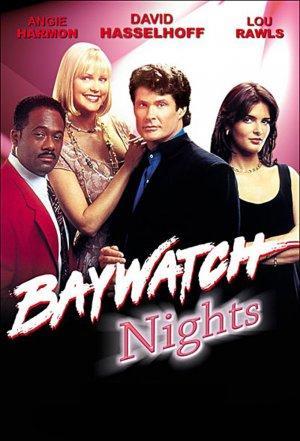
Welcome to Late Night Retro Television Reviews, a feature where we review some of our favorite and least favorite shows of the past!  On Tuesdays, I will be reviewing Baywatch Nights, a detective show that ran in Syndication from 1995 to 1997.  The entire show is currently streaming on You tube!

This week, season one comes to a close.

Episode 1.22 “Heat Rays”

(Dir by Peter Roger Hunt, originally aired on May 18th, 1996)

The first season wraps up with an episode that doesn’t really add up too much.

As was typical of the latter half of this show’s first season, this episode actually tells two separate stories.  In the first one, Donna is stopped while driving at night by three panicked people on a bridge.  They say that their friend is in the water below.  Donna jumps into the ocean, just to discover that it was all a trick to steal her car.

Donna floats around for a while.  She passes the time by talking to herself.  To be honest, she holds up surprisingly well for someone who is stranded in the middle of the ocean.  Eventually, a boat stops to help her.  Unfortunately, the two men on the boat are drug dealers and, when they’re both shot by a bunch of guys on a bigger boat, it’s up to Donna to save them and get them to dry land.

That may sound like an intriguing storyline but, oddly enough, it gets abandoned fairly quickly.  I kept waiting for Donna’s storyline to somehow intersect with the other storyline but it never did.  No one even thought to say, “Hey, where’s Donna?”  If I was Donna, I would be pretty mad about that.

As for the other storyline, it features Mitch, Garner, and Ryan investigating a series of murders and attempted murders that all involve the members of an old surf band called The Heat Rays.  It ultimately turns out that they’re being targeted by the daughter (Christa Sauls) of a woman (played by Judy Geeson) who was raped by several members of the band.

Again, that may sound like a storyline that has the potential to be intriguing.  And there is an interesting subtext to the story, as Mitch and Garner are forced to admit that their favorite band wasn’t as innocent and wholesome as they chose to remember.  But, in typical Baywatch Nights fashion, the story was a bit too predictable to really work.  It was easy to figure out who the murderer was because there was really only one suspect from the start.

This episode had a violent streak just felt out of place.  Baywatch Nights, in both its first season and its supernatural-themed second season, was essentially a goofy detective show starring David Hasselhoff.  Having multiple people die over the course of one episode just didn’t feel right for such a lightweight show.  Some shows are meant to be violent.  Some shows are at their best when they embrace their inherent silliness.  Baywatch Nights is the latter type of show.

So much for the first season.  Unfortunately, the show never really found a consistent identity or style during the first season.  However, that would change with the second season.

We’ll find out how next week!

Retro Television Review: Fantasy Island 4.21 “Basin Street/The Devil’s Triangle”


Welcome to Retro Television Reviews, a feature where we review some of our favorite and least favorite shows of the past!  On Tuesdays, I will be reviewing the original Fantasy Island, which ran on ABC from 1977 to 1984.  Almost the entire show is currently streaming on Daily Motion.

This week is a bit uneven.  Let’s dive into it!

Episode 4.21 “Basin Street/The Devil’s Triangle”

(Dir by George W. Brooks, originally aired on May 2nd, 1981)

Pilot Clay Garrett (Joe Namath — yes, the goofy football player) and cameraman Tom Spencer (Christopher Connelly) have come to Fantasy Island with Kerry Dawson (Trish Stewart).  Kerry is the host of a show where she explores isolated locations of the world.  Clay flies her where she’s going.  Tom films her.  Throughout the episode, it is suggested that — much like the characters at the center of Cannibal Holocaust — they’ve occasionally been guilty of staging the footage that has made them famous.

Kerry wants to search for the remains of an airplane that disappeared over 40 years ago.  The plane was flown by the famed aviatrix Wilma Deitrich.  Why they don’t just admit that Wilma is a stand-in for Amelia Earhart, I have no idea.  Mr. Roarke warns Kerry that the fantasy could be dangerous but he does not stop Clay, Tom, and Kerry from boarding a plane and then flying out across the ocean.

The plane ends up in the Devil’s Triangle, which I guess is this show’s version of the Bermuda Triangle.  The plane crashes on an uncharted island.  Kerry gets bitten by a snake and Clay sucks out the poison before he and Tom set off to look for the remains of Wilma’s plane.  Clay and Tom, incidentally, are both in love with Wilma.  Will Wilma select the boring cameraman or the boring pilot who sucked snake venom out of her body?

It’s a question that would perhaps be more compelling if Kerry had the slightest bit of chemistry with either man.  But she doesn’t.  Joe Namath is as stiff here as he was in C.C. and Company.  Christopher Connelly looks bored.  Kerry does eventually pick Clay so hopefully, they’ll be happy together.

(And yes, they do get off the island.  They find the wreckage of Wilma’s plane and use it to repair their own plane.  Amazingly, Wilma’s plan is still full of operational parts despite having spent over 40 years sitting on a deserted island.)

As for the other fantasy, Charlie Raines (Cleavon Little) wants to go to turn of the century New Orleans and meet his hero, jazzman Camptown Dodd (Raymond St. Jacques).  Roarke and Tattoo give him a magic clarinet and send him to New Orleans, where he immediately finds himself auditioning for Camptown.  Camptown wants Charlie to not only join his band but also lead it after his death.

DEATH!?

Yes, death.  Camptown refuses to sell Opium in his club and, as a result, he has been targeted for assassination by a corrupt police officer.  Charlie is so upset about this that Roarke himself steps into the fantasy to let Charlie know that he can’t change the past.

Okay, so Charlie can’t save Camptown but surely, he can bring Billie Joe (Berlinda Tolbert) into the present with him, right?  Afterall, Charlie has fallen in love with her.  No, Roarke says, that’s not how it works.

Fear not, though!  Once he’s in the present, Charlie discovers that Billie Joe was actually a guest at the Island and that Roarke combined two fantasies into one.  Yay!

The jazz fantasy was predictable but it was still better than the other fantasy.  Cleavon Little, Raymond St. Jacques, and Berlinda Tolbert all actually seemed to be invested in their characters, which made them a lot more fun to watch than the stiffs on the deserted island.

This week’s trip to the Island was a bit uneven.  The jazz fantasy was occasionally entertaining.  The other fantasy was forgettable.  I don’t hold that against, Mr. Roarke.  That’s just the way it goes sometimes.

Late Night Retro Television Review: CHiPs 1.22 “Flashback!”


Welcome to Late Night Retro Television Reviews, a feature where we review some of our favorite and least favorite shows of the past!  On Mondays, I will be reviewing CHiPs, which ran on NBC from 1977 to 1983.  The entire show is currently streaming on Freevee!

This week, the first season comes to a close!

Episode 1.22 “Flashback!”

(Dir by Michael Caffey, originally aired on April 1st, 1978)

When a recent graduate from te motor school joins the unit, he immediately rubs everyone the wrong way.  Brent Delaney (Joe Penny) may have graduated at the top of his class but, as Baker points out, he flunked public relations and everyone quickly tires of his holier-than-thou approach to policing.  Add to that, his father is a bigshot politician and everyone assumes that Delaney is just some rich kid who got the job through his connections.  Delaney’s arrogant and cocky attitude doesn’t do much to change that impression.

Fortunately, Baker and Ponch are both willing to look past Delaney’s cockiness.  In fact, they spend the majority of the episode remembering how, one day, a CHiP officer named Jon Baker met a cocky dirt bike rider named Ponch (Erik Estrada) and also how Baker talked Ponch into applying for a spot on the force.  No one gave Ponch much of a chance, largely because of his background as a juvenile delinquent and his friendship with a gang leader named Henry (Edward James Olmos).  But, soon, Ponch and Baker were patrolling the streets and rescuing two women who were trapped in a car that they accidentally drove into a swimming pool.  Ponch proved himself.  Will Delaney?

Yes, this a flashback episode but, interestingly enough, most of the flashbacks appear to have been shot specifically for this episode.  (There were two clips that I recognized as coming from the show’s pilot but the rest of the flashbacks appeared to be original.)  The flashbacks don’t play out in a chronological order, either.  Instead, they are somewhat randomly triggered by Ponch or Baker hearing an engine backfiring or spotting some person on a bike.  This episode comes as close as one can to answering the question of what a cop show directed by Nicolas Roeg would look like.

As for Delaney, he eventually proves his worth when he takes down a group of bikers who were stealing CHP motorcycles.  (One of the bikers is played by John Furey, who is best-known for playing Paul in Friday the 13th Part II.)  It’s a pretty good thing that Delaney caught those guys, seeing as how his motorcycle was one of those that was stolen.  Having proven himself, Delaney is welcomed into the CHP.  Even the formerly skeptical Grossman and Bear end up shaking his hand and telling him that he did a good job.  Way to go, Delaney!  I imagine we’ll never see him again.

And so ends the first season of CHiPs.  It was a fun season.  There was nothing particularly challenging about any of the first 22 episodes but the scenery was gorgeous and some of the chase scenes were exciting.  That’s really all you can ask for with a show like this.  Though I understand that Larry Wilcox and Erik Estrada did not particularly like each other, that wasn’t obvious during the first season.  In fact, even Estrada’s tendency to overact was nicely paired with Wilcox’s tendency to do the opposite.  For the first season at least, they came across like legitimate partners and friends.

Next week, we start season 2!

Retro Television Review: Miami Vice 2.10 “Bought and Paid For”


Welcome to Retro Television Reviews, a feature where we review some of our favorite and least favorite shows of the past!  On Mondays, I will be reviewing Miami Vice, which ran on NBC from 1984 to 1989.  The entire show can be purchased on Prime!

This week, things get bleak.

Episode 2.9 “Bought For Paid For”

(Dir by John Nicolella, originally aired on November 29th, 1985)

This is a dark episode.

It opens with Gina’s friend, a Haitian immigrant named Odette (Lynn Whitfield), being attacked and raped in Gina’s apartment.  The rapist is easily identified as Nico Arroyo (Joaquim de Almeida), the sociopathic son of a Bolivian general (Tomas Milian) who has been exiled to Miami after a failed coup attempt.  Odette used to work as a maid in the general’s Art Deco mansion and Nico is obsessed with her.

Gina is able to convince Odette to testify against Nico but then the general brings Odette’s mother to America and offers her a good deal of money in return for Odette agreeing to testify that the encounter with Nico was consensual.  Because her family is poor and desperately needs the money, Odette agrees.  With the charges dropped,  Nico goes to Odette’s home and kills her.

Gina goes to the general’s mansion and confronts Nico, knowing that it will lead to him trying to attack her in her apartment.  When Nico shows up, he’s carrying a switchblade but he drops it as soon as he sees that Gina has a gun.  Gina shoots him dead.

Watching this show, one gets the feeling that being a supporting player on Miami Vice could be a thankless task.  Switek, Zito, Trudy, and Gina are in every episode but they rarely get to do much.  This week Gina gets to have a moment and Saundra Santiago makes the most of it.  This episode exists in the shadow of the first season’s Give A Little, Take A Little, in which Gina was raped by Burt Young and, at the end of the episode, shot him dead as well.  At one point, when Sonny is arguing that Gina needs to accept that Odette is not going to press charges against Nico, Gina says that he knows why she can’t do that.  Later, after Odette dies, Gina fears that, because of her own experience, she may have pushed Odette too hard.  In the end, Gina shoots and kills an unarmed man, just as she did in Give A Little, Take A Little.  It’s a ruthless move but both of the men were scum who totally deserved it.  It’s hard not to appreciate the idea of Gina serving as Miami’s version of Ms. 45.

As I said at the start of this review, this is a dark episode.  Nico’s father committed war crimes in Bolivia but now he’s remade himself as a respectable member of Miami society.  Nico and his father live in a fabulous mansion and Nico spends his day lounging by the pool.  Meanwhile, Odette struggles day-to-day and is essentially sold out by her own mother.  (One of the things that gives Nico away as the rapist is the fact that Sonny recognizes the smell of his extremely expensive — and apparently rather pungent — cologne on Odette’s clothes.)  Nico feels that he can do whatever he wants to Odette because he’s rich and  she’s “bought and paid for.”  The system fails and Gina is forced to put her life at risk to get some sort of justice for Odette.  This is Miami Vice at its bleakest.  The world under all of the glitz and glamour is a dark one.

There is one funny moment though.  Gina and Sonny go out to a club with Tubbs and Odette.  Sonny watches Tubbs dance with Odette and he starts laughing.  And he simply can’t stop.  It feels like such a spontaneous moment that I have to wonder if it was scripted or if Don Johnson really did think Philip Michael Thomas was just a terrible dancer.

Next week, a figure from Crockett’s past resurfaces in Miami.  Maybe Castillo can give him so advice on how to deal with that.

Late Night Retro Television Review: Degrassi Junior High 2.13 “Pass Tense”


Welcome to Late Night Retro Television Reviews, a feature where we review some of our favorite and least favorite shows of the past!  On Sunday, I will be reviewing the Canadian series, Degrassi Junior High, which aired on CBC and PBS from 1987 to 1989!  The series can be streamed on YouTube!

The second season of Degrassi Junior High comes to a close with a historic episode!

Episode 2.13 “Pass Tense”

(Dir by Kit Hood, originally aired on March 28th, 1988)

The school year is nearly over and it’s time for the 8th Grade to graduate.  Next year, they will all be going to high school except …. well, they won’t.  Even while Stephanie and the Farrell Twins are making fun of the 7th Graders for having to do all the work to prepare for the big graduation dance, word comes down from the district that, starting next year, Degrassi Junior High will have a Grade 9.  Even though most of the show’s characters are set to graduate and go to High School, they’ll still be attending classes at Degrassi Junior High next season school year.

(The official story is that the high school was overcrowded so adding a Grade 9 to Degrassi was the only option.  The truth, of course, is that the show got popular and was renewed for a third season and the show’s producers didn’t want to lose 75% of their cast.)

However, one eighth grader will not be “graduating.”  Joey Jeremiah has flunked! Oddly, Joey passed his final exams but, as Raditch puts it, he only scraped by and Raditch feels that Joey is too smart to only be scraping by.  Mr. Raditch called Joey’s parents and told them that Joey could either go into the 9th Grade and be put in a low-academic program or he could repeat the 8th Grade and hopefully mature a little.  Joey’s parents agreed that Joey should be held back.  “Flunk our son!” they apparently said.

(To be honest, this seems like kind of an unfair move on the part of Mr. Raditch and I’m not really sure how Joey can be held back after passing all of his exams.  It seems rather arbitrary.)

At first, Joey declares that he’s not going to go to the graduation dance, even though the Zit Remedy is scheduled to make their public debut.  Wheels confronts Joey and tells him that he’s smart and that he owes it to his friends to show up.  Wheels gets a bit judgmental, all thing considered.  Joey is being held back on the whims of Mr. Raditch so Joey really has every right to be mad.  Aren’t there any lawyers in Canada who can sue the school on Joey’s behalf?

(Add to that, I always smile a bit whenever Wheels gets judgmental of anyone.  Hey, Wheels, Joey’s not the one who is destined to go to prison for killing someone while driving drunk.)

Joey eventually does show up at the dance, apparently having been convinced that his friends won’t be laughing at him behind his back.  (From what we see, everyone is supportive.  I guess they’re just nicer in Canada.)  Greeting Snake and Wheels, Joey takes a moment to flirt, for the first time, with Caitlin, who is destined to become the love of his life.  He then says that he’s ready to perform.  This leads to a historic moment as the Zit Remedy takes the stage for the very first time.  They perform their one and only song, the deathless Everybody Wants Something.

Everybody wants something

They’ll never give up

Everybody wants something

They’ll take your money

And never give up

Finally, Spike, who is allowed to attend the dance after not being allowed to attend class, goes into a labor as the episode’s end credits roll.  This is a huge moment, both because Spike is giving birth to Emma Nelson, who will be the lead character for the first few seasons of Degrassi: The Next Generation.  A running joke on DTNG would be Emma’s hatred of Everybody Wants Something so, for me, it was kind of fun to watch this episode and discover that this was the last song Spike listened to before giving birth.

(Speaking of Degrassi: The Next Generation, I had to smile at just how much Joey freaked out about getting held back.  DTNG was infamous for using the flimsiest of excuses to keep its more popular characters from graduating on time.  Ashley, Jimmy, Spinner, and a host of others were all held back.  Spinner was actually held back twice.)

And so ends the second season of Degrassi Junior High.  The second season was great and this finale did everything that a good finale is meant to do.  It wrapped up two major storylines while also hinting at what the future held.  It also gave Pat Mastroianni, Neil Hope, and Amanda Stepto a chance to show how much all three of them had developed as actors since the show’s first season. Mastroianni especially did a good job as Joey realized that his year of goofing off and not trying had finally caught up with him.  That said, I still think he needs to sue both the school and Mr. Raditch.  He probably needs to get emancipated from his parents as well.  What type of mother or father says, “Flunk my child?”

Next week, we start season 3!

Retro Television Review: All-American Girl: The Mary Kay Letourneau Story (dir by Lloyd Kramer)


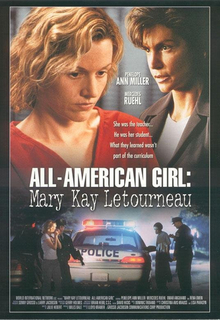
Welcome to Retro Television Reviews, a feature where we review some of our favorite and least favorite shows of the past!  On Sundays, I will be reviewing the made-for-television movies that used to be a primetime mainstay.  Today’s film is 2000’s All-American Girl: The Mary Kay Letourneau Story!  It  can be viewed on YouTube.

In 1996, a 34 year-old teacher named Mary Kay Letourneau decided that she had fallen in love with someone who was not her husband.

A 34 year-old deciding that they are no longer happy in their marriage and subsequently deciding that that they’ve found love with someone else is hardly an unusual or even surprising occurrence.  What made Mary Kay Letourneau’s case a national scandal was that the person that she decided that she was in love with was a 12 year-old student named Vili Fualaau.  Mary Kay started her affair with Vili when she was his sixth grade teacher.  When she was arrested and charged with two counts of second-degree rape of a child, Letourneau was pregnant with Vili’s child.  Even after being arrested, Letourneau insisted that she and Vili were soulmates.  After giving birth to Vili’s child, Letourneau was sentenced to six months of prison and somehow managed to avoid having to register as a sex offender.  After serving her sentence, Letourneau was promptly arrested again with Vili and was sent back to jail, where she gave birth to Vili’s second child.

All-American Girl opens with Mary Kay Letourneau (Penelope Ann Miller) in jail, insisting that everything that happened between her and Vili was consensual and that their love is real.  The majority of the film is shown in flashbacks.  Some of those flashbacks deal with Mary Kay, her husband (Greg Spottiswood), and Vili (Omar Anguiano).  Watching the flashbacks, I couldn’t help but notice that the film really did seem to be on Mary Kay’s side, to an almost ludicrous extent.  Her husband is portrayed as being a soulless sociopath, even before Mary Kay starts sneaking around with Vili.  As for Vili, he is presented as being the one who initiated his relationship with Mary Kay, flirting with her in class and comforting her when she starts crying in a school hallway.  The actor playing Vili looked, acted, and sounded considerably older than just 12 years old.  At times, he appeared to be nearly as old as Penelope Ann Miller.  And I’ll admit that it’s totally possible that Vili could have looked older than his age and maybe he did have a surprisingly mature vocabulary.  But still …. he was 12 years old!  Apparently, Letourneau cooperated with the film’s producers and that’s pretty obvious from the first minute we see Vili giving Letourneau a wolfish smile in the 6th grade.

The flashbacks dealing with Letourneau’s childhood are a bit more interesting, if just because Letourneau was the daughter of a congressman who ran for president in 1972.  (One of her brothers served in the first Bush White House.  Another served as an advisor to the 2016 Trump campaign.)  At one point, she taunts a group of protestors that have gathered outside of her family’s home and her father praises her courage.  The film hints that it was the twin traumas of her brother’s death and the discovery that her beloved father had fathered two children with a mistress that led to Letourneau’s subsequent instability.  Perhaps that’s true, though I think the film is a bit too eager to accept that as an all-purpose explanation.

You may have guessed that I had mixed feelings about this film.  Penelope Ann Miller gave an excellent performance as Mary Kay but the film’s attempts to portray May Kay as being even more of a victim that Vili were undeniably icky.  

As for the real Mary Kay, she married Vili four years after being released from prison.  They separated a year before Mary Kay died in 2020.  Their relationship inspired several films, most recently May/December.