Night Gallery 1.4 “Make Me Laugh/Clean Kills And Other Trophies”


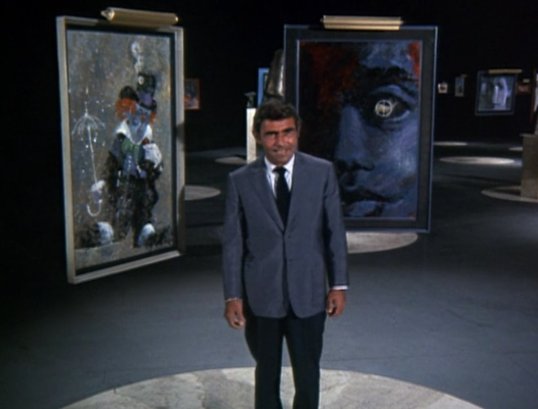
The fourth episode of Night Gallery originally aired on January 6th, 1971.  It was the first episode of the new year and it continued to open with Rod Serling walking through a most curious museum, inviting us to take a look at the macabre paintings on display and consider the stories behind them.

This episode featured two stories.
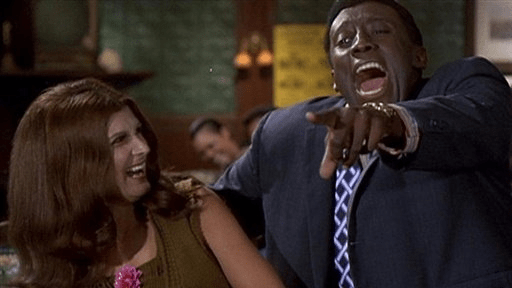
Make Me Laugh (dir. by Steven Spielberg, written by Rod Serling)

Jackie Slater (Godfrey Cambridge) is a comedian who can’t make anyone laugh.  He’s just been fired from his latest job and even his loyal agent (Tom Bosley) is suggesting that it might be time to throw in the proverbial towel.  While Jackie drowns his sorrows at a bar, he’s approached by a man named Catterje (Jackie Vernon).  Chatterje explains that he can cast miracles but, because he’s not very good at his job, the miracles often have unintended consequences.  “I don’t care!”  Jackie says, “I’ll take the risk!”  Jackie wants people to laugh at him.  Jackie gets his wish but it turns out that he should have listened to Chatterje’s warning.

This segment was directed by Steven Spielberg, back when he was just starting his career and he was largely working in television.  Spielberg also directed Eyes, which was a highlight of the Night Gallery pilot.  Unfortunately, his direction of Make Me Laugh is a bit less successful than his work on Eyes.  Spielberg’s direction features none of the inspired touches that made Eyes so successful.  Part of the problem may be that this story takes place in the word of comedy and comedy has never been a topic for which Spielberg has shown much affinity.

Make Me Laugh does feature a good lead performance from Godfrey Cambridge.  Otherwise, this segment is largely forgettable.
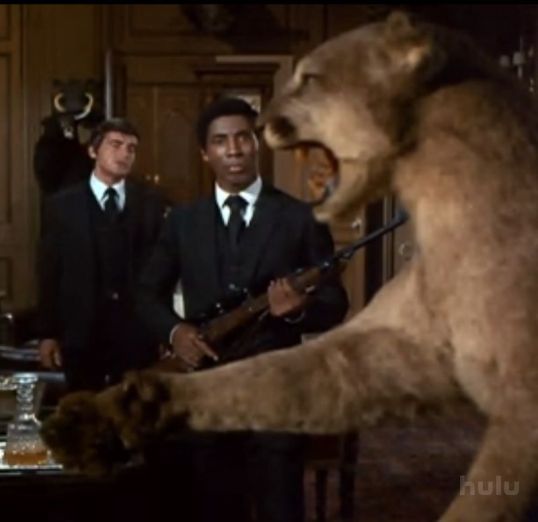
Cleans Kills And Other Trophies (dir by Walter Doniger, written by Rod Serling)

Raymond Massey plays Col. Archie Dittman, a wealthy racist who is obsessed with hunting and killing.  He even has a study full of the mounted heads of all of the animals that he’s killed.  Archie’s son, Archie, Jr. (Barry Brown), has just graduated from college and has no interest in hunting.  Col. Dittman demands that his son go on a hunt or risk being disinherited.  What the colonel fails to take into consideration is that both his bloodlust and his racism has offended his butler (Herbert Jefferson, Jr.) and that his butler has a magic-related revenge in mind.

Clean Kills and Other Trophies is hardly subtle but it does create and maintain a properly ominous atmopshere.  Raymond Massey gives a wonderfully villainous performance and it’s hard not to be amused by the fact that his son is wearing a peace signal prominently on his lapel, as if the segment’s director took one look at it and said, “What’s one thing that we can do to make the themes of this segment even more heavy-handed?”  The segment ends on a note that is so entertainingly over-the-top that it’s hard not to love it.

This episode was uneven.  Make Me Laugh does’t quite work but Cleans Kills and other Trophies is good enough to make up for the disappointing segment that precedes it.
Previous Night Gallery Reviews:

  1. The Pilot
  2. The Dead Man/The Housekeeper
  3. Room With A View/The Little Black Bag/The Nature of the Enemy
  4. The House/Certain Shadows on the Wall

Film Review: The Fountainhead (dir by King Vidor)


I don’t know if I’ve ever seen Gary Cooper look as miserable in any film as he did in the 1949 film, The Fountainhead.

In The Fountainhead, Gary Cooper plays Howard Roark.  Roark is an architect who we are repeatedly told is brilliant.  However, he’s always has to go his own way, even if it means damaging his career.  At the start of the film, we watch a montage of Howard Roark losing one opportunity after another.  He gets kicked out of school.  He gets kicked out of the top design firms.  Howard Roark has his own vision and he’s not going to compromise.  Roark’s a modernist, who creates sleek, powerful buildings that exist in defiance of the drab, collectivist architecture that surrounds them.

Howard Roark’s refusal to even consider compromising his vision threatens the rich and the powerful.  A socialist architecture critic with the unfortunate name of Ellsworth Toohey (Robert Douglas) leads a crusade against Roark.  And yet, even with the world against him, Roark’s obvious talent cannot be denied.  Dominique Francon (Patricia Neal) finds herself enthralled by the sight of him working in a quarry.  Fellow architect Peter Keating (Kent Smith) begs Howard to help him design a building.  Newspaper publisher Gail Wynard (Raymond Massey) goes from criticizing Howard to worshipping him.

Have I mentioned that Howard Roark doesn’t believe in compromise?  If you have any doubts about this, they’ll be erased about halfway through the movie.  That’s when Roark responds to a company altering one of his designs by blowing up a housing project.  Roark is arrested and his subsequent trial soon turns into a debate between two opposite philosophies: individualism vs. collectivism.

So, let’s just start with the obvious.  Gary Cooper is all wrong for the role of Howard Roark.  As envisioned by Ayn Rand (who wrote both the screenplay and the novel upon which it was based), Roark was meant to be the ideal man, a creative individualist who has no doubt about his vision and his abilities.  Cooper, with his down-to-Earth and rather modest screen persona, often seems to be confused as to how to play such a dynamic (some might say arrogant) character.  When Roark is meant to come across as being uncompromising, Cooper comes across as being mildly annoyed.  When Roark explains why his designs must be followed exactly, Cooper seems to be as confused as the people with whom Roark is speaking.  It doesn’t help that the 47 year-old Cooper seemed a bit too old to be playing an “up-and-coming” architect.  In the book, Roark was in his 20s and certainly no older than his early 30s.  Cooper looks like he should be relaxing in a Florida condo.

Who, among those available in 1949, could have been convincing in the role of Howard Roark?  King Vidor wanted Humphrey Bogart for the role but if Cooper seemed to old for the part, one can only imagine what it would have been like with Bogart instead.  Henry Fonda probably could have played the role.  For that matter, William Holden would have been an interesting pick.  Montgomery Clift and John Garfield would have been intriguing, though Garfield’s politics probably wouldn’t have made Ayn Rand happy.  If Warner Bros. had been willing to wait for just a few years, they could have cast a young Marlon Brando or perhaps they could have let Douglas Sirk make the movie with Rock Hudson and Lana Turner.  (Or, if you really wanted to achieve peak camp, they could have let Delmer Daves do it with Troy Donahue and Sandra Dee.)

If you can overlook the miscasting of Gary Cooper, The Fountainhead‘s an entertaining film.  King Vidor directs the film as if it’s a fever dream.  The film’s dialogue may be philosophical but the visuals are all about lust, with Pat Neal hungrily watching as a shirtless Gary Cooper breaks up rocks in the quarry and Vidor filling the film with almost fetishistic shots of phallic Howard Roark designs reaching high into the sky.  If Cooper seems confused, Neal seems to be instinctively understand that there is no place for underplaying in the world of The Fountainhead.  The same also holds true of Robert Douglas, who is a wonderfully hissable villain as the smug Ellsworth Toohey.  Interestingly, the film ends with a suicide whereas the novel ended with a divorce because, under the production code, suicide was apparently preferable to divorce.  I guess that’s 1949, for you.

Because America is currently having a socialist moment, there’s a tendency among critics to be dismissive of Ayn Rand and her worship of the individual above all else.  Rand’s novels are often dismissed as just being psychobabble, despite the fact that, in some ways, they often seem to be borderline prophetic.  (Barack Obama’s infamous “You didn’t build that!” speech from 2012 could have just as easily been uttered by Ellsworth Toohey or one of the many bureaucrats who pop up in Atlas Shrugged.)  Here’s the thing, though — as critical as one can be of Rand’s philosophy, there’s still something undeniably appealing about someone who will not compromise their vision to the whims of the establishment.  It’s goes beyond politics and it gets to heart of human nature.  We like the people who know they’re talented and aren’t afraid to proclaim it.  (Modesty, whether false or sincere, is a huge turn off.)  We like the people who take control of situations.  We like the people who are willing to say, “If you don’t do it my way, I’m leaving.”  In a way, we’re all like Dominique Francon, running our hands over architectural models while trying to resist the temptation to compromise and accept something less than what we desire.  We may not want to admit it but we like the Howard Roarks of the world.

Even when they’re played by Gary Cooper.

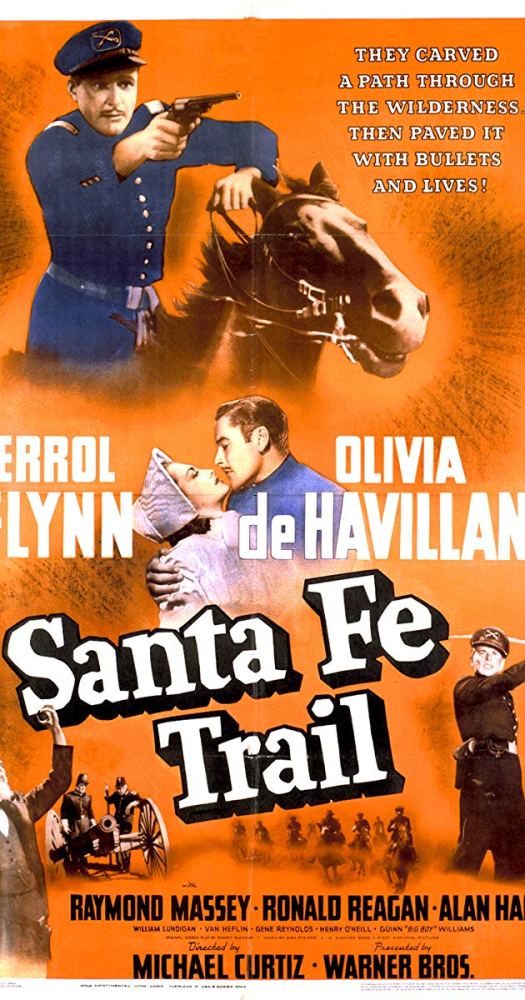
Hollywood History Lesson: Errol Flynn in SANTA FE TRAIL (Warner Brothers 1940)


gary loggins's avatarcracked rear viewer

A movie lover could get pretty spoiled living on a steady diet of Errol Flynn/Warner Brothers epics from the 30’s and 40’s. You’ve got Flynn, the personification of the classic “movie star”, performing heroic feats and romancing his leading lady (usually Olivia de Havilland ). A historical setting   serving as the backdrop to move the story along, expertly directed by Michael Curtiz or Raoul Walsh, a cast full of Hollywood’s greatest character actors, a majestic music score (mainly Max Steiner , but there were others equally as talented), action, drama, humor, conflict… what more could a film fan ask for?

SANTA FE TRAIL has all this and more, an energetic pre-Civil War tale guaranteed to hold your interest for its 110 minutes no matter which side of the Mason-Dixon Line you live on. It’s characters are drawn from history, but historic accuracy be damned… these films were all about…

View original post 774 more words

Lisa Reviews An Oscar Nominee: 49th Parallel (dir by Michael Powell)


Hello and welcome to the TSL’s continuing coverage of Oscar Sunday!  Today, along with some other Oscar-related things, I’m going to post reviews of some of the films that have been nominated for best picture over the years!  Let’s start things off with the 1941 Best Picture nominee, 49th Parallel!

Before anything, I should clear up some confusion about this film.  This is a British film about Nazis trying to reach the border between Canada and the U.S.  When it was first released in the UK, it was named after the coordinates of the border.  However, in the actual film, the Nazis never actually go to the 49th Parallel.  Instead, the film concludes at Niagara Falls.  However, it was probably reasonable assume that British audiences would not necessarily know or care whether Niagara Falls was actually located on the 49th Parallel.  Considering that they were currently at war with Germany, they had more important things to concern themselves with.

However, it was apparently felt that American audiences would notice that Niagara Falls wasn’t actually located on the 49th Parallel.  (Personally, I think the British may have been giving us too much credit.)  So, when the film was released in the United States, the title was changed to The Invaders.  When the film was subsequently nominated for Best Picture, it was nominated under the name The Invaders.  I’ve actually come across some online sources that claim that The Invaders and 49th Parallel are two separate films.  No, they’re the same film, it’s just that the film in question has two different titles.  Out of respect to the people who actually made the movie, I’ve decided to use the original title in this review.

When watching 49th Parallel (it’s available on YouTube), it helps to know something about history.  Today, there’s a tendency to overlook the fact that World War II had already been raging for nearly two years before the United States got involved.  Though the U.S. was an ally to Britain, it remained officially neutral until the Japanese bombed Pearl Harbor.  Up until that moment, many prominent Americans were isolationists and took the attitude that the war was Europe’s problem.  (On the other hand, Canada, as a Dominion of the British Empire, followed Britain into the war in 1939.)  Though the 49th Parallel may have been a British film that was largely set in Canada, it was also meant to frighten Americans and hopefully bring them over to the British side.

(When interviewed about the film, screenwriter Emeric Pressbruger said, “”Goebbels considered himself an expert on propaganda, but I thought I’d show him a thing or two.”)

Directed by Michael Powell, 49th Parallel opens with a German U-boat creeping into the waters around Canada.  The Nazis are hoping to disrupt shipping operations but it turns out that they’re no match for the Royal Canadian Navy.  (GO CANADA!)  When the U-boat sinks into the Hudson Bay, only six Nazis manage to survive.  Led by the arrogant Lt. Hirth (Eric Portman), the Nazis attempt to make their way to the border and to the safety of America.

Of course, it doesn’t turn out to be an easy journey.  Not only are the Germans in an unfamiliar country but they also keep running into Canadians.  Without fail, nearly every Canadian they meet is polite but willing to fight and die for his country.  The Canadians themselves are played by actors who, in the 40s, would have been familiar faces.  Laurence Olivier plays a fur trapper, getting top-billing for his cameo appearance.  Raymond Massey, who was best known for playing Abraham Lincoln, shows up as a Canadian solider.  Leslie Howard is the writer who discovers that Nazis have no respect for art.  Anton Walbrook is a German-Canadian farmer who rejects the attempts of Lt. Hirth to bring him over to the Nazi side.  The Canadians are so sympathetic that one of the Nazis is even moved to reject the Third Reich and is promptly executed by his compatriots, showing the audience the foolishness of hoping that the “good Germans” would ever be able to overthrow the bad ones.

It’s pure propaganda but it’s anti-Nazi propaganda so that’s not really a problem.  Powell keeps the story moving at a steady pace and all of the actors get impassioned performances.  You can tell this movie was more than just a job for them.  Instead, it was their way of fighting for their country and hopefully inspiring others to join in the battle against Hitler.  The film is both a love letter to Canada and a plea to the United States to renounce neutrality.  (Interestingly enough, by the time 49th Parallel made it to U.S. screens, America had finally declared war on the Axis Powers.)

49th Parallel was nominated for best picture but it lost to another World War II propaganda film, Mrs. Miniver.

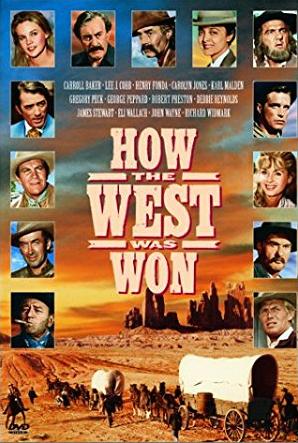
Lisa Reviews An Oscar Nominee: How The West Was Won (dir by Henry Hathaway, George Marshall, John Ford, and Richard Thorpe)


(With the Oscars scheduled to be awarded on March 4th, I have decided to review at least one Oscar-nominated film a day.  These films could be nominees or they could be winners.  They could be from this year’s Oscars or they could be a previous year’s nominee!  We’ll see how things play out.  Today, I take a look at the 1963 best picture nominee, How The West Was Won!)

How was the west won?

According to this film, the west was won by the brave men and women who set out in search of a better life.  Some of them were mountain men.  Some of them worked for the railroads.  Some of them rode in wagons.  Some of them gambled.  Some of them sang songs.  Some shot guns.  Some died in the Civil War.  The thing they all had in common was that they won the west and everyone had a familiar face.  How The West Was Won is the history of the west, told through the eyes of a collection of character actors and aging stars from Hollywood’s Golden Age.

In many ways, How The West Was Won was the Avatar of the early 60s.  It was a big, long, epic film that was designed to make viewers feel as if they were in the middle of the action.  Avatar used 3D while How The West Was Won used Cinerama.  Each scene was shot with three synchronized cameras and, when the film was projected onto a curved Cinerama screen, it was meant to create a truly immersive experience.  The film is full of tracking shots and, while watching it on TCM last night, I tried to imagine what it must have been like to see it in 1963 and to feel as if I was plunging straight into the world of the old west.  The film’s visuals were undoubtedly diminished by being viewed on a flat screen and yet, there were still a few breath-taking shots of the western landscape.

The other thing that How The West Was Won had in common with Avatar was a predictable storyline and some truly unfortunate dialogue.  I can understand why How The West Was Won was awarded two technical Oscars (for editing and sound) but, somehow, it also picked up the award for Best Writing, Screenplay or Story.  How The West Was Won is made up of five different parts, each one of which feels like a condensed version of a typical western B-movie.  There’s the mountain man helping the settlers get down the river story.  There’s the Civil War story.  There’s the railroad story and the outlaw story and, of course, the gold rush story.  None of it’s particularly original and the film is so poorly paced that some sections of the film feel rushed while others seem to go on forever.

Some of the film’s uneven consistency was undoubtedly due to the fact that it was directed by four different directors.  Henry Hathaway handled three sections while John Ford took care of the Civil War, George Marshall deal with the coming of the railroad, and an uncredited Richard Thorpe apparently shot a bunch of minor connecting scenes.

And yet, it’s hard not to like How The West Was Won.  Like a lot of the epic Hollywood films of the late 50s and early 60s, it has its own goofy charm.  The film is just so eager to please and remind the audience that they’re watching a story that could only be told on the big screen.  Every minute of the film feels like a raised middle finger to the threat of television.  “You’re not going to see this on your little idiot box!” the film seems to shout at every moment.  “Think you’re going to get Cinerama on NBC!?  THINK AGAIN!”

Then there’s the huge cast.  As opposed to Avatar, the cast of How The West Was Won is actually fun to watch.   Admittedly, a lot of them are either miscast or appear to simply be taking advantage of a quick payday but still, it’s interesting to see just how many iconic actors wander through this film.

For instance, the film starts and, within minutes, you’re like, “Hey!  That’s Jimmy Stewart playing a mountain man who is only supposed to be in his 20s!”

There’s Debbie Reynolds as a showgirl who inherits a gold claim!

Is that Gregory Peck as a cynical gambler?  And there’s Henry Fonda as a world-weary buffalo hunter!  And Richard Widmark as a tyrannical railroad employee and Lee J. Cobb as a town marshal and Eli Wallach as an outlaw!

See that stern-faced settler over there?  It’s Karl Malden!

What’s that?  The Civil War’s broken out?  Don’t worry, General John Wayne is here to save the day.  And there’s George Peppard fighting for the Union and Russ Tamblyn fighting for the Confederacy!  And there’s Agnes Moorehead and Thelma Ritter and Robert Preston and … wait a minute?  Is that Spencer Tracy providing narration?

When Eli Wallach’s gang shows up, keep an eye out for a 36 year-old Harry Dean Stanton.  And, earlier, when Walter Brennan’s family of river pirates menaces Karl Malden, be sure to look for an evil-looking pirate who, for about twenty seconds, stares straight at the camera.  When you see him, be sure to say, “Hey, it’s Lee Van Cleef!”

How The West Was Won is a big, long, thoroughly silly movie but, if you’re a fan of classic film stars, it’s worth watching.  It was a huge box office success and picked up 8 Oscar nominations.  It lost best picture to Tom Jones.

(By the way, in my ideal fantasy world, From Russia With Love secured a 1963 U.S. release, as opposed to having to wait until 1964, and became the first spy thriller to win the Oscar for Best Picture.)

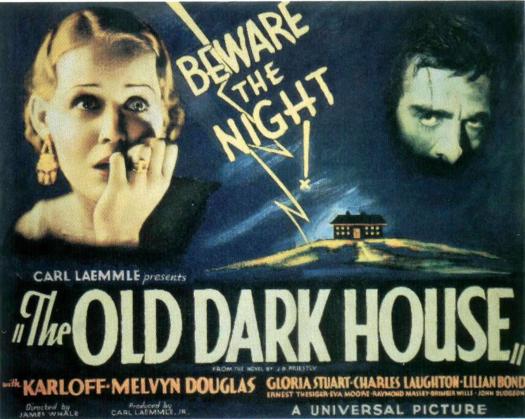
Happy Birthday Boris Karloff: THE OLD DARK HOUSE (Universal 1932)


gary loggins's avatarcracked rear viewer

William Henry Pratt was born on November 23, 1887, but horror movie icon Boris Karloff was “born” when he teamed with director James Whale for 1931’s FRANKENSTEIN. The scary saga of a man and his monster became a big hit, and Universal Studios boss Carl Laemmle Jr. struck while the horror trend was hot, quickly teaming the pair in an adaptation of J.B. Priestley’s 1927 novel THE OLD DARK HOUSE. This film was considered lost for many years until filmmaker and Whale friend Curtis Harrington discovered a print in the Universal vaults. Recently, a 4K restoration has been released courtesy of the Cohen Film Collection, and a showing aired on TCM this past Halloween. I of course, having never seen the film, hit the DVR button for a later viewing.

THE OLD DARK HOUSE has not only been restored to its former glory, but is a delightful black comedy showcasing…

View original post 994 more words

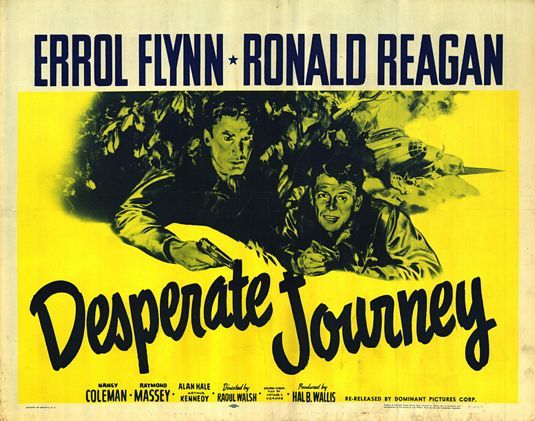
Happy Birthday Errol Flynn: DESPERATE JOURNEY (Warner Brothers 1942)


gary loggins's avatarcracked rear viewer

desp1

The actor known for his “wicked, wicked ways”, Errol Flynn was born June 20, 1909 in Hobart, Australia. The dashing Flynn skyrocketed to fame with a series of swashbuckling exploits: CAPTAIN BLOOD , THE SEA HAWK, and most notably THE ADVENTURES OF ROBIN HOOD. He was also featured in some of the great Westerns of the era (THEY DIED WITH THEIR BOOTS ON, SANTA FE TRAIL). Like all stalwart screen heroes, during the 1940’s Flynn made a number of wartime propaganda films to boost morale for the masses. One of these was DESPERATE JOURNEY, a totally improbable but highly exciting action yarn from the two-fisted, one-eyed Raoul Walsh, director of such macho fare as THE ROARING TWENTIES, HIGH SIERRA, and WHITE HEAT.

desp2

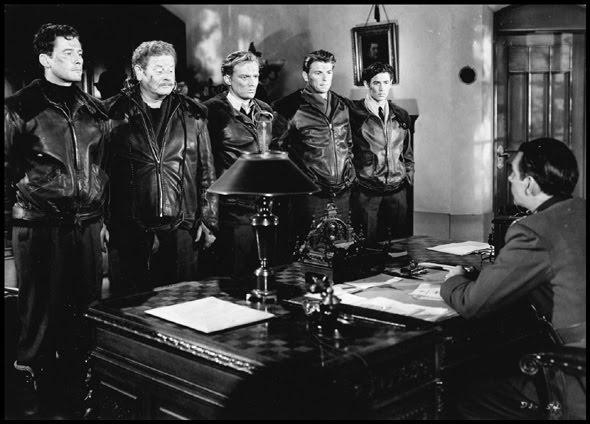
An RAF bomber squad is sent on a dangerous mission behind enemy lines to take out a train depot. They accomplish the task, but are shot down by Nazi heavy artillery. Forced to…

View original post 795 more words