The year is 1958 and four Brooklyn teenagers, all members of a largely non-violent street gang called The Lords of Flatbush, have enough grease in their hair to start a city-wide kitchen fire. It’s their senior year of high school. Chico (Perry King) tries to hook up with a new, blonde transfer student (Susan Blakely). Butchey (Henry Winkler) makes everyone laugh and hides the fact that he’s secretly really smart. Stanley (Sylvester Stallone) deals with his impending marriage to Frannie (Maria Smith). Everyone has to grow up eventually but at least the Lords of Flatbush will always have their memories and probably their leather jackets.
Nostalgia films that were extremely popular in the 70s, as the baby boomers were already starting to mythologize their youth. Lords of Flatbush is very much about that nostalgia, leading to a film that feels sincere but which is also pretty predictable. With its coming-of-age storylines and its mix of drama and comedy, Lords of Flatbush owes an obvious debt to American Graffiti. The movie, like its characters, is likable but not exactly memorable. Today, it’s really only known because it featured early performances from Sylvester Stallone and Henry Winkler. Winkler got his signature role as the Fonz on HappyDays largely based on his performance as Butchey, though Butchey is nowhere near as cool as the Fonz. Pre-Rocky, this movie was Stallone’s calling card in Hollywood and he rewrote enough of his own lines that he got an additional dialogue credit. Stallone actually gives a pretty good performance, even if he is obviously closer to 30 than 18.
Stallone’s best scene is when Stanley is trying to buy an engagement ring and Frannie insists that he buy one that costs $1,600. For the first time, Stanley realizes that getting married means committing to something other than hanging out with his friends and working on his car. Stanley buys the ring but threatens the jewelry store owner afterwards, telling him to never show Frannie a $1,600 ring again.
TheLordsofFlatbush is a film about the past but it’s mostly interesting due to the future of its stars.
Welcome to Retro Television Reviews, a feature where we review some of our favorite and least favorite shows of the past! On Mondays, I will be reviewing Miami Vice, which ran on NBC from 1984 to 1989. The entire show can be purchased on Prime!
This week, things get weird.
Episode 2.8 “Tale of the Goat”
(Dir by Michael O’Herlihy, originally aired on November 15th, 1985)
It’s hard to know where to begin with this one.
Legba (Clarence Williams III) is a drug lord that Sonny has been trying to take down for three years. While hiding out in Haiti, Legba reportedly dies. When his body is flown back to Miami, Crockett and Tubbs are waiting in the airport so that Crockett can snap a picture of Legba in his casket. Legba does indeed appear to be dead. But, at his voodoo-themed funeral, a man on a motorcycle riddles the casket with bullets. When Crockett and Tubbs (who were staking out the ceremony) open up the casket, they discover only a dead goat.
“Zombie!” a priest exclaims.
Legba has come back, though not as a member of the undead. Instead, while in Haiti, he ingested a toxin that put him in a 48-hour coma. Unlike a lot of people who take the toxin, Legba survives. However, when he is revived, he has suffered brain damage and is now walking and talking slowly. That doesn’t stop Legba from getting his old gang back together (including a dwarf who carries a pickaxe) and going after everyone who he feels has betrayed him. This includes his former lieutenant (Mykelti Williamson) and an obnoxious money launderer (Ray Sharkey) who owns a used car lot.
Tubbs doesn’t believe in voodoo, despite Crockett warning him of the dangers. Tubbs is more interested in Marie (Denise Thompson), Legba’s ex-girlfriend. Looking to keep Marie safe from Legba, Tubbs attempts to infiltrate a voodoo ceremony. You might think this would give Tubbs the perfect excuse to trot out the fake Caribbean accent that he occasionally used during the first season but instead, Tubbs is captured before he can even utter a word. He’s injected with the toxin and spends 48 hours in a coma, haunted by visions of Legba staring at him!
Eventually, Tubbs does come out of his coma and, amazingly, it takes him about five minutes to fully recover. The episode ends with another raid on a yacht. This time, Tubbs manages to kill the villain, shooting him in the back! In Tubbs’s defense, he was still having visions and he thought Legba was facing him. Legba dies and Marie is found in a coma but alive.
This was a weird episode, one that had enough plot for a two-parter. As it is, the story felt rather rushed. No sooner had Mykleti Williamson and Ray Sharkey made their appearances as criminals then Legba was doing away with them. No sooner had Marie stepped onto Crockett’s boat then she was being kidnapped by Legba’s men. No sooner had Tubbs decided to infiltrate Legba’s cult then he was getting injected with the voodoo toxin. And no sooner had Tubbs woken up from his coma then he was preparing to raid the yacht. Add to that, Clarence Williams III gave a performance that was without a hint of subtlety, speaking in accent that was impossible to describe. This wasn’t really a good episode but it was so weird that it was undeniably entertaining.
Next week, Dean Stockwell appears as an old friend of Castillo’s! Hopefully, he won’t be a voodoo priest.
On tonight’s episode of The Hitchhiker, the title character (Page Fletcher) continues to come across the worst people on the planet.
This time, that person is Eric Coleman (Ray Sharkey), a once great photographer who now makes a disreputable living taking pictures of celebrities and tragedies. When Eric has a chance to stop a woman’s suicide, he instead decides to take pictures. His new assistant goes out of her way to make Eric feel the error of his ways.
This episode features a convincingly sleazy performance from Ray Sharkey. Eric Coleman is a character who you will definitely want to see receive his comeuppance.
This episode originally aired on April 29th, 1989.
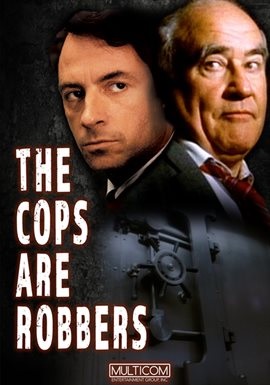
When Kirkland (George Kennedy) appoints veteran cop Jake Quinn (Ed Asner) to command a division of the Massachusetts Metropolitan Police, one of Quinn’s main duties is to root out corruption. Everyone knows that Captain Jerry Clemente (Ray Sharkey) is crooked but no one’s been able to prove anything. This has led to Clemente getting so cocky that he tries to pull off the biggest bank robbery of all time. Working with two other corrupt cops (played by Steve Railsback and James Keach) and some ex-cons who owe him a favor, Clemente masterminds the theft of $25,000,000 worth of jewelry.
Unfortunately, stealing that much brings in not only the FBI but it also makes Quinn even more determined to expose Clemente and all of his crooked associates. As well, the Mafia wants their part of the action and the members of Celemente’s gang aren’t as smart as their leader. Soon the walls are closing in. Will Clemente get away with his crime or will he end up getting arrested and eventually writing a book about the theft that will eventually be turned into a television movie?
Though the title seems more appropriate for a comedy, The Cops Are Robbers is a drama based on a true story. It actually could have used some comedy because the movie itself is pretty dry and straight forward. Ed Asner and George Kennedy give their usual competent performances, cast as the type of characters that they could have played in their sleep. Unfortunately, Ray Sharkey is nowhere near as effective as the man they’re trying to put behind bars. When he first started out, Sharkey made a name for himself by giving convincing performances as characters who were tough and streetwise but also sometimes neurotic. He received Emmy and Golden Globe nominations before he became better known for his trips to rehab than his acting ability. I think that. as an actor, Sharkey’s downfall was that he saw himself compared to Al Pacino so many times that he started to buy it and he eventyally started to attack every role with the same method-style intensity. Sometimes, like when he played Sonny Steelgrave during the first season of Wiseguy, it worked. Most of the time, though, it just led to him overacting and bellowing all of his lines. That’s the case with The Cops Are Robbers. Sharkey is so loud and perpetually angry that it’s hard to believe that he’s managed to get away with his crimes for as long as he has.
For those of us who don’t live in Massachusetts, the most interesting thing about watching The Cops Are Robbers is trying to keep track of who works for what agency. When it was mentioned that Clemente works for the Metropolitan Police, I immediately assumed that meant he was a Boston police officer. Only later did I learn, via a review on the imdb, that the Metropolitan Police were actually a state agency. That Clemente was a state official and not just a city cop does make his crimes slightly more interesting, though not enough to really liven up The Cops Are Robbers.
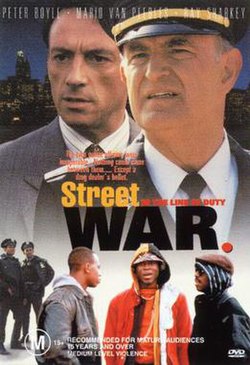
Street War, the fifth In The Line of Duty movie to be produced by NBC, takes place in Brooklyn. Raymond Williams (Mario Van Peebles) and Robert Dayton (Michael Boatman) are two uniformed officers trying to keep the peace in the projects. When Raymond is shot and killed in a stairwell, everyone knows that drug dealer Justice Butler (Courtney B. Vance) was responsible but no one can prove it.
The case is assigned to two detectives, Dan Reilly (Peter Boyle) and Victor Tomasino (Ray Sharkey). Reilly is a veteran cop who is just a few months away from retirement. Tomasino is the son of a “made man” who can’t understand why the drug lords in Brooklyn aren’t as interested in keeping the peace as the old Mafiosos were.
When Justice leaves Brooklyn so that he can hide out with his family in South Carolina, Reilly and Dayton follow him down there and discover that people in South Carolina distrust the cops just as much as people in Brooklyn. Meanwhile, back in Brooklyn, Justice’s second-in-command, Prince (Morris Chestnut), tries to keep an all-out war from breaking out.
Prince and Tomasino take turns narrating the movie. Prince talks about the reality of trying to restart your life after doing time in prison while Tomasino complains that “the animals” have taken over the city. (Because this was made for television, “Animals” is Tomasino’s go-to label for anyone he dislikes. Anyone with any experience with the police will know what word he is actually thinking.) While Chestnut gives a restrained and thoughtful performance, Ray Sharkey shouts his lines and snarls whenever he’s onscreen. Though it’s not always evident in this movie, Sharkey started out as a talented actor who played small roles in several independent films before starring in The Idolmaker. Unfortunately, Sharkey was also a heroin addict whose once promising career was derailed by a series of arrests and jail sentences. He looks thin and tired in Street Wars and, one year after the film aired, he would die of complications from AIDS.
With Sharkey yelling his lines, it falls on Peter Boyle to play the voice of reason in Street War. Dan Reilly is a cliché, the weary cop who still wants to make the world a better place and who is just a few days away from retirement. But Boyle does a good job playing him and brings his own natural gravitas to the movie.
Dick Lowry, who directed the first three In The Line of Duty movies, returns for this one and he keeps the action moving. Street War is significantly more violent than the previous movies, with even two children getting shot onscreen. The story itself is a predictable and Tomasino’s casual racism can be hard to take (even if he does eventually called out about it) but, thanks to the performances of Boyle, Boatman, Chestnut, and Vance, Street War is an improvement on Mob Justice and an adequate entry in the series.
Street War would be followed by two movies about FBI sieges, The Siege at Marion and Ambush in Waco. Since I’ve already reviewed both of those, I will be moving onto In the Line of Duty: The Price of Vengeance tomorrow.
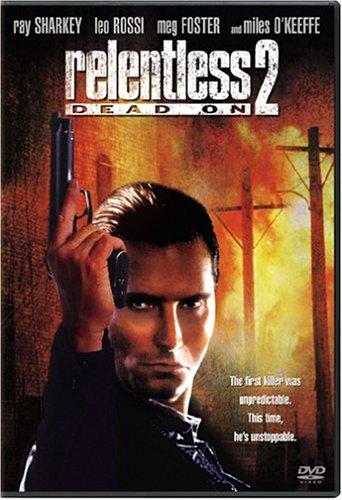
Still struggling to recover from having to act opposite Judd Nelson in the previous Relentless film, Los Angeles homicide detective Sam Deitz (Leo Rossi) finds himself investigating another string of seemingly random murders. This time, the killer is Gregor (Miles O’Keeffe), a master of disguise who hangs his victims, decorates the crime scene with Satanic graffiti, and takes a lot of ice baths. Deitz is forced to team up with a condescending FBI agent named Kyle Valsone (Ray Sharkey), who has his own reasons for wanting to capture Gregor and who might not have the best interests of the case in mind. As if having to deal with killer Russians and crooked FBI agents isn’t bad enough, Deitz is also having to deal with the collapse of his married to Meg Foster and the everyday irritations of being an intense New York cop in laid back Los Angeles.
Relentless II is a better than the first Relentless, mostly because Miles O’Keeffe is a better villain than Judd Nelson. Whereas Nelson was too twitchy to be taken seriously in the first Relentless, O’Keeffe is cold as ice and believably dangerous. He’s a worthy opponent for Rossi and Sharkey. How much Keeffe was in this movie? Just enough to make it work.
Whenever O’Keeffe isn’t doing his thing, the movie focuses on Deitz and Valsone. To a certain extent, their relationship mirrors the relationship that Deitz had with Malloy in the first Relentless except, this time, the mentor turns out to be just as bad the killer. Ray Sharkey was a good actor whose career nosedived because of his own addictions. He was always at his best playing streetwise bad guys, like Sonny Steelgrave in Wiseguy. He’s good as Valsone, giving a performance that indicates that, even if mainstream Hollywood wasn’t willing to take a chance of him, he could have carved out a direct-to-video career as a poor man’s Michael Madsen. Unfortunately, Sharkey contracted HIV as a result of his heroin addiction and he died of AIDS just a year after the release of Relentless II.
Leo Rossi gives another good performance as Sam Deitz. Rossi was usually cast as abusive boyfriends and low-level mobsters and it’s obvious that he enjoyed getting to play a hero for once. Meg Foster may not get to do much as Deitz’s wife but her otherworldly eyes are always a welcome sight.
Relentless II was the high point of the Relentless films. It made enough money to lead to a sequel. Sam Deitz’s days of hunting serial killers were not over.
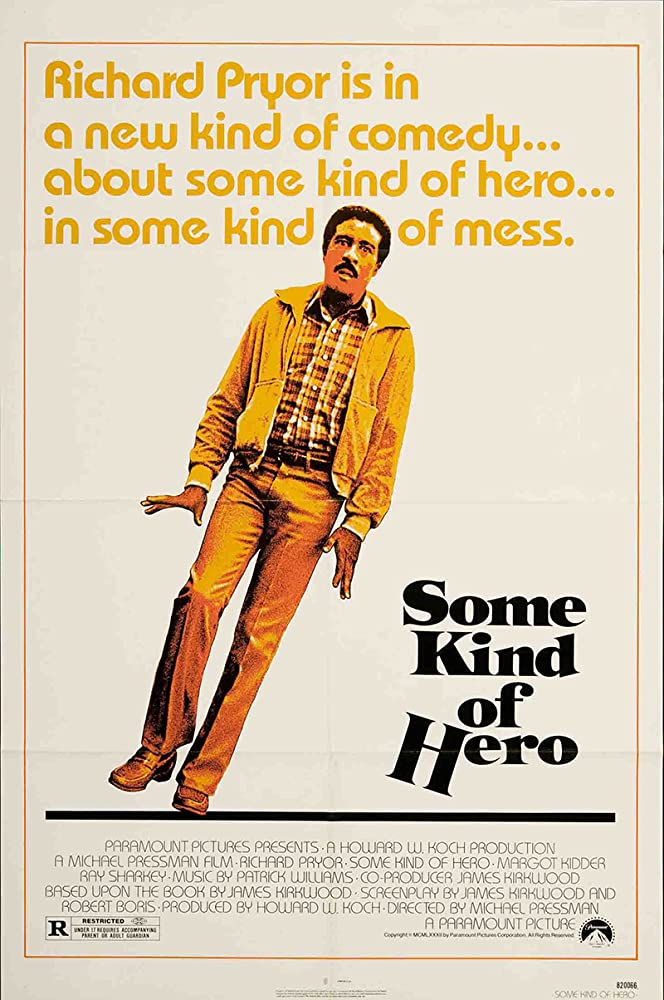
Eddie Keller (Richard Pryor) is a member of the U.S. Army, serving in Vietnam when he gets captured by the VC and spends the next few years in a POW camp. During that time, he befriends another POW named Vinnie (Ray Sharkey). Though the quick-witted Eddie is often able to outsmart his captors and their attempts to turn him into a propaganda tool, he finally snaps when he’s told that Vinnie will be allowed to die unless Eddie signs a “confession” in which he renounces both America and the war. Hoping to save his friend’s life, Eddie signs the paper.
After 5 long years in the camp, Eddie finally returns to America. He’s given a momentary hero’s welcome and then he is quickly forgotten about. After all, everyone wants to move on from Vietnam and Eddie, by his very existence, is a reminder of the war. However, Eddie can’t move on. His wife (Lynne Moody) left him for another man while he was missing. His mother (Olivia Cole) suffered a stroke and is now in a nursing home. Worst of all, because Eddie signed that confession, the army considers him to be a traitor and is refusing to release his backpay.
What can Eddie do? How about a rob a bank and then run off with Toni (Margot Kidder), a hooker with a heart of gold?
Like a lot of Richard Pryor’s starring vehicles, Some Kind of Hero is an uneven film. Pryor was a skilled dramatic actor but he was best known as a comedian and, in most of his starring roles, there was always a conflict between his serious instincts and the demand that all of his films be funny. Some Kind of Hero starts out strong with Pryor in Vietnam. The scenes with Pyror and Sharkey in the POW camp are strong. (In the novel on which the film was based, Eddie and Vinnie were lovers. In the film, they’re just friends.) Though there are funny moments during the first half of the film, the humor arises naturally out of the situation. During the first half of the film, Pryor may make you laugh but he also makes sure that you never forget that he’s on joking to maintain his sanity. But once Eddie returns to the U.S., Some Kind of Hero awkwardly turns into a heist film and the comedy goes from being darkly humorous to being broadly slaptstick. Eddie, who could survive being a prisoner of war and who could usually outsmart the VC, is suddenly transformed into a naive klutz. Richard Pyror does his best but the two halves of the film never seem to belong together.
Unfortunately, Hollywood never really figured out what to do with Richard Pryor as an actor. Some Kind of Hero at least shows that Richard Pryor could be a strong dramatic actor. Unfortunately, the film doesn’t really live up to his talents.
Sometimes, you watch a movie and all you cay say, at the end, is “What the Hell were they thinking?”
Wired is one such movie. Based on a widely discredited biography by Bob Woodward, Wired tells two stories. In the first story, John Belushi (Michael Chiklis, making an unfortunate film debut) wakes up in a morgue and is told by his guardian angel that he has died of a drug overdose. Did I mention that his guardian angel is Puerto Rican cabbie named Angel Vasquez (Ray Sharkey) and Angel drives Belushi through a series of flashbacks? Belushi meets Dan Aykroyd (Gary Groomes, who looks nothing like Dan Aykroyd). Belushi gets cast on Saturday Night Live. Belushi marries Judy (Lucinda Jenney). Belushi uses drugs, costars in The Blues Brothers, dies of a drug overdose in a sleazy motel, and plays a pinball game to determine whether he’ll go to Heaven or Hell. While this is going on, Bob Woodward (J.T. Walsh) is interviewing everyone who knew Belushi while he was alive.
There are so many things wrong with Wired that it is hard to know where to even begin. I haven’t even mentioned the scene where Bob Woodward travels back in time and has a conversation with Belushi while he’s dying on the motel room floor. Wired tries to be a cautionary tale about getting seduced by fame and drugs but how seriously can anyone take the message of any movie that features Ray Sharkey as a guardian angel? The scenes with Woodward are strange, mostly because the hero of Watergate is being played by an actor best known for playing sinister villains. (Seven years after playing Bob Woodward, J.T. Walsh was actually cast as Watergate figure John Ehrlichman in Nixon.) Considering that this was his first movie, Michael Chiklis is not bad when it comes to playing a drug addict named John but he’s never convincing as John Belushi. He never captures the mix of charisma and danger that made John Belushi a superstar. Wired wants to tell the story of Belushi’s downfall but never understands what made him special to begin with.
Wired tries to be edgy but it only succeeds for one split second. During the filming of The Blues Brothers, a director who is clearly meant to be John Landis walks over to Belushi’s trailer. Listen carefully, and a helicopter can be heard in the background.
As for the rest of Wired, what the Hell were they thinking?
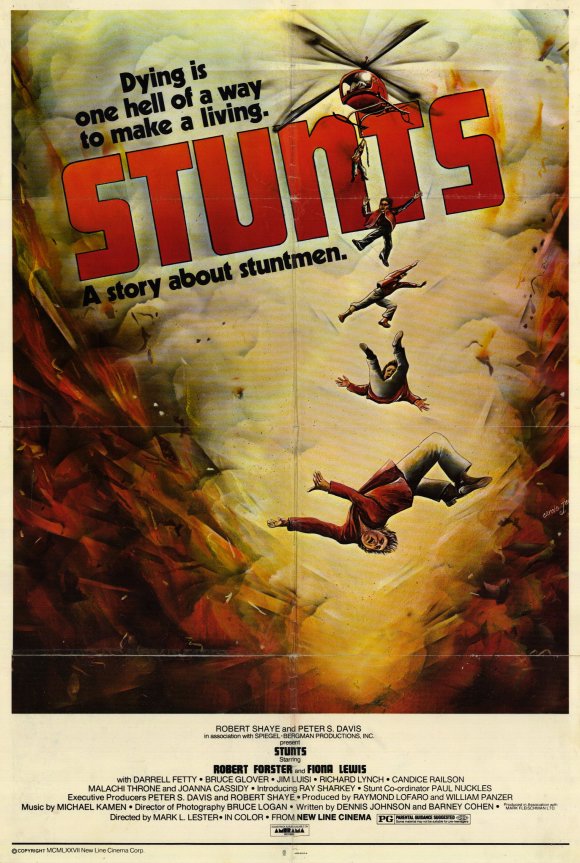
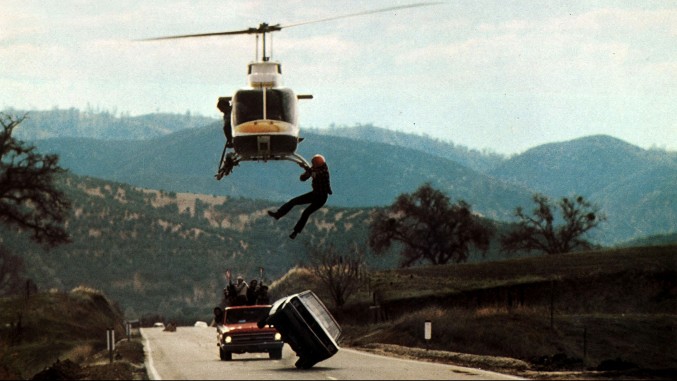
With the success of films like WHITE LIGHTING, CANNONBALL, DEATH RACE 2000, and SMOKEY AND THE BANDIT (not to mention the continuing fascination with Evel Knenevel), movies revolving around stunts and stuntmen were big box office in the 1970’s. New Line Cinema took note and produced STUNTS, a murder mystery about stuntmen being killed off that gives us a behind-the-scenes look at low-budget filmmaking in addition to a good cast and well-staged action.
When stuntman Greg Wilson’s hanging from a helicopter gag goes horribly awry, resulting in him plummeting to his death, his brother Glen arrives on the set determined to do the stunt himself and investigate Greg’s demise. Along the way he picks up B.J. Parswell, an attractive reporter doing a story on stuntmen. Glen’s fellow stuntmen start getting picked off one by one in gruesome “accidents”, and he must find the killer before he becomes next.
So, you want to be a rock and roll star? Then listen now to what I say: just get an electric guitar and take some time and learn how to play. And when your hair’s combed right and your pants fit tight, it’s gonna be all right.
If you need any more help, try watching these four films:
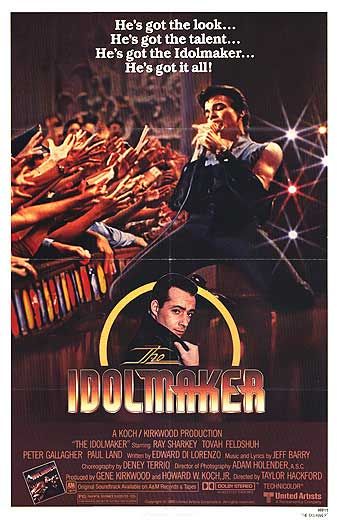
The Idolmaker (1980, directed by Taylor Hackford)
The Idolmaker is a movie that asks the question, “What does it take to be a star? Who is more interesting, the Svengalis or the Trilbys?” The year is 1959 and Vinny Vacari (Ray Sharkey, who won a Golden Globe for his performance but don’t let that dissuade you from seeing the movie) is a local kid from New Jersey who dreams of being a star. He has got the talent. He has got the ambition and he has got the media savvy. He also has a receding hairline and a face like a porcupine.
Realizing that someone who looks like him is never going to make hundreds of teenage girls all scream at once, Vinny instead becomes a starmaker. With the help of his girlfriend, teen mag editor Brenda (Tovah Feldshuh) and a little payola, he turns saxophone player Tomaso DeLorussa into teen idol Tommy Dee. When Tommy Dee becomes a star and leaves his mentor, Vinny takes a shy waiter named Guido (Peter Gallagher) and turns him into a Neil Diamond-style crooner named Cesare. Destined to always be abandoned by the stars that he creates, Vinny continually ends up back in the same Jersey dive, performing his own songs with piano accompaniment.
The Idolmaker is a nostalgic look at rock and roll in the years between Elvis’s induction into the Army and the British invasion. The Idolmaker has some slow spots but Ray Sharkey is great in the role of Vinny and the film’s look at what goes on behind the scenes of stardom is always interesting. In the movie’s best scene, Tommy performs in front of an audience of screaming teenagers while Vinny mimics his exact moments backstage.
Vinny was based on real-life rock promoter and manager, Bob Marcucci. Marcucci was responsible for launching the careers of both Frankie Avalon and Fabian Forte. Marcucci served as an executive producer on The Idolmaker, which probably explains why this is the rare rock film in which the manager is more sympathetic than the musicians.
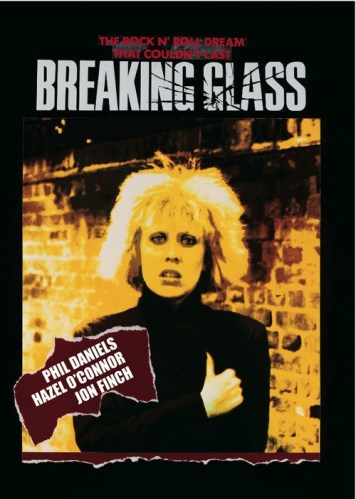
Breaking Glass (1980, directed by Brian Gibson)
At the same time that TheIdolmaker was providing American audiences with a look at life behind-the-scenes of music stardom, Breaking Glass was doing the same thing for British audiences.
In Breaking Glass, the idolmaker is Danny (Phil Daniels, who also starred in Quadrophenia) and his star is an angry New Wave singer named Kate (Hazel O’Connor). Danny first spots Kate while she is putting up flyers promoting herself and her band and talks her into allowing him to mange her. At first, Kate refuses to compromise either her beliefs or her lyrics but that is before she starts to get famous. The bigger a star she becomes, the more distant she becomes from Danny and her old life and the less control she has over what her music says. While her new fans scare her by all trying to dress and look like her, Kate’s old fans accuse her of selling out.
As a performer, Hazel O’Connor can be an acquired taste and how you feel about Breaking Glass will depend on how much tolerance you have for her and her music. (She wrote and composed all of the songs here.) Breaking Glass does provide an interesting look at post-punk London and Jonathan Pryce gives a good performance as a sax player with a heroin addiction.
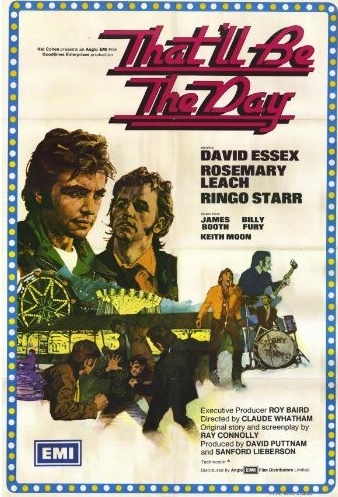
That’ll Be The Day (1973, directed by Claude Whatham)
Real-life teen idol David Essex plays Jim MacClaine, a teenager in 1958 who blows off his university exams and runs away to the Isle of Wright. He goes from renting deckchairs at a resort to being a barman to working as a carny. He lives in squalor, has lots of sex, and constantly listens to rock and roll. Eventually, when he has no other choice, he does return home and works in his mother’s shop. He gets married and has a son but still finds himself tempted to abandon his family (just as his father previously abandoned him) and pursue his dreams of stardom.
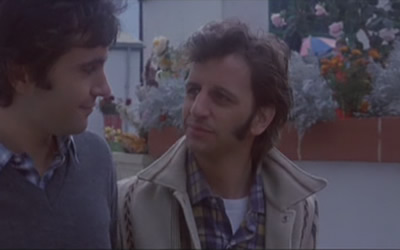
Based loosely on the early life of John Lennon, the tough and gritty That’ll Be The Day is more of a British kitchen sink character study than a traditional rock and roll film but rock fans will still find the film interesting because of its great soundtrack of late 50s rock and roll and a cast that is full of musical luminaries who actually lived through and survived the era. Billy Fury and the Who’s Keith Moon both appear in small roles. Mike, Jim’s mentor and best friend, is played by Ringo Starr who, of all the Beatles, was always the best actor.
That’ll Be The Day ends on a downbeat note but it does leave the story open for a sequel.
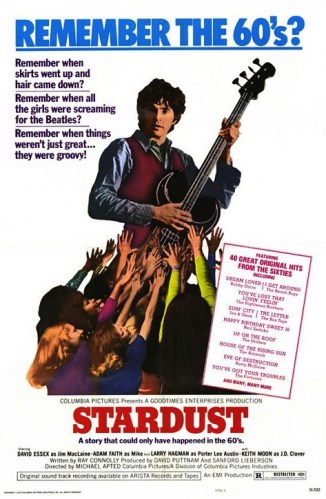
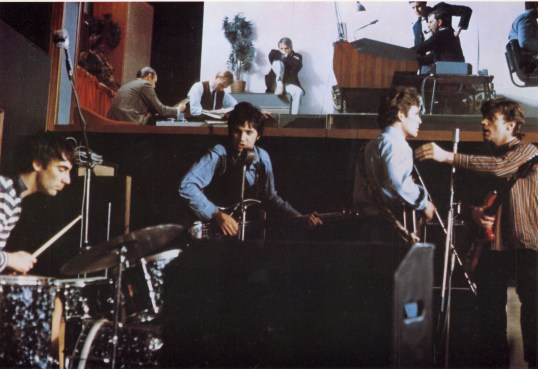
Stardust (1974, directed by Michael Apted)
Stardust continues the story of Jim MacClaine. Jim hires his old friend Mike (Adam Faith, replacing Ringo Starr) to manage a band that he is in, The Straycats (which includes Keith Moon, playing a far more prominent role here than in That’ll Be the Day). With the help of Mike’s business savvy, The Stray Cats find early success and are signed to a record deal by eccentric Texas millionaire, Porter Lee Austin (Larry Hagman, playing an early version of J.R. Ewing).
When he becomes the breakout star of the group, Jim starts to overindulge in drugs, groupies, and everything that goes with being a superstar. Having alienated both Mike and the rest of the group, Jim ends up as a recluse living in a Spanish castle. Even worse, he gives into his own ego and writes a rock opera, Dea Sancta, which is reminiscent of the absolute worst of progressive rock. Watching Jim perform Dea Sancta, you understand why, just a few years later, Johnny Rotten would be wearing a homemade “Pink Floyd Sucks” t-shirt.
Stardust works best as a sad-eyed look back at the lost promise of the 1960s and its music. Watch the movie and then ask yourself, “So, do you really want to be a rock and roll star?”
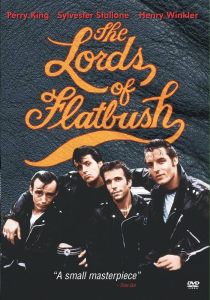 The year is 1958 and four Brooklyn teenagers, all members of a largely non-violent street gang called The Lords of Flatbush, have enough grease in their hair to start a city-wide kitchen fire. It’s their senior year of high school. Chico (Perry King) tries to hook up with a new, blonde transfer student (Susan Blakely). Butchey (Henry Winkler) makes everyone laugh and hides the fact that he’s secretly really smart. Stanley (Sylvester Stallone) deals with his impending marriage to Frannie (Maria Smith). Everyone has to grow up eventually but at least the Lords of Flatbush will always have their memories and probably their leather jackets.
 Sometimes, you watch a movie and all you cay say, at the end, is “What the Hell were they thinking?”

 Through the Shattered Lens