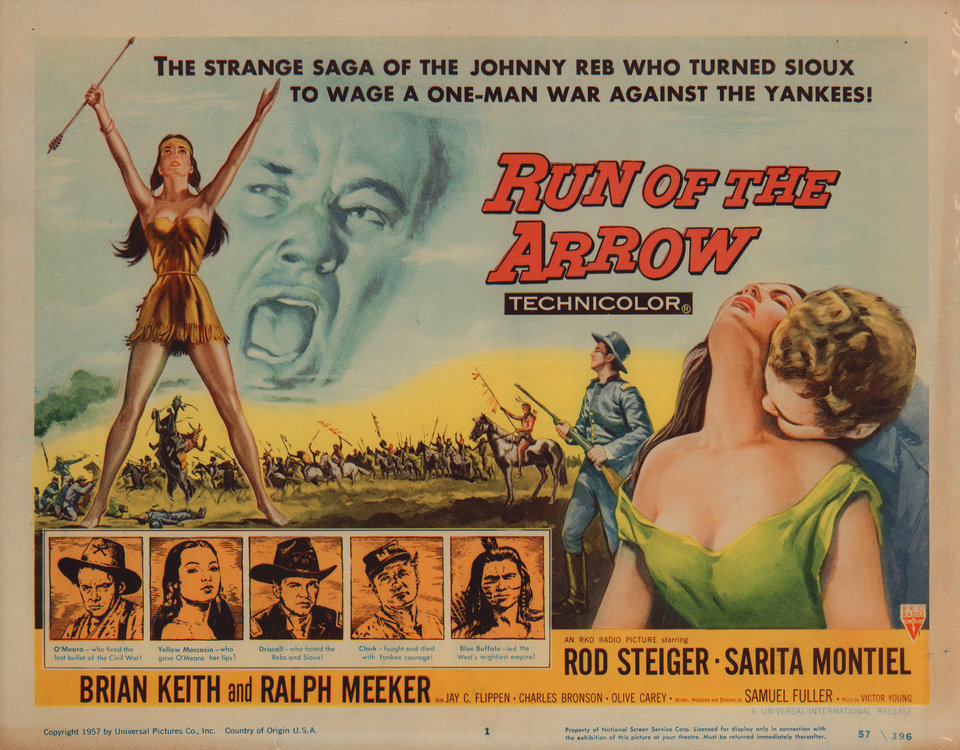
Brad reviews Samuel Fuller’s RUN OF THE ARROW (1957), starring Rod Steiger and Charles Bronson! 


RUN OF THE ARROW opens up on April 9th, 1963, with confederate sharpshooter O’Meara (Rod Steiger) shooting a Union lieutenant named Driscoll (Ralph Meeker). This turns out to be the final shot fired in the Civil War as General Lee is in the process of surrendering to General Grant. It also turns out to be Driscoll’s lucky day, as a slight warping of the bullet causes O’Meara’s aim to be off just enough for him to survive. With no more war to fight and with a heart full of hate for the Yankees, O’Meara declares himself to be a man without a country and decides to head out west towards the land of the Indians. As part of his travels he happens across Walking Coyote (Jay C. Flippen), an aging, renegade Sioux scout who’s headed back home to die. Walking Coyote takes O’Meara under his wing and teaches him the Sioux language, as well as many of their customs. When they’re captured by a band of Sioux warriors led by Crazy Wolf (H.M. Wynant), and are being prepared to be killed, Walking Coyote invokes the “run of the arrow”, a ritualistic game that could save their lives. Unfortunately, no one has ever survived the run of the arrow. But today, it seems there’s a first time for everything, as O’Meara survives just long enough to be found, hidden, and saved by the beautiful Indian squaw Yellow Moccasin (Sarita Montiel). Yellow Moccasin nurses him back to health and presents him to her tribal chief, Blue Buffalo (Charles Bronson), who spares his life since he survived the run. Blue Buffalo also welcomes O’Meara into their tribe and allows O’Meara and Yellow Moccasin, who have fallen in love, to get married and adopt the mute orphan boy, Silent Tongue, as their own son. Things seem to be going well until Sioux Leader Red Cloud (Frank DeKova) and Army General Allen (Tim McCoy) reach an agreement that allows for an Army Fort to be built in a narrowly defined area. While the construction of the fort is entrusted to an honest man of integrity named Captain Clark (Brian Keith), the agreement is ultimately sabotaged by the murderous Crazy Wolf, and then further by the Indian hating Captain Driscoll… yes, that same Union soldier that O’Meara shot on the last day of the war! When the fighting starts again, will O’Meara prove himself to truly be a Sioux warrior willing to kill American army soldiers, or is a part of his heart still with his country?

Director Samuel Fuller’s RUN OF THE ARROW is a movie about the damage that occurs when human beings allow their hearts to be so filled with bitterness and hate that they quit caring about other people. It’s also about what happens when those same people run into rational people of good will, and we find out if they’re still capable of even considering the possibility that their own hate has blinded them from the truth. In other words, it’s a film that’s possibly more relevant today than it was when it was made in 1957. Bitterness and hate is represented by the characters of O’Meara (Steiger), Crazy Wolf (Wynant), and Lieutenant Driscoll (Meeker). O’Meara hates Yankees, Crazy Wolf hates the white man, and Driscoll hates the Indians. The rational people of good will are the characters of Yellow Moccasin (Montiel), Blue Buffalo (Bronson), and Captain Clark (Keith). Yellow Moccasin saves O’Meara, when everyone else would have just let him die. Blue Buffalo engages in honest conversation with O’Meara and even welcomes him into their tribe. Captain Clark shows O’Meara an empathetic ear and kindness when so many others have told him to just get over himself. The actions and fates of the characters play out against this dynamic of hatred versus humanity, with the results underscoring just how tragic it is when people focus on the things that separate us rather than the things that unite us. It’s all so unnecessary, but it’s also a realistic vision of the world we live in. The film also struck me as particularly violent for a 50’s western, which also underscores that reality.

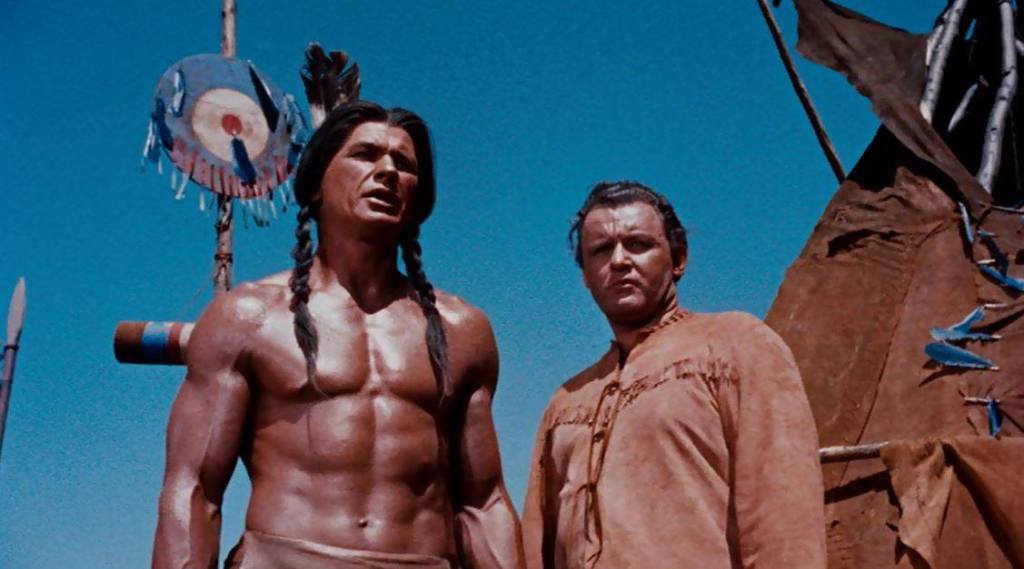
Some of the performances are very effective in the film. Rod Steiger’s Irish, confederate Sioux is an interesting character and the actor gives it his all as you’d expect. I’m a big fan of Steiger and his performance here only solidifies my respect for him. Brian Keith’s Captain Clark arrives fairly late in the proceedings and comes across as a tough, but honest man of integrity at a point when the movie really needs him. He has an excellent scene with Steiger where he debates the old confederate’s reasons for renouncing his citizenship with both sound logic, empathy, kindness and a hint of likable sarcasm all at the same time. It’s one of the best scenes in the film. And likewise, Charles Bronson, the most buff Hollywood Indian to ever strip down to a loincloth, comes across as a reasonable and kind tribal chief in his dealings. Bronson had played Indians before, but he was usually more of the renegade, warpath variety, so it was nice seeing him as a good guy here. H.M. Wynant took the renegade Indian role here which you might have expected for Bronson at the time. He’s suitably fierce but one-dimensional. The same can be said for Ralph Meeker as Lieutenant Driscoll. He’s pretty much just a stereotypical jerk. He’s good at being a jerk though! And Sarita Montiel, voiced by Angie Dickinson, is quite the beauty as Yellow Moccasin. We discussed H.M. Wynant and RUN OF THE ARROW with author Steven Peros on the “This Week in Charles Bronson Podcast.” Check out that interview below:

I’ve recently heard RUN OF THE ARROW compared to Kevin Costner’s DANCES WITH WOLVES, and there are definitely many similarities. I won’t go into all of those here, but one of the things I appreciated the most about RUN OF THE ARROW is the fact that the movie makes its feelings known about politics. In a movie filled with characters who have had their lives upended by the various decisions of political leaders, director Samuel Fuller has crafted a story that focuses most sharply on defining the quality of men based on what’s in their “hearts.” When it’s all said and done, oftentimes the only control we have is the way we respond to the events in our lives, and that’s not politics, it’s personal. To drive this home, in one of their conversations, Walking Coyote tells O’Meara that he could have been a chief if he had wanted to be. When O’Meara pushes the old scout on why he didn’t want the position, Walking Coyote responds with, “Because I hate politics!” On that point, I couldn’t agree more. 

Horror On TV: The Dead Don’t Die (dir by Curtis Harrington)


For today’s horror on television, we have a 1975 made-for-television movie called The Dead Don’t Die!

The Dead Don’t Die takes place in Chicago during the 1930s.  George Hamilton is a sailor who comes home just in time to witness his brother being executed for a crime that he swears he didn’t commit.  Hamilton is convinced that his brother was innocent so he decides to launch an investigation of his own.  This eventually leads to Hamilton not only being attacked by dead people but also discovering a plot involving a mysterious voodoo priest!

Featuring atmospheric direction for Curtis Harrington and a witty script by Robert Bloch, The Dead Don’t Die is an enjoyable horror mystery.  Along with George Hamilton, the cast includes such luminaries of “old” Hollywood as Ray Milland, Ralph Meeker, Reggie Nalder, and Joan Blondell.  (Admittedly, George Hamilton is not the most convincing sailor to ever appear in a movie but even his miscasting seems to work in a strange way.)

And you can watch it below!

Enjoy!

Horror on TV: The Night Stalker (dir by John Llewelyn Moxey)


Long before he achieved holiday immortality by playing the father in A Christmas Story, Darren McGavin played journalist Carl Kolchak in the 1972 made-for-TV movie, The Night Stalker.  Kolchak is investigating a series of murders in Las Vegas, all of which involve victims being drained of their blood.  Kolchak thinks that the murderer might be a vampire.  Everyone else thinks that he’s crazy.

When this movie first aired, it was the highest rated made-for-TV movie of all time.  Eventually, it led to a weekly TV series in which Kolchak investigated various paranormal happenings.  Though the TV series did not last long, it’s still regularly cited as one of the most influential shows ever made.

The Night Stalker is an effective little vampire movie and Darren McGavin gives an entertaining performance as the rather nervous Carl Kolchak.

Enjoy!

Film Review: The Naked Spur (dir by Anthony Mann)


First released in 1953, The Naked Spur is one of the most cynical and downbeat movies that I’ve ever seen.

It’s also one of the most visually beautiful.  Filmed in the Rockies and presented in glorious Technicolor, The Naked Spur is a western that is full of amazing scenery, from green forests to snow-capped mountains to a river that, under different circumstances, would probably be a wonderful place to just sit down and think for a spell.  Director Anthony Mann crafts an image of the American frontier that makes it easy to understand why anyone would want to explore it and build a new life there.  Mann contrasts the beauty of nature with the ugliness of the people who trample across it.

Jesse Tate (Millard Mitchell) is a grizzled and somewhat sickly prospector who runs into a stranger named Howard Kemp (James Stewart).  Kemp is, at first, antagonistic and paranoid but soon, he offers to pay Tate $20 if Tate will help him track down an outlaw named Ben Vandergroat.  Vandergroat, wanted for the murder of a U.S. marshal, is believed to be hiding in the mountains.  In need of the money, Jesse agrees.  Soon, he and Kemp are joined by another wanderer, a recently discharged soldier named Roy Anderson (Ralph Meeker).  From the minute that Roy shows up, it’s obvious that he’s not being totally honest about why he’s wandering around the Rockies.

As for Ben Vandergroat (Robert Ryan), he is indeed hiding in the mountains.  He’s accompanied by Lina Patrch (Janet Leigh), a naive young woman whose late father was one of Ben’s partners-in-crime.  Lina looks up to Ben as a father figure and refuses to believe that he could possibly be guilty of any of the things that he’s been accused of doing.  Ben, meanwhile, manipulates Lina into doing his bidding.

After being captured by Kemp, Jesse, and Roy, Ben proves himself to be far more clever than he initially seems.  After revealing that Kemp isn’t who Jesse assumed him to be, Ben works to try to turn the three men against each other.  There’s a reward on Ben’s head and, after Kemp reluctantly agrees to share the money with Jesse and Roy, Ben mentions that there will be a lot more money if its split two ways instead of three.  Soon, Ben has the three men distrusting each other even more than they already did.  However, Lina finds herself falling in love with Kemp.

The Naked Spur is a great film.  Featuring only five-speaking parts, it plays out like a particularly intense play and every single member of the cast does a great job of bringing the film’s characters to life.  Robert Ryan is coolly manipulative as the cocky Ben while Ralph Meeker is crudely menacing as the untrustworthy Roy Anderson.  Millard Mitchell is, at times, heart-breaking as the sickly prospector.  Janet Leigh reveals the strength underneath Lina’s naive persona.  Of course, the film is stolen by James Stewart, who is convincingly bitter and ultimately rather poignant as Howard Kemp.  Kemp feels like a continuation of the character that Stewart played in Broken Arrow He’s seen the worst that humanity has to offer.  Even in the beautiful Rockies, Stewart’s character cannot escape the ugliness that he’s witnessed firsthand.  Stewart’s performance as that haunted and angry Howard Kemp is one of his best.

The Naked Spur is an intelligent and well-acted western and one of eight movies that Stewart made with director Anthony Mann.  It’s psychological complexity, beautiful scenery, compelling script, and brilliant cast make it a true classic.

Days of Paranoia: The Anderson Tapes (by Sidney Lumet)


In 1971’s The Anderson Tapes, Sean Connery stars as Duke Anderson.

Duke is a career criminal, a safecracker who has just spent ten years in prison.  He’s released, alongside Pops (Stan Gottlieb), who spent so much time behind bars that he missed two wars and the Great Depression, and the quirky Kid (Christopher Walken, making his film debut).  Duke immediately hooks up with his former girlfriend, Ingrid (Dyan Cannon), and decides to rob the luxury apartment building where Ingrid is now living.

Of course, Duke will have to put together a crew.  It’s not a heist film without a quirky crew, is it?  Duke recruits the Kid and Pops.  (The Kid is happy to be in the game but he’s not a fan of violence.  Pops, meanwhile, has none of the skills necessary for living in the “modern” world and would much rather return to prison.)  Duke also brings in the flamboyant Tommy Haskins (an overacting Martin Balsam) and driver Edward Spencer (Dick Anthony Williams).  Duke goes to the mob for backing and Pat Angelo (Alan King) gives it to him on the condition that he take along a sociopathic racist named Socks (Val Avery) and that Duke kills Socks at some point.  Duke reluctantly agrees.

So far, this probably sounds like a conventional heist film.  Director Sidney Lumet mixes comedy and drama with uneven results but, overall, he does a good job of ratcheting up the tension and The Anderson Tapes is a good example of one of my favorite mini-genres, the “New Yorkers will be rude to anyone” genre.  At first glance, Sean Connery seems to be playing yet another super smooth operator, a confident criminal with a plan that cannot fail.  Duke seems like a criminal version of James Bond,  However, as the film progresses, we start to suspect that things might be getting away from Duke.  When Duke has to go the Mafia for support and is told that killing Socks is now a part of the job, we see that Duke isn’t as in-control of the situation as we originally assumed.  This is the rare Sean Connery film where he has someone pushing him around.

(Apparently, Connery took this role as a part of his effort to escape being typecast as Bond.  Perhaps that explains why Duke seems like almost a deconstruction of the James Bond archetype.)

Of course, what really lets us know that Duke isn’t as in-charge as he assumes is the fact that four different law enforcement agencies are following his every move.  From the minute he gets out of prison, Duke is being watched.  The apartment is bugged.  Security cameras records his every move.  Once the heist begins, we’re treated to flash forwards of breathless news reports.  The Anderson Tapes is less a heist film and more a portrait of the early days of the modern Surveillance State.  Of course, none of the agencies make any moves to stop Duke because doing so would reveal their own existence.  The film really does become a portrait of a government that has gotten so big and intrusive that it’s also lost the ability to actually do anything.

The Anderson Tapes is entertaining, even if it’s not really one of Lumet’s best.  Connery is, as always, a fascinating screen presence and it’s always entertaining to see a young Christopher Walken, showing early sings of the quirkiness that would become his signature style.  The Anderson Tapes is a portrait of a world where you never know who might be listening.

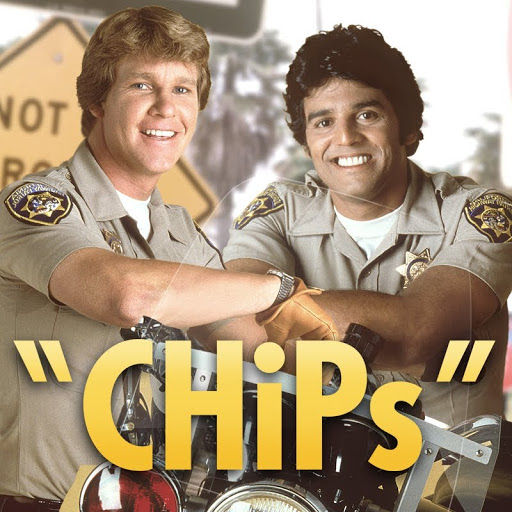
Late Night Retro Television Review: CHiPs 3.6 “Counterfeit”


Welcome to Late Night Retro Television Reviews, a feature where we review some of our favorite and least favorite shows of the past!  On Mondays, I will be reviewing CHiPs, which ran on NBC from 1977 to 1983.  The entire show is currently streaming on Prime!

Tonight’s episode is weird.

Episode 3.6 “Counterfeit”

(Dir by John Florea, originally aired on October 20th, 1979)

Ponch is shocked to discover that he’s carrying several counterfeit twenties.  He turns the money into the Treasure Department, hoping that it will mean receiving an monetary award.  Instead, he’s told that his reward is helping the government crack down  on the bad guys.  Ha!  Take that, Ponch!

That said, you better believe that Ponch is there to help arrest the counterfeiters, who turn out to be a bunch of phony preachers working out of a church.  I know that sounds like the sort of thing that could be interesting.  But, for the most part, these guys are still just generic CHiPs bad guys, even if one of them is played by veteran screen tough guy Ralph Meeker.

Meanwhile, Ponch goes on a date with a woman and is upset when it appears that she’s shallow and doesn’t want to talk about anything that is the least bit intellectual.  That’s our, Ponch!  He’s never shallow!  Fortunately, it turns out that his date isn’t shallow either.  She was just pretending to be shallow to test whether or not Ponch was shallow.  And now, it’s time to dance!  Wait, what?  That doesn’t make any sense.  Ponch — when are you going to settle down?  Disco isn’t going to last forever.

While that’s going on, architect James O’Hara (played by veteran dwarf actor Billy Barty) becomes frustrated with people assuming that he can’t drive because of his size.  He gets tired of all the dumb jokes and the condescending remarks.  As a result, he keeps getting into minor accident whenever he drives on the highway.  This was a strange storyline, largely because O’Hara’s scenes made up over half the episode despite the fact that he had never appeared on the show before and he barely interacted with the members of the Highway Patrol.  A part of me wonders if maybe this episode was meant to be a backdoor pilot for a series about James O’Hara.  The other weird thing about this episode is that O’Hara’s frustration over people making fun of his height was often played for laughs.  The whole thing just felt well-intentioned but oddly tone deaf.

If you’re keeping track, this episode had two Ponch storylines and a storyline about a guy we had never seen before.  Sorry, Baker!  If we had any doubts about who was the favored partner as far as this show goes, this episode erased them.

This whole episode just felt weird.  On the plus side, there was a lot of nice California scenery and there were quite a few accidents, which is the main reason why most people would have been watching the show in the first place.  But this episode really is an example of how a show can get bogged down with a character that we’ve never seen before and that we’ll probably never see again.  The episode just never comes together.

Horror on the Lens: The Night Stalker (dir by John Llewelyn Moxey)


For today’s horror on the lens, we have a real treat!  (We’ll get to the tricks later…)

Long before he achieved holiday immortality by playing the father in A Christmas Story, Darren McGavin played journalist Carl Kolchak in the 1972 made-for-TV movie, The Night Stalker.  Kolchak is investigating a series of murders in Las Vegas, all of which involve victims being drained of their blood.  Kolchak thinks that the murderer might be a vampire.  Everyone else thinks that he’s crazy.

When this movie first aired, it was the highest rated made-for-TV movie of all time.  Eventually, it led to a weekly TV series in which Kolchak investigated various paranormal happenings.  Though the TV series did not last long, it’s still regularly cited as one of the most influential shows ever made.

The Night Stalker is an effective little vampire movie and Darren McGavin gives a great performance as Carl Kolchak.

Enjoy!

The TSL’s Horror Grindhouse: Without Warning (dir by Greydon Clark)


1980’s Without Warning opens with a father (Cameron Mitchell) and his gay son (Darby Hinton) on a hunting trip.  The father taunts his son about not being what the father considers to be a real man.  He says that his son would have no chance of surviving in the wilderness.

“Why does it always have to be like this?” the son asks with a sincerity that will break your heart.

Suddenly, a bloodsucking starfish flies through the air, lands on the father, and starts to suck out his blood with a phallic stinger.  The father dies while his son watches.  The son picks up his rifle and prepares to fight back.  This will be the son’s chance to prove that his father was incorrect.  This is the son’s chance to prove that he can survive in the wilderness and….

Just kidding.  The son forgot to load the rifle and promptly gets a starfish to the eye.

That’s the type of film that Without Warning is.  Characters are introduced.  The majority of them are played by B-actor who have seen better days.  They get a few minutes of character development.  Then, they die and the viewer is left feeling a bit depressed because they all seemed like they deserved just a bit more screentime than they received.  Larry Storch shows up as a boy scout leader who gets a starfish to the back while trying to light a cigarette.  Neville Brand, Ralph Meeker, and Sue Anne Langdon hang out in a bar and refuse to believe that the Earth has been invaded by blood-sucking starfish.  Jack Palance plays a hunter and gas station owner who wants to capture an alien as a trophy.  Martin Landau plays Sarge, an unbalanced Vietnam Vet who has been telling people for years that there are aliens out there.  Everyone laughed at old Sarge but they won’t be laughing for long!  At the time this film was made, Palance was a two-time Oscar nominee.  He finally won his Oscar for City Slickers, a decade after Without Warning.  Martin Landau, for his part, won his Oscar 15 years after Without Warning.  Good for them.  If nothing else, this movie should remind everyone who has dismissed Eric Roberts’s chances that there’s still time!

That said, none of these familiar faces are the stars of the film.  Instead, the majority of the film follows four teenagers on a road trip, Sandy (Tarah Nutter), Greg (Christopher S. Nelson), Beth (Lynn Theel), and Tom (David Caruso).  David Caruso as a sex-crazed teenager sounds more amusing than it actually is.  If anything, the sight of him wearing shorts and t-shirt is almost blinding.  (As a fellow redhead, I sympathize.  We burn but we don’t tan.)  Tom and Beth die early on, leaving Greg and Sandy to try to escape from the alien (Kevin Peter Hall) who is tossing around the starfish.  Both characters are pretty generic but Christopher Nelson is at least likable.

Without Warning has a reputation for being the best film that Greydon Clark ever directed and I would agree that it’s one of his better ones, though I prefer The Forbidden Dance.  Then again, when you consider some of the other films that Clark directed, it’s easy to see that Without Warning didn’t exactly have a huge bar to clear.  Though the script borrows a bit too much from nearly every other horror film ever made, Without Warning is nicely paced and the killer starfish are genuinely frightening and their bloodsucking is almost Cronenbergian in its ick factor.  Just as he would for John Carpenter, cinematographer Dean Cundey gives us some nicely eerie shots of the alien.  Landau and Palance go all out, understanding that subtlety has no place in a film like this.  Without Warning is a dumb B-movie but it’s definitely entertaining.

Without Warning (1980, dir by Greydon Clark, DP: Dean Cundey)

12 Oscar Snubs From the 1950s


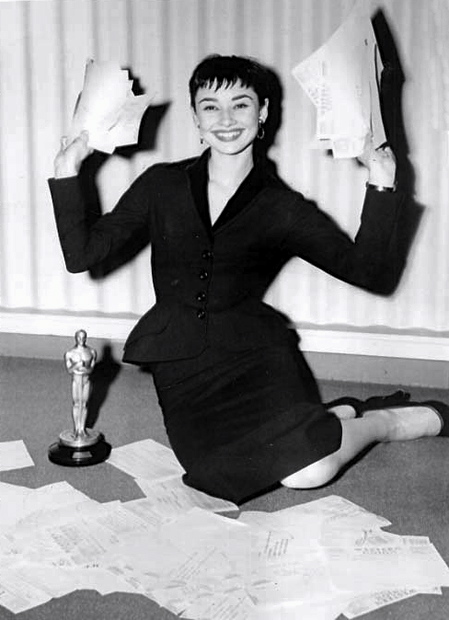
Audrey Hepburn and her Oscar.  At least the Academy didn’t snub her!

Continuing our look at the Oscar snubs of the past, it’s now time to enter the 50s!

World War II was over. Eisenhower was President. Everyone was worried about communist spies. And the Hollywood studios still reigned supreme, even while actors like Marlon Brando and James Dean challenged the establishment.  There were a lot great film released in the 50s.  There were also some glaring snubs on the part of the Academy.  Here’s twelve of them.

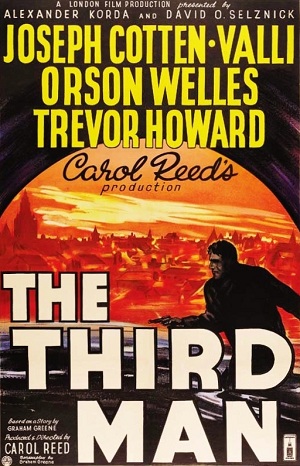
1950: The Third Man Is Not Nominated For Best Picture

….and Orson Welles was not nominated for Best Supporting Actor!  The Third Man received three Oscar nominations, for Director, Cinematography, and Editing.  The fact that Welles, Joseph Cotten, Alida Valli, and the film’s score were not nominated (and that King Solomon’s Mines was nominated for Best Picture instead of The Third Man) remains one of the more surprising snubs in Oscar history.

1952: Singin’ In The Rain Is Not Nominated For Best Picture

What the Heck, Academy!?  This was the year that The Greatest Show On Earth won the Best Picture Oscar.  Personally, I don’t think The Greatest Show On Earth is as bad as its reputation but still, Singin’ In The Rain is a hundred times better.

1953: Alan Ladd Is Not Nominated For Best Actor For Shane

How could Shane score a nomination for Best Picture without Shane himself receiving a nomination?

1954: Rear Window Is Not Nominated For Best Picture

Rear Window was not totally ignored by the Academy.  Alfred Hitchcock received a nomination for directing.  It also received nominations for Best Adapted Screenplay, Cinematography, and Sound.  However, Rear Window was not nominated for Best Picture and James Stewart, Grace Kelly, Raymond Burr, and Thelma Ritter all went unnominated as well.  Today, Rear Window is definitely better-remembered than the majority of 1954’s Best Picture nominees.  Certainly, it deserved a nomination more than Seven Brides For Seven Brothers and Three Coins in The Fountain.

1955: Ralph Meeker Is Not Nominated For Best Actor For Kiss Me Deadly

I guess I shouldn’t be surprised.  If the Academy wasn’t going to nominate Rear Window for Best Picture, there was no way that they would have nominated Ralph Meeker for playing a sociopathic private detective who, even if inadvetedly, helps to bring about the end of the world.

1955: Rebel Without A Cause Is Not Nominated For Best Picture or Best Actor

The 1955 Best Picture lineup was a remarkably weak one.  The eventual winner was Marty, a likeable film that never quite escapes its TV roots.  Picnic has that great dance scene but is otherwise flawed.  Mister Roberts was overlong.  Love Is A Many-Splendored Thing and The Rose Tattoo are really only remembered by those of us who have occasionally come across them on TCM.  Perhaps the best-remembered film of 1955, Rebel Without A Cause, received quite a few nominations but it was not nominated for Best Picture.  And while the Rebel himself, James Dean, was nominated for Best Actor, it was for his performance in East of Eden.  1955 was a strange year.

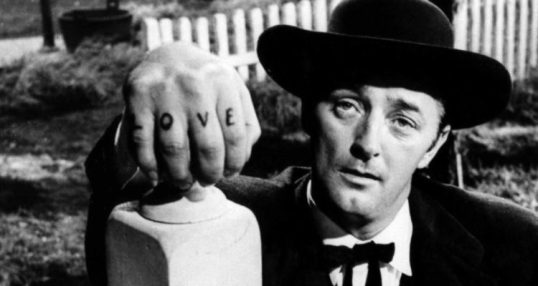
1955: Robert Mitchum Is Not Nominated For Best Actor For The Night of the Hunter

Robert Mitchum only received one Oscar nomination over the course of his entire career, for 1945’s The Story of G.I. Joe.  He deserved several more.  His performance as the villainous preacher in The Night of Hunter made Reverend Harry Powell into one of the most iconic film characters of all time.

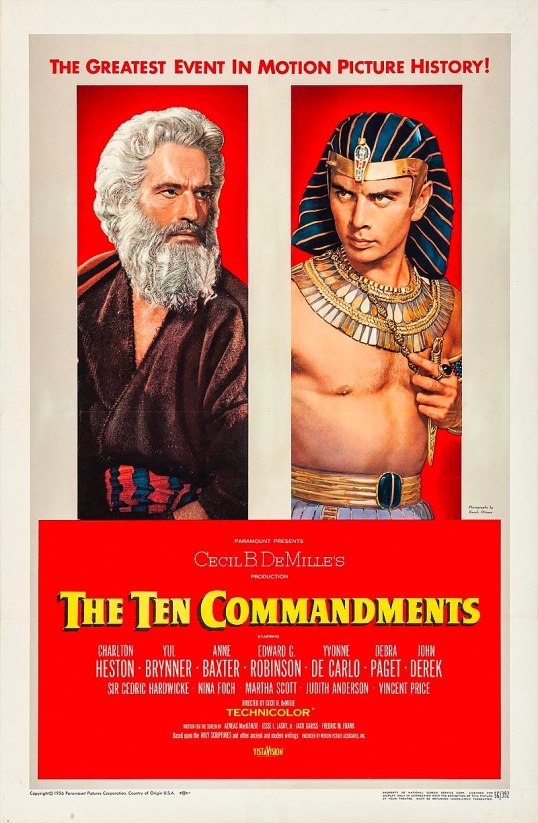
1956: Cecil B. DeMille Is Not Nominated For Best Director For The Ten Commandments

Cecil B. DeMille was only nominated once for Best Director, for 1952’s The Greatest Show On Earth.  DeMille, however, deserved to be nominated for The Ten Commandments.  As campy as DeMille’s films can seem today, he was an expert storyteller and that’s certainly evident when one watches The Ten Commandments, a film that holds the viewer’s attention for nearly four hours.  DeMille deserved a nomination for the Angel of Death scene alone.  The screams in the night are haunting.

1957: Henry Fonda Is Not Nominated For Best Actor For 12 Angry Men

With 12 Angry Men, Fonda did something that very few actors can.  He made human decency compelling.  One gets the feeling that, much like Tom Hanks in Captain Phillips, Fonda made it look so easy that the Academy took him for granted.

1958: Touch Of Evil Is Totally Ignored

Anyone who had researched the history of the Academy knows that there was no way that the 1950s membership would have ever honored Orson Welles’s pulp masterpiece, Touch of Evil.  That said, it still would have been nice if they had.  Touch of Evil has certainly go on to have a greater legacy than Gigi, the film that won Best Picture that year.

1958: Vertigo Is Almost Totally Ignored

Vertigo did receive nominations for Art Direction and Sound but Alfred Hitchcock, James Stewart, and the film itself were snubbed.

1959: Some Like It Hot Is Not Nominated For Best Picture or Best Actress

Some Like It Hot received 6 Oscar nominations, including nominations for Best Director, Best Actor, and Best Adapted Screenplay.  It did not receive a nomination for Best Picture and, sadly, Marilyn Monroe did not receive a nomination for Best Actress.  Much as with Henry Fonda in 12 Angry Men, one gets the feeling that the Academy took Monroe for granted.  It’s sad to realize that, while two actresses have been nominated for playing Marilyn Monroe, Monroe herself would never be nominated.

Agree?  Disagree?  Do you have an Oscar snub that you think is even worse than the 12 listed here?  Let us know in the comments!

Up next: Things get wild with the 6os!

Night of the Hunter (United Artists 1955; D: Charles Laughton)

Horror on the Lens: The Night Stalker (dir by John Llewelyn Moxey)


For today’s horror on the lens, we have a real treat!  (We’ll get to the tricks later…)

Long before he achieved holiday immortality by playing the father in A Christmas Story, Darren McGavin played journalist Carl Kolchak in the 1972 made-for-TV movie, The Night Stalker.  Kolchak is investigating a series of murders in Las Vegas, all of which involve victims being drained of their blood.  Kolchak thinks that the murderer might be a vampire.  Everyone else thinks that he’s crazy.

When this movie first aired, it was the highest rated made-for-TV movie of all time.  Eventually, it led to a weekly TV series in which Kolchak investigated various paranormal happenings.  Though the TV series did not last long, it’s still regularly cited as one of the most influential shows ever made.

Anyway, The Night Stalker is an effective little vampire movie and Darren McGavin gives a great performance as Carl Kolchak.

Enjoy!