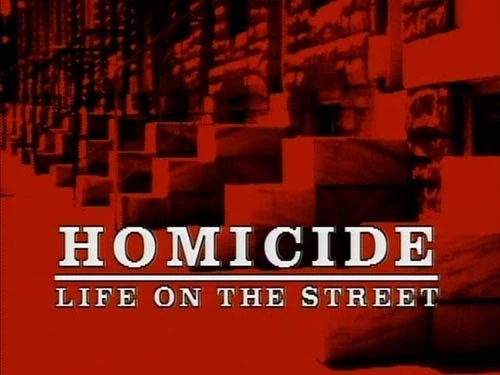
Retro Television Review: Homicide: Life on the Street 4.6 “Hate Crimes”


Welcome to Retro Television Reviews, a feature where we review some of our favorite and least favorite shows of the past!  On Sundays, Lisa will be reviewing Homicide: Life On The Street, which aired from 1993 to 1999, on NBC!  It  can be viewed on Peacock.
This week, Lewis solves a cold case.

Episode 4.6 “Hate Crimes”

(Dir by Peter Weller, originally aired on November 17th, 1995)

On the eve of Thanksgiving, a young man is killed outside of a gay night club.  Bayliss and Pembleton are investigating.  All of the witnesses say that the man was jumped by a group of skinheads.  While Pembleton, as usual, is set on capturing the guilty party, Bayliss is uncomfortable about the what he assumes to have been the victim’s identity.

Bayliss is a homophobe?  Really?

I guess this development doesn’t come totally out-of-nowhere.  There was an earlier episode where Bayliss was clearly uncomfortable dealing with an S&M-themed murder so he does have a history of getting weirded out by anything that goes against what he considers to be the straight and the conventional.  At the same time, it’s kind of hard to feel that Bayliss is often just whatever the writers need him to be at the moment.  For this episode, Pembleton needed a homophobe to deal with.  And, since Felton and Bolander are no longer on the show, the job fell to Bayliss, even though Bayliss — even at his most awkward and uncomfortable — has never been presented as being prejudiced before. For me, it’s hard not to feel that the episode would have been even more interesting if it was Pembleton — self-righteous, faith-struggling, Jesuit-trained Pembleton — was uncomfortable with the victim’s identity and if, for once, Bayliss could have been the tolerant one.  Pembleton’s a great character but occasionally, it’s hard not to feel that he’s almost too flawless.

That said, this storyline features a brilliant twist.  When Pembleton and Bayliss talk to the victim’s father (the great Terry O’Quinn), they ask him if he knew that his son was gay.  The father gets angry at them, says that if his son was gay then he deserved to die, and then kicks them out of the house.  Later, Bayliss and Pembleton learn that the victim was not gay.  Instead, the skinheads assumed he was gay and attacked him because he was outside of the nightclub.  Bayliss and Pembleton return to the victim’s father and tells him that his son wasn’t gay.  Only then does the victim’s father start to cry.  For him, his son was not worthy shedding a tear over until he was assured that his son wasn’t gay.  Of course, the father doesn’t realize that his prejudice is the same prejudice held by the skinheads who killed his son.  He’s stunned to hear his son was killed due to a mistake but it doesn’t occur to him that he rejected his son because he made the same mistake.

While that was going on, Lewis defied Howard and solved the Erica Chilton case.  (During the previous season, Howard was given the Chilton case after Crosetti committed suicide.  The since-departed Felton lost a key piece of evidence.)  When Erica Chilton’s daughter was brought to the office because she had been having dreams about her mother’s death, Lewis and Kellerman were the two detectives that talked to her.  Howard was not happy about this, saying that Lewis should have let her handle the interrogation.  Lewis. who has not been happy about Howard getting promoted to sergeant, told her to back off and to stop criticizing his former partner.  While the two of them were arguing, Kellerman got the little girl to remember that the murderer was wearing a monogrammed shirt and that his initials with “T.M.”  At the time of her murder, Erica was engaged to Tom Marans (Dean Winters).

Howard demanded that Lewis tell her before he interrogated Marans so that she could be in the Box.  So, of course, after Lewis and Kellerman tricked Tom into coming down to the station by telling him they needed him to look over some new evidence, Lewis proceeded to interrogate Tom without Howard being there.  With help of a new voice analysis machine, Lewis was able to get Tom to confess without much effort.  Lewis was also able to get a date with the voice analyst, Debbie Haskell (Allison Smith).  Sgt. Howard, meanwhile, got very, very pissed off.

Finally, Brodie (Max Perlich) — the cameraman who helped Lewis and Kellerman out a few episodes ago — got a new job when he was hired to help the Homicide Department film crime scenes.  I’m kind of amazed that they didn’t already have someone to do that.

This was a good episode, even if Bayliss’s homophobia did feel a bit forced.  While Andre Braugher and Kyle Secor were as great as always, I have to say that Clark Johnson really stole this episode as the cocky and rebellious Meldrick Lewis.  Howard is absolutely right about Lewis not treating her with the respect that she deserves.  At the same time, Lewis did finally solve the Chilton case.  So, maybe they’re even.

Probably not.
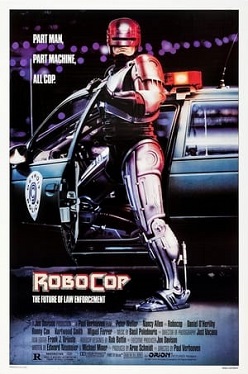
 

A Scene That I Love: Robocop Comes Home


Today is the birthday of Peter Weller, the actor best-known for playing the original Robocop in 1987.  Robocop is best-known for being violent and satirical but it also features one of the saddest scenes that I’ve ever seen.

Trying to piece together who he was before he was rebuilt, Robocop visits his former home and has flashbacks to his past life as Officer Murphy.  The house is empty now but the flashbacks show that it was once full of life.  Even with only half of his face visible, Weller shows Murphy’s loneliness as he walks around the house that he once called home.

Top Of the World (1997, directed by Sidney J. Furie)


Ray Mercer (Peter Weller) has just gotten out of prison and already, he and his wife Rebecca (Tia Carrere) are heading to Nevada for a quicky divorce.  However, a stopover in Las Vegas leads to Ray having a run of luck in a casino owned by Charles Atlas (Dennis Hopper).  Ray and Rebecca start to reconsider their divorce but their reconciliation is temporarily put on hold when the casino is robbed by a bunch of thieves led by Martin Kove.  Because of Ray’s criminal history, the police (led by David Alan Grier) consider Ray to be the number one suspect.  Ray and Rebecca try to escape from the casino and clear Ray’s name, leading to a night on nonstop action and an explosive climax at the Hoover dam.

One thing that you can say about Top of the World is that it certainly isn’t boring.  The action starts earlier and lasts nonstop until the end of the movie.  No sooner has Ray escaped from one scrape than he finds himself in another.  Despite the low-budget, the action scenes are often spectacularly staged and exciting to watch.  Another thing that you can say about Top of the World is that, for a B-movie, it certainly has a packed cast.  Along with Weller, Carrere, Hopper, Grier, and Kove, the movie also finds room for Peter Coyote, Joe Pantoliano, Ed Lauter, Gavan O’Herlihy, Eddie Mekka, Cary-Hiroyuki Tagawa, and even Larry Manetti of Magnum P.I. fame.  This movie paid off a lot of mortgages and probably funded more than a few vacations.

One thing you can’t say about Top of the World is that it makes any sense.  It doesn’t.  There are so many holes in the plot that you could fly a helicopter through them and that’s exactly what this film does.  But with the nonstop action and the entertaining cast, most people won’t mind.  I certainly didn’t!

Film Review: Robocop 2 (dir by Irvin Kershner)


Robocop 2, the 1990 sequel to Robocop, finds Detroit on the verge of getting nuked.

No, not nuked like that! Instead, there’s a new designer drug called Nuke and it’s tearing the city apart. Of course, Detroit has problems that go beyond just the new drug. The city is almost bankrupt. OCP, under the leadership of The Old Man (Dan O’Herlihy), is still running things behind the scenes. There’s still all sorts of petty crime to deal with. To be honest, it seems like the city has gotten even more out-of-control now that Clarence Boddiker is no longer around to oversee things.

Fortunately, Robocop (Peter Weller) is still patrolling the streets! But, for how long? There are lawyers who claim that Robocop is a huge potential liability and when you consider some of the stuff that went on during the first film, it’s hard not to see their point. His ex-wife is also suing the police department, claiming that Robocop has been harassing her. Despite being a robocop, our hero is still Murphy and he’s still haunted by memories of the family he once had. Or, at least, he is for the first few minutes of the film. That storyline kind of gets abandoned, along with a lot of other storylines.

While OCP is trying to develop a second robocop, one that can be mass produced and used to replace the human police force (the majority of whom have gone out on strike), a cult leader named Cain (Tom Noonan) is attempting to take over the city’s Nuke trade. Working with Cain is the usual gang of flamboyant malcontents. His second-in-command is a sociopathic child named Hob (Gabriel Damon). Hob may be a kid but he’ll kill anyone and he’ll enjoy himself while he’s doing it.

Robocop 2 is a bit of a mess. It apparently was rushed into production after the surprise success of the first film and filming started before there was even a completed script. As a result, there are a lot of storylines and themes that are brought up and then seem to mysteriously disappear. The film duplicates Paul Verhoeven’s satirical approach to the first film’s ultra-violence but, unfortunately, it does so in the most superficial way possible. Once again, we get the cheerful and vapid news reports about impending doom and once again, the violence is completely and totally over-the-top. But none of it carries any of the bite that was present in the first film. The first film worked because director Verhoeven actually was trying to make a larger point with all of the violence and the hints of growing fascism. He was attempting to challenge the audience and to get them wonder why they found all of the terrible thing happening in Robocop to be so entertaining. The sequel was directed by Hollywood veteran Irvin Kershner who was a good, workmanlike director but who also didn’t possess Verhoeven’s subversive sensibility. Far too often, Robocop 2 just feels like it’s going through the motions.

That’s not say that Robocop 2 isn’t occasionally an effective film. Dan O’Herlihy is wonderfully amoral as the Old Man and Tom Noonan is a worthwhile villain. Though Peter Weller has said that he wasn’t happy with how the overall film turned out, he still make for a sympathetic hero and he still manages to capture Robocop’s anguish without letting us forget that the character is still essentially a machine. I’m not really a big fan of films that use evil children for cheap shocks but Gabriel Damon is frequently chilling as Hob. Detroit is such a terrible place in the Robocop films that it’s not really a surprise when an evil child pops up and start shooting people. When compared to the first film, Robocop 2 may be a disappointment but it’s hardly a disaster.

Robocop 3 on the other hand….

Film Review: Robocop (dir by Paul Verhoeven)


Last week, I watched the original Robocop (along with Robocop 2 and Robocop 3) and I have to say that the first film holds up far better than I was expecting. Made and released way back in 1987, Robocop may be one of the most prophetic films ever made.

Consider the plot:

America is torn apart by crime and a growing gap between the rich and the poor. That was probably true in 1987 and it’s certainly true in 2021.

Throughout the film, we see news reports about what’s happening in the world. The news is always grim but the reporters are always cheerful and the main message is that, no matter what’s happening, the government is not to blame and anyone who questions the wisdom of the establishment is a fool. If that’s not a perfect description of cable news and our current state-run media, I don’t know what is.

The populace is often too busy watching stupid game shows to really pay attention to what’s happening all around them. I’m writing these words on a Wednesday, which means that Game of Talents will be on Fox tonight, immediately after The Masked Singer.

Detroit, a once proud center of industry, has now turned into a dystopian Hellhole where no one feels that they’re safe. Now, I don’t live in Detroit so I don’t know how true that is but I do know that most of the recent news that I’ve heard about the city has not exactly been positive. Also, this seems like a good time to point out that, even though the film is set in Detroit, it was shot in Dallas. Though the Dallas skyline has undoubtedly changed a bit since 1987, I still recognized several buildings while watching Robocop. Seeing Reunion Tower in the background of a movie that’s supposed to be set in Detroit was interesting, though perhaps not as interesting as seeing our City Hall transformed into the headquarters of Detroit’s beleaguered police force.

OCP, a multi-national conglomerate that’s run by the amoral but occasionally charming Old Man (played by the brilliant Dan O’Herlihy), has a contract with city of Detroit to run their police department. This certainly doesn’t seem far-fetched in 2021. Considering that we now have prisons that are run by private companies and that the government has shown a willingness to work with private mercenaries overseas, it’s not a stretch to imagine a city — especially one on the verge of bankruptcy — handing over the police department to a private company.

Two OCP executives — Dick Jones (Ronny Cox) and Bob Morton (Miguel Ferrer) — are competing to see who can be the first to create and develop a peace-keeping robot, a machine that will replace the need to employ (and pay) human police officers. Dick Jones goes with an actual robot, which malfunctions during a boardroom demonstration and guns down another executive. (The scene where the poor exec is targeted is both terrifying and darkly humorous at the same time. Particularly disturbing is how everyone in the boardroom keeps shoving him back towards the robot in order to ensure that they won’t accidentally be in the line of fire.) Bob Morton, however, takes a mortally wounded cop named Murphy (Peter Weller) and turns him into Robocop!

Robocop turns out to be a huge success and is very popular with the media. (Anyone who doubts this would really happen has obviously never watched news coverage of a drone attack.) As you can guess, Dick is not particularly happy about getting shown up by Morton and his robocop. Dick also happens to be secretly in league with Clarence Boddicker (Kurtwood Smith), the crimelord who blew Murphy apart in the first place.

(A gangster and a businessman working together!? I doubt that was shocking even in 1987.)

Robocop claims that he’s just a machine, without a past or emotions, but he’s still haunted by random flashes of his life as Murphy. Working with Lewis (Nancy Allen), Murphy’s former partner, Robocop tracks down Boddicker and his gang. A lot of people die in outrageously violent ways. (The scene where Boddicker and his gang use a shotgun to torture Murphy is still shocking, even after all these years.) The violence is so over-the-top that it soon becomes obvious that director Paul Verhoeven is deliberately trying to get those of us watching to ask ourselves why we find films like this to be so entertaining. On the one hand, Robocop is an exciting action film with a sense of humor. On the other hand, it’s the type of subversive satire of pop and trash culture to which Verhoeven would return with Basic Instinct, Starship Troopers, and Showgirls. This is the type of film that asks the audience, “What are you doing here?”

34 years after it was first made, Robocop remains a triumph. Peter Weller’s performance holds up well, as he does a great job of capturing Robocop’s anguish while, at the same time, never forgetting that the character is ultimately a machine, one that’s trapped in a sort of permanent limbo. I also really liked the performance of Miguel Ferrer, who takes a character who should be unlikable and instead makes him into a surprisingly sympathetic figure.

Of course, a film like this lives and dies on the strength of its villains and both Ronny Cox and Kurtwood Smith are ideally cast as Dick Jones and Clarence Boddicker. Kurtwood Smith especially took me by surprise by how believably evil and frightening he was. As a I watched the film, I realized that it was his glasses that made him so intimidating. Wearing his glasses, he looked like some sort of rogue poet, a sociopathic intellectual who had chosen to use his talents to specifically make the world into a terrible place. Boddicker’s crew was full of familiar actors like Paul McCrane, Ray Wise, and, as the always laughing Joe Cox, Jesse Goins. Interestingly enough, all of the bad guys seemed to genuinely be friends. Even though they were all willing to betray each other (“Can you fly Bobby?”), they also seemed to really enjoy each other’s company. That somehow made them even more disturbing than a group of bad guys who were only in it for the money. The villains in Robocop really do seem to savor the chance to show off just how evil they can be.

(Incidentally, for all of the Twin Peaks fans out there, this film features three members of the show’s ensemble: Miguel Ferrer, Ray Wise, and Dan O’Herlihy.)

Robocop holds up well as entertainment, prophecy, and satire. Though not much was expected from it when it was first released, it became a surprise hit at the box office. Needless to say, this led to a sequel. I’ll deal with that film in about an hour.

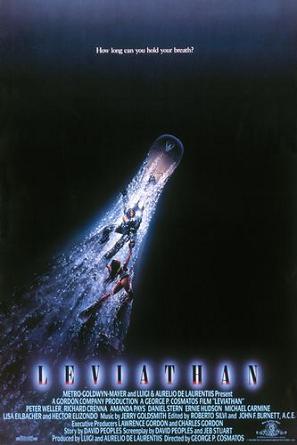
A Movie A Day #287: Leviathan (1989, directed by George Pan Cosmatos)


A group of miners are sent into a dangerous environment by an evil corporation.  When they explore an abandoned ship, they unknowingly bring a hostile creature onto their own vessel.  One of the crewman is killed when the creature mutates inside of his body.  The rest of the crew includes a scientist, one strong woman, one woman who cries, and a strong, silent captain.
Sound familiar?

No, it’s not Alien.  

Instead, it’s Leviathan, which could best be described as being Alien underwater with a dash of The Thing tossed in.  The main difference between Leviathan and the films that inspired it is that people are still watching Alien and The Thing while Leviathan is one of the most forgettable films that I have ever seen.  Peter Weller is the captain.  Richard Crenna is the scientist.  Amanda Pays has the Ripley role and Ernie Hudson fills in for Yaphet Kotto.  Daniel Stern plays Sixpack, who turns into a monster after he drinks contaminated Russian vodka.  (It happens to the best of us.)  Meg Foster, with her translucent eyes, represents the corporation.

That’s a good cast and the script was written by David Peoples (who also wrote Blade Runner, Unforgiven, and 12 Monkeys) and Jeb Stuart (who wrote Die Hard and The Fugitive).  The above average special effects were designed by Stan Winston.  Why, with all of these talented people involved in the production, is Leviathan so by the numbers and forgettable?  It probably had something to do with the presence of George Pan Cosmatos in the directing chair.  Cosmatos is also credited with directing Rambo: First Blood II, Cobra, and Tombstone.  The first two films starred Sylvester Stallone, who was known for directing all of his 80s films in every way but name only and everyone knows that Kurt Russell was in charge on Tombstone.

If you want to see Alien underwater done right, watch Deepstar Six.

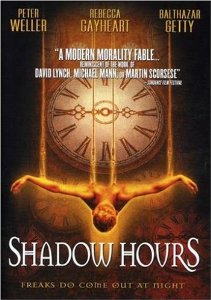
A Movie A Day #117: Shadow Hours (2000, directed by Isaac H. Eaton)


Straight from the direct-to-video graveyard comes this journey through the seedy underbelly of Los Angeles.  Michael Holloway (Balthazar Getty) used to drink every hour and snort cocaine every night.  That was the past.  Now, he is clean and sober.  Michael is married to Chloe (Rebecca Gayheart) and they have a baby on the way.  In desperate need of money to support his family, Michael gets a job working the night shift at a 24-hour gas station.  Most of his customers are the scum of the Earth until, one night, Stuart Chappell (Peter Weller) steps into the station.  Stuart claims to be a writer and he hires Michael to accompany him on an exploration of the dark side of L.A.  They start with strip bars and then eventually move on to fight clubs and BDSM parlors.  Everywhere they go, Stuart is recognized but everyone knows him by a different name.  Soon, Michael is not only drinking and doing drugs again but he is also the prime suspect in a murder.
Shadow Hours is a dumb but entertaining vision of Los Angeles as Hades.  It has loads of atmosphere but it’s all taken from other movies, a hint of Taxi Driver there and a pinch of 8mm here.  The film’s main weakness is that it stars Balthazar Getty, who, as an actor, has the least sympathetic screen presence this side of Edward Furlong.  Even if Getty was playing a paraplegic veteran who had devoted his life to finding good homes for stray puppies, he would still come across as unlikable.  Make him a loser who spend most of the movie lying to his pregnant wife and it is impossible to care what happens to Michael.  The film’s main strength is that it also stars Peter Weller, who is pitch perfect as the mysterious Stuart, who might be the Devil.  If the whole movie had just been Peter Weller going to bars and fight clubs and hanging out with Lydia Lunch, Shadow Hours would have been a B masterpiece.  It’s too bad he had to take an oil heir with him.

Horror on The Lens: Dark Prince: The True Story of Dracula (dir by Joe Chappelle)


So right now, if you wanted to, you could go down to your local theater and you could watch Dracula Untold and maybe learn about the origin of Count Dracula.

Or you could just sit here and watch the 2000 film Dark Prince: The True Story of Dracula below!  As directed by Joe Chappelle, this film is definitely low-budget but undeniably effective.  Rudolph Martin does a good job playing the title character and it’s always fun to see Peter Weller in a film like this.

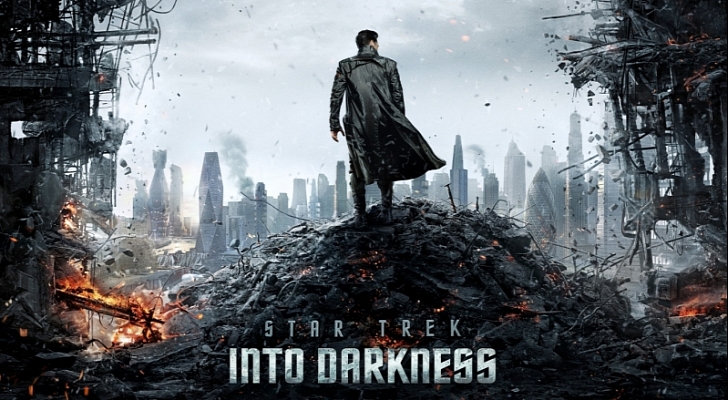
Trailer: Star Trek Into Darkness (International)


StarTrekIntoDarkness

Less than two months remain before the sequel to J.J. Abrams surprise reboot hit of Star Trek arrives in the theaters this summer. It’s set to be one of this summer’s tentpole event films and this later trailer looks to set to prove that to be true.

While the first two trailers went light on the main narrative of the sequel this international trailer looks to really focus on Benedict Cumberbatch’s character who is either going to be this Star Trek alternate timeline’s Khan or Gary Mitchell or an amalgam of the two. Either way the trailer is all about action and Sherlock-Smaug looking, talking and acting all superior evil towards Kirk and the rest of the Enterprise crew.

Star Trek Into Darkness is set for a May 17, 2013 release date.

Trailer: Star Trek Into Darkness (Super Bowl Exclusive)


StarTrekIntoDarkness

The sequel to J.J. Abrams’ 2009 Star Trek is just months away. It returns not just Abrams into the director’s chair but also the whole cast of the rebooted franchise back to boldly go where no one’s gone before.

Star Trek Into Darkness (still an awkward title but then we don’t to watch a film in the theaters because we like or don’t like how the title sounds) just released it’s latest trailer (this time a TV spot) during Super Bowl XLVII. The spot has new scenes and images that the previous teasers and trailers didn’t already show. We may have gotten a hint into the villain portrayed by Benedict Cumberbatch in the film. While the name Khan has never been mentioned in any ad and marketing spots since the film was announced I’d be very surprised if the villain is not some sort of analogue of that classic Star Trek rogue.

Star Trek Into Darkness is set for a May 17, 2013 release date.

Source: Joblo Movie Network