Horror Film Review: Alligator (dir by Lewis Teague)


1980’s Alligator begins in 1968.  While on vacation in Florida, a teenage girl named Marisa Kendall purchases a baby alligator named Ramon.  When she returns home to Chicago, her jerk of a father flushes Ramon down the toilet.

12 years pass.  Marisa (Robin Riker) becomes a herpetologist.  As for Ramon, he actually survives being flushed down the toilet and thrives in the sewer.  He eats the carcasses of animals that had been a part of an experiment involving a growth serum.  The serum had the desired effect of making the animals bigger but it also increased their metabolism to the extent that they became aggressive and had to eat constantly.  Evil industrialist Slade (Dean Jagger) is convinced that, by tossing the carcasses in the sewer, he’s ensured that no one will ever find out about the experiments.  Instead, he’s turned Ramon into a giant alligator who is always hungry.  Soon, the super-intelligent alligator is ambushing and eating sewer workers.

Burned-out Detective Dave Madison (Robert Forster) teams up with Marisa to solve the mystery of why so many body parts are turning up in the sewers.  It’s not easy.  No one wants to admit that there might be a giant alligator living under the city.  Everyone wants to believe that’s just an urban legend.  But, after a tabloid reporter (Bart Braverman) manages to snap a few photographs of Ramon before being devoured, the police are forced to deal with the fact that they’ve got an alligator on their hands.  As Slade continues to try to cover up his involvement, big game hunter Colonel Brock (Henry Silva) comes to town and announces that he will be capturing the alligator.

Directed by Lewis Teague and written by John Sayles, Alligator is a dark comedy disguised as a horror film.  While numerous people get eaten and the film ends on a properly ominous note, Alligator is obviously not meant to be taken seriously.  The cast is full of good actors who send up their own images.  That’s especially true in the case of Henry Silva, who appears to be having a blast as the hyper macho Colonel Brock.  Robert Forster, meanwhile, delivers his lines with a self-aware weariness that seems a bit more appropriate for a noir hero than a film about a detective investigating a giant alligator.  One reason why the film works is because Forster, Silva, and the rest of the cast understood exactly what type of film they were appearing in and they delivered their overheated lines with just enough wit to let the viewer know that the film was in on the joke.  The big and somewhat stiff-looking alligator may not look entirely real and it may move somewhat awkwardly but ultimately, it’s the most likable character in the movie.  It just wants to relax in the sewers but, every few minutes, someone else is bugging him.

When first released, Alligator struggled at the box office but it has since gone on to become a cult favorite.  Quentin Tarantino is a self-described fan and he had said he was inspired to cast Robert Forster as Max Cherry in Jackie Brown after seeing him as Dave Madison in this film.  That’s not bad for a movie about a giant alligator!

Retro Television Review: Miami Vice 2.22 “Trust Fund Pirates”


Welcome to Retro Television Reviews, a feature where we review some of our favorite and least favorite shows of the past!  On Mondays, I will be reviewing Miami Vice, which ran on NBC from 1984 to 1989.  The entire show can be purchased on Prime!

This week, things get weird in Miami!

Episode 2.22 “Trust Fund Pirates”

(Dir by Jim Johnston, originally aired on May 2ns 1986)

Pirate radio DJ Captain Hook (Richard Belzer) sits on his yacht in international waters and broadcasts music to Miami while, at the same time, brokering drug deals among other yacht owners.  His assistant is Noogie (Charlie Barnett), the informant who was all over the place during Miami Vice’s first season but who, up until this episode, was absent from the second season.

On another yacht, a group of Bolivians are gunned down by preppy young men who are led by Ivy League dropout Skip Mueller (Perry Lang).  Skip and his buddies brag about being pirates and cheerfully make jokes while standing over the bodies of the men and the women that they killed.

A seaplane pilot named Jackson Crane (a young Gary Cole) raids the Bolivian yacht and takes some of the boat’s equipment home with him.  Jackson is a longtime drug smuggler who claims that he’s on the verge of retirement.  He’s dating a woman named Lani (Nicole Fosse), who happens to be Skip’s sister.

In a trailer park, Jumbo (Tommy Chong) and his wife Fluffy (Denny Dillon) keep a running tally of how many rats they’ve killed while trying to buy drugs and fence stolen goods.  Jumbo calls everyone “man.”  Fluffy is good with a shotgun.

And, in the middle of all this, we’ve got two aspiring drug dealers named Burnett and Cooper.  Burnett and Cooper, of course, are actually Crockett and Tubbs.  Just two episodes ago, one of Miami’s fiercest drug lords figured out that Burnett and Cooper are actually cops but I guess he decided not to tell anyone, despite the fact that he still thinks Crockett owes him money.

It’s a bizarre episode, full of strange characters and a plot that has so many double-crosses that it’s hard to keep track of who is betraying who.  The episode was originally intended to be a sequel to Smuggler’s Blues, with Glenn Frey once again playing Jimmy the Pilot.  When Frey couldn’t fit a return appearance into his schedule, the script was rewritten to feature Gary Cole as a friend of Jimmy’s.  That said, it’s still obvious that the script was originally written more to highlight a popular guest star than to tell a totally coherent story.

Fortunately, Miami Vice works best when its a bit incoherent.  One the major themes of the show is that no one can be trusted and that everyone is willing to betray everyone else.  The world of Miami Vice is often illogical because it’s a world full of illogical people who tend to do whatever pops into their head at any given moment.  Another major theme is that everyone either wants to get rich from selling drugs or they’re just adrenaline junkies who get a high from being involved in the underground.  Skip and his friends are rich.  They just enjoy killing people and pretending to be gangsters.  This is one of the more violent and bloody episodes of Miami Vice.  Skip and his friends enjoy their work a little too much.

It’s a good episode and well-acted.  Gary Cole was considered for the role of Crockett before Don Johnson got the part and, in this episode, it’s easy to see why.  Even as a young actor, Cole has a rugged cynicism to him that’s both dangerous and compelling.  Perry Lang appeared in a lot of dumb teen comedies in the 80s, usually playing dorky nice guys.  He’s absolutely chilling as the sociopathic Skip Mueller.  And finally, there’s Richard Belzer, wearing an eyepatch, opening the episode by rapping with Noogie, and encouraging the criminals of Miami to enjoy some good music while breaking the law.  Full of strange characters and shocking violence, this episode captures the idea of Miami being a surreal playground for the rich, ruthless, and crazy.

Next week, season 2 comes to an end!

Late Night Retro Television Reviews: Monsters 1.2 “Holly’s House”


Welcome to Late Night Retro Television Reviews, a feature where we review some of our favorite and least favorite shows of the past!  On Wednesdays, I will be reviewing Monsters, which aired in syndication from 1988 to 1991.  The entire show is streaming on Youtube.

This week, on Monsters, a creepy robot gets a bit too possessive of its operator.  How monstrous is this robot?  Read on and find out!

Episode 1.2 “Holly’s House”

(Dir by Theodore Gershuny, originally aired on October 29th, 1988)

This week’s monster is Holly.

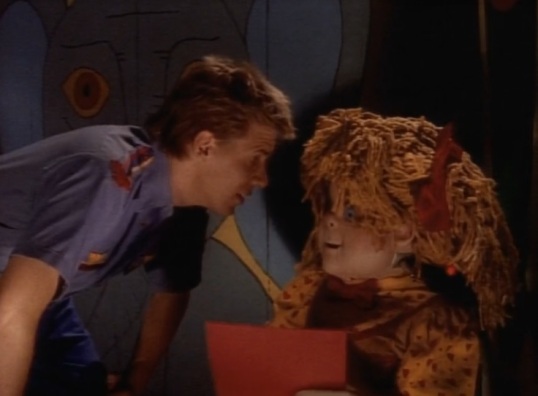
Holly is a robot.  (Sitting inside the Holly costume was actor Michael J. Anderson, who is best known for playing the backwards-talking Man From Another World on Twin Peaks and The Man Who Secretly Controlled Hollywood in Mulholland Drive.)  Holly is the star of an incredibly corny and kind of annoying children’s show called Holly’s House.  Every day, Holly deals with her friends, Early Bird and Mike the Mailman.

Mike the Mailman is actually an actor named Lenny (Perry Lang).  Lenny is the sometime boyfriend of Katherine (Marilyn Jones), the actress who not only provides the voice of Holly but also controls the robots movements during filming.  Katherine has been the star of Holly’s House for four years but she has just discovered that she is pregnant.  Katherine wants to quit the show, marry Lenny, and raise her child.  Holly, however, has other ideas….

This episode was basically a variation on the old idea of the ventriloquist being taken over by their dummy.  Is Holly the one who is being rude to Lenny and deliberately ruining the show or is it Katherine acting through Holly?  And when Holly snaps and starts attacking people, is Holly the one doing it or is it Katherine acting out through Holly?  Unfortunately, regardless of whether Holly is acting on her own or not, Katherine is still the one destined to take the blame for all of her anti-social behavior.

Holly was indeed creepy but this episode was still a bit of a let down.  I think the main problem was that there was no way that Holly’s House would have been a success.  I understand that the show’s portrayal of Holly’s House was probably meant to be a commentary on how vapid most children’s shows were but, even at their most vapid, most children’s shows are still somewhat cute.  Holly’s House only has three cast members — an ugly bird, a creepy robot, and an overly cheerful mailman.  There’s not a kid around that would watch that.  Holly obviously wasn’t happy about Lenny encouraging Katherine to quit the show but seriously, the show was probably on its last legs as it was.

One final note: This episode was directed by Theodore Gershuny, who was the ex-husband of cult film star Mary Woronov and who also directed Silent Night Bloody Night and wrote the excellent book, Soon To Be A Major Motion Picture.  While his direction of this episode didn’t really work for me, I do recommend his Christmas film and the book.

Sahara (1983, directed by Andrew V. McLaglen)


The year is 1927 and famed automobile designer R.J. Gordon (Steve Forrest) dies before he can enter his latest creation into the Trans-African Auto Race across the Sahara Desert.  Wishing to keep her father’s dream alive and prove that she’s just as good a driver as the boys, R.J.’s daughter, Dale (Brooke Shields), enters the race in his place.  Since women are not legally allowed to compete, Dale has to pretend to be a man.  She does this by wearing a fake mustache, which she tosses off as soon she drives over the start line.  It has to be seen to be believed.

Dale and her team set out on the race and they quickly get caught up in a tribal war between two separate factions of Bedouins.  Dale is captured by the lascivious Rasoul (John Rhys-Davies), who attempts to have his way with her.  Fortunately, Dale is rescued by Rasoul’s nephew, Sheikh Jafar (Lambert Wilson).  Jafar is enchanted by Dale’s beauty and wants her to marry him.  Dale eventually agrees but, the morning after the wedding, she sneaks out of Jafar’s tent, jumps back in her car, and rejoins the race.  When she gets captured by the other Bedouins, they force her to stand on a rock while surrounded by panthers.  Like Brooke with a mustache, it has to be seen to be believed.

Sahara was produced by Cannon Pictures.  Menahem Golan, who gets a story credit along with his usual producers credit on this film, was a self-described fan of Rudolph Valentino and Sahara was his attempt to pay homage to Valentino’s performance in The Sheik, as well as cashing in on the adventure zeitgeist that had been launched by the box office success of Raiders of the Lost Ark.  With a budget of $15 million, Sahara was one of Cannon’s most expensive films and the end result was a mix of high production values and typical Golan-Globus goofiness.  The desert cinematography may be impressive but this is still a strangely old-fashioned movie starring Brooke Shields as a race car driver who speeds through the desert without once getting a hair out of place.  As attractive as she was, Brooke was never much of an actress and requiring her to show more than one emotion at a time, as Sahara often does, seems like the ultimate act of hubris.  Say what you will about the films that Cannon made with Bronson and Norris, the two Chucks always seemed like they were perfectly cast.  Shields also has no chemistry with Lambert Wilson, who looks embarrassed at having to pretend to be Rudolph Valentino.  On the plus side, Raiders of the Lost Ark alumni Rhys-Davies and Ronald Lacey are both present in the film and seem to know better than to take any of it seriously.  Rhys-Davies especially always seems to be on the verge of laughing at his terrible dialogue.

Though the view may be impressive, the script is bad and the lead actors are lost.  Avoid Sahara at all costs.

Horror Film Review: Jacob’s Ladder (dir by Adrian Lyne)


The 1990 film Jacob’s Ladder asks the question, “Who is Jacob Singer?”

Is Jacob (played by Tim Robbins), a soldier serving in Vietnam who has just been severely wounded in an enemy attack and who is now barely clinging to life in a helicopter?

Is Jacob a withdrawn postal worker who lives in 1970s New York with his girlfriend, Jezzie (Elizabeth Pena), and who is haunted by horrifying visions of faceless, vibrating figures and viscous demons?  This Jacob is haunted by ill-defined past incidents.  Whenever he gets depressed, Jezzie is quick to demand that he snap out of it and that he stop thinking about anything other than the present day.  This Jacob can only watch as all of his old friends either sink into paranoia or die.  He hears rumors that they all may have been part of some sort of experiment involving LSD.  He’s sure that he served in the army but when he attempts to hire an attorney, he’s informed that the army has no record of him ever having served in combat and that they say he was discharged for psychological reasons.

Or is Jacob the husband of Sarah (Patricia Kalember) and the father of Gabe (Macaulay Culkin — yes, that Culkin)?  This is the Jacob who occasionally wakes up in bed with his wife and tells her that he’s been having the weirdest dream, one where he was living with “that crazy woman” from the post office, Jezebel?

Which one of these three realities is the truth for Jacob?  At times, Jacob himself doesn’t even seem to be sure.  Perhaps the one thing that you can be sure about in this movie is that whenever Jacob closes his eyes, he’s going to reopen them and discover that he’s in a different time and place.  Jacob spends almost the entire film trying to work out what’s happening in the present, what’s happening in the past, and what’s just happening in his head.

And, to be honest, it all gets a bit pretentious at times.  The film’s script has a lot on its mind.  In fact, it might have a little bit too much going on.  No sooner have you soaked in what the film has to say about denial and acceptance than you’re suddenly getting a crash course in MK-ULTRA and other mind-control conspiracy theories.  Whenever Jacob isn’t seeing demons and faceless apparitions, he’s being kidnapped by government agents.  There’s so much going on that this film can get a bit exhausting.

Fortunately, the film itself is such a triumph of style that it doesn’t matter that the script is a bit of a mess.  Director Adrian Lyne does a great job bringing Jacob’s nightmarish world to life.  Jacob seems to live in a world where the skies are permanently overcast and the streets are always wet after a recent storm.  When Jacob makes the mistake of walking down a subway tunnel, Lyne frames it as if Jacob is literally following a tunnel into Hell.  When a subway train rushes by Jacob, we catch disturbing glimpses of featureless faces facing the windows.  When Jacob sees a demon at a party, Lynne films the moment so that, just like Jacob, it takes us a few minutes to realize what we’re seeing.  And when Jacob is kidnapped and taken to a Hellish hospital, the scene is nightmarish in its intensity.

Tim Robbins gives a great performance as the emotionally withdrawn and haunted Jacob.  (In fact, he’s so good that it makes it all the more sad that he really hasn’t had a decent role since he won an Oscar for 2003’s Mystic River.)  He’s matched by Elizabeth Pena, who constantly keeps you wondering if Jezzie truly cares about Jacob or if she’s just another part of the conspiracy that seems to have taken over his life.

Jacob’s Ladder is an intensely effective, if somewhat messy, horror film.  Apparently, like almost every other horror film released in the 20th century, it’s currently being remade, with the remake due to released on February 9th.  Just in time for Valentine’s Day!

A Movie A Day #314: Body and Soul (1981, directed by George Bowers)


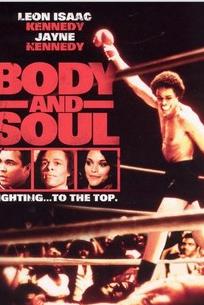
When his little sister falls ill with sickle-cell anemia, Leon Johnson (Leon Isaac Kennedy) has to make a decision.  He can either finish his education, graduate from medical school, and treat her as a doctor or he can drop out of school, reinvent himself as “Leon the Lover,” and make a fortune as a professional boxer!  At first, Leon’s career goes perfectly.  He is winning fights.  He is making money.  He has a foxy new girlfriend (played Leon Isaac Kennedy’s then-wife, Jayne Kennedy.)  But then the fame starts to go to Leon’s head.  He forgets where he came from.  He’s no longer fighting just to help his sister.  Now, he’s fighting for his own personal glory.  When Leon finally gets a title shot, a crooked boxing promoter known as Big Man (former JFK in-law Peter Lawford, looking coked up) orders Leon to take a dive.  Will Leon intentionally lose the biggest fight of his life or will he stay in the ring and battle Ricardo (Al Denava), a boxer so evil that he literally throws children to the ground?  More importantly, will he make his trainer (Muhammad Ali, playing himself!) proud?
Leon Isaac Kennedy, Muhammad Ali, and Peter Lawford all in the same movie!?  No surprise here, it’s a Cannon film.  Leon Isaac Kennedy was best known for playing a jailhouse boxer in the Penitentiary films and he was a good actor with charisma to burn so it probably made perfect sense to not only cast him in a remake of John Garfield’s Body and Soul but to let him write the script too.  The end result is a film that is too heavy-handed to be taken seriously but it is still an entertaining movie.  Body and Soul leaves not a single sports cliché unused but Kennedy was a convincing fighter and the boxing scenes are well-directed.  Muhammad Ali did a better job playing himself here then he did in The Greatest.  All in all, Body and Soul is a good movie for fight fans.

Body and Soul was not a box office success and Kennedy ended his film career a few years after it was released.  He is now the head of Leon Kennedy Ministries, Inc of Burbank, California.


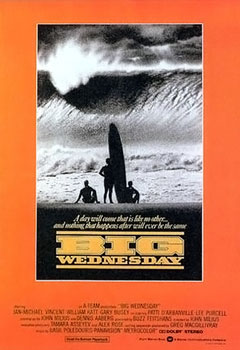
A Movie A Day #165: Big Wednesday (1978, directed by John Milius)


If there is a male bonding hall of fame, Big Wednesday has to be front and center.
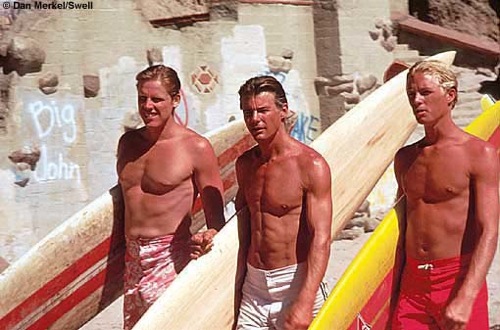
This episodic movie follows three legendary surfers over twelve years of change and turmoil.  Jack Barlowe (William Katt) is the straight arrow who keeps the peace.  Leroy “The Masochist” Smith (Gary Busey) is the wild man.  Matt Johnson (Jan-Michael Vincent) is the best surfer of them all but he resents both his fame and the expectation that he should be some sort of role model for the younger kids on the beach.  From 1962 until 1974, the three of them learn about love and responsibility while dealing with cultural turmoil (including, of course, the Vietnam War) and waiting for that one legendary wave.

After writing the screenplays for Dirty Harry and Apocalypse Now and directing The Wind and The Lion and Dillinger, John Milius finally got to make his dream project.  Big Wednesday was based on Milius’s own youth as a California surfer and he has said that all three of the main characters were based on different aspects of his own personality.  Expectations for Big Wednesday were so high that Milius’s friends, George Lucas and Steven Spielberg, exchanged percentages points for Star Wars and Close Encounters of  The Third Kind for a point of Big Wednesday.  The deal turned out to be worth millions to Milius but nothing to Lucas and Spielberg because Big Wednesday was a notorious box office flop.  Warner Bros. sold the film as a raunchy comedy, leaving audiences surprised to discover that Big Wednesday was actually, in Milius’s words, a “coming-of-age story with Arthurian overtones.”

I can understand why Big Wednesday may not be for everyone but it is one of my favorite movies.  It is one of the ultimate guy films.  Some of the dialogue and the narration may be overwrought but so are most guys, especially when they’re the same age as the surfers in Big Wednesday.  We all like to imagine that we are heroes in some sort of epic adventure.  The surfing footage is amazing but it is not necessary to be a surfer to relate to the film’s coming-of-age story or its celebration of the enduring bonds of friendship.  Katt, Vincent, and Busey all give great performances.  Considering their later careers, it is good that Big Wednesday is around to remind us of what Gary Busey and Jan-Michael Vincent were capable of at their best, before their promising careers were derailed by drugs and mental illness.  Be sure to also keep an eye out for infamous 70s character actor Joe Spinell as an army psychiatrist, a pre-Nightmare on Elm Street Robert Englund, playing a fellow surfer and providing the film’s narration, and Barbara Hale, playing the patient mother of her real-life son, William Katt.

One final note: At a time when the shameful stereotype of the psycho Vietnam vet was becoming popular and unfairly tarnishing the reputation of real-life vets, Big Wednesday was unique for featuring a character who not only joins the Army but who appears to return as a better person as a result.

Horror on the Lens: The Hearse (dir by George Bowers)


The_Hearse

Today’s horror on the Lens in 1980’s The Hearse!

You can read my review here and you can watch it below!

Enjoy!


The Daily Grindhouse: The Hearse (directed by George Bowers)


The_Hearse

I feel no shame in admitting that I love horror movies. I don’t think that’s any secret to anyone who has ever read my reviews on this site. When I’m feeling so restless that I can’t sit still or focus, all you have to do is give me a horror film (especially if it’s one that I’ve never never seen before) and I’ll be quiet for at least 90 minutes.

That’s why I’m always on the look out for horror movies that I haven’t seen before. If it’s a horror movie, I’ll watch it regardless of obscurity, age, or critical disdain. At its best, this habit has led to me discovering neglected cinematic gems like Sole Survivor.

And it’s worst, it’s led me to me sitting through films like 1980′s The Hearse.

The Hearse is one of those public domain film that turns up in every other Mill Creek Box Set and it tells a very familiar story. A recently divorced woman named Jane (played by Tish Van Devere, who was married to George C. Scott at the time) leaves the big city to seek peace and solace in a creepy small town that’s full of rednecks who stare at her with a combination of lust and total disdain. Jane moves into a house that once belonged to her aunt and, pretty soon, she’s hearing strange sounds and having nightmares. On some nights, she sees a hearse (which, earlier, had attempted to run her off of the road) pull up in front of her house.

Jane attempts to tell the local sheirff about the strange happenings at her house but he responds by suggesting that maybe she should move. The local townspeople respond to her concerns by telling her that her aunt made a pact with Satan. The local priest comes by and tells Jane that the necklace her aunt gave her is a symbol of Satan.

None of this really makes much of an impression on Jane, mostly because she’s busy dating this creepy guy named Tom. Tom rarely ever shows any emotion and, on those rare occasions that he does smile, his face looks like a leering skull.

Again, Jane doesn’t seem to notice any of this…

Obviously, horror requires a certain suspension of disbelief but, seriously, it’s hard not to watch The Hearse and feel as if the scariest thing about the movie is the idea that anyone could be as stupid as Jane.

That said, The Hearse isn’t a total waste of time. The nightmare sequence is genuinely effective and the film itself features a few creepy visuals but, then again, there’s no way the sight of a hearse pulling up in front of a house in the middle of the night couldn’t be creepy. Trish Van Devere does okay as Jane, though she was far better in both The Changeling and One Is A Lonely Number.   (The film also features a few too many less-than-credible scenes where the town’s teenage boys talk about how “hot and sexy” they find the aristocratic and rather uptight Jane to be.)  If, like me, you’re into film history, you’ll enjoy this film as a relic of the past, an example of what horror movies were like in a less ironic age.

Life is a Beach #4: Spring Break (dir by Sean S. Cunningham)


I think I may have made a mistake.  When I started reviewing beach films, I did so because it’s currently spring break for thousands of college students across the country and, right now, they’re all probably having a good time on the beach.  Unfortunately, what I didn’t consider was that watching and reviewing these films would make me start to wish that I was currently there with them.

Don’t get me wrong.  It’s not that I want to go hang out on the beach and party and flirt and get high and live for the moment and … well, no, actually, that’s exactly what I wish I was doing right now.  None of the beach films that I’ve watched so far have been good exactly but they do all get at a larger truth.

We all need some sort of spring break.

That’s certainly the theme of the 1983 comedy, Spring Break.

The heroes of Spring Break

The heroes of Spring Break

Perhaps the most surprising thing about Spring Break is that, unlike Malibu Beach and The Beach Girls, it was not produced by Crown International Pictures.  It certainly feels like a Crown International movie.  The film is a largely plotless collection of scenes, all of which take place over the course of spring break in Ft. Lauderdale.  It starts out as a comedy and then gets strangely dramatic towards the end.  It features a lot of nudity for male viewers but luckily, it has two hot guys for me so it all works out in the end.

Two nerdy students, Nelson (David Knell) and Adam (Perry Lang) go down to Florida for spring break.  Nelson does this despite the fact that he had promised that he would spend spring break working on his politically ambitious stepfather’s campaign.  When Nelson and Adam’s picture ends up in the paper, Nelson’s stepfather (Donald Symington) sends his operatives down to Florida to basically kidnap Nelson and drag him home.  Along the way, the stepfather also somehow gets involved in a plot to take over the motel where Nelson and Adam are staying.

Uhmmm…what?

Yes, it doesn’t make much sense but then again, the plot is never that important in these type of films.  What is important is that the motel is overbooked and, as a result, Nelson and Adam find themselves roommates with two hot guys from New York, Stu (Paul Land) and O.T. (Steve Bassett).

One thing that I did like about this movie is that it didn’t waste any time pretending that Stu and O.T. wouldn’t become best friends with Nelson and Adam.  Instead, the four of them start bonding as soon as they meet and they were all best friends within the first 15 minutes of the film.  Yay for another successful bromance!  But seriously, it is kind of sweet.

And it’s also fortunate because, once Nelson is kidnapped and held prisoner on a boat by his stepfather, who better to rescue him than two guys from Brooklyn?

Yes, it’s all pretty stupid but, as far as teen sex comedies from the early 80s are concerned, this is one of the better of them.  At the very least, Knell and Lang are both likeable and Land and Bassett are both hot and that really is about the best that you can hope from a film like this.  Add to that — and this is a theme that I seem to keep returning to as far as these beach films are concerned — Spring Break is a time capsule.  Though Spring Break was released before I was born, I feel like, having seen it, that I now have some firsthand experience of what it was like to be alive in 1983.

So 80s....

So 80s….

As I mentioned at the start of this review, Spring Break feels like a Crown International Picture but, actually, it was released by Columbia Pictures.  And it was directed by Sean S. Cunningham, who is probably best known for directing the original Friday the 13th!  Harry Manfredini even provided the music for both films.  That said, the fun-loving teenagers of Spring Break come to a much happier end than the ones at Camp Crystal Lake.