Late Night Retro Television Review: Highway to Heaven 2.21 “The Torch”


Welcome to Late Night Retro Television Reviews, a feature where we review some of our favorite and least favorite shows of the past!  On Thursdays, I will be reviewing Highway to Heaven, which aired on NBC from 1984 to 1989.  The entire show is currently streaming on Freevee and several other services!
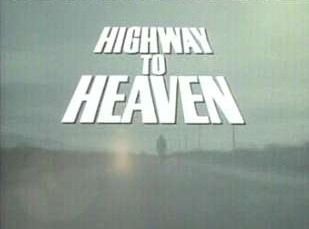
This week, its the most shocking episode of Highway to Heaven yet!

Episode 2.21 “The Torch”

(Dir by Michael Landon, originally aired on March 12th, 1986)

Everett Salomon (Herschel Bernardi) is a Holocaust survivor who has become wealthy and successful in the United States.  In poor health and in need of a heart transplant, Everett spends most of his time giving speeches about his experiences in the concentration camp.  He is disturbed by the rise in Holocaust denialism and has dedicated his remaining years to battling the scourge of Neo-Nazism.  In a disturbing scene that brings to mind the horrible images of the October 7 attacks, a Nazi named Cal (Robert O’Reilly) sneaks onto Everett’s property in the middle of the night and murders his dog.

Cal is a follower of Jan Baldt (Paul Koslo), a Neo-Nazi and a Holocaust denier who has turned his basement into a shooting range so that he and his buddies can fire their guns at pictures of John F. Kennedy, Martin Luther King, and Moshe Dayan.  Jan is consumed by hate and he’s teaching that hate to his young son, Rolf (played by a very, very young Mark-Paul Gosselaar).  While Jan rants about conspiracies and bankers, Rolf cleans the guns in the basement.

At a Nazi rally, Jan’s speech is interrupted by Everett’s son, Joseph (David Kaufman).  Cal proceeds to make his way through the crowd and ends up shooting Joseph dead.  When Everett hears the news, he has a heart attack and is rushed to the hospital by two paramedics, Jonathan Smith and Mark Gordon.  Meanwhile, while Jan and Cal celebrate in their basement, Rolf picks up a submachine gun and, not realizing it’s loaded, pulls the trigger and guns both men down.

Everett finally gets the heart transplant that he’s needed ever since he was first liberated from the camps.  Unfortunately, that heart comes from Jan Baldt.  At first, Everett refuses to accept the heart but then the ghosts of his parents and of Joseph appear to him and tell him that he has to continue to live and let people know the truth about what happened in the camps.

Later, Everett leaves the hospital and tells the reporters waiting outside that he will never be silent.

This seems to be one of the episodes of Highway to Heaven that anyone who has ever watched the show remembers.  Because the show is usually rather gentle and non-violent, this episode can be a rather jarring viewing experience.  The first time I saw it, the only thing that stunned me more than Joseph’s death was the subsequent deaths of Jan and Cal.  The episode ends on an uplifting note but I always find myself wondering what happened to Rolf.  Without his father around to brainwash him, will Rolf be able to learn something other than hate?  Or is it too late for him?  Is Rolf damned to follow in his father’s footsteps?

With the current rise of anti-Semitism, this episode still feels incredibly relevant.  There’s really not much difference between Jan Baldt’s rants and the stuff currently being spewed by Nick Fuentes, Candace Owens, and Brianna Joy Gray.  This episode reminds us that “never again” has to be more than just a catch phrase.
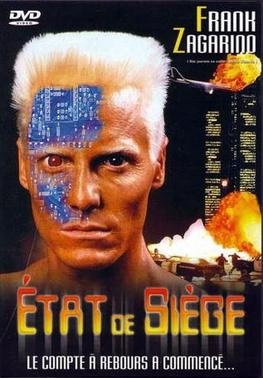
The TSL Grindhouse: Project Shadowchaser (dir by John Eyres)


The 1992 film, Project Shadowchaser, takes place in the near future.  It’s a time when cyborgs are a common sight and criminals are frozen and sent to a cryogenic prison.  At the same time, it’s close enough to the present that the FBI is still America’s main law enforcement agency and the President is still a powerful enough figure that terrorists would want to abduct his daughter.  It’s also close enough to the present that terrorists are still learning how to do their job from watching Die Hard.

Romulus (Frank Zagarino) is a cyborg who takes a hospital hostage, all to track down the president’s daughter, Sarah (Meg Foster).  The FBI feels that only the hospital’s architect, Mr. Dixon, can figure out the best way for the FBI’s strike force to enter the hospital.  Unfortunately, Mr. Dixon broke the law and has been put on deep freeze.  When the stoner who runs the cryogenic prison is told to thaw out Mr. Dixon, he screws up and accidentally unfreezes DeSilva (Martin Kove), a former football quarterback.

Knowing a good thing when he sees it, DeSilva pretends to be Dixon but, once he and the strike force enter the building, it become apparent that DeSilva/Dixon has no idea what he’s talking about.  All of the members of the strike force are killed when an elevator explodes.  Only DeSilva survives and now, whether he wants to or not, he’s going to have to battle the terrorists and save the President’s daughter!  It’s a good thing that she’s a football fan.

What a dumb movie this turned out to be!  Seriously, you can add all of the sci-fi elements to your Die Hard rip-off that you want to, a Die Hard rip-off is still a Die Hard rip-off and it’s hard to think of any other film (with the possible exception of No Contest) that so slavishly follows the Die Hard formula.  There’s nothing particularly surprising to be found in Project Shadowchaser.  The minute that Kinderman (Joss Ackland) shows up and declares that he’s taking over the operation from FBI agent Trevanian (Paul Koslo), it’s obvious that he’s going to turn out to be the one behind Romulus’s actions.  And from the minute that DeSilva meets Sarah, it’s obvious that they’re destined to fall in love.

I like Martin Kove on Cobra Kai and Kove brings a similar self-awareness to his role as DeSilva.  At times, Kove appears to almost be winking at the audience, as if he’s saying, “Hey, I can’t believe I’m in this movie either.  What are you going to do?”  Unfortunately, Kove often seems to be the only person in the film who is really in on the joke.  Needless to say, Project Shadowchaser is no Cobra Kai.

That said, I did appreciate the fact that the film’s entire plot hinged on a government employee accidentally unfreezing the wrong guy.  As a portrait of bureaucratic incompetence, Project Shadowchaser works perfectly.  I mean, let’s be honest.  If there ever was a cryogenic prison, the wrong people would probably be getting unfrozen all the time.  No one’s going to keep track of who is in which pod.

Downdraft (1996, directed by Michael Mazo)


When an out-of-control general was on the verge of destroying the world, Col. Jack Slater (Vincent Spano) did what he had to do and he killed him.  Now, Slater is in a military prison and separated from his family.  However, he’s offered an opportunity to win his freedom.  All he has to do is reassemble his old crew of military/scientist specialists and deactivate an underground computer.  The problem is that a mad scientist named LaGrange (Zdenek Maryska) is threatening to use the computer to destroy the world and the underground chambers are patrolled by a killer cyborg that has melded with LaGrange’s mind.  Meanwhile, above ground, General Devlin (Paul Koslo) is willing to sacrifice Jack and his team if it means covering up what’s happening underground.  If the cyborg doesn’t kill them, the super computer will.  If the super computer can’t get the job done, the government cover-up will do what has to be done.  If the government can’t do it, the earthquake will have to suffice.  Either way, it seems unlikely that Jack and his people are going to escape that underground chamber with their lives.

“Game over, man!”

No one shouted that in Downdraft but they could have because the scenes of the team searching the underground chamber will be familiar to anyone who remembers the space marines exploring the destroyed colony in Aliens.

“I’ll be back.”

No one says that in Downdraft but someone could have because the computer turning on the humans that created it will be familiar to anyone who remembers what John Connor told Sarah in The Terminator.

“Thank you and have a nice day.”

Again, no one says it in Downdraft but they could have because the killer cyborg might as well be named Robocop.

Downdraft takes elements from all of those films and then adds in the type of corrupt general who would send John Rambo to Vietnam and then abandon him there once it became obvious that Rambo had found evidence of American POWs.  There’s not much about Downdraft that feels original but I will give Downdraft credit for including a little bit of everything.  Not only is there a killer robot and a super computer and an untrustworthy general and a government coverup and a team of quirky nerds who know how to fight but there’s also a race against time to defuse a hydrogen bomb and several scenes of people having to climb rickety ladders and cross over chasms on unstable bridges.  The action is impossible to follow but when there’s so much of it, it almost doesn’t matter.  The main message of the movie is that humanity shouldn’t become reliant on supercomputers to run the world.  It’s a good thing we all learned that lesson, right?

Vincent Spano was a good actor, even in this.  Whatever happened to him?  While he’s saving the world, he also finds time to fall in love with a Russian scientist played by Kate Vernon, who went from playing a key supporting role in Malcom X to starring in this.  Everyone has bills to pay.  That was as true in 1996 as it is today.

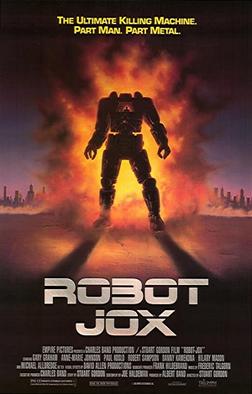
Guilty Pleasure No. 58: Robot Jox (dir by Stuart Gordon)


In the future, the world has been ravaged by a combination of nuclear war and infertility.  The face of diplomacy has changes as well.  Instead of wasting time with negotiations, treaties, or lengthy wars, countries now settle disputes through giant robot combat. 

In fact, robot combat is the most popular sport in the world!  The men who sit inside the head of the giant robots and who push the buttons that make the robots do their thing have all become national heroes.  They’re even more beloved than the robots that they control.  America loves Achilles (Gary Graham).  Russia loves Alexander (Paul Koslo).  Every fight is observed by hundreds of spectators sitting in the stands.

That becomes a problem when Achilles and his robot accidentally fall backwards and land on top of the stands.  Not only does this mean that Russia will claim ownership of Alaska but it also kills a lot of people who were only there because they thought they would get to watch some good old-fashioned giant robot combat.  Achilles is so upset that he announces his retirement.  He leaves robot combat camp and walks around the most depressing, dreariest city imaginable.  It’s hard not to notice that the city is full of signs imploring couples to have as many children as possible.  The humans would seem to be on the way out, regardless of what happens with the giant robots.

Fortunately, Achilles’s retirement only lasts for a day or two.  Once he learns that he’s going to be replaced by Athena (Anne-Marie Johnson), Achilles returns to fight Alexander.  It could be that Achilles is in love with Athena.  It could also just be evidence that it takes a lot more than a nuclear war to wipe out misogyny and Achilles can’t handle a woman controlling his robot.  Who knows?  Achilles is determined to redeem himself but Athena still wants her chance and it turns out that there is a double agent who is giving information to Alexander and the Russians!

Featuring a plot that was apparently made up on the spot, 1990’s Robot Jox is about as silly as a movie can get.  Several scenes are devoted to showing Athena and the other young robot pilots going through their training and it’s hard not to notice that none of it actually has anything to do with sitting inside the head of a giant robot and telling it what to do.  Instead, they do a lot of physical stuff, which makes no sense because piloting a robot would be a mental task, not a physical one.  But it gives the film an excuse to put a bunch of toned 20 year-olds in skin tight outfits and that was probably the main concern.   As for the double agent subplot, there’s only two possible suspects and it’s not difficult to guess which one is guilty.  The actors, for the most part, go through the motions though Michael Alldredge has some good moments as Achilles’s trainer and Paul Koslo is a blast as the maniacally evil Alexander.  In the future, it’s just not enough to destroy a man’s giant robot.  You have to laugh about it, too.

But, to be honest, Robot Jox is one of those movies that is so extremely silly that it’s impossible not to kind of like it.  The special effects may be on the cheap side but the robots themselves are actually fairly impressive and it’s hard not to smile at the sight of them stiffly walking across the combat area.  The film’s finale features not only a giant chainsaw that is stored inside the crotch of one of the robot’s but also a bizarre and impromptu trip into space.  I’m not really sure why the robots flew into space but it really doesn’t matter.  No one is going to watch Robot Jox for a coherent story.  This is a film that people watch because they want to see giant robots fighting.  And, on that front, Robot Jox delivers.

Previous Guilty Pleasures

  1. Half-Baked
  2. Save The Last Dance
  3. Every Rose Has Its Thorns
  4. The Jeremy Kyle Show
  5. Invasion USA
  6. The Golden Child
  7. Final Destination 2
  8. Paparazzi
  9. The Principal
  10. The Substitute
  11. Terror In The Family
  12. Pandorum
  13. Lambada
  14. Fear
  15. Cocktail
  16. Keep Off The Grass
  17. Girls, Girls, Girls
  18. Class
  19. Tart
  20. King Kong vs. Godzilla
  21. Hawk the Slayer
  22. Battle Beyond the Stars
  23. Meridian
  24. Walk of Shame
  25. From Justin To Kelly
  26. Project Greenlight
  27. Sex Decoy: Love Stings
  28. Swimfan
  29. On the Line
  30. Wolfen
  31. Hail Caesar!
  32. It’s So Cold In The D
  33. In the Mix
  34. Healed By Grace
  35. Valley of the Dolls
  36. The Legend of Billie Jean
  37. Death Wish
  38. Shipping Wars
  39. Ghost Whisperer
  40. Parking Wars
  41. The Dead Are After Me
  42. Harper’s Island
  43. The Resurrection of Gavin Stone
  44. Paranormal State
  45. Utopia
  46. Bar Rescue
  47. The Powers of Matthew Star
  48. Spiker
  49. Heavenly Bodies
  50. Maid in Manhattan
  51. Rage and Honor
  52. Saved By The Bell 3. 21 “No Hope With Dope”
  53. Happy Gilmore
  54. Solarbabies
  55. The Dawn of Correction
  56. Once You Understand
  57. The Voyeurs 

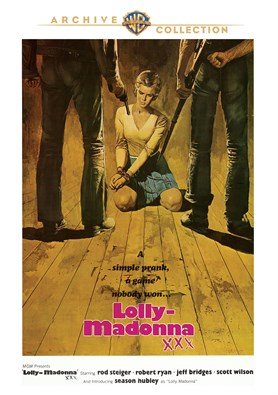
A Movie A Day #354: Lolly-Madonna XXX (1973, directed by Richard C. Sarafian)


In the backwoods of Hicksville, USA, two families are feuding.  Laban Feather (Rod Steiger, bellowing even more than usual) and Pap Gutshall (Robert Ryan) were once friends but now they are committed rivals.  They claim that the fight started when Pap bought land that once belonged to Laban but it actually goes back farther than that.  Laban and Pap both have a handful of children, all of whom have names like Thrush and Zeb and Ludie and who are all as obsessed with the feud as their parents.  When the Gutshall boys decide to pull a prank on the Feather boys, it leads to the Feathers kidnapping the innocent Roonie (Season Hubley) from a bus stop.  They believe that Roonie is Lolly Madonna, the fictional fiancée of Ludie Gutshall (Kiel Martin).  Zack Feather (Jeff Bridges), who comes the closest of any Feather to actually having common sense, is ordered to watch her while the two families prepare for all-out war.  Zack and Roonie fall in love, though they do not know that another Feather brother has also fallen in love with Gutshall daughter.  It all leads to death, destruction, and freeze frames.
Lolly-Madonna XXX is a strange film.  It starts out as a typical hicksploitation flick before briefly becoming a backwoods Romeo and Juliet and finally ending up as a heavy-handed metaphor for both the Vietnam War and the social upheaval at home.  Along with all the backwoods drama, there is a fantasy sequence where Hawk Feather (Ed Lauter) briefly imagines himself as an Elvis-style performer.  (Hawk also dresses up in Roonie’s underwear.)  Probably the most interesting thing about Lolly-Madonna XXX is the collection of actors who show up playing Feathers and Gutshalls.  Along with Steiger, Ryan, Martin, Bridges, and Lauter, everyone from Randy Quaid to Paul Koslo to Scott Wilson to Gary Busey has a role to play in the feud.  Lolly-Madonna XXX is too uneven and disjointed to really be considered a good movie but I can say that I have never seen anything else like it.

One final note: Lolly-Madonna XXX was directed by Richard Sarafian, who is best known for another early 70s cult classic, Vanishing Point.

A Movie A Day #302: Love and Bullets (1979, directed by Stuart Rosenberg)


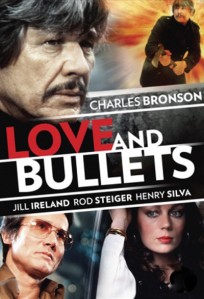
Joe Bomposa (Rod Steiger) may wear oversized glasses, speak with a stutter, and spend his time watching old romantic movies but don’t mistake him for being one of the good guys.  Bomposa is a ruthless mobster who has destroyed communities by pumping them full of drugs.  Charlie Congers (Charles Bronson) is a tough cop who is determined to take Bomposa down.  When the FBI learns that Bomposa has sent his girlfriend, Jackie Pruit (Jill Ireland), to Switzerland, they assume that Jackie must have information that Bomposa doesn’t want them to discover.  They send Congers over to Europe to bring her back.  Congers discovers that Jackie does not have any useful information but Bomposa decides that he wants her dead anyway.
Love and Bullets is an uneasy mix of action and comedy, with Bronson supplying the former and Ireland trying to help out with the latter.  Not surprisingly, the action works better than the comedy.  Because Charlie is an American in Switzerland, he is not allowed to carry a gun and he is forced to resort to some creative ways to take out Bomposa’s assassins.  Unfortunately, the scenes where Charlie and Jackie fall in love are less interesting, despite Bronson and Ireland being a real-life couple.  Ireland occasionally did good work when she was cast opposite of Bronson but here, she’s insufferable as a ditzy gangster moll with a strange accent.  While everyone else is trying to make an action movie, she’s trying too hard to be Judy Holliday.  Steiger’s peformance starts out as interesting but soon devolves into the usual bellowing and tics.

Love and Bullets does have a good supporting cast, though.  Bradford Dillman, Michael V. Gazzo, Val Avery, Albert Salmi, and Strother Martin all pop up.  The two main hit men are played by Paul Koslo and Henry Silva.  Silva’s almost as dangerous here as he was in Sharky’s Machine.

A Movie A Day #17: The Laughing Policeman (1973, directed by Stuart Rosenberg)


8232729_orig

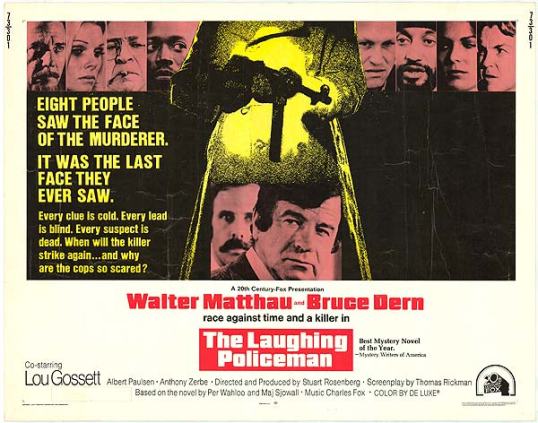
San Francisco in the 1970s.  Revolution is in the air.  Hippies are on every street corner.  A man named Gus Niles knows that he’s being tailed by an off-duty cop, Dave Evans.  Gus boards a city bus, knowing that Evans will follow him.  On the bus, an unseen gunman suddenly opens fire with an M3 submachine gun, not only killing both Evans and Gus but six other people as well.  After the bus crashes, the gunman calmly departs.  At first, it is assumed that the massacre was another random mass shooting, like Charles Whitman in Austin or Mark Essex in New Orleans.  But one San Francisco detective is convinced that it wasn’t random at all.

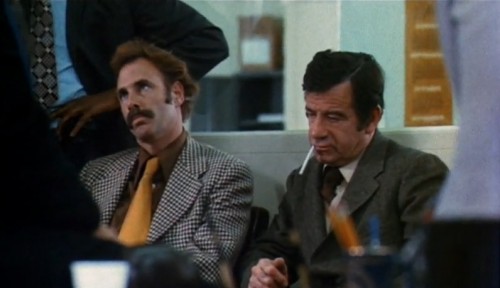
The Laughing Policeman was one of the many police procedurals to be released after the box office success of Dirty Harry and The French Connection and, despite the name, it’s also one of the grimmest.  While the complex mystery behind why Evans was following Gus and who killed everyone on the bus is intriguing, The Laughing Policeman‘s main focus is on the often frustrating nitty gritty of the investigation, complete with false leads, uncooperative witnesses, unanswerable questions, and detectives who frequently make stupid mistakes.  The movie’s first fifteen minutes are devoted to the police processing the bus, with Stuart Rosenberg (best known for directing Paul Newman in Cool Hand Luke) using overlapping dialogue to give the entire scene a documentary feel.  As Detective Jake Martin, Walter Matthau is even more cynical and downbeat than usual while Bruce Dern provides good support as a younger, more volatile detective.  The supporting cast is full of 70s character actors, like Lou Gossett, Anthony Zerbe, Gregory Sierra,and playing perhaps the sleaziest drug dealer ever seen in an American movie, Paul Koslo.

The Laughing Policeman was based on a Swedish novel that took place in Stockholm but, for the movie, Swedish Detective Martin Beck became world-weary Sgt. Jake Martin and Stockholm became San Francisco.  Rosenberg directed the entire film on location, giving The Laughing Policeman the type of realistic feeling that would later be duplicated by TV shows like Hill Street Blues, NYPD Blue, and Law & Order.  Though it may not be as well-known as either Dirty Harry or The French Connection, The Laughing Policeman is a dark and tough police procedural, an underrated classic of the genre.

Incidentally, The Laughing Policeman was one of the first films for which character actor Bruce Dern shared top billing.  According to Dern’s autobiography, Matthau generously insisted that Dern be credited, with him, above the title.

bruce_dern_walter_matthau_the_laughing_policeman_1973-500x288

More Of Bronson’s Best: Mr. Majestyk (1974, directed by Richard Fleischer)


Mr_Majestyk_movie_posterWhat happens when you combine the great tough guy writer Elmore Leonard with the great tough guy actor Charles Bronson?

You get Mr. Majestyk, one of Bronson’s finest films.

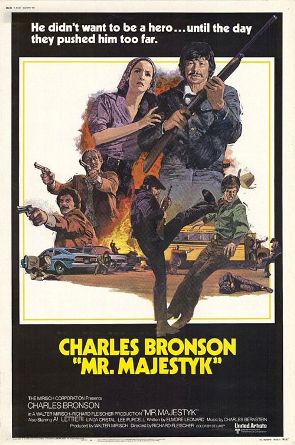
Vince Majestyk (Bronson) may be a former U.S. Army Ranger instructor and a decorated Vietnam vet but now that he has returned home to Colorado, all he cares about is running his watermelon farm.  With a lucrative harvest approaching, Majestyk hires a group of unionized Mexican migrant workers, led by the fiery Linda Chavez (Linda Cristal), to pick his crops.  When a local criminal named Bobby Kopas (Paul Koslo) shows up and demands that Majestyk hire his drunken crew instead, Majestyk does what Bronson does best.  He gives Kopas an ass-kickin’ beat down.

After Kopas charges him with assault, the local police arrest Majestyk and, despite his request that he be allowed three days to finish harvesting his crop, Majestyk is thrown in jail.  Also in the jail is a Mafia hitman named Frank Renda (Al Lettieri).  Renda may be a tough guy but nobody’s tougher than Vince Majestyk.  When Renda’s associates attempt to hijack a prison bus, Majestyk ends up hijacking it instead.  Majestyk plans to hold Renda hostage until the police agree to give him his three days of freedom so he can get back to his farm.  Renda even offers to pay him off but Majestyk doesn’t care about his money.  He just cares about melons.

Because he was the only 1970s action star who could be believable as both a decorated combat veteran and a no-nonsense watermelon farmer, Charles Bronson is the only actor who could have brought Mr. Majestyk to life.  Before he became an actor, Bronson worked for a living.  From the age of ten until he enlisted in the Army, Bronson worked in the Pennsylvania coal mines, earning one dollar for each ton of coal that he mined.  Though Bronson was never a great actor, his legitimately working class background allowed him to bring an authenticity to a role like Vince Majestyk that most other actors would have lacked.  When Bronson says that all he cares about is bringing in the harvest on time, you believe him just as much as you believe him when he’s beating up Paul Koslo or hijacking a prison bus.

The rest of the cast is full of good 1970s actors who have never really been given their due.  Al Lettieri may be best known for playing Sollozzo in The Godfather but he also does a good job as Frank Renda.  Paul Koslo plays another one his sleazy villains here and does a great job as Bobby Kopas.

Mr. Majestyk was directed by Richard Fleischer but, with its colorful characters, working class hero, and modernized brand of frontier justice, the film is clearly the work of Elmore Leonard. Though Mr. Majestyk is credited as being based on a novel by Leonard, Leonard actually wrote the screenplay before the novel.

The combination of Elmore Leonard and Charles Bronson makes Mr. Majestyk one of the best action films of the 1970s.

majestyk_rifle


Bronson’s Best: The Stone Killer (1973, directed by Michael Winner)


Stone_killerAfter tough New York detective Lou Torrey (Charles Bronson) lands in hot water for shooting and killing a teenage cop killer, he moves to Los Angeles and gets a job with the LAPD.  Working under an unsympathetic supervisor (Norman Fell), saddled with an incompetent partner (Ralph Waite), and surrounded by paper pushing bureaucrats, Torrey still tries to uphold the law and dispense justice whenever he can.  When a heroin dealer is murdered while in Torrey’s custody, Torrey suspects that it might be a part of a larger conspiracy, involving mobster Al Vescari (Martin Balsam).

Vescari is plotting something big.  It has been nearly 40 since the “Sicilian Vespers,” the day when Lucky Luciano, Frank Costello, and Busy Siegel killed all of the original mafia dons at the same time.  Viscari has invited mafia leaders from across the country to attend a special anniversary dinner.  During the dinner, all of Vescari’s rivals will be assassinated.  To keep things a secret, Vescari will not be using any of his usual hitmen.  Instead, he has contracted a group of mentally unstable Vietnam vets, led by Lawrence (Stuart Margolin).

Charles Bronson has always been an underrated film star.  His legacy has been tarnished by the cheap films he made for Cannon and, unlike Clint Eastwood, he never got a chance to really take control of his career and reinvent his image.  But during the 1970s, not even Clint Eastwood was a more convincing action star than Charles Bronson.  Bronson may have never been a great actor but he was an authentic tough guy with a physical presence that dominated the screen.

It was during this period that Bronson made his first four movies with director Michael Winner.  Though Death Wish and The Mechanic are the best known, The Stone Killer may be the best.  Tough, gritty, and action-packed with a great car chase, The Stone Killer was filmed on location in Los Angeles and some of the best parts are just the scenes of Bronson awkwardly interacting with the local, California culture.  If you have ever wanted to see Charles Bronson deal with a bunch of hippies, this is the film to see.  The Stone Killer also has more of social conscience than the usual 70s cop film, with Bronson’s character not only condemning excessive police brutality but also his racist partner.

(Ironically, Bronson and Winner would follow The Stone Killer with Death Wish, a film that many critics condemned as being racist and which suggested that the police were not being brutal enough.)

The other thing that sets The Stone Killer apart is that it has a great cast, featuring several actors who would go on to find success on television.  Balsam, Fell, and especially Waite and Margolin are all great.  Keep an eye out for a very young John Ritter, playing one of the only cops in the film who is not portrayed as being either corrupt or incompetent.

Though it may not be as well-known as some of his other action films, The Stone Killer is one of Bronson’s best.