Welcome to Retro Television Reviews, a feature where we review some of our favorite and least favorite shows of the past! On Mondays, I will be reviewing Miami Vice, which ran on NBC from 1984 to 1989. The entire show can be purchased on Prime!
This week’s episode took me by surprise!
Episode 3.11 “Forgive Us Our Debts”
(Dir by Jan Eliasberg, originally aired on December 12th, 1986)
Frank Hackman (Guy Boyd) has a date with Florida’s electric chair. Even though he claims that he’s innocent of killing one of Sonny Crockett’s former partners, Hackman says that he’s guilty of killing others and, having become a Christian while on Death Row, he is prepared to pay the ultimate price. He even suggests that his execution should be televised.
At first, Sonny is all for Hackman being executed. But then, a priest calls the Vice Squad and tells them that one of his parishioners confessed to having evidence that could prove that Hackman was actually in Vegas when the murder occurred. Sonny and the Squad track down Gus Albierro (Val Bisoglio), an auto mechanic who is dying of cancer and who says that he’s telling the truth to clear his conscience. Not long after Gus talks to Crockett, Gus is executed in his garage.
Convinced that Hackman is innocent, Sonny and Tubbs have one day to find the other person who was with Gus and Hackman in Vegas. That man turns out to be in the witness protection agency and, at first, he refuses to talk. Then Crockett takes him outside and beats him up.
Long story short: After having had his head shaved for his date with the electric chair, Hackman’s life is saved and he leaves prison a free man….
Now, up until this point, I felt that this episode was just another rather heavy-handed diatribe against the death penalty. Miami Vice, as a show, always leaned towards the Left and this episode features two smarmy Florida politicians who are eager to prove how tough they are on crime. I thought the whole episode was a bit too obvious in its storytelling and I thought my review would focus on the hypocrisy of Miami Vice criticizing the death penalty when almost every episode has ended with the bad guys being taken down in a hail of bullets.
(On a personal note, I’m against the death penalty because I think there is too much of a risk of an innocent person being executed. But, still, I’m not a fan of heavy-handed storytelling, regardless of whether I agree with the larger point or not.)
But this episode had one final twist waiting up its sleeve. Hackman steps out of prison and sees Sonny waiting for him. Sonny is feeling pretty proud of himself. He saved an innocent man, right? Wrong! Hackman proceeds to tell Sonny that he actually did kill Sonny’s former partner and that Gus lied in return for Hackman’s friends sending money to his family. That guy in witness protection who, at first, refused to testify? He was working with Hackman, too.
“I won’t need this anymore,” Hackman says, yanking off the cross that was hanging out around his neck.
And that’s how the episode ends! The bad guys triumph and it’s pretty much all Sonny’s fault! This was the most cynical episode of Miami Vice yet. The ending totally took me by surprise and it made me realize that, rather than being a heavy-handed and polemical, this episode was actually extremely clever and perfectly put together. Just as Hackman fooled Sonny, Miami Vice fooled the viewer (in this case, me). This turned out to be an excellent episode and certainly the best of season 3 so far.
Because of the holidays, this is my last Miami Vice review of 2024. My reviews of Miami Vice will resume on January 6th, 2025!
Are the streets to blame? Paranoia’s coming your way….
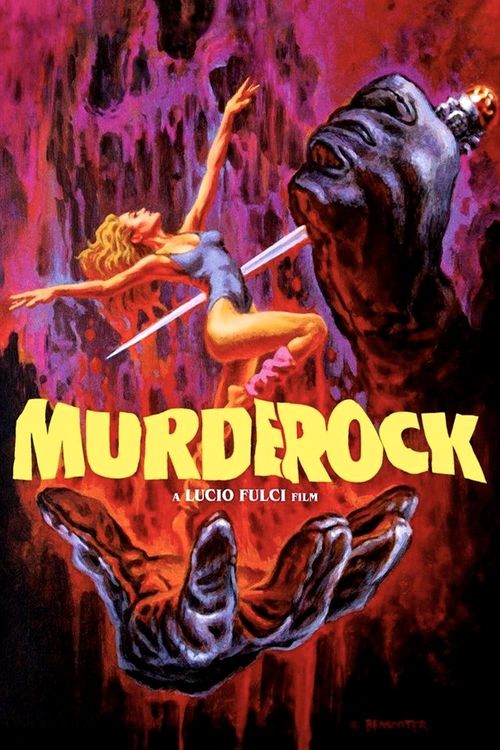
Ah, Murder Rock.
This 1984 film is often dismissed as being one of director Lucio Fulci’s lesser efforts, an attempt to combine the trappings of the giallo genre with the sexy, choreographed dance routines of Flashdance. And certainly, the film does lack the visceral, dream-like horror of The Beyond trilogy andZombi 2. The film’s killer isn’t even as interesting as The New York Ripper‘s killer who talked like a duck. That said, I think some critics have been a bit too hard on Murder Rock over the years. Taken on its own terms, it’s a well-made slasher with a healthy does of 80s style. Of course, I should admit that, as someone who grew up attending dance classes and dancing through the pain, I could relate to the film’s milieu. I’ve never had to deal with a zombie in real life but I did meet my share of dancers who would do anything to move up.
The film takes place at the Arts For The Living Center in New York City, where young dancers are hoping to land a spot on a televisions show and also hoping to avoid getting killed by the murderer who is haunting the locker rooms and using a long hairpin needle to stop the hearts of his victims. (The sound of a previously healthy victim’s heart beating on the soundtrack and then abruptly stopping is far more powerful than one might expect.)
Previously seen losing an eye in Fulci’s Zombi 2, Olga Karalatos plays Candice Norman, the owner of the dance studio. When one of her dancers is murdered while taking a shower, Candice is just one of many suspects. Candice, however, is haunted by a dream in which she sees herself being stalked by a handsome man (Ray Lovelock) carrying a hairpin. Later, Candice realizes that she’s seen the handsome man before. He’s George Webb, a male model whose face adorns a billboard. Candice starts to investigate George on her own, discovering that he’s apparently an alcoholic who lives in a run-down apartment. When evidence starts to show up suggesting that George could be the murderer, he claims that he’s being framed.
Of course, George isn’t the only suspect. There’s also Willy Stark (played by Christian Borromeo), a dancer whose girlfriend ends up as a victim of the murder spree. With his blonde hair and aristocratic bearing, Christian Borromeo was one of the most handsome actors to appear in Italian films in the early 80s. He didn’t do many films before retiring but he still managed to appear in films directed by Dario Argento, Federico Fellini, Ruggero Deodato, and Lucio Fulci. He played very different characters in all of his films and gave a good performance each time. One reason why I specifically want to single out Christian Borromeo here is because there’s still a lot of people online who are under the impression that Borromeo died a heroin overdose in the 80s. This is largely due to a comment that was made during an interview with David Hess, who co-starred with Borromeo in The House At The Edge of the Park. Hess was confusing Borromeo with their co-star, Garbiele Di Giulio. Di Giulio did indeed die of a heroin overdose. Christian Borromeo is still alive, though retired from acting.
As for Murder Rock, the killings are nowhere near as gory as in Fulci’s other films but that actually adds to the film’s creepy atmosphere. The killer is frightening because the killer is coolly efficient and can kill without resorting to the out-of-control, manic violence of quacking sociopath at the center of The New York Ripper. As is usual with Fulci, the film’s visuals are Murder Rock‘s greatest strength. The first murder occurs while the locker room’s light blink on and off, creating a truly frightening sequence as the camera seamlessly assumes the killer’s point of view. When the police investigate the crime, the flashes of the police cameras are almost blinding as they record the stark crime scene. Candice’s nightmares play out like a particularly macabre perfume commercial (and yes, that it meant as a compliment). Fulci’s camera roams from location to location, keeping the audience off-balance throughout the film. As he did in so many of his other films, Fulci makes New York look like the grimiest, most claustrophobic city in the world.
As for the dance sequences, they’re so over-the-top that you can’t help but love them. The film was obviously envisioned as a way to cash in on the popularity of Flashdance but Fulci’s dispenses of the romanticism that made Flashdance a hit and instead just focuses on bodies moving in a explosion of choreographed carnality. There’s nothing subtle about the way the film lingers on the spandex-clad dancers but then again, that’s why we love Fulci. He was not one to make apologies.
Fulci once said that Murder Rock was meant to be the first part of a projected trilogy of musical gialli. Who knows whether or not that’s true. (As an interview subject, Fulci was always quick to boat of the grand projects he had planned for the future. As the diabetic Fulci was in precarious health at the same time that he made his most popular horror films, there was always something rather poignant to Fulci’s constant boasting about all of the great films he planned to make.) As I said at the start of this review, Murder Rock is one of Fulci’s less-appreciated films but, as someone who loves both dancing and watching horror movies, I’ve always liked it. Even the fact that the killer is exposed in a way that doesn’t really stand up to close scrutiny just adds to the film’s charm. (Seriously, a good giallo rarely makes that much sense.)
That was my main reaction to watching the 1984 film, Purple Rain, a few nights ago. Over the years, there have been a lot of music stars who have attempted to make the transition to acting. Some have been more successful than others. While some have stuck to playing versions of themselves, others have attempted to become actual character actors and the end results have often been mixed. Being a strong stage performer does not neccesarily mean that person is automatically going to be a convincing film actor and the history of the movies is full of famous singers whose personality seemed to evaporate as soon as they had to act for the cameras and try to sound convincing while reciting dialogue. Taylor Swift has built up a strong and incredibly loyal fanbase but you wouldn’t necessarily believe that she was one of the world’s biggest stars if you only knew her from her wan and bland performances in Cats and Amsterdam. Indeed, while watching her in Amsterdam, it’s kind of hard not to be thankful when that car drives up and brings her performance to an end.
Prince, on the other hand, could truly act.
In Purple Rain, he plays The Kid. The Kid is an enigmatic musician living in Minneapolis, Minnesota. He’s the front man of a band called The Revolution and he sings songs that are, at times, almost disturbingly personal. The Kid rides a purple motorcycle and he’s one of those musicians who is driven to record almost every sound that he hears. (At one point, The Kid listens to a recording of an unidentified woman sobbing. Who exactly the woman was or why she was crying are questions that are never answered, though I think it’s possible it was supposed to be the Kid’s mother.) He performs to escape from the scars of his upbringing. His father (Clarence Williams III), a failed musician, regularly beats his mother (Olga Karlatos, who memorably lost an eye in Lucio Fulci’s Zombi 2). No one can deny The Kid’s talent but he’s also known for being a bit of a control freak and the other members of the Revolution sometimes feel that he’s not willing to give them the credit and opportunities that they deserve and….
Okay, obviously there are some similarities between The Kid and the man playing him. Purple Rain was Prince’s first film and his first acting role and it makes sense that he would want to play a character in a situation that he was familiar with. But that still doesn’t change the fact that Prince gives an excellent and charismatic performance in the lead role. Unlike so many other singers-turned-actors, he doesn’t lose his spark when he has to remember his lines. His presence doesn’t evaporate when the camera is turned on him. Instead, if anything, Price feels even more natural off-stage than on. Whether the Kid is being playful or serious, driven or defeated, Prince is never less than convincing. Yes, the audience never forgets that they’re watching Prince. But, at the same time, the Kid comes to life as an individual character with his own life and problems and personality separate of the actor who is playing him.
As for the film’s plot, it’s a fairly simple one. The Revolution is one of three bands that hold down the house band slot at the First Avenue nightclub. The Kid’s rival, Morris Day (played by Morris Day), plots to replace the Revolution by putting together an all-girl group called Apollonia Six. Apollonia Six is led by Apollonia (Apollonia Kotero), who is the Kid’s girlfriend. As Morris explains it, the Kid is too wrapped up in himself to help out Apollonia or the Revolution’s Wendy and Lisa.
And Morris Day has a point. As soon as Apollonia tells the Kid that she’s going to be working with Morris, the Kid responds by striking her. It’s a shocking scene but, as the film shows, it’s all the Kid learned at the hands of his father. It’s only after a personal tragedy that the Kid starts to realize that he does not have to be just like his father. That said, let us hope that the Kid invested in some therapy and some anger management courses after the end credits rolled.
As a character, the Kid would be unbearable if not for the strength and charm of Prince’s performance. Prince is amazing when he performs on stage and the film’s soundtrack still holds up but what makes the film work are the moments when Prince shows us the Kid’s vulnerable side. Self-loathing is not an easy feeling to play and it’s an even more difficult feeling to make sympathetic but Prince does both. The Kid knows that he’s self-destructive and immature but he’s also sincere in his desire to be better than his past. The film leaves you to wonder if he’ll succeed.
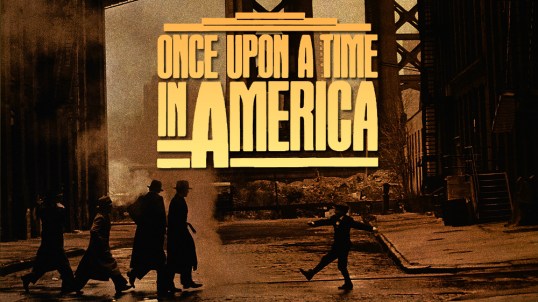
Before I start this review of Sergio Leone’s 1984 gangster epic, Once Upon A Time In America, I want to issue two warnings.
First off, this review is going to have spoilers. I’ve thought long and hard about it. Usually, I try to avoid giving out spoilers but, in this case, there’s no way I can write about this movie without giving away a few very important plot points. So, for those of you who don’t want to deal with spoilers, I’ll just say now that Once Upon A Time In America is a great film and it’s one that anyone who is serious about film must see.
Secondly, I’m not going to be able to do justice to this film. There’s too much to praise and too much going on in the film for one simple blog post to tell you everything that you need to know. Once Upon A Time In America is the type of film that books should be written about, not just mere blog posts. Any words that I type are not going to be able to match the experience of watching this film.
For instance, I can tell you that, much as he did with his classic Spaghetti westerns, Sergio Leone uses the conventions of a familiar genre to tell an epic story about what it means to be poor and to be rich in America. But you’ll never truly understand just how good a job Leone does until you actually see the film, with its haunting images of the poverty-stricken Jewish ghetto in 1920s New York and it’s surreal climax outside the mansion of a very rich and very corrupt man.
I can tell you that Ennio Morricone’s score is one of his best but you won’t truly know that until you hear it while gazing at Robert De Niro’s blissfully stoned face while the final credits roll up the screen.
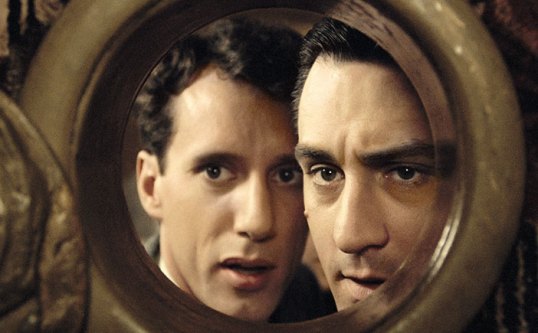
I can tell you that the film’s cast is amazing but you probably already guessed that when you saw that it featured Robert De Niro, James Woods, Treat Williams, Danny Aiello, Joe Pesci, Burt Young, Tuesday Weld, Elizabeth McGovern, and Jennifer Connelly. But, again, it’s only after you’ve seen the film that you truly understand just how perfectly cast it actually is. Given the politics of Hollywood and the fact that he’s unapologetically critical of Barack Obama, it’s entirely possible that James Woods might never appear in another major motion picture. A film like Once Upon A Time in America makes you realize what a loss that truly is.
So, if you haven’t seen it yet, I encourage you to see it. Order it off of Amazon. Do the one day shipping thing. Pay the extra money, the film is worth it.
Much like The Godfather, Part II (and Cloud Atlas, for that matter), Once Upon A Time In America tells several different stories at once, jumping back and forth from the past to the present and onto to the future.
The film’s “past” is 1920. Noodles (Scott Tiler) is a street kid who lives in New York’s ghetto. He makes a living by doing small jobs for a local gangster and occasionally mugging a drunk. He’s also the head of his own gang, made up of Patsy (Brian Bloom), Cockeye (Adrian Curry), and Dominic (Noah Moazezi). Despite his rough edges, Noodles has a crush on Deborah (Jennifer Connelly), a refined girl who practices ballet in the back of her family’s store. When Nooldes meets Max (Rusty Jacobs), the two of them become quick friends. However, their criminal activities are noticed by the demonic Bugsy (James Russo), who demands any money that they make.
The film’s “present” is 1932. Noodles (Robert De Niro) has spent twelve years in prison and, when he’s released, he discovers that some things have changed but some have remained the same. Max (James Woods), Cockeye (William Forsythe), and Patsy (James Hayden) are still criminals but they’ve prospered as bootleggers. Occasionally, they do jobs for a local gangster named Frankie (Joe Pesci) and sometimes, they just rob banks on their own. During one such robbery, they meet a sado-masochistic woman named Carol (Tuesday Weld), who quickly becomes Max’s girlfriend.
As for Noodles, he continues to love Deborah (Elizabeth McGovern). But, when he discovers that she’s leaving New York to pursue a career as an actress, he reveals his true nature and rapes her. It’s a devastating scene — both because all rape scenes are (or, at the very least, should be) devastating but also because it forces us to ask why we expected Noodles to somehow be better than the men who surround him. After spending nearly two hours telling ourselves that Noodles is somehow better than his friends and his activities, the movie shows us that he’s even worse. And, when we look back, we see that there was no reason for us to believe that Noodles was a good man. It’s just what we, as an audience, wanted to believe. After all, we all love the idea of the romanticized gangster, the dangerous man with a good heart who has been forced into a life of crime by his circumstances and who can be saved by love. In that scene, Once Upon A Time In America asks us why audiences continue to romanticize men like Noodles and Max.
As for the gang, they’re hired to serve as unofficial bodyguards for labor leader Jimmy O’Donnell (Treat Williams) and, in their way, help to found the modern American labor movement. (“I shed some blood for the cause,” Patsy says while showing off a huge bandage on his neck.) When fascistic police chief Aiello (Danny Aiello) needs to be taken down a notch, they kidnap his newborn son and hold him for ransom. (While pulling off this crime, they also manages to switch around all the babies and, as a result, poor babies go home with rich families and vice versa, neatly highlighting both the power of class and the randomness of fate.) However, the good times can’t last forever and, when prohibition is repealed, the increasingly unstable Max has to find a new way to make some money.
Finally, the film’s third storyline (the “future” storyline) takes place in 1967. Noodles has spent decades living under a false identity in Buffalo. When he gets a letter addressed to his real name, Noodles realizes that someone knows who he is. He returns to a much changed New York. Carol now lives in a retirement home. Deborah is an acclaimed Broadway actress. Jimmy O’Donnell is the most powerful union boss in America. Fat Moe’s Speakeasy is now Fat Moe’s Restaurant.
Once Noodles is back in town, he receives a briefcase full of money and a note that tells him that it’s an advanced payment for his next job. He also receives an invitation to a party that’s being held at the home of Christopher Bailey, the U.S. Secretary of Commerce.
Who is Secretary Bailey? He’s a shadowy and powerful figure and he’s also a man who is at the center of a political scandal that has turned violent. And, when Noodles eventually arrives at the party, he also discovers that Secretary Bailey is none other than his old friend Max.
How did a very Jewish gangster named Max transform himself into being the very WASPy U.S. Secretary of Commerce? That’s a story that the film declines to answer and it’s all the better for it. What doesn’t matter is how Max became Bailey. All that matters is that he did. And now, he has one final favor to ask Noodles.
(There’s a very popular theory that all of the 1967 scenes are actually meant to be a hallucination on Noodles’s part. And the 1967 scenes are surreal enough that they very well could be. Though you do have to wonder how Noodles in 1932 could hallucinate the Beatles song that is heard when he returns to New York in 1967.)
Once Upon A Time In America is an amazing film, an epic look at crime, business, and politics in America. It’s a film that left me with tears in my eyes and questions in my mind. The greatness of the film can not necessarily be put into words. Instead, it’s a film that everyone needs to see.
If your answer to the first question was yes, then you should definitely have had the same answer for the second. Along with launching the long and extremely influential genre of the Italian zombie film and being one of the best zombie films ever made, Zombi 2 is also one of the best horror films ever made.
First off, a few words about that title. Zombi was the Italian title for George Romero’s Dawn of the Dead. Zombi was a huge hit on Italy and, in that shameless way that is beloved by all Italian horror fans, producers Fabrizio De Angelis and Ugo Tucci decided to take advantage of Zombi‘s success by naming their upcoming zombie film Zombi 2. And, while I have always liked to think of Zombi 2 as being a prequel to Romero’s Dead trilogy, Zombi 2 is actually in no way related to Dawn of the Dead.
It has often been assumed that Zombi 2 was directly inspired by Dawn of the Dead. While Romero’s film certainly provided more of an influence than just providing a title, Zombi 2 was actually in production before Dawn of the Dead opened in Italy. And, ultimately, Zombi 2 is a far different film from Romero’s film. Eschewing the social commentary and satire that ran through Dawn of the Dead, Zombi 2 is instead a work of pure horror. They’re both excellent films but Dawn of the Dead ultimately inspires debate while Zombi 2 inspires nightmares.
Opening with a previously dead body being shot in the head as it slowly sits up on a stretcher and ending with a haunting vision of apocalypse, Zombi 2 is coated in a palpable atmosphere of doom. A boat floats into a New York harbor and the two cops who investigate are greeted by a lumbering and hungry corpse. Tisa Farrow plays the daughter of the boat’s owner. When she and a reporter (Ian McCulloch, giving a likable and bemused performance that often finds him playing straight man to a bunch of decaying corpses and which provides a nice run up for his openly subversive performance in Zombie Holocaust) team up to find her father, their investigation leads them to an isolated island where the haunted and alcoholic Dr. Menard (Richard Johnson, bringing so much gravity and self-loathing to his role that he literally elevates the entire film) is struggling to deal with an outbreak of zombies. Along with a boat captain (Al Cliver) and his girlfriend (Auretta Gay), McCulloch and Farrow try to escape the island before they end up joining the ranks of the undead…
As a director, Lucio Fulci was known for bringing his own unique visual flair to the horror genre. Fulci, perhaps more than any of the other great Italian horror directors working during the Italian horror boom of the 80s and 90s, literally brought nightmares to cinematic life. As a result, Zombi 2 is probably one of the most visually memorable zombie films ever made. From the minute that McCulloch, Farrow, Cliver, and Gay arrive on the island, you can literally feel the oppressively hot wind and dusty wind that blows through every scene. When the dead walk across the desolate landscape, Fulci emphasizes the decayed state of these zombies, forcing the audience to consider just how fragile the human body truly is. The fact that the undead manage to be so pathetic and so dangerous at the same time only serves to make them all the more frightening. When a group of conquistadors come back to life, Fulci films it from their point of view and, for a few minutes, we literally are one of the undead, clawing our way out of a grave. Needless to say, Fulci doesn’t shy away from the gore of a zombie apocalypse either. His zombies are ravenous and destructive. The Walking Dead may be bloody but it’s got nothing on Zombi 2.
Along with the conquistador scene, Zombi 2 is especially remembered for two scenes, both of which showcase the best of both Fulci and Italian horror.
One is the scene where Dr. Menard’s wife (Olga Karlatos) is menaced by zombies after taking a shower. Even after she slams the bathroom door, a zombies hand breaks through the door and grabs her by the hair and starts to pull her through the jagged hole in the door. As she is slowly pulled to her doom, her eyeball is pierced by a splinter of wood. It’s definitely an over-the-top moment, the type of thing that we expect from an Italian horror film. But, as over-the-top as it may be, it’s also incredibly effective and terrifying. It’s a scene that lets us know that there is no escape from our fate. It’s a scene that reminds us that the zombies will always win because there is no way to lock out death.
(In fact, it’s such an iconic scene that almost all of Fulci’s subsequent films would feature a character losing an eye. Adding a certain poignancy to his trademark scenes of ocular destruction was the fact that Fulci, himself, was diabetic and reportedly often feared that he would lose his eyesight.)
The answer, of course, is that there isn’t. Ultimately, in the world of Fulci’s film, whether by causes natural or unnatural, we’re all destined to become one of the zombies.
Lisa Marie picked her favorite scene from Lucio Fulci’s classic Zombie (aka Zombi, Zombie Flesh Eaters) and now I counter with my own favorite scene from this film.
This scene has a simple set-up. The wife of the doctor researching zombification on the island of Matool gets herself in a sort of a pickle. Zombies have laid siege to her island home and most of her servants have either fled into the night or have become zombie chow. She’s barricaded herself in a room as zombie begin to batter down doors to get to her. It’s in the sequence where she has thought herself safe as she’s barricaded the door to her room when the hand and arm of a zombie breaks through the door (for some reason quite flimsy and prone to splintering) and grabs her by the hair and begins to pull her out through the splintered hole in the door.
I could continue to describe the scene, but I think it’s better for people to see why this scene is the one I love from Lucio Fulci’s Zombie.




 Through the Shattered Lens