Late Night Retro Television Review: Highway to Heaven 4.16 “Back to Oakland”


Welcome to Late Night Retro Television Reviews, a feature where we review some of our favorite and least favorite shows of the past!  On Thursdays, I will be reviewing Highway to Heaven, which aired on NBC from 1984 to 1989.  The entire show is currently streaming on Tubi and several other services!
This week, Mark rejoins the police force and discovers that things have changed since he last wore the blue.

Episode 4.16 “Back to Oakland”

(Dir by Michael Landon, originally aired on February 3rd, 1988)

Jonathan and Mark return to Mark’s old hometown of Oakland, California.  When Mark stops by his old precinct, he discovers that most of the police force is home with “blue flu,” protesting budget cuts.  Mark volunteers to return to active duty for a few days.  He’s paired up with his former partner, Frank Lawler (Kenneth Kimmins).

Mark, however, discovers that things have changed in his absence.  Cops are viewed with suspicion by the people that they are supposed to be serving.  And Frank is an unrepentant racist who expects Mark to have his back no matter what.

Jonathan, meanwhile, gets a job as a security guard at an all-black apartment complex.  “You’re the first white man to ever work here,” he’s told by the landlady (Fran Bennett).  The landlady’s son, Albert (Guy Killum), doesn’t trust white people and resists Jonathan’s attempts to reach out to him.

When Albert is caught shoplifting by Mark and Frank, Frank takes him into a back alley.  Frank removes his handcuffs and dares Albert to take a swing at him.  Mark steps out of the store just in time to see Frank shoot and kill Albert.

“He attacked me!” Frank says.

“I put cuffs on him,” Mark says.

In the end, Mark refuses to cover for Frank.  Jonathan arranges for Albert’s younger brother (Kenny Ford, Jr.) to meet with Frank’s son (Mark Sussman).  The episode ends with the two of them introducing each other.

This episode was Highway to Heaven at its most earnest and heartfelt.  I imagine there are some that would complain that this episode attempts to “both sides” the issue of racism.  Both Albert and Frank are portrayed as being obsessed their hatred of another race.  That said, only one of the two men is portrayed as being in a position to kill the other and potentially get away with it.  The scene of Mark, who has spent the entire series bragging about his time as an Oakland cop, taking a stand and telling the truth about what happened in the alley is surprisingly powerful.  Mark does the right thing and he does it without hesitation.  Is the ending of the episode a bit naive?  Perhaps.  But it’s so sincerely done that it’s hard not to appreciate the show’s intentions.

In other words, this episode was an example of what Highway to Heaven did well.  It’s not subtle but it’s so heartfelt that the viewer can’t help but be moved.
Film Review: Save The Tiger (dir by John G. Avildsen)


1973’s Save The Tiger tells the story of Harry Stoner (Jack Lemmon).

When Harry was a young man, he loved baseball and he felt like he could conquer the world.  He saw combat in World War II and spent the final part of the war on the Island of Capri, recuperating after being wounded in battle.  Harry went on to partner up with Phil Greene (Jack Gilford) and they started a clothing company in Los Angeles, Capri Casuals.

Now, Harry is a middle-aged man who is still haunted by nightmares about the war.  He’s married.  He has a daughter attending school in Switzerland.  He’s respected in the industry.  He lives in a nice house in Beverly Hills.  And he’s totally miserable.  He wakes up every day and wonders what is happening to the country.  He talks about witnessing a wild pitch at a baseball game, missing the days when something like that could seem like the most important thing in his life.  He spends all of his time at work, cheating to balance the books and keeping clients happy by setting them up with a sophisticated prostitute named Margo (played, with a weary cynicism, by Lara Parker).

Save The Tiger covers just a few days in the life of Harry Stoner, as he searches for some sort of meaning in his life.  He gives a ride to a free-spirited hippie (Laurie Heineman) who offers to have sex with him.  (Harry replies that he’s late for work.)  He accepts an award at an industry dinner and, as he tries to give his acceptance speech, he is haunted by the sight of dead soldiers sitting in the audience.  With Phil, he debates whether or not to balance the books by setting fire to one of their warehouses in order to collect the insurance.  Harry sees a poster imploring him to “Save the Tigers.”  Who can save Harry as he finds himself increasingly overwhelmed by the realities of his life?

As I watched Save the Tiger, I found myself thinking about two other films of the era that featured a middle-aged man dealing with a midlife crisis while searching for meaning in the counterculture.  In Petulia and Breezy, George C. Scott and William Holden each found meaning in a relationship with a younger woman.  And while Petulia and Breezy are both good films, Save The Tiger is far more realistic in its portrayal of Harry’s ennui.  There is no easy solution for Harry.  Even if he accepted the hippie’s offer to “ball” or if he acted on the obvious attraction between himself and Margo, one gets the feeling that Harry would still feel lost.  Harry’s problem isn’t that he’s merely bored with his life.  Harry’s problem is that he yearns for a past that can never be recaptured and which may only exist in his imagination.  If George C. Scott and William Holden were two actors who excelled at playing characters who refused to yield to the world’s demands, Jack Lemmon was an actor who played characters who often seemed to be desperate in their search for happiness.  Save The Tiger features Lemmon at his most desperate, playing a character who has yielded so often and compromised so much that he now has nowhere left to go.

It’s not exactly a cheerful film but it is one that sticks with you.  Jack Lemmon won his second Oscar for his performance as Harry and he certainly deserved it.  Lemmon does a wonderful job generating some sympathy for a character who is not always particularly likable.  Many of Harry’s problems are due to his own bad decisions.  No one forced him to use “ballet with the books” to keep his business open and no one is forcing him to hire arsonist Charlie Robbins (Thayer David, giving a performance that is both witty and sinister at the same time) to burn down not only his warehouse but also an adjoining business that belongs to an acquaintance.  Harry could admit the truth and shut down his business but then how would he afford the home in Beverly Hills and all the other symbols of his success?  Harry yearns for a time when he was young and his decisions didn’t have consequences but that time has passed.

This isn’t exactly the type of film that many would expect from the director of Rocky but director John G. Avildsen does a good job of putting the viewer into Harry’s seedy world.  I especially liked Avilden’s handling of the scene where Harry hallucinates a platoon of wounded soldiers listening to his awards speech.  Instead of lingering on the soldiers, Avildsen instead uses a series of a quick cuts that initially leave the audience as confused as Harry as to what Harry is seeing.  Both Rocky and Save The Tiger are about a man who refuses to give up.  The difference is that perhaps Harry Stoner should.

“You can’t play with us, mister!” a kid yells at Harry when he attempts to recreate the wild pitch that so impressed him as a youth.  In the end, Harry is a man trapped by his memories of the past and his dissatisfaction with the present.  He’s made his decisions and he’ll have to live with the consequences but one is left with the knowledge that, no matter what happens, Harry will be never find the happiness or the satisfaction that he desires.  The tigers can be saved but Harry might be a lost cause.

The TSL Horror Grindhouse: Simon, King of the Witches (dir by Bruce Kessler)


Simon (Andrew Prine) is a bearded man who lives in a storm drain and who says that he is on a quest to become a god.  He also says that he’s a warlock and he wants to make sure that everyone understands that there’s a huge difference between being a wizard and being a warlock.  Don’t call Simon a wizard!

Simon’s quest for godhood hasn’t led to much success so he makes his living selling trinkets and charms to gullible people.  One night, the police arrest him for vagrancy.  While sitting in jail, Simon meets Turk (George Paulsin), a gay male prostitute who quickly becomes Simon’s first disciple.  With the help of Turk, Simon is introduced to upper class society.  It turns out that Turk’s clients include several very wealthy people.  Simon is a hit on the party circuit.  Slumming hippies view him as a potential guru.  Wealthy people view him as a humorous oddity.  Simon meets other occultists and starts to engage in bizarre rituals.  He finds time to date Linda (Brenda Scott), the daughter of the totally square district attorney.  Some people insist that Simon is a fake and some people say he is the real thing.  For his part, Simon is soon getting revenge on all of his enemies and taking part in all sorts of freaky ceremonies as he continues his quest for supreme power.

Don’t let the supergroovy name fool you.  Like a lot of films about the 60s and 70s counterculture, Simon, King of the Witches is remarkably dull.  The action moves slowly.  The plot never really makes that much sense.  Andrew Prine gives a wonderfully over-the-top performance as Simon but the rest of the cast never really seems to wake up.  The film’s most interesting moments are the ones where Simon effortlessly switches from upper class society to “street” society.  Undoubtedly, this film’s portrait of jaded people looking for the new thing and getting taken advantage of by a sociopathic grifter felt very familiar in the 70s.  And, actually, I guess it still does.  There’s still a lot of wannabe gurus out there and a lot of people who have neither the willpower nor the intelligence to see through them.  But the film itself just too boring to really be effective.  Probably the most interesting thing about the film is that Simon seems to be a mix of Charles Manson and Rasputin.  Like Manson, Simon knows how to take advantage of those who are lost and seeking a place where they can belong.  And, like Rasputin, Simon turns his sordid lifestyle into an asset when he’s trying to thrill the stuffy old folks.

As I mentioned earlier, the film’s saving grace is Andrew Prine’s intense performance as Simon.  Prine himself was an up-and-coming actor with a bright future ahead of him until his girlfriend, Kathryn Kupcinet, was murdered in 1963.  As the boyfriend, Prine was immediately a suspect.  Though the police quickly cleared him, the scandal still derailed his career and he ended up spending the rest of his career in films like The Town That Dreaded Sundown, Amityville II, and Simon, King of the Witches.

Horror Film Review: Crimes of Passion (dir by Ken Russell)


The 1984 film, Crimes of Passion, tells the story of three people and their adventures on the fringes of society.  One is just visiting the fringes.  One chooses to work there while living elsewhere.  And the other is a viscous demon of repressed sexuality.

Bobby Grady (John Laughlin) has what would appear to be an ideal life.  He has a nice house in the suburbs.  He appears to have a good job.  He has a lovely wife (Annie Potts) and he has friends who all remember what a wild guy Bobby used to be when he was younger.  Bobby’s grown up and it appears that he’s matured into a life of comfort.  In reality, though, Bobby is frustrated.  He worries that he’s become a boring old suburbanite.  He and his wife rarely have sex.  The commercials on television, all inviting him to dive into the life of middle class ennui, seem to taunt him.  In order to help pay the bills, he has a second job as a surveillance expert.

He’s hired to follow Joanna Crane (Kathleen Turner), an employee at a fashion house who is suspected of stealing her employer’s designs and selling them.  Joanna is describe to Bobby as being cool, ambitious, and always professional.  At work, she always keep her emotions to herself and no one seems to know anything about what she does outside of the office.  There’s no real evidence that Joanna is stealing designs.  Her employer just suspects her because Joanna always seem to be keeping a secret.

Bobby follows Joanna and he discovers that she’s not stealing designs.  Instead, she’s leading a secret life as Chyna Blue, a high-priced prostitute who wears a platinum wig and who tends to talk to like a cynical femme fatale in a film noir.  Bobby becomes obsessed with Chyna, following her as she deals with different johns, the majority of whom are middle class and respected members of society.  Chyna has the ability to know exactly what the men who come to her are secretly looking for.  A cop wants to be humiliated.  A dying man needs someone to care about him.  And one persistent and sweaty customer is obsessed with saving her.

The Reverend Peter Shayne (Anthony Perkins, in twitchy Psycho mode) hangs out on Sunset Strip and tries to save souls.  Those who he can’t save, he kills.  He carries the tools of his trade with him, a bible, a sex doll, and a sharpened dildo.  After Chyna tells him that she doesn’t want anything to do with him or his money or his religion, Shayne grows increasingly more and more obsessed and unbalanced.

The plot is actually pretty simple and not that much different from what one might find in a straight-to-video neo-noir.  What sets Crimes of Passion apart from other films of the genre is the fearless performance of Kathleen Turner and the over-the-top direction of Ken Russell.  Never one to shy away from confusing and potentially offending his audience, Russell fills the film with shocking and frequently surreal imagery.   Grady’s wife would rather watch insanely crass commercials than have sex with him.  (“We just got the cable,” she explains.)  When Shayne first approaches Chyna, the scene plays out in black-and-white and at a pace that would seem more appropriate for a screwball comedy than a graphic horror film.  When Shayne commits one of his first murders, his victim is temporarily transformed into a blow-up doll.  The sex-obsessed dialogue alternates between lines of surprising honesty and moments that are so crudely explicit that it’s clear they were meant to parody what Russell viewed as being America’s puritanical culture.

It’s not a film for everyone, which won’t shock anyone who has ever seen a Ken Russell film.  The film works best when it focuses of Kathleen Turner and her performances as Chyna and Joanna.  John Laughlin is a bit bland as the film’s male lead but that blandness actually provides some grounding for Russell’s more over-the-top impulses.  As for Anthony Perkins, he was reportedly struggling with his own addictions when he appeared in this film and he plays Peter Shayne as being a junkie looking for his next fix.  There’s nothing subtle about Perkins’s performance but then again, there’s nothing subtle about Ken Russell’s vision.

Crimes of Passion has some major pacing issues and, for all of Russell’s flamboyance, his visuals here are not as consistently interesting as they were in films like Altered States and The Devils.  Still, Crimes of Passion is worth seeing for Kathleen Turner’s performance and as a portrait of life on the fringes.  Even a minor Ken Russell film is worth watching at least once.

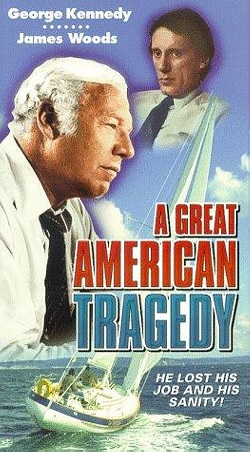
Retro Television Reviews: A Great American Tragedy (dir by J. Lee Thompson)


Welcome to Retro Television Reviews, a feature where we review some of our favorite and least favorite shows of the past!  On Sundays, I will be reviewing the made-for-television movies that used to be a primetime mainstay.  Today’s film is 1972’s A Great American Tragedy!  It  can be viewed on YouTube!

Brad Wilkes (George Kennedy) had a good career, working as an aerospace engineer.  He was able to buy a nice house.  With his wife, Gloria (Vera Miles), he was able to raise a good family.  He was even able to buy a sailboat, one that is the pride of the entire marina.  But then, one day, he’s told that the company is letting him go.

Returning to his home, Brad tells Gloria that he’s lost his job but that everything’s going to be okay because not only does he have a $10,000 pension but he’s sure he can find a new job.  “Of course, I might not be making $35,000 a year….” he says.

(Watching at home, I said, “Pfffft!  I make more than that!”  But, of course, Brad is talking about $35,000 in 1972 money, which would be the equivalent of a quarter of a million today.)

However, Brad soon discovers that getting a new job will not be as easy as he assumed.  It turns out that there are a lot of people out there looking for work and most of them are younger, cheaper, and better educated than Brad.  The bills start to pile up.  His former boss (Robert Mandan) informs Brad that his pension is going to be $7,000 less than he thought.  Brad forces himself to go down to the unemployment office so that he can collect $25 a week and then suffers the humiliation of being offered a loan by his well-meaning son-in-law (played by a youngish James Woods).  Gloria gets a job at the same clothing store where she used to shop and her lecherous boss (Kevin McCarthy) starts to hit on her.

For Brad, the final humiliation comes when he has to sell the boat.  A younger boat owner (Tony Dow, with a huge mustache) puts Brad in contact with a woman named Paula (Natalie Trundy).  Paula wants to buy the boat and, after they take it out on the water, Brad finds himself tempted to cheat on his wife.  It all gets to be too much for Brad and soon, he’s on a plane to Nevada where hopefully one good night at the craps table will be enough to pay his bills….

Watching this film, I found myself feeling very sorry for Brad while, at the same time, becoming very frustrated with him.  On the one hand, his company tossed him out after years of loyal service and then tried to screw him out of his pension.  On the other hand, Brad spent almost the entire movie in denial about how bad things actually were.  It’s one thing to be proud and it’s another to just be stubborn.  Knowing that he has next to no money, Brad still insists on throwing his annual 4th of July party and he even invites his former boss to come over and celebrate.  Brad simply cannot bring himself to admit that his old life is over but really, who can blame him?  He’s not the one who chose to be fired.

A Great American Tragedy was directed by J. Lee Thompson, who also did Cape Fear, The Guns of Navarone, the Planet of the Apes sequels, and several Charles Bronson films.  There are no fight scenes to be found in A Great American Tragedy but Thompson does get good performances from his cast and the film makes great use of George Kennedy’s likability.  The viewer remains sympathetic to Brad, even when he makes mistake after mistake.  A film about a formerly secure family suddenly discovering just how much the economy sucks, A Great American Tragedy remains just as a relevant today as when it was first made.

The Gumball Rally (1976, directed by Chuck Bail)


When he gets bored in a business meeting, Michael Bannon (Michael Sarrazin) calls his old friend, Prof. Samuel Graves (Nicholas Pryor) and says only one word: “Gumball.”  Inspired by that one word, dozens of racers assemble in New York, all planning on taking part in the Gumball Rally.

What is the Gumball Rally?  It’s a highly illegal race in which teams of two compete to see which team can drive from New York to the other side of the country in the least amount of time.  Bannon and Graves currently hold the record for completing the Gumball Rally in the quickest amount of time and all of the racers are determined to try to claim that record for their own.  Meanwhile, one cop named Roscoe (Norman Burton) is determined to break this race up.  Has there ever been a good cop named Roscoe?  Rosco P. Coltrane probably had more of a chance of stopping them Duke Boys than Roscoe does stopping the Gumball Rally.

If The Gumball Rally sounds familiar, it’s because it’s basically a less star-filled version of The Cannonball Run.  Instead of Burt Reynolds and Dom DeLuise, The Gumball Rally has Michael Sarrazin, Nicholas Pryor, Tim McIntire, and Norman Burton.  Instead of Jackie Chan making his American debut, The Gumball Rally has early performances from Raul Julia and Gary Busey.  Instead of Dean Martin and Sammy Davis, Jr., The Gumball Rally has Steven Keats and Wally Taylor.  You get the idea.  However, the lack of big stars in the cast works to The Gumball Rally‘s advantage.  Whereas you watch The Cannonball Run with the knowledge that there’s no way Burt Reynolds isn’t going to at least come in second, it seems like anyone of the eccentric teams in The Gumball Rally could win the race.

Make no mistake about it, The Gumball Rally is a car chase film, one that was released at the height of that underrated genre’s popularity.  The actors are all likable and almost all of the characters get at least one funny, personality-defining moment but the real stars of The Gumball Rally are the cars and the stunts. That’s not surprising as this film was directed by legendary stuntman Chuck Bail.  This film is full of spectacular crashes and near misses.  (The race’s lone motorcyclist is especially accident-prone.)  Again, the lack of stars in the cast (and the fact that the cast reportedly did most of their own driving) bring an added element of suspense to the stunts.  You watch The Cannonball Run and Smoky and the Bandit secure in the knowledge that Burt Reynolds is never going to crash his vehicle because he’s Burt Ryenolds.  You don’t have that same automatic security when the car is being driven by Michael Sarrazine or Tim McIntire.

It may not be as well known as some of the films that it inspired but, if you like a good car chase (or a good car crash) film, The Gumball Rally is for you.

The TSL’s Horror Grindhouse: The Terminal Man (dir by Mike Hodges)


Check out the poster for 1974’s The Terminal Man.

Look at it carefully.  Examine it.  Try to ignore the fact that it’s weird that George Segal was once a film star.  Yes, on the poster, Segal has been drawn to have a somewhat strange look on his face.  Ignore that.  Instead, concentrate on the words in the top left corner of the poster.

“ADULT ENTERTAINMENT!” it reads.

That’s actually quite an accurate description.  The Terminal Man is definitely a film for adults.  No, it’s not pornographic or anything like that.  Instead, it’s a movie about “grown up” concerns.  It’s a mature film.  In some ways, that’s a good thing.  In some ways, that’s a bad thing.

Taking place in the near future (and based on a novel by Michael Crichton), The Terminal Man tells the story of Harry Benson (played, of course, by George Segal).  Harry is an extremely intelligent computer programmer and he’s losing his mind.  It might be because he was in a serious car accident.  It may have even started before that.  Harry has black outs and when he wakes up, he discovers that he’s done violent things.  Even when he’s not blacked out, Harry worries that computers are going to rise up against humans and take over the world.

However, a group of scientists think that they have a way to “fix” Harry.  It’ll require a lot of brain surgery, of course.  (And, this being a film from 1973, the film goes into excruciating details as it explains what’s going to be done to Harry.)  The plan is to implant an electrode in Harry’s brain.  Whenever Harry starts to have a seizure, the electrode will shock him out of it.  The theory is that, much like Alex in A Clockwork Orange 0r Gerard Malanga in Vinyl, Harry will be rendered incapable of violence.

Of course, some people are more enthusiastic about this plan than others.  Harry’s psychiatrist (Joan Hackett) fears that implanting an electrode in Harry’s brain will just make him even more paranoid about the rise of the computers.  Other scientists worry about the ethics of using technology to modify someone’s behavior.  Whatever happens, will it be worth the price of Harry’s free will?

But, regardless of the risks, Harry goes through with the operation.

Does it work?  Well, if it worked, it would be a pretty boring movie so, of course, it doesn’t work.  (Allowing Harry’s operation to work would have been like allowing King Kong to enjoy his trip to New York.)  Harry’s brain becomes addicted to the electrical shocks and, as he starts to have more and more seizures, Harry becomes even more dangerous than he was before…

The Terminal Man is a thought-provoking but rather somber film.  On the one hand, it’s a rather slow movie.  The movie does eventually get exciting after Harry comes out of surgery but it literally takes forever to get there.  The movie seems to be really determined to convince the audience that the story it’s telling is scientifically plausible.  On the other hand, The Terminal Man does deal with very real and very important issues.  Considering how threatened society is by people who cannot be controlled, issues of behavior modification and free thought will always be relevant.

Though the film may be slow, I actually really liked The Terminal Man.  Judging from some of the other reviews that I’ve read, I may be alone in that.  It appears to be a seriously underrated film.  As directed by Mike Hodges, the film is visually stunning, emphasizing the sterility of the white-walled hospital, the gray blandness of the doctors, and the colorful vibrancy of life outside of science.  Though he initially seems miscast, George Segal gives a good and menacing performance as Harry.

The Terminal Man requires some patience but it’s worth it.

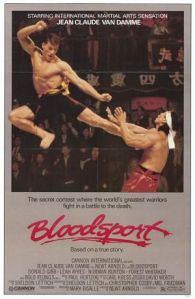
A Movie A Day #246: Bloodsport (1988, directed by Newt Arnold)


Bloodsport is one of Jean-Claude Van Damme’s earliest films and it is Damme good!
Forgive the terrible opening line but that is how they actually used to advertise Jean-Claude Van Damme films.  Everything was either Damme exciting or Damme amazing or Damme spectacular.  Though it was made by Cannon and had a much lower budget than the films Van Damme made during his 90s heyday, Bloodsport is still a Damme quintessential Van Damme movie.

Bloodsport claims that the story it tells is true.  Frank Dux (Van Damme) is a U.S. Army captain who goes AWOL so he can compete in Kumite, an illegal martial arts tournament that is held in Hong Kong.  Kumite is the only martial arts tournament where it is legal to kill your opponent.  Chong Li (Bolo Yeung) became champion by killing anyone who lasts more than a minute with him.  At first, no one believes that an American like Frank Dux has a chance of winning the Kumite.  What they do not know is that Frank was trained by the legendary Senzo Tanaka.  Frank is not just competing for personal glory.  He is also competing in honor of Tanaka’s dead son.

Bloodsport is both Van Damme and Cannon Films at their best.  Shot on location in Hong Kong, Bloodsport not only features Van Damme doing his thing but also gives him a memorable sidekick, Ray Jackson (Donald Gibb), who talks like a professional wrestler and gets all of the best lines.  When Ray and Frank first meet, they bond over a video game that appears to be an extremely early version of Street Fighter.  Also keep an eye out for Forest Whitaker (!), playing one of the CID officers who is assigned to track down Frank and arrest him for desertion.

Like any good Van Damme film, Bloodsport lives and dies on the strength of its fights and it does not skimp on the blood, the chokeholds, or the high kicks.  Bolo Yeung is a great opponent for Van Damme but everyone know better than to try to beat Jean-Claude Van Damme.  When it comes to fighting Van Damme, Duke put it best:

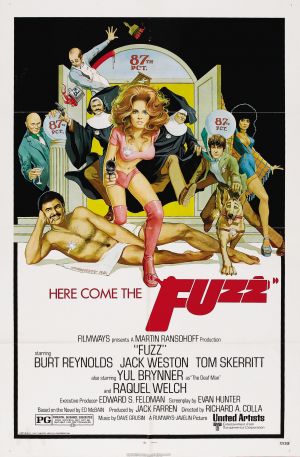
A Movie A Day #212: Fuzz (1972, directed by Richard A. Colla)


Detective Eileen McHenry (Raquel Welch) has just been given her new assignment and she is about to find out that there is never a dull day in the 87th Precinct.  How could there be when the precinct’s top detectives are played by Burt Reynolds, Tom Skerritt, and Jack Weston?  Or when Boston’s top criminal mastermind is played by Yul Brynner?  There is always something happening in the 8th Precinct.  Someone is stealing stuff from the precinct house.  Someone else is attacking the city’s homeless.  Even worse, Brynner is assassinating public officials and will not stop until he is paid a hefty ransom!
Based on the famous 87th Precinct novels that Evan Hunter wrote under the name Ed McBain, Fuzz has more in common with Robert Altman’s MASH than The French Connection.  (Skerritt and Bert Remsen, who plays a policeman in Fuzz, were both members of Altman’s stock company.)  Much like Altman’s best-regarded films, Fuzz is an ensemble piece, one that mixes comedy with tragedy and which features several different storylines playing out at once.  Scenes of homeless men being set on fire are mixed with scenes of Reynolds and Weston going undercover as nuns.  (Of course, Burt does not shave his mustache.)  Since it was written by Hunter, the film’s script comes close to duplicating the feel of the 87th Precinct novels.  Unfortunately, Richard A. Colla was a television director and Fuzz feels more like an extended episode of Police Story or Hill Street Blues than a movie.  Unlike Altman’s best films, Fuzz‘s constantly shifting tone and the mix of comedy and drama often feels awkward.  Fortunately, Fuzz does feature good performances from Reynolds, Westin, Skerritt, and Brynner, along with a great 70s score from Dave Grusin.  Raquel Welch is never believable as cop but she’s Raquel Welch so who cares?

Embracing the Melodrama #28: The Towering Inferno (dir by John Guillermin)


The_Towering_Inferno_1974-500x300

I have a weakness for the old, all-star disaster movies of the 1970s.  It could be because those movies remind me of how fragile life really is and encourage me to make the most of every minute.  Or maybe it’s because I have my phobias and, by watching those movies, I can confront my fears without having to deal with a real-life tornado, hurricane, tidal wave, avalanche, or fire.

Or maybe I just have a weakness of glitz, glamour, and melodrama — especially when it involves a huge cast of stars and character actors.  Yes that’s probably the reason right there.

Case in point: the 1974 best picture nominee, The Towering Inferno. 

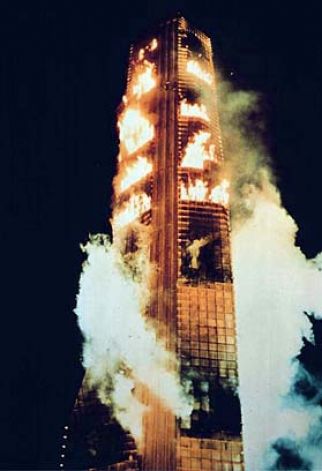
As is the case with most of the classic disaster films, The Towering Inferno is a long and big movie but it has a very simple plot.  The world’s tallest building — known as the Glass Tower — has been built in San Francisco.  On the night of the grand opening, a fire breaks out, trapping all the rich and famous guests on the 135th floor.  Now, it’s up to the fire department to put out the fire while the trapped guests simply try to survive long enough to be rescued.  Some will live, some will die but one thing is certain — every member of the all-star cast will get at least 15 minutes of screen time and at least one chance to scream in the face of the film’s still effective special effects.

628x471

As for the people trapped by the towering inferno, we don’t really get to know them or their motivations.  (Add to that, once the fire breaks out, everyone pretty much only has one motivation and that’s to not die.)  As a result, we don’t so much react to them as characters as we do to personas of the actors who are playing them.

Steve-McQueen-in-The-Towe-001

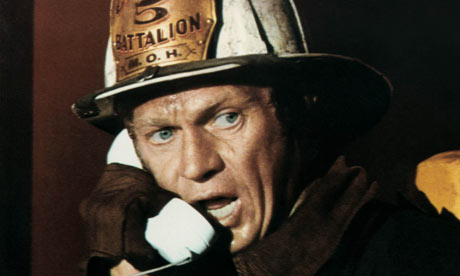
For instance, we know that Fire Chief O’Halloran is a fearless badass and a natural leader because he’s played by Steve McQueen.  McQueen brings a certain blue collar arrogance to this role and it’s a lot of fun to watch as he gets progressively more and more annoyed with the rich people that he’s been tasked with rescuing.

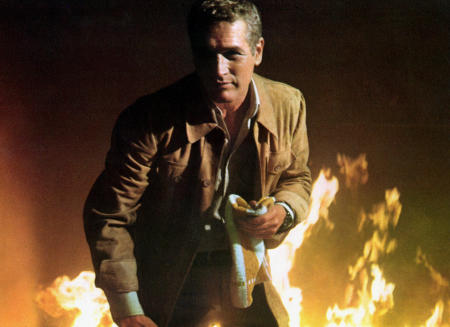
We know that architect Doug Roberts is a good guy because he’s played by Paul Newman.  Reportedly, Newman and McQueen were very competitive and, in this movie, we literally get to see them go-head-to-head.  And, as charismatic as Newman is, McQueen pretty much wins the movie.  That’s because there’s never a moment that O’Halloran isn’t in charge.  Doug, meanwhile, spends most of the movie begging everyone else in the tower to exercise the common sense necessary to not die.  (Unfortunately, despite the fact that he looks and sounds just like Paul Newman, nobody in the tower feels like listening to Doug.  If Towering Inferno proves anything, it’s that most people are too stupid to survive a disaster.)

paul-newman-inferno1

The tower’s owner, James Duncan, is played by William Holden so we know that Duncan may be a ruthless businessman but that ultimately he’s one of the good guys.  Holden gets one of the best scenes in the film when, after being told that people in the building are catching on fire, he replies, “I think you’re overreacting.”

Roger Simmons is Duncan’s son-in-law and we know that he’s ultimately to blame for the fire because he’s played by Richard Chamberlain.  Roger might as well have a sign on his back that reads “Doomed.”  The same can be said of publicity executive Dan (Robert Wagner) and his girlfriend, Lorrie (Susan Flannery).

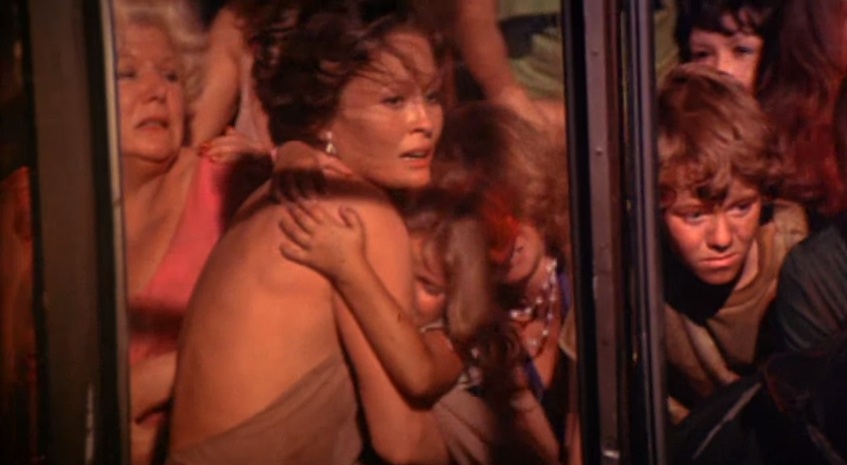
The_Towering_Inferno_1974_Faye_Dunaway_Mike_Lookinland

Faye Dunway is Susan.  She is Doug’s fiancée and she really doesn’t do much but she does get to wear a really pretty dress.  The same can be said of Susan Blakely, who plays Roger’s dissatisfied wife, and Jennifer Jones, who plays a recluse.  And good for them because if you’re going to be stuck in an inferno without much to do, you can at least take some comfort in looking good.

Then there’s Fred Astaire, who does not dance in this film.  Instead, he plays a kind-hearted con artist who ends up falling in love with Jennifer Jones.  Fred Astaire received his only Oscar nomination for his brief but likable performance in The Towering Inferno.

And finally, there’s the building’s head of security, Jernigan.  We know that he’s a murderer because he’s played by O.J. Simpson and … oh wait.  Jernigan is actually probably the second nicest guy in the whole film.  The only person nicer than Jernigan is Carlos, the bartender played by Gregory Sierra.

OJ

The real star of the film, of course, is the fire.  In the 40 years since The Towering Inferno was produced, there’s been a lot of advances in CGI and I imagine that if the film was made today, we’d be watching the fire in 3D and it would be so realistic that we’d probably feel the heat in the theater.  That said, the fire effects in The Towering Inferno are still pretty effective.  Now, I have to admit that I have a phobia (and frequent nightmares) about being trapped in a fire so, obviously, this is a film that’s specifically designed to work itself into my subconscious.  But that said, the scenes with various extras thrashing about in the flames are still difficult to watch.  There’s a scene where Robert Wagner and Susan Flannery find themselves trapped in a blazing reception area and it is pure nightmare fuel.

The Towering Inferno 9

The Towering Inferno is an undeniably effective disaster film.  At the same time, when one looks at the 1974 Oscar nominees, it’s odd to see The Towering Inferno nominated for best picture along with The Godfather Part II, Chinatown, and The Conversation.  Unlike those three, The Towering Inferno is hardly a great film.

But it is definitely an entertaining one.

toweringinferno2