Catching Up With The Films of 2025: The Life of Chuck (dir by Mike Flanagan)


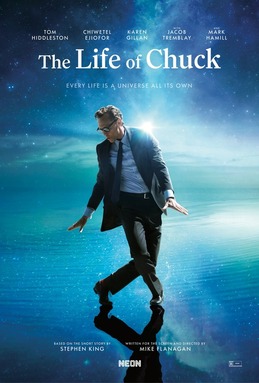
The Life of Chuck is a story told in reverse.

The world is ending and teacher Marty Anderson (Chiwetel Ejiofor) wonders why he keeps seeing signs that announce, “Charles Krantz: 39 Great Years! Thanks, Chuck!”  Marty’s ex-wife (Karen Gillan) calls him and tells him that, at the hospital where she works, she and her co-workers have taken to calling themselves “the suicide squad.”  It would be an effective moment if not for the fact that the film’s narration (somewhat predictably voiced by Nick Offerman) had already informed us of that fact.  Everyone wonders why the world is falling apart.  Why has the internet gone off-line?  Why has California finally sunk into the ocean?  Why are people rioting?  Several characters say that it’s the end times before then adding that it’s not the same end time that the “religious fanatics” and “right-wing nuts” always talk about.  Thanks for clarifying that!  It’s nice to know that, at the end of the world, people will still talk like an aging Maine boomer.

Nine months earlier, a straight-laced banked named Chuck Krantz (Tom Hiddleston) comes across a busker playing her drums on a street corner and feels inspired to start dancing.

Years earlier, a young boy named Chuck Krantz is raised by his grandmother (Mia Sara) and his grandfather (Mark Hamill).  Young Chuck (Jacob Tremblay) inherits a love of dance from his grandmother but, after she dies in a supermarket, his grandfather turns to drinking.  His grandfather keeps one room in their house locked.  (There’s even an absurdly huge lock on the door because The Life of Chuck is not a subtle one.)  Eventually, Chuck discovers what is hidden away in the room and it shapes the rest of his life.

Occasionally, solid genre craftsmen will fill the need to prove that they’re actually deeper than people give them credit for.  In 2020, Stephen King published a novella called The Life of Chuck.  In October of 2023, director Mike Flanagan announced that he had begun filming on his adaptation of The Life of Chuck.  Both King and Flanagan are better-known for their contributions to the horror gerne, though, around 2017, King apparently decided that he was also meant to be a political pundit.  (No writer, with the possible exception of Joyce Carol Oates, has done more damage to their reputation by joining twitter than Stephen King.)  There are elements of horror to be found in The Life of Chuck.  There’s the world ending during Act One.  There’s the locked rom in Act Three.  There’s the terrible acting of the woman playing the drummer in Act Two.  But this definitely is not a horror film.  Instead, it’s King and Flanagan at their most sentimental, heartfelt, and ultimately simplistic.

It’s ultimately a bit too self-consciously quirky for its own good.  Flanagan seems to be really concerned that we’ll miss the point of the film so he directs with a heavy-hand and, at times, he overexplains.  Sometimes, you have to have some faith in your audience and their ability to figure out things on their own.  The scenes of Chuck’s childhood are so shot through a haze of nostalgia that they feel as overly stylized as the scenes that don’t necessarily take place in our reality.  For the most part, the narration could have been ditched without weakening the film.  That said, the film is hardly a disaster.  There are moments that work, like the joyous scene of Tom Hiddleston dancing.  The film tries a bit too hard to be profound but there’s joy to be found in the performances of Hiddleston and Jacob Tremblay.  Chucks seems like a nice guy.

Thanks, Chuck!

Review: Civil War (dir. by Alex Garland)


“What kind of American are you?” — Unnamed ultranationalist militant 

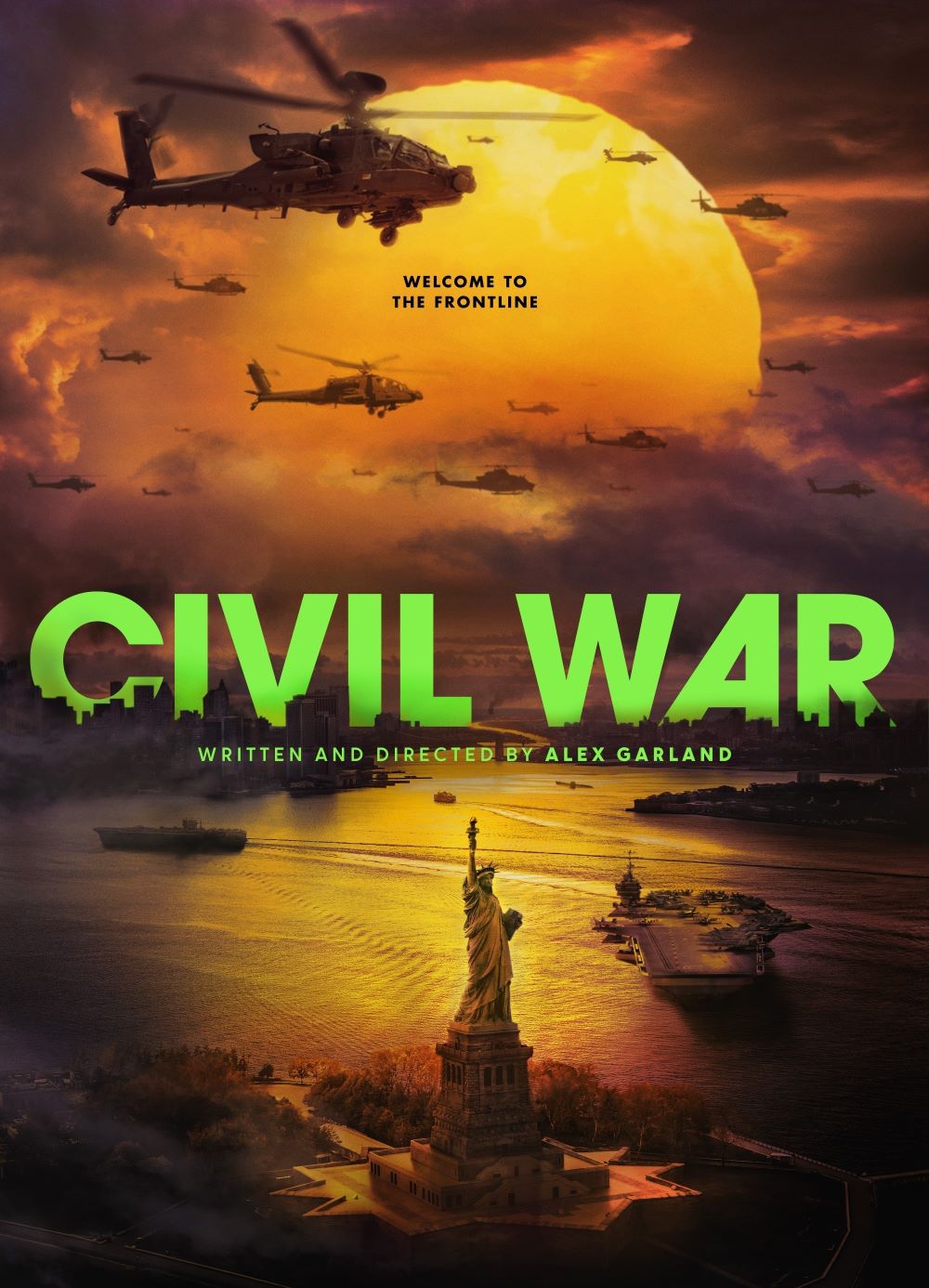
Alex Garland’s Civil War is the kind of movie that feels both uncomfortably close to reality and strangely abstract at the same time, like a nightmare built out of today’s headlines but deliberately smudged at the edges. It plays less like a political thesis and more like a road movie through a country that has already gone past the point of no return, seen through the eyes of people whose job is to look at horror and keep pressing the shutter anyway.

Garland frames the story around war journalists traveling from New York to Washington, D.C., hoping to reach the President before rebel forces do, and that simple premise gives the film a clear spine even when the politics around it stay fuzzy. Kirsten Dunst’s Lee, a veteran photographer, and Cailee Spaeny’s Jessie, a young aspiring shooter, are paired with Wagner Moura’s adrenaline-chasing reporter Joel and Stephen McKinley Henderson’s weary old-timer Sammy, forming a sort of dysfunctional road-trip family driving straight into hell. The setup is classic “last assignment” territory, but the context—an America shattered by an authoritarian third-term president and secessionist forces from places like Texas and California—is what makes the film play like speculative non-fiction rather than pure sci-fi. That Texas-California alliance as the Western Forces stands out as such strange bedfellows, two states about as diametrically opposed as you can get politically and culturally, which subtly hints at just how monstrous the president must be to drive them into the same camp against a common enemy.

The plot itself is pretty straightforward once you strip away the political expectations people bring in. The group moves from one pocket of chaos to another, crossing a patchwork United States where some areas still look almost normal while others are full-on war zones. The tension ramps as they get closer to Charlottesville and then D.C., eventually embedding with Western Forces as they push toward the capital. Along the way, the journalists encounter a series of vignettes—mass graves, roadside militias, bombed-out towns—that feel intentionally episodic, like flipping through the front page of a dozen different conflicts and realizing they all share the same language of fear and dehumanization.

Performance-wise, Dunst is the emotional anchor, playing Lee with a kind of hollowed-out professionalism that feels earned rather than performative. Her character is someone who has seen too many wars abroad and now finds herself documenting one at home, and Dunst sells that numbness without turning Lee into a complete emotional void. Spaeny’s Jessie, meanwhile, is the mirror opposite: all raw nerves and hungry ambition, constantly pushing closer to danger for the shot, until that drive becomes its own kind of addiction. Their dynamic—mentor vs. rookie, caution vs. thrill—gives the movie a human arc to track even when the bigger national stakes remain frustratingly vague.

The supporting cast makes the most of their moments. Moura brings a reckless charm to Joel, someone who clearly gets off on the chaos even as he understands the risks, while Henderson’s Sammy has that lived-in, old-school journalist vibe that makes his presence feel instantly comforting. Nick Offerman’s president shows up mostly as an image and a voice—an isolated leader giving delusional addresses about “victories” and “loyalty” while the country burns—which fits Garland’s choice to keep power distant and almost abstract. And then there’s Jesse Plemons in a late, unnerving scene as a soldier interrogating the group with the question “What kind of American are you?”, a moment that pulls the film’s subtext about nationalism and dehumanization right up to the surface.

Visually, Civil War is stunning and deeply unpleasant in the way it should be. Garland and his team lean heavily into realism: grounded battle scenes, chaotic firefights, and that disorienting sense of being in the middle of something huge and unknowable, with the camera clinging to the journalists as they scramble for cover or line up a shot. The film often uses shallow depth of field, throwing backgrounds into blur so explosions and tracers feel like ghostly streaks behind the tight focus on a face or a camera lens, which reinforces how narrow the characters’ survival focus has become. Sound design is equally aggressive—gunfire, drones, and explosions hit hard in a theater, and Garland doesn’t shy away from making violence both terrifying and, in a way, disturbingly exhilarating.

That’s one of the film’s more interesting, and arguably more uncomfortable, tensions: it’s overtly anti-war in its messaging, but it also understands that war, on a visceral level, can feel like a rush. Several characters clearly chase that feeling, and the film doesn’t let them—or the audience—off the hook for enjoying the adrenaline that comes from life-or-death stakes. There are moments where the action almost tips into “too cool” territory, but Garland usually undercuts this with the emotional fallout afterward, making it clear the cost of those images and thrills is paid in trauma and numbness.

Where Civil War is really going to divide people is in its politics—or more accurately, its refusal to spell them out. The film never fully explains how this United States got here or exactly what the sides are fighting over, beyond hints of authoritarian overreach and regional alliances like the Texas-California Western Forces. You get breadcrumbs: a third-term president who dissolved norms, references to an “Antifa massacre,” and presidential rhetoric that echoes real-world strongman language, but Garland refuses to plant a big obvious flag that says, “This is about X side being right or wrong.”

Depending on what you want from the movie, that choice either feels smartly universal or frustratingly evasive. On one hand, treating the conflict like a kind of Rorschach test lets viewers project their own anxieties onto the screen; it becomes a story about any country pushed too far by polarization, propaganda, and the normalization of violence. On the other, the vagueness around ideologies can come across as sidestepping tough specifics, especially in today’s charged climate, where audiences might crave a bolder stance on division and power.

To the film’s credit, its focus is very clearly on the experience of war, not the policy debates that preceded it. The journalists are not neutral robots; they have opinions, fears, and moments of moral conflict, but their professional instinct is to document first, analyze later, and that’s the lens the film adopts as well. You see how the job warps them: Lee’s exhaustion, Jessie’s desensitization, Joel’s thrill-seeking, Sammy’s weary sense of duty. In that sense, Civil War feels as much like an ode and a critique of war journalism as it does a warning about domestic collapse.

That said, the character work will not land equally for everyone. The emphasis on spectacle and raw incident sometimes leaves less room for layered personal depth, with figures beyond the leads feeling more archetypal than fully fleshed out. Even Lee and Jessie are shaped primarily by their roles in the chaos rather than extensive personal histories, which suits Garland’s lean, immersive style but might leave some wanting more nuance.

The last act, set during the assault on Washington and the White House, is where the film fully commits to being a war movie rather than a political allegory. The battle is staged with a mix of big, chaotic action and small, intimate beats: journalists diving behind columns, soldiers shouting directions, Jessie pushing closer to get the shot even as bullets hit inches away. It’s brutal and propulsive, driving home the film’s bleak thesis: once violence is normalized, legitimacy and process vanish, replaced by whoever has the most guns in the room.

Is Civil War perfect? No. It is at times overdetermined in its imagery and underdetermined in its world-building, and the decision to keep the “why” of the war so foggy will absolutely alienate viewers who wanted a sharper, more pointed statement about the current American moment. But it is also undeniably gripping, technically impressive, and thematically rich enough to spark real conversation about violence, media, and how far a society can bend before it breaks. As a piece of speculative near-future filmmaking, it lands somewhere between warning and reflection: not saying “this will happen,” but asking whether a country this polarized and numb to cruelty should be so confident that it won’t.

Miniseries Review: Death by Lightning (dir by Matt Ross)


Death by Lightning, a four-episode miniseries that recently dropped on Netflix, tells the story of two “forgotten men,” as the show itself puts it.

Michael Shannon plays James A. Garfield, the Ohio farmer and former Congressman who, despite attending the 1880 Republican convention solely to give the nominating speech for Secretary of Treasury John Sherman (Alistair Petrie), found himself nominated for President after the convention found itself deadlocked between supporters of Former President Grant (Wayne Brett) and Senator James Blaine (Bradley Whitford).  Garfield did not want to run for President and he certainly did not want to run with Chester A. Arthur (Nick Offerman), an associate of New York political boss, Roscoe Conkling (Shea Whigham).  However, in November of 1880, James Garfield was narrowly elected the 20th President of the United States.

Matthew MacFayden plays Charles J. Guiteau, a failed lawyer and self-proclaimed newspaper publisher who felt that a stump speech he had given at a small rally was responsible for Garfield’s victory.  Guiteau expected to be appointed to a position in the Garfield administration, perhaps as Consul to France.  In those days of no Secret Service protection and an open White House, Guiteau was one of the many random office seekers who managed to get a face-to-face meeting with Garfield.  What Guiteau did not get was a job.  While Guiteau may have deluded himself into thinking that he was an inside player, everyone else viewed him as being a pesky and disreputable character.  On July 2nd, 1881, Guiteau shot Garfield in the back.  After Garfield died in September, Guiteau was convinced that he would be pardoned by the newly sworn-in President Arthur.  Instead, Guiteau was hanged on June 30th, 1882.

(It’s now generally agreed that Guiteau was such a bad shot that Garfield would have survived his wounds if not for the incompetence of his doctors, who probed his wounds with their bare hands in an effort to extract the bullet.  Garfield died as a result of multiple infections caused by his medical treatment.)

Again, Death by Lightning describes Garfield and Guiteau as both being forgotten men.  That’s not quite true.  I knew who both of them were before I watched the miniseries but then again, I’m also a history nerd.  As much as I don’t want to admit it, it is true that the majority of today’s Americans don’t know either Garfield or Guiteau.  And yet, in 1881, America revolved around them and their fate.  Everyone checked every day for news on Garfield’s health and Guiteau’s trial was heavily covered by the press.  That’s something to remember whenever you hear people talking about how “history will remember” whatever may be happening in the news today.  History may remember but people are quick to forget.

As for Death by Lightning, it does a good job of telling not only the stories of Garfield and Guiteau but also Chester Arthur as well.  The miniseries takes place at a time when political machines dominated American politics and also at a time when the Spoils system and the widespread corruption that it engendered were both accepted as immutable political realities.  Guiteau, having spent his life seeing other people receive jobs for supporting the right candidate, felt that he was naturally entitled to whatever position he requested.  Guiteau’s actions actually did lead to reformation of the Spoils system, with President Arthur emerging an unlikely reformer.  Never again would a random office seeker by allowed through the front doors of the White House and never again would a President casually walk around Washington D.C. without some sort of guard.  With a smart script, good performances, and even a few moments of unexpected cringe humor, Death by Lighting recreates that moment in American history and it pays tribute to James A. Garfield, who was universally described by his contemporaries as being a decent man who was struck down before he could reach his full potential.

How historically accurate is Death by Lightning?  That’s a fair question.  Death by Lightning sticks to the established facts about Garfield and Guiteau but a scene in which Garfield’s daughter argues with him about immigration is undoubtedly meant to be more of a commentary on 2025 than 1880.  I think it can be argued that no film or series can be 100% historically accurate because those who actually witnessed the events in question are no longer with us.  Inevitably, the past is always viewed and recreated through the filter of the present.  And indeed, it is tempting to compares Garfield and Guiteau to our modern-day politicians and activists.  Guiteau, with his constant excuses for his own dumb decisions and his ranting and raving about how he speaks for the people, was a particularly familiar character.  As for the modest and honest Garfield, it’s sadly difficult to think of any modern-day politicians from the same mold.

As a final note, my favorite part of this miniseries occurred during the first episode.  The recreation of the 1880 Republican Convention is wonderfully entertaining.  It’s amazing to think that, in the days before television coverage required political conventions to become carefully choreographed and tightly controlled, there actually was legitimate suspense about who would end up being nominated.  Sadly, those days seem to be over.

Brad’s thoughts on MISSION: IMPOSSIBLE – THE FINAL RECKONING (2025)


I’ve been trying to make it to the theater to watch the latest, and reportedly the final, “Mission: Impossible” film featuring Tom Cruise as Ethan Hunt. I was finally able to make it this weekend! This film series has been a big part of my life, with the first film opening when I was just a 22 year old kid, and the final film being released when I’m a 51 year old grandpa! Going back to 1996 when Brian De Palma directed the first in the series, I have seen all eight at the movie theater. I have enjoyed all of them, with MISSION: IMPOSSIBLE II as my clear least favorite, which is quite strange since it was directed by John Woo, my favorite director of all of them. I still like it though. This Mission: Impossible franchise has done the near impossible in the fact that it has gotten better and better over the course of its twenty nine years in existence. The first four films in the franchise experimented with different directors, some of the best in the business. The fifth in the franchise, “ROGUE NATION,” was directed by Christopher McQuarrie, who would then direct the rest of the series, including this final installment. McQuarrie’s sure hand has brought us to this final place. In a way, I’m sad to see it coming to an end, but time seems to take a toll on all of us, even Ethan Hunt / Tom Cruise.

MISSION: IMPOSSIBLE – THE FINAL RECKONING, a direct sequel to MISSION: IMPOSSIBLE – DEAD RECKONING PART 1 (2023), opens two months after the prior film. With the evil “Entity” continuing to corrupt global cyberspace and create chaos, it appears the world is headed for a sure nuclear war. With no other choice, U.S. President Erika Sloane (Angela Bassett) reluctantly puts her faith in Ethan Hunt (Tom Cruise) and his team of IMF agents, including Benji (Simon Pegg) and Luther (Ving Rhames). He also gets help from Grace (Hayley Atwell), Paris (Pom Klementieff), and Theo (Greg Tarzan Davis). Together this team goes after Gabriel (Esai Morales), an evil terrorist who’s been working with the “Entity,” in a last ditch effort to eliminate the end-of-the-world threat for a bunch of people who will never know what has been done for them.

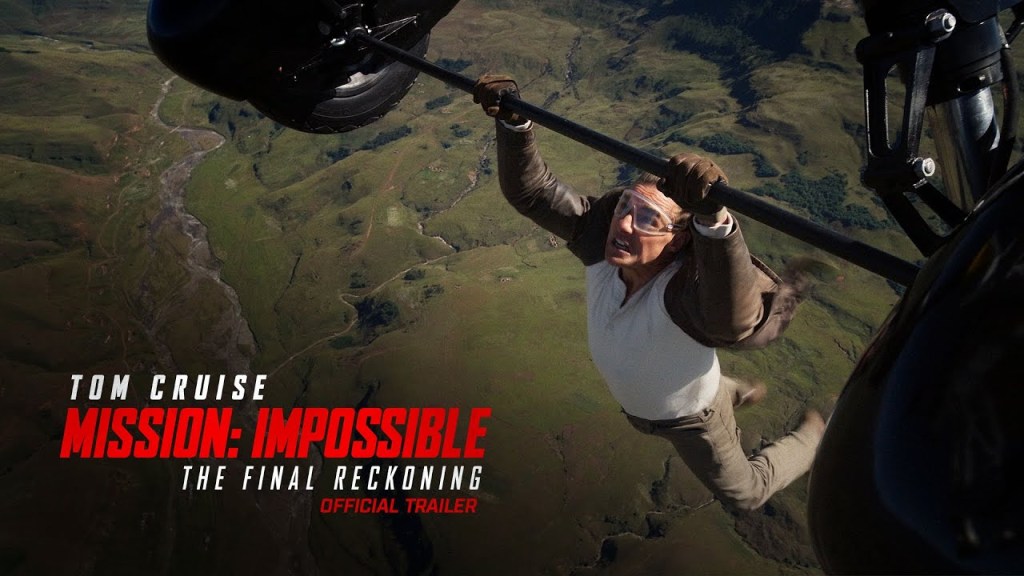
I think that MISSION: IMPOSSIBLE – THE FINAL RECKONING is an excellent conclusion to the series featuring Tom Cruise as Ethan Hunt. There are several reasons I feel this way. First, this final episode gives us the things that we’ve loved about the series from the beginning. For example, there is always a section of the film where the team will have to do something that is impossible. They’ll go through the plan with us, the audience, and they’ll explain why it’s impossible and the worst case scenarios they could run into. You can always count on the actual execution of the mission being even worse than the “worst case scenarios,” with the fun being in how they finally achieve their objective after all sorts of complications. We definitely get that here. Second, the relationships that Ethan Hunt shares with his long term team of Luther (all 8 films) and Benji (6 films) bring something special in this final episode. Luther (Ving Rhames) has been with Ethan from the very beginning, and this final episode proves that Ethan isn’t the only person on the team willing to give everything he has to protect a bunch of people who will never know his name. Benji (Simon Pegg) has been with Ethan since the third installment, and the series has seen him go from being nerdy comic relief to an important and trusted member of the team. He’s still funny, but he’s also right in the middle of everything. I like Pegg and it’s been satisfying seeing this character arc. Third, the action sequences are incredible. The final sequence where Ethan Hunt must climb on board not one, but two different biplanes to stop the evil Gabriel from getting away is awesome. These stunt sequences are incredible, and I actually got weak in the knees as I watched the death defying maneuvers, mostly featuring Tom Cruise himself. Fourth, this final installment enjoys revisiting past missions and characters, tying these prior events to where we are now in Hunt’s story. My favorite is the re-introduction of the character William Donloe (Rolf Saxon), the CIA Analyst from the very first film who ran the impenetrable, secure room that Hunt’s team is able to break into in Langley, VA. We learn that his character was banished to a remote post on the Bering Sea as a direct result of what happened 29 years earlier. When he re-emerges here, it’s revealed that his reassignment was the best thing that ever happened to him, and he’s also made an integral part of this final installment. It’s good stuff. 

Finally, I want to finish my thoughts on MISSION: IMPOSSIBLE – THE FINAL RECKONING by discussing actor Tom Cruise. It’s my personal opinion that Cruise is the last of a dying breed, the true movie star who gives everything he has for his films. There are no others who do what Tom Cruise does, which is put his life on the line to entertain us. Jackie Chan did the same thing in his heyday, and there aren’t any others left. The stunts that Cruise completed for this film, as well as the prior films, will never be matched again by a major movie star. That may even be a good thing, but my respect for Cruise’s commitment to his craft places him alone in my book as the greatest movie star on the planet. They certainly don’t make them like Tom Cruise anymore. 

At the end of the day, MISSION: IMPOSSIBLE – THE FINAL RECKONING is an incredible close to the extremely successful franchise. It’s probably not the best in the series as it may try to cover too much ground in its efforts to close everything out. Time and repeat viewings will determine its ultimate reputation, but I know that I enjoyed every second of it. I even had some moisture well up in my eyes at the end as the film was reaching its conclusion. I honestly doubt we’ll ever see such prolonged excellence again in a movie franchise. 

The Gunfighter, Short-Film Review, (Dir. Eric Kissack, Writer Kevin Tenglin)


There are many times when I watch a short-film with FEAR because so many are just terrible. “The Gunfighter” is VERY funny and I put it in the MUST WATCH category. For my dedicated readers, you know that recommending a film as a Must Watch is a small club. The Gunfighter won a number of awards, however, very few of the actors or directors went on to a big career, which is a real shame. See, I can still pull depression from the jaws of happiness. I think I need a Rx.

The Gunfighter takes the Western and gives the characters the ability to hear the Narrator (Nick Offerman). This creates a lot of comedy because the narrator is determined to have everyone in the saloon kill each other. I know this is dark, but it is HILARIOUS! The narrator reveals who is having affairs with each other, who is having sex with a man’s favorite sheep, and a prostitute who was given a disease from a man who has sex with a man’s favorite sheep.

This is definitely a short-film to watch …. like right now!

HBO showcases The Last of Us Teaser Trailer!


Naughty Dog’s The Last Of Us was one of the first modern videogames to gain my younger cousin’s interest in playing. Although I finished it the normal difficulty, she was able to complete it on its hardest settings and went on to continue with the sequel. So, we’ve been looking forward to HBO’s Live Action adaptation. What I didn’t realize was that Craig Mazin was involved in this, whose work on Chernobyl was amazing. Mazin is handling the writing along with the original author, Neil Druckman.

The Last of Us takes place in a world torn apart, where Joel & Ellie (Pedro Pascal & Bella Ramsey, both featured in Game of Thrones) have a difficult mission to accomplish. The show looks as if it’s keeping most of the elements from the game. The Fireflies and the Clickers, they’re all there. The cast listing even includes some of the voice cast from the game. I’m curious to see how they’ll incorporate that into this.

The Last of Us is set to premiere next year, on HBO and HBO Max.

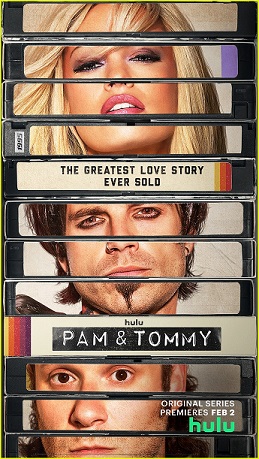
TV Review: Pam & Tommy “Destroyer of Worlds” (dir by Lake Bell)


After two blissfully Rand-free episodes of Pam & Tommy, Rand Gauthier (Seth Rogen) returned to dominate this week’s episode.  As soon as things opened with a close-up of Rand looking like someone had just run over his favorite pet, I groaned very loudly.  Rand is such an unlikable character and the show insists on trying to make us feel sorry for this loser.  Even if Seth Rogen wasn’t both miscast and intent on giving the worst performance of his career in the role, Rand would make Pam & Tommy difficult to watch.

Rand (or Reed or whatever his name is supposed to be) was basically upset because he wasn’t making any money off of the Pam and Tommy sex tape.  Instead, the bootleggers were making all the money.  Rand/Reed also got upset because cocaine addict Uncle Miltie (Nick Offerman) turned out to be a bad business partner.  Meanwhile, Butchie (Andrew “Dice” Clay, acting up a storm with little to show for it) wanted his money and demanded that Reed/Rand turn into a debt collector.  “I AM THE DESTROYER OF WORLDS!” a frustrated Rand declared as he collected a debt and seriously, what the heck?  (Folks, I gave up cursing for Lent.  Just go with me here.)  The episode’s best moment was when Rand tried to blackmail Tommy and Tommy reacted by setting the money on fire while Randy Reed watched.  What made this scene so great was that Tommy called Reedy Rand a loser.  Again, I got the feeling that we were supposed to feel bad for Rand but …. eh.  Who cares?  Rand is a loser and the mullet isn’t making him look any better.

If the highlight of the episode was Tommy setting that money on fire while taunting Rand, the show’s second best moment was Pam appearing on The Tonight Show and having to deal with a series of disrespectful and infuriatingly sexist questions from Jay Leno.  The actor playing Leno essentially played him as being the devil, which was kind of amusing.  Watching the scenes with Leno acting like a member of the Spanish Inquisition, I found myself thinking about how Ken Russell probably could have done something amazing with this material.  The scene ended with Pam having to talk Tommy out of beating up Jay Leno, which again was kind of amusing.  Just imagine if Tommy had stormed onto the Tonight Show set and thrown a punch while Jay was introducing Hugh Grant.  That would have been classic television.

As the Tonight Show debacle indicated, the release of Barb Wire was overshadowed by Pam and Tommy’s court case against Penthouse.  The judge ruled that the 1st Amendment gave Penthouse the right to publish still from the tape.  Tommy was too stupid to realize that the judge had ruled against him.  Pam responded with a monologue about how the judge was actually saying that it was okay to exploit her because she wore a swimsuit on Baywatch and she also previously appeared in Playboy.  Pam had a point but, as so often happens on this show, that point was somewhat negated by the fact that the real-life Pamela Anderson never signed off on having her life dramatized in Pam & Tommy and, as a result, the show is itself a bit exploitive.

The show also continues to feel a bit pointless, despite Lily James’s frequently excellent performance as Pam.  Again, it’s hard not to wonder why exactly this story demands the limited series treatment as opposed to the 90-minute movie treatment.  Indeed, by stretching thing out over 8 hours, Pam & Tommy just reminds us of how superficial this story really is.

One final note: early on in the episode, Butchie is shocked to discover that there’s a new coffee company in Seattle that’s called Starbucks.  I’ve noticed this is a joke that’s popped up in a lot of movies about the 90s and it feels rather lazy.  They should have made an AOL joke instead.

TV Review: Pam & Tommy 1.4 “The Master Beta” (dir by Lake Bell)


“I’ve made a terrible mistake.”

That was my thought after I published my review of the first three episodes of Pam & Tommy.  Don’t get me wrong.  I stand by everything that I wrote in that review.  The first three episodes were relatively well-made and they captured as specific point in time and Lily James was likably earnest as Pam.

Instead, my concern came from the fact that, by reviewing the first three episodes, I had now committed myself to watching and reviewing the entire series.  And, the more I thought about it, the more I realized that there was no way that Pam & Tommy could remain interesting for a total of 8 hours, not unless the show abandoned its Ryan Murphy-lite approach and did something really unexpected with its recreation of the story.  There’s just not enough there.  This is a good 2-hour story but Pam & Tommy is an 8-epiosde miniseries.  That’s 8-plus hours of Pam getting upset, Tommy acting like a dumbass, and Rand being every creepy guy who has ever approached you in a bar and started asking you about the book you’re reading.  (It would, of course, never occur to him that the main reason you’re reading the book is to avoid talking to guys like him.)

Having now watched the fourth episode, it’s hard not to feel that I was very much correct in my concerns.  Don’t get me wrong.  The fourth episode had its moments.  It featured an enjoyably intense performance from Don Harvey as the legendary Hollywood private investigator, Anthony Pellicano.  Once Tommy finally discovers that his safe has been stolen and Pam reminds him about the videotape, Pellicano is the man who they approach to track down the perpetrator.  This leads to a scene of Pellicano beating the crap out of Rand and it’s fun to watch.  Some of that is because Don Harvey is a master of portraying urbane menace.  But I have to admit that a lot of it is because Rand himself is such an annoying character.  This episode opened with Seth Rogen, as Rand, wandering around a porn set and trying to reconnect with his estranged wife (Taylor Schilling), who significantly was just trying to read Anne Rice’s latest book when he approached her.  Just the sight of Rand, with his mullet and his sad-sack facial expression, was so annoying that it was actually cathartic to see him get tossed around his apartment.

The problem is that the show wants us to feel some sympathy for Rand but there’s nothing sympathetic about him.  He’s a loser and the fact that he still loves his wife and still wants to take care of her doesn’t make him any less of a loser.  He’s a thief, a guy who accidentally stole a sex tape and then decided to put it online.  The fact that he later feels guilty doesn’t change the fact that he did it.  There’s as scene in the fourth episode where Rand is upset to see someone else selling bootleg copies of the tape.  On the one hand, it’s not a bad scene.  There’s an enjoyable irony to Rand discovering that someone has essentially stolen the tape from him after Rand went through so much trouble to steal the tape from Tommy.  But the show doesn’t seem to be sure whether it wants us to laugh at Rand’s misfortune or to sympathize with him as he realizes that the consequences of his actions are out of his control.  As a character, Rand is not compelling enough for both to be an option.

As for the title characters, both Sebastian Stan and Lily James do their best but I get the feeling that we’ve already learned all the we need to know about them.  There was one good moment that examined Pam and Tommy’s different reactions to the release of the sex tape but otherwise, neither Tommy nor Pam are really that interesting as characters.  I ended the fourth hour of Pam & Tommy very much aware that there were still four more hours to go.  What else, I found myself wondering, could be left to be said?

TV Review: Pam & Tommy Episode 1-3 (dir by Craig Gillipsie)


Currently (and, presumably, forever) available on Hulu, Pam & Tommy is a miniseries about …. well, it’s about many things.

It’s about the mid-90s, a time when people still used terms like “World Wide Web” and where no one thought twice about having to wait two or three minutes for one lousy web site to finish loading.  It’s about a time when dial-up internet was still considered to be something of an exotic luxury.  It’s about a time when the number one show in the entire world was the critically derided Baywatch and the show’s star, Pamela Anderson, was trying to make the jump from television to film.

It’s also about the early days of online porn and how it was first discovered that people would pay money to watch celebrity sex tapes.  It may seem strange to consider that this was something that needed to be discovered but, if you believe Pam & Tommy, apparently no one thought there was an audience for celebrity sex tapes before 1996.  Today, of course, celebrity sex tapes are so common place that they’re often leaked by the celebrity themselves.  Where would the Kardashians be if not for the celebrity sex tape industry?  Could it be that Kim owes as much of her success to Pamela Anderson and Tommy Lee as she does to O.J. Simpson?  Perhaps, which is a polite way of saying yes.

Pam & Tommy is also about the brief marriage of Pamela Anderson (Lily James) and Tommy Lee (Sebastian Stan).  When Pam & Tommy begins, Pam, as mentioned above, is the star of the number one show in the world.  Despite being a star, she’s not respected as an actress.  Instead, she’s usually treated as just being a body.  The show’s producers and directors have no trouble cutting her big monologue on a whim but they spend several minutes discussing just how tight her red swimsuit should be.  (After cutting her monologue, they condescendingly thank her for being a team player.)  Pam has a very earnest and somewhat heart-breaking desire to be taken seriously as an actress.  She describes Jane Fonda as being her role model.  Meanwhile, Tommy Lee is, for lack of a better term, an idiot.  He’s also a drummer for a band that used to be big.  He travels with an entourage.  His body is covered with tattoos, the majority of which have no meaning to him beyond, “I just thought it looked cool.”  Tommy is usually an arrogant bully, the epitome of the spoiled rock star.  Occasionally, with Pam, he’s sweet but if this miniseries stays true to what actually happened during Pam and Tommy’s marriage, that sweetness is not going to last.

Finally, Pam & Tommy is the story of Rand Gautheir (Seth Rogen).  Much like Tommy, Rand is a moron.  However, Rand has neither Tommy’s looks nor his swagger.  Instead, he’s just a schlub who works as a carpenter and tries way too hard to present himself as being an intellectual.  After Tommy humiliates Rand by firing him from a remodeling job, Rand retaliates by stealing a safe from Tommy’s garage.  (Tommy doesn’t even notice that it’s missing.)  Inside the safe, Rand finds a sex tape that Tommy and Pam made on their honeymoon.  With the help of gangster Butchie Periano (Andrew Dice Clay) and adult film veteran “Uncle” Miltie (Nick Offerman), Rand puts the video on the internet and plans to make a fortune.  Rand tells himself that he’s doing it because Tommy didn’t pay him for his work but it’s clear that Rand’s main motivation is jealousy.  Why should Tommy get a huge house and a beautiful wife while Rand is stuck in his little apartment?  Rand is at least as smart as Tommy.  Of course, the same could probably be said of the dog that Pam purchases when she and Tommy return from their honeymoon.

In other words, Pam & Tommy is about a very specific cultural moment.  So far, the series is taking a stylized approach to the material, mixing occasionally broad comedy with more dramatic moments.  Needless to say, it’s a bit uneven.  During the second episode, Tommy actually has a conversation with his penis about whether or not he should marry Pam.  It’s a funny idea but the scene itself goes on forever and, ultimately, the whole thing says more about the importance of generating twitter buzz than it does about why Tommy and Pam ended up getting married after knowing each other for only a handful of days.  The first three episodes were directed by Craig Gillipsie, who also directed I, Tonya.  Much like that film, Pam & Tommy is occasionally insightful but it also sometimes seems to get bogged down in its own condescending attitude towards the people who are at the center of its story.

And yet, there are also enough moments that work in Pam & Tommy that I’ll definitely watch the rest of the show.  So far, this is a series that is largely saved by its cast.  Seth Rogen has recently been so intent on presenting himself as being the only man in Hollywood with integrity that it’s easy to forget that he’s always been at his most entertaining (and sympathetic) whenever he’s been cast as a complete loser and it’s hard to think of anyone who could be a bigger loser than the character he plays in Pam & Tommy.  Sebastian Stan plays Tommy as being a destructive manchild and, for the first two episodes, he’s pretty obnoxious.  By the third episode, though, Stan is given a few quieter scenes and he manages to suggest that there’s something more to Tommy than just rock star bravado.  And finally, Lily James gives a wonderfully empathetic performance as Pamela Anderson, capturing her earnest desire to be something more than just a sex symbol.

The first three episodes of Pam & Tommy dropped on Hulu this week.  The remaining five episodes will be released on a weekly basis.  I don’t really know how you get 8 episodes out of this particular story but I guess I’ll find out soon.  Hopefully, the show will continue to focus on the best thing that it has going for it, its cast.

What If Lisa Picked The Oscar Nominees: 2020 Edition


With the Oscar nominations due to be announced tomorrow, now is the time that the Shattered Lens indulges in a little something called, “What if Lisa had all the power.” Listed below are my personal Oscar nominations. Please note that these are not the films that I necessarily think will be nominated. The fact of the matter is that the many of them will not. Instead, these are the films that would be nominated if I was solely responsible for deciding the nominees this year. Winners are listed in bold.

I should also point out that I’ve only nominated films that were actually released in 2020.  Undoubtedly, Nomadland, Minari, Judas and the Black Messiah, and The Father will do very well with the Academy tomorrow but, as far as I’m concerned, they’re 2021 films and not eligible for my nominations.  They will be eligible next year, when I do my 2021 edition of What If Lisa Had All The Power.

It should also go without saying that I’ve nominated films that I’ve actually seen.

You’ll also note that I’ve added four categories, all of which I believe the Academy should adopt — Best Voice-Over Performance, Best Casting, Best Stunt Work, and Best Overall Use Of Music In A Film.

Click on the links to see my nominations for 2019, 20182017201620152014201320122011, and 2010!)

Best Picture

The Assistant
Bad Education
First Cow
The Girl With A Bracelet
i’m thinking of ending things
Lovers Rock
Palm Springs
Promising Young Woman
Soul
The Vast of Night

Best Director

Stéphane Demoustier for The Girl With A Bracelet
Emerald Fennell for Promising Young Woman
Charlie Kaufman for i’m thinking of ending things
Steve McQueen for Lovers Rock
Andrew Patterson for The Vast of Night
Kelly Reichardt for First Cow

Best Actor

Ben Affleck in The Way Back
Riz Ahmed in Sound of Metal
Chadwick Boseman in Ma Rainey’s Black Bottom
John Boyega in Red, White, and Blue
Hugh Jackman in Bad Education
Delroy Lindo in Da 5 Bloods

Best Actress

Alison Brie in Horse Girl
Sidney Flanigan in Never Rarely Sometimes Always
Julia Garner in The Assistant
Melissa Guers in The Girl With A Bracelet
Sophia Loren in The Life Ahead
Carey Mulligan in Promising Young Woman

Best Supporting Actor

Brian Dennehy in Driveways
Aldis Hodge in One Night In Miami
Orion Lee in First Cow
Clarke Peters in Da 5 Blood
Paul Raci in The Sound of Metal
J.K. Simmons in Palm Springs

Best Supporting Actress

Jane Adams in She Dies Tomorrow
Glenn Close in Hillbilly Elegy
Olivia Cooke in Sound of Metal
Allison Janney in Bad Education
Chiara Mastroianni in The Girl With A Bracelet
Talia Ryder in Never Rarely Sometimes Always

Best Voice Over Performance

Jack Cruz in What Did Jack Do?
Bruce Davis in The Vast of Night
Tina Fey in Soul
Jamie Foxx in Soul
Nick Offerman in Frances Ferguson
Chris Pratt in Onward

Best Original Screenplay

The Assistant
Palm Springs
Possessor
Promising Young Woman
Soul
The Vast of Night

Bad Education

Best Adapted Screenplay

Bad Education
Emma
First Cow
The Girl With A Bracelet
i’m thinking of ending things
The Outpost

Best Animated Feature Film

A Shaun The Sheep Movie: Farmageddon
Onward
Red Shoes and the Seven Dwarfs
Soul

Best Documentary Feature Film

Alabama Snake
Athlete A
The Mystery of D.B. Cooper
Natalie Wood: What Remains Behind
The Social Dilemma
Tread

Best International Feature Film

Figurant
The Girl With A Bracelet
Gunpowder Heart
The Hater
The Life Ahead
The Shock of the Future

Best Live Action Short Film

Basic
Figurant
Host
Run/On
Waffle
What Did Jack Do?

Best Documentary Short Film

Betye Saar: Taking Care of Business
John Was Trying To Contact Aliens
Lions in the Corner
Quilt Fever

Best Animated Short Film

Canvas

If Anything Happens I Love You

Best Original Score

Call of the Wild
First Cow
Mangrove
Possessor
She Dies Tomorrow
The Shock of The Future

Best Original Song

“Boss Bitch” from Birds of Prey
“Diamonds” from Birds of Prey
“Everybody Dies” from The Outpost
“Future Shock Work in Progress” from The Shock of the Future
“Gratia Plena” from Fatima
“Husavik” from Eurovision Song Contest: The Story of Fire Saga
“Jah Jah Ding Dong” from Eurovision Song Contest: The Story of Fire Saga
“Metamorph” from Gunpowder Heart
“The Spirit of Christmas” from The Christmas Chronicles 2
“True Love’s Flame” from What Did Jack Do?

Best Overall Use of Music

Bill & Ted Face The Music
Eurovision Song Contest: The Story of Fire Saga
Lovers Rock
Proising Young Woman
The Shock of the Future
Soul

Best Sound

Eurovision Song Contest: The Story of Fire Saga
Lovers Rock
The Outpost
Possessor
The Shock of the Future
Sound of Metal

Best Production Design

Eurovision Song Contest: The Story of Fire Saga
Emma
First Cow
i’m thinking of ending things
Possessor
The Shock of the Future

Best Casting

The Assistant
First Cow
Lovers Rock
Palm Springs
Promising Young Woman
The Vast of Night

Best Cinematography

First Cow
i’m thinking of ending things
Lovers Rock
Mank
She Dies Tomorrow
The Vast of Night

Best Makeup and Hairstyling

Bill & Ted Face The Music
i’m thinking of ending things
Eurovision Song Contest: The Story of Fire Saga
Hillbilly Elegy
Ma Rainey’s Black Bottom
Promising Young Woman

Best Costume Design

Emma
Eurovision Song Contest: The Story of Fire Saga
Fatima
First Cow
Ma Rainey’s Black Bottom
Tesla

Best Film Editing

Extraction
i’m thinking of ending things
The Outpost
Palm Springs
Promising Young Woman
The Way Back

Best Stuntwork

Bad Boys For Life
Birds of Prey
Bloodshot
Extraction
The Hunt
The Outpost

Best Visual Effects

The Christmas Chronicles 2
The Midnight Sky
The Outpost
Possessor
Radioactive
Tesla

Films By Number of Nominations

8 Nominations — First Cow, Promising Young Woman

7 Nominations — Eurovision Song Contest: The Story of Fire Saga, i’m thinking of ending things

6 Nominations — The Girl With A Bracelet, Lovers Rock, The Outpost, Shock of the Future, Soul, The Vast of Night

5 Nominations — Palm Springs, Possessor

4 Nominations — The Assistant, Bad Education, Sound of Metal

3 Nominations — Birds of Prey, Emma, Ma Rainey’s Black Bottom, She Dies Tomorrow, What Did Jack Do?

2 Nominations — Bill & Ted Face the Music, The Christmas Chronicles 2, Da 5 Bloods, Extraction, Fatima, Figurant, Gunpowder Heart, Hillbilly Elegy, The Life Ahead, Never Rarely Sometimes Always, Onward, Tesla, The Way Back

1 Nomination — Alabama Snake, Athlete A, Bad Boys For Life, Basic, Bettye Saar: Taking Care of Business, Bloodshot, Call of the Wild, Canvas, Driveways, Frances Ferguson, The Hater, Horse Girl, Host, The Hunt, If Anything Happens I Love You, John Was Trying To Contact Aliens, Lions in the Corner, Mangrove, Mank, Midnight Sky, The Mystery of D.B. Cooper, Natalie Wood: What Remains Behind, One Night in Miami, Quilt Fever, Radioactive, Red Shoes and the Seven Dwarfs, Red White and Blue, Run/On, A Shaun The Sheep Movie: Farmageddon, The Social Dilemma, Tread, Waffle

Films By Number of Oscars Won

3 Oscars — The Girl With A Bracelet, Promising Young Woman

1 Oscar — The Assistant, Bad Education, Driveways, Eurovision Song Contest: The Story of Fire Saga, Figurant, First Cow, Frances Ferguson, If Anything Happens I Love You, i’m thinking of ending things, John Was Trying To Contact Aliens, Lovers Rock, Ma Rainey’s Black Bottom, The Outpost, Palm Springs, Possessor, Shock of the Future, The Social Dilemma, Soul, Sound of Metal, The Vast of Night, What Did Jack Do?

Tomorrow, the Oscar nominations will be released and we’ll see if how much or, more likely, how little the Academy and I agree upon!