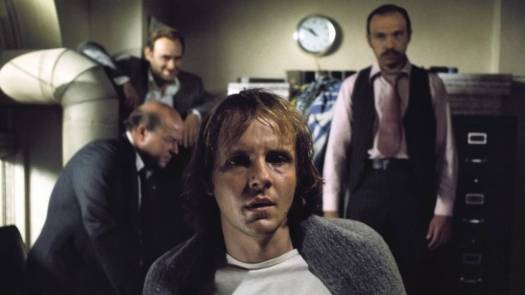
REPORT TO THE COMMISSIONER usually gets lumped in with the plethora of 70’s cop films, but I viewed it as a neo-noir. It’s structure tells the tale mainly in flashback, from the participating character’s differing perspective, and is dark as hell. I’m sure co-screenwriters Abby Mann and Ernest Tidyman were well aware of what they were doing: both men were former Oscar winners (Mann for JUDGEMENT AT NUREMBERG, Tidyman for THE FRENCH CONNECTION ) familiar with the conventions of the genre. The solid cast features a powerhouse collection of 70’s character actors, led by Michael Moriarty’s patented over-the-edge performance as protagonist Bo Lockley.
Lockley is a young, idealistic cop caught up in circumstances beyond his control, snaring him in an inescapable downward spiral. The film opens with a pair of New York City detectives discovering the body of a young woman, who turns out to be one of their own, an undercover…
“Some (producers) are able and humane men and some are low-grade individuals with the morals of a goat, the artistic integrity of a slot machine, and the manners of a floorwalker with delusions of grandeur”- Raymond Chandler, “Writers in Hollywood”, first published in Esquire Magazine, Nov. 1945
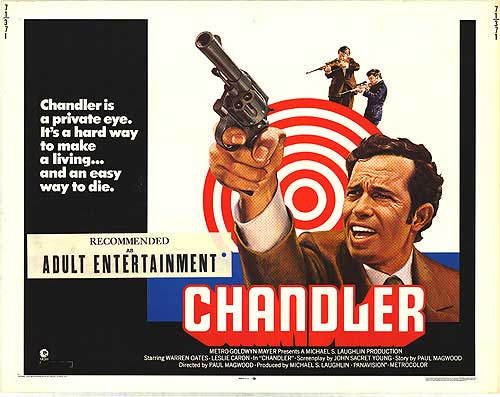
I had high hopes for CHANDLER, I really did. An homage to the hard-boiled fiction of Raymond Chandler (born July 23, 1888) with Warren Oates as the titular detective sounded like it’d be right up my dark alley. But as much as I wanted to like this movie, I was let down by its slow pace, convoluted script, and butchering by studio execs. Much of the film was cut, scenes were replaced, and the result is an evocative mood piece that ultimately doesn’t satisfy the noir lover in me.
I don’t have a problem with Warren Oates as Chandler, with his Bogie-esque look and low-key performance…
I was going to post on KLUTE last week, but between my Internet service going on the fritz and getting swept up in Oscar Fever, I never got around to it. Better late than never though, and KLUTE is definitely a film worth your time. It’s a neo-noir directed by that master of 70’s paranoia, Alan J. Pakula, who’s also responsible for THE PARALLAX VIEW, ALL THE PRESIDENT’S MEN, and SOPHIE’S CHOICE. KLUTE is both an intense thriller and character study, with an Oscar-winning performance by Jane Fonda.
PI John Klute is sent to New York City to investigate the disappearance of his friend, Tom Gruneman. Seems Gruneman has been sending obscene letters to Bree Daniels, a call girl he met there. Klute sets up shop in her apartment building, shadowing her and tapping her phone. When he finally goes to question her, Bree says she doesn’t remember Gruneman, but it’s possible he could…
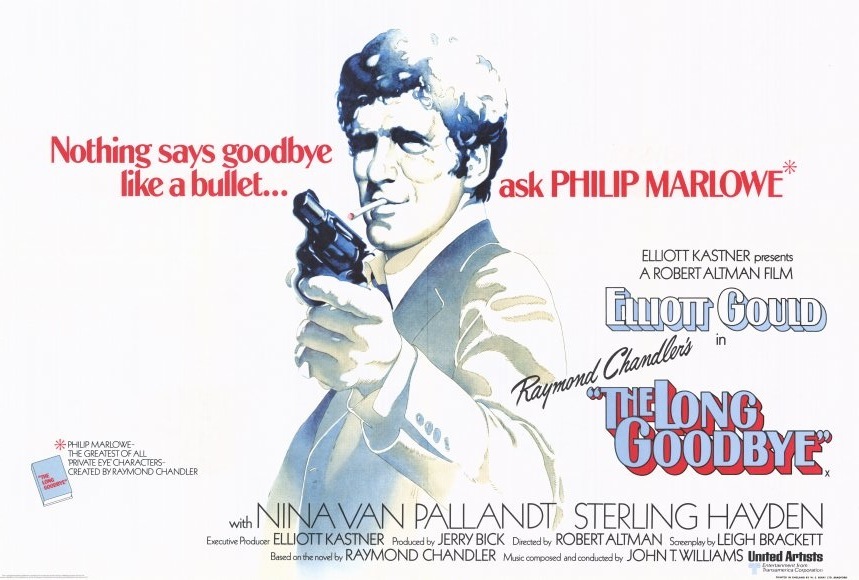
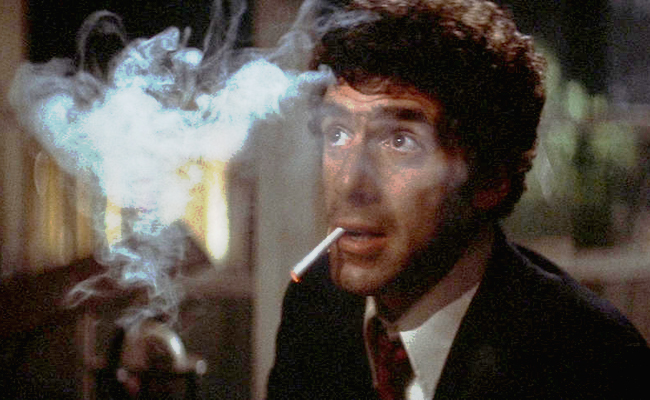
Elliott Gould was a hot Hollywood commodity in the early 1970’s. The former Mr. Barbra Streisand broke through in the 1969 sex farce BOB & CAROL & TED & ALICE, earning an Oscar nomination for supporting actor. He was marketed as a counter-culture rebel, quickly appearing in MOVE, GETTING STRAIGHT, LITTLE MURDERS, and Robert Altman’s M*A*S*H. But his flame dimmed just as fast, and his erratic onset behavior and rumored drug abuse caused him to become unemployable. When Altman decided to make the neo-noir THE LONG GOODBYE, he insisted on casting Gould as Philip Marlowe. The film put Gould back on the map, and though critics of the era weren’t crazy about it, THE LONG GOODBYE stands up well as an artifact of its era and a loving homage to Raymond Chandler’s hard-boiled hero.
Philip Marlowe is clearly an anachronism is 70’s LA, with his ever-present cigarette, cheap suit, beat-up ’48 Lincoln…
Philip Marlowe’s Hollywood history saw the shamus portrayed on the big screen by some very big names. Dick Powell, Humphrey Bogart, Robert Montgomery, George Montgomery, James Garner, Elliott Gould, and Robert Mitchum (twice) all played Raymond Chandler’s hard-boiled private eye at one point in their careers, with varying degrees of success. Los Angeles’ favorite detective also appeared on the small screen, and I decided to do some sleuthing and investigate the TV life of Philip Marlowe.
MARLOWE LIVE!
It was Robert Montgomery who first brought Marlowe into America’s living rooms on his anthology series ROBERT MONTGOMERY PRESENTS. But this time around, Zachary Scott played the gumshoe in a 1950 adaptation of THE BIG SLEEP. Marlowe fans would have a four year wait until he came back in another anthology, CLIMAX! hosted by William Lundigan. This time around, Dick Powell returned to the role in a 1954 telecast of THE LONG GOODBYE. There’s not…
One of the films I’ve really been following since last year and can’t wait to see this September is the latest film from Danish filmmaker Nicolas Winding Refn. I’ve loved his work since I first got introduced to his Pusher Trilogy and saw his two most recent work with Bronson and Valhalla Rising. He is following up the latter with what I could only describe as his own take on the neo-noir genre film, Drive.
At San Diego Comic-Con 2011, the latest trailer for Drive was introduced during the FilmDistrict panel which also had Guillermo Del Toro and his upcoming produced horror film, Don’t Be Afraid of the Dark. This latest trailer for Refn’s Drive is of the red band variety but from what I could tell from the trailer it shouldn’t be NSFW.
The trailer really doesn’t delve too much into all the plot points of the film. It does give a sense that the film has been influenced by past genre crime films and some of the classic grindhouse chase films of the 70’s. One thing I’m sure of is that this film’s cast looks to be one of the best for any film being released in 2011: Ryan Gosling, Carey Mulligan, Ron Perlman, Oscar Isaac, Albert Brooks, Bryan Cranston and Christina Hendricks just to name a few.
Drive is set for a September 16, 2011 release here in the United States.
My weekend was full of sleep, coughing and just vegetating in front of my bedroom tv as I tried to get better from my bout of the cold and flu. For some reason or another AMC channel decided to hold a mini-marathon of David Fincher’s classic neo-noir thriller, Seven, and I must say that I probably saw all three straight showings before sleep finally took over. It surely made for some very unusual, drug-induced dreams.
I’ve always seen Seven as Fincher at his most exploitative best. If there was ever a modern grindhouse exploitation film of the past twenty years I would have to consider Seven as one of them. From start to finish the film just felt grimy and made one feel dirty just for having seen it. Take away all the gloss and veneer afforded Fincher due to modern film technology and techniques this film was grindhouse to its core. No better scene exemplifies and solidifies Seven as a grindhouse exploitation film than it’s shocking, nihilistic ending which bucked traditional Hollywood happy ending (or at least and ambiguous one).
It’s been made famous due to the powerful performances from the three leads who dominate the scene. It is almost played off like a stage play with some gorgeous camera work from cinematographer Darius Khondji switching from Morgan Freeman to Kevin Spacey to Brad Pitt with mathematical precision as the scene unfolds through very strong dialogue by screenwriter Andrew Kevin Walker.
The performances shown by Spacey is both chilling and otherworldly as the sociopathic John Doe urging Pitt’s Det. Mills to become wrath and punish him for his sin of envy. Looking helpless and desperate is Freeman’s Det. Somerset trying to talk some sense and decency to the rapidly unraveling Mills who has just learned that what is inside the box he’s been screaming for is his wife’s head.
The fact that the unfolded and ended the way it did honors the grindhouse sensibilities of past exploitation films where the good guys never always win and even when they do it’s at a very heavy cost to the victor. This climactic ending to Seven is so nihilistic that when the film was first shown in 1995 many walked out grumbling at such a dark and heavy ending. Where was the Hollywood happy ending everyone was so used to. There was no cavalry charging last second to save the day. No deus ex machina intervening to show that Mill’s wife was still alive. No, Fincher and crew knew they had something special in their hands and went full tilt to see it through.
It’s no wonder I still consider Seven to be David Fincher’s best film to date.




 Through the Shattered Lens