Late Night Retro Television Review: Highway to Heaven 2.20 “Summit”


Welcome to Late Night Retro Television Reviews, a feature where we review some of our favorite and least favorite shows of the past!  On Thursdays, I will be reviewing Highway to Heaven, which aired on NBC from 1984 to 1989.  The entire show is currently streaming on Freevee and several other services!
This week, Jonathan and Mark do their bet to save the world from nuclear annihilation.  Good for them!

Episode 2.20 “Summit”

(Dir by Dan Gordon, originally aired on March 5th, 1986)

Maria Malinoff (Eda Reiss Merlin), a Russian immigrant, is dying.  Before she dies, she wants to see her son one last time.

The good news is that her son, Andrey Malinoff (Nehemiah Persoff), is currently in the United States.  Even better, Mark and Jonathan have been assigned to let Andrey know that his mother wants to see him and to convince him to set aside his bitterness and see her.

The bad news is that Andrey is now the deputy premier of Russia and the reason why he’s in the United States is to attend a summit with the President (voiced by Frank Welker).  Andrey is a communist who doesn’t believe in angels or American exceptionalism!

Mark and Jonathan are able to get jobs as waiters for the summit.  (It helps that there is another angel working at Camp David.)  They are even able to get Andrey away from his handlers long enough to take him to see his mother.  Andrey is convinced that Jonathan and Mark are with the CIA and their whole “mission” is a trick to keep him from attending the summit.  Mark dislikes Andrey because he’s a Russian and he think his country is superior to America.  Jonathan dislikes Andrey because he’s abrasive and refuses, at first, to accept that Maria is his mother.

Eventually, though, Maria starts to talk about what Andrey was like as a child.  Realizing that she is who she says she is, Andrey sits with his mother and talks to her until she passes away.  Then, he returns to the summit a (slightly) changed man.  He may still be a communist but at least now he knows the meaning of the word compassion.  Mark takes a few minutes to ask Andrey and the President to work out their differences, explaining that everyone in the world is scared of nuclear war.  The President, who is heard but not seen, is touched by Mark’s plea and agrees to have a long conversation about peace with Andrey.

Having apparently brought about world peace, Mark and Jonathan head off to their next assignment.

This episode — which was one of the few to be directed by neither Michael Landon nor Victor French — just felt silly, especially when compared to the strong episodes that came before it.  Nehemiah Persoff does a lot of blustering in the role of Andrey but he never convinces us of the character’s emotions or his transformation.  As an anti-communist, I enjoyed listening to Mark insult the Russians but otherwise, this well-meaning episode was a definite misfire.

Retro Television Reviews: Fantasy Island 3.18 “Aphrodite/Dr. Jekyll and Miss Hyde”


Welcome to Retro Television Reviews, a feature where we review some of our favorite and least favorite shows of the past!  On Tuesdays, I will be reviewing the original Fantasy Island, which ran on ABC from 1977 to 1986.  Almost entire show is currently streaming is on Youtube!

This week, Aphrodite comes to Fantasy Island, along with Marcia Brady!

Episode 3.18 “Aphrodite/Dr. Jekyll and Miss Hyde”

(Dir by Rod Holcomb, originally aired on February 2nd, 1980)

This week, Maureen McCormick returns to Fantasy Island!

The former Marcia Brady is playing Jennifer Griffin, the younger sister of renowned psychiatrist Melanie Griffin (Rosemary Forsyth).  Jennifer is dating a total lout named Ross Hayden (Don Stroud) and Melanie’s fantasy is to understand why women like her sister are irresistibly drawn to bad boys.

(Because bad boys are sexy rebels who don’t let anyone tell them what to do and just need the right woman to bring out their sensitive side.  It’s not that complicated!)

Roarke gives Melanie a vial of a blue serum that he claims is the same serum that Dr. Henry Jekyll used to transform himself into Edward Hyde.  Roarke warns Melanie that she should only drink two drops of the serum at a time.  Melanie does so and is transformed into the sexy Lilah, who dances up a storm at a nightclub and wins the attention of Ross, who is there with Jennifer.  Somehow, Jennifer does not realize that Liliah is her old sister, despite the fact that Lilah is essentially just Melanie wearing a wig and a little more makeup than usual.

Ross, however, does figure out that Melanie is actually Lilah.  Ross confronts Melanie in her cabin and forces her to drink the ENTIRE serum, as opposed to just the two drops.  Melanie is transformed into an growling old woman with bad teeth.  She ends up chasing Ross through the jungle, carrying a knife and growling at him until Mr. Roarke suddenly pops up and uses his magic powers to transforms Melanie back to her normal self.  Roarke suggests that Melanie should think about why she has so much anger towards men and …. wait a minute.  Does Roarke not realize that Ross basically just drugged Melanie and tried to force himself on her?  Why is it suddenly on Melanie to figure out why she doesn’t like men like Ross?

Anyway, Jennifer dumps Ross and she and Melanie leave Fantasy Island together.  We don’t see Ross leave Fantasy Island so I’m going to guess that he’s still somewhere in the jungle.

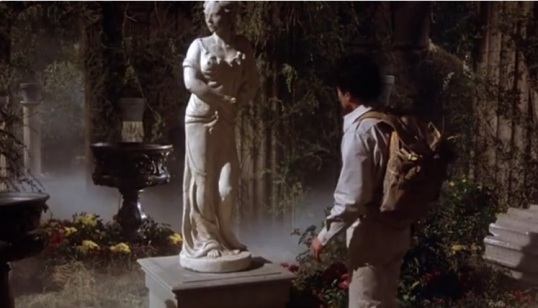
Speaking of the jungle, that’s where Professor Alan Blair (George Maharis) finds the lost temple of Aphrodite!

Alan’s fantasy is to find the perfect woman, who he believes to be Aphrodite despite the fact that anyone who is at all TV savvy knows that the perfect woman for Alan is actually his colleague, Minnie Hale (Belinda Montgomery).  No sooner does Alan find the temple than a statue of Aphrodite comes to life.  Alan and Aphrodite (played by Britt Ekland) make love all night and the next morning, Alan announces, “Aphrodite and I are getting married!”

However, it soon turns out that Aphrodite — much like that mermaid who tried to down John Saxon a few episodes ago — is all about destroying her lovers.  Soon, Alan is flying into a rage whenever anyone so much as looks at Aphrodite and Aphrodite is trying to convince Alan to stay with her in her temple forever.  Fortunately, Mr. Roarke shows up at the temple and announces that Aphrodite isn’t real because she’s just Alan fantasy.  Mr. Roake isn’t even phased by the lightening bolt that Aphrodite tosses at him.  Aphrodite is transformed back into a statue and Minnie reveals that her fantasy was that Alan would fall in love with her.

This was an extremely campy and silly episode, which also means that it was a lot of fun.  Between Britt Ekland inviting every man to come to her cave and Rosemary Forsyth chasing Don Stroud with a knife, this episode was a nonstop parade of weirdness and it’s hard not to wish that it had served as a template for every episode of Fantasy Island.  This week, the trip to the Island was definitely worth it!

Retro Television Review: Fantasy Island 2.12 “Charlie’s Cherubs/Stalag 3”


Welcome to Retro Television Reviews, a feature where we review some of our favorite and least favorite shows of the past!  On Tuesdays, I will be reviewing the original Fantasy Island, which ran on ABC from 1977 to 1986.  The entire show is currently streaming on Tubi!

This week, Fantasy Island is invaded by Nazis and Angels!

Episode 2.3 “Charlie’s Cherubs/Stalag 3”

(Dir by Cliff Bole, originally aired on December 9th, 1978)

Today’s episode begins with Mr. Roarke noticing that Tattoo is carrying a calculator with him.

“What is that, Tattoo?” he asks.

“A mini-computer,” Tattoo replies, “My cousin Igor sent it to me.  Computers can take away a lot of guess work.”

Mr. Roarke, obviously thinking that these “computer” things are but a mere fad, replies, “So can bikinis.  Let us meet our guests.”

This week, all of the guests have dangerous fantasies.  For instance, Danny Ryan (Cornel Wilde) is a World War II veteran who has never really been able to make it in the post-War world.  So, he invites three fellow vets to return with him to the French town in which they spent 1944.  During the War, they were POWS at Stalag 3 but they were famous for continually outsmarting Commandant Horst Von Stern (Nehemiah Persoff).  In fact, Von Stern’s career and reputation never really recovered from the time that Danny and his friends escaped.  (I imagine that, after the war, Von Stern’s reputation was also damaged by the fact that he was a freaking Nazi commandant.)  Not only has Mr. Roarke arranged for the old French village — complete with Fifi of the Resistance (played by Yvonne DeCarlo) — to be moved to Fantasy Island but he also brought over the old POW camp.  Unfortunately, Von Stern decides to come over as well and get his revenge by tossing Danny and friends back in the camp.

“You see,” Von Stern announces, “generals have fantasies too.”

What the Hell is going on with this Island?  Does Mr. Roarke just give anyone a fantasy, even a Nazi war criminal?  Actually, it appears that Mr. Roarke doesn’t know that Von Stern has come to the Island nor does he know that there is a treasure of stolen diamonds hidden in the village.  Apparently, Roarke decided to just let this fantasy run on autopilot without actually bothering to check in with what was going on.

Both Mr. Roarke and Tattoo are more concerned with the three secretaries (Melinda Naud, Brenda Benet, and Bond Gideon) who want to be Charlie’s Angels and solve a crime.  The crime involves a theft on Fantasy Island and …. well, it’s really not much of a mystery.  It’s basically a 20-minutes episode of Charlie’s Angels, with a bit less action but a lot more scenes of people saying stuff like, “He knows about electronics so he’s the thief!”  It was really a weak fantasy, which is a shame because, if I ever went to Fantasy Island, I would probably want to be a detective as well!

The show ends with Von Stern being sent to Germany to be put on trial for war crimes and the Angels saying that they’re ready to be secretaries again.  Roarke informs them that most angels fantasize about being secretaries.  Uhmmm, Mr. Roarke …. the proper term is administrative professional.  Everything appears to be wrapped up but, as the show ends, Tattoo announces that someone has stolen his mini-computer and Mr. Roarke laughs at his assistant’s misfortune.  Perhaps Tattoo losing his most prized possession was Roarke’s fantasy.

This was a weird episode.  Mr. Roarke might need to pay closer attention to what’s happening on his island!

Film Review: The Greatest Story Ever Told (dir by George Stevens)


The 1965 biblical epic, The Greatest Story Ever Told, tells the story of the life of Jesus, from the Nativity to the Ascension.  It’s probably the most complete telling of the story that you’ll ever find.  It’s hard to think of a single details that’s left out and, as a result, the film has a four hour running time.  Whether you’re a believer or not, that’s a really long time to watch a reverent film that doesn’t even feature the campy excesses of something like The Ten Commandments.

(There’s actually several different version of The Greatest Story Ever Told floating around.  There’s a version that’s a little over two hours.  There’s a version that’s close to four hours.  Reportedly, the uncut version of the film ran for four hour and 20 minutes.)

Max von Sydow plays Jesus.  On the one hand, that seems like that should work because Max von Sydow was a great actor who gave off an otherworldly air.  On the other hand, it totally doesn’t work because von Sydow gives an oddly detached performance.  The Greatest Story Ever Told was von Sydow’s first American film and, at no point, does he seem particularly happy about being involved with it.  von Sydow is a very cerebral and rather reserved Jesus, one who makes his points without a hint of passion or charisma.  When he’s being friendly, he offers up a half-smile.  When he has to rebuke his disciples for their doubt, he sounds more annoyed than anything else.  He’s Jesus if Jesus was a community college philosophy professor.

The rest of the huge cast is populated with familiar faces.  The Greatest Story Ever Told takes the all-star approach to heart and, as a result, even the minor roles are played by actors who will be familiar to anyone who has spent more than a few hours watching TCM.  Many of them are on screen for only a few seconds, which makes their presence all the more distracting.  Sidney Poitier shows up as Simon of Cyrene.  Pat Boone is an angel.  Roddy McDowall is Matthew and Sal Mineo is Uriah and John Wayne shows up as a centurion and delivers his one line in his trademark drawl.

A few of the actors do manage to stand out and make a good impression.  Telly Savalas is a credible Pilate, playing him as being neither smug nor overly sympathetic but instead as a bureaucrat who can’t understand why he’s being forced to deal with all of this.  Charlton Heston has just the right intensity for the role of John the Baptist while Jose Ferrer is properly sleazy as Herod.  In the role Judas, David McCallum looks at the world through suspicious eyes and does little to disguise his irritation with the rest of the world.  The Greatest Story Ever Told does not sentimentalize Judas or his role in Jesus’s arrest.  For the most part, he’s just a jerk.  Finally, it’s not exactly surprising when Donald Pleasence shows up as Satan but Pleasence still gives a properly evil performance, giving all of his lines a mocking and often sarcastic bite.

The Greatest Story Ever Told was directed by George Stevens, a legitimately great director who struggles to maintain any sort of narrative momentum in this film.  Watching The Greatest Story Ever Told, it occurred to me that the best biblical films are the ones like Ben-Hur and The Robe, which both largely keep Jesus off-screen and instead focus on how his life and teachings and the reports of his resurrection effected other people.  Stevens approaches the film’s subject with such reverence that the film becomes boring and that’s something that should never happen when you’re making a film set in Judea during the Roman era.

I do have to admit that, despite all of my criticism of the film, I do actually kind of like The Greatest Story Ever Told.  It’s just such a big production that it’s hard not to be a little awed by it all.  That huge cast may be distracting but it’s still a little bit fun to sit there and go, “There’s Shelley Winters!  There’s John Wayne!  There’s Robert Blake and Martin Landau!”  That said, as far as biblical films are concerned, you’re still better off sticking with Jesus Christ Superstar.

Film Review: Al Capone (dir by Richard Wilson)


The year is 1919 and a brutish young man named Al (played by Rod Steiger) has just arrived in Chicago.  He’s got a new job, working for the city’s top mobster, Johnny Torrio (Nehemiah Persoff).  Torrio is the second-in-command to Big Jim Colosimo (Joe De Santis) and is impressed enough by the young Al to take him under his wing.

It’s an exciting time to be a gangster in Chicago because prohibition is about to become the law of the land.  Alcohol is about to become illegal, which means that there will soon be an unregulated underground of people smuggling booze into the United States and selling it in speakeasies across the land.  Those speakeasies are going to be need men to watch the door and to toss out troublemakers and it turns out that’s a perfect job for someone who isn’t afraid of violence.

Someone like Al, for instance.

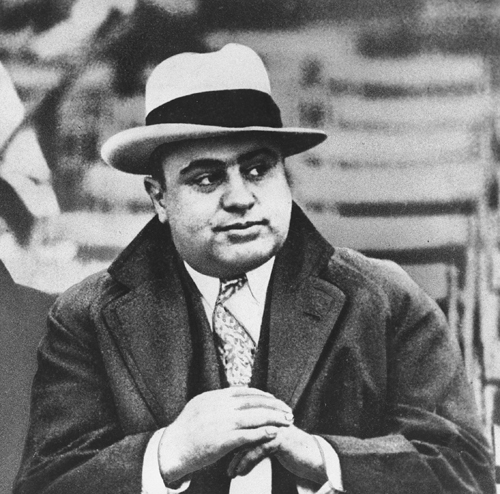
It’s while Al is working as bouncer that he receives a long and deep gash across his face.  When the wound heals, it leaves him with the scar that will come to define him for the rest of his life.  As much as he hates the nickname “Scarface,” it’s what Al Capone will be known as.

The 1959 film, Al Capone, follows Capone as he works his way up the ladder of the Chicago underworld until he eventually finds himself sitting atop an empire of corruption and crime.  Along the way Capone kills the majority of his rivals and finds the time to fall in love with Maureen Flannery (Fay Spain), the widow of one of his victims.

Well, perhaps love is the wrong word.  As played by Rod Steiger, Al Capone isn’t really capable of loving anyone but himself.  This film does not provide us with the superslick or diabolically clever Capone that has appeared in other gangster movies.  Instead, Steiger plays Capone as almost being a caged animal.  Capone comes to power through violence and betrayal and he uses the same techniques to hold onto power.  The film suggests that the secret of his success was his complete lack of conscience but that the same arrogant stupidity that makes him so fearsome also leaves him doomed to failure.  There’s really nothing subtle about Steiger’s performance but then again, there was probably nothing subtle about Al Capone, either.  Steiger’s tendency to overact every moment works well in the role of a man who constantly seems to be striking out at anyone who makes the mistake of getting too close to him.

Though many films had featured characters based on Capone, Al Capone was the first biographical film to actually be made about the infamous leader of the Chicago Outfit.  (Up until the mid-50s, the Hollywood Production Code expressly forbade anyone from portraying a “real” gangster in a movie.)  With the exception of the character of Maureen Flannery (who was a heavily fictionalized stand-in for Capone’s then-living widow), Al Capone is fairly faithful to the know facts of Capone’s life.  The film not only includes most of Capone’s violent acts (i.e., the St. Valentine’s Day Massacre) but it also explores both how Capone was protected by Chicago’s corrupt political establishment and how prohibition actually enabled the activities that it was meant to prevent.  Director Richard Wilson directs in a semi-documentary style and the film’s harsh black-and-white images capture the idea of a shadowy world hidden away from “respectable” society.  It’s a fast-paced film and fans of classic character acting will be happy to see James Gregory as an honest cop and Martin Balsam as a not-at-all honest reporter.

If you’re looking to put together a quick cinematic history lesson about the origins of the Mafia before you watch Martin Scorsese’s The Irishman later this year, Al Capone is a worthwhile addition to your curriculum.

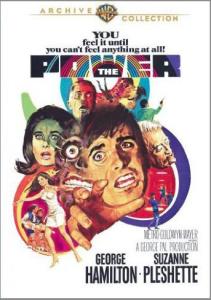
A Movie A Day #278: The Power (1968, directed by Byron Haskin)


Who is Adam Hart?

That is the mystery that Professors Jim Tanner (George Hamilton) and Margery Lansing (Suzanne Pleshette) have to solve.  Someone is using psychic powers to kill their co-workers in a research laboratory.  The police think that Tanner is guilty but Tanner knows that one of his colleagues is actually a super human named Adam Hart.  Hart is planning on using his super powers to control the world and, because Tanner is the only person who has proof of his existence, Hart is methodically framing Tanner for every murder that he commits.

The Power is underrated by entertaining movie, a mix of mystery and science fiction with a pop art twist.  It was also one of the first attempts to portray telekinesis on film.  Similar films, like Scanners, may be better known but all of them are directly descended from The Power.  George Hamilton may seem like an unlikely research scientist but he and Suzanne Pleshette are a good team and The Power makes good use of Pleshette’s way with a one liner.  Also keep an eye out for familiar faces like Arthur O’Connell, Nehemiah Persoff, Michael Rennie, Gary Merrill, Yvonne DeCarlo, Vaughn Taylor, Aldo Ray, and even Forrest J. Ackerman as a hotel clerk.


Lisa Marie Does The Wrong Man (dir by Alfred Hitchcock)


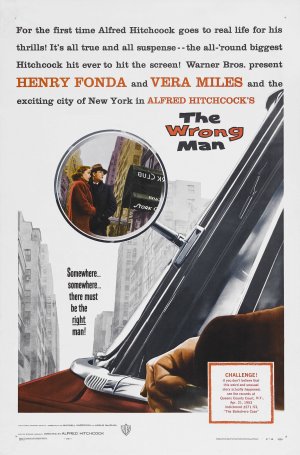
Since today is Alfred Hitchcock’s birthday, I figured why not take a few minutes to recommend one of his films that you may not have seen.  First released in 1956 but still painfully relevant today, The Wrong Man is one of Hitchcock’s best but it’s also one of his most underrated.

The Wrong Man deals with a common Hitchcock theme — i.e., an innocent man has been accused of a crime and, despite all of his efforts, cannot seem to convince anyone of his innocence.  The difference between The Wrong Man and something like Saboteur or Frenzy is that The Wrong Man is based on a true story.

Manny Ballestro (Henry Fonda) is a struggling musician.  He makes $85 a week, playing in a small jazz club.  But even though he may not be rich, he’s happy.  He loves his job.  He loves making music.  Even more importantly, he loves his wife, Rose (Vera Miles).  But Rose needs to have her wisdom teeth removed and it’s going to cost $300.  (As a sign of how much things have changed, I would have been relieved if it had only cost me $300 to get my wisdom teeth taken out.)  Desperate for money, Manny tries to borrow money on his wife’s life insurance plan.  What Manny doesn’t know is that the insurance office has been held up twice by a man who bears a vague resemblance to him.  A clerk calls the police and Manny soon finds himself being taken down to the police station.

Two detectives say that they need Manny’s help but they don’t tell him why.  But Manny knows he’s innocent of any crime and he believes that the police are on his side and he agrees to help.  When they tell him to walk into a liquor store, he does so.  When they take him to a deli, he goes in there as well.  When they demand to know why he was trying to borrow money on his wife’s life insurance, he tells them.  When they ask him about his financial difficulties, he tells them about that as well.  Why shouldn’t he?  He’s innocent and the police are just doing their job, right?  And when the cops finally ask him to copy down a few words that were used in the note that the robber slipped the clerk at the insurance company, Manny does so.  And when they then ask him to take part in a line-up, he does that as well…

And when Manny is arrested and charged with a crime … well, that’s when he finally understands that the system is not on his side.  His wife manages to hire a reputable attorney, Frank O’Connor (Anthony Quayle), to defend him but it quickly becomes obvious that the world has already decided that Manny is guilty.  When Manny and his wife try to track down some people who could provide Manny with an alibi, they discover that two of them are dead and one of them cannot be found.  For once, in a Hitchcock film, it’s not a case of conspiracy.  Instead, it’s just bad luck.

And, through it all, Rose continues to blame herself.  In fact, she is so wracked with guilt that she has a nervous breakdown.

It all leads to an amazingly disheartening courtroom scene.  As quickly becomes obvious, the judge has little interest in what’s happening in his court.  Even worse, the jury is unconcerned with the evidence.  Most of them are just annoyed at the inconvenience and punishing Manny seems like the perfect way to release their own frustrations…

It’s a bleak picture of the American justice system.  Watching The Wrong Man today, it’s tempting to say that the film is just a reflection of society in the 1950s and that things have changed today.  But really, have they?  True, the police may now be required to read someone their rights when they’re arrested.  A suspect can now ask for a lawyer.  We’ve got laws against entrapment and all the rest.  But that doesn’t matter.  We still live in a society where people are still widely presumed to be guilty, even after they’ve been found innocent in a court of law.  We still live in a society where the wrong man can have his life ruined because of one mistake.

The Wrong Man doesn’t get as much attention as some of Hitchcock’s other films.  In many ways, it’s an atypical example of his work.  Hitchcock was notorious for his dark sense of humor and his habit of waving away most plot points as just being mere “macguffins.”  With the exception of two scenes, both of which are meant to depict Manny’s mental state, The Wrong Man is filmed in a documentary style, one that occasionally seems more like Sidney Lumet than Alfred Hitchcock.  There’s next to no humor, nor are there any big or flamboyant twists.  In short, The Wrong Man finds the director of Psycho, Vertigo, and Rear Window at his most sincere.  It takes some getting used to.

But, once you do get used to it, The Wrong Man emerges as a powerful and bleak portrait of two innocent people at the mercy of a soulless system.  It’s a must see so be sure to see it!

The-Wrong-Man-poster

Lisa Marie Reviews An Oscar Winner For Labor Day: On The Waterfront (dir by Elia Kazan)


On-the-Waterfront

I like On The Waterfront.

Nowadays, that can be a dangerous thing to admit.  On The Waterfront won the Oscar for Best Picture of 1954 and Marlon Brando’s lead performance as boxer-turned-dockworker Terry Malloy is still regularly cited as one of the best of all time.  The scene where he tells his brother (played by Rod Steiger) that he “could have been a contender” is so iconic that other films still continue to either parody or pay homage to it.  On The Waterfront is one of those films that regularly shows up on TCM and on lists of the greatest films ever made.

And yet, despite all that, it’s become fashionable to criticize On The Waterfront or to cite it as an unworthy Oscar winner.  Certain film bloggers wear their disdain for On The Waterfront like a badge of honor.  Ask them and they’ll spend hours telling you exactly why they dislike On The Waterfront and, not surprisingly, it all gets tedious pretty quickly.

Like all tedious things, the answer ultimately comes down to politics.  In the early 50s, as the House UnAmerican Affairs Committee conducted its search for communists in Hollywood, hundreds of actors, writers, and directors were called before the committee.  They were asked if they were currently or ever had been a member of the Communist Party.  It was demanded that they name names.  Refusing to take part was career suicide and yet, many witnesses did just that.  They refused to testify, apologize, or name names.

And then there was the case of Elia Kazan.  When he was called in front of HUAC, he not only testified about his communist past but he named names as well.  Many of his past associates felt that Kazan had betrayed them in order to protect his own career.  On The Waterfront was Kazan’s answer to his critics.

In On The Waterfront, Terry Malloy’s dilemma is whether or not to voluntarily testify before a commission that is investigating union corruption on the waterfront.  Encouraging him to testify is the crusading priest, Father Barry (Karl Malden), and Edie (Eva Marie Saint), the saintly girl who Terry loves.  Discouraging Terry from testifying is literally every one else on the waterfront, including Terry’s brother, Charlie (Rod Steiger).  Charlie is the right-hand man of gangster Johnny Friendly (a crudely intimidating Lee J. Cobb), who is the same man who earlier ordered Terry to throw a big fight.

At first, Terry is content to follow the waterfront of code of playing “D and D” (deaf and dumb) when it comes to union corruption.  However, when Johnny uses Terry to lure Edie’s brother into an ambush, Terry is forced to reconsider his previous apathy.  As Terry gets closer and closer to deciding to testify, Johnny order Charlie to kill his brother…

The issue that many contemporary critics have with On The Waterfront is that they view it as being essentially a “pro-snitch” film.  It’s easy to see that Elia Kazan viewed himself as being the damaged but noble Terry Malloy while Johnny Friendly was meant to be a stand-in for Hollywood communism.  They see the film as being both anti-union and Kazan’s attempt to defend naming names.

And maybe they’re right.

But, ultimately, that doesn’t make the film any less effective.  Judging On The Waterfront solely by its backstory ignores just how well-made, well-acted, well-photographed, well-directed, and well-written this film truly is.  Elia Kazan may (or may not) have been a lousy human being but, watching this film, you can’t deny his skill as a director.  There’s a thrilling grittiness to the film’s style that allows it to feel authentic even when it’s being totally heavy-handed.

And the performances hold up amazingly well.  Marlon Brando’s performance as Terry Malloy gets so much attention that it’s easy to forget that the entire cast is just as great.  Rod Steiger makes Charlie’s regret and guilt poignantly real.  Karl Malden, who gets stuck with the film’s more pedantic dialogue, is the perfect crusader.  Eva Marie Saint is beautiful and saintly.  And then you’ve got Lee J. Cobb, playing one of the great screen villains.

The motives behind On The Waterfront may not be the best.  But, occasionally, a great film does emerge from less than pure motives.  (Just as often, truly good intentions lead to truly bad cinema.)  Regardless of what one thinks of Elia Kazan, On The Waterfront is a great work of cinema and it’s on that basis that it should be judged.

On_the_Waterfront_poster

Embracing the Melodrama #25: The People Next Door (dir by David Greene)


people_next_door

For the past week, I’ve been reviewing — in chronological order — fifty of the most, for reasons good and bad, memorable  film melodramas of all time.  I started with a film from 1916 called Where Are My Children? and now, as we reach the halfway mark, we also reach the 70s.  There were several reasons why I wanted to start the 70s with the 1970 drugs-in-the-suburbs melodrama, The People Next Door.  First off, not many people seem to have heard of it and I always enjoy discovering and sharing previously obscure films.  But, even more importantly, The People Next Door stars Eli Wallach, the great character actor who recently passed away at the age of 98.  Needless to say, Wallach is great in The People Next Door but then again, when wasn’t Wallach great?

At first glance, the Masons appears to be your typical suburban family.  Patriarch Arthur (Eli Wallach) may be a bit strict but he works hard to provide his family with a good life.  Wife Gerrie (Julie Harris) may seem to be a bit nervous at times but she still works hard to maintain a perfect home.  Son Artie (Stephen McHattie) may have long hippie hair and he does devote a lot of time to his band but otherwise, he seems to be a good kid.  And then there’s 16 year-old Maxie (Deborah Winters), who is blonde and pretty and overall the ideal American girl.  Even better the Masons live next door to the friendly Hoffmans, perfect David Hoffman (Hal Holbrook), his perfect wife Tina (Cloris Leachman), and their perfect teenage son, Sandy (Don Scardino).

But guess what?

Nobody’s perfect!

Arthur is actually a smug and overbearing bully whose constant bragging hides his own dissatisfaction with how his life has turned out.  He is jealous of his son’s future and his over protectiveness of his daughter takes on a distinctly disturbing tone as the film progresses.  Arthur is also having an affair with his secretary (Rue McClanahan).

Gerrie knows about Arthur’s affair but chooses to look the other way.  She goes through her day in a haze of smoke provided by the cigarettes that she is constantly smoking.  Like Arthur, she cannot understand her children.  Unlike Arthur, she does realize that she doesn’t have all the answers.

Artie may be a good kid but he feels totally and thoroughly alienated from the rest of the family and, because of his long hair, he is the constant subject of Arthur’s abuse.

And then there’s Maxie, who everyone believes to be perfect and wholesome until one night when she’s discovered tripping on LSD.  Arthur immediately assumes that Artie must have given his sister the drugs and kicks Artie out of the house.  However, what Arthur doesn’t realize, is that Maxie is actually getting the drugs from clean-cut Sandy.  Sandy doesn’t use himself but he has no problem with dealing.

To Arthur and Gerrie’s shock, Maxie tells them that she’s been using drugs for a while and she’s sexually active as well!  When Arthur subsequently discovers Maxie snorting cocaine and living with a naked biker, it’s naturally time for everyone to get into family therapy.  Unfortunately, the therapy doesn’t really help that much and soon, Maxie is again dropping acid and dancing naked on the front lawn…

As you can probably guess from the description above, The People Next Door is one of those families-in-crisis melodramas where everything that possibly can be wrong with a family is wrong with this family.  It’s always easy to dismiss well-intentioned films like this and The People Next Door has its share over-the-top moments.  But, at the same time, the film actually works better than most of the Suburban Hell melodramas of the early 70s.

That’s largely due to the performances, with Eli Wallach in particular giving an explosive performance as an all too plausible monster and Hal Holbrook and Cloris Leachman very believably bringing to life another family which turns out to be not quite as ideal as they first appear to be.  And then there’s Deborah Winters, who starts out as being so mannered that you think she’s going to give a bad performance but then, as the film progresses, you realize that Maxie is the one giving the performance because that’s the only way she can survive her “perfect” family.

I first came across The People Next Door on YouTube and, considering how much I love exposing people to obscure films, I was really looking forward to sharing it with you on this site.  But guess what?  In the three weeks between me watching this film and me staring this post, The People Next Door was taken down from the site.  I guess somebody is really dedicating to protecting the copyright on a film that hardly anybody in the world has actually heard of.

So, unfortunately, I can only share the trailer.

Watch it below!