Hi there and welcome to October! This is our favorite time of the year here at the Shattered Lens because October is our annual horrorthon! For the past several years (seriously, we’ve been doing this for a while), we have celebrated every October by reviewing and showing some of our favorite horror movies, shows, books, and music. That’s a tradition that I’m looking forward to helping to continue this year!
Let’s get things started with 1982’s Mazes and Monsters!
Based on a best-seller by Rona Jaffe, Mazes and Monsters tell the story of some college students who enjoy playing a game called Mazes and Monsters. Now, I realize that Mazes and Monsters may sound a lot like Dungeons and Dragons but they are actually two separate games. One game takes place in a dungeon. The other takes place in maze, got it?
When the players decide to play the game in some nearby caves, it causes the newest member of the group (Tom Hanks — yes, Tom Hanks) to snap and become his character. Convinced that he’s living in a world full of monsters and wizard, Hanks runs away to New York. How does that go? During a moment of clarity, Hanks calls his friends and wails, “There’s blood on my knife!”
It’s all fairly silly. There was a moral panic going on about role playing games when this film was made and this film definitely leans into the panic. But, in its own over-the-top way, it works. If you’ve ever wanted to see Tom Hanks battle a big green lizard, this is the film for you. And I defy anyone not to tear up a little during the final scene!
From 1982, here is MazesandMonsters! Happy Horrorthon!
In 1959’s The FBI Story, veteran FBI agent Chip Hardesty (James Stewart) delivers a lecture to a group of new FBI recruits. He tells them the story of both the FBI and his time as a member of the agency. Somewhat implausibly, it turns out that Chip was involved with nearly every major FBI operation, as we discover while watching this flashback-filled, episodic film.
Battling the Ku Klux Klan in the Deep South? Chip was there.
Investigating the Oklahoma Indian murders? Chip was not only there but he was also the one who solved them through handwriting analysis! (Decades later, the crimes and the investigation would serve as the basis of Martin Scorsese’s Killers of the Flower Moon.)
During the public enemy era, Chip was there. He was there when Baby Face Nelson killed several unarmed FBI agents, including Chip’s best friend (Murray Hamilton). He was there when John Dillinger was gunned down in Chicago. He was there when my distant ancestor “Pretty Boy” Floyd was killed in Ohio. He wasn’t there when J. Edgar Hoover personally arrested Alvin Karpis or when “Machine Gun” Kelly said, “Don’t shoot, G-Man!” but Chip still makes sure to tell the recruits about it. He also talks about the gunfight that killed Ma Barker, presented her as being a machine gun-toting madwoman.
Chip investigates subversives during World War II and helped to round up Americans of German and Japanese descent during the internment era. (Chip insists that they weren’t rounded up because of their ancestry but because the FBI had gotten reports that they might be disloyal.) When the war wraps up, Chip turns his attention to fighting the international communist conspiracy and good for him. (Communism sucks!)
Strangely enough, it appears that Chip also tells the recruits a good deal about his personal life because we certainly do see a lot of it. Chip marries a librarian named Lucy (Vera Miles), who struggles with the demands of being an FBI agent’s wife but who ultimately accepts that Chip has to do his duty. Sometimes, Lucy wants Chip to quit and sometimes, Chip is tempted to get out. But they always remember that Chip and the FBI have a job to do. They raise a family. They lose a son at Iwo Jima. Their faith in God and country remains undiminished.
The FBI Story was made with the full cooperation of the FBI, with J. Edgar Hoover personally approving the script and making suggestions. Hoover even appeared as himself in the film, accepting a report about an airplane bombing with a grim look on his face. At one point, Chip is prepared to quit the FBI until he hears a speech from Hoover and he’s so inspired that he keeps his resignation letter tucked away in his suit pocket. Since this film came out in 1959, there’s no details of the FBI tapping the phones of Martin Luther King or Hoover collecting dirt on his political opponents. Instead, The FBI Story is pure propaganda, your reminder that law enforcement never makes mistakes and civil liberties can be always be sacrificed for the greater good.
It’s simplistic propaganda and it’s overlong and it promotes a few falsehoods as facts. (Despite what the film says, Pretty Boy Floyd had nothing to do with the Kansas City Massacre and most historians agree that Ma Barker was not the criminal mastermind that Hoover made her out to be after she was caught in the crossfire between her sons and law enforcement.) The film rather casually dismisses the concern over the World War II internments of American citizens. To me, something like that is a big deal but the film insists to us that it was all blown out of proportion. That’s the one moment when not even the film itself seems to be totally sold on what it’s selling.
Fortunately, the film stars the ever-reliable James Stewart, who brings his natural mix of charm and gravity to the role of Chip Hardesty. Stewart was a bit too old to play Chip as a bumbling young man in the early part of the film but, as the character grows up, so does Stewart’s performance. The scene where he and Vera Miles learn that his son has been killed in combat feels like it’s from a different and far better movie. I guess my point here is that James Stewart was one of those actors who could make even questionable material watchable and that’s certainly what he does with The FBI Story. The FBI, at a time when Hoover was aging and the excesses of the McCarthy era had left many Americans uneasy about the government, decides to borrow James Stewart’s credibility to boost their own. You may not like the FBI but how can you not love Jimmy Stewart?
The FBI Story came out the same year as one of Stewart’s best films, Anatomy of a Murder, a film that was a complicated as The FBI Story was simplistic. Stewart gives one of his best performances in Anatomy of a Murder, playing the type of character that Chip Hardesty probably wouldn’t want to have much to do with. With these two films, Stewart showed us both sides of the American justice system, the men who are tasked with enforcing the law and, even more importantly, the men who are tasked with making sure that law was enforced fairly. Whichever side your on, you have to be happy to have Jimmy Stewart there.
After watching 1967’s The Graduate, I defy anyone to listen to Simon and Garfunkel sing about the darkness without immediately picturing a young-looking Dustin Hoffman (he was 30 when the film was made but he was playing 22) standing on a moving airport walkway with a blank expression on his face.
If you don’t picture that, maybe you’ll picture Dustin Hoffman floating in a pool, wearing dark glasses and barely listening to his parents asking him about graduate school.
Or maybe you’ll remember him driving his car across the Golden Gate bridge. Or perhaps sitting at the bottom of his pool with a scuba mask on. Or maybe you’ll see him awkwardly standing at the desk in the lobby of a fancy hotel, trying to work up the courage to get a room. Or maybe you’ll just see him and Katharine Ross sitting at the back of that bus with a “what do we do now?” expression on their faces.
(Supposedly, that expression was not planned and was just a result of the shot running longer than expected.)
Ah, The Graduate. Based on a novel by Charles Webb, Buck Henry’s script remains one of the quotable in history. “Mrs. Robinson, you’re tying to seduce me …. aren’t you?” “Plastics.” “Elaine!” Myself, I have an odd feeling of affection for the line “Shall I get the cops? I’ll get the cops.” Perhaps that’s because the line is delivered by a young and uncredited Richard Dreyfuss, appearing in his second film and adding to the film’s general atmosphere of alienation.
Alienation is the main theme of The Graduate. As played by Hoffman, Benjamin Braddock feels alienated from everything. He was a track star. He was a top student in high school and college. Now, he’s just a college graduate with no idea what he wants to do with the rest of his life. One can argue, of course, that Braddock brings a lot of his alienation on himself. He can be a bit judgmental, even though he’s the one who is having an adulterous affair with Mrs. Robinson (Anne Bancroft) while also falling for Mrs. Robinson’s daughter, Elaine (Katharine Ross). His parents (William Daniels and Elizabeth Wilson) can be overbearing but it’s possible they have a point. Is he planning on spending the rest of his life floating in their swimming pool? Benjamin says that he just needs time to finally relax. After being pushed and pushed to be the best, he just wants time to do what he wants to do before his life becomes about plastics. When I first saw this movie, I was totally on Benjamin’s side. Now, as I’ve gotten older, I’ve started to understand where his parents were coming from. Still, it’s hard not to feel that Benjamin deserves at least a little bit of time to enjoy himself. That’s what Mr. Robinson (Murray Hamilton) thinks, at least initially.
Mrs. Robinson is the most interesting character in the film, a force of chaos who lives to disrupt the staid world around her. She’s bored with her marriage and her conventional but empty lifestyle so she has an affair with Benjamin. Later, she grows bored with Benjamin and his desire to “just talk” for once and she moves on from him. Benjamin and Elaine are both likable and you find yourself wishing the best for them but Mrs. Robinson is the character who you really remember. Mrs. Robinson grew up without losing her sense of rebellion. One doubts that Benjamin and Elaine are going to do the same.
A portrait of American suburbia and 60s alienation, The Graduate would prove to be one of the most influential social satires ever made. A box office hit, it was nominated for seven Academy Awards. It was nominated for Best Picture, Best Director (Mike Nichols), Best Actor (Dustin Hoffman), Best Actress (Anne Bancroft), Best Supporting Actress (Katharine Ross), Best Adapted Screenplay (Buck Henry and Calder Willingham), and Best Cinematography (Robert Surtees). The Simon and Garfunkel songs that set the film’s mood were, for the most part, not eligible. (Only Mrs. Robinson was written specifically for the film.) I would argue that the film deserved to be nominated for its editing as well. In the end, the film only won one Oscar, for Mike Nichols. But, regardless of what awards it won or lost, The Graduate‘s legacy lives on.
Welcome to Retro Television Reviews, a feature where we review some of our favorite and least favorite shows of the past! On Sundays, I will be reviewing the made-for-television movies that used to be a primetime mainstay. Today’s film is 1971’s The Failing of Raymond! It can be viewed on YouTube!
Poor Raymond!
Played by a young Dean Stockwell, Raymond is patient at a mental hospital who blames everything that has gone wrong on his life on one failed test. During his senior year of high school, he got a 61 on an English test and, as a result, he not only only failed the class but he also wasn’t allowed to graduate. The test was administered by a substitute teacher named Mary Bloomquist (Jane Wyman), one who did not know that Raymond had a reputation for being a bit eccentric. When Raymond tried to ask her whether or not the final two questions were for extra credit, Mary refused to call on him because she was more preoccupied with her failed affair with another teacher (Dana Andrews). Raymond didn’t answer the final two questions, even though he believed that he had the correct answers. Now, locked away in a hospital, Raymond comes across an article announcing that beloved teacher Mary Bloomquist will soon be retiring and moving to England.
Seeking revenge, Raymond escapes from the hospital. While police Sgt. Manzek (Murray Hamilton) search for Raymond, Raymond returns to his old school. When he finds Mary in her classroom, Mary mistakes Raymond for a mover responding to a classified ad asking for help in getting all of her things packed up. Raymond may be a homicidal but he also craves direction and praise so he helps Mary with her packing. As he packs, Mary talks about her decision to retire and it turns out that she’s not quite the monster that Raymond imagined her to be. Mary is retiring because she feels that she has never made a difference as a teacher.
That said, Raymond is still determined to get his revenge. He wants Mary to give him the test a second time and to give him a passing grade. And if she doesn’t, he’s prepared to kill her. Unfortunately, despite claiming to have spent years studying the material, Raymond still thinks that Robert Browning wrote the Rhyme of the Ancient Mariner.…
As the old saying goes, you never know how much your actions might effect someone else’s life. Mary is a dedicated and well-meaning teacher who cares about her students but her decision to fail Raymond, made on a day when she was distracted by her own personal problems, is something that Raymond has never forgotten or forgiven. Mary can barely remember it happening but Raymond has based his entire life around that moment and, as the film progresses, it becomes clear that he’s incapable of understanding that the entire world doesn’t revolve around what happened to him during his senior year. On the one hand, Mary definitely should have answered Raymond’s question about whether or not the final two questions were multiple choice. On the other hand, Raymond has clearly been using the incident as an excuse to justify every mistake that he’s made sense. Ironically, Raymond’s quest for revenge gives Mary the chance to finally be the teacher that she truly wants to be.
It’s an intriguing premise. Unfortunately, like so many made-for-TV movies from the early 70s, The Failing of Raymond is occasionally a bit too stagey for its own good. Despite only being 73 minutes long, it never really develops any sort of narrative momentum. That said, Dean Stockwell gives a performance that makes clear why Alfred Hitchcock was planning on casting him as Norman Bates if Anthony Perkins somehow fell through. As played by Stockwell, Raymond is unfailingly polite and so obviously wounded that it’s impossible not to feel sympathy for him, even when he’s threatening to kill his former teacher. Jane Wyman, as well, gives a sympathetic performance as Mary, who, despite that one bad day with Raymond, really is the type of teacher we all wish we could have had.
This film was directed by Boris Sagal, who did several made-for-TV movies and also directed Charlton Heston in The Omega Man. His daughter, Katey Sagal, makes her film debut in a small role as one of Raymond’s fellow patients.
Welcome to Retro Television Reviews, a feature where we review some of our favorite and least favorite shows of the past! On Sundays, I will be reviewing the made-for-television movies that used to be a primetime mainstay. Today’s film is 1971’s A Tattered Web! It can be viewed on YouTube!
Sgt. Ed Stagg (Lloyd Bridges) is a good cop and an overprotective father. Ever since his wife left him, Ed has been determined to make sure that his daughter, Tina (Sallie Shockley), has a good life. So, as you can probably guess, Ed is not amused when he finds out that Tina’s husband, Steve (Frank Converse), has been cheating on her with Louise Campbell (Anne Helm). Ed has never liked Steve and would love it if his daughter left him. But, Ed still doesn’t want want Tina to have to go through the pain of knowing that her husband is seeing another woman.
Ed decides to drop by Louise’s apartment and talk to her himself. Louise, however, is not willing to let some old stranger tell her how to live her life. After all, she’s heard from Steve about what a terrible and judgmental father-in-law Ed is. Ed gets frustrated and shoves Louise. Louise stumbles back, hits her head, and …. uh-oh. Louise is dead! To be honest, it didn’t really look like she hit her head that hard. In fact, I had to rewatch the scene to see if she actually hit her head at all. But no matter. Louise is dead and Ed’s responsible.
The next morning, when Ed and his partner, Joe (Murray Hamilton), are called in to investigate Louise’s homicide, Ed is approached by Louise’s neighbor (John Fiedler), who gives him a description of a young man who he says he frequently saw going up to Louise’s apartment. The description perfectly describes Steve. The police sketch artist draws a picture that looks like just like Steve. Joe thinks that Steve is responsible. Not wanting his daughter to think that her husband’s a murderer, Ed decides to frame Willard Edson (Broderick Crawford), an alcoholic who frequently comes into the station and confesses to crimes so that he can have a place to sleep for the night.
Yes, it’s a tattered web indeed. Ed is able to talk Edson into confessing to the crime but then Steve does his own detective work and realizes that Edson couldn’t be the murderer. Ed tells Steve that he should just let the police arrest Edson because, otherwise, they’re going to come after Steve. Steve, however, says that he would rather be arrested and be given a chance to prove his innocence than just stand by idly while an innocent man goes to jail. Being a veteran cop, Ed wasn’t expecting everyone to be so damn honest!
A Tattered Web isn’t bad for a 70-minute made-for-TV movie. The film’s main strength is the cast, with Lloyd Bridges, Murray Hamilton, and especially Broderick Crawford giving strong performances. The scene where Ed talks Edson into confession is especially well-done, with Crawford giving a performance of growing desperation while Bridges himself appears to be on the verge of tears as Ed realizes what his life has become. Like his sons Jeff and Beau, Lloyd Bridges is such a likable actor that it’s hard not to care about what happens to the characters that he’s playing, even when he’s playing a murderer. A Tattered Web is an effective thriller that reminds viewers that guilt cannot be escaped.
Loosely based on a novel by Norman Mailer, the 1966 film, An American Dream, tells the story of Stephen Rojack (Stuart Whitman). Rojack’s a war hero, a man who has several medals of valor to his credit. He’s married to Deborah (Eleanor Parker), the daughter of one of the richest men in the country. He’s an acclaimed writer. He’s got his own television talk show in New York. He’s been crusading against not only the Mafia but also against corruption in the police department. He has powerful friends and powerful enemies. You get the idea.
He’s also got a marriage that’s on the verge of collapse. Deborah calls Rojack’s show and taunts him while he’s on the air. When Rojack goes to her apartment to demand a divorce, the two of them get into an argument. Deborah tells him that he’s not a hero. She says he only married her for the money and that she only married him for the prestige. She tells him that he’s a lousy lover. Being a character in an adaptation of a Norman Mailer novel, the “lousy lay” crack causes Rojack to snap. He attacks Deborah. The two of them fight. Deborah stumbles out to the balcony of her apartment and it appears that she’s on the verge of jumping. Rojack follows her. At first, he tries to save her but then he lets her fall. She crashes down to the street, where she’s promptly run over by several cars. The cars then all run into each other while Rojack stands on the balcony and wails. There’s nothing subtle about the first 15 minutes of An American Dream.
Actually, there’s nothing subtle about any minute of An American Dream. It’s a film where everything, from the acting to the melodrama, is so over-the-top and portentous that it actually gets a bit boring. There’s no relief from the screeching and the inauthentic hard-boiled dialogue. When a crazed Rojack starts to laugh uncontrollably, he doesn’t just laugh. Instead, he laughs and laughs and laughs and laughs and laughs and …. well, let’s just say it goes on for a bit. It’s like a 60s version of one of those terrible Family Guy jokes.
Anyway, the police don’t believe that Deborah committed suicide but they also can’t prove that Rojack killed her. Meanwhile, within hours of his wife’s death, Rojack meets his ex-girlfriend, a singer named Cherry (Janet Leigh). Rojack is still in love with Cherry but Cherry is also connected to the same mobsters who want to kill Rojack. Meanwhile, Deborah’s superrich father (Lloyd Nolan) is also on his way to New York City, looking for answer of his own.
An American Dream is a very familiar type of mid-60s film. It’s a trashy story and it’s obvious that the director was trying to be as risqué as the competition in Europe while also trying to not offend mainstream American audiences. As such, the film has hints of nudity but not too much nudity. There’s some profanity but not too much profanity. Rojack, Deborah, and Cherry may curse more than Mary Poppins but they’re rank amateurs compared to the cast of Who’s Afraid of Virginia Woolf? It’s an unabashedly melodramatic film but it doesn’t seem to be sure just how far it can go in embracing the melodrama with alienating its target audience so, as a result, the entire film feels somewhat off. Some scenes go on forever. Some scenes feel too short. The whole thing has the washed-out look of an old cop show.
All of that perhaps wouldn’t matter if Stephen Rojack was a compelling character. In theory, Rojack should have been compelling but, because he’s played by the reliably boring Stuart Whitman, Rojack instead just comes across as being a bit of a dullard. He’s supposed to be a charismatic, two-fisted Norman Mailer-type but instead, as played by Whitman, Rojack comes across like an accountant who is looking forward to retirement but only if he can balance the books one last time. There’s no spark of madness or imagination to be found in Whitman’s performance and, as a result, the viewer never really cares about Rojack or his problems.
Noman Mailer reportedly never saw An American Dream, saying that it would be too painful to a bad version of his favorite novel. In this case, Mailer made the right decision.
For today’s horror on the lens, we’ve got the 1982 made-for-TV movie, Mazes and Monsters!
Mazes and Monsters! Sounds pretty scary, doesn’t it? Well, have no fear. Mazes and Monsters is just a role-playing game, one that definitely should not be mistaken for Dungeons and Dragons despite the fact that it’s exactly the same as Dungeons and Dragons. Except, of course, for the fact that one game takes place in a dungeon and the other takes place in a maze.
A group of rich kids love playing Mazes and Monsters but, when they take it a step too far, it leads to the newest member of their group having a nervous breakdown, fleeing to New York City, and fighting demons that only he can see. Our delusional hero is played by an actor named Tom Hanks. Hey, whatever happened to him?
Anyway, Mazes and Monsters is kind of silly. You’re going to get sick of Chris Makepeace’s hats pretty quickly. It imagines a world where the most popular and attractive kids on campus just can’t wait to pretend to be clerics and magic users. And yet, in its own melodramatic way, the film works. If you’ve ever wanted to see Tom Hanks stab a green demon, this is the film to watch! This was one of Tom Hanks’s first roles and he already looks a little bit too old to play a college student but his trademark likability is already evident. When Tom has a moment of clarity and desperately announces that “THERE’S BLOOD ON MY KNIFE!,” it’s impossible for your heart not to ache for him a little. Finally, as over-the-top as the moral panic about the possibility of LARPers going crazy in New York may be, the ending actually is surprisingly effective.
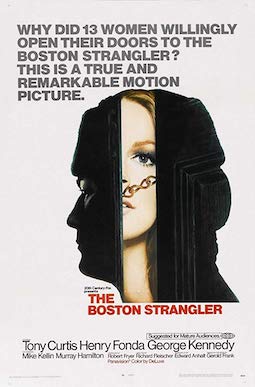
Between June 14, 1962 and January 4, 1964, 13 women between the ages of 19 and 85 were murdered in the Boston area. It was felt that they had all been killed by the same man, a monster known as The Boston Strangler. Though the police investigated many suspects, they never made an arrest. (One should remember that this was before the time of DNA testing or criminal profiling. The term “serial killer” had not even been coined. Today, sad to say, we take the existence of serial killers for granted. In the 60s, it was still an exotic concept.)
In October of 1964, a man named Albert DeSalvo was arrested and charged with being “the Green Man,” a serial rapist who pretended to be a maintenance man in order to gain access to single women’s apartments. After he was charged with rape, detectives were surprised when DeSalvo confessed to being the Boston Strangler. When confessing to the murders, DeSalvo got a few minor details wrong but he also consistently included other details that the police hadn’t released to the general public. Even when put under hypnosis, DeSalvo’s recalled those previously unreleased details. Because DeSalvo was already going to get a life sentence on the rape charges and because there wasn’t any physical evidence that, in those pre-DNA, could have conclusively linked DeSalvo to the crimes, he was never actually charged with any of the murders. Still, with his confessions, the cases were considered to be closed.
In 1966, before DeSalvo was even sentenced for the Green Man rapes, Gerold Frank wrote The Boston Strangler, a book about the murders, the investigations, and DeSalvo’s confessions. It was one of the first true crime books and, in 1968, it was adapted into one of the first true crime films.
Directed by Richard Fleischer (whose filmography somehow includes not only this film but also Dr. Dolittle, Fantastic Voyage, 20,000 Leagues Under the Sea, Conan The Destroyer, and Red Sonja), The Boston Strangler is really two films in one. The first half deals with the crimes and the police (represented by Henry Fonda, George Kennedy, Murray Hamilton, and James Brolin) investigation. This half of the film is pulpy and crudely effective, full of scenes of the cops rounding up every sex offender who they can find. There’s a scene where Henry Fonda talks to a prominent man in a gay bar that’s handled with about as much sensitivity as you could expect from a 1960s studio film. (On the one hand, the man is portrayed with respect and dignity and he’s even allowed to call out the patron saint of 1960s mainstream liberal piety, Henry Fonda, for being close-minded. On the other hand, everyone else in the bar is a stereotype and we’re meant to laugh at the idea that anyone could think that Henry Fonda could be gay.) Director Richard Fleischer makes good use of split screens, creating an effective atmosphere of paranoia. The scene where a woman tries to keep an obscene caller on the phone long enough for the police to trace his location made my skin crawl and served as a reminder that perverts predate social media. Another scene where a flamboyant psychic tries to help the police goes on for a bit too long but, at the same time, you’re happy for a little relief from crime scenes and terrified, elderly women discovering that their neighbors have been murdered.
The second half of the film features Tony Curtis as Albert DeSalvo. Curtis is effective as DeSalvo, playing him as being a self-loathing brute who is incapable of controlling his impulses. (Before committing one of his crimes, DeSalvo watches the funeral of John Kennedy, his face wracked with pain. Is the film suggesting that DeSalvo murdered to deal with the stress of life in America or is it suggesting that the hate that killed Kennedy was a symptom of the same sickness that drove DeSalvo? Or is the film just tossing in a then-recent event to get an easy emotional reaction from the audience?) As one might expect from a mainstream film made in 1968, The Boston Strangler takes something of a wishy washy approach to the question of whether DeSalvo’s crimes were due to sickness or evil. Yes, the film says, DeSalvo was bad but it’s still society’s fault for not realizing that he was bad. It’s the type of approach designed to keep both the law-and-order types and the criminal justice reformers happy but it ultimately feels a bit like a cop out. Still, the shots of DeSalvo isolated in his padding cell have an undeniable power and Curtis is both pathetic and frightening in the role. In its more effective moments, the second half of the film works as a profile of a man imprisoned both physically and mentally.
Watching the film today, it’s hard not to consider how different The Boston Strangler is from the serial killer films that would follow it. DeSalvo is not portrayed as being some sort of charming or interesting Hannibal Lecter or Dexter-type of killer. Instead, he’s a loser, a barely literate idiot who struggled to articulate even the simplest of thoughts. The cops aren’t rule-breakers or renegades. Instead, they’re doing their jobs the best that they can. Though the film ends with a title card saying that it’s important for society to make more of an effort to spot people like DeSalvo before they kill, The Boston Strangler has a surprising amount of faith in both the police and the law and it assumes that you feel the same way. It’s a film that takes it for granted the audience respects and trusts authority. It’s portrayal of the police is quite a contrast to the rebel cops who dominate pop culture today.
After the film came out, DeSalvo recanted his confessions and said that he had never killed anyone. He was subsequently murdered in prison in 1971, not due to his crimes but instead because he was independently selling drugs for prices cheaper than what had been agreed upon by the prison’s syndicate. After his death, many books were written proclaiming that DeSalvo was innocent and that the real Boston Strangler was still on the streets. Others theorized that the actual Strangler was DeSalvo’s cellmate and DeSalvo, knowing he was going to prison for life regardless, confessed in return for money being sent to his family. That said, in 2013, DNA evidence did appear to conclusively link DeSalvo to the murder of 19 year-old Mary Sullivan. Of course, that doesn’t mean that DeSalvo necessarily committed the other 12 murders. In fact, from what we’ve since learned about the pathology of serial killers, it would actually make more sense for the murders to have been committed by multiple killers as opposed to just one man.
Regardless of whether DeSalvo was guilty or not, The Boston Strangler is an uneven but ultimately effective journey into the heart of darkness.
Raymond (Dean Stockwell) has just escaped from a mental hospital and he has only one thing on his mind. Raymond wants revenge. Having looked over the past events of his life, Raymond has figured out that things started to go downhill for him when he failed a test in high school. He blames his failure on his old teacher, Mary Bloomquist (Jane Wyman).
At the same time that Raymond is escaping, Mary is planning her retirement. She’s decided that she no longer wants to teach. The job just doesn’t seem worth it anymore. But Raymond has other ideas. Raymond wants her to give him the same test that he failed ten years before. And this time, Raymond wants her to pass him or else.
The Failing of Raymond is a made-for-TV movie from 1971 and it features a good performance from Jane Wyman and a great one from Dean Stockwell. The film ultimately hinges on one question. Did Raymond really fail that test or did Mary fail Raymond?
The 1978 film Jaws 2 poses a question that has been asked many times under many different circumstances:
When will people learn?
Seriously, you would think that after everything that happened during the first Jaws, the people of Amity Island would be a little bit smarter when it comes to sharks. I mean, did Ben Gardner, the Kintner Boy, Quint, and Chrissie Watkins all die in vain? If I lived on Amity Island, I would be so paranoid about another shark attack that I would probably move to Manitoba. At the very least, I would demand that the beach be closed if there was even the slightest chance that another great white shark was somewhere out there, eating anyone foolish enough to get back in the water.
It’s just common sense!
But no. In Jaws 2, when another shark shows up and eats two divers and a water skier before blowing up a motor boat, no one is even willing to consider shutting down the beach. Even after Chief Brody (Roy Scheider) insists that another shark has shown up, no one is willing to listen to him. “I know something about sharks!” Brody insists but the town council just shrugs him off. Maybe they think that Quint and Hooper did all the work the last time and that Brody was just along for the ride.
Of course, Brody does bring some of his problems on himself. Brody spends a lot of this film sitting in the dark, brooding about sharks. When he sees a shadow in the ocean, he runs down to the beach and starts shooting at it. “It’s just blue fish!” someone yells while Brody looks a little confused. How shocked can we really be when the town council fires Brody? He was a loose cannon.
Before he gets fired, Brody orders his teenage son, Mike (Mark Gruner) to stay out of the water. Of course, Mike doesn’t listen. He goes sailing with his friends and his younger brother, Sean (Marc Gilpin). That’s a big mistake, of course. As soon as Mike and company are a good distance away from Amity Island, the shark attacks and leaves them all stranded at sea. Mike is knocked unconscious. Sean is trapped on a boat all by himself. One of the teenage girls, Jackie Peters (Donna Wilkes), totally freaks out while her older sister, Brooke (Gigi Voran), suggests that they all play charades to pass the time. Everyone dismisses her idea but you know what? I have it on very good authority that sharks love charades. I think Brooke was on to something…
Jaws 2 is a strange, strange movie. It’s really two films in one. Jaws 2 starts out as an almost by-the-book remake of Jaws. True, Quint’s dead. And Richard Dreyfuss had just won an Oscar so there’s no way Hooper was going to come back. But Brody’s back and he’s once again an island police chief who is afraid of the water and who can’t get anyone to listen to him. Just as Jaws started out as almost a small town comedy, Jaws 2 has an early scene where Brody has to deal with the quirky citizens of Amity Island. (Unfortunately, Harry and his really bad hat don’t make a return appearance.) A scene where a dead killer whale washes up on the beach is shot to remind us of the scene in the first in which Hooper and Brody examine a dead shark.
But then, halfway through, Jaws 2 turns into a totally different movie. Suddenly, the teenagers are trapped out in the middle of the ocean and the shark is circling them and Brody is searching from them and the whole movie just goes insane. Roy Scheider abandons any attempt at subtlety as he becomes as obsessed with shark as Donald Pleasence was with Michael Myers in Halloween. The shark turns out to be incredibly sneaky. He’s never around until you stick your hand in the water and then suddenly — SHARK!
How powerful is this shark? He’s so powerful that he eats a freaking a helicopter! Seriously, a coast guard helicopter tries to rescue the kids and ends up getting eaten by the shark! That scene alone is worth whatever’s led up to it. (I think Jaws 2 might be the first film to feature a shark eating a helicopter.) The film only gets crazier from there, with Brody eventually reduced to verbally taunting the shark while clutching onto a power cable.
Now, admittedly, those stranded teenagers aren’t the most developed characters in the world. There’s a lot of them and it’s sometimes difficult to keep track of who is who. Fortunately, this is a 70s films and that means that Jaws 2 is all about the hair. You may not know their names but you’ll never forget their hair:
Check out some of the members of the Jaws 2 hair club:
Jaws, come out to play…
(Okay, Luther wasn’t actually in the movie but just imagine if he had been!)
Anyway, Jaws 2 cannot begin to hold a candle to the original Jaws but it’s still a lot of fun. Admittedly, there are a few parts, especially during the first hour, that drag in a way that Spielberg, the consummate story teller, would not have allowed. I could have done without some of the lengthy scenes where Brody tries to convince the city council that there’s another shark in the water, if just because we already know that the shark’s there and we can guess that the beach isn’t going to be closed. (After all, if the beach was closed, there wouldn’t be a movie…)
But once the teenagers are stranded in the ocean and the shark is eating the helicopter and Brody is calling it a bastard while hanging onto a power cable, there’s no way that you can resist the charms of this sequel. Jaws 2 isn’t exactly good but it’s just so entertaining!
Jaws 2 frequently shows up on AMC so keep an eye out for it!